Gone but not forgotten, Kraut-y, Peel Sessions

Kurious-ah and Kurious-ah

Dead Beat Descendant by The Fall was the first track of theirs that really piqued my interest. Until then, I’d pegged Mark E Smith’s rattling racket as irritating and annoying, the atonal sound of Regal-stained fingers slowly scraping their way down a blackboard. When it popped up in the middle of an episode of Snub TV, Dead Beat Descendant had me hooked.

It wasn’t just the stinging garage band guitar riff, played on a Rickenbacker by a sulky, peroxide shock-wigged Brix that pulled me in, or the gnarly, relentless and repetitive Stray Cats meets Stooges bass, or the occasional daft parp of a one-fingered keyboard, or the metronomic tribal tub thumping that held the whole thing in place that got me – it was the group’s leader that grabbed me by the short ‘n curlies and demanded my attention. That, and the ballet dancer. I’d heard The Fall, but I’d never seen The Fall. And that was apparently important.

Lead singer Mark E Smith of English post-punk band The Fall photographed with Scottish dancer and choreographer Michael Clark during their “I Am Curious, Orange” collaboration, 1988.

Smith is hunched over his microphone and ready to spring, the German army-issued leather greatcoat he’s wearing letting all present know who’s in charge. “Come back here!” he demands with barely under the surface menace. The omnipresent smouldering fag, more ash than cigarette, is lodged at a downwards 30 degree angle between his fingers as he delivers the vocal, a lip-curled sneer the equal of a Mancunian Gene Vincent. Between lines he delivers terrific little off-beat Supreme handclaps and chews on an invisible glob of gum whilst staring his musicians down, lest they consider veering from his well-chosen path. Maybe that’s where the “Come back here!” line comes from. The band, as slick as the gears in a Victorian workhouse, are in tune with their leader and dutifully do what’s demanded of them.

Well, stone me! It turns out there was no German army greatcoat after all. Or a shock-wigged Brix. Or long-burning Regal King-Sized ‘tween the digits. It’s funny how your 30 year-old version of events turns fiction into reality. And it’s funny how, as it turns out, it’s the music that endures rather than the vision. Those hand claps, though… And the told-you-so smug grin on Mark’s face at the end. They were real.

It’s a great clip mind you. The ballet dancer (the awkward piece of the Mark/Brix split jigsaw, if you believe what you read online) pirouettes obliviously around the studio in the middle of the racket, in practise for her stint on stage with The Fall as they prepare to provide the musical backdrop to Michael Clark’s I Am Curious, Orange ballet at the Edinburgh Festival.

American guitarist Brix Smith, of rock group The Fall, poses on a giant hamburger from the set of the ballet ‘I Am Kurious Oranj’, performed by Michael Clark and Company, with music by The Fall at the King’s Theatre, Edinburgh, 20th August 1988. (Photo by Kevin Cummins/Getty Images)

A weird pairing, it’s certainly something that’d have been worth seeing, with Brix sitting cross-legged atop a giant hamburger while Mark prowls betwixt and between the ballet dancers, spitting venom about King Billy and barking out Cab It Up and Wrong Place, Right Time amongst others. I Am Kurious Oranj isn’t the top of the list of critics’ favourite Fall albums, but it’s right up there alongside Extricate on mine.

Here’s 2 contemporary Peel Sessions versions of future Kurious Oranj tracks.

The FallDead Beat Descendant (Peel Session, 31.10.88)

The FallKurious Oranj (Peel Session 31.10.88)


Gone but not forgotten

House Music

Crowded House‘s Into Temptation is a slow shuffling, McCartney-esque cheatin’ song, all minor chords and lilting vocals that carry the heavy weight of a clandestine world.

Crowded HouseInto Temptation

It’s a terrific wee song, played, like its subject matter, with a hesitant and delicate touch, necessary for allowing the melody to tip-toe in the gaps in between.

The guilty get no sleep in the last slow hours of morning,” offers Neil Finn, as the creeping chord progression ascends in the way a guilty party might sneak back up the stairs in the wee hours.

As I turn to go, you looked at me for half a second

With an open invitation for me to go into temptation.

Wow. There’s no denying what the song’s about, a 4 minute wonder that was inspired after a knock on Finn’s hotel room door one night. Staying there in the middle of a Crowded House tour, Finn had noticed a men’s rugby team and a women’s volleyball team were also residents. On opening, he realised the knock had been on the door of the room next to his and he caught a quick glimpse of a female volleyball player going (into temptation) into the room of the rugby player who was staying there. What goes on on tour stays on tour ‘n all that….

A fairly insignificant track from the band’s second album, Into Temptation benefits from being on Crowded House’s Best Of compilation, Recurring Dream where it remains as a slow-burning standout on an album packed full of great songs. Anyone with a liking for guitar based melodic pop should look no further. Never particularly hip or happening (never mind the AOR leanings of the music, they could’ve done with a decent barber and tailor), Crowded House nonetheless endure, a more straight-laced Go Betweens for folk who’ve never heard the Go Betweens, a safer bet than the edgier Del Amitri. It’s hip to be square, as someone once sang.

Like all the best Neil Finn compositions, Into Temptation features a brilliantly technicoloured chiming bridge where ringing arpeggiated guitars sparkle and the melody soars before returning once again to the unmentionable matter in hand. As far as songs of unfaithfulness go, it’s second only to James Carr’s Dark End Of The Street, another post for another day, for sure.

Cover Versions, Gone but not forgotten

Clash At The Dub-le

Affiliating yourself to tribal youth culture was once the be all and end all for musically-inclined teenagers, but you don’t need me to tell you that. Pre Stone Roses, the teenage Ian Brown was at various times a scooter boy, a northern soul disciple, a mod and a punk (a ‘monk’?!). When the future king of the swingers heard a local rumour that The Clash were in a Manchester recording studio he and his pal dropped any immediate plans they might’ve had and set about tracking down the only band that mattered to them. Unbelievably, they happened past a local music shop just as Topper Headon was trying out one of their kits. Even more unbelievably, after standing around watching The Clash’s heartbeat thrash seven shades from the kit, Brown and his pal were invited back to the studio by Headon to watch The Clash in action.

What unfolded was not any old recording session. The Clash were in the studio to record Bankrobber with reggae artist (and Clash support act) Mikey Dread in the producer’s chair. On the band’s timeline, the track would be released between the ubiquitous double London Calling and hotch-potch triple Sandanista! albums, a stand alone single that CBS originally refused to release. “It sounds like David Bowie playing backwards,” they argued stupidly. Only after import copies began selling in chart-bothering quantities did the label relent and release.

The ClashBankrobber/Robber Dub

It’s a terrific single, a million miles from the tinny, phlegm-spittled ramalama of their early stuff and a surprising left turn from some of London Calling‘s more arena-ready and FM-friendly tracks.

Bankrobber is epic, widescreen Clash; dub-inflected, full of twanging spaghetti western guitars and never-ending. Those doom-laden backing vocals went on for so long they ended up on The Specials’ Ghost Town the following year.

Bankrobber was the next logical step in dub for The Clash, coming a few months after their faithful attempt at Willie Williams’ Armagideon Time which appeared on the b-side of London Calling‘s lead single. In an unlikely instance of punk karaoke, the original plan for recording Armagideon Time involved the band visiting the famous Studio 1 in Kingston to record their vocals on top of William’s backing track. This was nixed straight away but as Mick Jones lamented, “they were happy enough to sell us the publishing for it though.”

Recorded (and renamed) with Kosmo Vinyl in London, The Clash’s version is free-form and ad-libbed after the 3 minute mark. Vinyl’s instruction for them to stop after ‘the perfect length for a pop single’ was roundly ignored, with Strummer shouting, “don’t push us when we’re hot!” Listen for Kosmo Vinyl’s voice and revel in The Clash’s musicianship and spontaneity from then on in.

The ClashJustice Tonight/Kick It Over

Willie Williams‘ ‘original’ version was itself built around the backing track for Real Rock, an early Coxsone Dodd/Sound Dimension release (and a future posting for sure), drawing a direct line from the pioneers of roots reggae to the trailblazers of punk.

I wonder if Ian Brown and his pal were aware of that back then in that recording studion in Manchester.

Willie WilliamsJustice Tonight

Get This!, Gone but not forgotten, Live!, Most downloaded tracks

2018 (Slight Return)

As is the way at this time of year, lists, polls and Best Of countdowns prevail. Happily stuck in the past, the truth of it is I’m not a listener of much in the way of new music. Idles seem to dominate many of the lists I’ve seen, and I want to like them, but I can’t get past the singer’s ‘angry ranting man in a bus shelter’ voice. I’ve liked much of the new stuff I’ve heard via 6 Music and some of the more switched-on blogs I visit, but not so much that I’ve gone out to buy the album on the back of it.

If you held a knife to my throat though, I might admit to a liking for albums by Parquet Courts and Arctic Monkeys, both acts who are neither new nor up and coming. I  listened a lot to the Gwenno album when it was released and I should’ve taken a chance on the Gulp album when I saw it at half price last week, but as far as new music goes, I think that’s about it. Under his Radiophonic Tuckshop moniker, Glasgow’s Joe Kane made a brilliant psyche-infused album from the spare room in his Dennistoun flat – released on the excellent Last Night From Glasgow label – so if I were to suggest anything you might like, it’d be Joe’s lo-fi McCartney by way of Asda-priced synth pop that I’d direct you to. Contentiously, it’s currently a tenner on Amazon which, should you buy it via them, is surely another nail in the HMV coffin.

2018 saw the readership of Plain Or Pan continue to grow slowly but steadily in a niche market kinda style, so if I may, I’d like to point you and any new readers to the most-read posts of the year. You may have read these at the time or you may have missed them. Either way, here they are again;

This slideshow requires JavaScript.

  • An article on the wonder of The Specials‘ b-sides.
  • Songs about snow and inclement weather.
  • Some words on the punk Beatles. Pete Shelley was very much still alive at the time of writing and retweeted the article.
  • A look at how the best reggae musicians steal the best soul tunes and make them their own.
  • Lush’s Miki Berenyi talks us through some of her favourite music. The most-read thing wot I wrote this year.
  • Stephen Sondheim , Leonard Bernstein, Tom Waits and Pet Shop Boys. Here.
  • First thoughts on Arctic MonkeysTranquility Base Hotel & Casino.
  • Why Eno‘s Here Come The Warm Jets should be in everyone’s record collection. Here.
  • Skids’ Richard Jobson waxes lyrical about Bowie. Here.
  • Some words on the quiet majesty of Radiohead‘s How To Disappear Completely.
  • Brendan O’Hare, loon drummer and all-round public entertainer in Teenage Fanclub chooses his favourite Teenage Fanclub tracks. Here.
  • The punk poetry and free scatting jazz of Patti Smith. Here.
  • A first-timer’s guide to Rome.
  • Johnny Marr live at the Barrowlands.

Feel free to re-read, Retweet, share etc.


See you next year.

Cover Versions, Gone but not forgotten

Glo-Ho-Ho!

‘Tis the season to be jolly…..

Elastica tend not to appear on many of the lists that constitute the Best Christmas Songs In The World…Ever. Back in 1995, only a year or so since they’d been ever-regulars on the covers of the music press yet long enough to have found them residing in the same ‘remember them?‘ category previously kept warm for them betwixt debut and follow-up album by the Stone Roses, they recorded a BBC Session for Mark Radcliffe that included a loose cover of Ding Dong Merrily On High.

It’s loose in all manner of the word. A band plagued by serious, secretive drug addiction could hardly put their name to a song called Ding Dong Merrily On High. And rather than run through a facsimile of the winter favourite, they instead rewrote most of the words, played the recognisable Christmas carol melody on gnarly bass and, with a nod and a wink to Patti Smith, kept the Latin chorus intact and renamed their version Gloria.

ElasticaGloria

It’s not bad in an arty, angular sort of way. Guitar strings scrape, the drummer keeps enthisiastic metronomic precision and Justine sulks her way through it doing her best Mark E Smith impression from behind her swinging, shining indie fringe. I wonder if they’d heard The Fall’s Christmas Peel Session by this point?

That’s a rhetorical question by the way. Of course they had.

Recorded around the same time as Elastica were the hot new thing, The Fall‘s Peel Session from December ’94 was notable for two things; One: The band did not one but two faithful, in a Fall kinda way, versions of Christmas standards. Two: The expanded line-up of The Fall at the time featured the glam-tastic sight and sound of two drummers, a shrivelled liver Glitter band for old post-punkers everywhere. Karl Burns was welcomed back into the fold and onto the drum stool after a 9 year absence alongside Brix, last seen on Fall duty 6 years previously.

Like malt whisky, that other great festive favourite, I find my appreciation for The Fall grows with each passing year. I discovered them around the time of Extricate and flirted with their back catalogue from thereon in, but it never really grabbed me in the way that I know it grabbed others. I admire them greatly though, whether they’re sawing their way through Eat Y’Self Fitter or going full-on garage band for their essential take on Mr Pharmacist or keeping it sparse and minimal on Hip Priest or spitting their way through Spoilt Victorian Child or….y’get the idea. There’s a Fall that’s suitable for everyone. It just takes some folk a while to find it.

The larger line-up in 1994 fairly suits the music. They bite and snarl their way through a daft version of Jingle Bell Rock, one-fingered keyboard parping the melody, lyrics changed to suit Captain Mark’s mood, the groop bottling the Christmas spirit in barely over a minute.

Hang on a minute! Christmas song done in band style? Rewritten lyrics?! BBC sesssion?!? I wonder where Elastica got that idea? They even nicked the snappy rattle of The Fall’s drum beat for their Christmas tune. They were never the most original of bands, Elastica, but then, you knew that already.

The FallJingle Bell Rock

Post Office rot in hell, Friday night on Oxford Street,

All walking with green M&S bags, join them up with old beef and sprouts,

That’s the Jingle Bell Rock.

Not quite yer finger-poppin’, frost dusted holiday hit first crooned by bobby soxxer favourite Bobby Helms. That’s the Jingle Bell Rock indeed. And who’s complaining?

Gone but not forgotten, Sampled

Covert Operations

I’ve Been Watching You by The Southside Movement is exactly the sort of record that could have even the most conservative of Sunday drivers pick up the pace to an even 32 mph and cruise the streets while Detroit leaning like a Fedora’d pimp in heat-hazed Harlem. Its mid 70s groove, a head-nodding amalgamation of on-the-one funk bass lines and metronomic kick drums is tailor-made for the job. One look at the band responsible for putting such a groove together should give you an idea of what it’s like, should you be lucky enough to be listening to the track for the first time.

The Southside Movement I’ve Been Watching You

The mid-paced care-free groove belies that fact that underneath the funk there’s a mildly stalkerish theme going on, essentially the tale of a married man watching unseen as the (married) woman of his desires goes about numerous clandestine affairs. Spy and the Family Stone, if you will.

Its four-to-the-floor funkiness wasn’t at all lost on the Beastie Boys. Where other rap acts take a huge chunk of something groovy and loop it forever in the foreground, I’ve Been Watching You was ‘bitten’ (the band’s term for underhandedly borrowing a desirable part of a record that could be played by the band themselves) and used as the basis for So What’cha Want, one of the Beastie Boys’ greatest tracks.

Starting with the sound of the Southside Movement’s bass drum spinning in full effect on an old Technics turntable, Ad Rock jumped on board, adding extra kicks and snares and building layer upon layer of that huge dunk, kack, da-dunk, kack… rhythm. It’s Trampled Underfoot While The Levee Breaks, the sound of John Bonham playing loudly in a cave. Slightly sloppy but very massive.

Beastie BoysSo What’cha Want

Once the beat was in place, Ad Rock looped it ad infinitum and called his Beastie bandmates in to hear what he’d done with the sample. The vocals came quickly, the trio weaving in and out in trademark fashion, their voices distorted by happy accident through the cheap karaoke mics they were using in place of the more sophisticated microphones normally found in a recording studio. When the track began taking shape, Adam Yauch suggested the band throw away the sample and play the whole thing themselves, which they ultimately did.

So, not quite sampled then (there’s no writing credit at any rate, which wasn’t uncommon in 1991), but if you strip away the layers of noise on top, disregard the whacked-out distorted vocals, dismantle the incessant guitar riff, the squeaky Hammond and the cinematic atmospheric fade-ins, the genesis of the whole record breaks down to that simple kick drum beat. Kick it!, as someone once said.

From the album Check Your Head, So What’cha Want is the product of the band’s relocation to LA, where they built a studio and furnished it with vintage equipment. Such was the era, the studio-based musicians of the day favoured more portable keyboards and digital equipment over bulky, fragile and unreliable vinatge gear from the 70s. The Beasties were eagle-eyed scanners of the classified ads and would be first to react when any listing for Fender Rhodes or Moog synth jumped out at them – a sad irony they said, as the musicians selling the equipment were usually doing so because they’d ‘failed’ to ‘make it’. Here were the Beastie Boys though; forward-thinking, vintage-loving musical magpies.

There’s a terrific Beastie Boys Book out just now, a chronological telling of the band’s history through eye-witness accounts, whacked-out recipes and mix-tape suggestions. Packed full of brilliant candid shots of the band plus associates (and NYC), it goes without saying you should have it on your Christmas list. Expect more Beastie-related stuff in the coming weeks as I work my way through it.

Gone but not forgotten

Smash Hit

There have been many instances of musicians appearing on records without credit or fanfare; Eric Clapton noodling across the top of While My Guitar Gently Weeps on The Beatles’ sprawling White Album. Lennon and McCartney themselves singing backing vocals on the Stones’ version of their own I Wanna Be Your Man. Mick Jagger somewhat ironically providing backing vocals on Carly Simon’s You’re So Vain. Lennon trading vocals with Bowie on the latter’s Fame, itself a track cribbed from James Brown (or perhaps it was the other way around). David Bowie surfing low under the radar on Arcade Fire’s disco stomping Reflektor…….. these examples are the tip of a very deep and very incestuous iceberg.

Whether it be for contractual reasons, record label conflicts or just plain mischieviousness, it’s likely your favourite musicians pop up on many more records than they’d like to let on. 

One of the first examples of musical skullduggery though must surely be the case of James Brown and the recording of (Do The) Mashed Potatoes. In 1959, Brown was coming to the fore as a sweat-soaked, soul-wracked, heart-bleeding bawler of gospel-tinged r’n’b. The darling of King Records, it seemed Brown and his Famous Flames band could do no wrong, until that was when Brown tried to cash in on the dance craze that was currently sweeping his neck of the woods. Despite his burgeoning fame it was apparent that no-one wanted to hear his stomping 12 bar instrumental espousing the joys of the doing the Doodle Bee. When the trend moved on to a new dance, James went to his label boss and suggested they cash in by recording (Do The) Mashed Potatoes.

Once bitten, twice shy, King Records refused to put it out so Brown took his idea to the rival Dade Records. They agree, on the condition that it was recorded under an assumed name (Dade boss Henry Stone was terrified of King Record’s Syd Nathan, the Peter Grant of the deep south soul scene), which is why along with seeing the track credited to James Brown and the Famous Flames you’ll also find it credited to Nat Kendrick & The Swans. The same band, the same line-up, the same record.

Nat Kendrick & The Swans(Do The) Mashed Potatoes

(Do The) Mashed Potato is nothing you’ve never heard before; a standard 12 bar r’n’b instrumental, it’s a 3-button mohair suit kinda record, punctuated now and again by whoops and hollers and ridiculous potato-themed war cries;

Mash’ Pa-Tay-Das, yeah!

Hash Brown Pa-Tay-Das, yeah!

French-Fried Pa-Tay-Das, yeah!

I’ve no idea what they shout in the last part, but they sure sound excited.

It is, of course, thrillingly terrific. A primal slice of tribal us v them floorshakin’ soul. You’re either with us or against us is Brown’s underlying message and by the end of Part 1, I, you, us and them are definitely with him, one nation under a groove. Frustratingly I don’t have a version of Part 2 but I can imagine exactly how it goes.

Of course, when the record proved a success, the steely Syd Nathan insisted on future copies being issued on his label. He also bowed to Brown’s superior knowledge of fads and fashions by allowing him and his Famous Flames to record such future ‘classics’ as Wobble Wobble and The Dish Rag. Good throwaway pop records, it should be said, but neither as thrilling nor as plain daft as (Do The) Mashed Potato.

Gone but not forgotten

Keith Martin

I write a weekly column for the Irvine Herald and felt it was appropriate to publish a slightly longer version of this week’s piece here. I must begin by stating that there are many others far more qualified than me to write this, John Niven in the Daily Record for one, not to mention the numerous emotional and heartfelt tributes from his pals online, but if you’ve ever encountered Keith he’ll have doubtlessly left his indelible mark on your soul. Not for nothing was his occupation listed as ‘Pyrotechnics’ on Facebook. Once met, never forgotten.                                                                 Keith, 1983. Photo by Gordon Hay

We begin this week with the sad news that one of our musical brothers has passed away. Keith Martin was a well-known Irvine face respected for his love of music, his strong political beliefs and his uncompromising attitude.

As a teenager, legally still too young to drink, I’d see Keith and his pals every Friday night in the old snug in The Turf, a studied riot of biker jackets, loud opinions and carefully considered hair, exuding the sort of attitude that can’t be faked. I didn’t yet know anyone in bands, but it was clear that Keith and his gang was exactly that. As it turned out, Keith was the focal point of the band, called the Big Gun. Not only that, but John Peel had played their single, Heard About Love, and, making it his Record of the Week, enthused over its infectious, fresh out the box melody.

Big GunHeard About Love

Big Gun by Gordon Hay

Over the years, through his circle of pals I got to know Keith a wee bit better and whenever I found myself in his company he would always hold court, his sense of humour as infectious as his willfully argumentative stance on just about anything that was being discussed.

Keith by Basil Pieroni

To paraphrase That Petrol Emotion, Keith was an agitator, an educator, an organiser. An English teacher in Glasgow by day, by night Keith would organise club nights in the city.

For several years he ran the Spitfire Club where the walls shook to Keith’s eclectic taste in music. Agit-punk rubbed shoulders with scratchy post punk, filling-loosening dub reggae and the hardest of hip-hop, a necessary oasis in an era of super clubs and superstar DJs.

If there wasn’t a gig to be had for whichever band he had formed, Keith would create an event to enable them to play. His band Hard Left played a heady hybrid of the swill of sounds laid down by the music policy at the Spitfire Club. If Weatherall had had his name attached to Omerta, I reckon it’d be a considered classic by now.

Hard LeftOmerta

Hard Left by Gordon Hay

In recent years Keith had been the drummer in Dead Hope, a critics’ favourite who’d released an excellent self-funded album from which they gained exposure and airplay on BBC6 Music. I believe too, that discussions are still underway between the band and a prominent indie label to have the album re-released on a larger scale. You’d love it.

Dead HopeLandslide

Dead Hope played the tiny but perfect Harbour Arts Centre in Irvine back in April this year and stunned their audience into submission with a brutal sonic assault of caustic barbed wire guitars and gravel-throated vocals. The band would play just a couple more times, the last in Glasgow in August, before the cancer that Keith had been battling with began to get the better of him.

Keith passed away last weekend at the age of 51. He will be dearly missed by his wife Allison, his family and his tight-knit circle of pals.

Get This!, Gone but not forgotten, Hard-to-find

Rimbaud 2: It’s A Pay Check, Jack

A dozen or so years ago, a concert celebrating the life and work of Robert Burns took place at Culzean Castle on the South West coast of Scotland, not far from where I’m typing. I’m quite into Burns, in an enthusiastic amateur kinda way. I get involved when it’s that time of year in the schools and organise the school Burns Supper. I’ll put together wee groups of kids who’ll eagerly sing Green Grow The Rashes (the Michael Marra arrangement) while I get to rock out gently with some well-rehearsed finger picking on my guitar. At home, we’ve done Burns Suppers celebrating the bawdier side o’ Rabbie that they don’t teach at school, helped along by the sort of food and drink you’d be hard-pushed to find in a school dinner hall. There are tons of Burns scholars out there who take it far more seriously and who could bore the breeks off most of us with their ability to recite his most obscure work which is why, when the concert was announced at Culzean  – with headliners Lou Reed and Patti Smith – I thought I’d give it a miss. “I don’t really fancy hearing Lou ‘n Patti pretend they know the inner workings of Burns’ songbook when they could be doing their own stuff instead,” I reasoned. Big mistake as it turned out, as Lou and Patti by and large did their own stuff, regardless or not of what the promoters had signed them up for. Patti even made the Scottish news on TV the next night for gobbing on the side of the stage, offending those stuffy, ancient scholars I’ve just mentioned. Old punks, eh. What’re they like?

Oor ain Eddi Reader, herself a mad Burns fanatic, was on the bill and in the encore she sang the famous ‘doot-di-doo’ backing vocals for Walk On The Wild Side alongside Patti Smith. I know people who’ll be reading this that have wide-eyed stage-side footage of the moment. Why did I not go? Why?

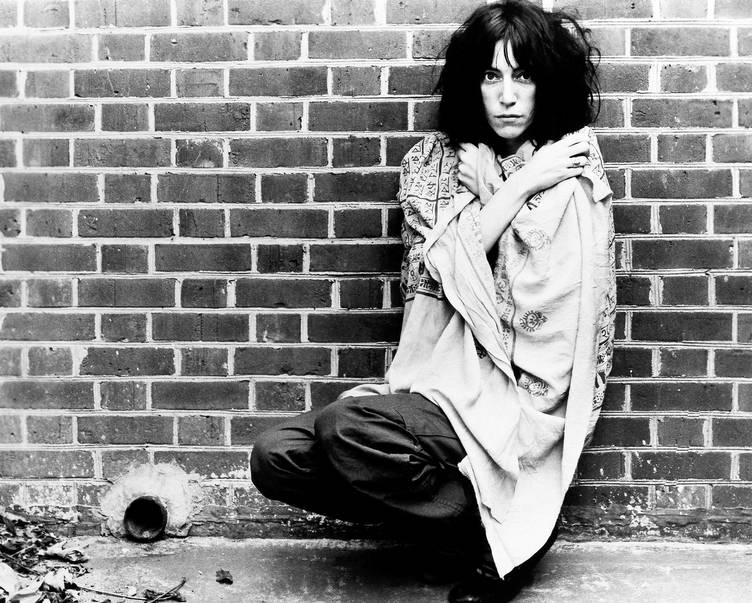
I’ve grown into Patti Smith in a big way. She was always there, a trailblazer for the strong, bloody-minded women from Chrissie Hynde to PJ Harvey who have a place in my record collection, but in recent years I’ve really come to acknowledge her as one of the greats. Morrissey, Michael Stipe and any Maconie-voiced BBC4 documentary will all tell you this of course, but unless you were lucky enough to be there at the time, I’m not sure her importance shines through for generations of mine and since.

Horses is her biggie, of course. A raucous brew of poetry set to music, it’s the sound of flared nostrils and itchy, twitchy jangling nerves riffing on French existentialists, Jesus and the futility of existence – the big stuff, in other words. Wrapped in monochrome with bird’s nest hair, it’s a challenging listen, certainly more difficult to get into than, say, Patti’s contemporaries The Ramones and Blondie who were street suss enough to add some pop to their schlock. The centrepiece of the album is, wonkily, mid way through side 2.

Patti SmithLand

Land is a free-flowing example of all that Patti does best, over 9 carefully metered minutes of what musicologists might call a triptyche, with 3 parts of music played under the one theme. Every word is enunciated precisely and clearly, given equal gravitas. She howls, she whispers, she duets with herself. She’ll rap on something deeply esoteric one moment and then she’ll be singing about the watusi and Bonie Moronie the next. The words come in floods; pretentious, populist and pure. I can’t pretend to know exactly what she’s on about and I’m not certain that the young Patti in 1975 could’ve told you either. It sounds fantastic though.

Patti has a crack band behind her, rising and falling, ebbing and flowing in time to her carefully-written prose, yet for the entire track they keep it simple. At any moment, Richard Sohl on keys could break into the most heart-stopping piano run, but he doesn’t. Lenny Kaye could easily let fly with an electric burst of pop/punk bloooze, but he doesn’t. There’s ample opportunity over 9 minutes for an Animal-esque freak out on the drums, yet Jay Dee Doherty reigns himself in. With Patti Smith, it’s all about the vocal. The words are everything.

Here’s Piss Factory, her early b-side documenting her time working a crappy job for crappier money.

Patti SmithPiss Factory

Just Kids, Patti’s autobiography about her life with Robert Mapplethorpe continues this theme. It’s a literary ride on the A Train, taking the reader right into the centre of a mid 70s New York that most of us can only imagine. Their story is played out against a backdrop of the Chelsea Hotel, Max’s Kansas City and Coney Island and features walk-on parts from Andy Warhol, Alan Ginsberg and William Burroughs. Art, music and fashion explode and fuse together and everything and anything is possible, doable and done. Mapplethorpe struggles with a sexual identity that would eventually tear the couple apart but (or perhaps because of this) it’s a beautiful read;  a love letter to and for Mapplethorpe and the city that brought them together. There they are up there, an androgynous Keef ‘n Mick for the Blank Generation. Even without the music, Patti’s words are powerful. Read it.

Footnote

It was a conversation with Johnny Marr a few years ago that made me go home and re-evaluate Patti Smith until her genius really sank in. I was charged with taking photos of Johnny and his fans after a gig. The waiting line snaked around long enough that half the folk in it ended up missing their last connection home. At the front of the line was a girl who might’ve been 13 and might’ve been 33. Small, disheveled and unkempt, she’d been first to queue outside the venue at lunchtime on the day of the show and as soon as the doors had opened she’d ran for the front of the stage where she stood holding onto the barrier and never letting go until it was time to meet Johnny at the end. Johnny recognised her straight away. “Hello again darlin’!” he greeted with a hug. “How are we today? Listen – hey, listen! – make sure you get a bed tonight, eh? No more sleeping in doorways, eh?

Once, I bunked off the school,” he told me afterwards, “and skipped the train to Liverpool to catch Patti Smith. Sneaked in the stage door! That night I slept in Liverpool Bus Station and it was the most terrifying night of my life. That girl at the front comes to all the shows. She comes alone, leaves alone and always turns up the next day. I kinda worry for her, y’know?

If artists have such a hold on folk that they’re prepared to forfeit a roof over their head for the night so that they can see them in concert, they’re worth listening to.

Cover Versions, Get This!, Gone but not forgotten

She And Him

In the early days of Plain Or Pan I penned under the nom de plume of Phil Spector. I suppose it was a combination of being embarrassed to put my real name to anything that might read like a 3 year old’s best efforts and the fact that I didn’t really want anyone to know I had a sideline in writing about old music that kept me from using my own actual name. Things came to the fore when my daft pseudonym cost me the chance of an interview with Nancy Sinatra. “Why on earth would I want Phil Spector to interview me?” she growled, not quite getting the fact that it wasn’t yer actual Phil Spector who’d been in touch. “He was a strange, strange, man and I want nothing to do with him.” At the time, Nancy had been working with a still-hip Morrissey, and I was hoping to base our interview around the recordings they’d been making. Alas, it never happened.

Shortly afterwards I was contacted by someone who wanted me to interview Sandie Shaw. By coincidence, another iconic singer with connections to Morrissey, this was too good an opportunity to pass up. There and then I dropped the pretence and proudly added my own name to the by-line in every article I’d written here. The subsequent interview and article with Sandie (where she name-dropped Morrissey, Debbie Harry and Siouxsie Sioux within the first 5 minutes) became the first piece of paid writing work I’d ever done.

Anyway, back to Nancy S. I’ve had her Greatest Hits rotating recently, a scratchy, crackly 11-track best of that I picked up for 50p (!) in a wee junk shop just off of Glasgow’s Byres Road. Much of it is kitsch nonsense, the sort of stuff that, had she not been the daughter of an icon, may well never had been afforded the attention it got.

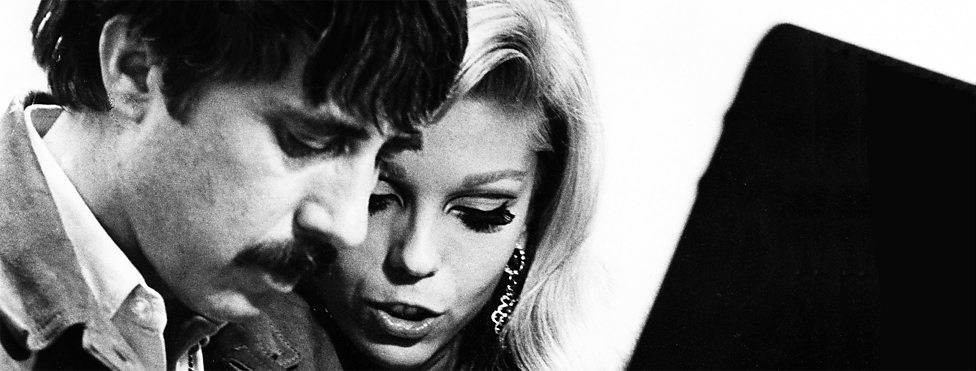
The material she recorded with Lee Hazlewood though is fantastic, a heady combination of female/male, light/shade, sweet/sour on record. Sinatra’s voice is cutesy-cute, all light and airy melodies blown in from Hit Factory central. Hazlewood rumbles in like a gothic cowboy, with a voice deeper than a well and twice as dark. Together, they make the sound of milk chocolate and dark chocolate on vinyl.

Some Velvet Morning is the one for me.

Nancy Sinatra & Lee HazlewoodSome Velvet Morning

Druggy, fuggy and full of sexual innuendo, it’s a psychedelic pop masterpiece, miles away from the light and airy country pop that defines many of their duets.

Hazlewood takes the lead, gliding in on a bed of Barry-esque strings with a baritone that could rattle the lids on the coffins of the dead. He gives way to Nancy, fluttering in like a waltz-time muse. “Sing like a 14 year old who fucks truck drivers,” he instructed, with the blessing of ol’ blue eyes himself. Can you imagine anyone getting away with that nowadays?!?

The whole thing see-saws back and forth, a call-and-response danse macabre. Had it popped up soundtracking The Wickerman or a crucial scene in a Tarantino movie you wouldn’t have been surprised. Quentin T. may yet find a use for it in the future, I feel. Musically, the record is very rich. With instrumentation by the famed Wrecking Crew, it’s lush yet louche, wonky and weird and wonderful.

The other high point of their collaborations is Summer Wine, a track that has all the makings of a great lost Bond theme. There’s the innocent female vocal, parping brass and a not-so-subtle nod to all things Bond with the addition of John Barry’s ubiquitous 5 note signature theme midway through.

Nancy Sinatra & Lee HazlewoodSummer Wine

The Lee/Nancy thing was done to great effect by Mark Lanegan and Isobel Campbell a few years ago. A post in the near future for sure….

As a bonus for now, here’s Lee’s version of Nancy’s signature theme. It’s a cracker.

Lee HazlewoodThese Boots Are Made For Walking

And here’s Let Me Kiss You, Nancy’s take on the Morrissey track that led them to find one another, the song I never got to ask her about. Hey ho. Morrissey has quite rightly come in for a lot of stick in recent times, and whether he still holds a place in your heart or not, you can’t deny that his performance in the background of this record is vintage Stephen.

Nancy SinatraLet Me Kiss You