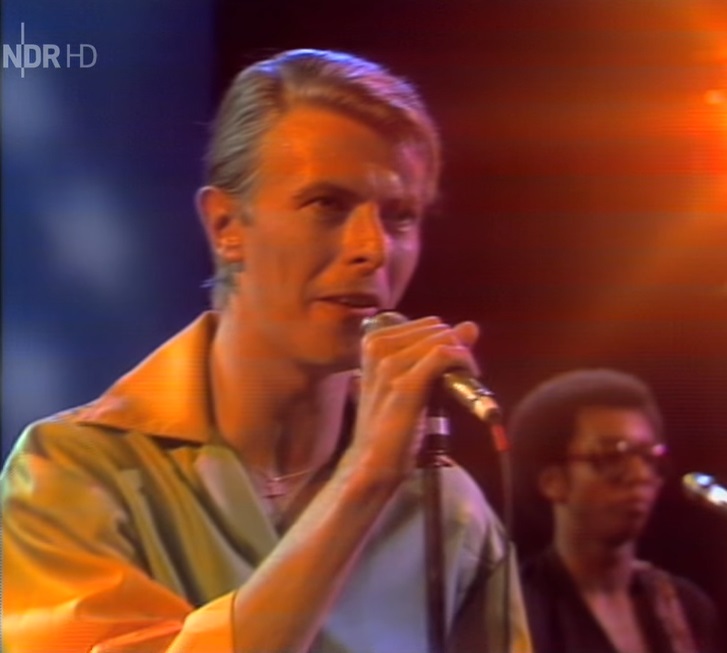
If you happen to find yourself in an isolation situation over the coming days and weeks, you could do worse than while away the time by watching this two, three, four, more times. It’s David Bowie at one of his creative peaks – a 45 minute show from 1979, Musikladen in Bremen, filmed for German TV and up on YouTube (or just below here) for you to gawp and gasp at any time you like.
Beginning with Heroes‘ Sense Of Doubt, all Clockwork Orange menace and icy, crystalline strangeness, it finishes to muted applause – “Where’s the rest of my band?” asks Bowie rhetorically – before they ease their way into a thumping, swirling Beauty and The Beast, the band waking up, falling into step and coming alive.
Where on Heroes the track is the sort of processed art rocker that Bowie would make his own as the ’70s played out, on this live version, the band grind it out with a jarring rhythm uncannily like The Stranglers on Down In The Sewer. Now, I’m not suggesting that Bowie stole from The Stranglers – he didn’t really need to – but Heroes was released six months after Rattus Norvegicus, and it’s possible…just possible…that he’s magpied a riff and feel from the punk scene and reinterpreted it in his own way. That’s a very Bowie move, after all.
Bowie’s band is disparate. It’s a line-up that, when read on paper, really shouldn’t work – a 7-piece gathering of hot shots and big hitters including Moog protege Roger Powell on synth, desperate to coax futuristic sounds from his instrument whenever a space in the music allows and the jazz-trained Sean Hayes on complementary keys.
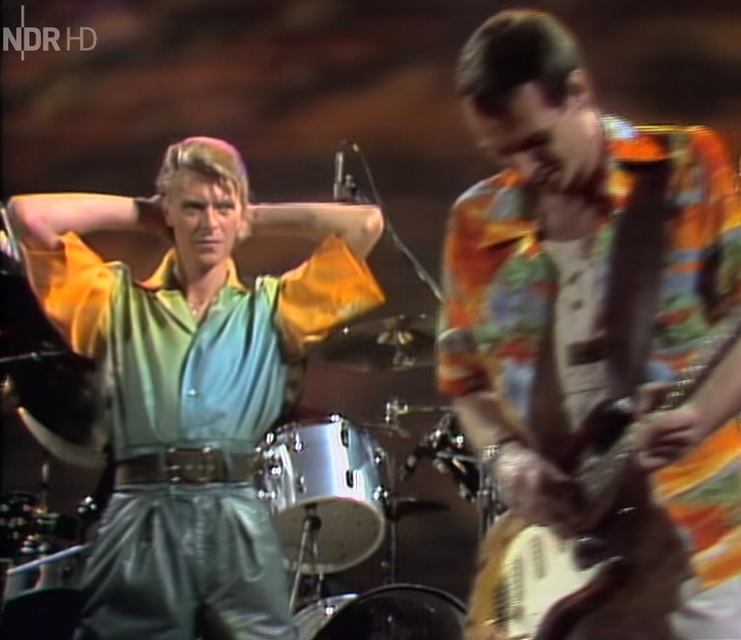
At the back, there’s Carlos Alomar, his slick rhythm guitar as steady and regular as the Soul Train and just as dependable. There’s an all-in-white ‘n mirrored shades electric violin player (a dead ringer for BA Robertson, but clearly, it’s not) who perfectly plays the arty scratchings of a prime time Velvets’ John Cale with no expression of emotion whatosover. And stage right, hanging there like a long drip of docile, grinning water is Adrian Belew, colouring the fantastic mish-mash of sound with notes as loud and outstanding as the choice of shirt he’s worn for the occasion.
Magicking up whammy bar-driven howls of electrified liquid mercury from a battered old Stratocaster, Belew plays no chords, only unconventional hair-raising solos; long and winding, full of squealing and screeing sussss-ttt-aiaiaiaiai-nnned n-o-o-o-o-t-essss that last entire rhyming couplets and in the case of Heroes, entire verses. At various points, Bowie looks on in quiet admiration. Fuck, he’s thinking, my band is good…and this guitar player is on a whole other level altogether. Before long, Belew would be enhancing Talking Heads’ live sound in similar fashion, but for now he’s Bowie’s.
Bowie’s band are out of this world, totally against the times – it’s 1979, remember, and the musical world is largely constrained to three minutes of jerky riffing and laddish ramalama – and they are flying. Having fun too. As is Bowie himself.
All teeth and cheekbones, and dressed in high-waisted leather trousers and a billowing, massively-collared shirt that my dad might have described as flouncy (a get-up that Spandau Ballet would later sell their plastic souls for), he’s serious, majestic, stately on a brilliant version of Heroes, playful and relaxed on a rollin’ and tumblin’ run through of Jean Genie, and having the time of his life on a rockin’, noo-wavey TVC15, with nothing less than great Bowie hair throughout.
All facets of his personality are duly covered, with the period from Station To Station and the Berlin trilogy captured wonderfully for anyone (like me) who was far too young or unborn to appreciate it at the time. Imagine living in a world where David Bowie never existed. Unthinkable.
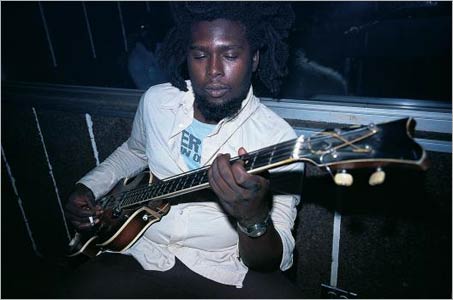
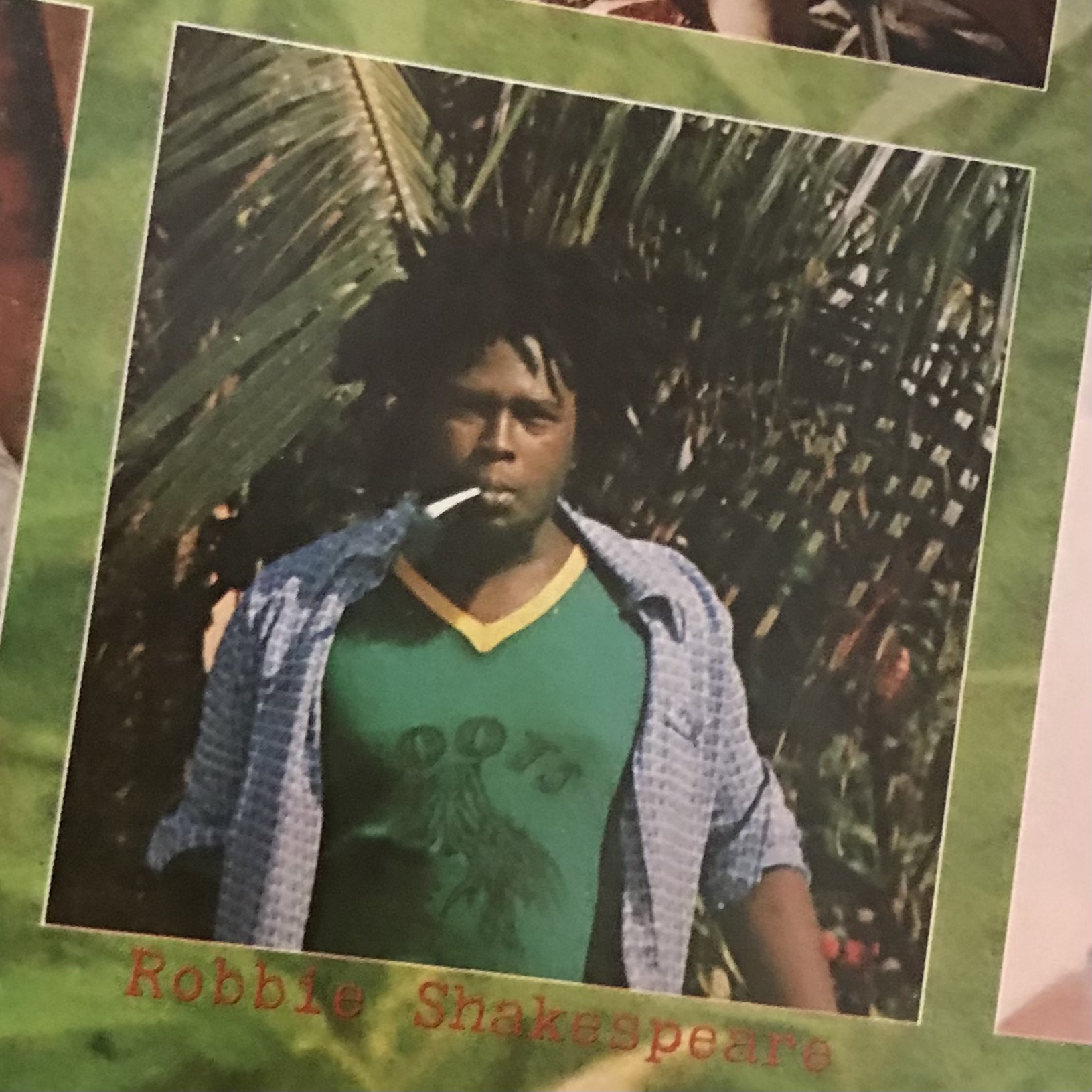
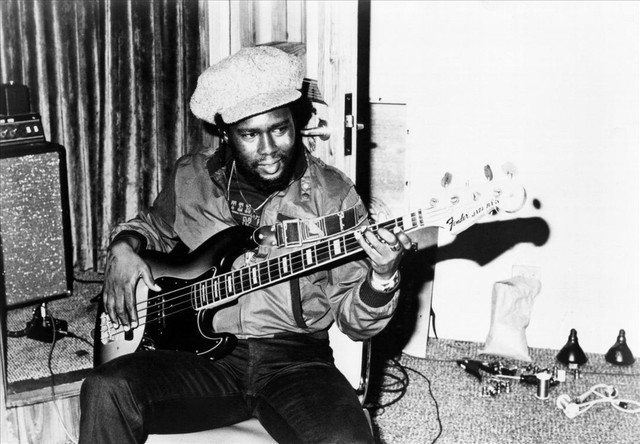
If you’re a regular reader of this parish, chances are you’ll own some music that features the basslines of Robbie Shakespeare. The bass players’ bass player, he died in Florida yesterday aged 68 following kidney complications. A pioneer of reggae and its many and varied offshoots, his basslines are as iconic as the genre itself; booming and thudding but always playing a tune within the tune.
Such is the fluid and ambivalent nature of the haphazard approach to such essential things as credit and copyright in those early, formative years of reggae, many of the recordings that Shakespeare played on remain uncredited. He’s there on Bob Marley‘s breakthrough Catch A Fire album, an honorary Wailer filling the spaces between the offbeat in Concrete Jungle, his melodic solidness providing the four stringed groove courtesy of his McCartney-inspired Hofner bass.
He’s there on Gregory Isaacs‘ Cool Ruler album, providing a steady rhythmic counterpart to Issacs’ sweet-toned lovers rock and uplifting spirituals, the noodling, head nodding, dread-shaking yin to Isaacs’ yang.
He’s there too (credited this time) on Peter Tosh‘s self-explanatory Legalise It album, a lamppost-sized spliff wedged between his teeth, his ganja-fuelled basslines meandering wide and expansive, slo-mo and steady. I’m listening to it now as I write this and his playing, in all its room shakin’, filling-loosenin’, flare-flappin’ majesty is really brilliant.
On many of the albums that will remain his legacy, he was joined by drummer Sly Dunbar, with whom he formed a formidable partnership that did as much for a fertile, ever changing but always grooveable scene as Nile Rodgers and Bernard Edwards did with Chic. Just as Nile and Bernard crossed over into unexpected territories with Madonna, Bowie and co, so too did Sly and Robbie. Bob Dylan, Mick Jagger and even Serge Gainsbourg sought solace in their rocksteady riddims. Go and listen to Dylan’s Jokerman to hear the results of what happens when ascerbic folk and loose and spacey reggae collide.
Grace Jones – Private Life
Some of Shakespeare’s (and Dunbar’s) greatest work remains the stuff he/they did with with Grace Jones. Marrying reggae and funk basslines to new wave guitars and synths, Grace’s band created ambient, atmospheric and always revealing music, incredibly unique and stylish y’know…just like the singer who had hired them.
You’ll be well aware of the big ones – Slave To The Rhythm, Private Life, Pull Up To The Bumper, their electro-fried version of Iggy Pop’s Nightclubbing, etc etc, but it’s their little-heard take on Joy Division’s She’s Lost Control that pulls me in every time.
Grace Jones – She’s Lost Control
It’s, well, kinda boing-y, isn’t it?! A rubber band bassline, augmented by bicycle cranks, a trampolining wonky background noise and the guitar scrapin’, chain rattlin’ ghost of a horrified Ian Curtis, it’s spectacular (even if the 12″ version above goes on maybe a wee bit too much). It’s all in the production – rich and deep enough to make the heart vibrate, light and airy enough to tingle the senses. It’s cavernous and widescreen and just about as long and interesting as the career itself that Joy Division carved out. It is, you’ll notice, the bassline that carries it, played effortlessly by Robbie Shakespeare, the true root at the base/bass of roots reggae.
How are your eating habits these days? With COP26 taking place a couple of farmers’ fields and a few country miles over the horizon from my back window, I, like everyone else I suppose, should be making more of an attempt to cut out the red meat. Our eldest is full-on vegetarian, something I’m proud of her for having the conviction to stick to, but it does make dinner time a mess of multi-cooking. As a family we try and have a couple of meat-free meals a week, but we could be doing more. Mike Joyce (clang) told me that when Morrissey (clang!) pointed out to the other Smiths one day that you wouldn’t eat a dog, so why would you contemplate eating a cow, he had no answer to it and turned vegetarian there and then. I nodded earnestly while in a non-preachy way Johnny Marr (clang!!) outlined the benefits of veganism and urged me to “give it a try for a bit“, but an hour later I was in a chip shop stuffing a smoked sausage supper down my brass neck. Shamefully and with a side dollop of regret, I must say, but still…
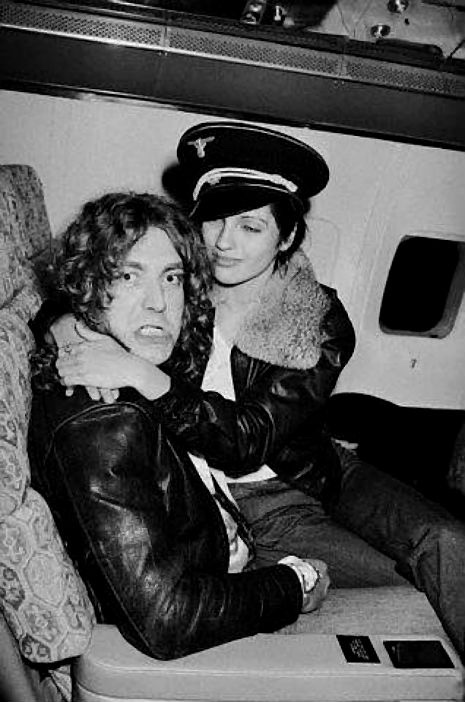
Someone I doubt very much who, in their early days, gave much thought to being carbon neutral and eco-aware is Robert Plant. Led Zeppelin came galloping into town like the four horsemen of the apocalypse, cruising on the jetstream of The Starship – their own private Boeing 720, crash-landing only to pillage and plunder and play some rock and roll before gallivanting out again in a haze of hennaed hair and the sighing swoons of every female within radius. Simpler times the ’70s, so they say. Eco-schmeco.
I met Robert Plant once. July 1995. I was working for Our Price, helping train the counter staff to use a new-fangled barcode scanning stock control system we’d invested in. The job took me everywhere from Inverness to Leeds and many places in-between. I travelled mainly by rail, read a ton of books as I did so and spent the duration of the job finding out where my £15 a night meal allowance would stretch to best. (The Qismat Tandoori in Elgin, if you’re interested.) In the July I was to go to our new shop at Glasgow Airport and begin training the staff on the ins and outs of our new payolla-proof system. Emptying my bag at my mum’s, I dumped most of the stuff I now deemed unnecessary for my time at the airport, including, crucially, my well-thumbed copy of Hammer Of The Gods, the infamous, unauthorised Led Zeppelin biography that dug the dirt on groupies, snapper fish and the physical and metaphorical muscle of Peter Grant. Of course, the first customer – the first customer! – through the door was only yer actual Robert Plant. As he arrived at the counter and the wee stack of CDs he was buying were being rung through, I engaged him in conversation.
“I’ve just being reading a book about you.”
“Oh yeah?” he said, genuinely interested.
“Yeah… Hammer Of The Gods…” I offered.
“Oh!” he said, with a wry smile, looking straight at me. He didn’t quite twirl those golden curls through his fingers the way he absent-mindedly did mid set in ’73, but he might as well have done. He was still a bit of a looker. The light from the Albert King CD he had been inspecting glinted in his clear blue eyes – rock god eyes that have seen more than you or I will ever see – and he spoke his words of wisdom.
“Yeah… Jimmy didn’t come out of that one looking too good, did he now?!”
It was at this point I was wishing I could get him to sign a CD, but with the counter being small, narrow and unpassable, there was no opportunity to squeeze past the most famous rock star I’d ever met and pick one from the racks. And by now I was cursing myself for having dumped the book from my bag. Then, out of the blue, the girl serving him presented him with the shop’s autograph book. “Yeah, sure,” he smiled, taking the pen she had offered.
Whoever had the foresight to stick an autograph book at the till in an airport record shop deserves a medal for quick thinking. It was full of all sorts – Bjork, Keith Floyd, Robert Downie Jr. There was even a wee Rolfaroo in there. Can we still mention that? Anyway, Robert happily obliged, adding his name in a large, swooping, blue inked signature. I noticed at the time (and can still picture in my head now) that it looked very similar to the ‘ZOSO‘ logo on Led Zep IV. A neat coincidence.
I’m not a rock fan by any means – all that pillaging and plundering and bare-chested daftness and whathaveye – but I do love a good amount of Led Zeppelin; those first four albums mainly, plus selected parts of Physical Graffiti. They’ve had their shameful moments, well-documented in that (genital) warts ‘n all book, but sometimes – most of the time? – it’s OK to separate the art from the dubiously-moralled artist. And shallow as I am, I am a sucker for a sloppily-played, turned up to 10 guitar riff. Sometimes, when the urge strikes, and usually only if the house is empty, nothing other will do than a proper baws oot blasting of Led Zeppelin.
Led Zeppelin –Custard Pie
Custard Pie is the perfect example of that tight-but-loose label that Led Zep acquired, Jimmy’s guitar to the fore, slapdash and funky but ultra-together, propelled by a wall of thunder behind, the drums almost leading on the off-beat, John Paul Jones riffing around on a clavinet or something similar in the gaps in-between. Robert opts for a restrained guttural croon, rockin’ yet soulful. Swathes of wah-wah and wailing harmonica carry the song to its conclusion, a no-frills, no nonsense rock and roll boogie, Jimmy up the frets and playing to the very limits of his abilities.
Custard Pie is the riff my fingers fall into whenever I pick up a guitar these days. It’s a beauty, ideal for stretching the pinky and working on the timing of the right hand, although I usually give up sometime around the first notes of the lightning flash solo. I’ve no patience for cock rock wizardry such as that. Nor have I much truck with the outdated and iffy subject matter (a Plant-based diet of a very different sort). Great rockin’ tune but.
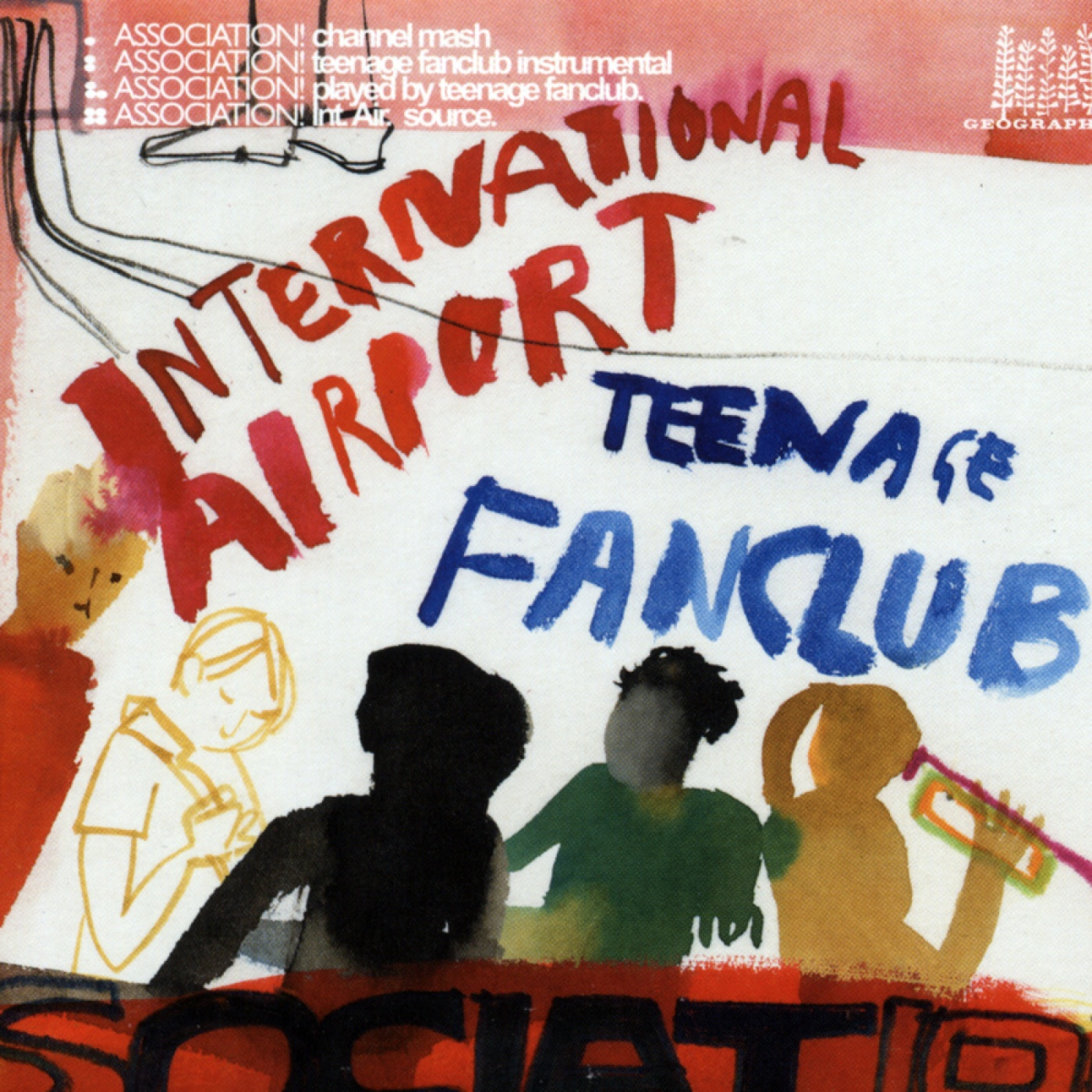
I’m particularly fond of this wee Teenage Fanclub curio. One half of a 2004 split single with International Airport (the side project of long-time Pastel Tom Crossley), each act has their version of the ‘Airport’s Association! on either side of the 7″.
Teenage Fanclub – Association!
Teenage Fanclub’s version is a lovely mid-paced chugger that grooves along at exactly the same pace and rhythm as Gerry Love tapping a battered desert boot while snapping a gub full of Juicy Fruit in time to the beat. It’s head nodding sunshine pop, all fruggable bassline and lazy, hazy double harmonies where Norman’s voice and Gerard’s seemingly mesh and melt into one another. The guitars, scrapy and scratchy at the start but clean and chiming fromm thereon in, rise and fall and ring and sparkle behind the vocals, acceding on occasion to the faintest of tinkling pitched percussion and the same thrumming atmospheric organ that fades in at the beginning.
It’s just about missing a handful of swinging fringes and some John Sebastian-conducted Lovin’ Spoonful on-the-beat handclaps, but feel free to add your own where you know they should go. You’ll probably want to pick it up a bit after the band drops out before coming back in alongside those ghosting backing vocals – “Won’t you tell it to me doctor?” Lovely stuff, it must be said.
Association! wouldn’t have sounded at all out of place on the following year’s Man Made album, but as you know, all the best bands – The Beatles, XTC, New Order, The Smiths, (add your own selection here: ________) – leave some of their greatest material off of the albums and keep them instead as stand alone tracks. Despite being a cover, Association! endures to this day as one of TFC’s best-kept secrets.
It’s somewhat difficult to make out lyrically, and not being well-known enough to appear on any of the internet’s lyric sites means much guesswork is required to work out what’s being sung. Repeated plays – and I’ve been playing it non-stop again for the past couple of days – throw up references to Castle Bay, boats, moving water, on the wreck of the Association – it’s about a boat! – and, I’ve got myself convinced, something about a Rubik’s Cube.
I mean, I dunno. The Fanclub could sing the obituaries page in last week’s Herald and make it sound like throw-away sun-kissed perfection, but on this track their melodic mumbling prevails. Phonetically though, it sounds wonderful.
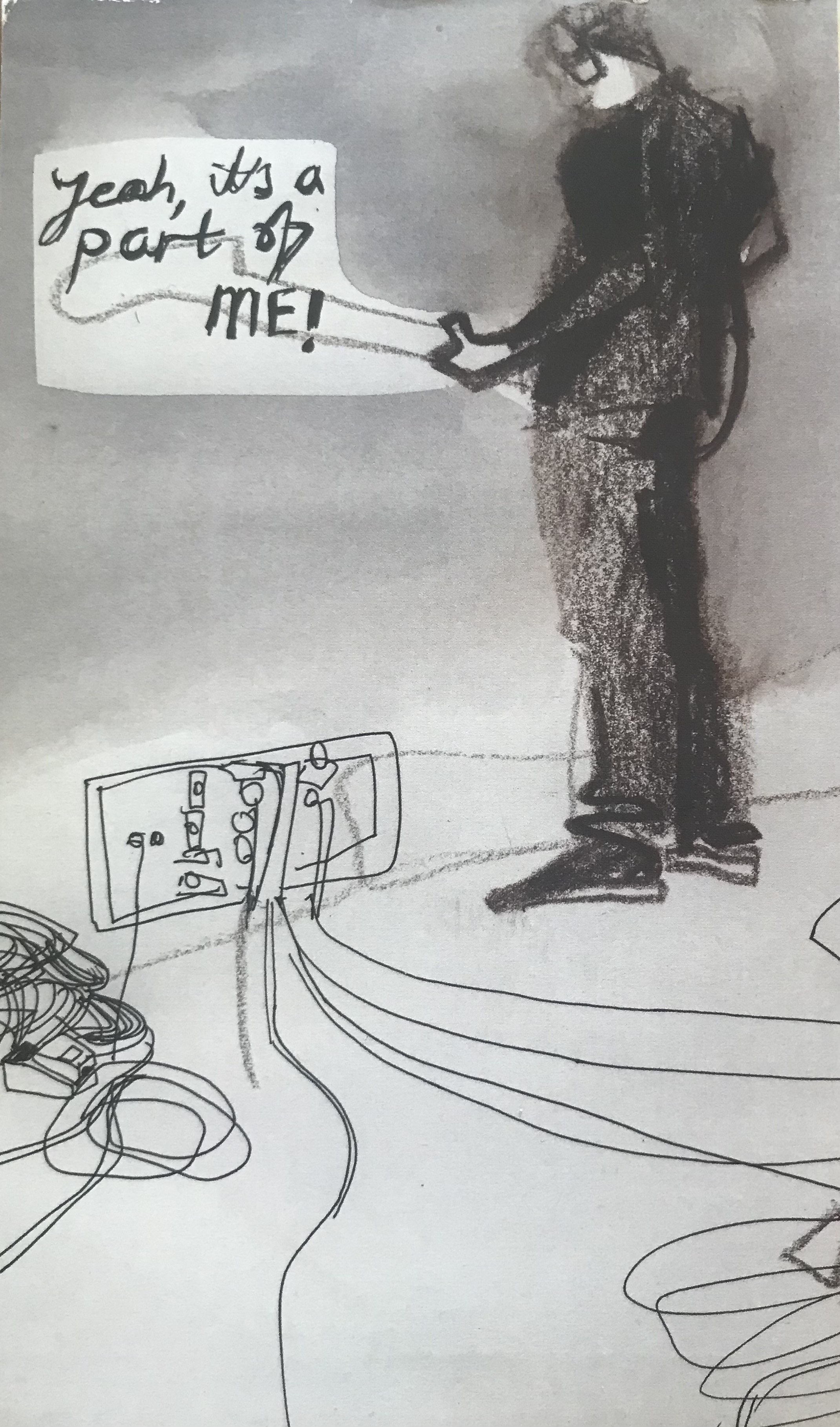
“I’m part of the association, the circle of the free….
stereo music…yeah it’s a part of me.”
Or something like that.
The original throws up no further clues…
International Airport – Association! Channel Mash
Even tinklier than TFC’s version, and that’s a melodica in there too, isn’t it? – International Airport’s take has a home-made rough around the edges feel to it that I suspect most acts would have trouble capturing in their own way. There’s a lovely cyclical bassline to it, different to Gerry’s but no less wonderful, and some off-kilter harmonies that only add to the charm. Aggi Pastel wafts in and out at the tail end of some of the lines – “now you gotta wait and see” – and the drop-out on this version has some lovely rudimentary wheezy slide guitar accompanying the overlapping vocals.
What’s clear to hear is that International Airport had grand plans for their song – it’s lo-fi but with hi-fi ambitions – and that perhaps those plans could only be realised through Teenage Fanclub’s gift for a close-knit harmony and a closely-mic’d vintage guitar. Great songs are great songs are great songs though, no matter the bells and whistles you can hang on them. But I suspect you knew that already.
The healthy song-writing one-upmanship in The Beatles meant that after Paul McCartney had presented the others with the music hall-by-way-of-Fats Domino Lady Madonna and had it committed forever to tape, John Lennon sat himself at the piano to compose a worthy response.
The result was Hey Bulldog, a driving barrelhouse blues rocker, with ascending, augmented chords in the chorus and some epoch-defining stinging lead guitar throughout.
The Beatles – Hey Bulldog
It’s truly fab four in execution; Lennon pounding away at the ivories, his sandpaper-roughed and double-tracked vocals just on the right side of raw, McCartney playing melodic lead bass, a whole tune within the tune, and harmonising the key lines from start to finish, Ringo going tribal for the song’s intro then jangling heavy rhythmic tambourine to keep the beat from thereon in and George, quiet George, brilliantly colouring the whole thing with some rasping fretboard fireworks, minimum fuss but maximum fury.
For years I’d believed the solo to be played by McCartney – in tone and technique it’s very him – but research points to George and his Gibson SG, so the cap is duly doffed. There’s a tiny wee lick he throws away towards the end of that stinging solo upon which Badfinger, Jellyfish and countless others have based entire careers. If you know, you know.
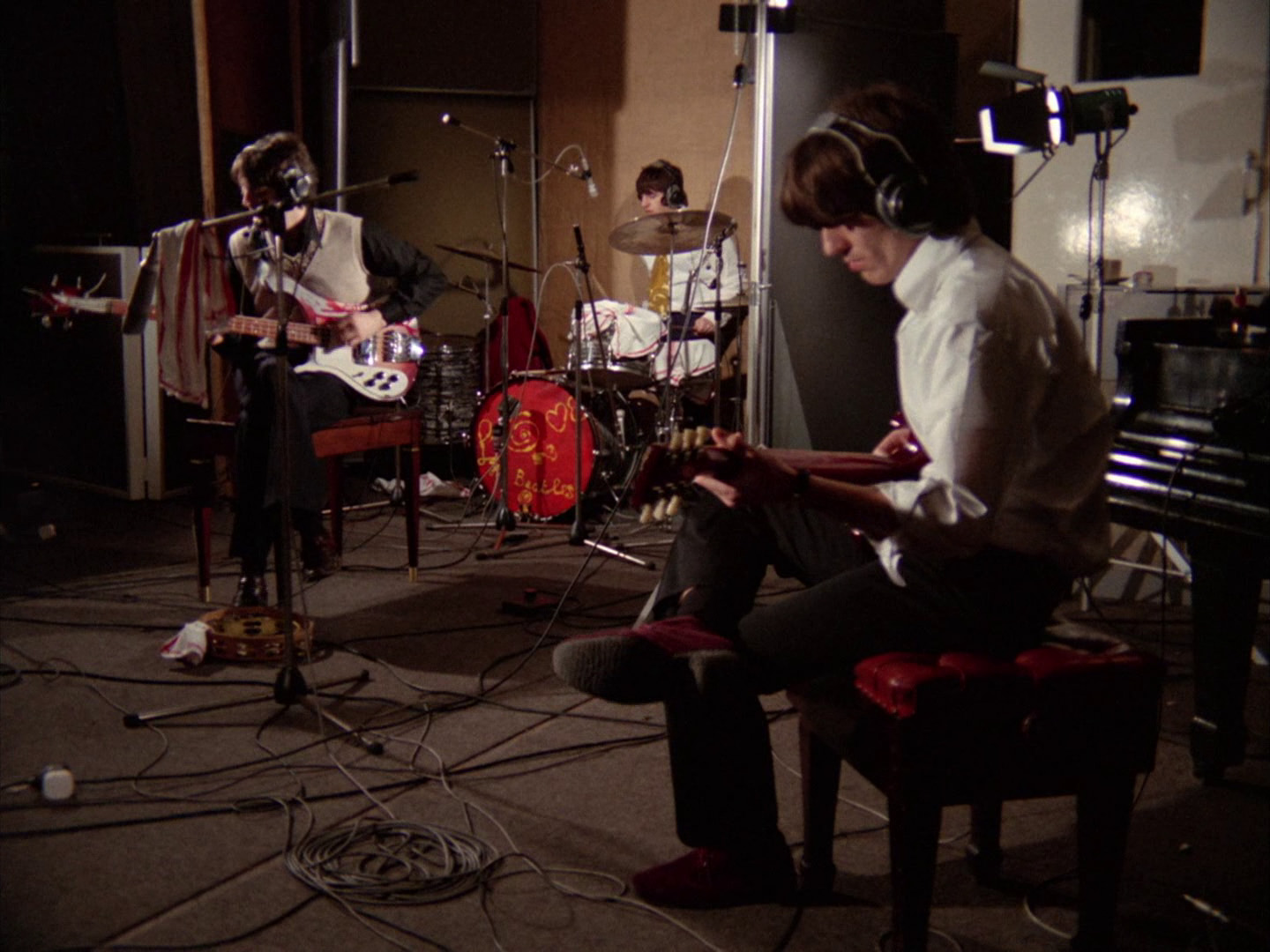
With the Lady Madonna session wrapping up quicker than expected, and Abbey Road’s Studio 3 still booked for use, the plan was to use the time to film The Beatles working in the studio so that the footage could be used in a promotional film to promote Lady Madonna around the world. Such is the speed of things in Beatleworld though, that by the time the cameras were rolling, The Beatles were already beating and barking Lennon’s brand new tune into shape. The footage that duly accompanied the Lady Madonna promo is actually film of them recording a handful of the ten takes it took to nail down Hey Bulldog.
The Beatles – Hey Bulldog – isolated McCartney bassline
Amazingly, incredibly, written on the spot and played no more than ten times – how many times did YOU go away and learn your part before daring to step into a recording studio? – Paul’s muted palmed and woody thunk is the constituent part that drives the whole track. 98% flatwound Rickenbacker snap and 2% forgivable slop, McCartney’s bass playing in this phase of The Beatles is never anything less than peerless, inspired and beautiful. You knew that already though.
In the pantheon of indispensable Beatles lists, it’s only in recent years that Hey Bulldog has crawled its way on there, finally recognised as one of the band’s great tracks.
A sampler’s nightmare – pinch a portion of Beatles and you’d better have a good lawyer at the ready, it’s for that very reason you rarely encounter a Beatles sample. Yes, you can point to The Sounds Of Science on Paul’s Boutique, cut ‘n pasted together in the last century, way back when waters were murkier, but since then, there’s not been much. Cypress Hill took McCartney’s cooing opening bars to Your Mother Should Know and looped them into hip hop heaven on a track (a remix perhaps) that I can no longer locate. Jay Z’s official/unofficial Grey Album dismantled the White Album with varying degrees of brilliance, and that’s about it.
The Roots – switched on that they are – appropriated the Hey Bulldog riff into their own Thoughts At Work, a track that appeared only on original vinyl copies of Phrenology then, following a hard rap (ba-dum tish) at the door from suited and booted legal heavies, never again.
The Roots – Thoughts At Work (orig. vinyl-only release)
Welded to a beat created from the oft-sampled Incredible Bongo Band’s version of Apache, it’s a sweary blast that’ll make you want to drive the Fiat Punto slowly down the High Street, Detroit leaning with the windows down, like the hep cat you secretly always wished you could be. A pretender, a nearly-was, much like the track that rides on the coat tails of the sample it stole.
“Charlie Watts died,” I say to Mrs Plain Or Pan when she gets in from work.
“Oh…I know him,” she says, recognising the name from somewhere…and proceeds to sing the opening ‘fa-fa-fa fa fas‘ from The Kinks’ ‘David Watts‘. “He was the drummer in The Who, wasn’t he?”
Every day is Give Us A Clue in our house and the sad, sudden, unexpected news regarding the metronomic heartbeat of the Stones provided yet another beauty.
I’ve been in the same environs as Charlie Watts three times, yet I’ve set eyes on him just the once. Or maybe twice.
The first: The Rolling Stones’ Urban Jungle tour at Hampden Park in Glasgow, July 1990. Derek and I were in the traditional Rangers end – a great place to be in the mid ’80s when Scotland were rampaging their way towards another World Cup finals, but not so great for the current Stones show. The stage set was so massive and clunky that we found ourselves watching them side-on. A never-ending flood of fence-jumpers made their way from the terracing around us and melted anonymously into the standing section, their stick-it-to-the-man actions loudly cheered whenever the Rock Steady security guy tripped and fell while chasing them, but I’m ashamed to say that I was too scared of getting caught and turfed out before opening act Gun had hard-rocked their way through their 17th guitar solo or third number, whichever came first, so with a grumpy but understanding Derek, we watched from our acute angle afar.
Mick and Keef did their thang, front and centre. Ronnie prowled just behind them. Bill Wyman’s replacement was…somewhere…(who cared?) and Charlie? His kit was stuck so far at the back that, even when they came to bow at the end, he ended up being obscured by a massive, deflating rubber doll that had popped up during Honky Tonk Women. So, although I saw the Stones in concert – “We should really see them before they break up“, contended Derek, thirty one summers ago – I never did see Charlie and that nonchalant face of his as the band ground through the gears of Tumbling Dice and Brown Sugar and Miss You and a gazillion other greats. Gimme, gimme, gimme the honky tonk blues indeed.
The second: Lake Ontario, Toronto, September 1997. We’re on honeymoon, Mrs Pan and I, and out on a wee tourist pleasure cruise on Lake Ontario. It’s a roasting hot day, even out on the lake, and it’s all going on; an enthusiastic tour guide pointing out significant buildings on the Toronto skyline, free drinks, a reciprocal beep and wave from other passing pleasure cruisers and then… from nowhere, up glides this big boat. It’s blasting rock music. It’s got the MTV logo all over it. And it has a host with a microphone.
“Hey you guys! We got the Stones on board!” And there they are – Mick, Keith, Ronnie, the Wyman replacement and Charlie, jazz-cat cool and riffing across his snare and hi-hat, staring off into the middle distance, lost in his playing. And just as quickly, there they went. Stone me! Literally. No photos were taken, of course. Oh no! I wasn’t always as smart as I am these days.
The third. Edinburgh a couple of years ago. We had tickets for Wicked at the Playhouse. I very kindly gave mine to my mum. Musicals ain’t my thing, I reasoned. And while they’re at the theatre, I thought to myself, I can check out the record shops without feeling I’m pushing my luck. So that’s the plan. I leave everyone at the Playhouse, I walk the short walk up Leith Street and at the top I’m met by a heaving throng of people, all gathered around the Balmoral Hotel. The road is sealed off. Half a dozen limos are circulating outside. The word on the street is that the Stones are, at any moment, leaving in the fancy cars to soundcheck at Murrayfield, where they’ll play later that evening. Well, what can a poor boy do, but hang around and catch a glimpse of a Stone or two.
A good hour and a bit later and suddenly there’s a burst of activity and yer actual Mick Jagger is standing at the top of the stairs that lead in and out of the hotel. With well-practised schtick, he holds court. “Awl-right!” he camps from below a red baseball hat, his linen suit looking expensively louche from 20 metres away. While I’m fumbling for the phone I’d long-since stuck in my pocket, he does a wee wave, one of those where the fingers bend at the knuckles and that’s about it, and, with a hop and a skip and a jump, he’s bundled by half a dozen burlies into his car. Wow, I think. He’s the same age as my father-in-law. How daft is that?! I catch myself laughing and a foreign tourist moves slightly away from me. Next there’s Keef. I think I manage to snap the top and/or back of the bird’s nest on his head. The wee twisted red ribbon is, I think, the giveaway. Or maybe it was Ronnie. I dunno. The photo, on later inspection, proves inconclusive.
This nonsense goes on for what seems like forever and then, suddenly, there’s another swell of noise, a shouldery jostle from the tourist beside me and there…I think…yes…eh?…aye!…hmmm…definitely…it’s Charlie Watts; whippet thin, nice suit, grey hair atop a Mount Rushmore of sagging lines…and then he’s gone. Just like that.
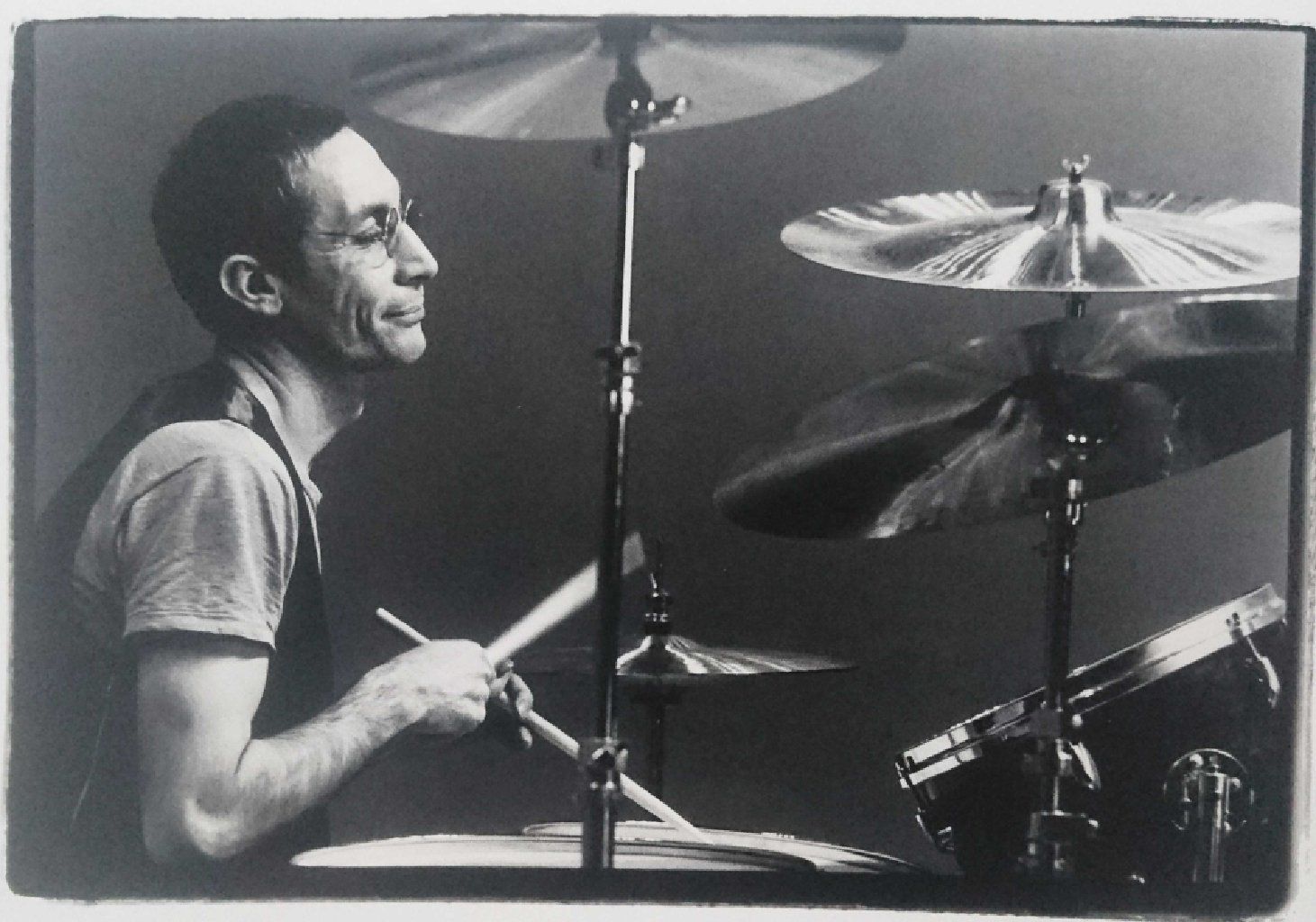
The Rolling Stones have oft-featured on these pages and without checking, I’d imagine Charlie gets a mention every time. This doesn’t always happen when you spend your time writing about guitar bands, especially ones with such iconic guitarists, but there’s a fair argument to be made that the Stones wouldn’t have rolled quite so smoothly with anyone else keeping time at the back.
Always that tiny half beat behind the group, Charlie provided the groove and swagger, the calmest man in the crew as the madness and mayhem spiralled around him. To have been a part of that group during their golden years must have been quite something indeed, yet even when knee-deep in (and on) hard drugs, Charlie appeared to be never anything other than in control at all times. With his hands on the reigns, he gave the others the permission to push forward, instructed them when to hold back and allowed them the space in which to play some of the grooviest, bluesiest rock ‘n roll of all times, dapper as a dandy and nonchalant as fuck.
See y’later Charlie. I’ll have my camera ready the next time.
Part voodoo, part gumbo and part mumbo jumbo, Bo Diddley‘s Who Do You Love? comes at you skifflish and rhythmic, a one chord groover that’s endured for 65 years and counting. It’s the sound of the deep south; bluesy yet beat-driven, insistent and instantly catchy, Bo’s lyrical swagger and braggadocio doing its best to woo the object of his desires. You can stick with him on the safe side of the street, he’s saying, or you can cross over to the dangerous side with me and my rattlesnake whips, cobra snake neckties and human skulls. What’s it to be, baby?
Bo Diddley – Who Do You Love?
The guitar tone is pretty fantastic. It’s knee-tremblingly jittery and juddery, all echoing tremelo action and muted left palm and when Bo’s lead guitarist ventures beyond the fifth fret call-and-response riffing to let loose the solo, the electric guitar squals and squeals for possibly the first time in recorded rock ‘n roll. Future household names sat bolt upright in box rooms the world over, senses tingling with electricity and brains jangling with endless possibilities.
Almost rockabilly in feel and execution – play it back to back with Chuck Berry’s Maybelline for full effect – Who Do You Love? hasn’t quite yet got that Diddley Beat that would become his signature, but rattling away somewhere in the background, behind the railroad snare and the tea chest bass, are a pair of maracas that would prick at least the ears of a blues-obsessed Welshman and give birth in time to the Rolling Stones. It’s an important record for sure.
Who Do You Love? is a standard for garage bands and bar room bawlers everywhere. It’s been covered and recorded by a gazillion artists, from faithful facsimiles of the original to more outlandish and unique takes.
The Jesus And Mary Chain‘s version kerb-crawls on a path of fuzz bass and monotonous, reverb-heavy drum machine, a street-smart, street-walking panther clad in black leather.
The Jesus And Mary Chain – Who Do You Love?
Jim Reid’s vocals are mogadon-heavy, slo-mo and slurred, all faux Americana, menacing and sinister and hung-off-the-microphone at ninety degrees. Plus ça change, as they say in East Kilbride.
By the time the JAMC’s version has oozed its way, oil slick thick, to the halfway mark, you’re acutely aware that brother William, usually already fifteen rounds gone in a fight with a bucketful of feedback and crashing shards of glassy, ear-splitting sonic terror is, on this record, comparatively understated. He’s there though, happy to be in the background, hitting the odd sustaining, reverberating chord and slopping splashes of sonic colour to the palette whenever the urge makes itself known from beneath the bird’s nest on his giant, Stooges ‘n Velvets-filled heid.
By far his most important job it seems though is to abruptly turn off the drum machine, just as the JAMC did when playing live.
Famously, The La’s hated their debut album. Where the record-buying public heard it for what it was – a great collection of well-constructed chiming, rattling and rolling songs, Lee Mavers rubbished it as a mismatch of tracks recorded at various sessions with a variety of producers over a couple of years; a guide vocal here, an unfinished guitar part there, a work in-never-ending process. Given a sprinkling of magic dust by Steve Lillywhite and released against the band’s wishes, it lacked, shouted Mavers, spontaneity, cohesion and the requisite ’60s dust. Chas Smash, once of Madness and at the time The La’s A&R guy told me recently of the band’s American tour to promote the record when Lee, faced with the wibbling and gurning jocks on ButtKiss FM – “I love your shit, man!” – would slap a beat-up C90 in front of the presenter and declare loudly and proudly, “Dis… (slap!) is da fookin’ album, la. Play dis one instead!” The record company people, with the promotional weight and might of Polygram behind them, would hold their heads in their hands in despair as, station after station, Mavers would repeat his trick until eventually, the stations stopped playing any La’s at all.
Likewise the Beta Band. They certainly weren’t the first band to disown their debut album, but they were equally as vocal as The La’s. “It’s definitely the worst record we’ve ever made,” announced Steve Mason when it was released in 1999, “and it’s probably one of the worst records that’ll come out this year. It’s fucking awful.”
Coming a year after the celebrated ‘Three EPs‘ compilation, the band took the magpie ‘n kitchen sink approach that they’d developed over those three singles and threw everything, literally and metaphorically, into the self-titled debut album proper.
They wanted to make it a double album, with each of its four sides recorded in a different continent; Asia, South America, and so on. Economics had the final say unsurprisingly, and so much of the record was put together in a shed that belonged to the grandfather of the band’s keyboard player/sampler/DJ John Maclean. An ambient companion piece was eventually shelved, trimming the intended double album to a single ten track record.
It was a difficult record to pigeonhole, and thank goodness for that. In an era when bands were defined by the trainers they wore or the records they never namechecked, The Beta Band was almost unclassifiable. It bulges and bursts with ideas; wonky Scottish raps, carnival drums, filling-loosening dub reggae bass, frazzled and meandering psychedelic guitar lines… sometimes within the one track.
Beta Band – Broken Up Adingdong
Goat Fell and Glen Rosa on the Isle of Arran given a psychedelic makeover
Broken Up Adingdong is almost every idea considered for the album realised in miniature. Beginning on a rhythm of pattering handclaps and what might be someone playing makeshift drums with the palms of their hands on the back of an acoustic guitar, it motors along on a steady, skifflish two chord shuffle that falls somewhere between the scrubbed to the knuckles approach of The Woodentops and the measured discipline of Can or the Velvet Underground.
Tumbling waterfalls of acoustic guitar – similar to the occasional riff that permeates The Patty Patty Sound‘s ‘Monolith‘ – chime their way in and out of the tune, panning from left to right and back again (try it with headphones on for full effect) and as it builds to a crescendo of overlapping vocals, repetitive chants and frantic, double-time claps, it gives way to a collage of beats.
Calypso drums dance and weave in and out. Loosely tightened drums thunder with Bonhamesque brute force. Hairspray hi-hats hiss their way across the top, disco without the glitterball, as some sort of Donna Summerish string sweeps in and then out again just as abruptly. One of those old-fashioned bicycle horns hee-haws its squeaky guffaw between the tapestry of pots ‘n pans percussion and the whole thing rattles and rolls to a stuttering close, as dignified as the Eastenders theme tune tumbling down ten flights of tenement stairs. It’s messy, hypnotic and groovy as fuck.
Time has been kind to the Beta Band and The Beta Band. It’s certainly not the clunker the band suggested it was, and not for a minute do I believe Steve Mason when he said as much. Twenty years on, I suggest you revisit that debut album as soon as you can.
Years ago, in the grim and distant past, I was doing some supply teaching work. Back then, much like it is nowadays, permanent teaching jobs were thin on the ground as to be almost non-existent, so any call from any school was gratefully received.
“Are you able to work tomorrow…?”
“Yes!”
“…morning only…?”
“Eh, yes.”
“…in the nursery?”
“Uh… … …Yes.”
It was that bad. Imagine trying to secure a mortgage on that kinda deal. One day I was asked to go to a school and take a primary 7 class for a couple of days. The class teacher doubled-up as a member of the school management team and was on a course, so I was asked to cover.
Two things tend to happen if you’re called in as a supply teacher. Either you go into the classroom the back of eight o’clock and on the desk is a detailed plan to follow; numeracy and literacy lessons for every differentiated group and/or individual, a selection of topic-based activities that the kids can choose to do in any order, an art lesson perhaps, a short story… far more than you’ll ever need, but enough to ensure your day is action-packed with work set by a conscientious teacher at all of the learners’ abilities. Alternatively, you might find a quickly scribbled note instead. “Feel free to do whatever…as long as they’re busy…Lucy and Emma will give out any jotters you’re looking for. Don’t let Jayden sit next to Reuben or you’ll have a fight on your hands. They’ll want to sit together, and they’ll try it on with you, but I’ll have Reuben’s mother up at the school if you do and she’s a pain in the arse, so please don’t.”
As it was, this particular time fell somewhere in the middle.
“The kids are working on subtraction. They have their own work and know what to do. They have gym after the break. We’re doing gymnastics but if you want to do something else I don’t mind. For literacy, here’s a reading comprehension book. Normally I differentiate depending on the groups, but just pick one exercise and do it with the whole class if it makes it easier for you. They also have the laptops this afternoon. We’ve been learning how to set up a class database, but again, do as you please.”
I flicked through the comprehension book. It was the usual teaching aid full of book extracts, poems and made-up news reports, all with a variety of questions that, if answered correctly, would demonstrate each pupil’s reading ability. Then, jumping out at me from the the bottom corner of one page was a picture of Bob Marley, a classic shot of him in closed-eyed freeze frame, his defiant fist punching the air like the exclamation mark on a political soundbite. It accompanied a passage about the slums of Kingston in Jamaica; crime, poverty, hardship. Stone me! I’d found my literacy lesson.
When the time came, I asked the class if anyone had heard of Bob Marley. Straight away, half a dozen hands shot up. With a massive, knowing grin, one wag filled us in. “Ma br’er huz a poster a’ him oan his wa’. ‘E’s smokin’ a massive doobie in it!” Righto. So we knew who Bob was. Did we know where he grew up, I asked. No-one did. We read the passage about life in Kingston, about the shanty towns and high-rise tower blocks where people lived on top of one another and where gun crime, murder and gang warfare was a normal way of life for much of the population. Bob Marley was held up as an example of someone who’d managed to escape this life and was now one of Kingston’s most-celebrated sons. The passage carried a tale of morality; work hard, be good to others and you can make a better life for yourself. I’m not sure that message got through to the kids in the class, most of whom were still sniggering at their classmate who’d said the word ‘doobie’ to this unfamiliar teacher, but there we were.
“‘No sun will shine in my day today…the high yellow moon won’t come out to play.‘ It doesn’t matter the time of day, I pointed out, if you live in this part of Kingston, you’ll live in permanent darkness. Bob Marley wrote that.”
“‘Darkness has covered my light and turned day into night… No chains around my feet but I’m not free, I know I am bound here in captivity…’”
It’s amazing when a casually-acquired knowledge of Bob Marley’s music will come in handy.
“How d’ye ken a’ that?” they asked. For the first time in my nascent supply career, I had a classroom hanging on everything I said.
I explained about Concrete Jungle, the opening track on Bob Marley and The Wailers’ Catch A Fire album. It’s basically folk music, I explained. In Scotland, folk singers sing about fishing boats and sheep farming, about the threat of nuclear war and about people they know. Bob Marley’s music is also folk music, albeit coated in sunshine and played with a reggae beat. Much discussion of what reggae was followed, ending with me asking the kids to clap out a four-beat bar of handclaps with me emphasising the stomps of my foot on the off beat while over-egging some shonky ‘ooh-yeahs’ in an approximation of Bob Marley on Jammin‘. It did the trick. Bob sang about what he knew, and on Concrete Jungle, he’s telling you how tough his life was.
In the corner of the classroom was a smartboard. Nowdays, they’re ten-a-penny in schools and there’s nary a classroom that doesn’t have one, nor a teacher who doesn’t know their way around it, but back then, smart boards were a brand new thing. I have no doubt that the smart board was in this particular classroom because the teacher, being a member of the management team, had pulled rank to snaffle one of the few that the school had sourced. I connected it up and, this being the days when YouTube wasn’t blocked by the authority’s servers, put on the version of Concrete Jungle that The Wailers had played on Whistle Test. It was dynamite.
The kids sat in studied appreciation as Marley sang the words I’d told them previously, his band playing with effortless cool. Marley might’ve been centre-stage, but it was clearly his band who were driving it. Not only did they look great, they played great too. A practically motionless and stoned immaculate Peter Tosh barely touches the strings of his guitar yet the opening notes, all open wah and weeping pain, meander fluid and free before falling into its rocksteady chicka-chicka rhythm. The easy, soulful falsetto he contributes throughout is the perfect counterpoint to the melancholy and sadness of Marley’s lead vocal. The keys, very reminiscent of Stevie Wonder’s Superstition I noted to myself, (I hadn’t noticed that before) clack and squeak their way into the groove, never in the way but always there for requisite funk.
By the time the whole band has fallen into step, they’re cooking up quite a quiet storm. It’s easily one of my favourite music-on-TV clips. The kids in that P7 class loved it too. For the rest of that day in the classroom, we used the laptops to research Marley’s life and death and legacy. There was a steady stream of Bob tunes flowing from the iPod I’d rescued at break time from my car as we wrote, read and learned his story. Eking out all they could about the football-playing, ganja-smoking Bob Marley, the kids worked in small groups to create wonky and ropey but well-researched and honest presentations. Concrete Jungle is almost, in today’s parlance, a deep cut, but ask those kids (adults today) and I bet half of them would name it as their favourite Bob Marley tune.
Bob Marley & The Wailers – Concrete Jungle
There’s another version of Concrete Jungle, the demo that Chris Blackwell felt needed westernised to suit UK radio play. It’s a bit rough around the edges, but bereft of the shinier production of the more well-known version that opens Catch A Fire, it’s something of a beauty.
Bob Marley & The Wailers – Concrete Jungle (Jamaican Demo)
For the second day, I showed a map of Glasgow on the smartboard. “It’s Glasgow,” I pointed out unnecessarily. “But who can find anything relating to Kingston or Jamaica?” I drew an invisible circle around the Kingston Bridge and Jamaica Street and waited for their oohs and aahs.
“Bob Marley also wrote about slavery,” I said. “In fact, his song ‘Slave Driver’ is exactly about that.” We listened to that track too and discussed it before spending the rest of the day researching the Glasgow tobacco lords and the legacy they’d left the city of Glasgow. No statues were toppled, no history was rewritten. Instead, 30 or so young minds were informed and expanded in many different ways. And all thanks to a random picture of Bob Marley that was in an old book that the teacher left out for me. Stir it up, as a great man once said.
I came to Hamilton Bohannon‘s Dance Your Ass Off back to front. I had no idea, back in 1987 when I first flipped That Petrol Emotion‘s Swamp to the other side (the double A side, no less) that the track was a cover. I had never heard of Hamilton Bohannon. I had no idea Dance Your Ass Off began life, not as a hard-riffing indie rock thumpalong, but as a string-swept, four-to-the-floor disco funk number.
Hamilton Bohannon – Dance Your Ass Off
In hindsight, it was obvious. In an era when Stone Roses were still a leather-clad goth band and the phrase ‘there’s always been a dance element to our music’ had yet to be uttered by plooky, bucket-hatted chancers with no end of shame-faced brass neckery, That Petrol Emotion were cross-pollinating the best of dance with loud guitars and danceable rhythms and creating their own niche in a post-Smiths, pre-Roses landscape.
Listening to them 30 or so years later, That Petrol Emotion still stand up. Not of their time, but out of time. As it turned out, there always was a dance element to That Petrol Emotion’s music, not least when they turned up to play a gig in Glasgow’s Sub Club, mecca of dance music for discerning clubbers throughout the west of Scotland and beyond.
When you learn that Hamilton Bohannon was a born-again, God-fearin’ devout Christian, Dance Your Ass Off comes as something of a surprise. Many of Bohannon’s tracks were syrupy, slow-paced love ballads to the higher order, so that he decided to kick loose with swampy, chicken scratchin’ guitar and bad ass bass nailed to bubbling, fluid on-the-one funk should be celebrated with carefree, arms aloft in the air abandon.
‘Make a lotta noise!‘ he instructs. ‘And dance all night!‘ That’s easy to do when the rhythm laid out in front of you is so single-minded in its mission to get you to move. Double-time handclaps drop in and out, see-sawing strings saw their way through the middle while the drummer – possibly Bohannon himself – holds the beat steady for a full eight minutes.
There’s some crowd pleasin’ call and response as the strings waver their way ever-closer to Mayfield territory, all Blaxploitation shimmer and underlying menace, but the groove never abates. With the thick soup of guitar, bass and drums at its core, Dance Your Ass Off comes across like The Meters transplanted to Studio 54. And there ain’t nuthin’ wrong wit dat.
That Petrol Emotion – Dance Your Ass Off
That Petrol Emotion were first and foremost a guitar band but they understood the appeal of a steady rhythm section and some wildly interlocking riffage. Swamp on the a-side would make that explicitly clear to any doubters. Their take on Dance Your Ass Off is a testosterone-fuelled, muscled-up triumph.
With sights firmly set on the indie dance floor, it locks into its groove and rocks hard in half the time of Bohannon’s original. The guitars, all feral Telecaster twang and snap, fall somewhere between hard jangle and post punk rage, concrete thick yet flab-free and linear. A gnarly, growly bassline replaces the uber funk of the original.
The little scratching noise you hear in the background under Steve Mack’s enthusiastic north-west American yelp is that of Faith No More making notes to crib the punk/funk bassline for their own end. We care a lot, indeed. It’s a groovy cover, all things considered.














 Plain Or Pan