Get This!, Gone but not forgotten

Homo Superior In My Interior

It’s 1981. Buzzcocks come together to begin working on their fourth album, Martin Rushent in the producer’s chair. The band is broke, both financially and creatively. Pete Shelley, stuck in a deep rut of writer’s block, brings a handful of half-finished songs left over from his pre-Buzzcocks days. The others bring nothing much at all.  With the sessions quickly collapsing, Rushent suggests to the group that Buzzcocks take a break. The producer and singer though, they alight in Rushent’s state-of-the-art studio to work on some of Pete’s tracks.

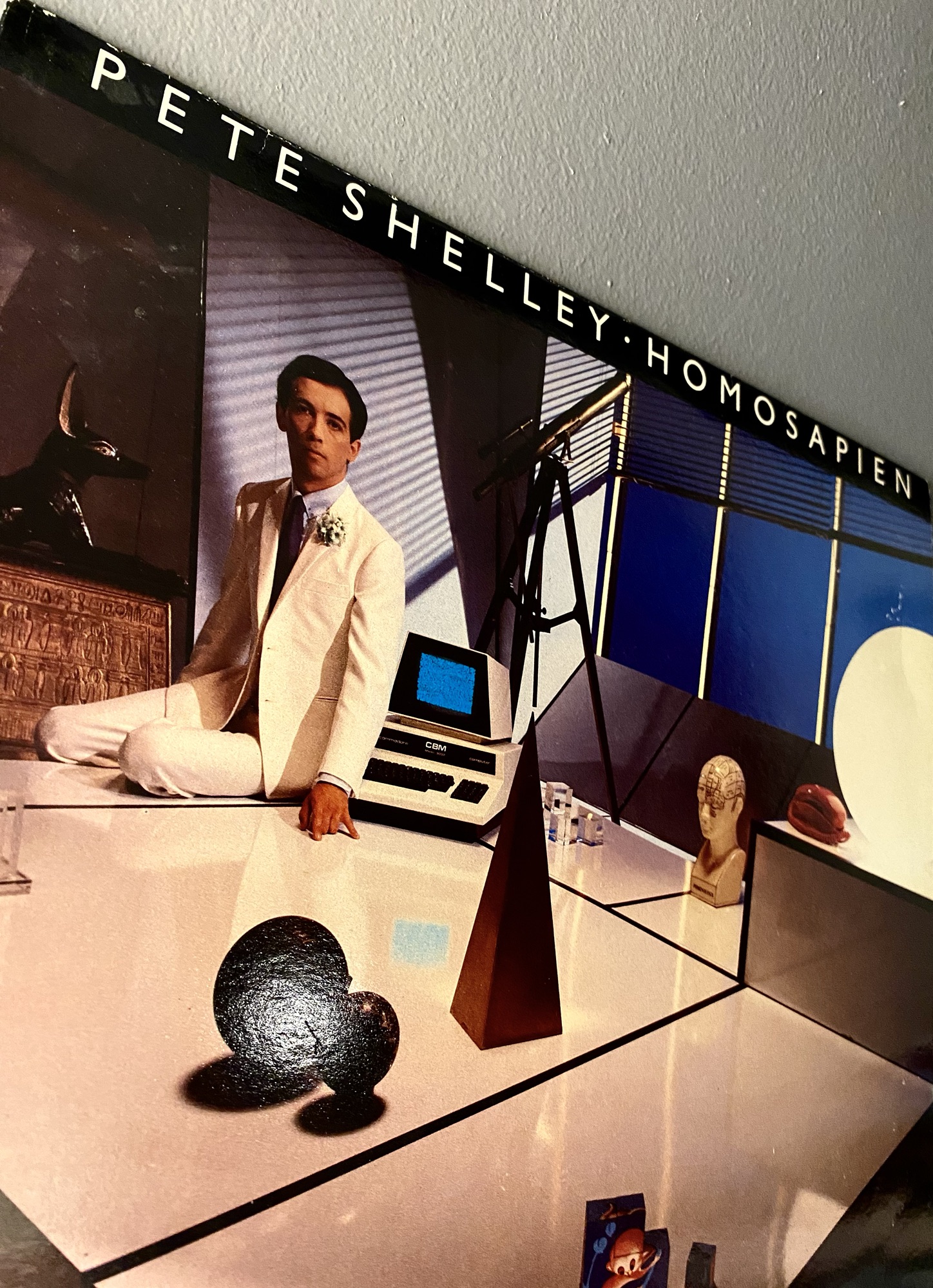
Pete Shelley’s resultant *debut album Homosapien might’ve spun with the same spiky frothiness as the act he’s most associated with, but it was glossed in a sheen of Rushent-powered machinery; synths, drum machines and programmed sequencers that were very much in keeping with the musical landscape of 1981. The cover tells the story – a careful placement of arcane artefacts and cutting edge technology that dates it somewhere in a near future where Kraftwerk might meet Blake’s Seven around the boardroom table for a healthy discussion on the merits of analogue vs digital. The result, if we’re being honest, was a bit of a mixed bag. The eponymous lead single though? That’s a stone cold cracker.
Homosapien judders and jars its way in on the same motorised rhythm as Buzzcocks’ Something’s Gone Wrong Again, all mid-paced bounce, effect-heavy 12 string acoustic guitars, their swirling chords slashed and stabbed. It makes for a great sound. It even finds space to add an undercurrent of I Wanna Be Your Dog-giness in the verses…verses that borrow heavily from the sequenced bassline that throbs its way through Abba’s Does Your Mother Know? Play them back to back yourself and tell me I’m wrong. I bet Rushent knew exactly what he was doing here. Why wouldn’t a producer keen for a hit want to borrow a hint of DNA from pop music’s greatest contemporary hit makers?!

For all the producer’s sprinkling of magic though, it’s the singer who’s the real star of the show here. Shelley’s delivery is, as ever, terrifically sneery and archly camp, double tracked at the end of lines and even more so all over the chorus, adlibbing up and up the scales as the record fades out. It’s once you focus on the words being sung that the gravity of the record becomes crystal clear.

‘Shy boy, coy boy, cruisers, losers’.

‘Homo superior in my interior

I don’t wanna classify you like an animal in the zoo‘.

‘I just hope and pray that the day of our love is at hand‘.

You and I, me and you, will be one from two, understand?

Adding such a transparent lyric was for sure a real, eh, ballsy move by Shelley, but once it had found the ear of a jobsworth radio researcher, the record was promptly banned by the BBC. The organisation who beamed Larry Grayson into millions of living rooms every Saturday night was aghast at the record’s ‘overt references to homosexuality‘.

Exhibit A, m’lud: ‘Homo superior in my interior‘.

What a zinger of a line but.
With the era of diversity and acceptance still just a formative if growing movement on the horizon, Homosapien is perhaps the first pop song to use non-coded lyrics to get its message across. It’s brave stuff to be writing, singing, recording and releasing in 1981.

No Homosapien, no Smalltown Boy perhaps. No Smalltown Boy, no open discussions around the living room telly during Top of the Pops as its video plays for the umpteenth time. In its own small way, Homosapien is a groundbreaking record. It’s almost a bonus that it sounds utterly fantastic, and more so 40+ years later.


*We’re not counting Pete’s pre-Buzzcocks 1974’s experimental, instrumental album Sky Yen, are we? Are we?
Hard-to-find

Magazine Article

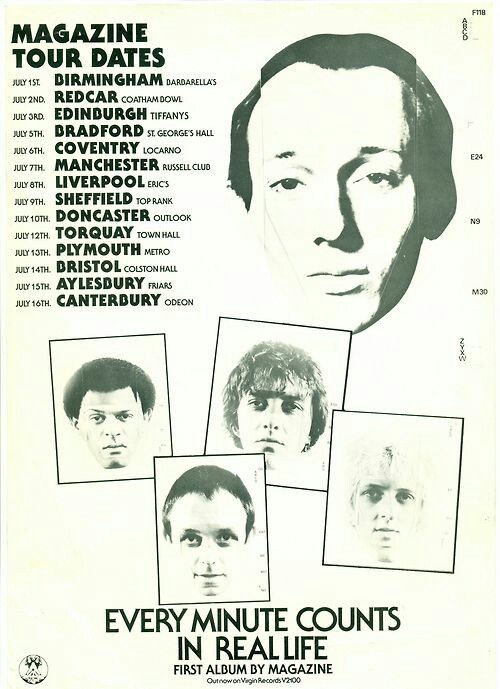
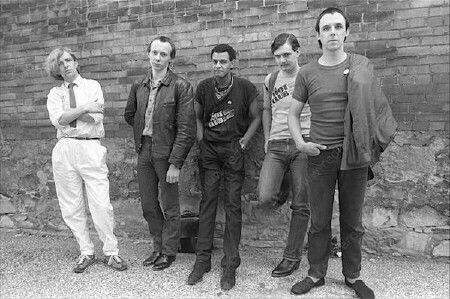
Howard Devoto was one forward-thinking guy. He gets the Sex Pistols up to Manchester for two shows. Is responsible for turning the whole of the city onto punk and, by default, is the catalyst for creating all the most important Mancunian acts in history  – every one of ’em. As leader of Buzzcocks, he creates and releases possibly the first-ever DIY single (Spiral Scratch, of course) and then, at the sharp razor’s edge of punk, calls time on his position in Buzzcocks and leaves to form Magazine, his Wings to Buzzcocks Beatles, the first post-punk act on the planet. Nowadays ‘post-punk’ is a term thrown at any old band post ’79 with a tinny guitar and a clever lyric, but without Howard having the foresight to leave Buzzcocks at such an early stage – in 1978! – when he could already see where punk was heading (Buzzcocks notwithstanding) – we might never have had the term ‘post-punk’ in the first place.

Anyway, Magazine. In Magazine, Howard pulled aside the ramalama of punk’s guitar attack and gave us a peek at what was hiding behind the scars; music that was arty, cerebral, clever. They’re a good band, Magazine. Quite possibly a great band. Those records – the first three especially – hold up strongly against anything released then or since.

Is there a better track out there than first album Real Life‘s The Light Pours Out Of Me? I think not. As much as I’ve been long-familiar with its buzzsaw riff and keyboard sheen, I heard the track at the weekend there as part of the warm-up music for the little-known Caezar – an anthemic Scots act with a neat line in soundscaping guitars and electro-throb bass – and, played loud in an empty room, it knocked the socks clean off me.

The sound engineer was playing around with the band’s intro playlist before doors opened – some Bowie (A New Career In A New Town), some early Talking Heads – and he happened to prick my ears by alighting briefly on the Magazine track. When he’d finished balancing sound levels, the room now empty of both engineer and, as yet, ticket holders, I jumped back on to the mixing desk to cue up and play The Light Pours Out Of Me, in full, with no interruptions…at ear splitting volume. It sounded glorious.

MagazineThe Light Pours Out Of Me

It’s a masterclass in studied repetition. Opened by a simple military two-step drum beat that never wavers or strays until almost – count ’em – the third minute, it’s joined by a strutting bass line, all sleek black cat purr and prowling menace, John McGeoch’s signature six note creeping riff surfing atop. With the group locked tightly together and playing the same thing over and over, we’re only then introduced to singer Devoto. High of fringe and high of ideal, he half sneers, half camps his vocal line, enunciating each lyric straight down the barrel of the mic.

Time flies…time crawls

Like an insect…up and down the walls

The light…pours out…of me

A chink in the repeating blackness of the riff, McGeoch switches to sliding barre chords then back to The Riff. That’ll be yr tension and release (and tension again). The jackboot stomp of the bass continues to mangle all who gets in its way. The drummer drums that same pattern, solid and steady, eyes front and focused. He could choose to scattergun the odd Moonism or two, of course he could – they all did that in the punk days, after all…but this is post-punk. Repetition is discipline, to quote another Mancunian trailblazer. The group soldiers on relentless and regardless.

The conspiracy…of silence ought

To revolutionise…my thought patterns

The light…pours out…of me

There’s another verse. Another two line chorus and then RAT-A-TAT-A-TAT the drummer rattles into action, McGeoch glides up the frets for some alterantive riffage, Barry Adamson switches his bass from sleek black cat to concrete block and briefly, the track soars, powered by glistening keyboards and Devoto’s wide-open imagination.
You’ll want to find yourself somewhere that you can blast this for all it’s worth. The Light Pours Out Of Me is a good track through a phone. A great track on record. An absolute killer through a proper P.A. With Magazine (McGeoch, Adamson et al), volume is king. Turn it up and play it loud.


Gone but not forgotten

Rock Goes To Collage

This song is a beauty. It begins with a four to the floor bass drum ‘n boot-heeled stomp; urgent and glam, exactly the sort of beat that would reduce lesser frontmen to demand the audience showed him their hands in above-the-head crass communion.

BuzzcocksFiction Romance

Not Pete Shelley though. A guitar line follows, waspish and chugging, two notes playing in unison with the kick drum. Zhung-zhung-zhung-zhung-zhung zha-zhung, zhung-zhung-zhung-zhung-zhung zha-zhung. A second guitar falls into line. Same riff, different effect. Chorus? Flange? Both? It’s as shiny and metallic as the record sleeve that houses the album upon which it can be found and it’s full of the promise of what might follow. The drum roll that clatters in exactly where you expect it to wakes the bass payer from his slumber and the band, Buzzcocks, now playing as one, is a fraction faster, a fraction keener.

Shelley is straight into the vocal. A fiction romance, I love this love story, he goes, and you’re lured into a false sense of what the song is about. The chords shift from F to A – an unusual change from a band who made a bit of a trademark of playing unexpected chord changes – and, just as the guitar playing suggests trouble ahead, the vocal turns sour. That never seems to happen in my life. Ah. So it’s another unlucky in love love song from a band who made a bit of a trademark of writing and playing unlucky in love love songs. Not just any old unlucky in love love songs, though. Buzzcocks played them with a whip-smart ferocity while Shelley delivered them with a knowing coquettishness. Unpretentious and everyman, Buzzcocks were and are remain entirely peerless. You knew that already though.

Here comes the chorus? Bridge? Refrain? I dunno, but it’s perfect. Those F-shapes are slid up the frets and back down again, changing the gears, dropping the speed until we’re back to The Riff and Buzzcocks are off and galloping once more. By the time we’ve breathlessly pogoed our way to the outro, the band is locked in as one to the flow of the music – headnodding Stooges sludge played by effete Boltonians. Fiction roma-aaance! Fiction roma-aaance! they repeat and repeat, underlining once and for all that this love thing is a work of fiction entirely, then, just when you least expect it, they switch gear into another riff for the entirety of the last whole minute, ending on a vocal-less Beatles For Sale aping I don’t get you-ooh. A band that references itself! How arch! It’s outrageous and groovy and one that most bands would happily swap their vintage Les Paul jnrs for.

There’s a swirl to the music, a floaty air of proggish punk/punkish prog wrapped in stomped-on effect pedals and Martin Rushent’s complementary production. Not for Buzzcocks the glam tourettes of Sex Pistols nor the biscuit tin production of the first Clash album. They knew what they were after from the off and captured it perfectly. They sound timeless…which they are. If y’don’t like Buzzcocks, y’don’t like life.

Buzzcocks’ debut album Another Music In A Different Kitchen was so-titled after the band borrowed and butchered a line used by Howard Devoto to describe one of Linder Sterling’s collages. As essential to punk as the artwork of Jamie Reid, Linder’s collages largely featured pin-ups and topless models torn from top shelf magazines and relocated to domestic subservience. Their heads and faces were usually replaced by steaming kettles or hissing irons and they’d be placed on top of a sideboard, perhaps, or maybe a kitchen worktop. Chaotic art that allows for discourse and social commentary. Subversive and smart. Like the band wot embraced it.

Get This!, Gone but not forgotten, Live!, Most downloaded tracks

2018 (Slight Return)

As is the way at this time of year, lists, polls and Best Of countdowns prevail. Happily stuck in the past, the truth of it is I’m not a listener of much in the way of new music. Idles seem to dominate many of the lists I’ve seen, and I want to like them, but I can’t get past the singer’s ‘angry ranting man in a bus shelter’ voice. I’ve liked much of the new stuff I’ve heard via 6 Music and some of the more switched-on blogs I visit, but not so much that I’ve gone out to buy the album on the back of it.

If you held a knife to my throat though, I might admit to a liking for albums by Parquet Courts and Arctic Monkeys, both acts who are neither new nor up and coming. I  listened a lot to the Gwenno album when it was released and I should’ve taken a chance on the Gulp album when I saw it at half price last week, but as far as new music goes, I think that’s about it. Under his Radiophonic Tuckshop moniker, Glasgow’s Joe Kane made a brilliant psyche-infused album from the spare room in his Dennistoun flat – released on the excellent Last Night From Glasgow label – so if I were to suggest anything you might like, it’d be Joe’s lo-fi McCartney by way of Asda-priced synth pop that I’d direct you to. Contentiously, it’s currently a tenner on Amazon which, should you buy it via them, is surely another nail in the HMV coffin.

2018 saw the readership of Plain Or Pan continue to grow slowly but steadily in a niche market kinda style, so if I may, I’d like to point you and any new readers to the most-read posts of the year. You may have read these at the time or you may have missed them. Either way, here they are again;

This slideshow requires JavaScript.

  • An article on the wonder of The Specials‘ b-sides.
  • Songs about snow and inclement weather.
  • Some words on the punk Beatles. Pete Shelley was very much still alive at the time of writing and retweeted the article.
  • A look at how the best reggae musicians steal the best soul tunes and make them their own.
  • Lush’s Miki Berenyi talks us through some of her favourite music. The most-read thing wot I wrote this year.
  • Stephen Sondheim , Leonard Bernstein, Tom Waits and Pet Shop Boys. Here.
  • First thoughts on Arctic MonkeysTranquility Base Hotel & Casino.
  • Why Eno‘s Here Come The Warm Jets should be in everyone’s record collection. Here.
  • Skids’ Richard Jobson waxes lyrical about Bowie. Here.
  • Some words on the quiet majesty of Radiohead‘s How To Disappear Completely.
  • Brendan O’Hare, loon drummer and all-round public entertainer in Teenage Fanclub chooses his favourite Teenage Fanclub tracks. Here.
  • The punk poetry and free scatting jazz of Patti Smith. Here.
  • A first-timer’s guide to Rome.
  • Johnny Marr live at the Barrowlands.

Feel free to re-read, Retweet, share etc.


See you next year.

Hard-to-find

Hooklines And Thinkers

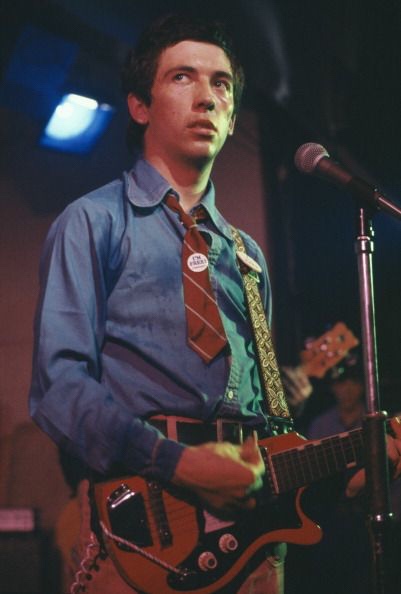
In the first wave of punk’s angry snarl, I can only imagine Buzzcocks were a breath of fresh air. Not for them the stare-down-the-lens-of-the-camera Lydon sneer or the guttural, phlegmy Strummer howl. Instead, Pete Shelley stuck to his Mancunian roots and inflected/infected his vocal with a camp twist, one eyebrow permanently arched while stealing side-long glances at the camera like a not-that-hard-to-get Saturday night tease down the Wheeltappers And Shunters.

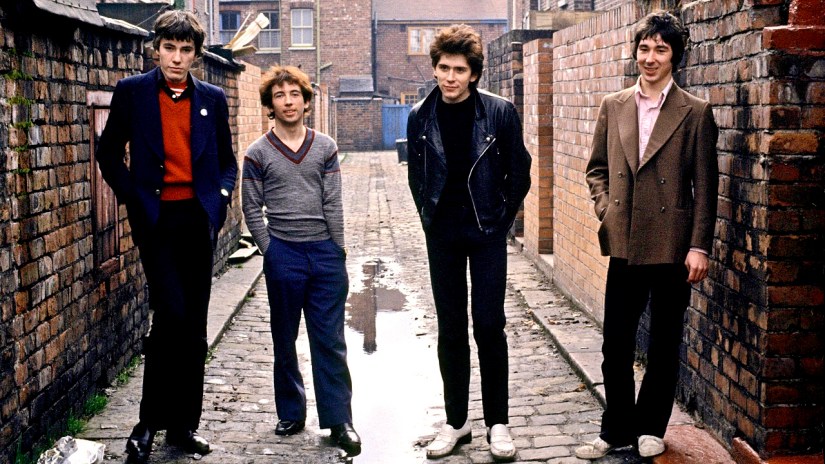
If The Undertones were The Ramones on happy pills, Buzzcocks were the punk Beatles. Most punk acts played a ham-fisted, snot-encrusted take on Chuck Berry’s 12 bar blues. ‘This is a chord. This is another. Now form a band‘, to paraphrase the famous slogan. With a Buzzcocks’ record though, you’re never far away from a weird and wonky chord or an unusual time signature or a proggy sound effect. Buzzcocks mattered.

Overarchingly, Buzzcocks were all about the three minute thrill of the pop rush. I challenge you to pick a Buzzcocks’ track that’s not a few seconds away from a brilliant hookline, be it a singable guitar riff, a perfectly-placed drum fill or a wobbly backing vocal. Buzzcocks really knew the value of a melody. It might’ve been hidden behind a same-sex symphony and the happy clatter of twin guitars, but it was always there.

These Promises (ah-ah)…

Reality’s a dream (ooh, ooh, ooh)…”

I just want a lover like any other, What Do I Get? (clang clang)…

BuzzcocksWhat Do I Get?


The whole of What Do I Get is basically Punk Go The Beatles, from the fade in and giddy rush of the verses via the triple vocals in the chorus and middle 8 down to the “tricky guitar solo!” in the middle. By the breakdown at the end, the whole band have come in on flat backing vocals, Shelley’s off and ad-libbing his “at all at all at all at all” vocals and the whole 2 minutes and 57 seconds comes to a perfect end with a none-more-Beatles “you-ooo!” and major 7th chord. It don’t get much better than that, if y’ask me.

BuzzcocksNoise Annoys

Buzzcocks ability to make melody matter (even on the baiting Noise Annoys) is why Singles Going Steady still sounds fantastic 40 years later. It’s basically The Beatles in flares and M&S v-necks.

In the serious world of discussing records, it’s not really the done thing to champion a Greatest Hits compilation, but drop the pretence for a minute. Singles Going Steady should be in every record collection. As, for that matter, should Complete Madness, Snap! By The Jam, Blondie’s Greatest Hits and maybe even The Best Of The Beatles (copyright Alan Partridge). But you knew that already, eh?


(C) Kevin Cummins

(C) Kevin Cummins

Hard-to-find

Never Mind The Buzzcocks

Telephone Operator by Pete Shelley gallops along like a post-punk, electro mash up of The Osmonds’ Crazy Horses and Take Me I’m Yours by Squeeze. Shelley is in full-on sneering-camp mode and as the record plays, you can just picture him looking side-on to an imaginary camera, left eyebrow slightly raised, arch and knowing.

It’s post punk and therefore post Buzzcocks, but it’s lost none of the key ingredients forever associated with his part in the punk Beatles – a nagging riff (played on synth rather than guitar), a melody with more hooks than a metre of Velcro and a sensational production courtesy of Mancunian marvel Martin Rushent. The track practically bursts out of the speakers with its room-filling throb. I think you’d like it.

Pete ShelleyTelephone Operator

pete shelley telephone 7

There’s also a Dub Version that can be found in the darkest corners of the ‘net. I’m not certain in what capacity it was released as it doesn’t appear on the b-side of the 7″ I have. It’s hardly essential – lots of echoey guitar riffs, some bloops and bleeps and sweeping synths, but sadly, none of the magic that makes the original version such a brilliant record.

Pete ShelleyTelephone Operator (Dub Version)

Telephone Operator is taken from Shelley’s second solo LP, XL-1, a loose-concept album that originally came with a programme that allowed you to play it via your ZX Spectrum (the iPad of 1983, kids), where lyrics and graphics would appear on-screen in time to the music. Ahead of the game, then, although the record buying public failed to engage with it. Four weeks after release, XL-1 had dropped out the charts, never to be seen again. Telephone Operator was the ‘big’ single from it, crashing in at a lowly 66 before vanishing likewise.

Despite this, Shelley’s post-Buzzcocks output is quite interesting and definitely worth investigating. He knows his way around a pop melody and has a sound that is defiantly his. The Buzzcocks may be the act that keeps him in new shoes, but there’s plenty other interesting stuff with his name attached to it.

*Bonus Track!

Here‘s long-gone nobodies Big Dipper with their take on Homosapien, Shelley’s first solo single and a song that suffered from a BBC ban at the time due to some fruity lyrics and allusions to same-sex sex (‘Homo Superior, In My Interior‘).

Big DipperHomosapien

pete shelley bw