Broadway Jungle by Toots and The Maytals is exactly the sort of incessant, insistent ska for this mid summer’s day. Clanging in on a bar of wonky barroom piano and a clatter of dustbin lid drums, it quickly starts on the front foot, gets on the good foot and never lets up for two and a half yelping, head nodding and chin jutting minutes. It’s the sort of tassled loafers ‘n suedehead knees-up that could bring a grinning smile to a jaggy-elbowed cadaver. If y’don’t like this, y’don’t like music, etc etc
Toots and The Maytals – Broadway Jungle
Information on this particular Toots recording from 1964 is scant, but here’s the scoop: the young Toots Hibbert recorded his early stuff with Studio One, Coxsone Dodd’s hit-making factory in Kingston.
A never-ending production line of classic ska, dub and reggae tumbled forth; alongside Studio One big hitters such as The Skatalites’ Guns Of Navarone, Horace Andy’s Skylarking and Bob Marley’s early ska-inflected tunes, Toots and his band released Six And Seven Books Of Moses, Pressure Drop, Monkey Man and Do The Reggay – the track that gave their genre of music an international name.
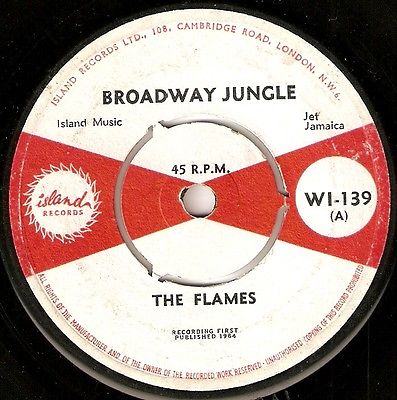
An inevitable fall-out arose over royalties, leading to Toots and his Maytals leaving the label to sign for arch rival Prince Buster. Things got confusing. Promoters, in the pocket of Studio One, ceased to bill the band as Toots and The Maytals. Prince Buster, in an attempt to starve Studio One of contract-fulfilling royalities, subcontracted the release to Island, who, unaware of the ongoing beef between Studio One and Prince Buster, released Toots’ Broadway Jungle under the moniker of brand-new group The Flames.
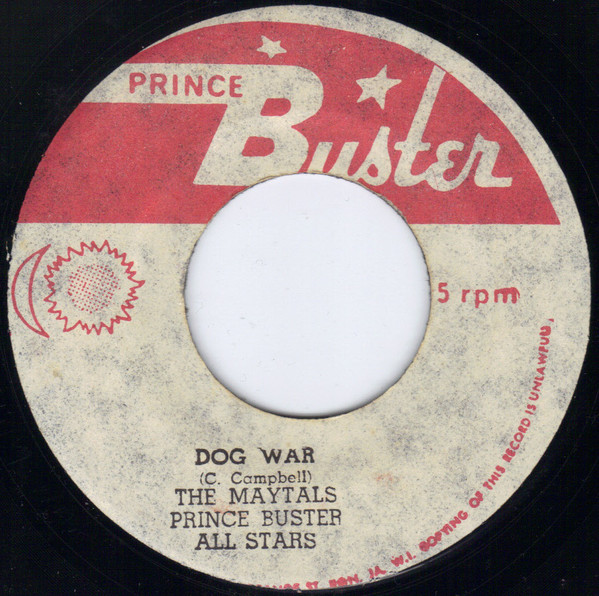
To stay one quickstep away from the lawyers and money-chasers, further re-releases saw the record released on Prince Buster’s own label, the name of the song changed to Dog War.
To further muddy the trail, the band name changed too. At one point, music fans could go to gigs and watch The Vikings play Jamaica Ska, confusingly aware that they were actually watching Toots and The Maytals play Broadway Jungle. D’you follow?!
Regardless of the name of the band or the title of the song, Toots’ (or The Vikings’. Or The Flames’) Broadway Jungle (or Dog War. Or Jamaica Ska) is nothing short of essential listening. It’s a tune about breaking free from the jungle – a metaphor perhaps for their Studio One contract – and hitting the bright lights of the big time, a prescient thought given that the Maytals’ most succesful years were still to come.
Political, danceable, joyful and as rhythmic as a steam train going full pelt, Broadway Jungle should be available on prescription. It’ll cure all ailments. Take as often as necessary and repeat.
The Euros start at the end of this week. That they’re occuring a year later than planned means nothing to my nation. My son is 14 and he’s ridiculously excited at the thought of seeing Scotland on the big stage for the first time. A former work colleague on Facebook last week was equally effervescent. “This’ll be the first time I’ve seen Scotland at a championship!” he frothed through heavily bearded face and a craft beer held by tattooed hands. Jeez! Has it really been that long?! ‘Young’ Chris must be 27 or so by now, and given that it’s 23 years since Scotland last crashed out of the World Cup Finals in France, then, yes, it really has been that long.
When I was my son’s age, Scotland was always at the World Cup. We had a glorious run of epic failures between ’74 and ’90 when we’d get an unlikely result against the big nations, get thumped by an unfancied smaller nation and miss out on progression because of goal difference. It was always the way.
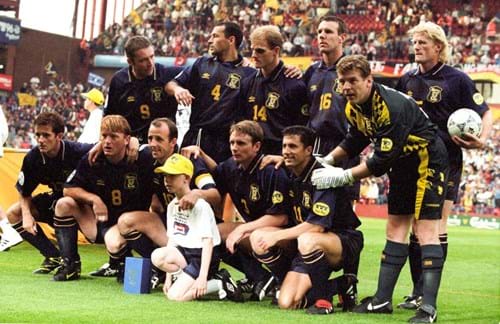
Back in 1996, the Euros were in England. Just as now, England and Scotland found themselves pitted against one another. That particular big match swung on the famous penalty miss. England, somehow one-nil up through Alan Shearer were being out-played, out-fought and out-thought by Craig Brown’s superstar-free team. With just over 10 minutes to go, the Scots laid siege yet again on David Seaman’s goal, and, played through on goal, Gordon Durie was chopped to the ground.
Penalty!
Captain Gary McAllister took responsibility and a nation watched aghast as his blasted effort was punched to safety by the swashbuckling Seaman, all VO5 swish and Magnum moustache (a save that crackpot spoon bender Uri Geller claimed to have orchestrated through channelled energy and mumbo jumbo.) To rub salt into the wounds, England then ran the length of Wembley and topped off a decent passage of football with a Gascoigne wonder goal. Bastards.
Going into the final game against Switzerland at Villa Park, Scotland was still in with a chance of progressing. We had to hope England could stick 4 past the Dutch – a team that had drawn 0-0 with Scotland – while we went about our job of beating the Swiss. Four points and a decent goal difference would see us through. It’s the hope that kills you, they say…
Two nights before the game I received a call from my brother’s pal.
“We’ve a spare ticket for Villa Park….”
“I’ll take it!”
“...d’you want it?”
“I’ll take it!!”
“…’cos the thing is, our bus is full, so you’d need to make your own way to Birmingham. We’ll meet you outside the ground when you get there. Big Alan…d’you know Big Alan? He’ll be wearing a massive tartan hat and a Jimmy wig. You won’t miss him.”
Ah shite. After phoning around, I found a space on a bus that was travelling at sunrise from Paisley. It was full of headcases and hardened away-day drinkers. “Drink up, pal, there ye go…” The journey was long, with one guy rat-a-tatting on a snare drum for hours on end and at least five piss stops before we’d crossed the border. Eventually the driver pulled into a layby on the outskirts of Birmingham. “Lads, the polis’ll be on the bus a mile from here. I’m stopping so’s ye can get rid o’ yer empties and anything else you might not want them to find when they get oan. So drink up and empty oot.”
A mile up the road, two police officers wearing those tall, rounded, English police helmets – an unexpected sight, though I’m not sure why that should have been a surprise – came on board. One affable, one looking for bother, a busload of hardened, steaming Scotsmen smiling glaikitly back. “Alroight lads. There’s no booze on board this boose is there?” Naw, ociffer, naw, there isnae, came a handful of muttered replies as bad cop rummaged without success in seat pockets and luggage compartments. “Enjoi thu match, lads!” said good cop before they turned and left. You could’ve punctured the paranoia with a kilt pin.
We arrive at Villa Park. The bus parks alongside 30 or so other supporters’ buses at the Aston Leisure Centre and we pile out, blinking into the afternoon sunshine. I’m looking for Big Alan in his big bunnet and Jimmy hat, but my new-found pals, having been here the week prior when we played the Netherlands, have other ideas. The Aston Working Men’s Club is just over the road. A tiny wee building with a bar. Somehow, I’m at the front of my new gang as we enter the door. A wee old guy looks us up and down. The state of us!
“Oim sorry, lads, this is a members’-only cloob….”
He looks beyond me and my new pals at the thirty or so supporters buses alighting on his doorstep.
“…but you can join today for a pound.”
The place was quickly rammed. The snare drum rattled. The singing got louder. The cheap pints went down quickly and often. Kick off fast approached. It dawned on me that I still had no ticket. I mean, I knew all along that I had no ticket, but I knew one was waiting for me. Either my brother’s pal had it, or Big Alan did. But I had no idea where to find Big Alan. I didn’t even know Big Alan. Mobile phone? This was 1996, mate. The bar started emptying as supporters drained their pints and turrned their attentions to the game. I wandered outside, stoating about amongst hordes of Jimmy hat-wearing Scotsmen, all merrily pissed up and heading to the game, in the unlkely hope that the mysterious Big Alan might make himself known to me. I happened upon a chipshop and found myself suddenly starving. I think I was too drunk to order, but I left with food.
“Gie’s a chip!” I hear outside, and my tea is swooped upon by half a dozen blootered Scotsmen. From out of the depths of tartan hell, up pops my brother’s pal, waving something in my face. “You’ll be wantin’ yer ticket, ya fud?” The magnetism of alcohol and its ability to bring disparate folk together is a strange, brilliant thing. Let’s go!
The game was magic. My overall abiding memory was not of McCoist’s winner – a curling, outside of the foot peach right into the top corner in front of us in the Holte End – or the hairs-on-the-neck-still sight of the crowd going nuts in that same Holte End on the TV replays as McCoist runs towards Craig Brown and the Scotland dugout (I saw it played again the other day and it places me right back into that moment in time), or Scott Booth’s half chance near the end of the second half, or the excited buzz around the stands as England unbelievably went the required 4 goals up against the Dutch, or the deflated inevitability when Seaman allowed a half-shot to squirm through his legs, giving the Dutch the goal they needed and putting Scotland out, on goal difference, again.
Nope, my overrall abiding memory is one of being absolutely ten pints-bursting but not wanting to go in case I missed anything. McCoist’s goal just before half time was a relief…but the end product following a mad sprint and hellish queue at the gents’ at half time was even greater.
England’s campaign that year was soundtracked by Three Lions, a jaunty comedy double act-fronted Britpop bash that reflected on England’s failure to win anything for years. Thirty years of hurt, pal? Best make that fifty-five and counting… It was nothing compared to the unofficial Scottish ‘song’ though.
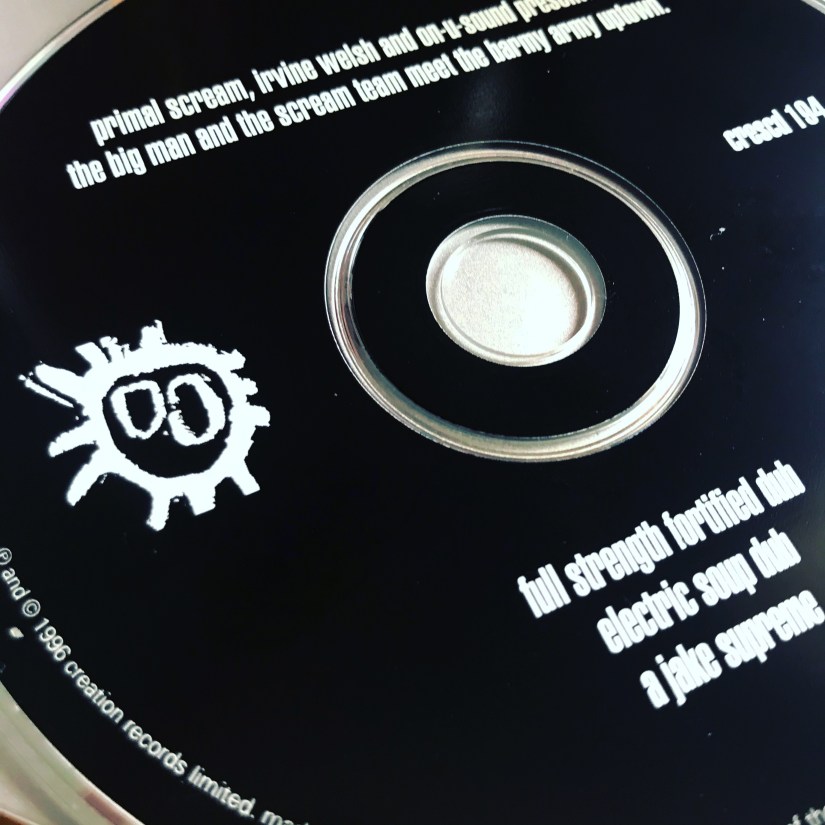
Swept up in the euphoria that comes when your country is playing at a tournament, Primal Scream joined forces with Leithite Irvine Welsh in a West Coast meets East Coast stand-off that was confrontational, self-deprecating and about as far removed from the ethos of a football song as a is humanly possible. The record may have come stickered with one of those Paul Cannell Screamadelica suns, but don’t let that fool you. The Big Man And The Scream Team Meet The Barmy Army Uptown was produced by Adrian Sherwood and foreshadowed the dubbed-out elecronica of Eko Dek.
Primal Scream, Irvine Welsh and On-U Sound Present – The Big Man And The Scream Team Meet The Barmy Army Uptown (Full Strength Fortified Dub)
Welsh is in full-on baiting mode, sticking the metaphorical size tens into Rangers fans, the metaphorical nut on the arrogance and entitlement of the English media and their football team and holding a mirror up to Scottish fans on tour.
I was sitting outside Wembley in ’79 Jock cunts in London, massive carry-out Talking to a guy in an ice cream van So drunk for weeks that we’d gone waaaay past the point of wanting tickets It’d be horrendous now if someone was to hand you a fucking ticket You’d have to leave all this bevvy outside the ground, by they polis dumpbins? No fucking way 10 minutes into the fucking game you’d be climbing up the fucking walls to get out
Behind him, the band play big slamming guitars and a repeating sample chants ‘who are ye‘, Denise Johnson wafting in and out of the electronic stew with soulful backing vocals. Three Lions it definitely ain’t.
Crossbar Challenge accepted
For what it’s worth, I think Steve Clarke will mastermind Scotland’s first-ever qualification out of the group stages. Beyond that is anyone’s guess… we have a dream, and all that. It’s taken time, but he’s fostered that hard-to-beat, no-team-is-invincible mindset that saw him take my team Kilmarnock to the lofty heights of 3rd in the league and European football. For one week we were top of the actual league too…when the news filtered across the terracing that Cetic had dropped points to Livingston, the crowd, drunk on what might be and Steve Clarke-fuelled self-belief broke into a spontaneous and lively rendition of ‘we’re gonnae win the league‘. Quite ridiculuous…and quite thrilling.
There will be, sadly, hopefully, the chance to replicate that chant at the end of this season. Killie, in a Clarke-free freefall since his departure to the national team, found themselves dumped out of the top league a couple of weeks ago. The less said about that, the better, but with luck we’ll be chanting that ridiculous chant again come the middle of May next year. Killie’s loss was clearly Scotland’s gain. I love that man and I’m sure, once we’ve gatecrashed that other exclusive members’-only club by reaching the knock-out stages, I’ll love him even more in the coming weeks.
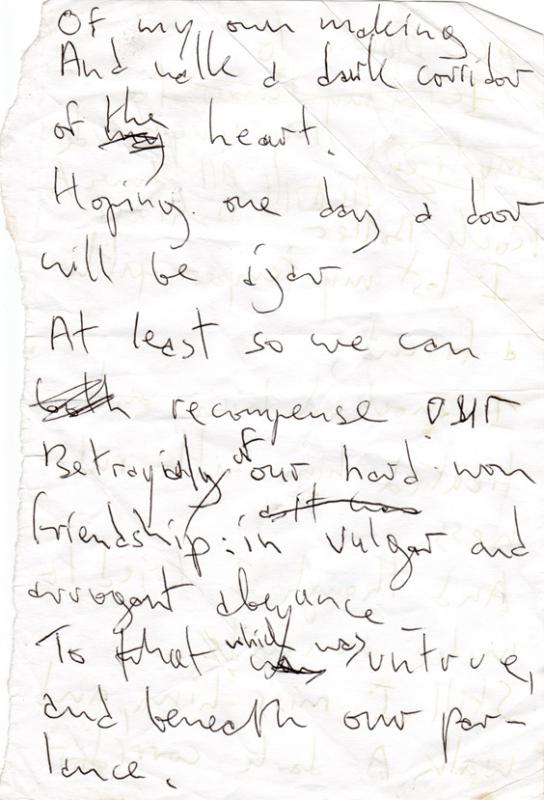
Dr Bucks’ Letter is late-ish era Fall at their best. Taken from The Unutterable, it’s an incessant, kerb-crawling jackbooted stomp of a track; claustrophobic, indulgent and relentless, the sound of The Fall doing half-speed dub techno. The disciplined beat and fuzzed-up riff underpin a crackle of electro static and a cackle of spoken word, random keyboard outbursts that sound like guard dogs in heat and a clanging Holger Czukay bassline that fights for ear space in-between a returning signature riff. It’s not quite a kitchen sink production, but it’s getting there.
The Fall – Dr Bucks’ Letter
The cherry on the top is Mark E Smith’s spoken word vocal, the lyric referencing an unfortunate fall-out with a friend – ‘of my own making, I walk a dark corridor of my heart, hoping one day a door will be ajar at least so we can recompense our hard-won friendship.’
He may have been viewed as a grizzly, alcohol-soaked hard-heart, but Smith could write flowing sentimentality like no other, even if, perhaps to keep his image somewhat intact, he delivers it in a voice that borders on menacing. There’s the complexity of MES right there.
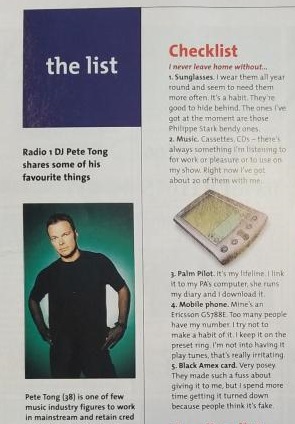
As the track reaches it’s conclusion, Smith bizarrely – yet thrillingly – reads aloud an abridged version of a magazine interview with superstar DJ Pete Tong, cackling to himself/at Tong’s superficial lifestyle and the vacuousness of it all.
There aren’t many folk who’d have the nerve to lift text from such disparate places – a Virgin Rail customer magazine, as it goes, but there y’go – proof, if any were needed, that Mark E Smith wasn’t yer average writer.
Dr Bucks’ Letter is a Fall track that works for all sorts of reasons. The references in the magazine article to Palm Pilots and CDs and cassettes (no vinyl, Pete?) has the track firmly dated as 2000, a portent of a new millennium with another new Fall line-up in the making and at least a further 83 albums before the fall of The Fall with MES’s untimely death in 2018.
It’s worn far better than some of its lyrical influences, has Dr Bucks’ Letter. Indeed, it never sounds anything other than ‘now’, a decent snapshot of a band who’d perhaps lost their way a wee bit at the time.
There was a time before the first lockdown when I was approaching something that I might have considered (cough) peak fitness. The waist line was slowly reducing in inverse proportion to the kms clocked on the treadmill in the gym I’d started frequenting. Thanks to the ten minutes here and there on the rowing machine with the temperamental display and sqeaky seat, my shirt buttons no longer gaped and strained when I sat down. Even the odd punishing 3 minutes on the cross-trainer had, it seemed, its benefits. And I felt better.
By the second lockdown though, I was well on my way from 5K to couch. Before January was out, I’d smashed it. I’d tried running in the street. It was too cold, too wet, I looked daft, it made me too wheezy, whatever. Most of the time, I was gubbed and I could still see the roof of my house – and this was when it was pitch black at four in the afternoon. I went from hero to zero in one and a half lockdowns, a couch potato happily binging on McCoy’s flame-grilled steak crisps and marathon telly sessions. And it felt just as good, to be honest. Better even, if I’m being really honest.
Last week I had to return to my place of work, a roof under which I hadn’t been since the third week in December. The government’s advice of ‘if you can work from home, you should work from home’ was strictly adhered to and that work was duly done; more than normal some days, less than normal on others, just about balancing out come a Friday afternoon. But now, the frontline called. I popped the work trousers on last Monday and, oof! It was hard to believe that I’d ever managed to get the belt to the well-worn leather at the fourth notch at all. Here I was breathing in deeply and yanking it all the way to the second pathetic notch, the loose little bit of belt too short to tuck properly into the buckle. Nobody’ll notice, I figured, as the overhang obscures most of the buckle anyway. The state of me.
I hit the gym again a couple of days ago. And then again yesterday. I wasn’t quite queuing up to get in, but I did have the run of the place to myself, which was just as well. I swear my old friend the treadmill laughed at me as I eyed it up. Then it groaned as I stepped onto it. Who’s laughing now, eh, treadmill? I took it easy and slowly. After a few minutes I cranked it up to a speedy snail’s pace and then, with an extreme burst of lethargy and my aimed-for target somehow creeping up within reach, I managed to clock an impressive three kilometres. I ran three and a half yesterday, alongside 30 minutes of endurance work on the exercise bike, riding the Toblerone-shaped hills of the Swiss Alps whilst staring hollow-eyed at the playing fields of north Ayrshire.
The old trusty iPod soundtracked these sessions of pain, shuffling its way through a library of music it probably thought it would never play again. This long-forgotten rattlin’, reverberatin’ riot of dub reggae really hit the spot during the last ascent of those murderous fake alps.
King Tubby – King Tubby Dub
A whacked-out instrumental take on Rare Earth’s Motown standard Get Ready, King Tubby Dub is just about the right rhythm for pedalling up those imaginary mountainsides; hi-hats splashing in time to the wobbly legs pumping away at the pedals, horns blasting and forth as back teeth are gritted in pain, the ricocheting percussion bringing on ever-pooling beads of grotesque sweat.
The irony of a King Tubby track playing as I sweated out a year’s worth of crisps, alcohol and lockdown luxury was not lost. King Tubby? ‘king Tubby indeed.
Two sessions in and that belt is still only at the second notch though. Instant results are not forthcoming.
If I crane my neck out of the window over my right shoulder where I am currently writing, I can just about see the windmills at Whitelee Wind Farm, a massive 215-turbine development that is capable of powering over a third of a million homes and is very likely the reason these words make it beyond my fingertips and out into the great beyond. The wind farm is situated on Eaglesham Moor, a windswept, sparse and barren moorland that lies on the fringes of East Ayrshire and East Renfrewshire, just to the south of Glasgow. Before the motorway was extended close-by, it was often the route used by commuters who worked in East Kilbride and Motherwell. Using it in winter time was usually fraught with danger; single-lanes, sudden snowfalls, low-lying clouds of darkness. It was an imposing, unwelcoming part of the world.
Almost 80 years ago (May 1941), Rudolph Hess, Hitler’s right hand man and orchestrator of much of the Nazis’ unforgiveable crimes against humanity, crashed his plane into the ground on Eaglesham Moor. Quite what he was doing flying solo over Scotland has never been satisfactorily explained, but common consensus would suggest that he was flying to meet the Duke of Hamilton – a well-connected figure – in an attempt to call an end to the Second World War. When his plane began running low on fuel, he began to bail out first his ammunition and then himself by parachuting before the inevitable happened. A bang was heard as the explosives ignited, closely followed by the stuttering sound of his plane’s engine as it crashed nose-first into the peaty Scottish soil.
The locals of Eaglesham village, realising it was a German Messerschmitt that had come down, raced to get a closer look. First on-site was a pitchfork-wielding farmer, and it was he who Hess surrendered to. He was taken to the Home Guard in the nearby town of Busby, but it wouldn’t be until the following day, when military personnel began descending on the locality, that the pilot’s identity became apparent. Within a week, Hess was imprisoned in the Tower of London. He was given the Prisoner of War number 31G-350125.
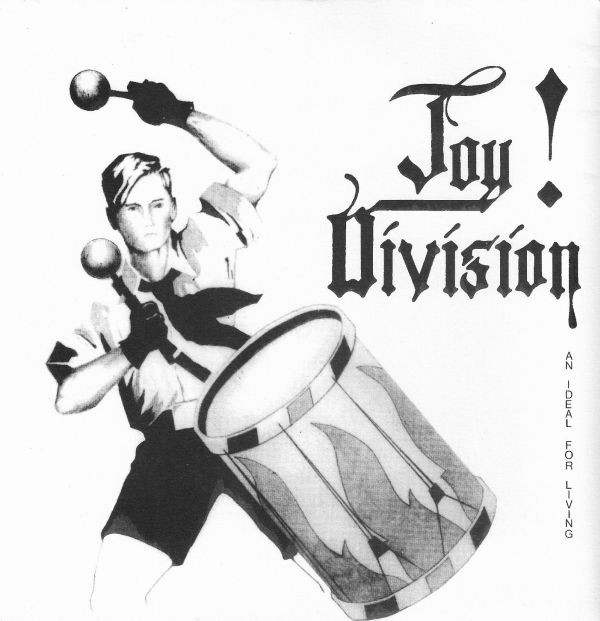
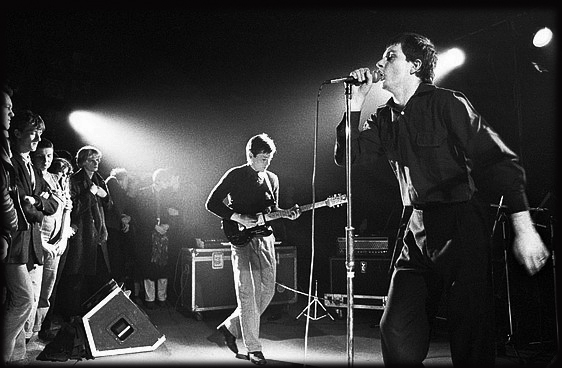
As you of course know, Joy Division‘s debut release, the An Ideal For Living EP featured dubious Nazi imagery. Alongside the band’s iffy name written in Germanic font, the sleeve shows a Hitler Youth drummer boy. Call it misguided, call it punk, but when the time came for the EP to be rereleased, it’s interesting to note that the drummer had been replaced by an arty shot of some scaffolding and the band’s name – still contentious of course – was printed in a much more agreeable font. The accusations of Nazi sympathy didn’t end though.
The opening track Warsaw – the band’s original name, after the city in Poland that the Germans laid siege on at the start of the war – began with a punkish shout of numbers, but not the enthusiastic and standard 1, 2, 3, 4! that countless bands have used to herald their giddy arrival. Warsaw begins with an enthusiastic “3-5-0-1-2-5-Go!“, not quite the number of the beast, but not far from it. Joy Division laid out their statement of intent by counting off with Rudolph Hess’s Prisoner of War number. And for good measure, they repeated the 31G prefix over and over in the chorus.
Joy Division – Warsaw
Now, the mid ’70s was a time of Warlord and Victor comics, of Commando books and Sven Hassel novels, of best man’s fall in the playground. It was an era when you could ask your grandparents what they had done in the war and they still had the grey matter and compos mentis to tell you. Many cities bore the scars of bombed-out, shell-shocked destruction. Kids played on the rubble where former factories stood. For many in ’70s UK, the memories of the war were clearer and easier to recall than what they’d eaten for yesterday’s breakfast.
That Joy Division had something of an obsession with WWII was not that unusual. In fact, it was pretty normal. To put it into perspective, less time had elapsed between the Second World War ending and Joy Division releasing An Ideal For Living than the time between New Order’s Ceremony and their return-to-form of sorts album, Music Complete. Just let that sink in.
The track that brought Joy Divison to the world is an angry blast of prime punk; insistent, exciting and real, with a great wheezing, descending riff between the choruses and the verses. Even this early on, Stephen Morris’s drums have a slight tang of electronic treatment, rattling and reverberating between Ian Curtis’s punkish shout and Peter Hook’s solid slab of bass, as far removed from his signature sound as you could possibly get.
By all accounts, Joy Division were quite the thrill in the live setting, and, as self-producers, they captured just that on Warsaw and the rest of the EP. It’s essential listening and still thrilling even after all these years. You knew that already though.
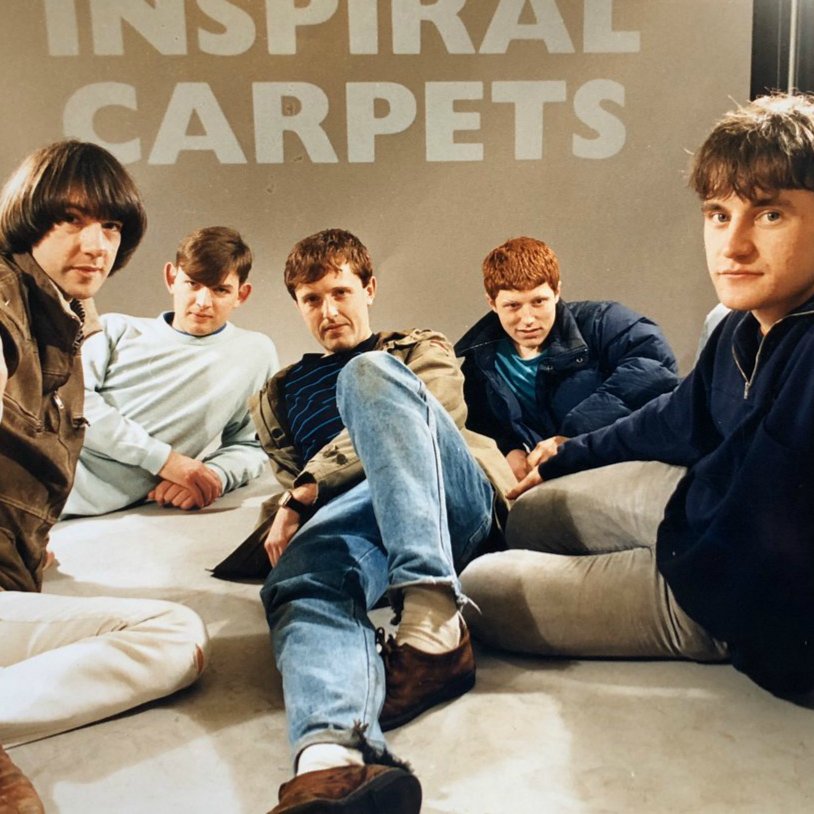
There’s something about those early Inspiral Carpets records that’s really great. And by early I’m talking about the pre-Tom Hingley, pre-chart, pre-baggy (eugh) records; tunes formed and fermented in garages, coated in a dusty Nuggets-inspired layer of authenticity and woven together through sheer punkish energy over anything resembling finesse.
Well, yes, Clint Boon was undeniably a whizz on the Farfisa and, given that he was at least 42 years older than the other Inspirals, it’s perfectly logical reasoning that he should be skilled on his instrument of choice whilst the others faffed around with open chords and one-finger bass lines played through the same sort of Peavey amps that my very own garage band would use to blast our own hamfisted first attempts at songwriting out into the neighbourhood, but what those early Inspirals perhaps lacked in subtlety led them to create a sound that was unlike anything I’d heard. I know now about Nuggets and what have ye, but back in 1988, the Inspiral Carpets were something of a revelation. To these ears, they were dynamite.
Lazy naysayers would often point to The Doors as the obvious point of reference. For me, though, Inspiral Carpets had much more in common with Teardrop Explodes. It’s there in the second-hand ’60s references fed through an anything-goes indie attitude, the organs and rat-a-tat drumming…the over-arching sense of melancholy that’s created in their maelstrom of noise.
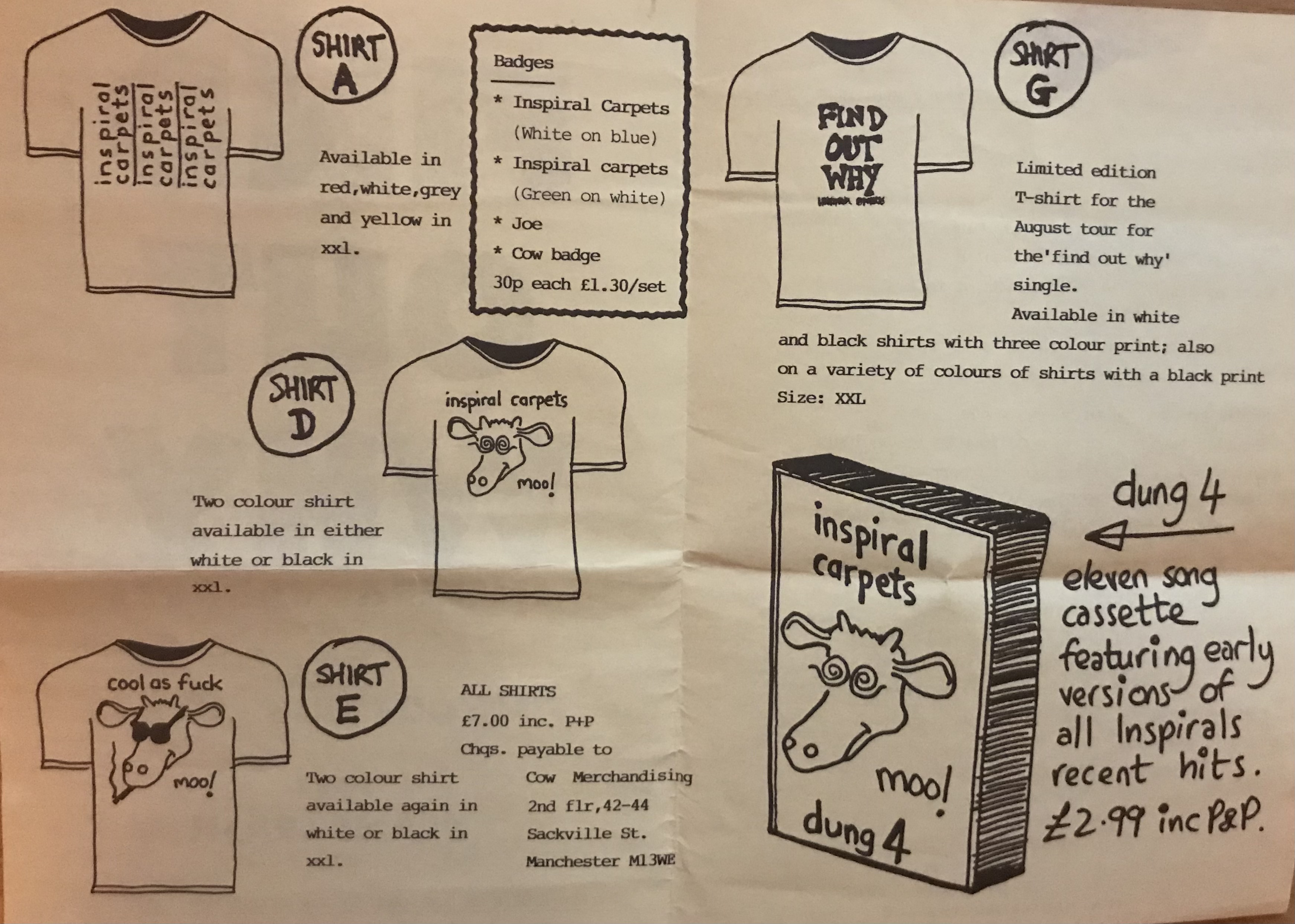
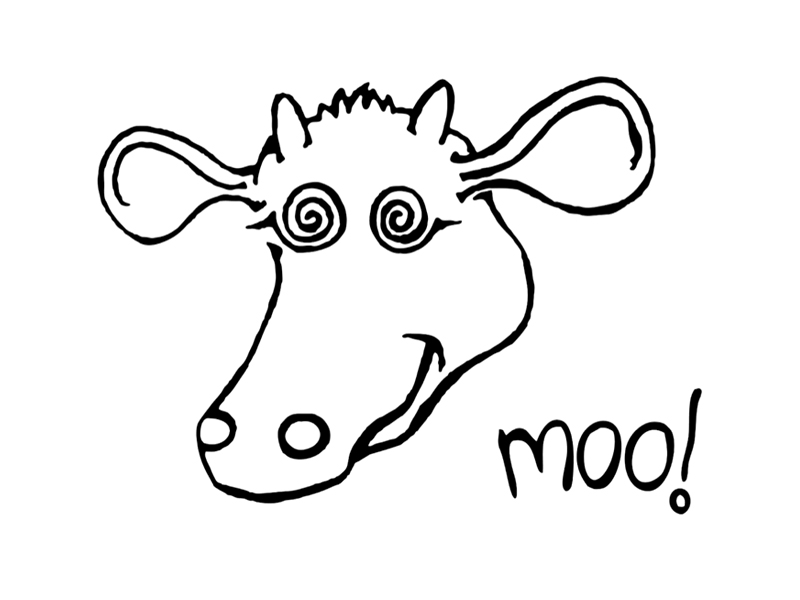
I saw them live a handful of times in those pre-Hingley days and they were always worth catching. And the early records always came with wee folded flyers -‘Moos-letters‘ they were eventually called, with a pudding-bowled nod of the head to the trippin’ cow that would become their logo and record label. You could send away for tapes and t-shirts, proper cottage industry stuff, a product of the fanzine scene of the mid ’80s and a precursor to today’s Bandcamp era. Handily, each Moos-letter charted the band’s rise to success, from Glasgow Tech to Strathclyde University to Barrowlands to the SECC, that Dung 4 cassette steadily rising in price to a giddy £4.49 before being finally unavailable by the time of Moos-letter 5.
Like many of you reading this, I sat with a tape permanently ready to record anything of interest on the John Peel show. Peel loved the Inspiral Carpets. Between 1988 and ’91, they recorded four sessions for his show – that’s the same number as The Smiths in about half the time, although only a mere 20 sessions short of the total set by his beloved Fall.
Not long after seeing Inspiral Carpets open for the Wedding Present, they did their first Peel Session (August ’88) and I sat itchy-fingered by the Grundig music centre, expertly de-pressing the pause button in the exact moment between each track fading and Peel’s warm voice of encouragement announcing the name of the track just played.
“That’s Inspiral Carpets in session tonight with ‘So Far’. Mighty fine stuff indeed. And we’ll be hearing more from them later on. Which I’m rather looking forward to.” I wish, in hindsight, that I’d thought to leave the tape running and capture more of his iconic voice.
Inspiral Carpets – Greek Wedding Song (Trainsurfing EP version)
One particular track on that session stood out. With a title that screamed ‘working title’, Greek Wedding Song is the perfect microcosm of that early Inspirals’ sound; shouty vocals atop that urgent, Teardrop Explodes-ish bassline and fizzing guitars buried deep in a swirl of ’60s-inspired swelling keys that fall somewhere between wasp-in-a-jar stylophone and noodling Ray Manzarek classicism.
In just a minute and a half, the band lays out their punkishly amateur stall, only for the tune to come waltzing back in after the false ending on a ne-ver a – never a frown Golden Brown coda. ‘It’s a bit short for a Peel Session, lads‘, Clint Boon might’ve said beforehand. ‘Let’s stretch it out by going full-on Stranglers for another minute or so.’ Influences worn proudly on sleeve, it’s a cracker.
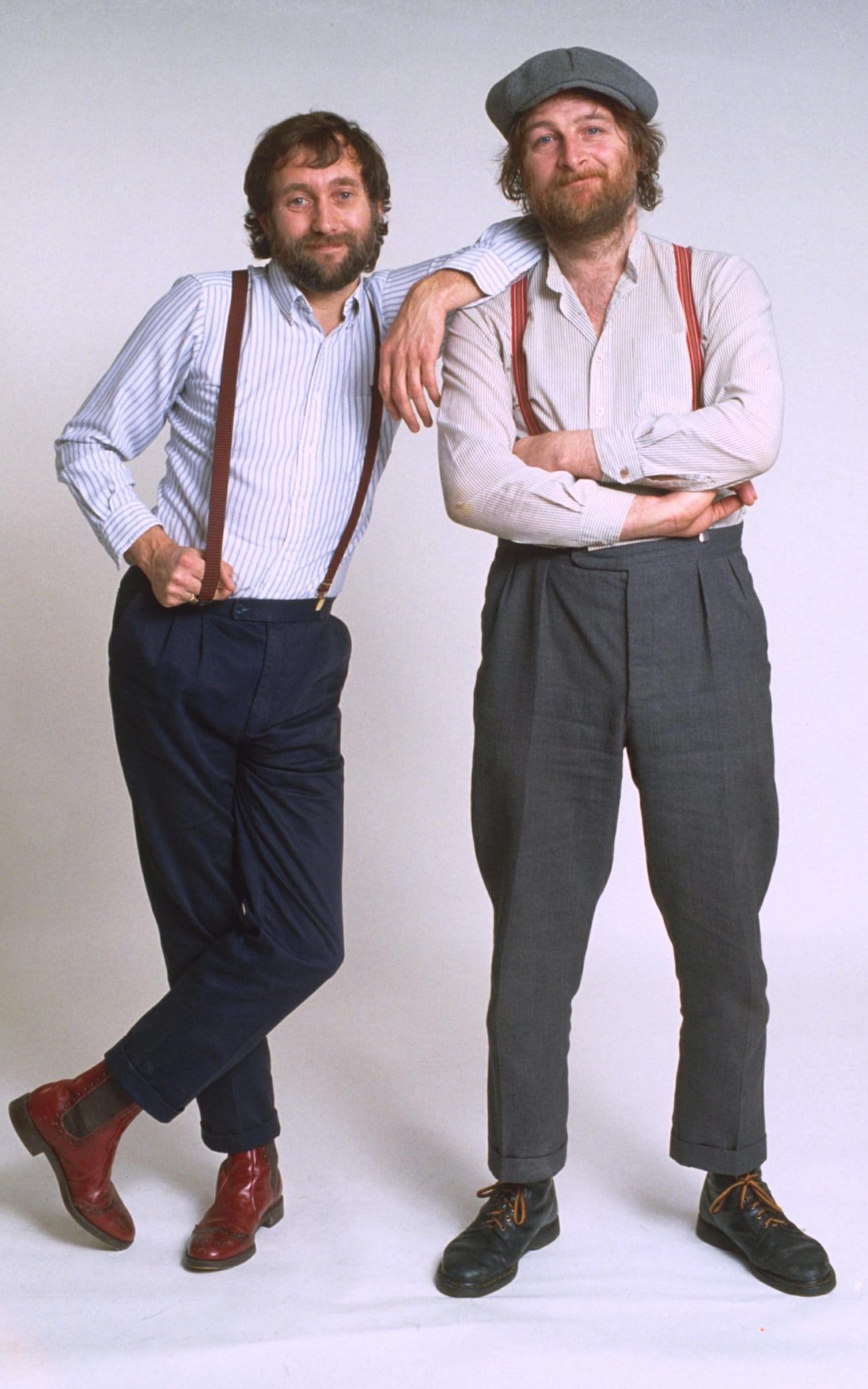
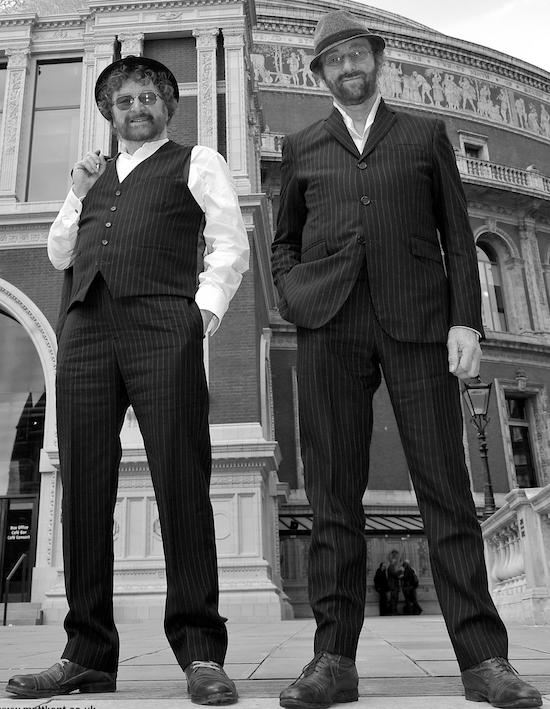
They were a joke band perhaps. Or, to be kinder, a bit of a novelty. Up here, they definitely were. Well out of step with the musical times, you were never far away from a jauntily-angled pork pie hat framing a fuzzy face, and a piano tie worn with the cut of white jacket that Gregory might’ve worn to impress his Girl. On first-name terms with both the bubble perm and bubble and squeak, Chas ‘n Dave were purveyors of raucous Knees Up Muvver Braahn, pianer-driven barrelhouse rock ‘n roll, all walking basslines and rapid-fire, machine gunning Cockernee couplets that tripped over themselves in a race to outdo one another on the way to the finish line, Top of the Pops novelty fodder that provided the jokey sandwich filling between Dog Eat Dog and Girls On Film.
And yet, and yet…
They also produced There Ain’t No Pleasin’ You.
It’s a stone-cold classic of any era. But I suspect you knew that already.
Chas ‘n Dave – Ain’t No Pleasin’ You
Those strings! That melancholy! It wallows in pathos and regret until, by the final verse, the poor guy who’s the subject of the song has decided to leave his insufferable partner for good. Written solely by Chas Hodges (piano, aviator shades, hair and facial sculpting by Jeff Lynn), There Ain’t No Pleasin’ You came fully formed after a conversation with his brother about his wife giving him grief for hanging a pair of curtains the wrong way.
Hodges rewrote the story, added a Just Like Starting Over by way of Fats Domino groove and a drum intro that has at least one too many beats – count them – it’s just not quite right! – and quickly went about writing a song that, had it come from the pen of McCartney, or indeed Lennon – listen to the production on that bridge, it’s pure John – would be held in far higher regard than it presently is.
Well I built my life around you, did what I thought was right But you never cared about me, now I’ve seen the light Oh darlin’, there ain’t no pleasing you
You seem to think that everything I ever did was wrong I should’ve known it all along Oh darlin’, there ain’t no pleasing you
By the time you get to the first bridge you find yourself really rootin’ for the guy, a neat mirroring of subject matter where it’s usually the woman who’s had enough and is walking out on the man.
You only had to say the word, and you knew I’d do it You had me where you wanted me, but you went and blew it
Now everything I ever done was only done for you But now you can go and do just what you wanna do I’m telling you
That double vocalled harmony on the ‘do it/blew it‘ ryhme and then the ‘but now you!‘ line – double tracked with his best pal for moral support – is stupendous! But it’s that ‘everything I’ve ever done‘ line that does it, isn’t it? Proper soul-baring stuff. It’s no coincidence that Bryan Adams would co-opt its sentiment for his monster smash hit a decade later, but whereas Adams was all kitchen sink bluster and bombast, Chas ‘n Dave were kitchen sink drama, angry and antagonistic. Melodrama in a minor key, they meant it, maaan.
By the time Chas has had the audacity to rhyme bluffin‘ with nuffin‘ it dawns on you just how great a song this really is. Chas ‘n Dave wrote dozens of cheerful pub song singalongs that I couldn’t care less about ever hearing again, but There Ain’t No Pleasin’ You is something of a beauty in amongst all the daft stuff they are usually associated with. Structurally, it plays out like a proper classic, with a repeating bridge, a signature string sweep and a great vocal. It can happily revolve on repeat for an entire evening and I’ll never tire.
There’s a really great session from Abbey Road, here…
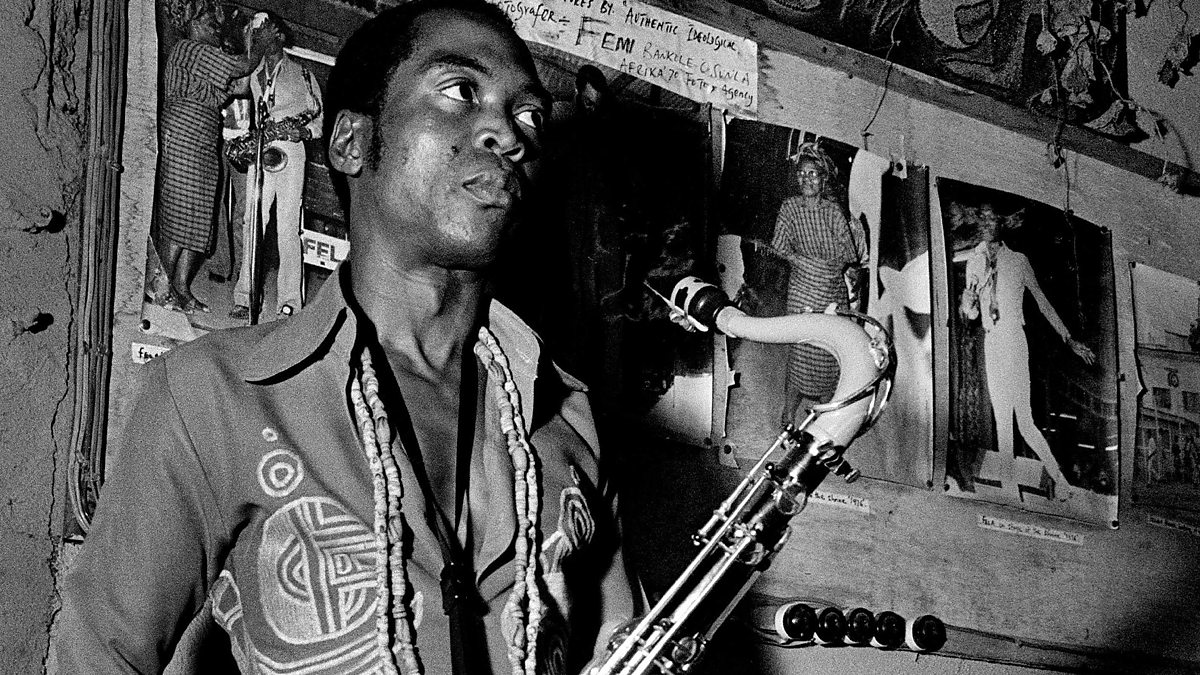
Fela Kuti was, to borrow from That Petrol Emotion, an agitator, an educator, an organiser. A music and sociopolitical trailblazer, he was equal parts multi-instrumentalist and political activist. The founder of Afrobeat, he combined on-the-one funk with rippling, rattling one chord jazz and more often than not included a lyric that savaged the powers in charge; look for 1977’s Sorrow, Tears and Blood, which calls out police brutality as the perfect example.
1975’s Expensive Shit is the story of being framed, set to a groove that falls somewhere between the freeflowing Blue Note jazz of Gil Evans and James Brown’s mid 70s excursions in funk. Wandering, electric piano fights for earspace with chattering, polyrhythmic drums and clickety-clacking off-beat percussion. Underpinned by body popping bass and fanfaring trumpets, Fela’s saxophone noodles across the top with just as much regard for boundaries as its player’s attitude to authority.
Fela Kuti – Expensive Shit
Just as you begin to think you’re in the middle of a tight-but-loose instrumental – those muted trumpets really know how to elongate their presence – along comes Fela and his backing singers, singing a song, half-Nigerian, half-English, of being set up by the police.
Finding himself in posssesion of a joint that had been planted on him by corrupt police officers, Kuti swallowed it. The police took him into custody, knowing that nature’s way would eventually incriminate their innocent target. Always one step ahead of the authorities though, Fela managed to swap stool samples with a sympathetic inmate and was released without charge.
On 1976’s Zombie, Kuti waged a war on the militaristic Nigerian government of the era. He likened the military to zombies, dead-eyed government stooges, incessantly carrying out sinister orders from above.
Fela Kuti – Zombie
Propelled by a fluid and skittering Tony Allen drum groove and the assembled brass of Africa 70, Kuti’s band, Zombie begins on a fade-in, suggesting the band have been working up the groove for a quite some time before we get to hear it. It’s not until it reaches Kaa the snake levels of hypnotism that Kuti’s call-and-response vocals come in.
Attention! (Zombie!) Double up! (Zombie!) Fall In! (Zombie!) Fall out! (Zombie!) Fall down! (Zombie!) Get ready! (Zombie!)
Nigerians loved it, to the point where they’d mimick the soldiers who lined the streets. “Zombies!” they’d shout, arms straight out ahead and limp at the wrist in mocking pose. So incensed was the government at Kuti, they systematically attacked and destroyed Kalakuta Republic, the studio-based commune he’d set up with his family and band. On the government’s say-so, 1000 soldiers raided the community. They beat Kuti to within an inch of his life, raped the women and threw Kuti’s elderly mother from a first floor window. She would die of her injuries.
As an inflammatory reaction to the charge that he was kidnapping women and keeping them hostage against their will, on the first anniversary of the Kalakuta violence he simultaneously married 27 of the women in his community; dancers, vocalists, musicians. Not long after, he was banned from Ghana after a riot broke out during Zombie. Later that same year at the Berlin Jazz Festival, his band would quit following rumours that he planned to use their fee to fund his presidential campaign. A colourful figure to say the least.
Fela Kuti fought a long fight with authority, calling out injustice, corruption, brutality and downright wrongness at every possible turm. He continued to be a real thorn in the side of those in charge for another 20 years, before his death in 1997. His back catalogue and life story is worth some of your time.
In A Lonely Place first appeared on the b-side of New Order‘s debut release, Ceremony.
New Order – In A Lonely Place
Unlike its flip side (a great introduction to a brand new band, but essentially (perhaps) Joy Divison’s Transmission given a fresh coat of paint), In A Lonely Place is a headswim of swirling, Hook-piloted bass and womb-like ambient atmospherics.
Continuing where he left off with Joy Division, Stephen Morris plays all manner of unexpected, inventive drum patterns; regimented and military-like in some places, free form and skittering in others, but always with a tectonic, glacial pace that might, when I stop to think about it, make him the lead instrument on the track.
Icy laters of synth coat the whole six and a half minutes in a sheen of glistening permafrost, with the warmth of a blown-in melodica and Morris’s cymbal splashes adding the requisite colour.
Turning the filters up from stark monochrome to an off-white sepia, a still-reluctant Sumner on vocals goes full-on Curtis, downbeat, downtrodden, down down down, grinding the gears of this New Order to a juddering, rumbling, fading halt. It’s bleak, it’s spacey, it’s elegant.
Caressing the marble and stone Love that was special for one The waste and the fever and hate How I wish you were here with me now
Written by Ian Curtis and rehearsed by Joy Division, In A Lonely Place could well be Curtis’s eulogy to himself. In reality though, the song takes its title and subject matter from an old noirish Humphrey Bogart movie. The plot has all the ingredients of a classic pot-boiler; a down-on-his-luck writer, a murdered actress, a hard-boiled, finger-pointing cop, and presciently, as the movie poster says, a surprise finish.
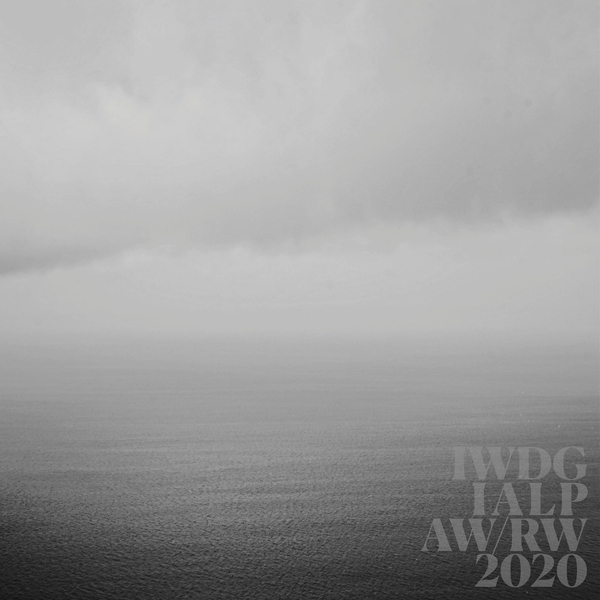
It’s a year since the passing of Andrew Weatherall, and to mark the anniversary, his brother Ian has joined with Duncan Gray under the moniker IWDG to record an elegiac tribute to him. They’ve taken New Order’s In A Lonely Place and updated it for the clued-in and open-minded amongst us.
More uptempo and lighter on its feet that the original, it is nonetheless respectful of the source. The melodica is still there, dubby and ethereal. The vocal, when it chooses to appear, is synth-like and robotic, its ‘how I wish you were here with me now‘ refrain taking on new meaning. And New Order’s imperial engine room, the star of the show on the original version, has been shunted sidewards, replaced and replicated by a couple of anonymous chrome and silver machines. It’s a really great version…
(It’s four really great versions, in reality.) Spread across the other three tracks you’ll find mixes by Weatherall associates David Holmes, Keith Tenniswood and the Hardway Bros. From the brief snippet you’ll find online, that Tenniswood one, all 17 downtempo minutes of it, sounds incredible. The EP is both reverential yet forward-thinking. I think you’d like it.
If Weatherall is your kinda thang, you might want to head over to Bagging Area where you’ll find Adam and his always-authoritative take on all things Andrew.
1966. The decade was in full swing. Skirts grew shorter as hair grew longer. Some team or other won the World Cup. Bands were beginning to realise that there might be a bit of longevity in this fleeting thing called the music business after all. The album was at the point of becoming more important than the single. At the end of the summer The Beatles put out Revolver and played their last live show in front of a paying audience, turning their attentions instead to using studio technology to realise their artistic vision.
The Stones were just warming up though. Barely four years old, they were on a phenomenal run of records. In 1966 alone, they released their fourth album Aftermath and a run of half a dozen singles/EPs, all unique, all still instantly singable 55 years on; As Tears Go By, 19th Nervous Breakdown, Paint It, Black, Mother’s Little Helper, Lady Jane and, the cream of them all, September’s Have You Seen Your Mother, Baby, Standing In The Shadow?
The Rolling Stones – Have You Seen Your Mother, Baby, Standing In The Shadow?
Riding in on a snarling lip curl of droning, wah-wahd Brian guitar, Have You Seen Your Mother, Baby, Standing In The Shadow? rattles along for two and a half frantic minutes, a downhill-without-the-brakes-on clash of badly recorded trumpets, thumping, divebombing bass and hard-to-hear percussion, welded for posterity to a rhythmic piano riff, all left hand and boogie woogie blues, and topped-off by one of Jagger’s more throat-ripping vocals, slightly too high a key perhaps, but one that all adds to the urgency.
Have You Seen Your Mother, Baby, Standing In The Shadow? was indeed an urgent record. Needing a new tune to premier on the Ed Sullivan Show, the track was commited to tape almost as soon as Jagger had jabbed the last full stop on his lyric sheet. If you could pick apart its constituent pieces you might be able to spot Bo Diddley maracas and handclaps, Keith’s clipped, staccato guitars fighting for earspace with Brian’s fuzzed-out proto-punk riffage, some rattling, brain-jangling electrics in the breakdown and a brass section that pre-dates the loose ‘n louche Exile On Main Street by a good few years.
There’s an awful lot going on in its electric soup, not least a nod and a wink to the American underground, a Nuggets for the mainstream if you may. Keith Richards hated the final mix. It was muddy, he said. The trumpets sounded raspy and far-off. The track’s original groovy rhythm was buried underneath a blanket of white noise and peripheral faff and yet…and yet…Have You Seen Your Mother, Baby, Standing In The Shadow? may well be the best Stones’ track of ’em all, Keith.
Take note of those Mick ‘n Keith call ‘n response vocals. Richards especially is having a ball. “I’m glad I opened your eye-eye-eye-eyes!” he goes, rhyming eyes with ice and time and fine on every other line, filling the spaces where the band pause for the briefest of respi-ay-ay-ites.
Charlie, always the backbone of the Stones, almost always a half beat behind the others but not on this record, makes the most of these mini-breaks, pausing for a nanosecond before driving the band home to its wonderful, widescreen, barre chorded end. You can practically see the impish Jones smirking from underneath that beautiful outgrown bowl cut, the devil making work for his less-than-idle hands as it plays out in reverbed slo-mo.
The next year would bring Let’s Spend The Night Together, Between The Buttons, drug busts, Ruby Tuesday, court cases, We Love You, Who Breaks A Butterfly On A Wheel?, Their Satanic Majesties Request…. It was quite the time to be a Rolling Stone.
It’s worth highlighting too the record’s b-side, a psychedelic barrelhouse blues number titled Who’s Driving Your Plane?
The Rolling Stones – Who’s Driving Your Plane?
In it’s sloppy, midpaced booming fug, all emphasised vocals and eee-long-gated vowels, I can never hear this without imagining a hunched-up Shaun Ryder singing it. It’s all rather great, an underplayed hidden gem(Stone).


















 Plain Or Pan