Cover Versions, demo, Stinky

Weller Weller Weller oops

elo 72

10538 Overture was the debut single by the Electric Light Orchestra. It was written by Jeff Lynne and produced by Roy Wood when he was still in The Move, pretentiously given the ‘Overture‘ title and prompted the split of the band. Released in 1972, it was the love child of I Am The Walrus and The Who’s more bombastic moments; a Heinz 57 variety pack of swooshing synths, see-sawing cellos, minor key breakdowns, ELO’s trademark multi-tracked vocals….and a terrifically cod-psychedelic, eastern-tinged descending guitar riff.

10538 Overture

10538 Overture would eventually appear on ELO’s self -titled debut LP, with it’s big, ambitious sound a portent of things to come. In America, the same album was released as ‘No Answer‘, after the man from the US record company phoned the band to get the name of the LP. No one picked up, the under-assistant west coast promo man wrote ‘no answer‘ on his paper, left his desk, and someone picked up his note and ran off to the printers where the sleeve was being assembled. True story, that.

Perhaps drawn in by the backwards Beatlish bits and the windmilling Townshend chords and Moonisms on the drums as 10538 Overture drags itself to a bloated end, Paul Weller‘s magpie-like antennae pricked up. “That descending guitar riff,” he thought. “I’m having that.”…..

Weller demo:
weller 95A shame-faced Paul hides his head

Welding it on to a mid-life crisis of a lyric, Weller gave birth to The Changingman, lead single from the epoch-defining Stanley Road LP. Named after a picture his son had drawn – “Who’s that?” “It’s the changingman, daddy,” the single reached number 7 in the charts, at the time a career best for the solo Paul.

This is where it gets a wee bit muddled. On the LP, the track is credited solely to Weller, but if you consult that last bastion of credibility Wikipedia, you’ll see that Weller shares the writing credits with 3 others – Brendan Lynch, his producer of choice at the time who added the ambient textures and wonky noises (his remixes from this time are terrific) that lift the track above bog standard r’nb fare, a certain R. Wood who we now know all about, and, most interestingly of all, forgotten cult hero and Syd Barrett for the Brit-Pop genearation, Lee Mavers.

The Changingman LP/Single version:

Quite what Mavers’ involvement in the writing of the song was is unclear (if any), although around that time he was in a bit of a sorry state through drugs. It’s been suggested that Paul Weller took one of Lee’s unreleased tunes and built Changingman on top of it. Some of the lyrics (‘the more I see the more I know, the more I know the less I understand‘) are kinda La’s-ish as well. Weller, on Go! Discs, as was Mavers at the time (or was he still, in 1995?), also had Lee open a few shows for him. Maybe he was just trying to help him out, a support slot here, a writing credit there,  but as you’ll know already, Mavers is pretty comfortably well-off thanks to the regular royalties he receives for There She Goes (between £5000-£10000 a month, depending on where you read). Maybe Bo Diddley nut Lee contributed the percussive backbeat that gives the track it’s mid 60s swagger towards the end. Who knows? I need to investigate further…

The Changingman Radio1 Evening Session 8th May, 1995 (Exactly one week before the album release);

rod 90sRod Weller

Around the same time as Weller was releasing Stanley Road, an ill-advised Rod Stewart was assembling a catalogue of contemporary tracks of the day that would make up a covers LP. When I first heard about this album, I immediately thought of it as similar in spirit to Bowie’s Pin Ups LP. Primal Scream’s Rocks. Cigarettes And Alcohol. Skunk Anansie’s Weak. All would be filtered through the Rod voice and into the Mondeos and family saloons of 40-something Britain. There was even space for a (terrific) track by Scottish underachievers Superstar that would make writer Joe McAlinden very wealthy.  At the sessions, Rod tackled The Changingman with all the gusto of a prime time Faces, although the finished version comes across as a highly polished piece of session musician rawk and nothing like the raggedy arsed Faces it could’ve been. Consequently, it never made the final cut.

The Changingman Rod Stewart version;

Never has a singer betrayed his talent quite like Rod.

But that’s for another day.
Cover Versions, demo, Gone but not forgotten, Hard-to-find, Sampled

Massive Attack

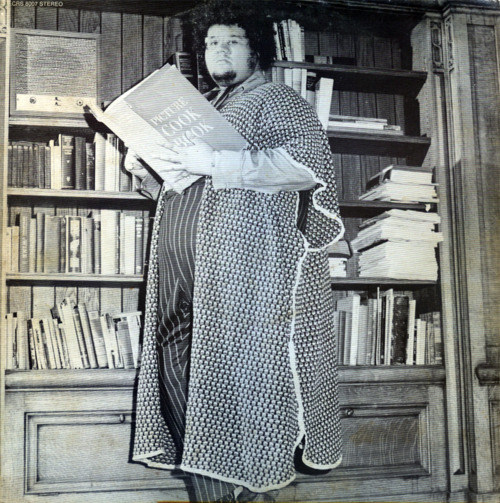
Baby Huey is one of the forgotten stars of 70’s soul, mainly because he died in October 1970 and it wasn’t until much later on, when his music was discovered by the hip-hop community that he gained any sort of acknowledgment.

baby huey lp

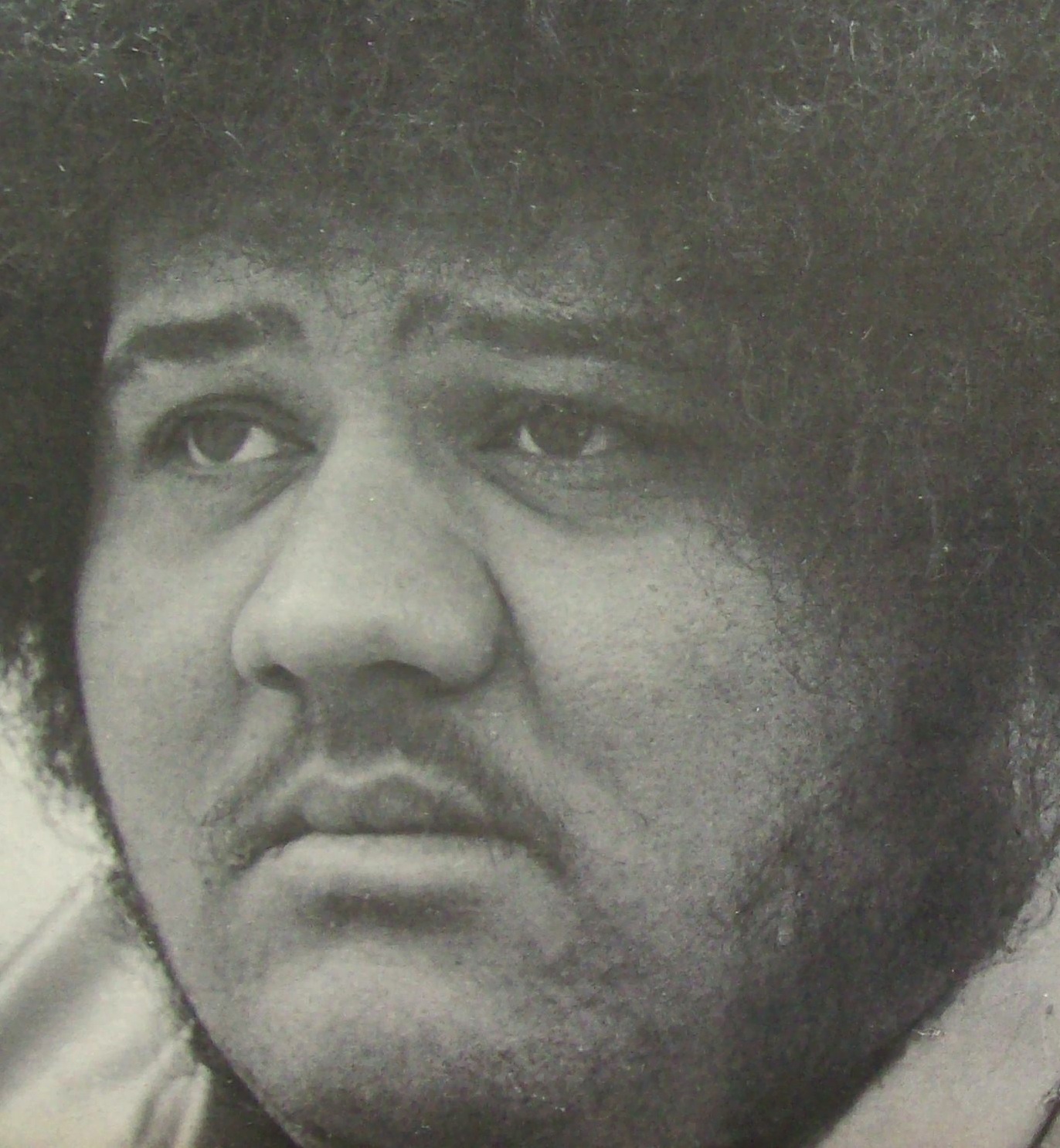
Named after a 1950s cartoon duck, the ironically-monikered Huey was massive in every way – he was massively overweight (between 25 and 28 stones (or 350-400 lbs if you’re that way inclined), he wore his hair in a massive afro,  he had a massive voice and used it to create massive tunes. He was a massive drinker. He even had a massive heroin addiction to go with it all.

baby huey

He came to the attention of Curtis Mayfield and signed to his Curtom label. Mayfield became something of a mentor to him and gave him the songs that would make up the A and B sides of his first single. Mayfield also suggested he get rid of his band The Babysitters, forever stuck in a mid 60s Motown rut. Curtis wanted Huey to expand (no pun intended) his sound towards the more politicised, psychedelicised sound of the times, which, sacked band or otherwise, he achieved. Huey’s tunes are packed full of riffs, refrains and drum breaks galore. Huey liked his music to ebb and flow, bringing the band down so he could throw in a social commentary or two, before letting the band soar in a riot of bass and brass. His songs regularly stretch out beyond the 6 minute mark and (I’d wager) are a sampler’s delight.

baby huey 7

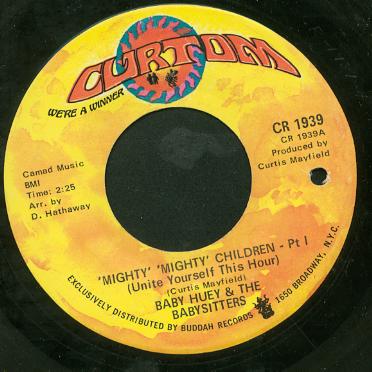
First single Mighty Mighty Children is a one-chord groover, held together by stabbing Blaxploitation brass, wah-wah ripples and pseudo live vocals. Mighty indeed.

Mighty Mighty Children (Part 1)

Here’s Listen To Me, Baby Huey’s 2nd (and final) single release. A stone cold lost classic, it‘s terrific! Beginning with a taught guitar riff and Huey’s big voice careering between balls-out soul belter and Is It Real Or Is It Memorex glass-shattering falsetto, it fairly gets carried along on a tidal wave of trumpets and electric keys, clattering cowbell and ‘Have Mercy Brother!’ soulful paraphrasing. I think you’ll like it;

Listen To Me

On the other hand, Huey’s version of Sam Cooke’s A Change Is Gonna Come is downbeat, treacle-thick and just shy of 10 long minutes. By the end you’ll be praying that a change is indeed gonna come. His wee spoken word part reminds me of James Brown or Isaac Hayes – all social conscience dressed up in occasionally trippy echoed sound effects. Settle in for the ride…

A Change Is Gonna Come

Most of these recording didn’t come out until after Huey was dead. An album, The Baby Huey Story was released to general indifference in 1971 and quickly forgotten about. My tracks come from the 1999 CD reissue that’s probably since been quickly forgotten about. You could do worse than track it down.

baby huey 2

Cover Versions, demo, Get This!, Hard-to-find

Vive le phonq

Imagine the pop landscape in 1967. It wasn’t just the trousers that were starting to get expansive. Everything’s got that slightly psychedelicised and trippy, frazzled edge to it. Itchycoo Park. Heroes and Villains. Penny Lane. Purple Haze. See Emily Play. Even The Temptations and other wide-lapel wearers on the Motown roster were abandoning their sure-fire recipes for success. Psychedelic Shack anyone? A future post for sure. Records became longer, more free-form and stretched out. Less structured, with not so much emphasis on the tried ‘n tested verse/chorus formula. But still pop. That bit’s important. The time was ripe for Sly and the Family Stone.

In 1967, Sly Stone didn’t like his record company. In fact, he didn’t trust them one iota. Sly had a bit of leeway though. He’d just had a top ten smash hit both sides of the Atlantic with Dance To the Music, a tune that did exactly what it says on the tin. So when Clive Davis at CBS asked Sly to follow it up with more of the same, the ever-willful and awkward Sly did just that.

sly keyboard

Sly decided to follow up Dance To The Music with a garage punk/funk version of the exact same track, stripped of all vocals save a tiny spoken word part and the chorus…..which this time was to be be sung entirely in French.

Naturally, he chose to call it Danse à La Musique. Released under the nom de plume of French Fries, it was terrific. The same du-du-du-dumb four-to-the-floor caveman stomping beat and growling fuzz bass drives it along. Street corner jazz scat vocals ping-pong back and forth, trying to be heard above the din of a joyfully fuzzed up, wasp-stuck-inside-your-car guitar track, clearly being played by a guitarist who’s just wired up a fuzzbox for the very first time. There’s precious little brass, replaced instead by a primitive keyboard that plays random Eastern-tinged phrases like a snake charmer on acid. The champion of a tambourine player never once stops throughout. His/her arm must’ve ached like a teenage boy’s with a Meaty, Beaty, Big ‘n Bouncy bargain Box Set for company. The whole thing is over and done with in three freaked-out flare-flapping minutes. I think you’ll like it.


sly kathyBONUS TRACK!

Here‘s a demo of Sly and co turning The KinksYou Really Got Me into a piece of proto Acid Jazz. Not sure if I like this or not, but it’s a curio right up Plain Or Pan’s street. And yours…

Cover Versions, demo, Gone but not forgotten, New! Now!

No Phils

let it be me 78

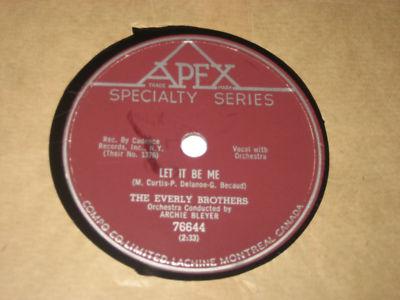
John Peel went through a phase of playing really old 78s from yesteryear. Ancient ghostly blues by unheard of singers long-since departed, popping and crackling away like one of my Gran’s heart attack-rich fry-ups. From out of nowhere they crept up on you, weird, wonderful and wonky. It might’ve taken you a couple of minutes to realise that there was any music playing at all, such was the understated beauty of it all. But before you knew it, there it was, under your skin and ingrained forever.

As if beamed in from another time and place, the music below has just slipped out into the ether…

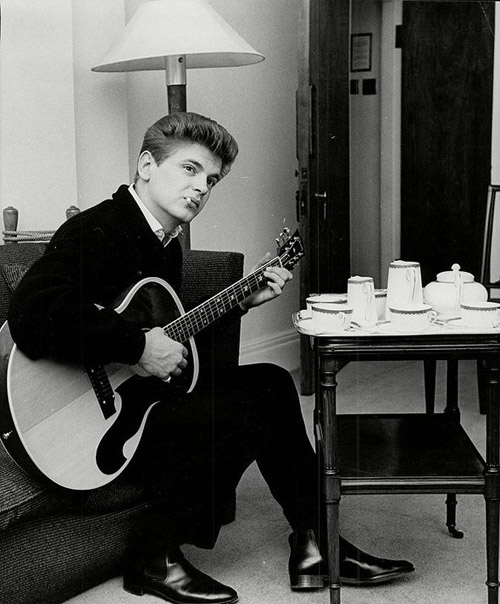
Eddi Reader and wee brother Frank side by side at the piano singing the Everly‘s Let It Be Me with all the fragility of Bambi with a broken leg. It’s as fresh as the new year, yet sounds as if it was committed to shellac a century ago. Just like one of those old Peel 78s. It’s a heartfelt spontaneous tribute to Phil, recorded on iPhone and let loose on the breeze for anyone who happens upon it. I think it’s terrific.

Here’s another version…

The same song sung at the same session, this time the recording is taken from Frank’s iPhone. More Frank than Eddi on this version. And there’s nothing wrong with that. A bedroom Spector somewhere could probably jigsaw the 2 tracks into one. Over to you..

Here‘s the Everly Brothers’ original:

phil everly

Dig out a dram, play all the tracks above back to back with The Smiths’ Asleep and there’s your Friday night in right there.

Alternative Version, Cover Versions, demo, Dylanish, Get This!, Gone but not forgotten, Hard-to-find, Kraut-y, Most downloaded tracks, Six Of The Best, studio outtakes

Lucky Seven

Plain Or Pan began back in January 2007. December 2013 saw the 7th full year of the blog. The end of the year makes me come across all misty eyed and giddy at the thought of this blog being not only still in existence but in rather rude health. At some point recently, the one-and-a-half millionth visitor crossed the threshold to read all about James Brown or Lou Reed or some forgotten Teenage Fanclub b-side. Facebook followers are in abundance, Twitter sends its fair share of readers in this direction and if you read that wee panel on the right, you’ll notice visitors from as far afield as Buenos Aires, Berlin and Ayr. Thank you one and all!

What better way to celebrate 7 years of typos, titbits and factual inaccuracies than with the annual Plain Or Pan Best of the Year CD*.

This slideshow requires JavaScript.

*I’ll provide the tunes. You make the CD.

Our team of stat monkeys works double shifts over the festive period before presenting me with documented proof of the most listened to and downloaded tracks from Plain Or Pan throughout the year and I compile them into a handy CD-length album, complete with artwork, that can be added straight to your iTunes or wherever and onto your iPod to listen to during that new-fangled jogging craze you’ll ditch by February. Alternatively, it could be burnt off to listen to, old-skool style, on a couple of shiny discs in the car.

Tracks included:

PixiesRiver Euphrates (Gigantic ep version)

Victoria Wood14 Again

The SmithsRusholme Ruffians (demo)

James Brown(Hot) I Need To Be Loved

SupergrassCaught By The Fuzz (acoustic)

The CrampsI Wanna Get In Your Pants

The House of LoveDestroy The Heart (demo)

Neil YoungBirds (Mono single version)

Elizabeth Archer & the Equators Feel Like Makin’ Dub

Beak>Mono

Dave EdmundsBorn To Be With You

The CliqueSuperman

Ike TurnerBold Soul Sister

CanI’m So Green

WilcoImpossible Germany

The Mamas and PapasSomebody Groovy

Santo & JohnnySleepwalk

Dee ClarkBaby What You Want Me To Do

The SpecialsToo Much Too Young (LP version)

Barry AdamsonSet The Controls For The Heart Of The Pelvis

NeuHallogallo

MogwaiThe Sun Smells Too Loud

Trash Can SinatrasLittle Things That Keep Us Together

Roxy MusicVirginia Plain (Peel Session)

*** a cracker! ***

Get it here.

pop 7 cover art

Normal service resumed next week. Lookin’ forward to it!

Alternative Version, demo, Get This!, Gone but not forgotten, Most downloaded tracks, Yesterday's Papers

Ghosts Of Christmas Past (2)

Incredible but true. The fact remains that two of the main creators of The Best Christmas Song In The World…Ever are now dead and neither of them is Shane MacGowan.  13 years ago yesterday, Kirsty MacColl was killed by an out of control speedboat whilst swimming with her family off the coast of Cuba. And Pogues guitarist Phil Chevron succumbed to cancer in October of this year. Yet MacGowan, coming in at 18/1 with all his beautiful flaws and imperfections somehow manages to stagger on.

pogues shane

First Appeared December 13, 2011


This time last year I read an article in one of Mrs Plain Or Pan’s magazines about Christmas. The article asked a carefully selected sample of celebrities to describe their perfect Christmas Day.

A long walk in the woods with my fiancé,” cooed Kathryn Jenkins, “before curling up in front of the log fire with a glass of mulled wine.”

“We always start the day with a champagne breakfast,” revealed Maureen Lipman. “Traditionally, we open presents after dinner, then the whole family settles down to watch The Snowman.”

How very twee and Daily Mail of them. I don’t know about your house, but mine on Christmas Day is nothing like that at all. “Those carrots are mushy…and the sprouts are still raw! You useless bleep!”(whispered of course,  so the relatives can’t hear us arguing, 3 feet away on the other side of the wall). “You told me when to put them on!” “Could you not tell the carrots were ready? Couldn’t you use your bleeping brains for once?” etc etc etc. Like I said, I don’t know about your house, but I’m inclined to think it’ll be more like mine than Kathryn Jenkins’ or Maureen Lipman’s come next Wednesday.


Still Alive! Todd Marrone did this, the talented so-and-so.


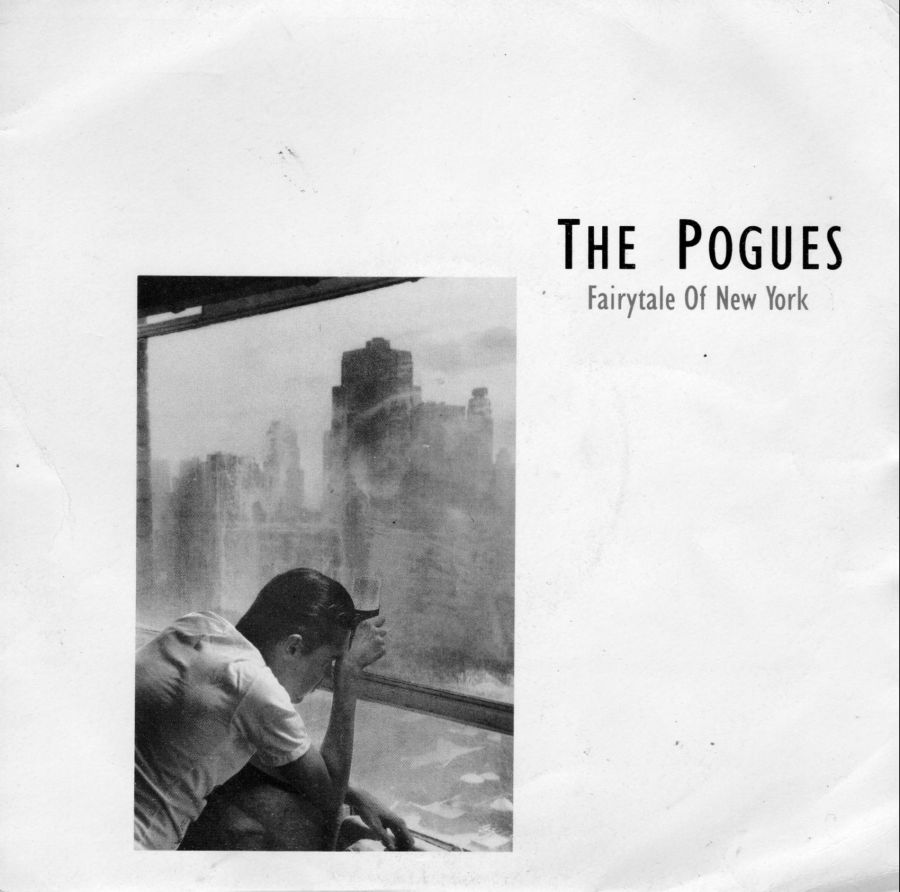
You know this already, but just for the record, Fairytale Of New York is the best Christmas song of all-time. It doesn’t matter what’s gone before (the Phil Spector album, Bowie ‘n Bing’s Little Drummer Boy, the glam slam of Slade and Wizzard) or what came after (East 17? Cliff Richard? Kylie Minogue panting her way through Santa Baby with all the sex appeal of Shane MacGowan having an asthma attack?) Some of these records are better than others, but none of them come close to capturing the essence of Christmas (raw sprouts, useless husbands and all) quite like The Pogues.


A Fairytale Of New York is almost unique amongst Christmas songs in that it tackles the ‘C’ word with none of the blind enthusiasm or misty-eyed schlock normally reserved for such events. Slade set their stall out before a bell has even been clanged in excitement. “It’s Christmaaaaas!!” yells Noddy, and you know from then on in you’re in for a rollicking yuletide ride. Wham drown that thinly-disguised same-sex love song of theirs in a gazillion sleigh bells and suddenly everything in George Michael’s garden is rosy.  “All I Want For Christmas,” enthuses Mariah Carey, “is yooouuuuooooouuu!” Yeah, and an X-Box, an iPod and a flat screen TV, Mariah. We’re all materialistic over here. And while you’re at it, could you get me a job too? And maybe find someone who’ll give us a mortgage? Aye, bah humbug ‘n all that jazz. The Pogues have gone for none of that. Fairytale Of New York is still romantic, but it’s also raw, real and ragged, full of remorse for past misdemeanours while hoping for a better future. Nicely gift wrapped of course in a Pogues-punk waltz-time, with added BBC ban-defying swearing.


It’s a terrific arrangement, put together quite masterfully by Steve Lillywhite. Initially written as a duet between Shane MacGowan and Pogues bass player Cait O’Riordan, then scrapped when she left the band, it was Steve Lillywhite who suggested getting the missus in to duet with MacGowan instead. Listen to the demos below and hear how he transformed The Pogues’ half-finished ideas into the final record, with its peaks and troughs and instrumental breaks. Hear too how he gets the best out of Shane, who at this point in his life was eating tabs of acid the way the Fonz eats gum (all the time, if you didn’t know), whilst washing them down with enough brandy to drown a whale. Lillywhite somehow coaxes him out of the famous fluent Macgowanese mumble and into that raucous final take.


The Music:


Ennio Morricone’s Overture from Once Upon A Time In America, from where Shane pinched the melody. Play it (below) – you’ll spot it immediately! It’s a terrific piece of emotive, melancholic music in its own right:

One of the first takes. Fluffed lines, missed cues….and the band played on.

Shane ‘n Cait almost full-length run-through duet with alt. lyrics, missed cues, forgotten words………and the band played on.

The ‘blueprint version’– Starts with Shane ‘n James Fearnley on accordion. Different lyrics again. Shane struggles with the concept of singing in tune. Band in top form as usual. After listening to this you can begin to appreciate the contribution Kirsty MacColl made to the finished record.

The final take. The best Christmas song ever.

pogues fairytale cover


Alternative Version, demo, Gone but not forgotten, Hard-to-find, Live!, studio outtakes

33 rpm

 lennon

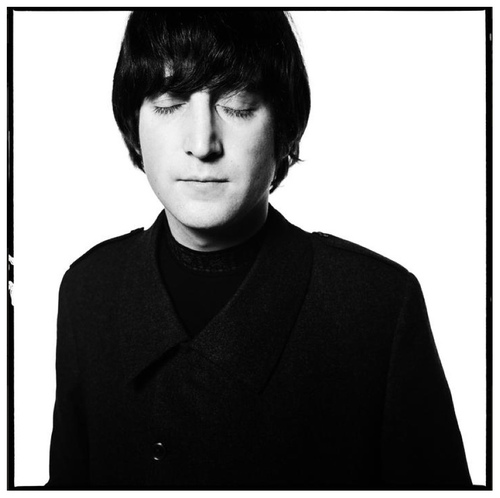
33 years ago today, John Lennon was shot dead outside his New York home.

When he died he was younger than I am now.

By the time I’d decided at the ripe old age of 32 that teaching might be the vocation for providing for my family, John Lennon had already lived a colourful life in Hamburg, formed the Beatles, split the Beatles, was one of the most recognisable faces on the planet and half-way through a solo career. Not bad going when you stop to think about it.

On the day he died, I came home from school to find my mum cleaning out the kitchen cupboards and crying. I shuffled about awkwardly, trying to be invisible while looking for the chocolate biscuits that weren’t in their usual place. Imagine seemed to soundtrack that whole era, Lennon’s unofficial national anthem for the world playing on every radio station across the globe.

Here’s the first take of Imagine, that other gun-wielding maniac Phil Spector at the controls and recorded at John’s house in Ascot. See when the honey-thick warm strings come in at the start with the piano……..s’beautiful, man!

And here’s a live version from 1971. Just John and his acoustic guitar in front of a politely reserved audience. Imagine wouldn’t be the song it was until Lennon’s death. Who knew?

Here’s the demo of Real Love. Lennon gives birth to Elliott Smith whilst sketching out a minor keyed spidery piano part that would never see the light of day during his lifetime.

And here’s the Jeff Lynne-produced shiny, polished-up Threetles version, released to promote the mid 90s Anthology series. Packed full of George’s slide guitar and some warm Beatles harmonies, it is (to paraphrase Alan Partridge) the band ELO could’ve been.

A few years ago, we visited New York. Just across the road from the Dakota Building in Central Park we came across Strawberry Fields. Once we’d managed to squeeze ourselves in between the hordes of quietly determined Japanese tourists hell-bent on not letting us through (Give Peace A Chance, my arse), much like that December day in my kitchen in 1980, we looked in slightly self-conscious silence at the wee tiled memorial.

I could post a picture of it, but it looks exactly the same as any one you choose to Google, although my picture has a random scattering of Autumn Central Park leaves on top of the black and white tiles, rather than the candles of eternity that were somewhat ironically missing that day.


*Bonus Schmonus!

Tis the season to be jolly ‘n all that. Here’s the rough version of Happy Xmas (War Is Over). Written and recorded in the space of a day, as was Lennon’s wont at the time, the record company failed to act quickly enough, and it missed out on being that year’s Christmas single. As with Imagine, it’s only since his death that Happy Xmas became truly popular.

lennon chapman

Lennon autographs a copy of his Double Fantasy LP for the man who would return to kill him six hours later. 

demo, Get This!

Love Songs

It starts slow and understated, and remains so for 15 spine-tingling minutes. Vintage synths hold down eee-long-gated chords as a nylon-stringed acoustic guitar picks out little arpeggios underneath. A wee chiming bit of pitched percussion tinkles away in the foreground, announcing itself like a far-off ice cream van shimmering in the haze. There’s a faint whiff of 1970s BBC library music, of the sort you might hear while the girl played noughts and crosses with the clown as you waited impatiently for something to happen through the arched window. A beautiful wee melodica pops up now and again, backed by the same guitar arpeggios, this time chiming away on a clean electric guitar. Then a polite banjo, picking out that same melody. By the time the flutes flutter in, your world has turned beige and tan and orange, you’ve styled yourself a side parting and the beginnings of a moustache have appeared on your top lip. An Open University degree beckons…

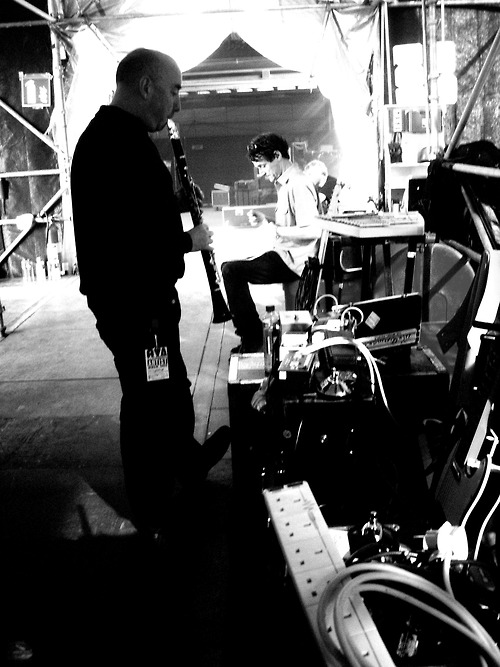
gerard love lightships Gerard Love. Happy to take a back seat when there’s a clarinet around.

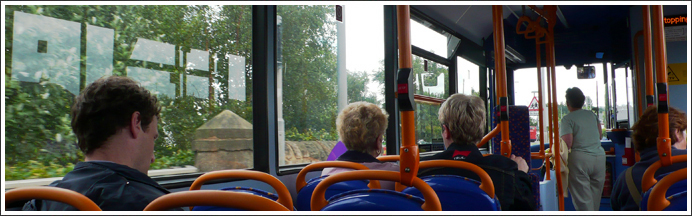
Motorhead it ain’t. It’s called All I Have To Do Is Sit And Wait and it’s from a five year old, buried-in-time and long-since forgotten about project of Teenage Fanclub’s Gerard Love. Made to accompany a film about a place called Abbey View, it’s designed to be listened to on the bus from Dunfermline to Abbey View, a journey that takes 18 minutes and 43 seconds, the exact length of the original pice of music. You can find out more about it here. Somehow, I only have it in a slightly edited form, but I’m sure you get the idea. Music for a long summers day, or a short bus journey, if the driver put his foot down a wee bit, or skipped a stop or two, he’d have you in Abbey View before the edited version has faded away.

gerardlove

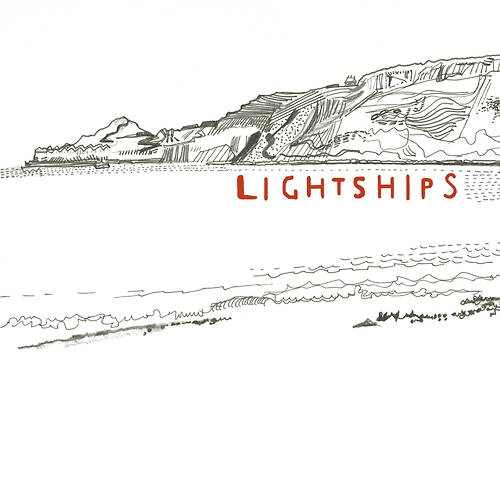
Of course, this was all a precursor to Love’s excellent Lightships album from last year. It’s just that no-one had really heard it until it sneaked out online for 5 minutes then sneaked itself back in again. Grab it quick.

Above is the aforementioned Lightships doing University Avenue from their Fear And Doubt EP.  Sprung from the same DNA as the above track, with added singing, it‘s a beauty. Stop The Clocks, sings Gerry. Aye, stop the clocks indeed. Sit down, relax, play on repeat. And if you haven’t heard Lightships……………….

lighships fear and doubt ep

demo, Hard-to-find

Telly Addict

The name Television has popped up here a couple of times recently. James Brooks from Land Observations name-checked them in his Six Of The Best article and a couple of weeks ago I was comparing the laconic vocals and snaking guitar sound of Charlie Boyer & the Voyeurs latest single to that of Tom Verlaine and Richard Lloyd. All this has coincided with the old iPod (well, it’s not that old – 3 and a half years – but I suppose that’s ancient in tech-speak) refusing to sync any new additions to my iTunes library and, worse than that, wiping itself clean of all the 140+GB of crap that was on there originally and deciding it’s just not going to work any more. Even the (cough) ‘Genius’ at the Apple store in Glasgow had to somewhat disappointingly concede defeat. As the iPod goes everywhere with me at all times this has proven nothing short of a disaster. So much so that I’ve gone all end-of-the-millenium retro and started playing CDs again. Real, shop-bought CDs in the car and on the stereo at home (I had to dust it  a wee bit first, I’m ashamed to admit). Having exhausted the Can Lost Tapes box set that fell into my hands for less than £18 in a destined-to-die HMV store, the one album I’ve had on constant repeat for a fortnight is Marquee Moon, the debut album by Television.

Television, First Avenue NYC 1977

Terrific photo, aye? More about it here.

It’s now considered something of a (yawn) seminal classic or something, so far out of step/ahead of the pack when first released that it sounds fresh, ageless and timeless when you listen to it now. But you knew that already. In mid 70s America, Television found themselves roped in with the NYC punk lot, seemingly by virtue of having a regular gig at CBGBs. Original bass player Richard Hell, with his penchant for ripped jeans, safety pins and  home-made spiky haircut is considered the true originator of the punk style, but by the time of Marquee Moon‘s release, he had long since left the band to form The Voidoids and invent the Stray Cat Strut with their I Belong To The Blank Generation single…

Anyway. Where were we? Oh aye, Television. Where did they fit in? Not for them the 3 chords-in-platform-heel Stonesy glam slam so beloved of the New York Dolls. Not for them the legs akimbo cartoon buzzbomb of the brothers Ramone. Not for them the high-brow beat poetry set to the low-brow beat music of Patti Smith. Television set themselves apart from the off. With an approach to their individual instruments bordering on muso, and a healthy disregard for the two and a half minute pop song, they were so far out of step/ahead of the pack that they still sound fresh, ageless and timeless today. Guitars intertwined like psychic snakes, riffing off one another creating astonishing Fender Jag ‘scuse me while I kiss the sky melodies and counter melodies seemingly at will. Not quite free jazz, but certainly free from the straight-jacketed constraints of their 3 chord loving peers. Learn an F chord, barre it and move it up and down the frets. Play it loud, play it fast, there you go, you’re a band.  Television were so far ahead of this, it’s not hard to understand why, 35 years later they were 1) seen as misfits and 2) sound as now as the latest daft haircutted, snake-hipped gang of teenagers straight off the cover of the NME.

First single (not on the album) Little Johnny Jewel was a taste of things to come. 7 minutes of art rock, all cheese-grater strings and rake-thin bass, slightly out of tune chords, random blips and blops and clattering, carefree jazz drumming, with a more spoken-word than singing approach to the vocals, the pre-pubescent seeds for Marquee Moon were sown. After an aborted session with Brian Eno, and balls duly dropped, the band started fashioning the music that would grace the album. Tougher, meatier, more aggressive yet airy, effeminate and even effete when compared to the band’s contemporaries, the alt. mix of the title track is the aural equivalent of watching Picasso sketch Guernica. Or something less pretentious than that. Friction, with its galloping elastic band riff and  ‘Eff! Are! Aye! See! Tea-Eye-Oh-Enn!’ refrain is a personal favourite amongst an LP full of personal favourites. If you’ve never heard Television, rectify that now!

television

Just as The Velvet Underground before them and The Beta Band since (I digress, but believe me, one day The Beta Band will come to be as revered as the truly great originators they were. They will!), Television never really got their dues at the time. But their influence is writ large in any twin guitar band with a penchant for razor-sharp riffs and meandering solos. Scratch just under the surface of all the usual suspects (you know who they are) and you’ll find a well-worn copy of Marquee Moon rotating ad infinitum between the grooves. The coolest part of it all? Well, rumour has it that around the time of recording the Blue Sky Blue album, Wilco’s Jeff Tweedy received the ultimate birthday present from his wife- a guitar lesson from Richard Lloyd. Not the first band that springs to mind at the mention of meandering solos and disregard for a well constructed pop song, Wilco did indeed adopt a more Verlaine/Lloyd approach on some of Sky Blue Sky‘s less structured tracks. Impossible Germany, for example, features a pair of clean, chiming guitars wrapping themselves around one another for 6 shimmering minutes. The solo alone is pure Lloyd. Or Verlaine. I can never tell the difference. If you’ve never heard it, rectify once more.

demo, Gone but not forgotten, Hard-to-find

Hot Rod

Over Christmas a pal on Facebook posted a video of Boogie Nights by Heatwave. With it’s super-slinky bass sound and below-the-bell-bottoms baritone “got to keep on dancin’, keep on dancin‘” backing vocal, it’s the sort of record that could have me Dad dancing for ages. (*Just to clarify – I’m not a Yorkshire man. I’m from further oop north than that – when I say me Dad dancing, I don’t mean it could get my own father on his feet. Although it probably could. I mean that Boogie Nights makes me dance in my own rhythmically-challenged Ayrshireman fashion. Like I said – just to clarify).

When the Heatwave video appeared I mentioned that the track was written by the same guy who wrote Thriller for Michael Jackson, Rod Temperton. I also rather glibly suggested he was now dead, when in fact it was pointed out that he’s very much alive and kicking and sleeping on a bed of crisp, fresh $100 bills every night in his Bel Air mansion. Probably. There’s nothing that unusual about songwriters who write one or two massive hits, but have a look at the picture below. You shouldn’t judge a book by its cover and all that, but……

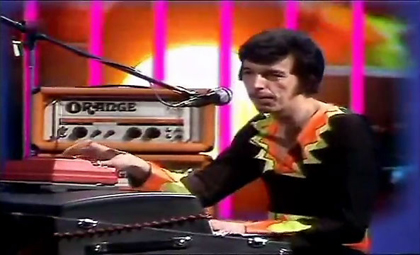
rod temperton

Rod Temperton, the man who re-invented slick dance floor disco and wrote just about the most recognisable track of the 80s and beyond is a skinny-arsed, geeky white man with a rubbish pencil moustache and pre-perm footballer’s haircut. All the way from Cleethorpes in the north of England. A town with about as much musical pedigree as a squeaky dog toy. Yet there he is – the not-quite-invisible man to the side, goofing and gurning his way through three minutes of proper 70s American black man funk. And he wrote it. On top of a pile of dirty washing in a tiny flat. No wonder he’s laughing. All the way to the bank, he’s laughing.

Rod’s story is perfect Plain Or Pan fodder. Here follows a brief catch-up if you’re new to his name.

Beginning his musical apprenticeship in the working mens’ clubs around Tyneside and the north east of England, by the early 70s Rod had left the glamour of the frozen food factory where he worked in Grimsby and sought out his chance on the German club circuit. Like most bands who did this tour, he played long-into-the-night sets and his playing improved ten-fold. Rod and his Hammond organ were much in demand. An ad in Melody Maker led to him joining Heatwave and it was from there that Rod’s talents took him to the toppermost of the poppermost. Not quite the token honky (Heatwave’s drummer looked out of place also), Rod was the driving force behind the multi-cultural group’s success – Stateside million sellers, the whole shebang, before his work brought him to the attention of Quincy Jones.  He’d go on to write three tracks for Michael Jackson’s debut Off The Wall LP and was retained by Jones and Jackson to work on the difficult-second-album follow-up, Thriller.

Originally, when I did my Thriller demo, I called it Starlight. Quincy said to me, ” You managed to come up with a title for the last album, see what you can do for this album”. I said, “Oh great,” so I went to the hotel, wrote two or three hundred titles, and came up with the title Midnight Man.  The next morning, I woke up, and I just said this word…Something in my head just said, this is the title. You could visualise it on the top of the Billboard charts. You could see the merchandising for this one word, how it jumped off the page as Thriller.

Quick! Grab these! They’ll probably be gone faster than you can say Beat It!

StarlightMichael Jackson‘s demo of Thriller

Vincent Price spoken part for Thriller (first run-through)

Billie JeanMichael Jackson‘s demo

As well as the title track, Rod wrote Baby Be Mine and The Lady In My Life, both more derivative of the kind of smooth soul tracks that he can seemingly knock out in his spare time. Difficult second album? Thriller has since become The Biggest Selling Album…Ever!, selling in excess of 60 million copies along the way. But you knew that already. Buy maybe you didn’t know that the wee skinny guy from unfashionable Cleethorpes had a huge hand in it. He still makes me laugh whenever I see Boogie Nights on any of those old TOTP repeats: