John Peel went through a phase of playing really old 78s from yesteryear. Ancient ghostly blues by unheard of singers long-since departed, popping and crackling away like one of my Gran’s heart attack-rich fry-ups. From out of nowhere they crept up on you, weird, wonderful and wonky. It might’ve taken you a couple of minutes to realise that there was any music playing at all, such was the understated beauty of it all. But before you knew it, there it was, under your skin and ingrained forever.
As if beamed in from another time and place, the music below has just slipped out into the ether…
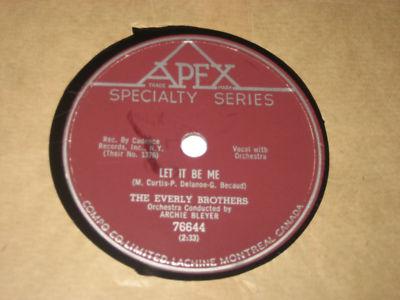
Eddi Reader and wee brother Frank side by side at the piano singing the Everly‘s Let It Be Me with all the fragility of Bambi with a broken leg. It’s as fresh as the new year, yet sounds as if it was committed to shellac a century ago. Just like one of those old Peel 78s. It’s a heartfelt spontaneous tribute to Phil, recorded on iPhone and let loose on the breeze for anyone who happens upon it. I think it’s terrific.
Here’s another version…
The same song sung at the same session, this time the recording is taken from Frank’s iPhone. More Frank than Eddi on this version. And there’s nothing wrong with that. A bedroom Spector somewhere could probably jigsaw the 2 tracks into one. Over to you..
In 1963, civil rights activist and singing jazzman Oscar Brown Jr wrote and recorded The Snake, a finger clickin’, stand-up bass poppin’ bossa nova, free from unnecessary jazz frill but full of electric piano stabs and fluid electric guitar riffs. It‘s a cracker.
Borrowing heavily from one of Aesops’ fables, Brown’s track was a metaphorical parable about trust – a woman is conned by a seemingly in need of help half-frozen snake who by the end of the song has bitten her with poisoned tongue.
“Oh shut up silly woman!” said the reptile with a grin. “You knew darn well I was a snake before you took me in!”
You might know The Snake better as a northern soul belter. Half a decade after the original, Al Wilson took the tune by the scruff of the neck and turned it into something that, by 1975 (No. 41 on the UK charts), would be a talcum-dusted Mecca floor-filling monster.
Propelled by a properly frugging four-to-the-floor soul bassline, brass stabs build and build with each increasingly frenetic key-changing verse, Hal Blaine’s drum fills tumble like acrobats atop oil cans and the kitschest of hissing female vocals (Yesssssss! Come on in!) carry the chorus.
Without a doubt it‘s guaranteed to get me dancing like the rhythmically-challenged Ayrshireman I am.
You might be surprised to learn that neither Al Wilson’s version nor the more unknown original were the first versions of The Snake I heard. Nope, it was second division indie also-rans Dodgy who first brought The Snake to my attention in 1994, including it on the b-side of their “double E-sided” Melod-EP.
Sticking with Al Wilson’s as their blueprint, the Dodgy version is a rush. It’s faster, fatter and has added mariachi trumpets in the tripping-over-itself finale. I love it. They’re still going, you know….
Plain Or Pan began back in January 2007. December 2013 saw the 7th full year of the blog. The end of the year makes me come across all misty eyed and giddy at the thought of this blog being not only still in existence but in rather rude health. At some point recently, the one-and-a-half millionth visitor crossed the threshold to read all about James Brown or Lou Reed or some forgotten Teenage Fanclub b-side. Facebook followers are in abundance, Twitter sends its fair share of readers in this direction and if you read that wee panel on the right, you’ll notice visitors from as far afield as Buenos Aires, Berlin and Ayr. Thank you one and all!
What better way to celebrate 7 years of typos, titbits and factual inaccuracies than with the annual Plain Or PanBest of the Year CD*.
This slideshow requires JavaScript.
*I’ll provide the tunes. You make the CD.
Our team of stat monkeys works double shifts over the festive period before presenting me with documented proof of the most listened to and downloaded tracks from Plain Or Pan throughout the year and I compile them into a handy CD-length album, complete with artwork, that can be added straight to your iTunes or wherever and onto your iPod to listen to during that new-fangled jogging craze you’ll ditch by February. Alternatively, it could be burnt off to listen to, old-skool style, on a couple of shiny discs in the car.
Tracks included:
Pixies – River Euphrates (Gigantic ep version)
Victoria Wood – 14 Again
The Smiths – Rusholme Ruffians (demo)
James Brown – (Hot) I Need To Be Loved
Supergrass – Caught By The Fuzz (acoustic)
The Cramps – I Wanna Get In Your Pants
The House of Love – Destroy The Heart (demo)
Neil Young – Birds (Mono single version)
Elizabeth Archer & the Equators – Feel Like Makin’ Dub
Beak> – Mono
Dave Edmunds – Born To Be With You
The Clique – Superman
Ike Turner – Bold Soul Sister
Can – I’m So Green
Wilco – Impossible Germany
The Mamas and Papas – Somebody Groovy
Santo & Johnny –Sleepwalk
Dee Clark – Baby What You Want Me To Do
The Specials – Too Much Too Young (LP version)
Barry Adamson – Set The Controls For The Heart Of The Pelvis
Neu – Hallogallo
Mogwai – The Sun Smells Too Loud
Trash Can Sinatras – Little Things That Keep Us Together
Pink Floyd’s Meddle LP was released in 1971, sandwiched between 70’s experimentally textured Atom Heart Mother and 72’s omnipresent, global-shagging Dark Side of the Moon. Sitting between these two LPs, Meddle is more experimental and free-flowing than its conventionally-structured follow-up; There are whoosing wind effects galore, barking dogs (the eponymously titled Seamus, named after recording Steve Marriott’s hound – it’s a howler in every meaning of the word) and one entire side is given over to a self-indulgent ambient collage that, some claim, can be synced in perfect harmony with Kubrick’s 2001: A Space Odyssey (side 2’s Echoes). If techno-hippies The Orb had played guitars instead of sequencers they might’ve come up with an album like Meddle.
It’s not an album I listen to very often – maybe once in the last 10 years, but I do like track 3 – Fearless. An eastern-tinged, six minute-plus electric skiffle blues played in the sort of open tuning that Jimmy Page might have employed during the writing of Led Zeppelin III, it meanders like the Ganges on a hot day.
It starts terrifically, the recurring, nagging riff underpinned by a sample of the Anfield Kop singing You’ll Never Walk Alone, Gilmour in full-on Home Counties posh boy whisper mode. Throughout, strings bend like bluesy elastic bands, electric guitars intermittently chime, harmonics ping, a piano tinkles, Fab Four backing vocals weave in and out of the rich tapestry of sound….but everything always comes back to The Riff. You should listen to it, you’d like it.
The Charlatans certainly did.
Musicians stealing other musicians’ tunes is nothing new. Pick a month at random from the sidebar on the right there and you’ll find umpteen examples without looking too hard. Right now, you’ll have your own examples bouncing around your head. So we shouldn’t single The Charlatans out for individual attention.
“Here comes a soul saver on your record player…”
Their track Here Comes A Soul Saver has Fearless written all over it. Or rather, it has Fearless written through it like the words on a stick of Blackpool rock, the Pink Floyd track the scaffolding upon which The Charlatans build their magpied groove.
They’ve done a good job of it too – all 1970s Ian McLagan keys and inspired chord changes, but The Riff continues brazenly throughout. “No-one’ll notice,” they probably thought in 1995, “it’s from the Pink Floyd LP that no-one listens to.”
And they would’ve gotten away with it too, if it wasn’t for this Meddling kid.
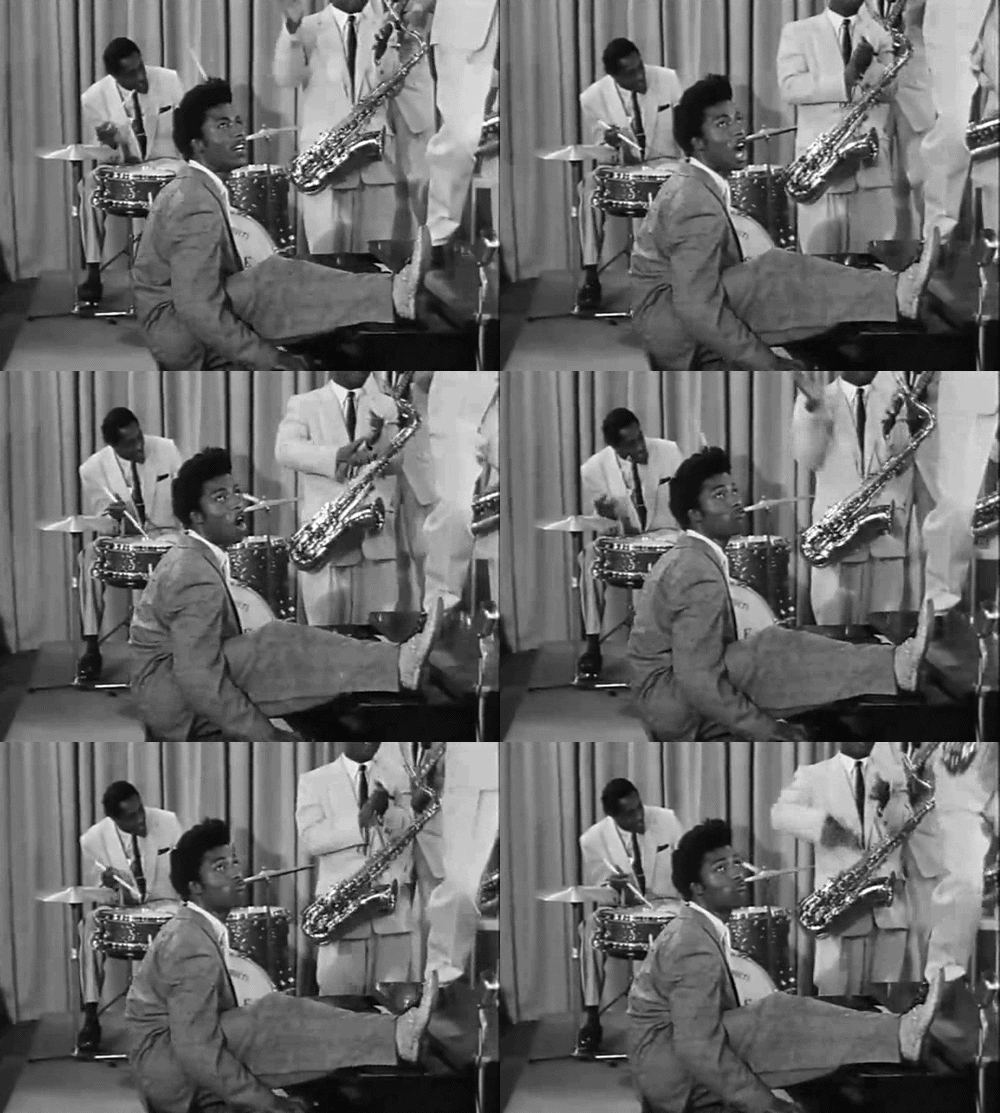
Elvis may have been the King, but Little Richard was certainly the Queen. He’s terrific, isn’t he? The high priest of camp; his pompadoured hair like a Texan oil slick, sticky and stationary above those mad, popping eyes and perfectly plucked brows, the occasional dog-bothering ‘whoooo!’ while his hands pound away on the pianer with all the frenzied dexterity of a teenage boy with unlimited broadband and a lock on his bedroom door. Tee-riffic.
Slippin’ And Slidin’. Tutti Frutti. Lucille. Good Golly Miss Molly. Rip It Up. Long Tall Sally. Every one a throat-ripping, stone cold classic……..the building blocks of rock and roll and all that was to follow. But you knew that already.
‘Before Elvis, there was nothing‘, said John Lennon, but The Beatles owed Richard Penniman a huge debt or two. McCartney for one modelled his whole voice on Richard’s every single time his group broke free from the shackles of balladry and ruffled their rugs to the delight of the watching world – from the backing vocals on The Beatles’ own version of I Wanna Be Your Man right through to the White Album’s Why Don’t We Do It In The Road, the spirit of Little Richard was never far away.
Here’s one you might not’ve heard before:
The Most I Can Offer (Just My Heart) is superb. Released on his 3rd album The Fabulous Little Richard by a slightly twitchy record company after he’d indicated a preference for thumping the bible rather than the thumping boogie woogie of yore, The Most I Can Offer is a mid-paced soul-shaking break-up ballad (of course!), all rasping tenor sax and ding-ding-ding minor 7ths on the keys. It throws me every time. Why? Because it sounds like a duet between a high, quavering falsetto’d voice and a southern souler. Imagine if William Bell had sung with the black cleaner lady who appears from the waist down in every Tom And Jerry cartoon. Except The Most I Can Offer seems to be Richard and Richard alone, his voice alternating between broken-hearted blues mama and a down-on-his-knees tear-soaked gospel bawler. The version I’ve given you is Take 4. Which sounds exactly like takes 1, 2 and 3 and no doubt the master version too. If you have but an ounce of soul you’ll want to play this again and again and again.
And here’s another:
Hey Hey Hey Hey, as reprised on the Beatles For Sale LP by those self-same Little Richard fans mentioned earlier. An out-and-out rocker, this features Richard at his most extreme, extravagant and extraordinary, pompadour bouncing while the piano pumps out primal jive ‘n wail. You can almost see the whites of his eyes on this recording.
And if you think the original’s good, you should have a listen to the Jim Jones Revue‘s outstanding needles-in-the-red version;
Proof, if any were needed, that Little Richard is as relevant today for any musician seeking the mother lode of rock ‘n roll.
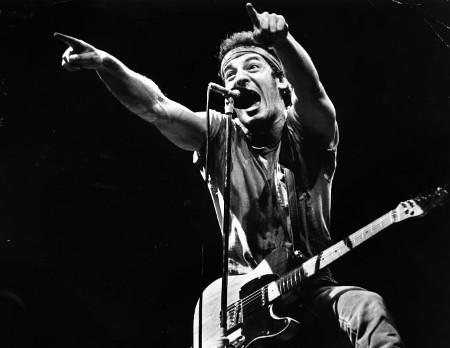
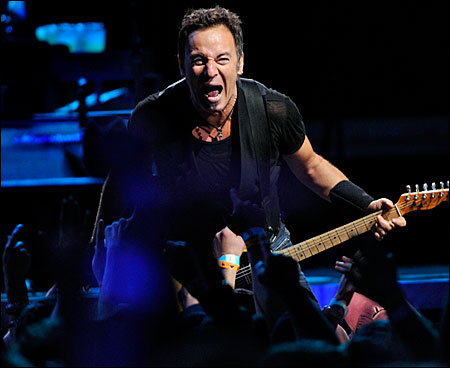
I haven’t ever quite gotBruce Springsteen. I can appreciate the appeal, and I can rattle off a list of his tunes I quite like, but that’s just it – tunes I quite like. There’s nothing there I love. Not even Tenth Avenue Freeze Out. Or Hungry Heart. Or Cadillac Ranch. Or Born To Run. I like ’em. But I don’t love ’em. I don’t feel the need to re-spin them as soon as they’ve faded out in the same way I do with many other musical sacred cows. What’s the difference between Born To Run and most of Meat Loaf’s outpourings over the last 30 years? Very little, if y’ask me. And Meat Loaf is a pantomime figure to be laughed at and poked with a big shitty stick. So why not Bruce?
Bruce’s schtick is all just a wee bit forced, I think. Everything’s done through gritted teeth and clenched fist, his furrowed brow and earnest intentions dressed up in last year’s Levis for maximum ‘man of the people’ effect. Four hour live shows? Come on! Even if Paul McCartney turned up in my back garden and ask me to accompany him on fat-fingered guitar to play a four hour greatest hits show, that would still be about two hours too long. Possibly. And all that huffing and puffing and biker-booted blue collar bluster – pffft! – even his ballads sound as if they’re wrapped in layers of testosterone, desperate to escape their confines, but bundled up as tightly as his upper arms underneath the sweat-stained cut-off denim shirt. Look at him! He can’t even play that famous Tele of his properly due to the constrictions. That, in part, explains the gritted teeth I suppose.
Here’s the crux though – Bruce writes a good song. I know he does. But his versions just don’t hit the spot the way the cover versions do.
Because The Night – Bruce version
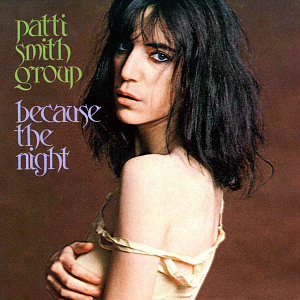
Written during the Darkness On The Edge Of Town album sessions, he dashed off Because The Night, discarded it almost immediately and gave it to Patti Smith, who was in the studio next door recording what would become the Easter LP. She got herself a writing credit as she changed some of the words and added her own. But you knew that already. Her version is better. In fact, hers is the definitive of the 18 covers (and counting) to date. PJ Harvey certainly thinks so……..she based much of her mid-career on it. But you knew that already too.
Because The Night – Patti version
Along with Gerry Rafferty’s Baker Street, Patti’s Because The Night reminds me of French toast. I have a vivid memory of listening to the ‘Hit Parade’ countdown one sunny Summer night on a wee portable radio in the back garden and hearing both records while my dad made French toast in the kitchen, the sizzle and smell making its way back to me sitting with my back against the roughcast on the garage wall. Patti’s record eventually got to number 5, though I’m too scared to Google the rest of this fact as it’s very likely both records didn’t ever appear in the same chart. Don’t check. Or if you do, don’t tell me if I’m wrong. It’ll ruin what has been a 35+ years memory.
Huff….pufff…wheeze….
Inspired by a lyric in Elvis’ Let’s Play House (“You may have a pink Cadillac but don’t you be nobody’s fool”), Bruce wrote Pink Cadillac as a car-as-sexual-metaphor bluesy gruntalong. Written at the turn of the 80s but kept it in his vaults until 1984, Bruce stuck it on the b-side of Dancing In The Dark.
Pink Cadillac – Bruce version
The year previously, Bette Midler had asked to record it, presumably to add her own high camp gloss to an already suggestive lyric.
“I love you for your Pink Cadillac….crushed velvet seats….riding in the back…oozing down the street.”
‘Pink Cadillac is not a girls’ song‘, vetoed Bruce.
And that was that, until Natalie Cole somehow got the go ahead to record her version and take it all the way to number 5 (just like Patti) in March 1988. Bruce calling it Pink Cadillac was a bit more glamorous and rock ‘n roll sounding than, say, Pink Camel Toe, that’s for sure. But we all know what he was getting at, eh? Nudge, nudge, wink wink and all that. It’s quite spectacular that someone so straight-laced as Natalie ‘daughter of Nat King’ Cole should be allowed to record it. Maybe she thought she was singing about a car.
Pink Cadillac – Natalie version.
Barring the none-more-80s glossy feel (or, to be more accurate, because of the none-more-80s glossy feel) it could almost be Aretha Franklin as recorded by Prince, couldn’t it?
*Bonus Track!
Ever one for spotting a trend and putting an arty spin on it, here’s David Bowie doing It’s Hard To Be A Saint In The City. Recorded in 1974 in the middle of his white-powdered Young Americans phase, it’s a tune that divides Bowie fans. For what it’s worth, I think it’s a brilliant version. I bet those check-shirted good ol’ boys over the Atlantic hate it though.
Nothing at all like the Brooce original. Poor man’s Dylan, no?
By now, of course, there’ll be people I know, friends even, who are rattling off tut-tut-tut emails to me, pointing out the errors of my ways. Waaaaaghh! Here….have a Bruce face in reply….
There’s a strange bit of serendipity to this post. I’d spent a night last week putting some stuff together for my weekly article and then on his Sunday Service show on 6 Music, Jarvis Cocker played the very track I was planning to write about. In itself, that’s a happy coincidence. But the fact that I’d planned to introduce the record (which has nothing to do with Jarvis) by writing a wee bit about Pulp beforehand was a bit weirder. So, as you read this, imagine the Twilight Zone theme playing away ad infinitum in the background.
If you drew a trajectory charting the popularity of Pulp LPs, there’d be a massive, Everest-sized spike where Different Class appeared and sadly, not much else. Pulp were a proper, fully-formed album band, but save for their brief flirtation with mainstream success, not many (common) people would really know. Indeed, many folk probably consider them a bit of a one-hit wonder. Their last album, 2001’s We Love Life is one of Pulp’s very best. Crashing in at number 6 on the album chart, before crashing straight back out and never to be seen again a mere 3 weeks later, it was a real blink and you’ll miss it album. If you’ve never had the pleasure, you should make some time to acquaint yourself with it.
One track, Bad Cover Version, is a terrifically thought-out ballad that draws parallels between a failing relationship (“a bad cover version of love is not the real thing“) and the 2nd rate dopplegangers we often accept in place of the real deal – Top of the Pops compilation LPs (“thebikini-clad girl on the front who invited you in”), the Stones since the 80s, later episodes of Tom & Jerry when they could talk, the last episodes of Dallas, the TV series of Planet of the Apes, and so on. Amongst the things Jarvis lists is “the second side of ‘Till The Band Comes In’“.
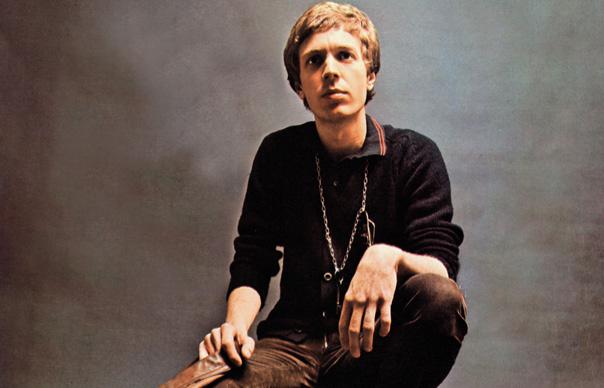
Till The Band Comes In was the much-maligned and undersold 5th LP by Scott Walker (his 6th, if you count his Sings Songs From His TV Series LP). Much like We Love Life, the critics had the artist pegged as ‘past his best’, it too was a bit of a flop and never really got the attention it deserved. The line about the second side of Till The Band Comes In was a joke at Walker’s expense, given that it was he who produced We Love Life for Pulp. Are you still hearing The Twilight Zone music in the background? It’s a circle of life, as one piano player once remarked.
Scott Phwoar
Back in the day before he was producing other people’s flop records and long before felt the need to create an approximation of melody from bashing hanging lumps of meat, Scott Walker reveled in making orchestral-rich pop songs. Like a baritone-rich Serge Gainsbourg he sang of syphillis, sailors and suicide and was nothing at all like yer average teen heart throb. On Till The Band Comes In, you’ll find Little Things (That Keep Us Together). Almost a companion piece to his own version of Jackie, though with less gallop and more gasp, Little Things finds Scott clinging to the coat tails of a melody as jabbing strings and tumbling toms race one another to the finish line. It’s great.
And as if that’s not thrilling enough, here come the Trashcan Sinatras, back in the days when they were The Trash Can Sinatras, faithfully gatecrashing Walker’s tune with all the ramshackle beauty of a wooden-legged man hurtling haphazardly down a hill and into the neighbour’s hedge while being chased by an angry slevvery dug. Which, metaphorically at least, the Trash Cans were round about then. They fairly clatter into Little Things; the old Roland Jazz Chorus set to maximum wobble in a thrilling rush of knee-trembling, reverb-soaked, John McGeogh-esque post-punk while a breathless Frank hangs on to the vocals for dear life.
My first recollection of the Trash Cans doing this was for a Billy Sloan session on Radio Clyde around ’91 or ’92. Like most of the Trash Can’s unofficial output from those days, I have it on a hissy, taped-off-the-radio C90 somewhere, but the version above is taken from the b-side of 1993’s How Can I Apply single. A lost nugget of a record from an era when every Trash Can’s release was packed-full of top quality songs from an apparently never-ending production line that put every other band to shame. But you knew that already.
TCS, Shabby Road, 1993
*Trashcans fact!
Long before John started wearing the famous stripey t-shirt, he was awfy fond of a t-shirt bearing the cover of Scott 1. No pictures exist. Believe me, I’ve looked…
With their jagged, juddering, short, sharp, post-punk riffs, Wire were always ripe for rip-off. And so, along came Elastica…
Three girls, one guy and a couple of borrowed Wire tunes:
Justine Frischmann. Brash, floppy-fringed, posh-parented and on/off squeeze of both Damon Albarn and Brett Anderson simultaneously. Charmingly, one would leave love bites on her backside for the other to find. But you knew that already.
Donna Matthews. Pouting, doe-eyed indie-boy poster girl who’s guitar always looked a bit too big for her. Partook in way too much heroin.
Annie Holland. Razor-cheekboned bass player. The quiet one.
Justin Welch. Clem Burke-esque drummer who belched his way through Top 20 hit Line Up. Also partook in too many pills ‘n powders.
With their classic 2 guitars, bass and drums set-up and songs pilfered from post-punk’s recent past, Elastica were no different at all from any other provincial rehearsal room band. They were formed by Frischmann after she advertised for musicians ‘influenced by The Fall, The Stranglers, and Wire’, (something that would come back to haunt them) and when they came on the scene, the London-centric media held them up as the next big thing, helped in no small way through an endorsement by King Steve of Lamacq, Radio 1 DJ, label boss and indie uberlord. Elastica received far more column inches in the music press than any new band really had the right to. Rave review followed rave review. Cover followed cover. The public bought it and before you knew it, Elastica were the next big thing.
They couldn’t handle it though. The simple ratio of too many drugs and not enough songs caused the band to implode. For Elastica, it would be a long stretch (aye!) before their second, long-since forgotten about LP. 5 years it took them to release it (a lifetime in the fickle, fad-dominated world of pop music), hot on the heels of a gap-filling mini LP of sorts. Then nothing.
Back to the debut album though. It fizzes with gay punk-pop abandon. Choc-full of those jagged, juddering, short, sharp post-punk riffs. Connection was the biggy. Number 17 with a bullet and proof, if any were needed, that Elastica were a bona fide chart success.
Proof, too, that Wire‘s Pink Flag LP was a regular rotator on the Elastica turntable. Here’s Three Girl Rhumba. The thieving mapgpies.
The belching drummer-enhanced opener Line Up was another.
Ever heard I Am the Fly by Wire? (Wait for the chorus…)
Elastica certainly had. The thieving magpies.
Another crime was committed in the name of biggest hit single Waking Up, it’s twanging see-saw riff and chord structure totally ripping off The Stranglers‘ No More Heroes.
Elastica just about stopped short of adding a bouncing Farfisa, but they were fooling no-one.
And there are others. The album’s S.O.F.T. somehow manages to sound like most of The Pixies‘ Doolittle LP in less than 4 minutes. Vaseline‘s chorus could be Debbie Harry’s finest moment. Pop pilferers who got lucky. That just about sums Elastica up. Both The Stranglers and Wire secured out-of-court settlements for all of Elastica’s sticky-fingered troubles. Quite rightly too. it just goes to show, recycle any old tosh from the past and if it’s presented as the best thing ever since the last best thing ever, the gullible will buy it. You should seek out Wire’s Pink Flag if you haven’t heard it, though. You’d like it. S’a cracker.
*Elastica Trivia!
Countdown fans may be able to work this out quicker than others, but who d’you think played keyboards on half the tracks on the first album? T’was none other than Dan Abnormal. Think about it…
Barry Adamson, baritone booming bass player with Magazine has a terrific back catalogue of albums released under his own name. Successfully walking the tightrope that straddles imagined film noir soundtracks on the one side with spoken word, sample-packed beat happenings on the other, they’re the sort of albums that would and should (and maybe even have) appeared on those Mercury lists every September. Perfect for late night/early morning listening, hip to the jive advertisers and marketers have used his music to great effect over the past 15 or so years.
For me, the jewel in a particularly shining crown is 1996’s Oedipus Schmoedipus, an excellent assortment of Tom Waits-ish gravelly Gauloises rumbles, Massive Attack samples and other borrowed jazzy interludes that might’ve fallen into the ‘trip-hop’ pigeonhole all those years ago, Miles Davis covers and big, fat, beat-driven affairs that swing like the John Barry 7 on steroids. There are a number of stellar contributions from a just-famous Jarvis Cocker, an almost dead Billy MacKenzie and Adamson’s old band mate from Bad Seeds days, the perennial Nick Cave.
Gliding by on a rush of gospel hysterics, jigsawed-together old soul records and whispered Cocker vocals, the Jarvis contribution (above) isn’t particularly Pulpish, but with its talk of damp beds and asthma inhalers and the suggestion of afternoon you-know-what bubbling under the surface, the lyrics certainly are. Set The Controls For The Heart Of The Pelvis indeed. Equally superb, but poles apart in terms of sound, the Billy MacKenzie track, Achieved In The Valley Of The Dolls places Mackenzie’s high falsetto alongside twanging guitars, bubbling synths and none-more-90s-drums, creating a highly polished piece of slick AOR pop.
Without being glib or anything, the Nick Cave track sounds well, just like Nick Cave. Fine if you like that kind of thing, although to be honest, Nick Cave has never really been my kind of thing. I know, I know, shoot me…..Here‘s the Massive Attack-sampling Something Wicked This way Comes instead.
Barry’s best remains his re-interpretation of the Bond theme. From 1992’s Soul Murder LP, 007, A Phantasy Bond Theme alternates between skanking blue-beat rhythms, twanging Bond guitars, Jamaican spoken word patois and a brassy, swingin’ big band. How that idea ever formed in Adamson’s head we’ll never know, but somehow he managed to create an absolute belter of a record. If you only download one thing this week….etc, etc….
*Bonus Track!
No excuse required really, but here‘s Magazine’s debut single Shot By Both Sides. Written by Pete Shelley and Howard Devoto and featuring a terrific lead guitar riff. But you knew that already….
Beatles For Sale wouldn’t be many people’s choice of favourite Beatles album, but it’s by far my favourite Beatles album cover. You can marvel at the druggy, warped close-up that heralds Rubber Soul, and Klaus Voormann’s pen and ink collage on the front of Revolver, and it’s hard not to appreciate the vision behind Peter Blake’s Sgt Pepper concept, but no album cover then or since probably froze the zeitgeist of a precise moment in time quite like the Robert Freeman shot for Beatles For Sale. Taken in London’s late Autumn Hyde Park, it cryogenically captures the band in the clothes they turned up in, battered, brusied and bloodied by Beatlemania, baggy-eyed and bored of it all, desperate for their beds and a bit of peace and quiet. Great hair though.
Beatles For Sale was the 4th Beatles album in 21 months. That’s four LPs. In less than two years. Coming hot on the heels of the phenomenal A Hard Day’s Night LP (their first to feature all-original material), Beatles For Sale represented something of a dip in quality for the band. And, as outlined above and below, no wonder why…
In late 1964, Beatles found themsleves in the unenviable position of requiring material to release in time for the lucrative Christmas market. EMI suddenly owned the biggest, fattest cash cow of them all and, what with this pop music lark being a short-lived affair and whatnot, were keen to milk it for all it was worth. Recording started only one month after A Hard Day’s Night was released and many of the songs were written in the studio and recorded there and then during any free days between shows. All associated with The Beatles (including the band themselves) knew they were being somewhat exploited.
George Martin: “They were rather war-weary during Beatles for Sale. One must remember that they’d been battered like mad throughout ’64, and much of ’63. Success is a wonderful thing, but it is very, very tiring.”
Paul McCartney: “We would normally be rung a couple of weeks before the recording session and they’d say, ‘We’re recording in a month’s time and you’ve got a week off before the recordings to write some stuff.“
Neil Aspinall: “No band today would come off a long US tour at the end of September, go into the studio and start a new album, still writing songs, and then go on a UK tour, finish the album in five weeks, still touring, and have the album out in time for Christmas. But that’s what the Beatles did at the end of 1964. A lot of it was down to naivety, thinking that this was the way things were done. If the record company needs another album, you go and make one.“
And to think Prince had the cheek to scrawl ‘Slave‘ on his face in protest at how Warner Music treated him.
Stuck for material, the band resorted to Cavern Club cover versions of yore. Indeed, almost half the LP (6 out of 14 songs) is made up of twanging country rockers and raucous rockabilly re-hashes. Not bad, all the same, just not the great leap forward you might’ve expected following A Hard Day’s Night. Of the original material, Lennon is in full-on Dylan mode (he met him around the same time in New York), harmonica wheezing like an asthmatic tramp, acoustic guitar high in the mix, and McCartney treads water slightly, looking for the inspiration to guide him towards Help and Rubber Soul. In the UK, no singles were taken from the LP, although I Feel Fine (written when Lennon riffed along to a playback of Eight Days A Week) and She’s A Woman, recorded at the same Beatles For Sale sessions were released on the one single, which duly rocketed to the toppermost of the poppermost just before Christmas. Despite the mood surrounding The Beatles at this time, I Feel Fine remains a defiant high point of early-mid period Fabness.
Ever since I heard it (and bought it) on that terrible, none-more-eighties Stars On 45 single, I’ve always had a something of a soft spot for No Reply. Maybe it’s because it reminds of BB discos when, loaded up on Kwenchy Kups and cheap maize-based crisps, I’d slide across the church hall floor from one end to the other while the ‘DJ’ played all 15 minutes of the terrible non-stop pumping Beatles karaoke just to annoy all of us who wanted Baggy Trousers and Stand & Deliver.
Contrast and Compare:
No Reply (Mono)
No Reply (Stereo)
Anyway. No Reply. As done by The Beatles. I like how Lennon starts it straight away, before breaking into the hysterical “I nearly died!” section. And I like McCartney’s bridge, with its rush of handclaps and Little Richardisms in the backing vocals. Over and done with in little over 2 minutes, it’s a muted melancholy masterpiece.
*Bonus Track(s)!
Elliott SmithI’ll Be Back
Here‘s Elliott Smith‘s terrific version of A Hard Day’s Night‘s I’ll Be Back, all double-tracked vocals and sparkling electric guitar. Nice nod to John, Paul, George and Ringo at the end. Super-rare, I’ve featured it before. But it’s worth giving it the space again. And for entirely different reasons, a great cover too.
Och, go on then…
(Stars on 45, all 15 minutes of it. Download available only on request. You don’t need it.)










 Plain Or Pan