Over two million visitors since Jan 07. The material on Plain Or Pan has been downloaded, digested and discussed by every knowing hipster throughout Europe, North America, South America, Australia, Asia and Africa - truly Plain Or Pan-Global! One and a half million thanks to each and every one of you!
monophonicsound;monophony, the favoured recording method pioneered in the 1960s by Phil Spector.
monolithic
[mon-uh–lith-ik]
Adjective
characterised by massiveness, total uniformity, rigidity, invulnerability, etc.
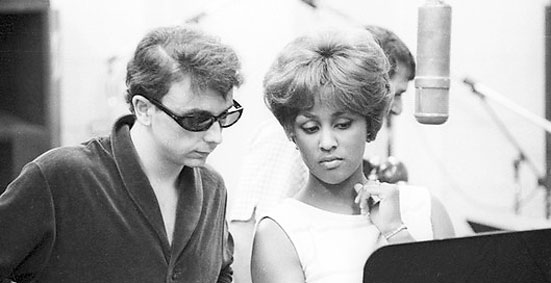
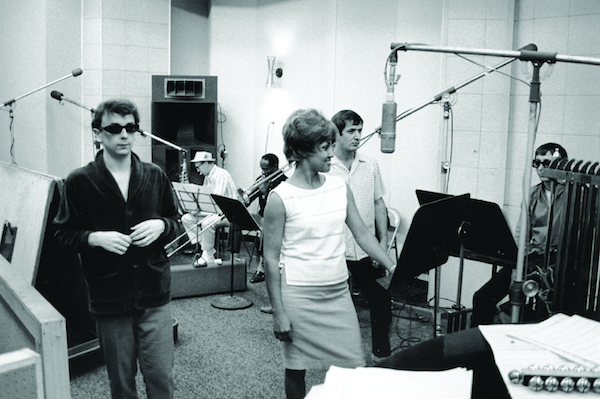
Darlene Love‘s Christmas (Baby Please Come Home) is massiveness incarnate. Invulnerable, invincible and right at the top of the Christmas tree when it comes to the best musical festive fare ever recorded. The only original track to appear on Phil Spector‘s A Christmas Gift For You LP, it’s a thumping major to minor rock ‘n roll tearjerker about lost love. Phil Spector originally put it together with the intention of having his wife Ronnie along with the other Ronettes record it. But after a few false starts and failed takes, he quickly realised she wasn’t singing it with the requisite oomph and instead drafted in Darlene Love.
Ronnie recalls her time in the studio with Specctor:
“Phil worked everybody so hard on the album and the days kind of blurred into each other, thinking about it now. But there was a real Christmas party atmosphere in the studio, even though it was the height of summer, and a lot of great musicians were involved. They weren’t that well-known at the time but so many of them went on to become famous in their own right, like Leon Russell. Sonny Bono and Cher were involved in a lot of the stuff too, so was Glen Campbell. We worked hard, though, some days we’d be in the studio for eight or nine hours just doing one verse of one song.”
Darlene was way down the pecking order with Spector. She’d sang lead on He’s A Rebel for The Crystals and had applied her Noo Yoik drawl to umpteen of Spector’s kitchen sink productions, but Christmas (Baby Please Come Home) was one of the first times she’d been allowed to fly solo and, as you’ll know if you’ve heard the record, she soars gloriously.
The song was released with high hopes ahead of Christmas 1963, but in a bizarre twist of fate found itself released on the very day JFK was assassinated in Dallas. Holiday spirit instantly ruined, the record failed to find airplay amongst the bulletins lamenting the President’s death and was quickly withdrawn from sale. What could’ve been the greatest Christmas number 1 of all time never came to be.
Darlene Love – Christmas (Please Come Home)
Spector loved the finished version. So much in fact, (and no doubt stung by the record’s withdrawal), he felt the record had year-round appeal. Such a brilliant cacophony of sound shouldn’t be kept under lock and key and only let out for one month in twelve, so he asked Jeff Barry and Ellie Greenwich to re-write it as a ‘boyfriend song’. Minus a few sleigh bells but not much else, it still sounds brilliant, yet somehow not quite right. Years of associating it with Christmas makes it a bit of a strange one.
Darlene Love – Johnny (Please Come Home)
This version was hidden away on an obscure b-side and failed to live up to Spector’s wish. Indeed, not a lot of people know it even exists. There you have it.
There were a few Whistle Test repeats on BBC4 last week, one of which jumped out at me. Nick Lowe was leading Brinsley Schwarz through a great, soulful version of Surrender To The Rhythm, a track from their 1972 ‘Nervous On The Road’ LP. I’d never knowingly heard Brinsley Schwarz before and I was getting into the song’s groove when it hit me: That wee occasional keyboard riff! The phrasing in Nick Lowe’s delivery! I’ve heard this song before!
Placed in time somewhere post glam and pre punk, Brinsley Schawrz were part of the pub-rock movement, a gritty, back-to-basics scene where ‘real’ musicians were more concerned with the make-up of their songs than the make-up on their face. Keen and earnest, the scene nonetheless spawned Kilburn & The High Roads, who would morph into the Blockheads, the 101ers (who featured a pre-Joe Strummer John Mellor on guitar) and Dr Feelgood, a major influence on the young, impressionable Paul Weller (to this day, Weller still plays From The Floorboards Up without a plectrum, choosing instead to adopt the open-handed Wilko strum whenever he plays it live).
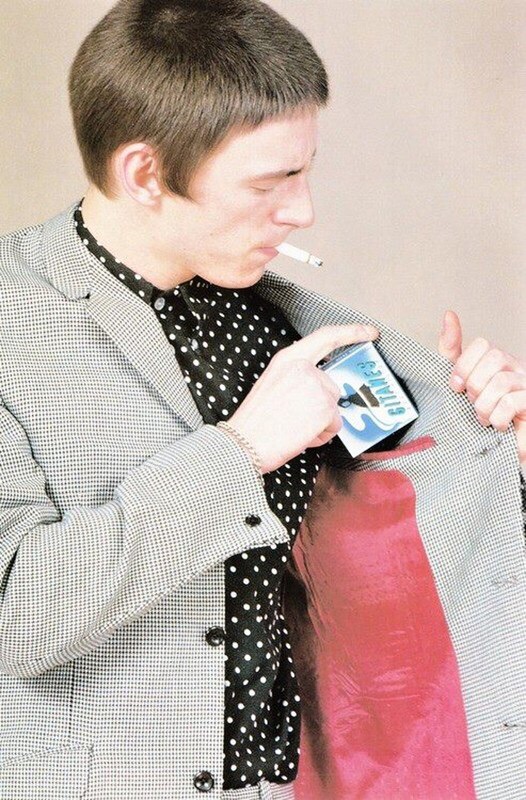
Weller, as it turns out, is more brazen about stealing things than you maybe realise. He has form – not only a strumming pattern from Wilko Johnson but also a career-long vocal delivery cribbed from Steve Marriott, a haircut half-inched from everyone from Worzel Gummidge to Muriel Gray and, more blatantly than any of this, the riff for Changingman that he heartilyappropriated from ELO’s 10538 Overture, something I’ve pointed out before. But long before the heady days of Brit Awards and Stanley Road etc, he was borrowing the mood, the feel and sometimes the chords and melody from more obscure tracks and passing them off as his own work.
Time has been kinder to the much maligned Style Council than the dissenters might have thought back in the day (C’mon! This might cause a row down in Slough, but some of those tracks are ace – pretentious, aye! Ludicrous, aye! But ace – check out Weller’s recent tour for unarguable proof!) They were a deliberate move away from the Jam’s laddism; cricket jumpers, cycling gear, blokes with arms draped around one another, Weller at the back, pastel sweater hanging off his shoulders like a C&A catalogue model. All reference points lay somewhere between Dusty In Memphis, Curtis in Chicago and tongue firmly in cheek, and you either got it or you harked back to a time when Eton Rifles was the only thing that mattered.
Their debut single Speak Like A Child (in itself the title of a Herbie Hancock LP on Blue Note) is to this day a high point in The Style Council’s back catalogue, even if (as if turns out) you really have heard it before. With its breathy vocal delivery and airy Hammond lead, it isn’t entirely a million miles away from Brinsley’s Surrender To The Rhythm. Contrast and compare:
Brinsley Schwarz – Surrender To The Rhythm
The Style Council – Speak Like A Child
Not content with pilfering blatantly from the past for his more soulful numbers, Weller went on the rampage through the more obscure parts of sunshine pop, alighting at Harper & Rowe’s 1967 bossanova boogaloo The Dweller and stealing the best bits for Have You Ever Had It Blue? This track was a highlight of the recent tour, the band kicking out the jams to play their blue notes under blue lighting, an inward-looking circle of nodding, noodling jazz-heads, but how many of the appreciative audience knew they were in effect listening to a carefully restructured cover version?
I’ve always loved The Style Council’s track, with its Gil Evans-arranged trumpet motif, the non-rock time signature and wordless Dee C Lee doo-be-doo backing vocals. As a 16 year-old, I thought Weller was a bit of a genius for having ‘written’ something so finger clickingly jazz. Great tune ‘n all that, Paul, but really, how did you manage to get away with it?
Harper & Rowe – The Dweller
The Style Council – Have You Ever Had It Blue?
*Bonus Track!
Here‘s The Style Council‘s With Everything To Lose, essentially the first version of the above track. No brass, different words, carefree flute etc etc
McAlmont & Butler will, for many, be forever known as ‘one-hit wonders’, the answer to a thousand pub quizzes thanks solely to the dynamic duo’s three octave, four minute single Yes. That it’s a sensational record is not up for debate. The full-length version is particularly thrilling, all reverb ‘n twang ‘n handclaps ‘n kitchen sink thrown in for good measure.
But they have another, far less well-known track that is almost just as skyscrapingly brilliant.
During the sessions for what would’ve been the duo’s third album, aborted after Butler teamed up with his ex Suede partner in crime, Brett Anderson, for the short-lived Tears project, they recorded Speed.
It starts off slow and measured, kinda like a soulful cousin of the Jesus And Mary Chain’s Sidewalking, but while the JAMC fling a bucket of feedback and forced Americanisms over the lot of it, McAlmont & Butler continue where they left off on Yes. If Dusty In Memphis had been Dusty In East Kilbride….
Faster than the Bullet trains in the eastit goes, before the guitar, electric and wired, zooms off out into the air and the female choir come in on the chorus.
Lazy folk might point to the fact that it seems to take its cue from the Yes blueprint – deliberately mid-paced with tumbling toms, a Spectorish percussive backbeat atop sweeping strings, Butler’s guitar heroics and up-strummed chords, that sensational triple-octave vocal, but that would be to ignore the fact that Speed is something of a masterpiece all by itself.
It may be mid-paced, but I swear that by the time it floats and flounces its way to the end, it’s slightly faster, slightly louder and slightly further burrowed into your brain. You won’t even realise you’re doing the measured handclaps until you catch a sight of yourself doing a Jagger pose into the mirror, feather boa ‘n all. At least, I didn’t.
It’s a shame that after being released on 7” and download, it managed only to scrape to a lowly number 193(!) on the charts.
Who knew the charts went that far back/down?
Had Speed been released 9 years earlier in 1995 as the follow-up to Yes, it’s a stick-onthat McAlmont & Butler would never have been left on the shelf alongside those other pub quiz answers Baha Men, Nena and 4 Non Blondes, even if they’re as far removed as possible from the talent-free lucky hit makers just mentioned – their recent tour had rave reviews every night. But you knew that already.
I can vividly remember sitting in a physics class in 2nd year of school. Mr Hill was explaining how it was possible for a radio audience listening in Paris to hear the first notes of a song in the Albert Hall, London, marginally before the audience in the back row of the venue. Something to do with sound waves and frequencies and the speed of sound in a vacuum, he explained. Actually, I’m just making this part up. I have no idea how it works, which maybe explains why I never elected to take physics beyond the basic foundation level. It’s mind-blowing and all that, but really, who gives a shit?
Well, maybe some of last night’s audience in Glasgow’s Hydro. Officially the 3rd busiest venue in the world (behind London’s O2 and New York’s Madison Square Garden) it’s a beast of a venue. Filled to capacity most nights of the week, it’s hosted all the big acts since opening a couple of years ago; Prince, U2, Taylor Swift, all the hot tickets come to Glasgow’s Hydro where, for the majority of the audience they appear like Lego versions of the real thing, far off in the distance, or, plooks ‘n all, on two massive video screens suspended either side of the stage.
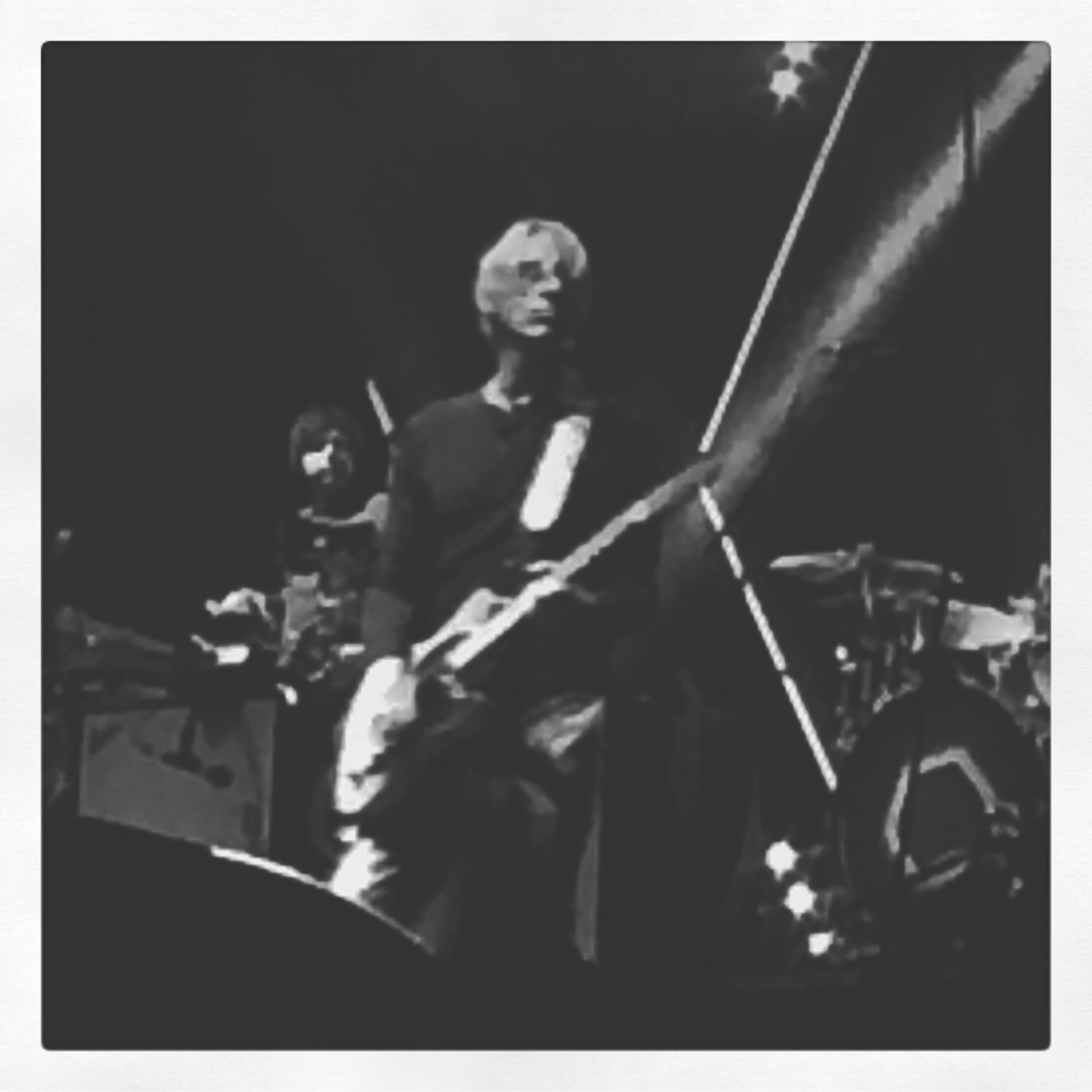
Some of the seats in the Hydro are in a different postcode to the stage. Others may well be in a different time zone, such is their distance from the action. Any old mod tuning in from Paris last night may well have heard the first bars of Long Hot Summer (yes!) before those poor folk head to toe in Pretty Green way up there at the back. Which means those Parisians would’ve had the first inkling that Paul Weller last night was on fire, raging with emotion, attacking his guitar like the angry young man he once was and still defiantly kicking against the pricks.
CLANG! (That’s the sound of a name about to be dropped….)
Johnny Marr told me recently that he’d never deny his audience the chance to hear the choicest of cuts from his stellar Smiths’ catalogue. Why would you, he said, when he enjoyed playing them and the audience wanted to hear them. Yes, he’s proud of his most recent work, but he’s equally proud of the songs that got him to where he is today. Weller, it’s pleasing to note, has done likewise.
A lengthy and epic career-spanning 28 song set-list was played out to his usual audience; aulder and balder with a touch more spread around their middle-aged waists but still bellowing and punching the air in celebration like it was ’78 or ’82. Or even ’95. Jam songs (for such a long time the missing link in his set) followed Style Council songs (for such a long time the missing link etc etc) which followed early solo classics which were followed by tracks from his current patchy but it-makes-sense-in-the-live-arena Saturn’s Pattern LP. In fact, almost every facet of Weller’s career was represented tonight. I think the only phase not acknowledged was his Wild Wood LP, which is really saying something, bop-bop-shoobeedoo-wop. You could sit right now and write a brilliant 28 song set of the tracks he didn’t play, but that would be churlish. Weller’s set tonight was carefully thought-out and paced. I’d even go as far as saying that this was the best I’d ever seen him.
Kicking things off in an understated fashion with the snappy one-two of I’m Where I Should Be and Long Time from the latest album, he was quick to dip into the depths of his stupendous back catalogue. The Jam’s Man In The Corner Shop was followed by Ghosts from the same era. The wham-bam bossanova of The Style Council’s Have You Ever Had It Blue came immediately after My Ever Changing Moods, Weller’s foil Steve Cradock doing his best Curtis Mayfield impression on the wah-wah.
The sideman was on fine form tonight, let loose on expanded versions of Up In Suze’s Room and Porcelain Gods. Into Tomorrow was recast as a dubby, spacey sprawling epic, as expansive as the waistline on some of those old mods’ sharply-creased trousers. Elsewhere, we had a slightly-too-slow take on Start!, a sublime Above The Clouds which sounded like a long-lost cut from Marvin Gaye’s What’s Going On LP, a spiky ‘n snarling Peacock Suit, a rare outing for lost single Starlite, a fantastic wigged-out version of The Jam’s In The Crowd and ooh, more than a handful of other crackers. It all finished off in the 2nd encore with a celebratory run through of Town Called Malice, Weller breaking into a smile as he bashed his tambourine into the microphone. He’s fast-becoming the English Neil Young; both have 3 distinct phases of their career, both can by awkward and bloody-minded, both are happy to give you epic sets filled with jam-heavy breaks (no pun intended) and they can both effortlessly switch from rocker to ballad to piano to electric guitar and back again. He’s alright, is our Paul.
via @BazzaMills on Twitter
The hardest-working man in the Hydro was undoubtedly Weller’s sound man. Those recent albums have been dipped in atmospherics and electro whooshes and the soundman sprinkled his magic dust over every track tonight, Weller’s voice echoing off and out into the ether, drums ricocheting around the room. This wasn’t just a bog-standard plug in and play gig, it was an all-encompassing, multi-sensory event. Sound and vision, to steal a phrase.
When Weller next returns to Glasgow, I’ll be surprised if it’s to the Hydro. He enjoys Glasgow, it’s always a fixture on his tour, but his gigs here have followed a pattern over the past decade or so. A gig at the Barrowlands was followed by an up-scaling to the Armadillo. He returned afterwards to the scuzzy setting of the Barrowlands. Next time round, he popped up in the rarely used for gigs Braehead Arena, before coming back once again to the Barrowlands and its familiar sprung dancefloor. He’s at his best in the smaller venue, where he can make real contact with the audience and create a true communion. I doubt if many artists can honestly say that about the Hydro, regardless of how popular a venue it has quietly become. “Nice gaff!” remarked Steve Cradock at one point. Yes, but it’s just that wee bit big, isn’t it?
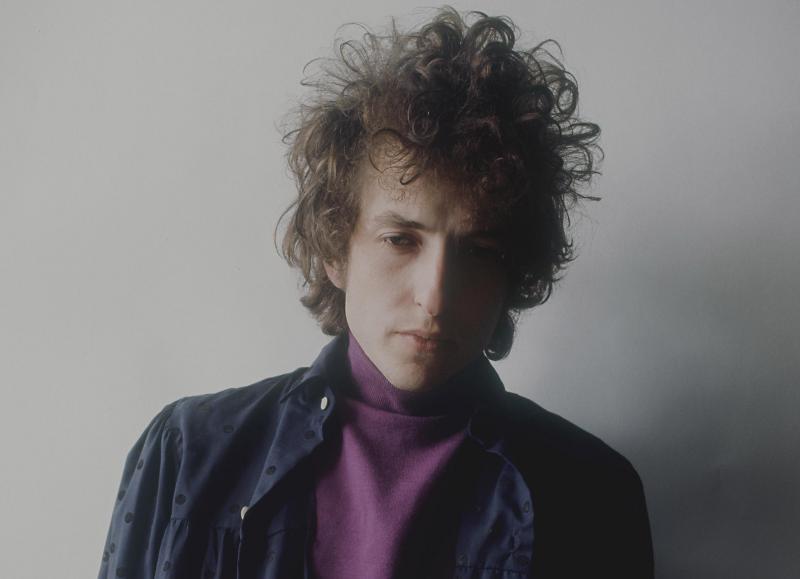
In ‘No Direction Home’, Martin Scorsese’s Bob Dylan bio-documentary, a twinkling-eyed Bob recounts how he stole essential folk and blues records from a friend. “Just being a musical expeditionary,” is how Bob put it. Clearly, the records had an influence on the young magpie-eyed Zimmerman, and you could argue that they helped shape his first few forays into songwriting. You could even argue that it was a good thing he liberated the vinyl – he might never have written the melody to a song like ‘Girl From the North Country’ or ‘With God On Our Side‘ without them. Someone else’s loss is everyone else’s gain. Think about that for a minute.
I’ve been living for the past few days with the latest, stupendous collection in the Bob Dylan Bootleg Series. Volume 12 (entitled ‘The Cutting Edge’ – which is exactly what it is) comes in a multitude of wallet-busting formats. Keeping in line with my purchases of the previous 11 collections, I went for the sensible 2CD version. It’ll fit snugly on the shelf next to the rest of them, a glorious potted treasure of some of the very best bits of Bob’s previously unheard work.
When this edition was first announced, there was a collective frothing of the mouth from Bobcats the world over. At the very top of the scale was the Deluxe 18 CD version, containing every note, every mis-placed harmonica parp, every cough, splutter and stumbling intro that Bob and his band had committed to tape in the whole of 1965 and 1966. A whole two years-worth of Bob outtakes from his most golden period – the alchemist at work, the ‘thin, wild, mercury sound’ in creation. A Dylanologists dream. And nightmare. Have you seen the price tag?
“A steal at $600!” remarked my pal in an email. “Which is exactly what I’ll be doing as soon as it makes its way into the darkest corners of the internet!”
And now that those 18 CDs have indeed made themselves very comfortable in a dark Dylan-shaped corner of the world wide web, steal them we did. Someone else’s loss is everyone else’s gain, and all that jazz.
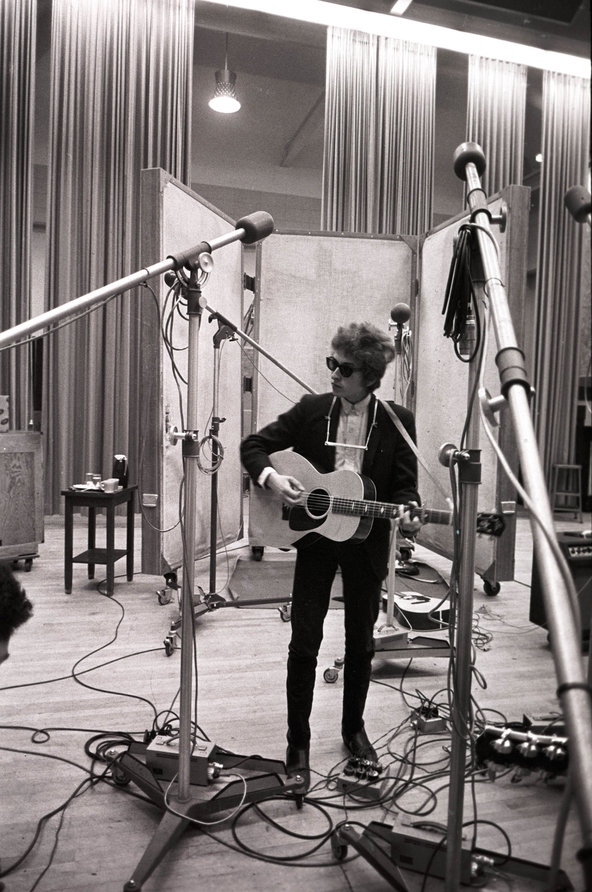
What is there to say about the recordings? That they’re fantastic almost goes without saying. It’s a wonderful glimpse into Bob’s psyche, into his working process in the recording studio. The collection quickly debunks the myth that Bob was a spontaneous worker, that he pulled the songs from the air, assembled his band and recorded them in the time it took to batter through them.
Bob Dylan – Visions Of Johanna (Take 7 Complete)
There are multiple versions of every track. Some replayed as frantically scrubbed skifflish Bo Diddley rockers, some as barrel house blues worthy of a scene in Boardwalk Empire. Many sound like the versions you know and love, half-baked and not quite right but essentially the blueprints for the finished versions. The sequencing of each track takes you on a journey from first sketch to final run through, a trip that’s often wild and wandering, but never less than thrilling. Stinging electric guitars vie for your attention with honey-coated keys and rasping brass, though central to the mix is always Bob’s voice; close-miked in the acoustic ones, bawling like a garage band rocker in the fast ones, all the time (to quote David Bowie) that perfect mix of sand and glue. Anyone who says that Dylan can’t sing is a moron, right?
Bob Dylan – Just Like A Woman (Take 16)
Now and again a favourite track will pop up disguised as a New Orleans funeral dirge or a full-blown electric rocker. It can be good fun playing ‘name that tune‘ or spotting a lyric from one song that finds itself embedded in a different song by the end of the session. And Bob has a wicked way with a title. Whether or not he has the ‘real’ titles in his head or not, he plays merry havoc with the engineer.
“83277 Leopard Skin Pill Box Hat Take 1”
“No! No! This isn’t Leopard Skin Pill Box Hat…this is Black Dog Blues!”
“Oh…I’m sorry…Everyone’s startin’ together. Right on the beat. Black Dog Blues Take 1. I want everybody together from the top and all the way through, because one take is all we need on this, man. It’s there! Ok! We’re rollin’ on one…”
And what follows are umpteen takes of Obviously Five Believers. Obviously.
Dylan’s wild phrasing is all encompassing throughout. He runs through Stuck Inside Of Mobile With The Memphis Blues Again a gazillion times, each time the melody stretching and bending just a little bit further than the previous time, but clinging gamefully to the tune the way a rowing boat might struggle to keep course on a choppy sea. He can make whole verses fit into two lines, and he can make a couple of lines stretch to a whole verse with his eee-long-gay-ted approach. S’beautiful!
Bob Dylan – Stuck Inside Of Mobile With The Memphis Blues Again (Take 1)
The studio chatter is what you pays yer money for. You can be a fly on the wall in New York or Nashville as Bob painstakingly arranges and rearranges lyrics, verses, whole tunes. His band, while handsomely paid, remain extremely patient. During a handful of takes of Tombstone Blues, Bob continually chokes over the same line.
“Aw man!” cries Bob. “I’m sorry!”
“Would it help if you put the lee-rics on a stand, Bob?”
“Naw, it wouldn’t, man!”
And off they go once more, the beat group backing their Messiah jester until he gets what he hears in his head out his mouth and onto tape. It’s all ridiculously essential music. But you knew that already. Here’s a rollickin’ fuzz bass-enhanced run through of Subterranean Homesick Blues, never before available until now.
I read something in particular last week that made me laugh. It was one of those internet memes that litter the floor of social media. This one poked fun at Liverpool FC. To paraphrase (as I can’t find it right now), since the last time Liverpool managed to win the league, Wayne Rooney has been born, grown up (that’s debatable, but still…) and won the league half a dozen times or whatever with Manchester United. It ended by declaring loudly that no Liverpool fan had ever Tweeted “We’ve won the league!” as Twitter hadn’t been invented the last time they’d done so. Clearly written by someone wearing Salford-tinted sunglasses, it grabbed my attention for a wee while at any rate.
Some things in life happen so infrequently, they’re considered extra special. A view of the Aurora Borealis from Irvine Beach (I can’t believe I bloody well missed it too!) The Persoid meteor shower (ditto – too cloudy above my house). That Liverpool league win (I was old enough. Even with Kenny Dalglish in the ranks, it meant nothing to me.) Or Scotland playing at the World Cup on a flat screen telly. No Scotland fan has ever hash-tagged a tweet with the sign-off #tartanarmyworldcupfinals, that’s for certain.
These events are so special, if you happen to be one of the lucky ones who experience the seismic moment, you’ll be asked to recount your version of events every week until the next time it happens. My pal is still talking about splashing about in some Parisienne fountain in 1998 wearing nothing but a Jimmy hat and a Gendarme-friendly smile.
There are parallels with music, not least the welcome return of oor ain Trashcan Sinatras. Their last album ‘In The Music’ still regularly rotates on the more discerning stereos of the land as their owners pine for a new album, or a new EP, or a new song, or a new chord, or a new anything from the band. It’s tough being a Trashcans fan.
The Hardest Working Band In Slow Business have eeked out a career stretching a quarter of a century and more. In this time, more popular bands have come and gone. Yet, foregoing all fads ‘n fashions, the Trashcans have ploughed on, surviving bankruptcy, revolving bass players, trans-Atlantic recording sessions, rip-off managers and somehow, in 2015, they’re still around making beautiful records.
For the past few months they’ve been encouraging their steadfast fan-base to pay for the next LP in advance via Pledge Music. Unsurprisingly, the band met their pledge and have since comfortably exceeded it. Also unsurprisingly, an LP originally earmarked for a September release remains tantalisingly just out of reach, in the can but not out the bag. We TCS fans are used to delays. A few months delay might see the career of some fashionable bunch of pointy boots ‘n haircuts come and go in a blaze of mis-placed hysteria. Trashcans fans simply stick the kettle on, play any one of the band’s other 5 albums and wait. And wait. And wait. Until…
…an email lands informing you a new track ‘Best Days On Earth’ is available for download.
A Pledgers-only exclusive (so no free downloads here, I’m afraid), it’s greedily downloaded and before you know it, champions of the band including Billy Sloan at BBC Radio Scotland and Gideon Coe at 6 Music are releasing it across the airwaves and out into the ether. A new Trashcans track is born and born free. And wouldn’t you know it? It’s a cracker.
Trashcan Sinatras – Best Days On Earth
It’s bearing all the hallmarks of a TCS classic – on first listen it’s the melody that gets you. Frank’s half crooned, half swooned vocal surfing atop a mid-paced grower. It’s possibly the most ‘pop’ thing they’ll release. By the second listen it’s all about the counter melodies, the wee ‘ooh-ee-ooh-ee-oohs‘ in the outro. Third listen in a row and the lyrics start worming their way into the brain – a roll call of loved ones and relatives no longer with us imploring us to make each day count –
The heart is designed to run out of time
There’s no pause and rewind
The transmission’s live…
Along with the rest of the LP (to be called Wild Pendulum) it’s put together with the help of Simon Dine, the mastermind behind the trilogy of “I’m Back!” Paul Weller albums, from the ‘return to form‘ of 22 Dreams, continuing with the full-on sonic assault of Wake Up The Nation and ending with the fall-out sputter of Sonik Kicks. He’s added his trademark 60s samples – John Barry jangling keys, Spectorish sleigh bells and wrapped it up in a warm and woozy production.
The best thing is, having been lucky enough to get a lid’s ajar, peak inside the box (Oh aye! When that email popped in my in box, that was one of my Best Days On Earth), I can confidently say that Best Days isn’t even the best track on the LP. There’s a track called What’s Inside The Box which may just make your heart melt; slide guitar easing out into orbit on a wave of wah-wah, breathy vocals, stoned parping Bacharach trumpets and Beach Boys harmonies sung quite possibly by Frank’s ‘other’ singing sister. Anyway, now I’m teasing. Bet you can’t wait.
That Pledge page is still taking orders by the way. Go here now. You won’t regret it, or I’ll give you your money back.
UPDATE FROM FRANK READER 10th November…..
It’s always nice to hear from yer actual Frank. After reading this piece tonight he sent me the following information;
Just read the ‘piece’ on us there – thanks, Craig! I’m glad to hear you like WITB too – that’s a lassie called Susan Sanchez singing, not another Reader. And FYI, Simon didn’t produce the album. He co-wrote some songs with us and supplied some instrumental loveliness, but it was Mike Mogis who pulled it all together, and it was another of the Bright Eyes guys, Nate Walcott, who played all those crazy keys – couple of wunderkinds, those two.
Oops! Lots of misinformation from these hands. Now you know.
Six Of The Best is a semi-regular feature that pokes, prods and persuades your favourite bands, bards and barometers of hip opinion to tell us six of the best tracks they’ve ever heard. The tracks could be mainstream million-sellers or they could be obfuscatingly obscure, it doesn’t matter. The only criteria set is that, aye, they must be Six of the Best. Think of it like a mini, groovier version of Desert Island Discs…
It’s all the fault of James Grant that by 1987 I had beige chinos, a battered Levi’s denim jacket (later to be autographed/ruined by four fifths of the Inspiral Carpets outside Level 8 at Strathclyde University) and a mile-high quiff that was impossible to control. It didn’t matter whether I used half a gallon of goo every morning or battered it into shape with builders’-strength Brylcreem, by 2 in the afternoon it was wild and wayward and wavering in my eyes. Most folk at the time assumed it was in tribute to Morrissey, a reasonable assumption given that The Smiths were Kings of our world, but an assumption that was off the mark. If you’ve been reading the past couple of weeks, you’ll know that I was always far more of a Johnny fan than a Morrissey fan, and while I had a similarly collapsing coiffure (“…the rain that flattens my hair, oh these are the things that kill me…“), it was always modelled on the wee skinny frontman from Love & Money. Somehow, much to my annoyance, his never moved an inch. Which begs an obvious question….
“Haha! I didn’t use a lot of ‘product’. Maybe some Boots gel that everyone used in those days. With a wee touch of hairspray. Stick that on it and the quiff would stay like that for a week. I think I once mentioned on TV that I used Ellenet hairspray and the next day the record company took a call from them. I have what you call ‘a good head of hair’, so I never really used much. There was certainly no magic trick or anything!“
So. In the days before the internet there was Ellenet. If only I’d known…
James is a super-talented musician. Since his teens he’s been writing songs of substance that would put a writer with twice his experience to shame. In Love & Money he could effortlessly switch from neo Young Americans blue-eyed soul to sophisto-pop to Chic-esque rinky dink guitar riffing, and he couldn’t wait to fire off a flash guitar solo as slick as whatever it was that held his beautiful hair in place.
As a band we were lucky. In the early 80s, Glasgow was the epicenter of the music world. Edwyn and Clare Grogan were our standard bearers, bringing Glasgow pop to the world. Every gig we played, there were record company folk standing there waving cheque books at us. It was ridiculous but totally fantastic – everything we’d ever wanted was coming true. Love & Money signed a publishing deal and recording deal with Phonogram. They were responsible for putting out Dire Straits ‘Brothers In Arms’ – what’s the statistic? One in every 3 homes owns a copy on CD? Well, they had money to burn, and without being mercenary about it, if they weren’t spending it on us, they’d be spending it on someone else.
We ended up in New York recording studios, in LA, making videos in Tokyo. It was all quite ridiculous. Here I was, brought up in Bridgeton and Castlemilk, swanning about in some far-off place, being indulged with millions of pounds being spent on us.
My dad didn’t believe what I did for a living. He was a bin man. He’d worked as a store man in the Tennent’s Brewery. He’d fought the fascists in the Second World War. ‘You’re a whit?!?’ he’d ask. ‘A song writer?!? In a group?!?’ To him, only folk like David Bowie made records and appeared on telly. ‘Where were you this weekend?’ he’d quiz. ‘London, aye? Whereabouts? Bayswater? I know Bayswater quite well. Where did you stay?’ He genuinely didn’t believe I was doing the stuff I was doing. When (first single) ‘Candybar Express’ came out, we went on Razzamataz (Kids TV Programme) and I sat down with him to watch it. He looked from the telly to me and back again and I think then the penny dropped.
Duran Duran’s Andy Taylor took production duties on Candybar Express, a track that was promoted to within its life of an actual Top 40 chart placing. Subsequent singles always seemed to fall just as short, but while it was disappointing not to have chart success, they were given the opportunity to record the follow-up with Gary Katz, famed for his production duties with Steely Dan. Can you imagine any band today being afforded such a major label luxury? If you haven’t cracked the Top 3 with your first single (is there still a Top 3? Are there still charts?) you’re considered an ‘epic fail’, or whatever the parlance of the day is. Love & Money would go on to record 3 more LPs, to diminishing commercial success, but to much critical acclaim.
Third LP ‘Dogs In The Traffic‘ is my personal favourite, a view shared by The Scotsman who voted it the 30th best Scottish Rock and Pop Album Of All Time, just between the random pairing of Wet Wet Wet’s Popped In, Souled Out and Donovan’s Sunshine Superman (and 12 places higher than Love & Money alumni The Bathers’ Kelvingrove Baby). Opener Winter could almost be George Michael’s A Different Corner before it morphs into a multi-layered tasteful guitar wig-out. Johnny’s Not Here has a coda that could be straight off of the Sign O’ The Times LP.
Love & Money – Johnny’s Not Here
Elsewhere, muted trumpets fight for ear space with keyboard stabs, weeping pedal steel, the odd brass section and the occasional orchestral sweep. All this is incidental of course, as James’ guitar and vocals are central to a production worthy of a Dulux endorsment. Bluesy one moment, and finger picked with all the deftness of Bert Jansch the next, his instrument is the perfect foil for his voice, a voice that resonates with all the depth of a life lived in song. Mature and introspective, throwaway pop this is not. It also happens to be James’ favourite L&M LP too.
“Artistically, it’s my best body of work. I find it difficult to listen to. You might gather from the lyrics that I wasn’t in a happy place when I wrote it, it took a lot out of me, but it’s gained a longevity that I’m really proud of.”
James Grant is the real deal. If you don’t believe me, seek out any of his subsequent 5 solo albums and you’ll find out for yourself.
These days, James isn’t a touring artist in the traditional sense – he rarely puts together 15/20 date tours or leaves home for a month on the road. He’s more selective where and when he plays and as a result, is one of the hottest tickets in town. Ahead of this Friday’s (6th November) sold-out show in Irvine’s Harbour Arts Centre, James took time out to give us his Six Of The Best.
This slideshow requires JavaScript.
Slade – Cum On Feel The Noize
This was the first record I ever bought. 25p in Woolies, Castlemilk. I was really excited by the record. I loved Slade, and Cum On Feel The Noize is a brilliant record. I met Noddy (with Lemmy, believe it or not) after one of our shows at The Marquee. Lemmy suggested we enter the stage from a giant inflatable vagina, wearing buffalo horns. A while later, Noddy was a guest on Round Table. Our track ‘My Love Lives In A Dead House’ was one of the records played. “That!” declared Noddy. “Is a Number One record!” Noddy had come through for me!
Led Zeppelin – Whole Lotta Love
Led Zeppelin were a big influence on me. I bought a second-hand, scratched copy of Led Zeppelin II from Hi-Fi Exchange. From the opening riff I just thought, “This is it! This is for me!” It was a quasi-religious experience. And Zeppelin were so famous. It was all about the music. Getting into Led Zeppelin was like joining an exclusive club. I wanted to know about music. Led Zep told me.
Talking Heads – I Zimbra
This was also hugely influential. It’s all about the groove. The record just used phonetics and created something new. It’s a very intellectual record. Made by David Byrne, of course. An intellectual man. Hearing I Zimbra for the first time was a musical epiphany.
(By coincidence, this very track was featured here last week.)
David Bowie – Starman
I watched with my school pals when he sang this on that famous Top Of The Pops episode. Is he a boy or a girl? Or an alien from Planet Zorg?!? We just didn’t know. He was just so appealing. Beautiful, alluring, mysterious. Bowie is enormously talented. Even his demos have it. The demo of Lady Stardust when it’s just him at the piano singing it, extraordinary really.
Roxy Music – Love Is The Drug
This is luxurious debauchery. It’s so sophisticated yet easy and it gets me every time. The bass is played with a pick. That’s not how an American band would have done it. Very English. Rather, very European to be more precise. Which, I suppose, was Bryan Ferry’s shtick.
Bob Dylan – Visions Of Johanna
This is one of my favourite songs of all time. Some of the lines in it! The imagery! ‘The ghost of electricity howls in the bones of her face.’ What does that even mean? Yet, if you listen to Dylan, you know exactly what that means. Songs poured out of Dylan. He couldn’t help himself. As a rule, music lyrics should NEVER be compared with poetry…..but this is as close as it gets. Visions Of Johanna bridges that gap.
And there you have it – a perfectly balanced set of tracks very much in the Plain Or Pan mould. I expect you may own more than half of these yourself, but they’d make a terrific little compilation for someone less informed.
It’s also become apparent over the course of this series that David Bowie is the clear leader in the ‘most frequently selected artist’ category. And there ain’t nowt wrong with that.
You can keep up to date with all of James’ goings-on via Twitter @jamthrawn or on his excellent (chords for songs! interactive community!) official web page here.
Me? I’m off down the front on Friday night, big can of Ellenet doon ma jukes.
As fresh as it sounds, this track coulda been recorded an hour ago by some hep band of skinny-jeans ‘n slick-backs from Brooklyn. Listen again and you could be forgiven for assuming that it was spawned a decade earlier in the windswept deserts of Africa, playing out tinny AM radios anywhere between Mali and Mozambique.
The more switched-on amongst you could be forgiven for suggesting Can in one of their relatively straightforward moments; foreign chanting, infused with the groove and with nary an eye on the clock. Squint, and it could even be Happy Mondays around their first album; chiming and repetitive, a hands-in-pockets baggy-trousered circular mooch around the scuzziest parts of town. Slow down the little counter riff that plays between the chanted lines and it’s almost the later-era Loose Fit.
Truth is, it was recorded in 1979 by Talking Heads and featured on their 3rd LP, ‘Fear Of Music‘.
Talking Heads – I Zimbra (LP Version)
It’s African in origin – a twin guitar attack – one playing the incessant, loping guitar riff that rises and falls with the tide of the song, the other playing a demented desert blues somewhere beyond the 12th fret, both fighting for ear space with poly-rhythmic Afro beats pinned down by the muscle of Tina Weymouth’s solid ‘n steady bass.
It’s snake-like, enhanced somehow, someway, by sonic architect Brian Eno. He’s credited with adding guitar to the stew, but I doubt we’ll ever really know for sure. Done in the days before his oblique strategies, perhaps he told himself to play more orange, or something like that. Either way, the combination of musicians, producers, instruments and ambience created one groovy mover.
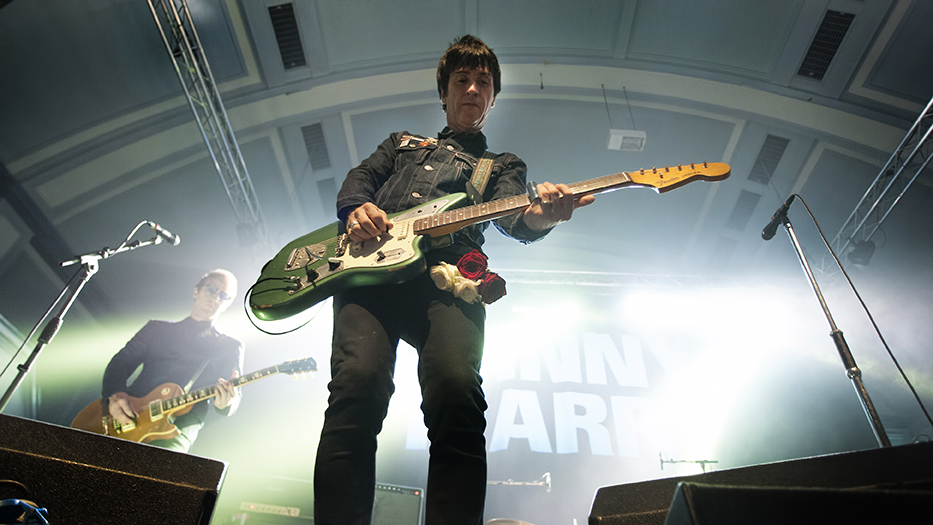
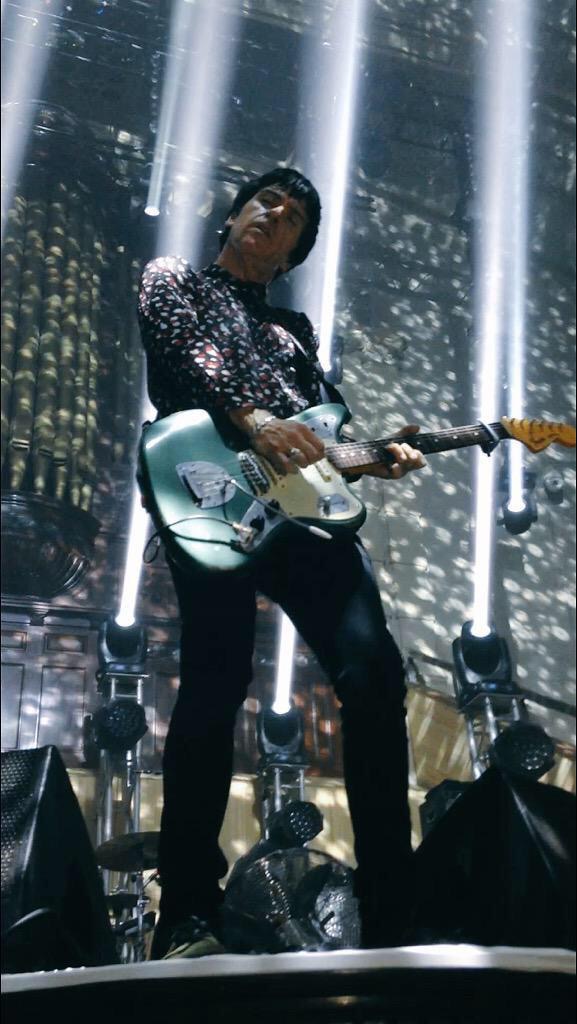
There was a defining moment last Thursday night when Johnny Marr was up in space somewhere, out among the stars and playing his melodies gifted from the Gods, showering the faithful at his feet with little arpeggiated notes of joy. It all happened midway through his celebratory, revelatory gig in Kilmarnock’s Grand Hall, and midway through a pulsing take on Electronic‘s evergreen Getting Away With It. Recast as an electro throb (“This is a disco song from Manchester“) with jagged, edgy guitars, it was accompanied by a pair of stark blue flashing strobes, marching in time to the guttural punch of the bass. As the song reached its peak, somewhere a flick of the switch turned the venue from rave central into a spangled, sparkled music box. The light changed from stark blue to glitter ball white as the music shifted from electro pulse to pure Marr; the chiming, echoing notes cannoning off the turn of the century walls and out into the ether. Surrounded by a swirl of mirrored light careering from a pair of over-sized disco balls and out on the edge of the 6 ft high stage, lost in his own music, it did indeed look like Johnny Marr was on the edge of the universe.
(c) Stuart Westwood
My day with Johnny was a day like no other. I’d interviewed him 2 weeks previously, giving me something of an ‘in’ when it came the time to meet him. I should backtrack slightly here. I’m part of the team who promoted the gig, so I was involved in the set-up of it. This meant me and my giddy head would be around the venue for the day leading up to the show itself. At the end of our interview, Johnny had promised to sign my guitar, and I’d carefully left it by the mixing desk, within eyesight at all times.
He was due to soundcheck at 4pm, and by half 2 I was starving. He wasn’t in the venue as he’d gone off for a jog around the provincial town of Kilmarnock, but I didn’t want to chance nipping out to a shop for a quick sandwich in case my moment would arrive. After the show, I reasoned, it would be pandemonium with people clamouring for his attention – before the show was my best bet at face-to-face conversation. I was having a conversation with his tour manager (about aeroplanes, of all things), when I was first aware of his presence. Some folk will tell you that the room changes when a famous person enters. In typical Johnny fashion, he made his announcement via his guitar. With my back to the stage, a quick blast of distorted blues gave way to the recognisable riff of The Headmaster Ritual. I tried to act non-plussed in front of the tour manager, but my eyes gave it away. He stopped our conversation and wandered off, leaving Johnny playing to an empty Grand Hall, save myself and a disinterested sound engineer by the mixing desk.
(c) this author
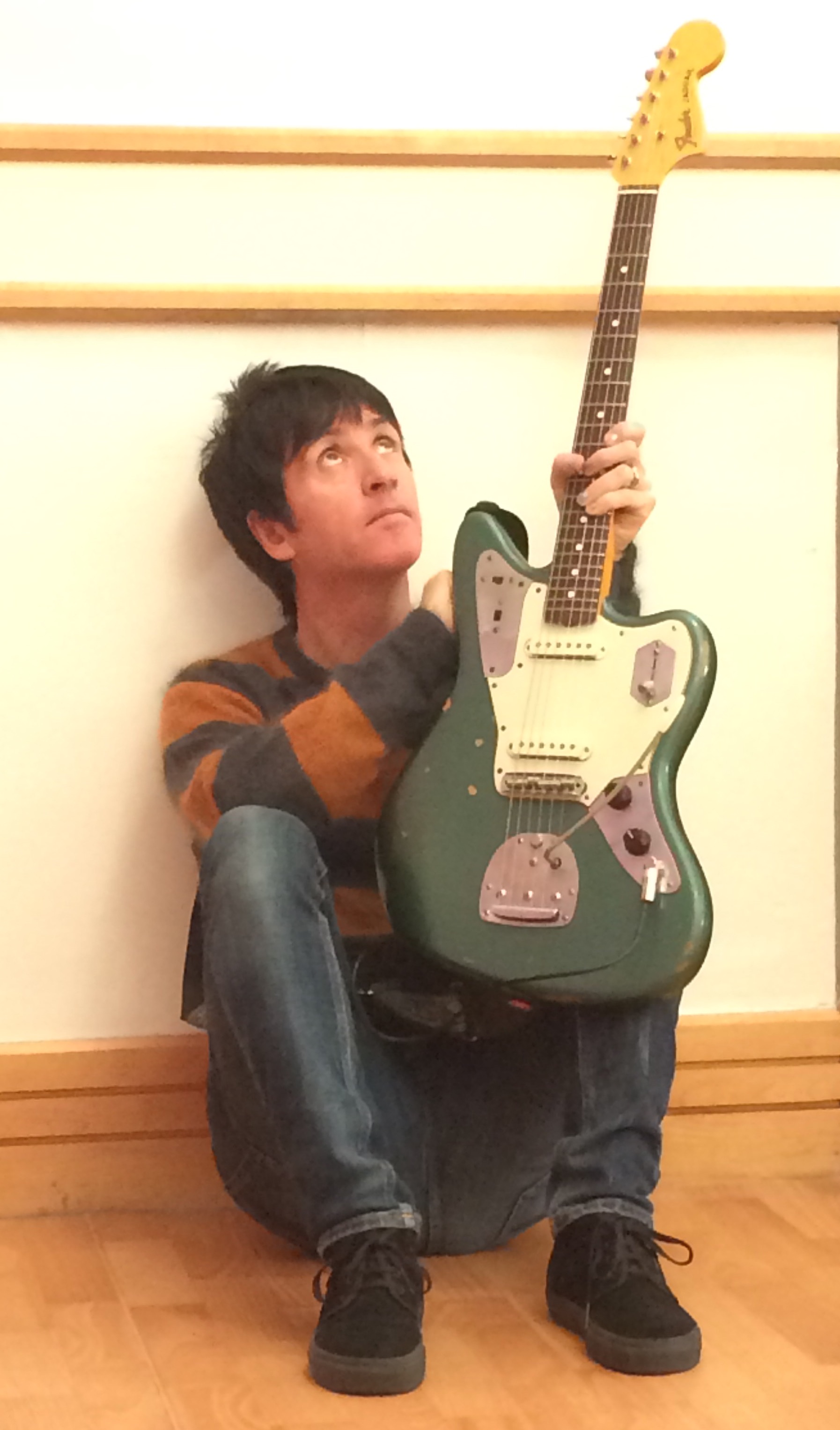
Stone me! It’s Johnny Marr! With cool hair. In a none-more-punk mohair sweater and a pair of jeans my 14 year old daughter might struggle to get into. He’s tiny! Put-him-in-your-pocket tiny! Like a little Lego version of the real thing, he bent down by his pedal board and made a few adjustments, now and again clanging a chord for good measure. Calling his technical team over he explained what he wanted. “When I play with this pedal (Clang! Tchk Tchk Tchk Tchk Tchk… ) I want those little blue lasers. When I use the reverb (Clang! Dun-dun-dun-dun-dun…) I want the subtle wash.” The whole show, it struck me there and then, is as choreographed as a Legs ‘n Co dance routine. Albeit a post-punk riot of Marr originals and Smiths’ classics, but a scripted, well-rehearsed version of spontaneity nonetheless.
Once happy with the instructions given to his lighting guys he bounces off the stage, keenly aware of my presence. “Johnny!” I call out, and he comes over. “We spoke on the phone a couple of weeks ago.”
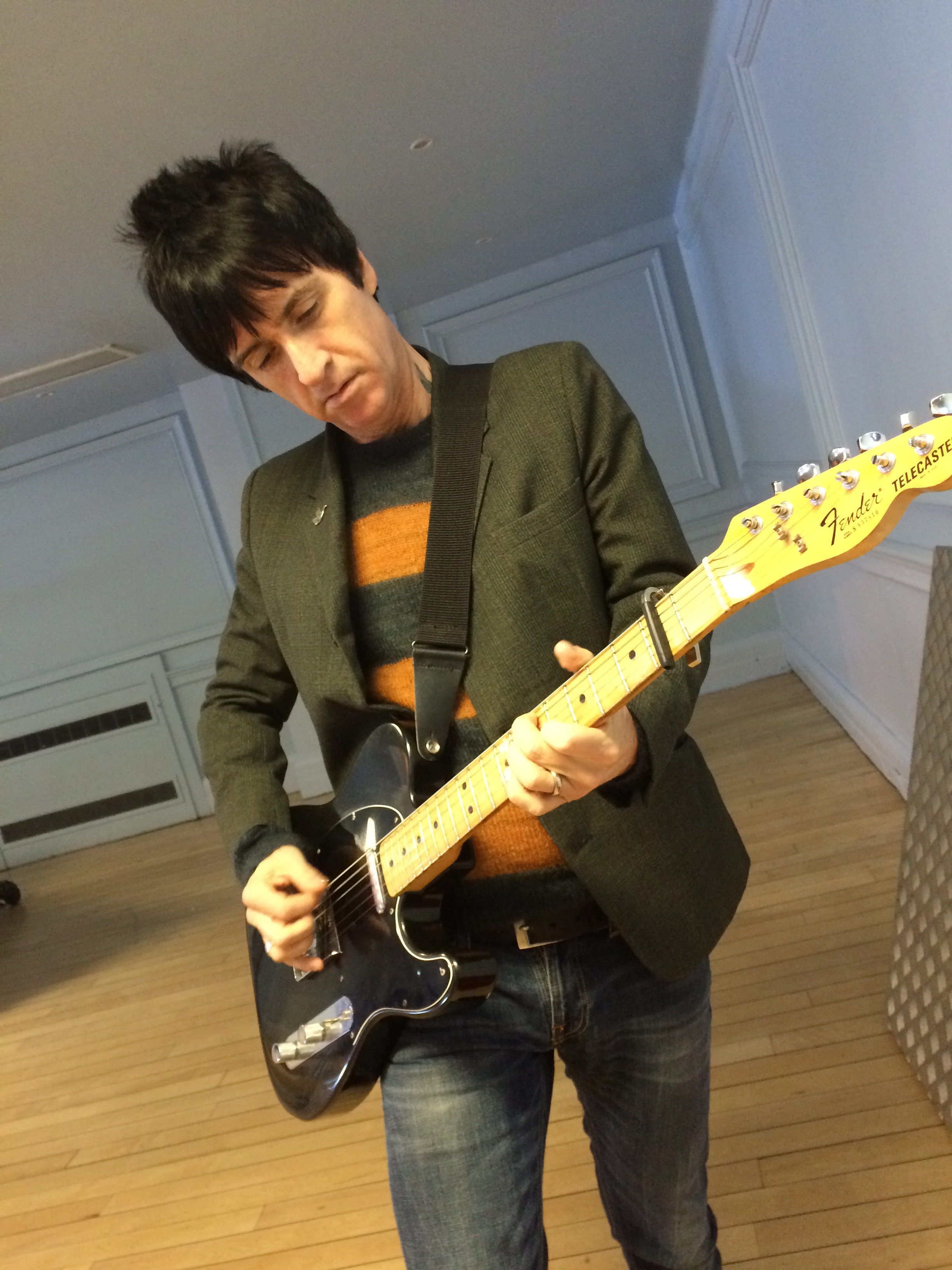
“Craig?!? Great article, brother! How’s your little lad? Still playing his guitar? Did you bring yours then?” and before I’m fully aware of the situation I’m actually in, he’s leading me across to the mixing desk where he’s spied my guitar case. “Go on then! Let’s see it!” and he takes it out of the case, ignoring the Smiths vinyl I’ve stashed there for signing. “I like it….a ’78 you said? Californian? Great – a proper punk guitar!” He turns it over in his hands, casting his eye over the details. “No binding on the neck. I like that. See that knot in the wood there? Love it. Not too heavy….d’you know the green one I played on the Meat Is Murder LP? (of course I know it!) It weighed a ton. This is a nice guitar. You’ve got a good one there.” And then he puts it on. I’m about to pee my pants in excitement.
(c) this author
“What’s your favourite Smiths tracks?” He plays a few Marr-esque open chord runs up and down the neck. This! Can’t! Be! Happening! Then he notices my Queen Is Dead LP, lying expectantly for the caress of a Sharpie. “Have you worked out Some Girls Are Bigger Than Others yet?” And he plays it. Effortlessly and perfectly. He lets me video him playing it too. This is all too much. Of course, I only go and spoil it.
“So,” I say confidently. “Do you use your 3rd finger or your pinky for this part…” and, as he hands me my own guitar, the one I’ve played constantly for 25 or so years, I proceed to tie my fat fingers in knots whilst playing not only the wrong notes but the wrong fucking strings. Some Girls.. is a tune I play regularly, and while I’m not super fluid with it, I’ve never once played it as badly as I do at this very moment. Put it down to big match nerves, but I’ve really let myself down here.
(c) this author
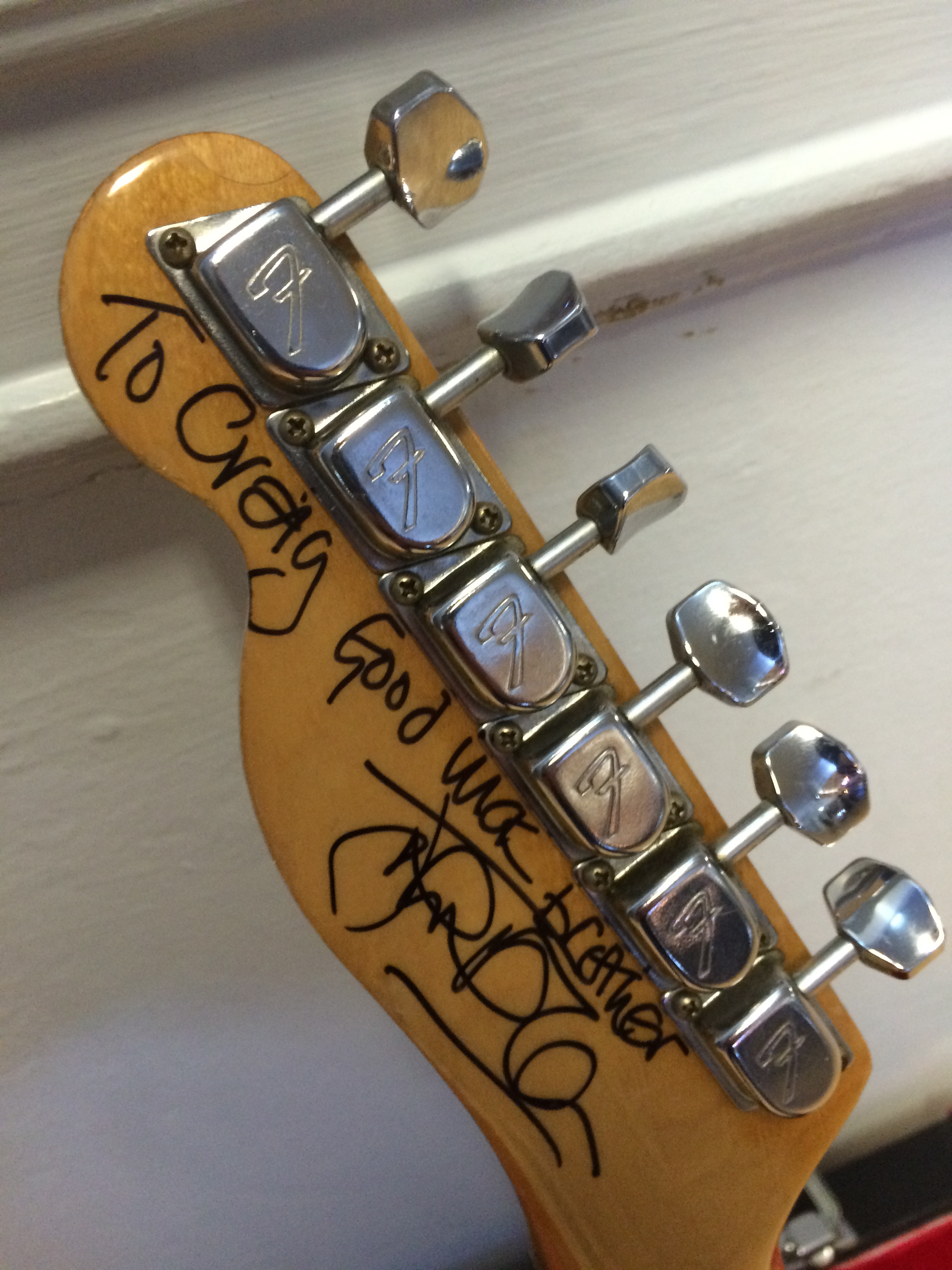
Anyway, our conversation continues for a while. We get pictures, he signs my guitar, he signs my Smiths vinyl, we hug, he says thanks again for writing a great article, (brother) and then he’s off to join his band for the soundcheck proper, where I watch from the balcony as they play their version of Depeche Mode’s I Feel You a couple of times and run through a ramshackle version of The Sweet’s Ballroom Blitz.
“Ever since we announced the Kilmarnock gig, people keep telling me it’s the place where the Ballroom Blitz happened.” (The man at the back said ‘everyone attack‘ was apparently shouted as a fight broke out during a Sweet gig in the Grand Hall in the early 70’s, something that has now passed into local legend.) “It’s not on the set-list, but if it turns out OK in the soundcheck, we might do it in the encore.” As it turns out, they don’t, though Johnny does ad-lib a few lines towards the end of Boys Get Straight.
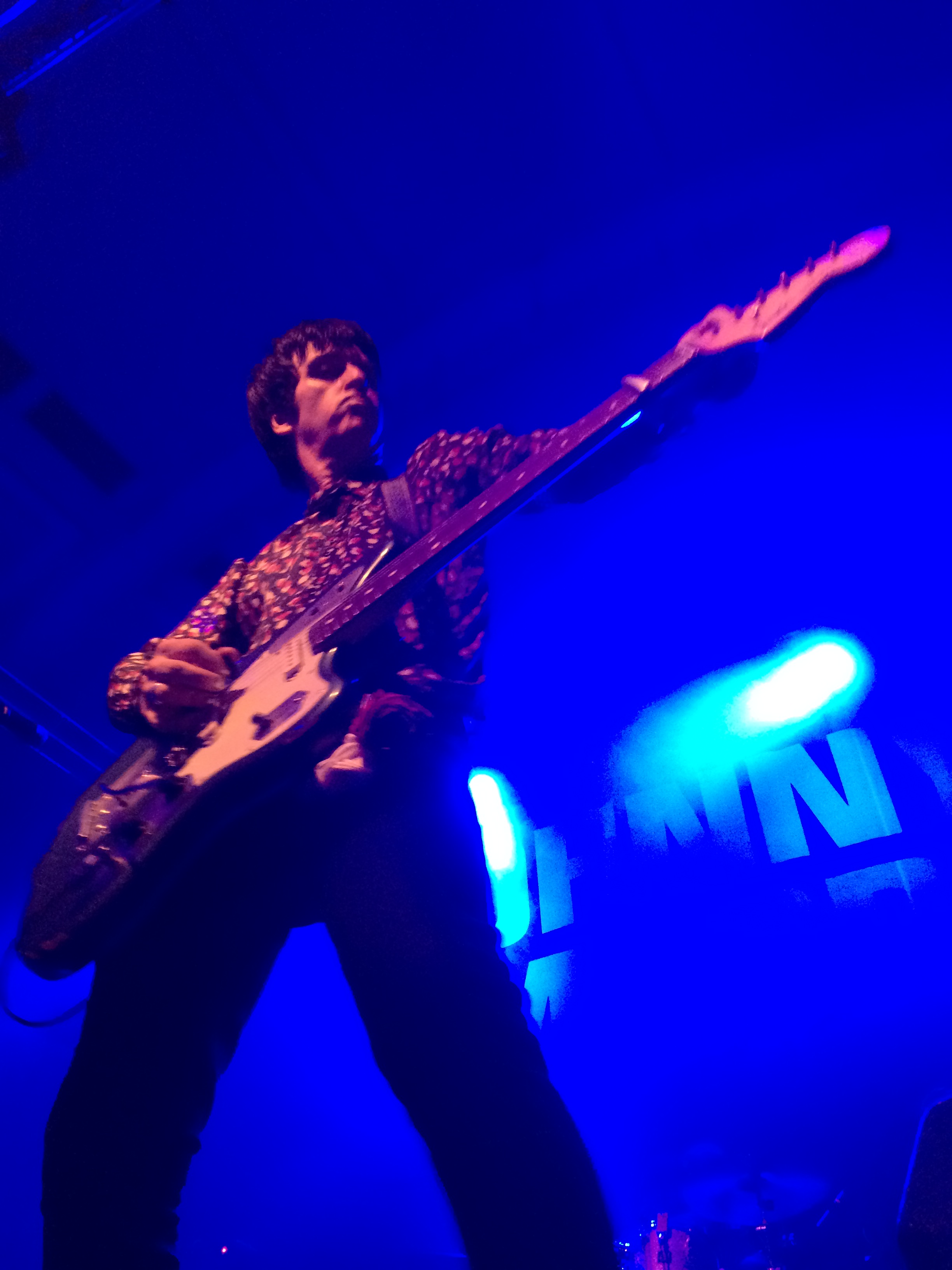
The gig itself? It’s super great, of course. A heady mixture of Messenger and Playland tracks, interspersed with choice selections from The Smiths’ superlative back catalogue. Second song in is is Panic and the room goes berserk. Johnny is a whippet thin rod of electricity, darting from one side of the stage to the other. Pogoing here. Windmilling there. In profile. In sillhouette. In denim jacket. In spotty shirt. Take your eyes off him at your peril. The Headmaster Ritual gets another outing. There’s a fantastic breakneck galloping Bigmouth Strikes Again. There Is A Light is mass communion. You Just Haven’t Earned It Yet, Baby, surely the best Smiths track to never be a single, kicks off the encore, where he’s joined by his son Nile (from support band Man Made – they’re worth a-watchin’) on a surprisingly good take on The Primitives’ Crash.
(c) this author
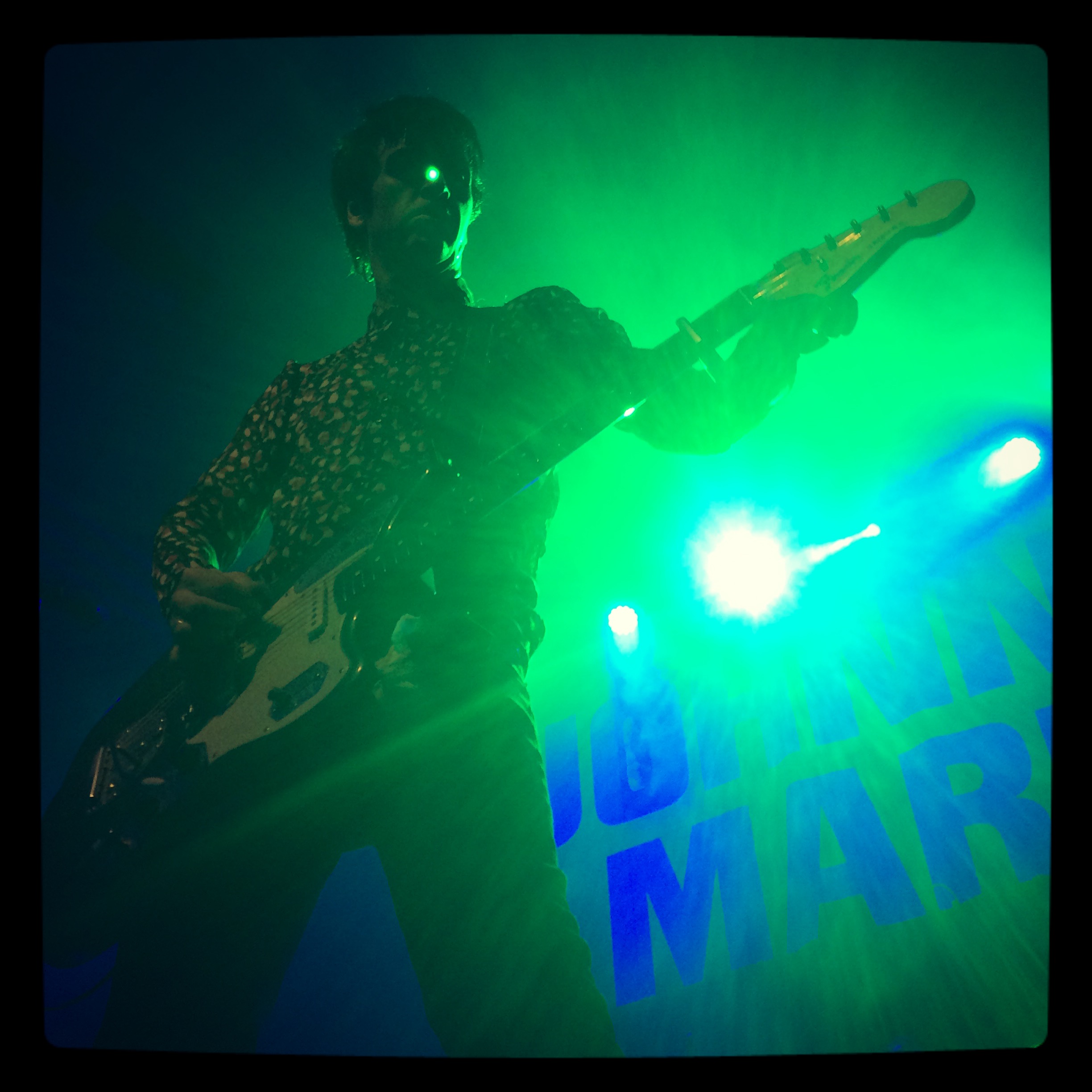
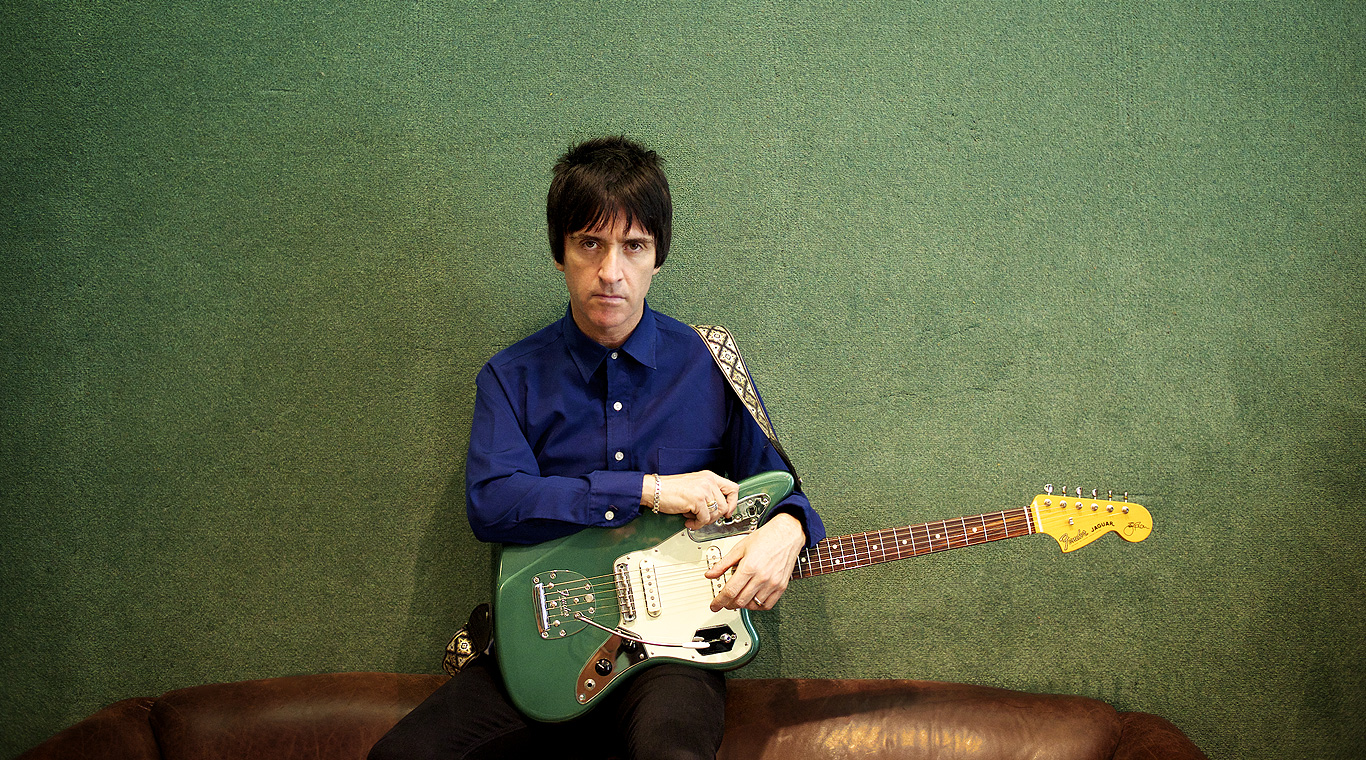
By the last song of the night, Johnny has us in the palms of his teeny tiny talented hands. How Soon Is Now? is a wobbling, juddering juggernaut, Marr wringing sustained notes of feedback from his famous green Jag. I decide to throw caution to the wind and, relying solely on the AAA pass I’m proudly wearing (remember Wayne’s World?) I’m off into the photographers’ pit, empty by law of the management since the 4th song and hoping for a decent snap of the occasion. As Johnny starts his de-tuning freak-out, I rush in. “Johnneeeey!” I scream, and he looks my way – purely coincidental, but still – and stands right above me, posing for me, as my phone fires as many photos as it can handle. He looks down from the top of the mountain at one point and gives me a wink (!) and then he’s off back to the mike, my photos in the bag. It’s all quite thrilling.
(c) this author
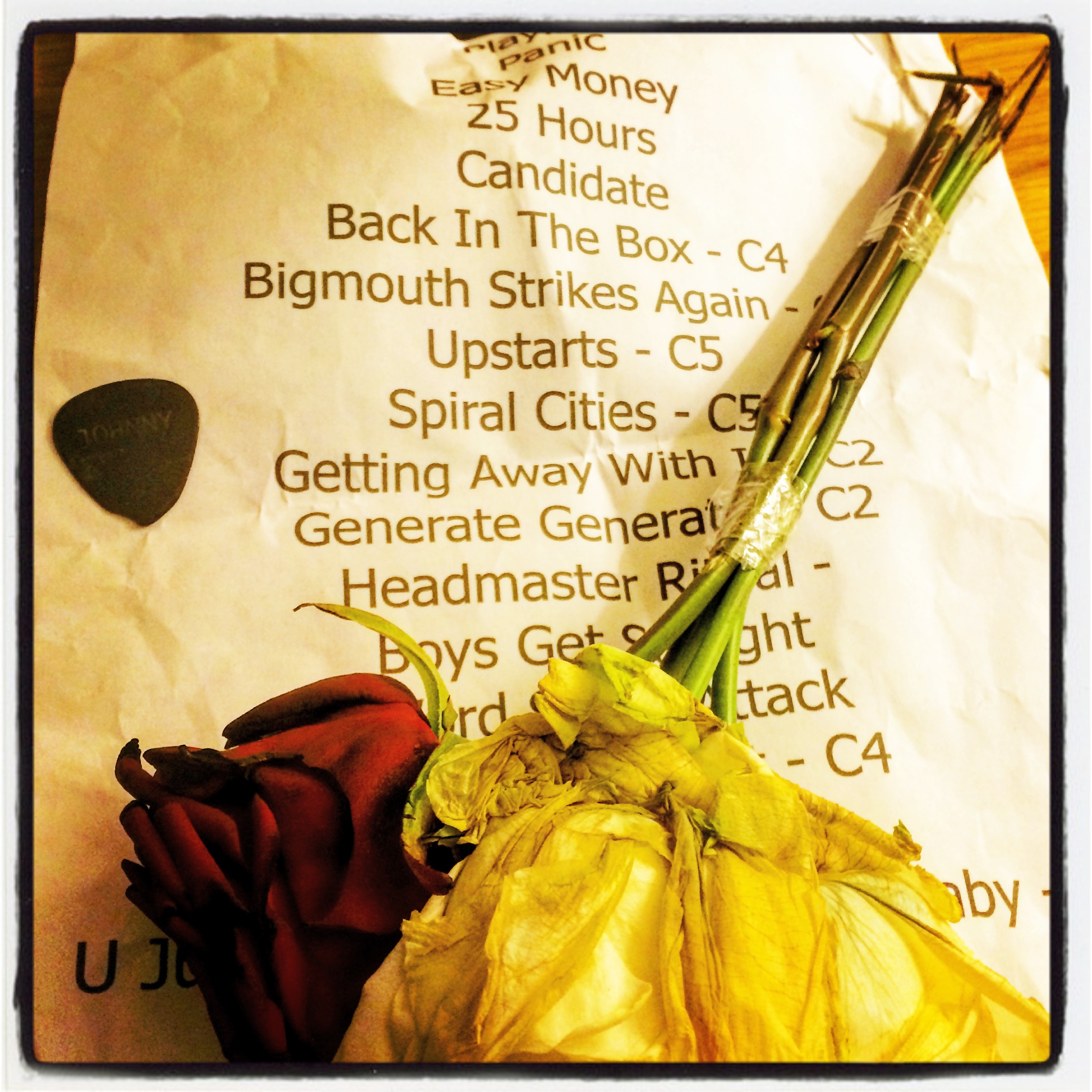
There’s more conversation (“neat capo trick, by the way, I tried it out. I’m gonna use that on something!“) and pictures after the show, a show he genuinely loved doing. It’s after midnight by the time we pack up and I head home carrying a signed guitar, a couple of signed Smiths records, Johnny’s set list, his road tested and slightly chipped signature-bearing plectrum….and the red and white roses that dangled from his belt loop for the entirety of the gig. Quite what I’ll do with them, I don’t know. They’re sitting in front of me as I type, a faded and falling apart memento of a day that will never fade from my memory. It’ll be quite a while before they’ve scraped me down from the ceiling, believe me.
Six Of The Best is a semi-regular feature that pokes, prods and persuades your favourite bands, bards and barometers of hip opinion to tell us six of the best tracks they’ve ever heard. The tracks could be mainstream million-sellers or they could be obfuscatingly obscure, it doesn’t matter. The only criteria set is that, aye, they must be Six of the Best. Think of it like a mini, groovier version of Desert Island Discs…
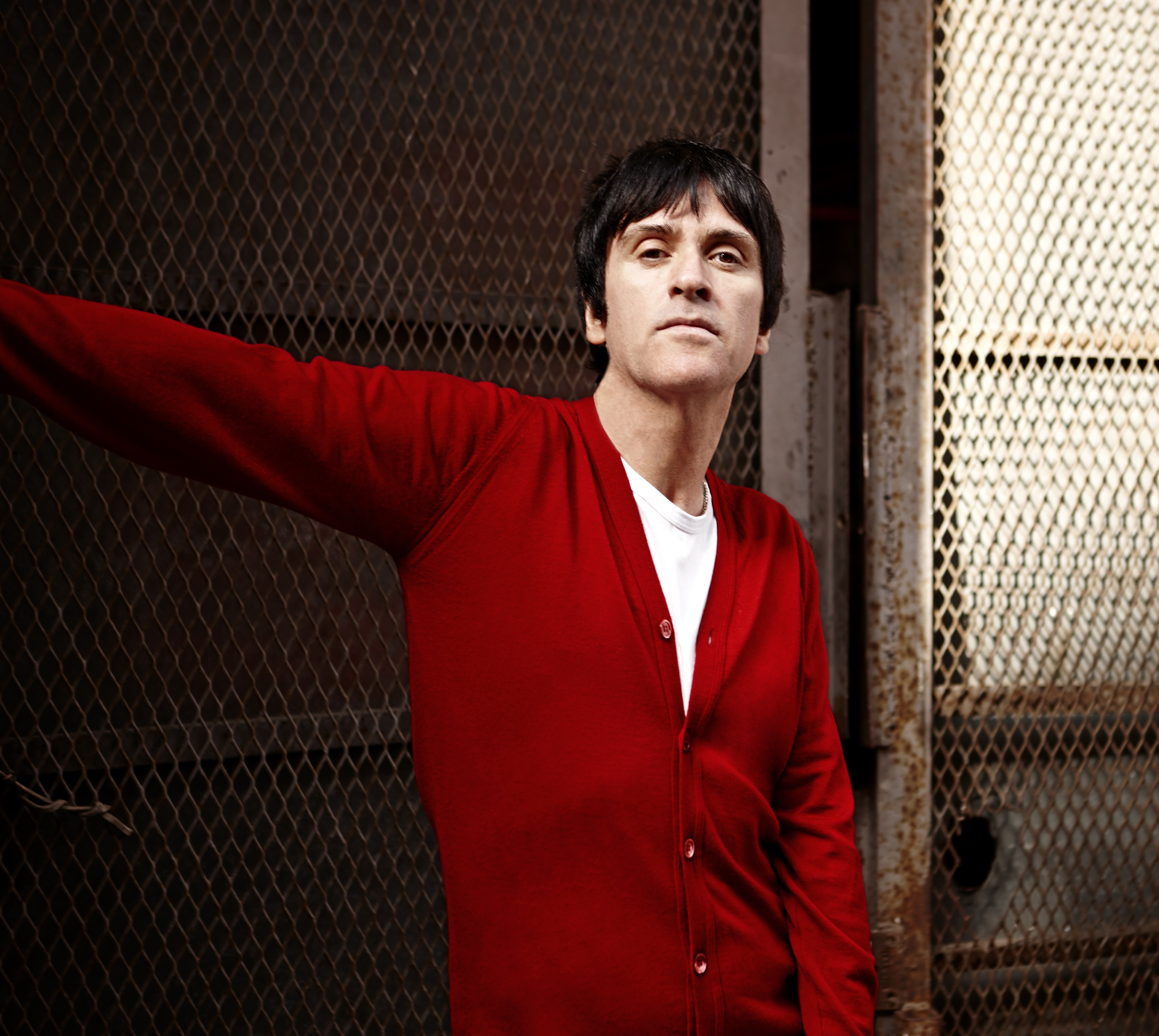
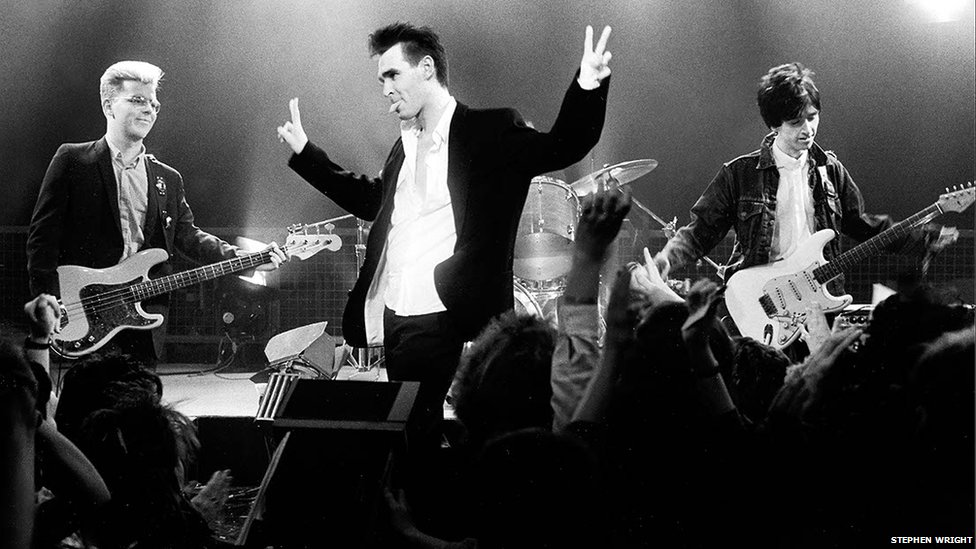
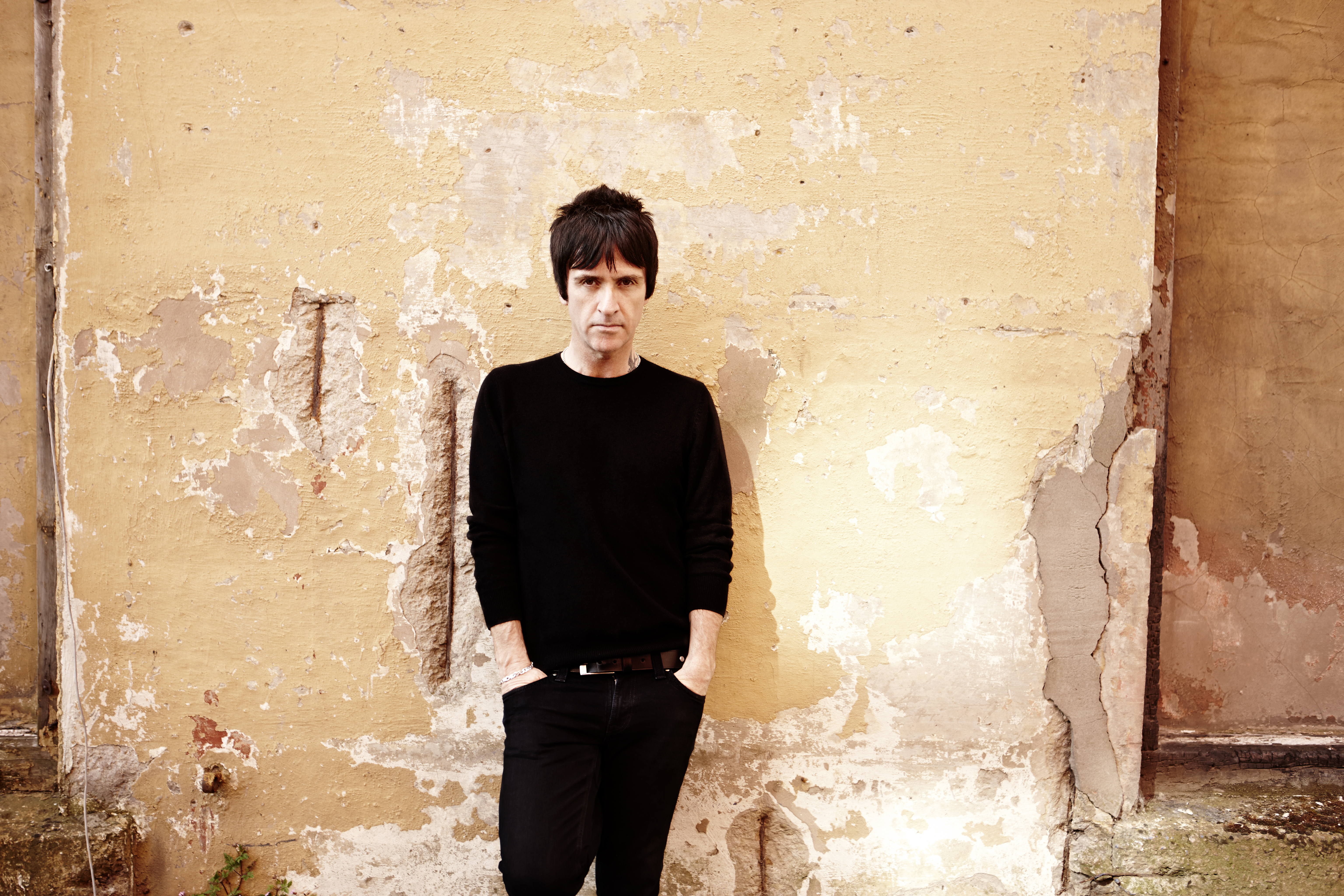
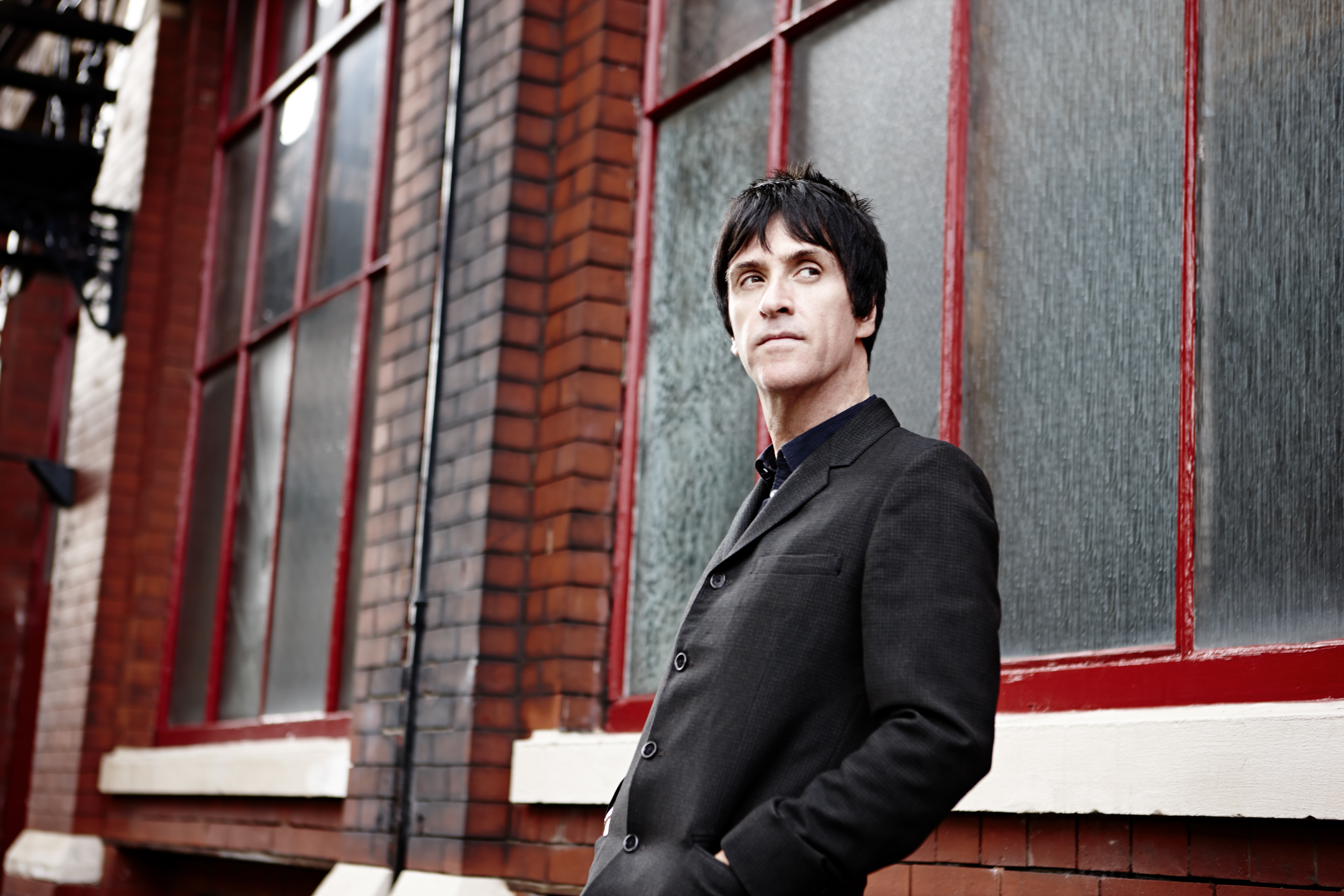
Johnny Marr is the wunderkid guitar player who, one day in 1982 knocked on the door of 384 King’s Road in the Stretford area of Manchester and encourgaged the bequiffed answerer to be the wordsmith that would sing atop his unique tunes. Together, they formed a partnership that would over a few short years become the most unique British guitar group of all time. To many of a certain age they were our Beatles, our Pistols, our band. There was no-one like them before and there’s been no-one like them since. From the first time I heard them (unusual for such a seismic event, I can’t actually remember when this was), The Smiths became my favourite band and, as a ham-fisted, fat-fingered guitar player with lofty ambitions, Johnny Marr became my instant hero.
With a guitar in his hands, Johnny is a magician. In The Smiths, brightly ringing, sparkling arpeggios fell from his fingers as regularly and as rhythmically as the Mancunian rain. Over the course of one memorable weekend the barely 21 year-old Johnny wrote three of the tunes that would define not only his band but an entire era; William, It Was Really Nothing, How Soon Is Now? and Please, Please, Please Let Me Get What I Want were all committed to tape in order to have something new to present to producer Stephen Street come the Monday morning. Three time-tested classics. One weekend. 21 years of age. Unbelievable.
As a Smith, Johnny wrote an obscene number of brilliant, inventive tunes. Lazy writers would go on about his ‘chiming‘, ‘jangly’ guitar sound, but there was far more to his arsenal than that. There was always, even in the Smiths’ most tender moments, a bite to his guitar. He could fingerpick. He could play inventive chord patterns. He could fingerpick and play an inventive chord pattern underneath it at the same time, with 10 fingers sounding like 25. ‘Like Lieber and Stoller piano lines playing alongside the guitar‘, to misquote him from those early days. Then there were the open tunings, the Nashville tunings, the hitting of the strings with knives to get the desired effect. He reinvented the wheel.
Johnny agreed to an interview ahead of his forthcoming October tour, a tour that takes in the west coast forgotten backwater of Kilmarnock (a show I’m involved in putting on) and telephoned me from his car, “somewhere on the outskirts of Manchester, just out of rehearsals. It’s good to get the band back together and blow the dust off the songs. I’m energised and enthused and I can’t wait for the tour to start.“
I explain to Johnny that our interview will be in two parts. The first part will focus on his recent work, his upcoming tour and his in-the-pipeline autobiography. The second part will focus on his Six Of The Best, albeit a 6otB with a difference. But more of that later.
Tell me about the last couple of years, then. It seems to me that it’s been quite full-on and intensive – two albums (The Messenger and Playland) written, recorded and released in two years and toured around the world and back again. This is the sort of behaviour I’d expect from a band with it all to prove, not from someone who’s made his mark in the world and who, by now, should be sitting back admiring his body of work from the comfort of an easy chair.
I’ll take that as a compliment. I really enjoy my work. It’s what I do and I’m good at it. It’s actually been 10 years of non-stop action! I joined Modest Mouse in 2005, just in time to record the ‘We Were Dead Before The Ship Even Sank’ album. That album really took off in the US and we toured there for a few years. It was pretty great, playing in a band again. Then, as fate would have it, Modest Mouse decided to take a break from touring and at the same time, The Cribs asked me to join as a guitar player. Without so much as a pause, it was back to being full-on and intense all over again. But I like that. I’m not into taking a year off.
Over my time in The Cribs I collected lots of ideas for songs. My travels informed what I was writing about, and as I wrote I had a specific sound in my head for a group that could play them. It was important to me that the band I put together should operate like the best bands; we should live in the same city and we should all be friends. I’m lucky that my best mates also happen to be the bass player, the guitar player and the drummer in my band.
The Messenger was released in 2013 and was really well-received. This gave me the encouragement to keep going, and I got on a bit of a roll. The songs that ended up on Playland the following year were very much a narrative for city life. I’ve always seen the two albums as a pair. Playland was my ‘difficult second album’, but I think I pulled it off. It sounds vital and NOW!
I point out that, from The Smiths via Electronic and The The to Modest Mouse and The Cribs, Johnny Marr has had a lot of ‘difficult second albums’.
Ha! Yeah! That’s true. ‘Meat Is Murder’ was a pretty good 2nd album, wasn’t it? I’ve always been a fan of them – I loved Talking Heads and The Only Ones second LPs. You don’t always have the luxury of having a long time to write your follow-up album. Usually, they’re written on the hop. Both Talking Heads and The Only Ones were made under the conditions conducive to getting the job done.
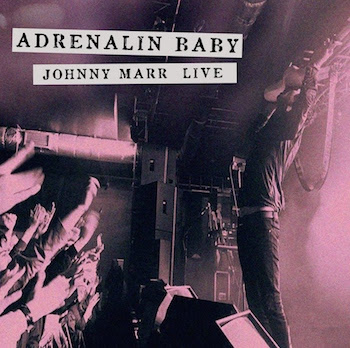
And now, following the wham-bam knockout of the two LPs, you have a tour that will see the Messenger/Playland era come to a close and immortalised for posterity in your first live album, the aptly-named Adrenalin Baby (recorded earlier this year in Manchester and due November.)
Yeah. The live album. I’m really proud of it. It’s a really good document of the time. I’ve kept it to one CD (although it’ll be a double LP) as it’s short ‘n sweet and doesn’t outstay its welcome. It’s a good representation of the live set. Hopefully, people who come to the shows will enjoy it as a reminder of what the shows were like, and those who never made the shows will get an idea of what the live set is all about. I wanted it to sit alongside my favourite live LPs, albums like Bowie’s ‘Stage’ and Iggy’s ‘TV Eye’.
I remark that my favourite live album is The Ramones’ ‘It’s Alive’.Oh yeah! The energy on that is amazing. D’you know, I stole my copy! I wasn’t sure I was going to like it, so I ‘borrowed’ it from the local newsagent and never gave it back. It’s a brilliant album, isn’t it? Like all the best live albums it has volume and energy. Hopefully, people will get that from Adrenalin Baby.
Adrenalin Baby is a good potted history of Johnny’s best bits – half a dozen or so tracks from The Messenger/Playland eras, a cherry picking of the Smiths tracks he plays live, Electronic’s perennially melancholic Getting Away With It and a garage band ramalama run through of I Fought The Law. It’s Alive indeed.
Looking at the tracklisting of the album and scrutinising the playlists from the recent tours, it’s clear that Johnny holds his back catalogue dear to his heart. This is where my idea for this Six Of The Best came from – if Johnny were to put 6 of his own tracks into a time capsule to be dug up in 100 years time, which tracks would he choose? What are the tracks that Johnny Marr is defined by?
You want me to pick my own tracks? Cool! I’ve never been asked that before. Usually, everyone wants to talk to me about The Stooges. You want me to pick my own records? Alright then. Let me think about that.
And think about that he does. Johnny then very methodically gives me a chronological list of what he deems to be his best bits. An impossible task, most folk would agree (and a final choice that many would also disagree on), but, for the record, here are the tracks that Johnny Marr is most proud of having been involved in.
The Smiths – How Soon Is Now?
Y’know? The Smiths really blew me away. I’m defined by them and I can quite happily live with that. The combination of guitar sounds on How Soon Is Now? is amazing. The layering. The patience required to put it all together….it hadn’t been done before and it hasn’t been done since. I’m very proud of How Soon Is Now?
Electronic – Get The Message
The band was borne out of The Smiths and New Order, but sounded like neither. We were very unique. Bernard and myself had a real spark. Get The Message is a great example of what we do best. Those early days in Electronic were great fun. I remember the first tour, drinking pints of champagne after an insane Barrowlands show.
The The – Slow Emotion Replay
I can only play harmonica one way (!), and it’s all there on Slow Emotion Replay. The guitar part – it’s what people think I sound like. You and I know differently, of course.
Modest Mouse – Dashboard
This is the track that kind of kicked off the 1st phase of my ‘new’ career. When we wrote the album, all my guitar parts were worked out in advance. I spent ages with my effects pedals making mad Captain Beefheart sounds until I discovered what I was looking for. I’m extremely proud of the guitar sound on the whole record. Everything you can hear in the left-hand speaker is me, doing my best Beefheart impression.
The Cribs – We Share The Same Skies
I’ve chosen this for the same reasons as Slow Emotion Replay. The guitar playing – classic me, isn’t it?!?
Johnny Marr – The Messenger
This song is a good representation of how I like to sing. I was never known as a singer, but I’m comfortable doing it. The Messenger is kinda post-punk in feel, jagged and spiky but the vocals are warm and textured. I like that juxtaposition.
Never one to look back, Johnny is always looking forward to the next thing. After “10, 15 years of offers”, now is the right time for him to commit his memories to print in the form of an autobiography.
“There’s a genuine interest in my life from enough people to warrant this. I was always unsure about doing this, but then I saw the satisfaction – no pun intended! – that Andrew Oldham got from penning his two memoirs. And Nile (Rodgers) writing his – well, that’s me been given the seal of approval to do my own.”
We have a wee chat about music autobiographies in general and enthuse about Keith Richard’s book, specifically the section where he talks about discovering open G tuning and how that opened up a whole new world of guitar playing.
We also chat about our kids, how it must be great, I say, to look out and see your son (Nile’s band Man Made are the support on the October tour) on stage, following in your footsteps. And then, the gent that he is, Johnny passes on some advice for my own son (he’s only 8) who’s beginning his first tentative steps on the six string. Getting guitar tips from Johnny Marr – does it get any better than that? I even have the cheek to pass on a capo trick I’ve discovered for myself – not quite the whole new world that Keith Richards discovered in open G, but enough of a trick for Johnny to prick his ears and say, “Right, run that past me again! Ah! Got it! I’m gonna try that next time I play ‘There Is A Light..’”
Whether he will or not remains to be seen, but what a great way to finish an interview!
Johnny Marr is on tour this month. Check all the usual places for ticket details.
West of Scotland fans might like to get themselves to Kilmarnock for his only date in the area on Thursday 15th October. See you down the front.