Get This!, Peel Sessions

Senses Working Overtime

Ever since the Electric Prunes mixed their mojo and told us they’d had Too Much To Dream Last Night, licence was given to your more outré groups – the ones who perhaps make a riot of layered noise with a pop sensibility at the core – to mess with your mind and get all psychedelic on yr eyes ‘n ears.

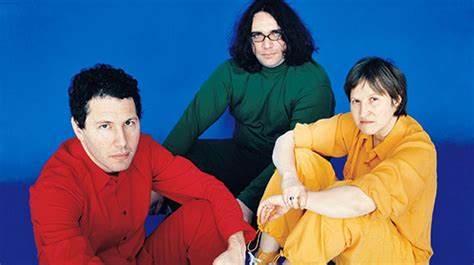
Yo La Tengo come, like Frank Sinatra before them, from Hoboken in New Jersey, but they’ve as much in common with Ol’ Blue Eyes as I do. Sinatra croons. Sinatra swings. Yo La Tengo swoons. And occasionally, Yo La Tengo stings. The groups’ group, they have a tidy way with minimalist backing and a bah-buh-bap backing vocal. They can weave silk worm-like tendrils of unwinding melody, gossamer-thin and stretched out for miles, and they know how to hook you in with a Bacharach-like parping horn and finger-clicking beat, but it’s when they’ve ingested the good stuff –  when they’ve had too much to dream last night – that Yo La Tengo becomes a different beast entirely.

Yo La TengoI Heard You Looking (Peel Session)

I first came to I Heard You Looking via Teenage Fanclub in the mid ’90s. Theirs is a faithful interpretation that had me scampering backwards to see what I’d missed out on, and as much as I really like YLT tracks such as My Little Corner Of The World (the Bacharach one) or the locked-in groove of Autumn Sweater (like Spacemen 3 writing for St Etienne), I always return to their original version of I Heard You Looking.

Maybe it’s because they’ve spent their time looking across the Hudson at Manhattan’s skyline that the tune – and it is a tune, in all senses – is massive. It builds from the very foundations like a skyscraper itself being constructed. A hesitant electric guitar creeps in with an upward-moving riff, all sliding chords, open strings and nerve-jangling expectation. Splashes of ride cymbal wash across crackling, electrified, open-miked airwaves. The drummer scratches his Noo Joisey ass and yawns his lazy way in. The bass player falls in line with both his drummer and the riff-playing guitarist and the group lock in to begin their slow jam.

Subtle shifts in the ambience – there’s two guitars interplaying by now, one sticking to the motherlode riff, the other wandering gaily up the frets, free-soloing and feedbacking and pulling the group ever-northwards – lift the volume and the intensity to the max. One guitarist has enough of the straightjacket approach and breaks loose in vivid technicolour, John Coltrane with an offset Fender and seemingly free reign to do whatever. The group surges and pulses in waves of electric guitar, pushing and pulling, ebbing and flowing, tearing the ears and the heart and the head in an unspooling of structure and frame. Then, an unseen nod of the head between the assembled musicians and the shards of white-hot noise and scattergun Moonisms are brought crashing back to earth by the anchor that is the riff.

And the group goes again.

And again.

For almost ten headswimmingly magic minutes.

…..

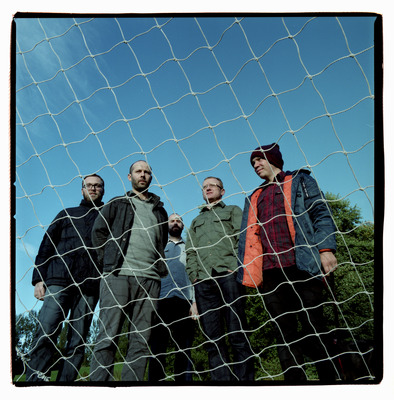
Another group who are no strangers to the effect of a noisy and epic jam is Mogwai.

When Stuart Braithwaite’s book came out a couple of years ago, the chapters fell into easy chunks;

I formed a band. I got really wasted. I listened to The Cure.

I rehearsed with the band. We got really wasted. We went to see The Cure.

We got really good. We got reeeally wasted. The Cure asked us to support them.

We got really, reeeally wasted. We got really, reeeally wasted with Robert Smith.

Life is complete.

C’mon Stuart! Life might be great cos you get to get up to shenanigans with Robert Smith every once in a while, but life is really complete because you happened to record, amongst a back catalogue of well-thumbed and well-spun albums, the most perfect track somewhere along the way.

For all of Mogwai’s loud/quiet/hailstorm of anvils that they’ve committed to record, none of it – none! – sounds so thrilling as The Sun Smells Too Loud. It really is the greatest track Mogwai have stuck their name to.

MogwaiThe Sun Smells Too Loud

Electro pulse. Shimmering twang. Whammy bar action. A great second chord. And a great third chord. A fantastic sliding up and up and down guitar riff, the group surfing the action in the background. The Sun Smells Too Loud is a hazy, woozy end of the night beauty. Great for cycling to too.

Repeated listens (and there’s been more than a few since parent album The Hawk Is Howling first appeared) throw up new melodies and counter-melodies within the spaces, not to mention tinkling milk bottle percussion and vintage, droning synths, but more importantly, The Sun Smells Too Loud throws up an aching melancholy. It’s all heart, all soul and all good. It might simply be non-organic electric guitar music played atop a rudimentary beat box, but The Sun Smells Too Loud is as soulful as Sam Cooke. It just is.

Sometimes, as on nights like this, the electric guitar, in all its variances and guises, is all y’need. Turn up to 10, as they used to say on the run out grooves.

Football

Score Draw

In 2005 the Berlin based Scottish artist Douglas Gordon came up with the idea of creating a film about Zinedine Zidane. Zidane was at the time arguably the finest football player on the planet; an attacking midfielder who played the free-roaming number 10 position while wearing the number 5 shirt for Real Madrid, playing with equal measures of flair, balance, vision and aggression. Zizou could make things happen and had the ability to change games with an ambitious pass or turn of speed or selfish zig-zagging run. His unpredicatable Gallic temper that simmered just below the surface added the extra edge that set him apart from his peers.

Gordon and his film-making partner Philippe Parreno set up 17 cameras in strategic points around the pitch before a league game at the Bernabeu between Real Madrid and Villareal. They were designed to capture every facet of Zidane’s game over the 90 minutes and didn’t disappoint.

With precious little fanfare the film begins as the game kicks off and ends on the referee’s final whistle. It’s relatively low on budget yet high in concept. The excitable Spanish TV commentary tells the story of the game, but really, that takes second place. Zidane is on screen for (almost) the entirety of the match, sometimes without the ball and sometimes with. You get a real feel for the speed of the game as the ball flashes on screen and just as quickly off again, set on its way by the outside of Zidane’s right boot or acutely richocheting as the number 5 clatters meaningfully into an oncoming opponent.

Those 17 cameras miss nothing in Zidane’s game; the awe-inspiring strength and skill, the disgruntled shouts to less tuned-in teammates, the occasional stroppy spit, the dirty looks to the referee, to the temper-flaring fight that leads to a red card and Zidane’s premature end to the match. If the filmmakers had written a script it wouldn’t have been any less perfect.

For the entirety of the film, the Spanish commentator and ambient crowd noise generated by 80,000 fans compete with a superb understated score by Mogwai. Film maker Gordon was a huge fan of the band and to get them on board he showed them a rough cut of the film soundtracked by their remixed Mogwai Fear Satan EP. Blown away by the concept and the clash of football and music, Mogwai agreed to get involved and set about creating an instrumental soundtrack.

The finished result plays underneath the film. It’s slow, quiet and understated, the polar opposite of the film’s subject matter, yet it works brilliantly. Sometimes you’ll forget it’s playing only for a ghostly thrumming guitar or phased out section of white-hot feedback to melt back into earshot. Pick of the bunch for me is the brooding Black Spider where vibrating clean-amped six strings allow ample space for a glockenspiel to pick out a simple melody as a lazy drummer half-heartedly adds percussive splashes in the background. Like its subject matter, it’s a beauty.

MogwaiBlack Spider

Get This!, Gone but not forgotten, Kraut-y

Cum On Feel The Neus

cycling

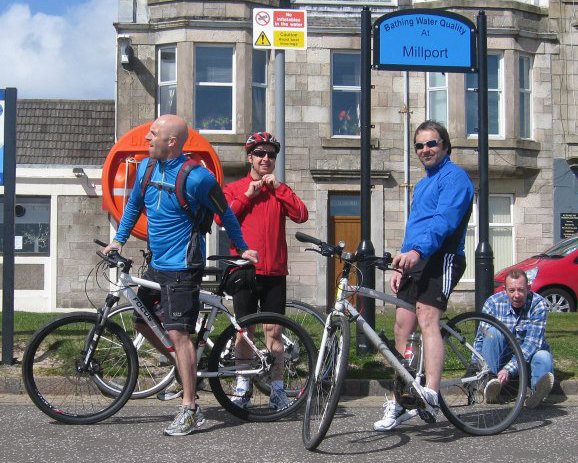
I’ve been doing a lot of cycling recently, up and down Ayrshire’s sun-baked coast, and much of it has been soundtracked by Neu! I’ve become a bit fed up of my self-compiled iPod ‘Cycling‘ playlist, a playlist that was put together a year ago with great care and attention, added to sporadically since and been sequenced and resequenced numerous times to reflect the ebbs and flows of an average 30 mile ride – a blood-pumping fast one to start (a track by the essential yet horribly-named Fuck Buttons, the name of which escapes me at the moment), before settling into the groove and rhythm of cycling to the combined output of Underworld, Land Observations, Kraftwerk and the likes. And Mogwai’s The Sun Smells Too Loud. That’s always a good one when it pops up. But I got fed up with all of it and started listening to complete albums instead. Searching for the ideal cycling companion. Did you know, you can cycle from Prestwick to Kilwinning in exactly the time it takes London Calling to play? If it’s not too windy…

NEU! PressefotoKlaus Dinger and Michael Rother of Neu!

As much as I love my guitar bands though, I prefer to cycle to electronic music. Music with a pulse beat. Music that plays repetitively. Music that is enhanced when, between the gaps in the tunes, you catch the whirr of a well-oiled chain snaking through the sprocket. Which is where Neu! come in. Not really pure electronic music, Neu! They play guitars and stuff. It’s just that, in amongst the found sounds and random ambient noises they’ve commited to tape, the band have a knack of locking into a good groove and can go at it for ages. Proper head-nodding music. But you knew that already.

Their track Hallogallo has been a cycling staple for over a year. Rhythmic, repetitive and driven by that very motorik, Krauty pulsebeat that’s required for my type of cycling (“I wanted to be carried on a wave like a surfer”, said Rother, explaining his music a few years back), it’s almost as if it was made with me in mind. Which is frankly ridiculous. If someone had told the band in 1972 that their 10 minute opus would be able to be freely listened to on a portable device whilst someone wheezed their way along the highways and byways of the national cycle network, they’d have accused you of smoking something more potent than the jazz cigarettes they were willingly ingesting.

NEU! Pressefoto

Imagine if after leaving The Beatles, Pete Best had gone on to form The Rolling Stones. Not content with being the founding father in one extremely influential group, he goes on to build another. Dinger and Rother did just this. Both were in a prototype Kraftwerk, before splitting and forming Neu! To paraphrase an old joke, I’d say Neu! play both types of music – arty and farty. The three albums they released in the 70s – 1972’s Neu!, ’73’s Neu! 2 and ’75’s Neu! 75 are hugely influential (not then, of course, but now) and greatly important in the development of the Krautrock sound – “an ambient bassless White-light Pop-rock mantra,” as Julian Cope described it in his excellent (and recently reprinted) Krautrocksampler. Remarkably, I picked up an original in a  book sale in Kilwinning library for 25p!

If you’re expecting to hear verse/chorus/verse/chorus/bridge/chorus/fade to end, look away now. If you’re made of sterner stuff, jump right in. It’s a bit like drinking alcohol for the first time. Initially, you pretend to like it, but secretly find it hard to stomach, but before long you wondered how you got by without it.

Hallogallo is the opening track from Neu!

Für Immer is the opening track from Neu! 2. “A greener richer Hallogallo“, to quote Julian Cope again. It’s another terrific example of the Neu! sound – a relentless, motorik driving pulse with textured layer upon layer of chiming, ambient guitar and occasional whooshing flung in for good measure. I think you’ll like it.

millport cycle

*Bonus Track!

The Sun Smells Too Loud by Mogwai. Cut from the same Krauty kloth, but with a heavier guitar. S’a cracker.

And, hey! If you go here, you can download Krautrocksampler as a PDF, for free. Danke schön!