Alternative Version, Hard-to-find, Peel Sessions

Keeping It Peel 2013

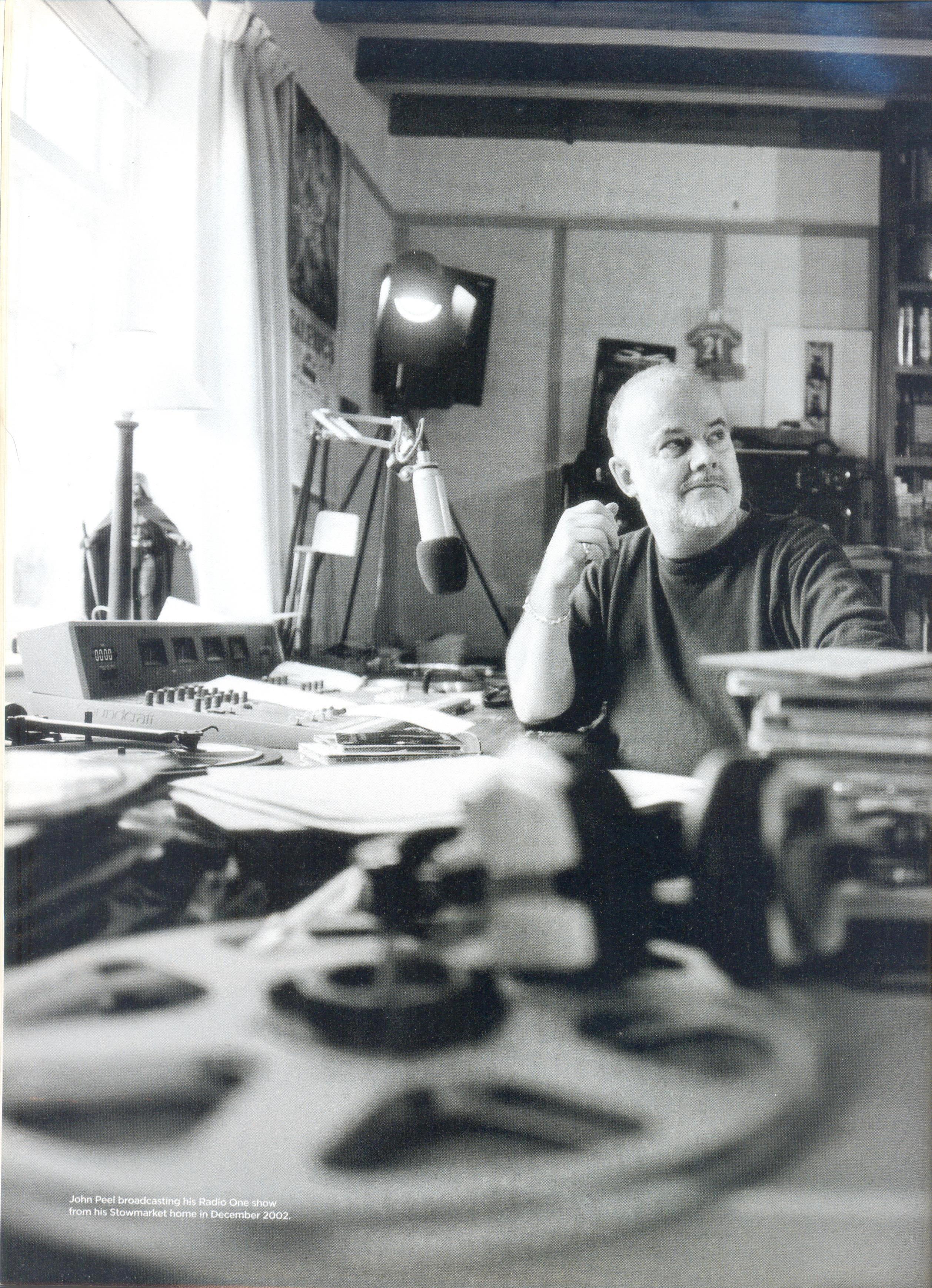
john peel home studio

Keeping It Peel is the brainchild of Webbie, who writes the excellent and informative Football And Music blog.  An annual celebration of all things Peel, it’s purpose is to remind everyone just how crucial John Peel was to expanding and informing listening tastes up and down the country. Be it demo, flexi, 7″, 10″, 12″, EP, LP, 8 track cartridge, wax cylinder or reel to reel field recording, the great man famously listened to everything ever sent his way, and if it was in anyway decent he played it on his show. Sometimes, he played the more obscure records at the correct speed. Sometimes he didn’t. And sometimes, no-one noticed.  John Peel is the reason my musical tastes expanded beyond the left-field avant-garde edginess of Hipsway and Love And Money and the reason why my mum stopped singing her own version of whatever it was I was playing (“Take a ri-ide on the Suga Trayne!”) and started asking me to “turn that racket down” whenever she passed my teenage bedroom door. Thank you, John.

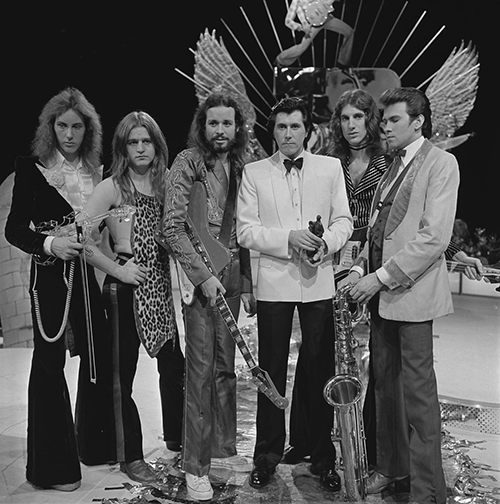
This year’s Peel Session selection features Roxy Music from February 1972. It’s a cracker……..

roxy music 72

But first, a history lesson.

1972 was a pivotal year in music. The number of influential/classic albums released in those 12 months is nothing short of staggering (I’d like to say “off the top of my head“, but Google is a handy wee tool now and again).

Take a deep breath and off we go; Neil Young‘s Harvest (and the unreleased Journey Through The Past), Nick Drake‘s Pink Moon, Pink Floyd‘s Dark Side Of The Moon (hey – I’d never spotted that before – Pink and Moon…anyway…), The Spotlight Kid and Clear Spot, both by Captain Beefheart (2 albums in one year, nae bother), Todd Rundgren‘s Something/Anything, Talking Book AND Music Of My Mind by Stevie Wonder (2 albums in one year, nae bother), T Rex‘s Bolan Boogie and The Slider (2 albums, one year…), Big Star‘s #1 Record, The Stones’ Exile On Main Street, Bowie‘s Ziggy Stardust, the soundtracks to Superfly and The Harder They Come (Curtis Mayfield and Jimmy Cliff), Black Sabbath 4, Steely Dan‘s Can’t Buy a Thrill, Greetings from LA by Tim Buckley, Can‘s Ege Bamyasi, Transformer by Lou Reed, Marvin Gaye‘s Trouble Man, and the debut eponymously titled LP from Roxy Music. Crikey! That’s almost a classic album a fortnight! And there’s a ton more I haven’t even mentioned! Oh to have been a teenager with a disposable income in the early 70s……

Roxy Music At Royal College Of Art In London in 1972

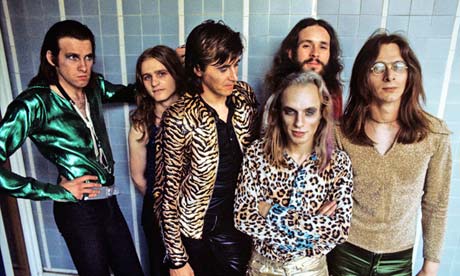
Roxy Music looked as if they’d been beamed down from the first spaceship from Mars and sounded just as other-worldly. Dressed in a clash of tiger print and tinfoil, faux fur and flares, and with a sound giving as much space to the clarinet and oboe as to yer more traditional rock instruments (and we haven’t even mentioned Brian Eno’s synthesiser), they were so out of step with the fashion of the day (compare them to the list above), it’s easy to see why John Peel would champion them. Between January 1972 and March 1973, they recorded 5 thrilling John Peel sessions. Their session recorded in February 1972 (although not broadcast until 1st August – anyone know why?) is particularly brilliant, featuring the yin and the yang of Roxy Music in two tracks.

The Yin

A full six months (a light year in 1972 musical terms) before being released as their debut single, Virginia Plain was recorded as part of that February session. Over a minute longer than the released version, the Peel version is a proto-punk glam slam, overloaded with fizzbomb guitars and a seemingly improvised solo, all whammy bar and feedback sturm und drang. Hogging the limelight, Phil Manzanera made sure there was no room for the single’s twangy bass solo here.

Virginia Plain Peel Session, 18 Feb 72

Years later he would indeed be flying down to Rio! but, when he wasn’t purloining other bands’ equipment, I’m sure sticky-fingered street urchin and future Sex Pistol Steve Jones was cribbing notes on Manzanera’s guitar sound during this transmission. A verse sung over 2 open chords….. stray wafts of controlled feedback….. a fantastic, fluid and free-form guitar solo….. a four-to-the-floor jackboot stomp. A full 4 years before UK punk was ‘invented’, Roxy Music were doing it, maaaaan. If this version of Virginia Plain doesn’t make you want to go and learn a couple of chords and start a band in a desperate middle-aged attempt at hipster cool, nothing will.

roxy music 1973

The Yang

On the debut album you’ll find If There Is Something, a countryish clip-clopping slide guitar and piano-led song in (prog alert!!!) three distinct parts. According to that bastion of trusted information Wikipedia, it ‘s been said that the first part of the song is a youth wondering about love, the second part adults in the heat of passion and the third part the singer in old age thinking about their past love. Gads. Whatever you think, in length and libido it manages to invent both prog rock and Pulp. Heavily-effected saxophones waft in and out, guitars get fuzzier and quieter as the track progresses and the ending is bathed in synthesised melancholic heaven, Ferry crooning in his collapsed quiff like a pub singer after half a dozen Guinesses.

If There Is Something Peel Session, 18 Feb 72

The Peel Session version is free from slide guitar and twice as long as the released version, clocking in at over 12 meandering minutes, the track ebbing and flowing like the champagne at one of Bryan Ferry’s socialite soirees. A few short years later they’d be making syrupy cocktail dross like Avalon. Remember Roxy from 72; weird, wonky and wonderful, unparalleled and untouchable.

*Bonus Track!

No Roxy Music feature is complete without the funniest bit of telly ever. Johnny Vegas as Eno? Oh aye!

peel bathOch, John!

Cover Versions, Dylanish, Hard-to-find

Boss Tunes

I haven’t ever quite got Bruce Springsteen. I can appreciate the appeal, and I can rattle off a list of his tunes I quite like, but that’s just it – tunes I quite like. There’s nothing there I love. Not even Tenth Avenue Freeze Out. Or Hungry Heart. Or Cadillac Ranch. Or Born To Run. I like ’em. But I don’t love ’em. I don’t feel the need to re-spin them as soon as they’ve faded out in the same way I do with many other musical sacred cows. What’s the difference between Born To Run and most of Meat Loaf’s outpourings over the last 30 years? Very little, if y’ask me. And Meat Loaf is a pantomime figure to be laughed at and poked with a big shitty stick. So why not Bruce?

bruce1984

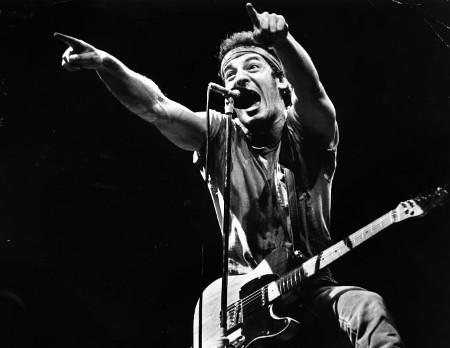
Bruce’s schtick is all just a wee bit forced, I think. Everything’s done through gritted teeth and clenched fist, his furrowed brow and earnest intentions dressed up in last year’s Levis for maximum ‘man of the people’ effect.  Four hour live shows? Come on! Even if Paul McCartney turned up in my back garden and ask me to accompany him on fat-fingered guitar to play a four hour greatest hits show, that would still be about two hours too long. Possibly. And all that huffing and puffing and biker-booted blue collar bluster – pffft! – even his ballads sound as if they’re wrapped in layers of testosterone, desperate to escape their confines, but bundled up as tightly as his upper arms underneath the sweat-stained cut-off denim shirt. Look at him! He can’t even play that famous Tele of his properly due to the constrictions. That, in part, explains the gritted teeth I suppose.

Here’s the crux though – Bruce writes a good song. I know he does. But his versions just don’t hit the spot the way the cover versions do.

Because The NightBruce version

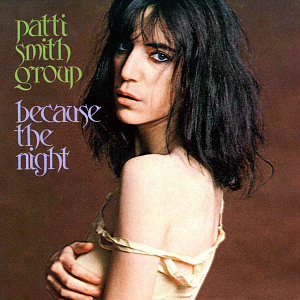
Written during the Darkness On The Edge Of Town album sessions, he dashed off Because The Night, discarded it almost immediately and gave it to Patti Smith, who was in the studio next door recording what would become the Easter LP. She got herself a writing credit as she changed some of the words and added her own. But you knew that already. Her version is better. In fact, hers is the definitive of the 18 covers (and counting) to date. PJ Harvey certainly thinks so……..she based much of her mid-career on it. But you knew that already too.

patti smith 7

Because The NightPatti version

Along with Gerry Rafferty’s Baker Street, Patti’s Because The Night reminds me of French toast. I have a vivid memory of listening to the ‘Hit Parade’ countdown one sunny Summer night on a wee portable radio in the back garden and hearing both records while my dad made French toast in the kitchen, the sizzle and smell making its way back to me sitting with my back against the roughcast on the garage wall. Patti’s record eventually got to number 5, though I’m too scared to Google the rest of this fact as it’s very likely both records didn’t ever appear in the same chart. Don’t check. Or if you do, don’t tell me if I’m wrong. It’ll ruin what has been a 35+ years memory.

bruce-springsteen- face2 Huff….pufff…wheeze….

Inspired by a lyric in Elvis’ Let’s Play House (“You may have a pink Cadillac but don’t you be nobody’s fool”), Bruce wrote Pink Cadillac as a car-as-sexual-metaphor bluesy gruntalong. Written at the turn of the 80s but kept it in his vaults until 1984, Bruce stuck it on the b-side of Dancing In The Dark.

Pink CadillacBruce version

The year previously, Bette Midler had asked to record it, presumably to add her own high camp gloss to an already suggestive lyric.

I love you for your Pink Cadillac….crushed velvet seats….riding in the back…oozing down the street.”

Pink Cadillac is not a girls’ song‘, vetoed Bruce.

And that was that, until Natalie Cole somehow got the go ahead to record her version and take it all the way to number 5 (just like Patti) in March 1988. Bruce calling it Pink Cadillac was a bit more glamorous and rock ‘n roll sounding than, say, Pink Camel Toe, that’s for sure. But we all know what he was getting at, eh? Nudge, nudge, wink wink and all that. It’s quite spectacular that someone so straight-laced as Natalie ‘daughter of Nat King’ Cole should be allowed to record it. Maybe she thought she was singing about a car.

Pink CadillacNatalie version.

Barring the none-more-80s glossy feel (or, to be more accurate, because of the none-more-80s glossy feel) it could almost be Aretha Franklin as recorded by Prince, couldn’t it?

pink cadillac 7

*Bonus Track!

Ever one for spotting a trend and putting an arty spin on it, here’s David Bowie doing It’s Hard To Be A Saint In The City. Recorded in 1974 in the middle of his white-powdered Young Americans phase, it’s a tune that divides Bowie fans. For what it’s worth, I think it’s a brilliant version. I bet those check-shirted good ol’ boys over the Atlantic hate it though.

Nothing at all like the Brooce original. Poor man’s Dylan, no?

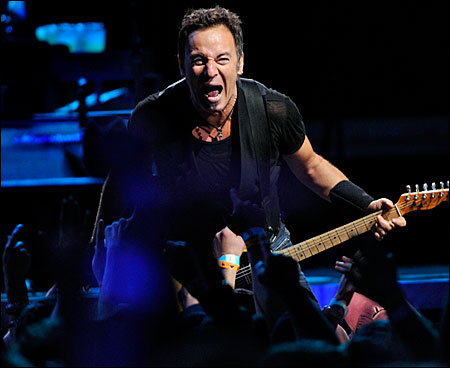
By now, of course, there’ll be people I know, friends even, who are rattling off tut-tut-tut emails to me, pointing out the errors of my ways. Waaaaaghh! Here….have a Bruce face in reply….

bruce face

Live!

Feelgood Factor

Paul Weller at the Barrowlands on Monday night was terrific. The opening night of his ‘One Night Only‘ tour, this was Weller’s way of gathering up the best bits of his back catalogue and playing them with a renewed effervescence and vigour that could shame a band with a combined age less than half his 55 or so years.

paul weller barrasPaul Wellblurred

Not that we knew it at the start. A Paul Weller gig without an album to promote always puts the needle into the red on the old apprehensionometer – this might’ve meant a set of brand new material to endure, with a couple of greatest hits flung in at select moments to appease a restless crowd. Not a bad night out maybe, but not really what you want on a Monday night. From the off, though, when a free from fanfare and flashing lights Weller strolled on at the unfashionably early time of 8.30pm, all perma-tan and tight, tight trousers, and fired into Sunflower, it was clear he was here to entertain. Earlier on, the DJ had played a not entirely inspired selection of 60s and 70s 45s. You won’t need me to list them for you. Stuck somewhere in the middle was Bowie’s Golden Years – a wee clue to how the night would proceed. Not for PW a cosy pipe ‘n slippers run through of his earlier past triumphs, this was going to be a back catalogue cherry pick through his own golden years, played for us like the Angry Young Man from Woking he once was.

The set was given a modernist (no pun intended) twist thanks to the liberal sprinklings of sonic stereo swooshes and panning vocal effects that were in equal parts druggy and dubby, but especially due to the use of a piercing Telecaster for half the songs. This gave the band an angular, angry, post-punk sound; aggressive yet arty, taut yet trippy.

Third song in was From The Floorboards Up, and even more so than the recorded version, it was total Wilko Johnson. From the opening slashed chords onwards, Weller channeled his inner Dr Feelgood. Not many would’ve noticed, but for this track PW ditched the plectrum (just like Wilko!) strummed with open hand (just like Wilko!) and perfected that thousand yard stare (just like Wilko!) Between a couple of verses he even had the nerve to do that spasmic, wired-to-the-mains electrified stagger across the stage – aye, just like Wilko! Tonight Matthew, for the next three minutes, I’m going to be Wilko Johnson. And he was. Never before have I seen such an obvious ‘we’re not worthy’ episode of hero worship. Did anyone else spot it?

photo(1)

The set thereon in was inspired. The Style Council’s My Ever Changing Moods was a surprise early addition, fuelling an unspoken frenzy amongst 1800 souls that he might dare to play a couple of (whisper it) Jam songs. He did. A punchy, punky Start! received almost the biggest cheer of the night, and even the inability of Weller to hit the high notes of his youth couldn’t dampen things. I don’t know what Weller thinks of this – he’s clearly comfortable playing these old songs that mean so much to so many, but his own, more recent back catalogue is sounding sensational in its current form – Dragonfly, Andromeda, Sea Spray, Wake Up The Nation, Come On Let’s Go, 7&3 Is The Striker’s Name. They are equally as deserving of that same roof-raising cheer – a roof-raising cheer that reached delirious levels of excitement when the group walked out for the second encore and the bass player thudded into the opening Motownisms of A Town Called Malice. Weller, on joint tambourine and Telecaster duties looked like the happiest man on the planet. And given that 1800 people had just spontaneously combusted in total delight, that’s really saying something.

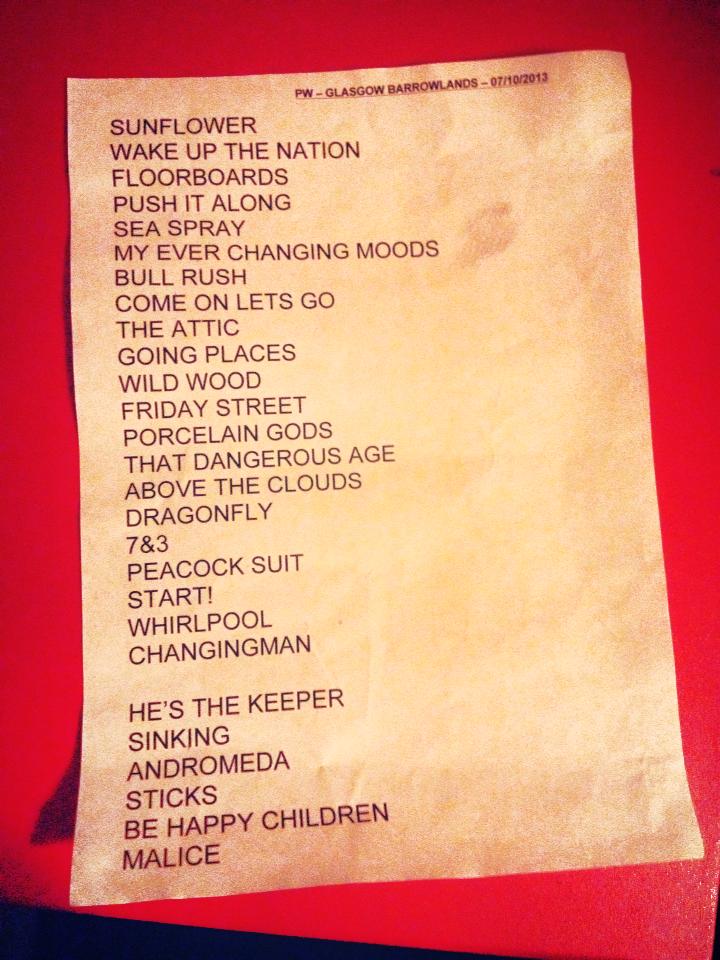
weller set 7.10.13

Disappointments? None really. The above set list shows He’s The Keeper and Out Of The Sinking, neither of which he played, for whatever reason. I did think, early on, when it was clear he was here to entertain, that we might get Into Tomorrow. But no. And it’s possible to create your own brilliant set from the obvious tracks he didn’t play – Brushed would’ve sounded great in this set for example (as would Out Of The Sinking for that matter), and I’d have liked to hear Starlite, the forgotten single released between the last two LPs, but really, you can’t complain. A just-short-of two hours set with tracks from all eras fizzing off the stage like welders’ sparks is a good night out, is it not?

This is, I’m certain, the most fired-up and relevant Weller I’ve ever seen in concert. If you have a ticket for one of the shows, you’re going to really enjoy it. If you don’t have one, do everything you can to get one.

My ears are still ringing, by the way…..


Get This!, Hard-to-find, Yesterday's Papers

Kinks, Konkers and Kids in Kasualty (slight return)

Slightly recycled from Plain Or Pan’s back pages, this article is adapted from one that first appeared 5 years ago…

Autumn. The nights are drawing in and the curtains are drawing shut. The heating comes on a bit earlier than normal and stays on that wee bit longer. You can smell winter coming in the air. The leaves are turning red and yellow. Conkers are on the ground and in the playground. Kids are off to the medical room for a good dose of TCP and a telling off.

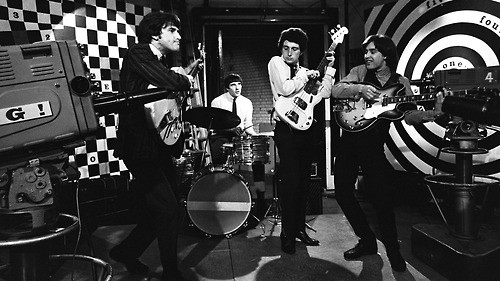
kinks rsg

It’s round about now that I like to dig out ‘Autumn Almanac’ by The Kinks, a song that so perfectly sums up this time of year. You don’t even have to be quintessentially English to appreciate lines such as, “I like my football on a Saturday, roast beef on Sundays, alright! I go to Blackpool for my holidays, sit in the open sunlight.”

No doubt about it, it’s one of my all-time top 5 favourite songs ever. Just ahead of ‘Ally’s Tartan Army’  by Scotland’s 1978 World Cup Squad, though just behind ‘There She Goes’  by The La’s.

Lee Mavers once lectured me on the brilliance of Autumn Almanac  for a good 10 minutes. “From the dew-soaked hedge creeps a crawly caterpill-ah!” he offered, in his sing-song Mersey twang. “How good a line is that, La!?! ‘Friday evening, people get together…hiding from the weather…’ The chords, the feel, the melancholy…….it’s not as good as Waterloo Sunset, though, is it?”

kinks autumn almanac ad

The single version of Autumn Almanac was recorded in September 67 and released 3 weeks later. No great strategic marketing campaign with focus groups, target audiences and avoidance of any other big act’s single being released at the same time. Get in the studio, cut the record, release the record. Times being simpler then, Autumn Almanac climbed to either number 3 or number 5 on the charts, depending on which music paper you were reading.

Recorded for Top Gear just a few weeks after, on October 25th 1967 at the BBC’s Maida Vale Studio 4 and broadcast 4 days later, the above track is taken from a well-known Kinks bootleg* called ‘The Songs We Sang For Auntie’, a 3 CD set that compiles most of (or all?) the unreleased BBC session stuff from 1964-1994. A must-have for any fan of a band who were matched surely only by The Beatles in terms of high quality output.

Ask anyone to name 3 Kinks singles and they’ll give you all the usual suspects, but I bet it’d be unlikely Autumn Almanac would feature in too many lists. It’s an under appreciated classic, that’s for certain. Just ask Lee Mavers.

*Since writing this article, there’s been an official Kinks BBC release. But you probably knew that already.

Yes, yes, yes! It’s my Autumn Almanyac!

Hard-to-find

All The Way Fey Bearsden

fey

Pronunciation: /feɪ/

adjective (feyer, feyest)

  • 3 archaic, chiefly Scottish fated to die or at the point of death.

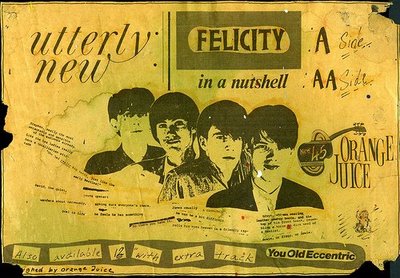
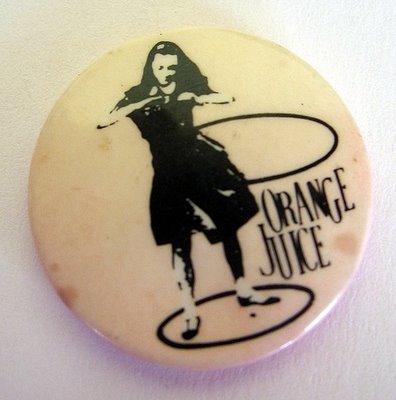
Orange Juice were the feyest of the fey. Their Velvets-by-Chic approach to music was terrifically exciting; a ramshackle beauty forever teetering on the fringes of falling apart. They remind me of teaching my kids how to ride their bikes. One minute you’re bent double and holding on to a wobbly stabiliser-free frame to stop them bothering the tarmac, the next you’re running behind them silently willing them to not turn round in amazement at what they’ve already managed, but to focus on the road ahead and zig-zag safely to a stop.

orange juice bw

Pick any song at random from the early Orange Juice catalogue and you’ll find the sonic equivalent. At any given moment, things might unravel and the whole thing could come stuttering to an ungracious ending. On some of those records, you can practically see the 4 band members give one another excited nods of encouragement as they play their way out of the first chorus and back to the verse. (If you’ve ever had the good fortune to play in a ‘promising local band‘ (copyright Irvine Times, July 1989), you’ll know exactly what I mean). Not for OJ the mask of distortion that many a youthful band will use to cover up all manner of mistakes. Their almost-to-the-point-of-being-in-tune cheesewire-thin guitars rattling off fancy-pants major 7ths and suspended 4ths were played to sound just as Leo Fender and Friedrich Gretsch intended – clean and ringing and with a nice touch of reverb. For Orange Juice, it was always about the angle of the jangle. But you knew that already.

One of the very finest in a fine, fine back catalogue is (To Put It) In A Nutshell. You’ll find it closing out the end of their debut LP, You Can’t Hide Your Love Forever. A perfect set-closer from an imperfect album, In A Nutshell was Edwyn Collins’ first (first!) attempt at a ballad. Another that sounds like it’s about to come undone at the seams, it was originally conceived as a duet with Nico. Shame it never quite came to fruition. Her rounded, one dimensional Germanic  chamber folk vocals would’ve sounded terrific. “I looked deep within my pockets“, “You’re a heartless mercenary“, “Can I pay you in kind?” etc etc. I bet you’re singing them in faux German right now. Even the sh-sh-sh-shoo-doo bits.

orange juice

I empathise with Edwyn – that ‘promising local band‘ once wrote a letter to Michael Stipe asking if he’d like to contribute backing vocals to one of our non-smash non-singles. What the fuck were we thinking? You won’t be surprised to learn he never wrote back, but ever since the demise of REM, I’ve often wondered if he’d still be up for it, 24 years later.

Anyway, back to Orange Juice.

Here’s the earlier Postcard Records version of In A Nutshell:

And here’s a rare instrumental version. Put on a German accent and go all Nico for a few minutes. So audacious, jah?:

orange juice badge

Cover Versions, Get This!, Hard-to-find

Bad Cover Version/Good Cover Version

There’s a strange bit of serendipity to this post. I’d spent a night last week putting some stuff together for my weekly article and then on his Sunday Service show on 6 Music, Jarvis Cocker played the very track I was planning to write about. In itself, that’s a happy coincidence. But the fact that I’d planned to introduce the record (which has nothing to do with Jarvis) by writing a wee bit about Pulp beforehand was a bit weirder. So, as you read this, imagine the Twilight Zone theme playing away ad infinitum in the background.

If you drew a trajectory charting the popularity of Pulp LPs, there’d be a massive, Everest-sized spike where Different Class appeared and sadly, not much else. Pulp were a proper, fully-formed album band, but save for their brief flirtation with mainstream success, not many (common) people would really know. Indeed, many folk probably consider them a bit of a one-hit wonder. Their last album, 2001’s We Love Life is one of Pulp’s very best. Crashing in at number 6 on the album chart, before crashing straight back out and never to be seen again a mere 3 weeks later, it was a real blink and you’ll miss it album. If you’ve never had the pleasure, you should make some time to acquaint yourself with it.

One track, Bad Cover Version, is a terrifically thought-out ballad that draws parallels between a failing relationship (“a bad cover version of love is not the real thing“) and the 2nd rate dopplegangers we often accept in place of the real deal – Top of the Pops compilation LPs (“the bikini-clad girl on the front who invited you in”), the Stones since the 80s, later episodes of Tom & Jerry when they could talk, the last episodes of Dallas, the TV series of Planet of the Apes, and so on. Amongst the things Jarvis lists is “the second side of ‘Till The Band Comes In’“.

Till The Band Comes In was the much-maligned and undersold 5th LP by Scott Walker (his 6th, if you count his Sings Songs From His TV Series LP). Much like We Love Life, the critics had the artist pegged as ‘past his best’, it too was a bit of a flop and never really got the attention it deserved. The line about the second side of Till The Band Comes In was a joke at Walker’s expense, given that it was he who produced We Love Life for Pulp. Are you still hearing The Twilight Zone music in the background? It’s a circle of life, as one piano player once remarked.

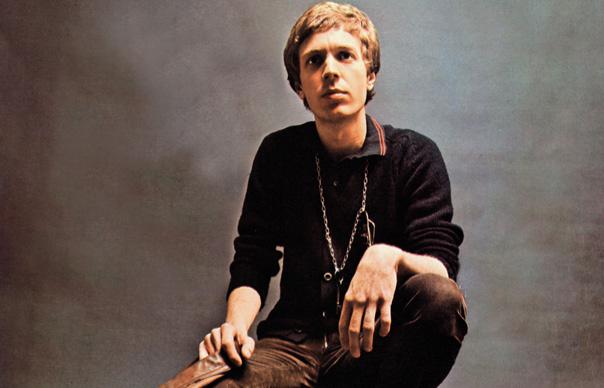
scott walker 70

Scott Phwoar

Back in the day before he was producing other people’s flop records and long before felt the need to create an approximation of melody from bashing hanging lumps of meat, Scott Walker reveled in making orchestral-rich pop songs. Like a baritone-rich Serge Gainsbourg he sang of syphillis, sailors and suicide and was nothing at all like yer average teen heart throb. On Till The Band Comes In, you’ll find Little Things (That Keep Us Together). Almost a companion piece to his own version of Jackie, though with less gallop and more gasp, Little Things finds Scott clinging to the coat tails of a melody as jabbing strings and tumbling toms race one another to the finish line. It’s great.

And as if that’s not thrilling enough, here come the Trashcan Sinatras, back in the days when they were The Trash Can Sinatras, faithfully gatecrashing Walker’s tune with all the ramshackle beauty of a wooden-legged man hurtling haphazardly down a hill and into the neighbour’s hedge while being chased by an angry slevvery dug. Which, metaphorically at least, the Trash Cans were round about then. They fairly clatter into Little Things; the old Roland Jazz Chorus set to maximum wobble in a thrilling rush of knee-trembling, reverb-soaked, John McGeogh-esque post-punk while a breathless Frank hangs on to the vocals for dear life.

My first recollection of the Trash Cans doing this was for a Billy Sloan session on Radio Clyde around ’91 or ’92. Like most of the Trash Can’s unofficial output from those days, I have it on a hissy, taped-off-the-radio C90 somewhere, but the version above is taken from the b-side of 1993’s How Can I Apply single. A lost nugget of a record from an era when every Trash Can’s release was packed-full of top quality songs from an apparently never-ending production line that put every other band to shame. But you knew that already.

tcs 93TCS, Shabby Road, 1993

*Trashcans fact!

Long before John started wearing the famous stripey t-shirt, he was awfy fond of a t-shirt bearing the cover of Scott 1. No pictures exist. Believe me, I’ve looked…

elliott smith, Get This!, Gone but not forgotten

Happily Everly After

Happily Everly After. It sounds like a throwaway Stanley Unwin line. Perhaps something he’d have spokey-woke on the deeply joyous Small Faces’ Ogden’s Nut Gone Flake album. Or perhaps not. In any case, I’m referring to Phil and Don, The Everly Brothers. But you knew that already.

everly brothers 1

The Everlys were so close to the front of the queue at the birth of rock ‘n roll they were practically the midwives. Little Richard might’ve been around pounding his piano to welcome this kicking and screaming new born thing into existence, and Chuck Berry would’ve been somewhere by his side, but it was the Everlys who sat by the bed mopping the fevered brow and shouting perfectly harmonised words of encouragement. A close-knit singing duo with a dual love of country music and a twangin’ guitar, they created a vocal style like no-one else. Big brother Don sang the low parts. Phil, two years his junior, did those keening highs. Added to a rattlin’, rollin’ skiffle rhythm, they suddenly had a sound and found themselves at the forefront of the late 50s music explosion. The Beatles were huge fans, approximating the vocal style of the Everlys’ Cathy’s Clown onto their own Please Please Me like the fanboys they undeniably were.

Paul McCartney’s love for the Everlys went as deep as writing On The Wings Of A Nightingale for them in the mid 80s, giving them a hit single long after they’d been confined to the dustbin of yesteryear and oldies radio.

The Everly’s legacy was cemented not by what they did well, but by what they failed at.  Between them, Phil and Don had six children and went through half a dozen divorces – five from actual matrimonial wives and one colossal split from one another. To say they didn’t really get on with one another would be something of an understatement, but nonetheless they muddled through for a good few years, their warm harmonies disguising the icy coldness each felt towards his sibling.

Like many acts of their era, they suffered the somewhat obligatory bad management/bad label deal in the late ’50s.  Their golden early 60s period was knocked off the rails, initially by the advent of Beatlemania and latterly through their failure to capture the mood of a nation during the Vietnam War. This led to drug and alcohol problems, which led on to other issues…..the loathing and hate that each felt for his brother reached its peak in 1973 when Phil threw his guitar down mid Cathy’s Clown and walked off stage. To paraphrase Don (I can’t find the actual quote)  – “The Everly Brothers are dead…..though we died 10 years ago.” Despite possessing fine musical skills and supreme singing voices, a lukewarm and half-arsed approach to what constituted their individual solo ‘careers’ meant that the Everlys became obsolete in the singer-songwriter-rich’70s. Save their father’s funeral, it would be a decade before they spoke again, brought together by Albert Lee who produced their Live At The Albert Hall comeback show, and a mediating McCartney and his gift of the hit single a year later.
ev bros

Proper musicians’ musicans, the Everlys have left an influence far and wide throughout popular (and not so popular) music.

Anthony Red Hot Chili Willi Kiedis named his son Everly. Thanks, Dad.

Paul McCartney (again) namechecks them on Wings’ Let ‘Em In; Sister Suzie, brother John, Martin Luther, Phil and Don…

Neil Young brazenly nicks the riff from Walk Right Back, slows it down a touch, and with the aid of some good ol’ homegrown, writes Harvest Moon and bags himself a proper critic-pleasing return to form in the process. Contrast and compare:

Walk Right Back:

Harvest Moon:

Elliott Smith‘s eye-wateringly perfect Waltz #2 opens with the couplet; First the mic, then a half cigarette, Singing “Cathy’s Clown”. 

And tucked away on the b-side of Lloyd, I’m ready To Be Heartbroken (in itself a we’re not worthy bow-down to Lloyd Cole), you’ll find Camera Obscura‘s lilting countryish ballad, Phil And Don, bathed in pathos and regret and sounding like the heartbreaker it really is.

*Bonus Track!

Here’s the Everlys doing When Will I Be Loved. A microcosm of all that is good about the Everly Brothers – twangin’ guitar riff, skiffley backbeat and harmonies like glue.


Now grab your coat and go and get yourself a copy of an Everly Brothers Greatest hits compilation. No home should be without one. And get yerself a Camera Obscura album while you’re there. You’d like them.

Everly-Brothers-Atlas-Sound(crop this image carefully and you’ve got a Smiths 7″ sleeve that never was)

Hard-to-find, Peel Sessions, Studio master tapes

Punctured Bicycles, Desolate Hillsides And All That Jazz

Recorded between London and Manchester almost 30 years ago (September/October 1983), This Charming Man was the record that transported The Smiths up and out of the late-night, Peel-championed margins and into the mainstream, Top Of The Pops and all.

smiths this charming man

A giddy rush of walkin’ talkin’ Motown basslines and chiming staccato guitar riffs, topped off with Morrissey’s yelping yodel, it still sounds exhilarating to these ears as I type right now. Even the much-maligned New York Mix, with its none-more-80s ricocheting rim shots and ghostly guitar fade-ins still does it.

The Top Of The Pops appearance (the band’s first of 11) a few months later in November was superb, with Morrissey battering about his oversized bunch of gladioli in a show of high camp, while the other 3 played like seasoned telly regulars in matching M&S polo necks. Save a select, hip few, this was the first time many folk had actually seen The Smiths and the effect was seismic. It’s no surprise that by that weekend, sales of Brylcreem had risen 110%, old men’s barbers up and down the country were queued out with boys wanting flat tops, “but just leave the front bit, thanks” and any number of grannies were wondering what had happened to that nice chiffon blouse they’d been keeping in their wardrobe for that special occasion. Your David’s wearing it, gran. Teamed up with that cheap glass-beaded necklace our Doreen gave you when she was eight. And he’s off to the Red Lion where there’s every chance he’ll get himself half a light ale and a right good kicking. Me? I was still in my bedroom, listening to Frankie’s Relax until the wee small hours.

Much has been made of the speed at which Morrissey and Marr wrote in the early days. This Charming Man was one such song. Johnny had heard Aztec Camera’s Walk Out To Winter on regular radio rotation and felt his band should be getting the same attention. With a John Peel session coming up (14th September, to be aired one week later), Marr pulled out all the stops to write a catchy, radio-friendly tune in a major key (G, if you’re asking, though really A, as he tuned his guitar up one whole step). According to Johnny, the tune took him all of 20 minutes to write, although he would spend far longer with producer John Porter to perfect the sonics in the studio.

“There are about 15 tracks of guitar. People thought the main guitar part was a Rickenbacker, but it’s really a ’54 Tele. There are three tracks of acoustic, a backwards guitar with a really long reverb, and the effect of dropping knives on the guitar — that comes in at the end of the chorus.”

Listen for that wobbly doiiiinnnngg every now and again – that’s the two Johns (Porter and Marr) dropping kitchen knives on an open-tuned guitar. You can’t do that with GarageBand, kids.

smiths 83

Morrissey, on the other hand, was studio shy. He often had to be coaxed into doing more than one or two vocal takes. His lyrics for This Charming Man were impossibly impenetrable to this 13 year old, and to be honest, not much has really changed over the past 30 years. Singing about some sort of clandestine sexual initiation or other, Morrissey’s words were “just a collection of lines that were very important. They seemed to stitch themselves perfectly under the umbrella of This Charming Man.” The lyrics were almost certainly taken from Morrissey’s faithful notebook, his collection of words in search of a tune, but they weren’t entirely Morrissey’s own.

The 1972 film Sleuth, starring Michael Caine and Laurence Olivier features a scene where Olivier points a gun at Caine calling him ‘a jumped up pantry boy who doesn’t know his place‘.

The 1961 movie adaption of Shelagh Delaney’s A Taste Of Honey features two characters discussing their evening. ‘Are you going dancing tonight?’ ‘I can’t, I haven’t got any clothes to wear.’ Delaney would prove to be a rich source of material for Morrissey’s lyrics. But more of that another time.

Stolen words or otherwise, what’s undeniable is that This Charming Man ramped The Smiths up a notch or two and set them off on their all-too brief trail-blazing journey through the mid 80s.

Here’s the music:

This Charming Man (London mix)

This Charming Man (Manchester Mix)

This Charming Man (New York Vocal Mix)

*Bonus Tracks!

Howsabout some more of those studio master tape tracks? Below you’ll find the bass, the guitar, the vocal and a guitar/percussion track. Isolated parts, perfect for your inner George Martin. Or indeed, inner John Porter.

Andy’s bass track:

Johnny’s lead guitar part:

Morrissey’s vocals:

Guitars/percussion track:

charming charlie

Get This!, Hard-to-find

Carol Rules Oh Kaye!

It’s a long story, but just over a week ago I found myself tartin’ around backstage with the Magic Numbers and fell into conversation with their super-cool bass player,  Michele Stodart. A total muso, we hit it off straight away. For Michele, music’s Year Zero was 1964 and her favourite bands tend to be the originals, or those (like her own band) inspired by the originals. Our talk turned from James Jamerson’s one fingered bass lines to the thrill of seeing all three of Teenage Fanclub take the mike at the same time and why I should give Joni Mitchell another listen (I’ve never been a fan. Michele is a super-fan).

michele

Michele.  Ma belle.

(Photo (C) Paul Camlin)

Michele is a really terrific musician in her own right. Like all the best bass players, her basslines are wee tunes within tunes. Isolate them from the rest of the music and you’d find yourself frugging like a frugging maniac. But it’s not just what she plays. It’s how she plays it. Michele plays her instrument as if it’s an attachment of herself. When she’s lost in the music (and on the evidence of the Magic Numbers set, this is often) she’s headbanging, legs akimbo and hair a go-go like a foxy, female Ramone. That she caresses her guitar like a young wife might her soldier sweetheart when he returns unscathed from a tour of duty in Afghanistan only added to the weak-at-the-knees, heart-a-flutter heightened state of arousal I foun...SPLASH!….

That was the sound of a bucket of ice cold water being tipped over my head. Phew! I went all misty eyed there at the flashback of it all. But now, back to the story.

We got chatting because I mentioned to her that she is hands-down no contest the best female bass player since Carol Kaye. The table tennis ball she was skelping back and forward across the ping pong table was straightaway ignored as she dropped what she was doing to skelp me instead with a hi-five. Table tennis forgotten about, we got down to the business of talking music. And Carol Kaye featured much in our conversation.

carol kaye

Carol Kaye is one of the most prolific, widely heard bass players ever. You might not know what she looks like, or even have heard her name, but you’ll know the stuff she’s played on. I could quite confidently predict that your record collection will feature her Fender bass lines somewhere amongst the grooves.

She is most famous for her work with The Wrecking Crew. I’ve already written quite a big piece about their significance in popular music. I’d urge you to clear 10/15 minutes of your time and go and read it here. While there, you’ll also be able to listen to audio tracks of some of Carol’s best-known work.

A lone woman in a man’s, man’s world, Carol had to work that wee bit harder than the boys in order to gain acceptance. Coming from a jazz background she was schooled in reading charts and in 1963 fell into popular music quite by accident, being in the right place at the right time when the appointed bass player failed to show up on time for a Capitol Records session. Carol stepped in and from that moment on found herself much in demand.

beach boys session carol kayeLook closely…

Throughout the 60s, Carol played on hundreds, possibly thousands of hit records. No-one, least of all her, is actually certain how many. A one-time in-house Motown staffer, she’s somewhat contentiously laid claim to playing some of the label’s finest lines that had always been attributed to the afore-mentioned James Jamerson – Bernadette and Reach Out for the Four Tops and I Was Made To Love Her for Stevie Wonder amongst others. What’s undeniable though is that her high-pitched staccato motifs helped make God Only Knows one of the Beach Boys’ finest. Her 5 note written off-the-cuff intro makes Wichita Lineman instantly recognisable. The opening of Nancy Sinatra’s These Boots Are Made For Walkin, the Mission Impossible theme, the breakdown in River Deep, Mountain High. All the work of Carol. I bet you’re humming them right now.

She often played anonymously. The boys in the bands with their Beatles cuts and pointy boots may have looked the part, but often were hopeless musicians. As well as her more well-known stuff with Phil Spector and Brian Wilson, Kaye played some of the trickier bass parts on Love‘s Forever Changes album, Neil Young‘s first LP and the first couple of Frank Zappa albums. What pedigree!

Her indelible stamp runs through the very core of music like the word ‘Blackpool’ in a stick of rock. Responsible for creating the very DNA of popular music, Carol Kaye is an actual living legend. Just ask Michele Stodart.

Here’s just a teeny tiny fraction of some of the music she’s played on;

Andmoreagain from Love‘s Forever Changes LP

Glen Campbell‘s Jimmy Webb-penned Wichita Lineman

I’m Waiting For The Day from Pet Sounds

Porpoise Song by The Monkees

Ike and Tina‘s River Deep Mountain High

carol kaye 1

*Carol fact #1!

Carol played bass on Frank Wilson’s northern soul standard Do I Love You (Indeed I Do). (Indeed, she did).

*Carol fact #2!

Carol is Paul McCartney’s favourite bass player.

I’ve often played Pet Sounds and cried. I played it to John so much that it would be difficult for him to escape the influence … it was the record of the time. The thing that really made me sit up and take notice was the bass lines … and also, putting melodies in the bass line. That I think was probably the big influence that set me thinking when we recorded Pepper, it set me off on a period I had then for a couple of years of nearly always writing quite melodic bass lines.

Six Of The Best

Six Of The Best – Romeo Stodart

Six Of The Best is a semi-regular feature that pokes, prods and persuades your favourite bands, bards and barometers of hip opinion to tell us six of the best tracks they’ve ever heard. The tracks could be mainstream million-sellers or they could be obfuscatingly obscure, it doesn’t matter. The only criteria set is that, aye, they must be Six of the Best. Think of it like a mini, groovier version of Desert Island Discs…

magicnumbers0410press07(1)

Number 16 in a series:

O Romeo, Romeo! Wherefore art thou Romeo?

Eh, he’s on a London bus, actually.

When I call Romeo Stodart, singer, songwriter and guitarist with brother/sister 4 piece The Magic Numbers he’s making his way back from his second visit to the raved-about Bowie exhibition at London’s Victoria & Albert Museum. It takes a wee bit for our voices to become attuned to one another; mine being the 90 miles an hour broad Ayrshire variety whilst his sits somewhere halfway between Honolulu and the Holloway Road. Like his singing voice, it’s very soothing and liberally peppered with “yeahs” and “mans“, like a caricature 60s San Franciscan hippy, except for real.

Laid-back and loquacious, Romeo is an excellent interviewee. We’re here ostensibly to talk about The Magic Numbers up and coming gig as headliners at the very first Freckfest in Irvine and pore over his favourite tracks of all-time, but we cover way more ground than that; Neil Young, death metal, South American audiences and the David Bowie exhibition all come up in conversation.

Romeo enthuses about one of the artifacts on display in the V&A – an invoice for a Hunky Dory recording session charging Bowie £40 for studio and musicians’ time.

Imagine recording an album as good and timeless as that for £40………mind you, two ninety-nine gets you Garage Band these days!”

Romeo lives and breathes music. Growing up firstly in Trinidad & Tobago and laterally in New York, before settling in London, he remembers as a small boy picking up his uncle’s 7″ singles and “running my fingers along the grooves of these strange objects, wondering how it all worked.” He first became aware of the power of song when one day, walking into his living room, he found his whole family sitting in floods of tears as Patsy Cline’s ‘I Fall To Pieces‘ spun infinitely on the turntable. He knew then, at that moment, that The Song, especially songs that told a story, had magical powers. He wanted more.

magic numbers studio

Younger readers take note. You, yeah, you can log on and download the entire back catalogue of the history of popular music and all its sub-genres anytime you like. Illegally. For free. Look hard enough and it’s all there for you, hanging from a virtual tree and waiting to be plundered like the next door neighbour’s apples. Back in our day, getting hold of music was a mythical quest, an adventure, something that actually cost you real money, perhaps more money than you maybe had. I spent so much money on records, I ended up having to sneak mine into the house, crammed into a not-quite-big-enough schoolbag so that my mum wouldn’t find out. To this day, I can look at any New Order 12″ and see the creases on the corners where my Rucanor hold-all damaged it. The fool that I am.

Romeo’s first musical purchase was Guns ‘n Roses Appetite For Destruction, although it wasn’t entirely his to own.

My friend and I put our money together and bought it – ‘I’ll have the record, you can have the sleeve’ – and we shared it like that until we had enough money between us to buy another copy.”

From Guns ‘n Roses it was but a denim ‘n leather clad hop, skip and jump to Metallica, Slayer and the very bowels of death metal. That Romeo had a bit of a metal phase is not up for debate. That he kept his beard in tribute to this chapter in his formative years perhaps is. Once he started buying music, the next logical step for Romeo was to go and see it played live. His first gig was at Madison Square Garden, to see all 3 nights of Guns ‘n Roses residency. He wasn’t impressed.

The first night, I’m like, ‘Yeah man!’ This is awesome!’ There’s smoke, lights, it’s loud, it’s super-exciting! They’re playing ‘Welcome To the Jungle’! The next night I’m like, ‘Yeah, this is good’, although it was much the same as the first night. By the third night, when Axl started ranting about the media at the same point in the set, and the roadie walked on to give Slash a cigarette after one of his solos, I realised it was just a show. Total theatre.

magic numbers buenos aires

There’ll be no media rants at Freckfest. No roadies participating in pantomime. No riots. The Magic Numbers recently played Brazil and Argentina and were bowled over by the crowd response. They like playing in off-the-beaten-track places, and for the last few years, nowhere has been more off the beaten musical track than Irvine.

Unlike the big city audiences in say, London, who can see any number of well-known bands in a  night, we love playing to provincial audiences who are starved of bands. We play better in front of a fervent crowd, a crowd not standing back, arms folded saying ‘Go on, impress us’. This is our last full band electric performance before our acoustic tour, and we want to tear the roof off the place.”

(Come back next year, Magic Numbers, and the council might just let you do that very thing. But that’s another story for another day…)

The Irvine crowd are in for a good gig. We’re playing really well just now, firing off one another. It’s great to get back out on the road and just play the songs we love.

And talking of songs we love…………

romeo 6otb

Romeo’s Six Of the Best is a cracker – a right good mixture of well-known obscurities and just plain old, eh, obscurities. Wonky 60s ballads…..roots reggae…..soulful singer/songwriters….ambient techno…..new bands….it’s like a microcosm of Plain Or Pan itself;

Please Stay – The Cryin’ Shames

A hauntingly beautiful song written by Burt Bacharach. This was the last ever record produced by the late great Joe Meek and it just sounds unlike anything else. I love the lead vocal. Guess if it’s a man or woman singing….. 

(Apologies for the interruption, but please take 10 minutes after reading this and acquaint yourself with the terrific Joe Meek piece I wrote here.)

You Don’t KnowBob Andy


Bob Andy’s a really important and influential songwriter from Jamaica. Apparently, upon having a huge hit with Young, Gifted & Black here in the UK under Bob & Marcia he didn’t like the weather and would get lost driving around London so basically couldn’t bother capitalising on pursuing his career abroad. Anyway, this song is a recent discovery. Again, there’s something really powerful in the vocal delivery. I can’t stop playing it.


Beak >   – Mono

I love Beak>

Pretty much everything Portishead’s Geoff Barrow has been involved in or put out I’ve loved. I went to see them play a killer show at The Lexington in London that was so rammed, yet mid show he left the stage and pushed through the crowd to go for a slash as the toilets were on the other side of the venue. ‘Talk amongst yourselves’!  I really like that kinda carry on. Anyway, this was on a recent 7 inch. I play this out when I DJ. I recommend you listen to it LOUD


It’ll Never Happen AgainTim Hardin

This is probably one of my favourite songs of all time, two minutes and thirty seven seconds of just pure confessional honest emotion. This and Speak Like A Child are up there with his best I think, they usually make it onto most mix tapes I make for people. Depresses the hell outta them ;0) 


Ordinary Joe Terry Callier

This has one of the best opening lines in a song ever…

‘And for my opening line…’

Just cool as! Terry Callier was someone who just oozed soul. Within every style of music he honed in on, it was there in abundance. Another favourite of mine to DJ, and a song we have covered a few times out on the road. 


Avril 14th Aphex Twin


This is one of the most beautiful pieces of music ever made. I love the prepared piano sound. Genius. It’s up there with Erik Satie, a simple but hugely affecting piano instrumental. We’ve used it as intro music many a time, and to be honest it would make perfect outro music, leaving this world behind to a true gem. A must hear. 

The Magic Numbers dust down their electric guitars for a full-on headline slot at Freckfest in Irvine this Saturday (17th August). They then head out on a nationwide acoustic tour. You should go and see them…..

mag num tour