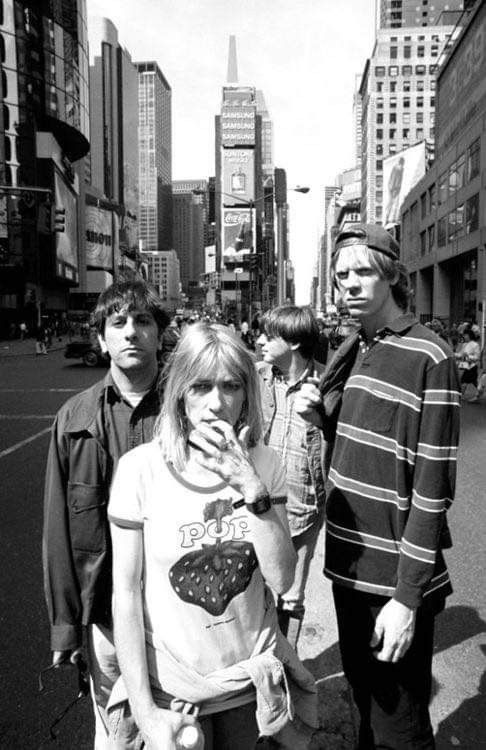
Parade was the soundtrack album to Prince‘s royally slated vanity project Under The Cherry Moon, an artily-filmed flop that aimed to evoke the golden era of 40s Hollywood; Art Deco, the French Riviera, silvery black and white tint ‘n all, but landed somewhat short of the mark. Over the course of what is a solid 8/10 album (insert the incoming sound of a million outraged Prince fans here) that flits between Mountains‘ on-the-one shuffling groove and the wonky jazz-inflected pop of Girls & Boys, the electro-funk of Kiss and the more standard perv-pop of New Position (he just about gets away with rhyming spunk with funk in the second verse) Prince runs the whole gamut of his flashy never-ending talent. He saves the very best til last though.
It’s the piano that does it. That and the sympathetically arpeggiated acoustic guitar. And the voice. The voices, actually. Three musicians, three voices, one great song. Coming at the end of Prince‘s eight album in as many years, Sometimes It Snows In April arrives quite unexpectedly, sent down from heaven to land as softly and prettily as a snowfall in April itself.
Prince – Sometimes It Snows In April
Sometimes It Snows In April is sparse, downbeat and fragile, the very opposite of the machine-powered dirty funk that precedes it. It’s just Prince with Wendy & Lisa, making what would turn out to be their last appearance on a Prince album. It’s the perfect way to bow out too; tinkle some high up the board keys, breathe some airy vocals across the top and allow the boss to take the song where it needs to go.
It sounds almost played and recorded on-the-hoof. Unsurprisingly, Prince’s vocal is spectacular, flitting effortlessly through the octaves from whispered restraint to skyscraping falsetto, his phrasing floating around the melody with relaxed, close-miked ease.
The guitar is sparse because the player (Prince? Wendy?) isn’t yet exactly sure of what to play. The piano (Prince? Lisa?) is similarly bare-boned. There are no drums, no electric keys, little in the way of bass. It’s Prince in the wee small hours, his musical sidekicks at his beck and call, just out of bed and jamming it all out beside him in their nightwear, adding their reverb-drenched backing vocals at the crucial moments. By the third chorus, just as the three have found their sweet spot, they bring it all to a close. “All good things, they say, never last.” Given the girls’ tenure in Prince’s backing band it’s the perfect refrain.
At one point the song was given a full-blown, power ballad orchestral make-over, but that version remains, alongside gazillions of other delights, locked tightly in the Prince vault. Someone should dial in 1999 and I reckon the door’ll swing wide open.
Anyway. The lyric of Sometimes It Snows… relates to Christopher Tracy, the lead character in the movie – played by Prince, of course – a flamboyant, flapper-era gigolo – of course! – who gads about the south of France swindling outrageously wealthy French women. Of course. In the movie – spoiler alert – Prince’s character dies and the song soundtracks the moment in the film when his former friends and lovers are reminiscing on how great he was. If you can see past the ego and the massive heid (and who wouldn’t have a massive heid if they too were as groovy and talented and attractive as Prince?) you can’t help but think it’s just about the most perfect song Prince wrote. A bold claim, but I’ll fight you for it. Or fight U 4 it, as the man himself wouldn’t have said.
There’s been no snow this April. Just splitting sunshine, shorts on and barbecues roaring. Another indicator of the unusual times we’re living through, as unpredictable as Prince at the end of Parade but nowhere near as pretty.
He wasn’t all about the dressing up, y’know. Or the heroin habit. Or the kidnapping and chaining up and false imprisonment of the male escort. Boy George made some great records too. Not necessarily the Culture Club ones that he’s best known for, although anyone who tells you they don’t like Do You Really Want To Hurt Me? is lying – that great, dubby bass outro alone is totally ripe for sampling into a blissed-out, cosmic audio adventure by someone with talent. Weatherall could’ve done wonders with it. Maybe he did….I dunno.
Post Culture Club*, George fully embraced the burgeoning club culture of the acid house scene. Stealing a nod on The Shamen by a good couple of years, he and long-time pal Jeremy Healy produced the nudge-nudge, wink-wink Everything Starts With An E, a four-to-the-floor, hands-in-the-air dancefloor banger that was enthusiastically put together following Healy’s first visit to Ibiza.
E-Zee Possee – Everything Starts With An E
Taking the island’s anything-goes manifesto, the track featured some (frankly hideous) rock guitar shredding, a Ronald McDonald sample and some box-fresh ragga toasting from reggae artist MC Kinky which was then welded to a steady 120 beats per minute groove. At times evocative of the slinky electro groove that powers Lil’ Louis’ French Kiss, Everything Starts With An E chugs along quite happily for seven and a half minutes.
Turn-of-the-decade epoch-defining, it conjures up images of liberated care-free, hedonistic young folk; bare-chested boggle-eyed boys, jaws going like the clappers, ogling the girls and the strobed-out, sillhouetted podium dancers in far-flung foreign nightclubs. By the time it builds to the end, the loved-up, laser-lit crowd is as one, raising their hands higher and higher and higher to the eh-eh-eh-eh-eh-Eh-Eh-EH-ECSTACY-EEEH! refrain, arms stretched straight up in praise-the-Lord euphoria as the chant and the dancers peak as one. I’d been on Ibiza at the time and yeah, that’s just how I remember it, daddy-o.
Produced while the dance music scene was still relatively underground, the duo created a label, More Protein, purely to enable the track’s release. Despite George’s obvious chart potential and Healy’s background in occasional chart grazers Haysi Fantayzee, no label it seems would touch the track, the lyric proving too hot for the more sussed executives who rejected it. In the event, the single peaked at number 15 with no airplay but also none of the tabloid furore that accompanied Ebeneezer Goode a couple of years later. A product very much of its time, it remains a slightly dated artefact from a dance scene that was heading pell mell overground from the underground.
Reflecting the balanced yin-yang of the More Protein logo, if Everything Starts With An E was a Saturday night record, George’s next venture was Sunday morning’s bleary-eyed groove.
Jesus Loves You – Generations Of Love (full length mix)
Generations Of Love is the sound of the Mediterranean, of beach cafes and breaking waves, late sunsets and early sunrises.
It has all the hallmarks of Ibizan influence; the filtered windchimes (?) at the start, the break beat, the sparse Italo house piano line, the ricocheting whooshes and a soulful vocal bang in the centre of the mix. George’s voice is spectacular here, a silken husk that duets with itself throughout the record, until MC Kinky pops up like a hyperactive ne’erdowell gatecrashing a redemptive meditation session.
The lyric too is multi-faith, the message one of hope over hate.
No big AIDS sensation…No twenty-eighth clause…The end of apartheid…No message of war
Generations of love have done you wrong
The Jew and the Gentile…The black and the gay…The lost and the futile…They’ve all got something to say The African nation…The sword of Islam…The rebels in China…The Sikhs and the Tams
And there’s much more we can say And there’s much more we can do And there’s much more we can learn
Jesus Loves You – Generations Of Love
The 7″ version might be even better. It breezes along on the same shuffling beat, but includes essential frantically-scrubbed Spanish acoustics and some lilting Paris-in-the-Spring accordion. Not something I’d ordinarily miss, but perfect on this Balearic brain soother.
*Culture Club phase 1. There was a flat as a pancake attempt at a reunion a few years ago. Filmed for posterity by the BBC, I’m fairly certain none of the principal players would want to watch again.
Man. Life is unfolding in slow motion just now. Days blur into nights, nights turn into TV or reading marathons, the mornings become afternoons and we’re back to chopping red peppers with the 5 o’clock government briefing playing out in the background. The sense of displacement, of unreality, isn’t helped by the nightly dissemination from the Government stooge at the middle lectern. It’s quite a skill to stand there and say nothing at all for a whole hour, to bat and deflect any difficult questions, to go against your own principles and celebrate the NHS after voting against health workers getting a pay rise then cheering the result when it was overwhelmingly rejected, but that’s what they do. It’s what their pal did the day before and it’s what some other insipid flunky with a home counties accent and a degree in talking pish is going to have to do tomorrow evening as well. And it’s all reactive – because of this, we’ll do that. It’s never proactive. The other constant is the continual anonymity of the Prime Minister. At the first opportunity of escape, he was off. Ah-tchoo, he went, and he was nowhere to be seen, what little reputation he may have had rapidly sliding into negative numbers. Distressingly, the only thing that does change daily is that ever-rising death count. The highest in Europe, they’re expecting. They can see it coming, but they don’t know what to do. Worrying times indeed.
It’s music we always return to, the instant fix in a world gone wrong and this slow pace in life has been sound-tracked by all manner of great stuff recently. With more time on my hands, and more phone in my hand, I’ve been digging deeper into corners of the world wide web I may have previously by-passed. The ever-reliable Adam over at Bagging Area has created a trio of terrific Isolation Mixes, seamlessly ambient pick ‘n mixes of stuff you may be familiar with, woven in-between previously unheard beauties. Jack Kerouac samples over Joe Strummer records, Eric Cantona versus Daniel Avery, plenty of Weatherall and David Holmes, the odd slice of Durutti Column…. not always the sort of stuff I’d feature regularly here, they’re great mixes and you could do worse than head over to Bagging Area and find them there.
The Orb – Blue Room
Listening to Adam’s mixes has had me reaching back to The Orb, in particular Blue Room, their long-form 40 minute single that led to one of Top Of The Pops more esoteric moments. It‘s an astonishing piece of music; groovy, arch, out there and created purely for the benefit of exploiting chart rules. Up until 1992, CIN rules dictated that chart singles could be no longer than 25 minutes long. A change in the rules, a reaction to dance culture when singles came backed with multiple remixes, allowed singles of up to 40 minutes to chart. The Orb took this as a challenge and created the 39:57 Blue Room.
Blue Room grooves along on windswept ambience. It bubbles and bleeps, dives and soars. One minute it’s flotation tank otherworldliness, the next it’s cosmic time travelling through the galaxies. An ethereal female vocal drifts in and out. Spacey whitewashed whooshes leave vapour trails floating out into the ether. There’s an occasional half-hearted beat, a sparse drumkit recorded in a far-flung place, the Gobi desert maybe, that eventually creeps into the foreground of your conscience.
It’s around 7 and a half blissed out minutes before the beat properly kicks in, kept in time by a combination of drums and congas and coloured by the sort of looping, circular dub bass that hasn’t been heard since Screamadelica the year before. It’s dance music Jim, but not as we know it. For 40 minutes it ebbs and flows, the key elements coming and going like actors in a West End play – lead role one act, supporting cast the next – until it fades out on a mangled sample of Marilyn Monroe singing Happy Birthday to JFK.
Entering the singles chart at number 12, Blue Room rose to number 8 the following week and earned itself a slot on the nation’s favourite TV pop show. A very edited version of the track was played while a bemused production team and audience watched on.
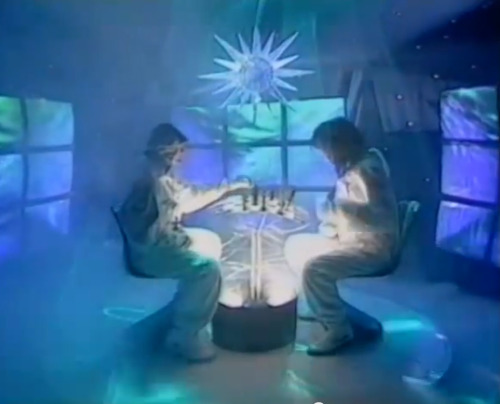
Bathed in green and blue light, the two principle members, Alex Paterson and Thrash, sat side-on to the cameras, heads down, practically silhouetted, and played out a game of futuristic chess dressed in exactly the sort of suits the government should be providing for every health worker in the land at this time. Not quite the epoch of Bowie and Ronson but for comedown clubbers everywhere, this was their moment.
I always thought he looked like he was about to topple over, the mid 60s Bob Dylan. With the stripy pipe cleaner-thin spindles he called legs carrying the weight of that fantastic dark blue suede military jacket, the Ray-Bans stuck high up that hooked nose and the wildly exploding crow’s nest ‘fro, not to mention the ideas constantly forming and reforming in that speed-addled super-brain of his, it’s amazing that the top-heavy troubadour never once fell flat on his face. On the contrary, mid 60s Bob was The Man, one step ahead of his manager and his band and his audience, barely giving consideration to anyone willing and able to catch up with him.
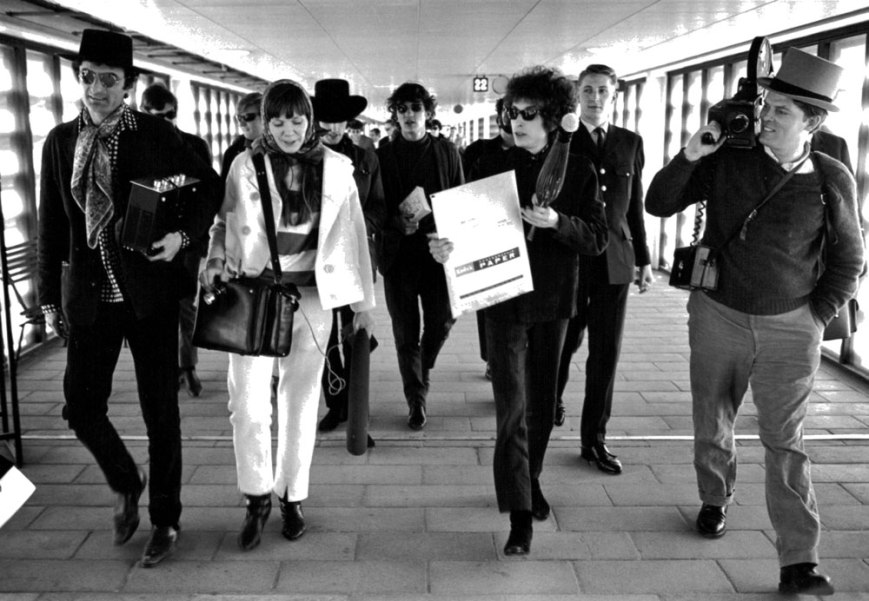
Dylan et al (DA Pennebaker in the top hat) at London Airport, May 6th 1966
By the time he’d hopped over from Dublin in May 1966 to commence his tour of the UK, Dylan was 4 drummers in with the previous three, including Band legend Levon Helm, jumping the good ship Bob in favour of a quieter life. Incessant nightly booing, it seemed, wasn’t what any of them had signed up for. Dylan arrived here a bona fide superstar, the voice of a new socially-conscious generation, every show sold out in advance. Aloof, arrogant and quotable in abundance, The Zim riled the stuffy British press. He didn’t play their expected game. His one press conference, at London’s Mayfair Hotel, was a testy affair. Music journalists were sat side by side with the more straight-laced journalists from London’s press establishment and so questions came from a bristling mix of the informed and the ignorant; What d’you like? What d’you loathe? There seems to be an electric element creeping into your sound…. What d’you think of England? Are you married? (Answer: I’d be a liar if I answered that, and I don’t lie.)
When the Melody Maker’s Max Jones suggested that he didn’t hear protest songs any longer, a weary Dylan shot back.
“All my songs are protest songs! You name something, I’ll protest about it! All I do is protest!”
Even Keith Altham, the most cutting-edge, most well-respected music writer of his time and the golden boy at the NME to boot, found himself on the wrong end of Dylan’s surreal wit. “Why is it,” he asked, “that the titles of your recent singles, like ‘Positively 4th Street’ and ‘Rainy Day Women #12 & 35’ bear no apparent connections with the lyrics?”
‘It has every significance,’ returned Dylan. ‘Have you ever been down in North Mexico?’
Bob Dylan, press conference at the Mayfair Hotel in London in 1966.
Dylan batted everything off with an abstract absurdness that came easy to him. He treated the journalists like morons, prompting one to complain that “Cliff Richard was never like this,” firing back the funniest, most-perfect answers you might ever read.
Q: What do you own?
A: Oh, thirty Cadillacs, three yachts, an airport at San Diego, a railroad station in Miami. I was planning to bus all the Mormons.
Q: What are your medical problems?
A: Well, there’s glass in the back of my head. I’m a very sick person. I can’t see too well on Tuesdays. These dark glasses are prescribed. I’m not trying to be a beatnik. I have very mercury-esque eyes. And another thing—my toenails don’t fit.
With everything being captured for posterity by DA Pennebaker’s shoulder camera, Dylan and an unwitting press played their part well. It’s all there in the wired, messy travelogue Eat The Document if you didn’t know already. If only for the brief clip of Dylan and his band standing at the corner of George Square in Glasgow, tapping their toes to a passing pipe band right outside where the Counting House pub stands these days, seek it out.
It was this backdrop that informed the charged nature of the shows. Playing the same two sets each night, Dylan opened with a set of acoustic songs, just him, his guitar and a selection of harmonicas. They were generally very well-received, as rightly they should’ve been. Dylan was on top form, rolling out fantastic versions of some of his best-loved recent songs; She Belongs To Me with its slightly altered lyric, the eee-long-gat-ed phrasing in It’s All Over Now, Baby Blue, the lean, mean and near 12 minute Desolation Row, the definitive Mr Tambourine Man, its clearly enunciated words and perfect clarity sticking two fingers up the naysayers who’d sneer that Dylan couldn’t sing. It was the perfect set that would prove to be Dylan’s concession to the accepted notion of folk for the night.
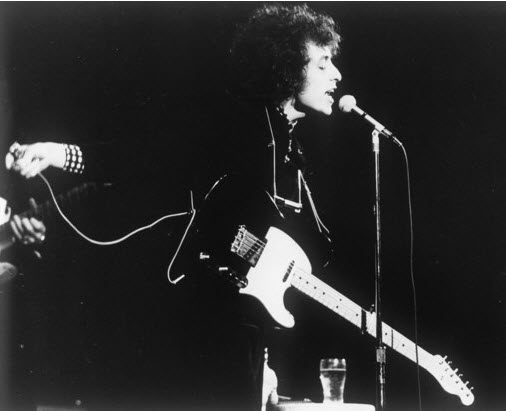
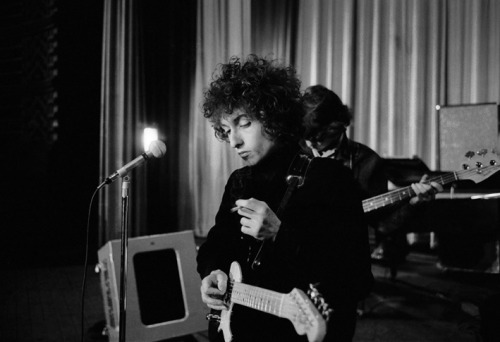
After a short break he’d return, leading his band, a clobbering riot of Cuban heels and mohair suits and unkempt hair and electric guitars who’d plug in and play loud. Dylan too strapped on an electric, a Telecaster, wearing it over the shoulder the way a huntsman might take his gun out to shoot deer, a suitable metaphor given what would unfold. The second set always started with Tell Me, Momma, a gutterpunk garage band blooze that was the unholy sound of Pete Seeger and his axe and his high and mighty ways about folk music au-then-ti-ci-tee being blasted far and high over the Grand Coulee Dam. Never released as a studio version, the only official release comes via the Albert Hall 66 Official Bootleg – which was actually recorded in the Free Trade Hall in Manchester a week or so beforehand. But you knew that already.
Bob Dylan – Tell Me, Momma (Manchester, May 17th 1966)
The start of this recording, with the band clattering across the wooden stage to take position, the muffled and hushed, expectant audience, Dylan’s off-mike harmonica trills and the boot stomp count in that leads to the slap-in-the-face pistol crack snare never, ever fails to excite.
And then, when the band comes in…oh aye! They cook up a terrific howling storm; loud, raucous and in your face. Dylan looks his audience straight in the eye, takes aim and fires.
“But I know that you know that I know that you show, something’s tearing…up…your…mi-ii-ii-ind.”
If this fails to thrill you, if this fails to make you jump up and punch the air and shout, “Go Bob!” as loud as you can, then I can’t help you. No-one can. It’s his voice. He’s stoned or speeding or upping or downing or something, but Bob’s vocal is just great. Slurred yet enunciated, sloppy yet eager, he has you right there and then. Around him, out-with the eye of the storm, merry chaos ensues. A beat group?! At a folk concert?! With keyboards and electric bass and drums and everything?! Robbie Robertson, Dylan’s cooler than ice foil on the left fires of wildly sparking, cheesewire-thin electric riffs on his own arctic white Tele, played high up in the mix so as to cut through the chaotic racket. It’s incessant 12 bar blues played with fuck you punk spirit, the greatest sound around. And, at the end, applause. Real clapping and stuff. It wouldn’t last though. In Manchester, once the audience realises this set ain’t gonna be like the last one, the applause gives way to a slow handclap after only the second number, I Don’t Believe You (She Acts Like We Never Have Met).
Bob Dylan – I Don’t Believe You (She Acts Like We Never Have Met) (Manchester, May 17 1966)
Previously cast as an acoustic blues on his Another Side Of… album, it’s reborn in ’66 as another beat-driven garage band rocker, heavy on the Hammond, always returning to its signature amped-up guitar riff. By the second song in, half his audience have chucked him for good. Those that stayed with him though had electric ideas of their own. Listen carefully to I Don’t Believe You and you’ll hear the genesis of The Faces’ Cindy Incidentally, a story for another time.
If this is your kinda thing, hunt out Jewels & Binoculars, a 26 CD bootleg of every parp ‘n fart from Bob’s harmonicas in 1966. It’s the gemme, as they say round these parts. Until then, here’s Bob and his band entertaining a confused Dublin audience. Wonderful stuff.
Strange times abound. You’ve probably been working from home the past week or so, perhaps sat at your makeshift workspace in a pair of two days-old underpants, your face and razor no longer on speaking terms. Yes, perhaps even you, ladies. Maybe too there’s a chalky white toothpaste trail down the front of your t-shirt, the one you also slept in last night as it happens (and what’s it to ya?), a stain that, you notice, looks like a grubby white silhouette of Africa when you look in the bathroom mirror. You’ve been checking and rechecking your phone to clarify if it’s a Tuesday afternoon or a Sunday morning or even a Thursday night, the same phone that loudly heralds your daily step count and quietly informs you of an increase in screen time…..for the third week running. The telly plays in the background, a never-ending loop of graphs in an upward trajectory, safely-distanced shots of hastily-built hospital wards and talking heads of serious scientists and gormless government officials. The Prime Minister has chucked it, isolated due to The Virus (he says), so no more babbling hyperbole of squashing sombreros, but really, we all know he’s keeping out of the road because he’s feart to answer questions he has no decent answer for.
In times like this, I, we, look to music. Recently, it’s been a mix of Buzzcockian post-punk and a reacquaintance with the Zim at the start of the day, dub reggae and a bit of ska for lunch and John Martyn until the second? third? glass is drained and bedtime has long-passed. Last night I lifted and redropped the needle on his Glistening Glyndebourne half a dozen woozy, boozy times. A future article for sure.
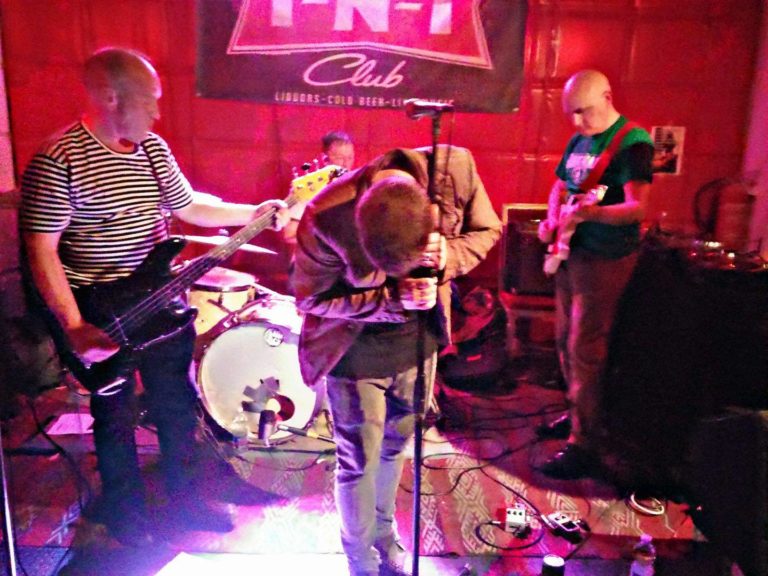
A recent article focused on Cloth and their label Last Night From Glasgow. As you read this, the label is in the midst of curating and compiling The Isolation Sessions, a timely, hastily hatched and socially-conscious album with a noble purpose: the small, independent venues that host weekly shows, many of them featuring LNFG artists, venues that struggle at the best of times, will share in all proceeds from its sales. Simple, yet (fingers crossed) effective. The hope is that this endeavour should help in some small way towards these venues staying alive until who knows when. By the end of April, The Isolation Sessions should be complete and ready for release. You can pre-order it here.
What sets the album apart from most other compilations is that this is an album where labelmates cover one another’s tracks. The aforementioned Cloth have a go at reworking acoustic neo-folkie Annie Booth, who returns the favour by turning in a gossamer-thin version of Sleep. The Gracious Losers, Glasgow’s sprawling, scabby-kneed take on an Arcade Fired-up E-Street Band will cover psychedelic shoegazers Domiciles. Sister John offer up a faithfully introspective recording of Stephen Solo‘s Secrets You Keep, enhanced by the combined female/male vocals. For reference, think of those fantastic Isobel Campbell and Mark Lanegan albums from a few years back. Yes, that great.
The best track so far – and so far is the caveat here, because only a third of the album has been made available to LNFG subscribers, is Close Lobsters‘ amazing version of Cloth’s Curiosity Door. To fully appreciate it, you must first be familiar with the original;
Cloth – Curiosity Door
Curiosity Door is fantastic; synthesised pealing church bells giving way to whispered vocals, sparse percussion and lean, fat-free pulsing guitar, the pinged harmonics ringing long into the empty spaces. Womblike, dreamy in a just-woken-up manner and pin drop-quiet, it’s the perfect sampler of what Cloth is about. Never heard them? Curiosity should get the better of you. Boom boom.
Close Lobsters have only gone and – wow! – totally reinterpreted Curiosity Door as a motoric, propulsive mid 70s kosmische groover, all compasses going wild for map reference 51°14′N 6°47′E and Düsseldorf, West Germany. Listen to this!
Close Lobsters – Curiosity Door
Close Lobsters’ version is washed in Suicide keyboards, Michael Rother guitars and slow-burning, fractal, vapour trails that Sonic Boom would give his 1962 Vox Phantom for. The first thing you notice though is Andrew Burnett’s close-miked Scottish burr. Slightly menacing, slightly sinister, it brings to mind some of those great Pulp records where Jarvis whispers only for you, right down and deep into your ear. All summer, you’d shave your head, he goes. Given the current trend for DIY stay-at-home buzzcuts, well, how prescient!
I’ve had this on non-stop repeat for the past 24 hours and I can say with absolute confidence that it’s the best thing I’ve heard this year. When all of this is over and we get back to live music again and Last Night From Glasgow give the compilation the proper launch it deserves, I hope very much that, as great as Close Lobsters’ new album is in its own right, they’ll coax the band into playing their version of Curiosity Door very loudly indeed.
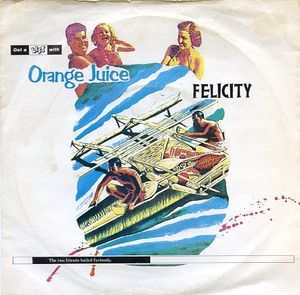
David Gedge introduced The Wedding Present’s breakneck run-through of Orange Juice‘s Felicity with those words, delivered in a perfectly-sighing, world-weary Yorkshire brogue. I first heard TWP version on Tommy, the album released in the wake of George Best‘s success, a stop-gap of odds and sods and radio sessions – Felicity came from a Peel Show – that would keep the growing fanbase happy and dipping into their pockets until the second album proper was ready. For reference, think Hatful Of Hollow at a hundred miles an hour. “William Shatner?” I pondered. “What on earth does Star Trek have to do with The Wedding Present?”
Well, nothing, as was plainly obvious to everyone but me. Shatner’s Captain James T Kirk was the lead character in Star Trek. James Kirk also happened to be the name of the lead guitar player in the definitive line-up of Orange Juice. It was quite the epiphany when I joined the dots on that one. “Aaah,” I mused, safe in the glow of triangulation. It’s the simple things that matter.
It must’ve been great to have been in Orange Juice in 1981 and 1982. Just a hop and a step on from punk, these leaders of a brave new open-minded world channelled the sublime- Velvets/Buzzcocks/Chic with the ridiculous – Davy Crockett hats/Boy Scout shorts/open-toed sandals and white socks with no fear of ridicule. Bands these days, with their marketing strategies and social media channels and Spotify demographics might take all of this for granted, but believe me, Lewis Capaldi and Foals and Blossoms, it wasn’t always thus. Orange Juice had the reference points and the in-jokes and the fantastic haircuts. The world was theirs for the taking. By the time of You Can’t Hide Your Love Forever, they’d outgrown Postcard Records but hadn’t yet fiddled around with the magic ingredients in their sound, so that first album rattled and rolled majestically. The cover of Al Greeen’s L.O.V.E.…Edwyn’s incredibly tender In A Nutshell…the Motown by way of Mount Florida Falling & Laughing…. it really was the sound of young Scotland.
Orange Juice – Felicity
Felicity made itself known towards the end of side 2. The key word for it is collapse. From the wobbly woah-woahs onwards, it’s never more than a beat away from potential disaster. The guitars, brilliantly-shimmering and sparkling are forever a half-trip and stumble from being an unlistenable out of tune mess. The timing is slightly off, the game backing vocals admirable, the frothy enthusiasm of the four players clear for all to see, but when they clatter their way into the galloping key change near the end, it’s the four to the floor disco beat that keeps it all together, striving to maintain the semblance of musicality that helps Felicity come to a still-standing stop.
Look closely and you’ll see Edwyn’s magnificent, blow-dried quiff teeter on the verge of limp collapse, wrung out and hung out to dry. Look closer still (around the 2:15) mark) and you might even spot David Gedge forming yer actual Wedding Present. And who could blame him?
And then listen again. Really listen! Listen to the slo-mo piano line at the start. Zoom in on that bouncing bass line. Pay attention to those well thought-out guitar lines. The tremelo! The triple-string riffing! The referee’s whistle that was so de-rigeur in early 80s New York dance records! Even in a light years-away Glasgow tenement, Orange Juice clearly had a collective finger on the pulse. Then there’s Edwyn’s joyous James Brown cop near the end. “Take me to the bridge now!” he shouts with dizzy abandon. It’s a proper jangling racket, Felicity. The sound of happiness, as Collins sings, but also the sound of fishermen’s stripy t-shirts and pleated waists and eyebrows forever-arched; feisty and fey, young punkish enthuisasm bottled forever. Sexy, as Gedge remarks at the end of his band’s version. Sexy.
At the tail end of the 80s, Sonic Youth‘s Kim Gordon sat down with LL Cool J to interview him for a piece in US music magazine Spin. A fan of his music – she loved Cool J’s first album, Radio – the plan was to show how the artists maybe had something in common. Despite each coming from wildly differing marginalised backgrounds, Gordon, a woman from the underground punk rock scene and Cool J, a black man from the misrepresented rap scene would/should be able to empathise with each other’s experiences of prejudice in music. They had a tenuous common link in Def Jam supremo Rick Rubin who’d come out of the same scum-rocker scene that allowed Sonic Youth to grow and develop, but, really, that was about it.
Sonic Youth’s bass player quickly discovered she had very little in common with the hot to trot rapper. Indeed, it wouldn’t be out of sorts to say she didn’t really like him….and he didn’t really give two hoots in any case.
With his current album Walking With A Panther tearing up the Billboard Hot 100 and a fleet of luxury cars parked outside his brand new, furniture-free home, LL came across as very much the stereotypical big-shot rapper, a boy from the projects who had landed very much on the soles of his box-fresh sneakers, his frat-boy opinions on subjects as divisive as what made comedians funny and how to treat women drawing a clear line in the sand.
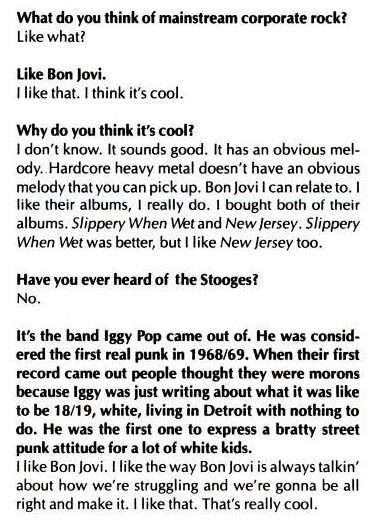
Amongst the tension, there’s a genuinely funny moment when Gordon prods Cool J into giving his opinion on contemporary rock music. As well as admitting to a love of Bon Jovi (“both their albums“), he just doesn’t get the obvious parallel between Iggy in the late 60s and his own experiences 20 years later.
With references to Cool J (‘Kool thing, walkin’ like a panther’) and a lyric that takes exception to LL’s objectification of women, it’s fairly hard hitting. Political, pro-feminist, angry, anti-misogynist, it ramps up another level when Public Enemy’s Chuck D pops up to ‘tell ’em ’bout it. Hit ’em where it hurts.’
“Hey, kool thing!” instructs the uber-cool, street-smart Gordon.
Come here, sit down. There’s something I go to ask you.
I just wanna know, what are you gonna do for me?
I mean, are you gonna liberate us girls
From male white corporate oppression?
Tell ’em ’bout it indeed. Maybe Kim Gordon thought that by changing the ‘C’ in ‘Cool’ to a ‘K’, LL wouldn’t realise it was about him. She was probably right. I wonder if he’s aware of it yet. I doubt, with his Benz, his BM, his Audi and his Porsche lined up in the drive of the house he called Fantasyland that he’d be all that bothered. I may be wrong, but I don’t think LL Cool J ever replied in rap to Gordon’s dis. Unusual for a rapper, that.
Working Men’s Club have just about the least Googleable name in music but they’re worth swiping through all references to the Wheeltappers & Shunters of the world until you find them. They really are. Last year they found their way to Plain Or Pan, directing me towards their excellent Bad Blood track, a song subsequently pressed on a limited 7″ that tickled the top ten of yer actual singles chart. The charts might not be relevant to you or I as much these days, but you can bet the lint in your pocket that it meant a whole lot to the young northern English three piece.
With an album imminent (5th June is the date to circle on your year planner) they’ve emerged from the studio with a slightly changed and expanded line-up, but no less of the tuneage and teenage abandon that made Bad Blood and its follow-up Teeth so great.
Album track A.A.A.A. spits and snarls like those ’80s/’90s Fall collaborations with Coldcut; vocals megaphoned in from across the Pennines…sparse guitars spitting fury…vintage synths hovering and haemorrhaging between the processed beats…the whole thing sounding like a hornets nest on fire. It’s magic.
Working Men’s Club were due to go out on tour with Baxter Dury and yer actual Noel Gallagher over the coming weeks, gigs that obviously won’t now happen. I suggest you pre-order their album instead and then, when the live music scene gets up and running again, you’ll know every noise and every nuance on what promises to be a debut to rival all others this year. You might even find yourself at one of their own headline shows when they hit the virus-free road in their own right.
As far as guitar-based indie rock goes, 2019 arguably went to Fontaines DC. 2020 though is Working Men’s Club’s for the taking. Click the logo below and it’ll take you straight to your music retailer of choice.
Like many of the tracks released by the constituent parts of the group that created it, Disappointed by Electronic was released as a standalone single, a gap-plugger that sated the appetite of their fans in the period between the first two albums. A fantastic gap-plugger it was too.
Bernard Sumner’s New Order were awfully fond of (perhaps even hell-bent on) ensuring singles stayed off of albums. Ceremony, Temptation and Everything’s Gone Green didn’t make it to Movement and Blue Monday, Confusion and Thieves Like Us didn’t appear on the chronologically closest Power, Corruption And Lies, although by the time of Low-Life, lead single The Perfect Kiss was a central part of the album and from then-on in, a good proportion all of their singles were used to promote a parent album.
Johnny Marr’s Smiths gave great value for money, regularly releasing one-off singles that would eventually appear as 33 rpm tracks on compilation albums further down the line; How Soon Is Now? (originally a b-side), Shakespeare’s Sister, Heaven Knows…, William…, Panic, Ask. All started life spinning at 45rpm.
Pet Shop Boys were perhaps the more conventional of the trio. On a major label they maybe didn’t have the same clout that an indie band might have on a small label (though what do I know?) and accordingly, almost all of their singles, in that imperial run from West End Girls and Love Comes Quickly through So Hard and Being Boring to 1991’s DJ Culture and Was It Worth It? were taken from their studio albums of the time.
(Photo by Kevin Cummins/Getty Images)
Disappointed is very much a product of its time and place. Chronologically, it was written around the end of 1991, when Johnny was between The The projects and just before Bernard returned to New Order to record Republic. Despite being patchy in parts (and that’s a whole other blog post), the last decent album in New Order’s original form gave us Regret, arguably the last truly great New Order single; soaring and melancholic, built on a bed of asthmatic guitar and hard-wired technology, and, from the negatively-leaning titles in, you can draw a straight line between that New Order track and Electronic’s 4th single.
Electronic – Disappointed (7″ mix)
By the end of 1991, Pet Shop Boys had amassed 19 hit singles to their name (pop quiz – name them!) Anything they touched turned to sold and gold. They were the masters at minor key pop, “The Smiths you can dance to,” as Tennant famously said at the time. Arriving on a bed of synth washes and era-defining Italo house piano – conceived by Johnny’s brother Ian – Disappointed‘s hookiness (not Hooky-ness) is immediate and immersive, mainly due to Neil Tennant’s cooing ah-ah-aah refrain.
Three seconds in and it sounds like the greatest Pet Shop Boys hit that never was. Tennant employed all the best PSB tricks; minor key melancholy, smoothed-out spoken word in the verses, flying like a kite in the chorus, those earworming ah-ah-aahs and pulsing glacial synths to the fore.
It worked. On release in July ’92, the single climbed to number 6 on the UK charts, kept out of the top 5 by Mariah Carey’s helium-voiced take on the Jackson’s I’ll Be There. Ironically enough, the b-side to Disappointed was a remix of Idiot Country.
Seemingly content to take more of a back seat at the time, Johnny has an understated role in the single. He breaks into full-on Nile Rodgers funk for most of it, riffing across the top 3 strings like he hadn’t done since 1985’s Boy With The Thorn In His Side, his right hand rattlin’ the rhythm while his left shapes the funk, but contribution-wise, Disappointed is probably 45% Neil, 35% Bernard and 20% Johnny. The sum is greater than its parts though. It’s a great single, almost a lost single really, given the ubiquity of Getting Away With It and its not-quite-as-good follow-up Get The Message, but one that deserves reappraisal.
When Tom Jones brought It’s Not Unusual parping and swinging into the 60s, all bold as brass confidence and knicker-dodging hip-shakes, little did anyone know that the record that introduced the lothario from the Valleys to the world was in fact a demo recording. Yes. A demo. Jones was just another struggling singer, one flop single to the good and looking for a break, when he was asked to contribute a guide vocal for what was to be the next Sandie Shaw single. When Shaw heard the demo she immediately passed, claiming that she couldn’t better the vocal on the demo and suggested Jones’ version was released instead. It was, and from it, Jones went on to meet Elvis, catch more knickers than he could dodge and turn a suspicious shade of orange with each passing year. A good career move, you’d have to agree.
Established artists being offered and turning down songs is, if you pardon the pun, not unusual. The opportunity for the songwriter is clear; big artists have big hits and generate big money. Who wouldn’t want a slice of that? The Sheerans and Swifts of this world must be batting them off on an hourly basis. They’ll have layers of management filtering out only the very best of them of course, and if a writer is lucky, maybe their chosen artist will even listen to what they have to offer. Maybe.
Occasionally though, art is more important than commerce. The tectonically-paced Blue Nile have never been motivated by anything as crass as chart position or commercial success. Sure, they’ve had a (brief-ish) taste of both but for the Blue Nile, it’s music as art that’s the important thing. Their four albums stand as perfectly-considered collections in their own right, to be played as a whole from ebbing start to flowing finish, each Linn drum and symphonic sweep, every harmonising horn line and tight ‘n taut Strat part agonised over through hours – years, even – of studio sessions. The lyrics on top are just as precious, delivered as they are by Paul Buchanan’s iconic, laconic yawning drawl, a voice as idiosyncratic and essential as Bowie’s and that’s no lie.
They’re an enigma, the Blue Nile, as insular and secretive as they come, emerging only as and when they have something worth sharing. You might be walking up the Byres Road in Glasgow’s West End and imagine you’ve just passed Paul Buchanan coming out of Fopp or, later on, do a double take at the guy in the QM who looks really like PJ Moore, more grey than you imagined, more facial hair, perhaps….and then realise that it really was two thirds of the Blue Nile that you encountered in the one day. Hidden in plain sight, the Blue Nile have managed to attain the enviable position of maintaining both healthy record sales and anonymity on their hometown streets. What your Sheerans and Swifts wouldn’t give for that…
JJ Gilmour is a great songwriter (and singer, but we’ll come to that shortly.) He shot to prominence as a member of The Silencers, played massive shows in France and Germany where the band were, perhaps unbelievably but no less true, as popular as U2 and Simple Minds, before the downward slide of sales and the inevitable end. Since then, Jinky’s carved out a niche career penning the most beautiful and perfect songs, as melodic and melancholic as McCartney at his peak (and again, that’s no lie) and regularly plays shows that are heartbreaking and uplifting in equal measure. A career in stand up awaits Jinky should he choose to hang up his guitar, but comedy’s gain would be very much music’s loss.
Jinky’s songs are terrific, equally at home as stripped-back acoustic ballads or full-band blow outs. Melody is the key and Jinky’s songs have it in spades. On his last album, 2017’s Dix, JJ took the decision to record an acoustic album, augmented by occasional strings and complementary piano. Soul baring, naked and raw, it’s an album that would spin nicely at 2am after you’ve gone through the aforementioned Blue Nile’s back catalogue, with the lights low and a glass half empty.
Midway through you’ll find the incredible Glasgow Town.
JJ Gilmour – Glasgow Town
This slideshow requires JavaScript.
Jinky wrote Glasgow Town with Paul Buchanan in mind. You can hear it in the airy space between the notes, the arrangement stripped of superfluousness, the spotlight trained on the voice hanging in the vacuum. It would’ve made a great opener on either of the first two Blue Nile albums, records that are ingrained with the grit of Glasgow’s soul, albums that shimmer within and radiate majestically at the edges.
Jinky’s Glasgow Town does likewise. If you’ve ever been lucky enough to hear him perform it live, you’ll know. Time stops, the air is sucked out of the room and all the focus is on the wee guy stage centre, baring his soul in that wonderfully expressive voice. He’s loved, is Jinky, perhaps even more than that Buchanan fella, although I’m not so sure that he’s fully aware of that.
Through a network of connected friends, Glasgow Town eventually did make it to Paul Buchanan. The story goes, as Jinky heard from one of those mutual friends, that the Blue Nile vocalist, the guy with the voice as idiosyncratic and essential as Bowie’s and that’s no lie, liked it. “That’s perfect as it is,” he was heard to say. “I couldn’t do it any better.” He was right too. If you want to own a version of Glasgow Town, go for the original.
Unlike Tom Jones, Jinky hasn’t gone on to Vegas residencies and knicker-dodging global success, but then, Tom Jones will never write a song as wonderful as Glasgow Town. Who’s the real winner?