Get This!, Gone but not forgotten

Not Dodgy

I spent some time in the company of Dodgy’s Nigel Clark at the end of last week. He was up doing a one-man show – all the Dodgy hits, a few of his own solo songs, a smattering of carefully-chosen covers (Tom Waits, Frankie Valli, a spontaneous run-through of the new Beatles single), all interspersed with off-kilter chat and rueful observations on life in 21st century Britain. He’s a massive soul music fan – that would explain the cover of ‘The Night‘ that he ended with, and the various soul covers that constitute those early Dodgy b-sides – and thrillingly, he played a version of a fantastic Stax track from 1975 that was totally new to me. The song found a home in my ear and, after many YouTube plays and before I’d gone to bed in the wee hours of Saturday morning, I’d found a copy of the 7″ online and bought it. I think you’ll like it…

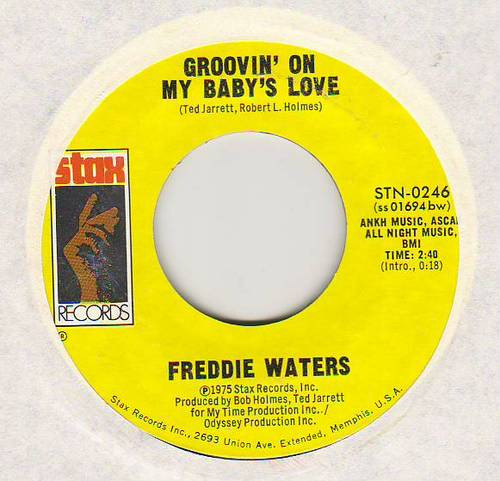
Freddie WatersGroovin’ On My Baby’s Love

Tinkling Fender Rhodes, descending chords playing against up-sweeping strings, a slow ‘n steady groove of snare ‘n kick drum, a cooing female backing vocalist going against the grain of Waters’ gravelly soul man voice in the chorus…there’s no chicken-scratch guitar or tasteful Cropper-esque blue notes, nor nary a whiff of honeyed brass, yet it has all the necessary ingredients, as Ray Charles one said, in a recipe for soul.

The bridge –‘some people worry ’bout simple things‘ – is pure grits ‘n gravy Memphis soul. In the hands of an Otis Redding or a William Bell or a, yes! Al Green, Groovin’ On My Baby’s Love might’ve bothered the pop charts. And maybe it did, but apparently, very little has been written about either Freddie Waters or Groovin’ On My Baby’s Love so I don’t know about that. I’m certain some switched-on soul brother or sister here will keep me right though. Typically, the track alone should have both singer and song held in far higher regard than the world seems to afford them.

There will, of course, be hundreds of songs like this, floating out in the ether, waiting for the record collector’s butterfly net to catch them as they flutter past. By way of payment, I sent a suitably gobsmacked Nigel a link to Darondo‘s Didn’t I. Featured here a few years back on the recommendation of Gerry Love – another soul-loving beat group employee, as it goes – it deserves another shining of the Plain Or Pan spotlight.

DarondoDidn’t I

Obscure-ish mid ’70s soul recommendations most welcome. Add them in the comments below.

Get This!

Knocks Opportunity #1

I was contacted recently by the folk responsible for the Japanese version of the remastered reissue of Cake, the Trashcan Sinatras‘ first album. They wanted to know if I could provide an accurate translation of the meaning behind the lyrics to their debut single, Obscurity Knocks.

What, for example, does ‘I’ve turned 21, I’ve twist, I’m bust and wrong again,’ mean? Witty and pun-filled, articulate and alliterative, Obscurity Knocks is a perfect distillation of all that’s good about the Trashcans’ wordplay, but sung in a rich Ayrshire brogue, many of its metaphorical subtleties were lost to the ether.

The Trashcans (wanting to appear enigmatic and mysterious, to Go! Discs continual exasperation) kept most of their words tightly under wraps back then (although they did include Obscurity Knocks‘ lyrics on the rear of the single’s UK cover) and, in the absence of printing them on Cake‘s inner sleeve like other bands might have done, it was left to fans – and often foreign fans at that – to scribble them down as heard and offer their best versions in the rudimentary chat rooms of the nascent world wide web. Gen, my new Japanese pal, has a grasp of English that truly puts my pidgin Japanese to shame and while his understanding of the lyric was fairly accurate, I offered to go directly to the band for an official set of lyrics. A couple of messages later, I had them to hand and Gen in Japan soon had what he needed.

Gen then suggested I write something for the reissue’s sleevenotes – a Plain Or Pan-style article on Obscurity Knocks itself. Now, while that was instantly appealing – and something I immediately set to work on – I suggested going one better. I’d actually written sleevenotes for the brand new UK reissue of the album. They were ready to go, along with a new gatefold sleeve, a lyric sheet, unpublished photos, the full works when, at the final hurdle, the band decided to revert to the record’s original packaging; no lyrics, blurred photos, no sleevenotes. Enigmatic and mysterious, remember?

All of this meant that I had a set of sleevenotes without a home. Would the Japanese label like to use them? After the go-ahead from the TCS themselves, the sleevenotes found a new home in the far east. The start of this week was spent explaining some of the idioms and turns of phrase that Gen had trouble putting into pure Japanese – ‘Muscled their instruments into the mix‘, ‘A welcoming world of non-competitive leg-ups‘, ‘Baw-deep in melody,‘ (I never wrote that last one, but you get the idea) –  and there now is, apparently, a set of sleevenotes written by my own fine hand and translated beautifully and lovingly by Gen into Japanese. I really can’t wait to see what they look like.

This now means that I am left with an article on the giddy rush of Obscurity Knocks. Not one to waste things, it forms the rest of this post beyond the track itself below…

Trashcan SinatrasObscurity Knocks

Thoughts on ‘Obscurity Knocks’

It’s February 1990. The Trash Can Sinatras gatecrash a smattering of small, switched-on corners of the world with Obscurity Knocks, a bright ‘n breezy strumathon of major and minor 7ths that skirls and skelps and flies straight outta the traps like life itself depends on it – which it very much does. Obscurity Knocks might well be the band’s debut single, yet the Trashcans are already world-weary and wary of a music business that doesn’t quite fit their aesthetic. ‘I like your poetry but I hate your poems,’ they spit, a reference to the many rejections they had before Go! Discs came to their rescue and made them Irvine’s Most Likely To. ‘I’ve turned 21, I’ve twist, I’m bust and wrong again,’ they lament, the poker game a metaphor for their dealt hand in a life already decidedly bleak. ‘The calendar’s cluttered with days that are numbered,’ they complain, an existential crisis poetically stated in alliteration and pun. This band is something special, those words suggest, something articulate and funny and literate. Not since, oh, The Smiths maybe, has such a package come ready-made for the more discerning listener.

It helps too that Obscurity Knocks comes gift-wrapped in the greatest rush of guitars this side of The Clash and The Beatles, not in sound, clearly, but in total attitude and self-belief. That spring-fresh, hip-slung electric guitar and dusted-to-the-knuckles rattling acoustic fuse together perfectly like spit ‘n polished chrome to create a sound that can mellow a decent malt at five paces. A mesh of finger-twisting riffage at breakneck pace, they’re the springboard from which the song’s melody leaps and delights. That lightning-fast solo that pops up midway through? It brings to mind African high line and Roddy Frame and Richard Thompson and maybe even an unexpected hint of Octopus’s Garden, but it’s all over before you’ve even realised it.

Add in the tub-thumping glam stomp of a chorus, the call and response backing vocals, the drop out around the ‘Ba ba bleary eyes’ line, the zinging chords that accompany the final and decisive ‘but I hate your poems.’ Oh man! As far as stall-setting opening statements go, few bands have done better.

Some naysayers might point to Obscurity Knocks’ punning title and suggest it was a prescient fortune telling of what could have followed, but if you’re reading this, you’ll know that the Trashcan Sinatras (just the two words these days) are still very much in the business of writing and recording songs that foam to the brim with inventive guitar lines and clever wordplay. Knock on, Trashcans. Knock on.

Cake ‘n beer, Shabby Road 1991


Get This!, Sampled

And They Catch Him And They Say He’s Mental

Spring-Heeled Jack was a Victorian character of folklore; a leaping, springing, impish and devilish figure with gentlemanly characteristics that might tear you in two with his clawed fingers or simply stare you half to death with his fireball-red eyes. He was able to leap high across the sooty rooftops of old London town and vanish quickly into the thick and murderous night. I’m sure he must pop up (and pop off again) in some Sherlock Holmes story or other, but I’m no Conan-Doyle expert. If he doesn’t, then that’s a perfect opportunity wasted, Arthur. It truly is.

Spring-Heeled Jim is a track off of Morrissey‘s last great solo record, Vauxhall And I. Still dressed in decent jeans and with great hair, Morrissey takes the idea of Spring-Heeled Jack and turns the Victorian villain into a post-War East End gangster – pwopah salt of the earf, loves his mother, makes sure old Mrs Jones’ milk and paper is on her doorstep each and every morning…you gotta look after one annuva, aintcha? The sort of a figure that’s part Ronnie and Reggie Kray and part Jack-the-lad, just don’t you dare cross him. I’m sure you get the idea.

MorrisseySpring-Heeled Jim

The track creeps in on a highly atmospheric guitar track, all stealth and menace and ominous foreboding. It rolls slowly and stately like a pea souper curling from the Thames, a mixture of high in the mix plucked acoustics and a wash of reverb and sustain that would probably be more at home in Kevin Shields’ home studio but in the surroundings of a Morrissey record sounds exotic and perfectly-placed as track two’s wrong-footing mood setter. There’s sampled film dialogue playing in the background and, just as you’re trying to place it (it’s very Morrissey), the chords change and Morrissey makes himself known.

Spring-Heeled Jim winks an eye

He’ll ‘do’… he’ll never be ‘done to’

He’ll take on whoever flew through

It’s the normal thing to do

There’s scene-setting and then there’s Scene-Setting and Spring-Heeled Jim sets out its – his – stall very clearly.

So many women his head should be spinning…Spring-Heeled Jim slurs the words…once always in for the kill, now it’s too cold.

He’s an old soak, is Jim. Happy to sit in his armchair, French brandy by his side, Daily Mirror lying open at the racing pages, ready to share his stories with his many visitors – he still demands respect, after all. He’s a one-time womaniser who’d cut you from ear to ear (from ‘ere to ‘ere) should you as much as look at his female companion, although that’s probably all for show anyway, as Morrissey has pegged him as a mixed-up individual with latent homosexual tendencies that just won’t cut it in the world Jim has chosen for himself. (That’s just my opinion, your honour.)

That film dialogue that runs through the track until the last, “…and they catch ‘im and they say ‘e’s mentuhl” is from We Are The Lambeth Boys, a late ’50s documentary that follows a gang of young south London teddy boys, aiming to disepl the myth that they’re violent and delinquent youths.

When the plummy, clipped accent of the presenter isn’t spoiling things, the Lambeth Boys ride in an open top truck singing “We are the Lambeth Boys!” and shouting “‘allo darlin’” at every female they pass. They sing cockney knees-up ditties. They go to the dancing and eye up the girls (or boys) on the opposite side. They sidle up to prospective partners and with a cool nod of the head, lead them on a quickstepping jitterbug around the floor of the dusty dancehall while Lonnie Donegan’s ‘putting on the agony, putting on the style‘ skiffles its way to its conclusion. They care very much about their hair and their two-piece suits and ties. They also smoke like the London of the industrial revolution. As far as social history documentaries go, it’s a must watch.

Give yourself 50 minutes and watch the full thing here. You’d love it.

It’s an obvious Morrissey go-to, We Are The Lambeth Boys. There’s the us-against-them gang mentality that he instilled in The Smiths and every other group he’s formed around him since. There’s the rock ‘n roll reference points. The haircuts. The clothes. The attitudes. The good-looking male protagonists. Any still from the film could have been a piece of Smiths cover art.I can’t emphasise just how essential a watch it is!

For being fiercely Mancunian, Morrissey seemed to form a special bond with London in the early ’90s. That train heaved on to Euston and before you knew it he was referencing Battersea and Bethnal Green, Arsenal and West Ham, East End boxing clubs, Piccadilly and Dagenham and Ronnie and Reggie and having his picture taken outside the Grave Maurice pub, a favourite watering hole of those same Krays. Creating characters that were so clearly unfluenced by and based upon the unsavoury players of old London was the natural conclusion to this, and Spring-Heeled Jim endures as one of Morrissey’s best tracks on one of his greatest albums.

Get This!

Spatial Brew

Johnny Marr sat in on a two-week residency on BBC 6 Music recently. I tried to catch all eight (ten?) shows, either at the time or via catch up, as Johnny is, as you know, a genial conversationalist and someone worth listening to. He’s a music enthusiast as much as you or I, infectious, with stories to tell about the records he’s playing and the ability to have you instantly seeking out more about some of the artists he’s chosen.

Thomas Leer was one such artist. I wasn’t familiar with him at all but before the track in question had even played out, I had been on eBay and elsewhere to locate a copy of it.

Thomas LeerDon’t

Cliché merchants will tell you it’s one of those tracks that could’ve been recorded and released yesterday…or 2001…or 1979…or indeed any time in the past 40-odd years (and the shot of Thomas above might well back up that theory) but come on – it’s so post-punk, so anything goes, so experimentally Sylvian and so early ’80s (1982) it’s absolutely of its time…and brilliantly so.

Repetitive and murky, hypnotic and other-worldly, it has bendy, slinky, Talk Talk-ish bass, weird and wired, tightly-strung electric guitar and a synthetic ambience that might find it sitting comfortably between the quirks and cracks in Talking Heads’ Remain In Light, Can’s Tago Mago and The The’s Soul Mining. Pretty great company, then.

There are no traditional verses and choruses, no whistleable melodies, no obvious hooks…until it dawns on you that the hook is in the arrangement and production; harmonic pings, rudimentary drum machine and huge swathes of reverbed electronics that give it a swampy, wee small hours creeping to the dawn vibe. It’s bedsit Brian Eno, warmly claustrophobic and flotation tank funk, edging up on you tightly wrapped in Leer’s own sinuous and serpentine vocal yet simultaneously widescreen and spatial and vast.

I love the half-sung, half-spoken vocal – Don’t make excuses about where you were last night. Don’t. – and the seedy yet sophisticated, meandering pull of the track. It could play for three hours straight and I doubt I’d notice. It’s not an in your face track, but it’ll certainly find its way into your ears. Its creator would, in a year or two, find a level of success playing in Act with ex-Propaganda vocalist Claudia Brücken, but that solo track above is the absolute equal of anything of his that’s better-known.

I must look into his back catalogue.


Get This!, Live!

Good Golly Mr Molley

Jazz. Mention the word to a certain demographic and they”ll say one of two things; “Jazz? I don’t like it,” or “Jaaazz! Nnnice!” The more positive reaction is nearly always delivered mock-whispered and accompanied with a hand gesture, the index finger curling to pinch invisible air with the tip of the thumb, John Thompson Fast Show fashion. “Nnnice!” Pffft. The cliché kills.

Freckfest had a jazz gig the other night there, in the HAC in Irvine – the Brian Molley Quartet. One of Scotland’s leading saxophonists, Molley has played all over, from the Edinburgh Fringe to India to the jazz clubs of New York’s Greenwich Village. He’s involved with the Hacienda Classical thing. He’s an in-demand sessioneer for many of your favourite acts looking for sympathetic sax or flute on a recording. To have him in the HAC, a terrific wee 100-seater venue that has living room intimacy and a seriously great vibe was fantastic.

Firstly, I must paraphrase another well-worn cliché. I don’t know about jazz, but I know whatta like. Years behind the Our Price counter broadened my liking for and appreciation of its many strains, seeking out first the obvious artists, then the stuff name-checked by the groups I listened to, before finding my own way with it. I wrote about this recently, so I won’t repeat myself here. Suffice to say, jazz is just fine in my house. To say you don’t like it? That’s like saying you don’t like music itself. Jazz comes in many guises and sizes, from bebop to hard bop to post-bop, swing to modern to trad, modal, vocal, gypsy and fusion… Just because you don’t like Metallica doesn’t mean you won’t love the Human League or Laura Marling or Yard Act, so saying you don’t like jazz is a bit daft, if y’ask me.
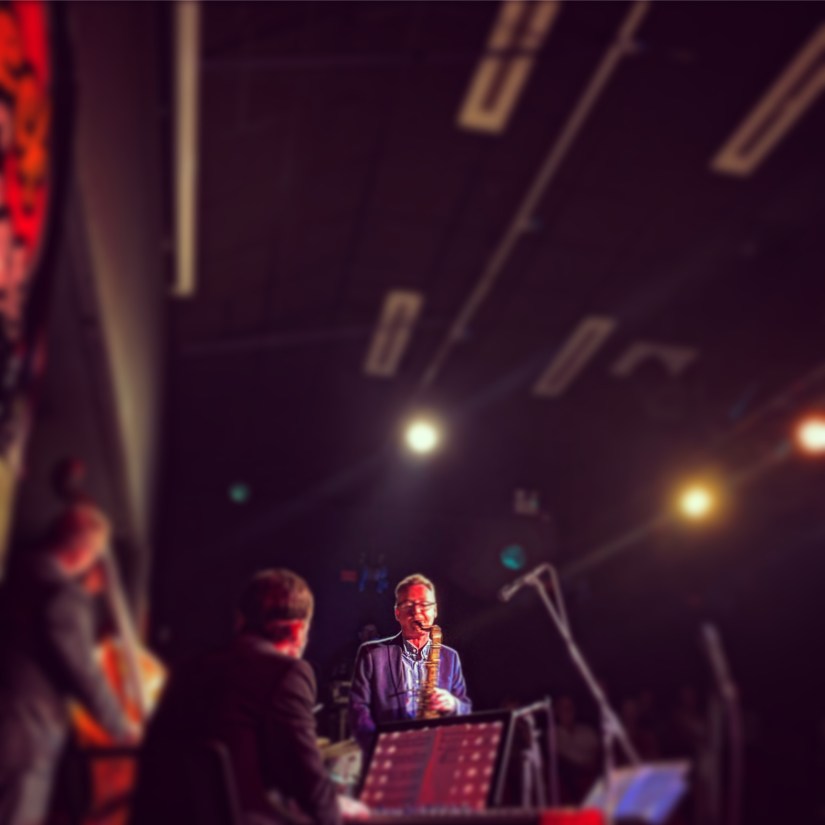
The Molley Quartet played two sets, Espirito do Brasil, both built around the Brazilian jazz of Jobim and Gilberto and Getz. Lazy, summery and entirely accessible, it was the ideal gig for popping the live jazz cherry. The Quartet set up in typical jazz fashion; suited up, their leader out front, the other three curved in a semi-circle behind him, the keys to Molley’s right, the bass and drums of the rhythm section to his left. They’ve got their charts in front of them – the basic chords by which they hold the bones of the tune, looped and repeated to allow the individual players to stretch out and express themselves, playing by feel and intuition and, Molley assures me later, without repetition.

It was immediate that we were in the presence of seriously great players. The leader would count them in and from nowhere the most luxurious sound would unwind. The sax, rasping and honeyed, led the way. I was standing just off the stage, close enough to watch the little fountains of spit spray from the instrument as Molley worked his magic with the keys beneath his fingers. By the end of the Quartet’s second selection, I’d slunk down the wall and I was sitting on the floor, my legs stretched out, a week of hard work in the real job already far behind me. Molley ran wild and free, up the scales and down again, detouring with dexterity and imagination, leading the ears to new places but always bringing them back to the tune’s melody. With a nod so subtle the majority of the audience might’ve missed it, he’d reign himself in, step aside and, with the polite ripple of applause from the aficionados in the audience tailing off, allow the piano player (Alan Benzie) to stretch out and express himself.

Fingers a blur, Benzie was off and finding new melodies within the structure, uncovering the blue notes in each passage, stabbing at his keys then caressing them, firing off little triplets in the high octaves, the bass low and brooding through his left hand. Once or twice he even mistakingly played two side-by-side keys instead of the one, happening almost so fast as to be unnoticed, but adding to the heightened drama of jazz being played live and in the moment, right in front of you. Again, the keyboard player knew when to step back to allow the rhythm section to showcase their playing, and following another appreciative clap from the audience, double bass player Brodie Jarvie would take the lead.

Booming and twanging, his thick fingers worked the four strings like an archer restringing his bow, bending them up and out with his right hand, holding them fast and steady on the fretless neck with the left. Ba-dow! it went. Ba-dow! Ba-dunk! Ba-Der! Fantastic and thrilling and right there in front of you. Live jazz – who knew it could be so essential?

And perhaps the best was still to come. The remarkably-named Max Popp on drums has a languid American accent and a Chet Baker quiff that never droops, despite the heat of the band and the room, despite the intensity of the Quartet. His top button is loosened at one point, the only signifier that he is feeling anything other than the flow of music.
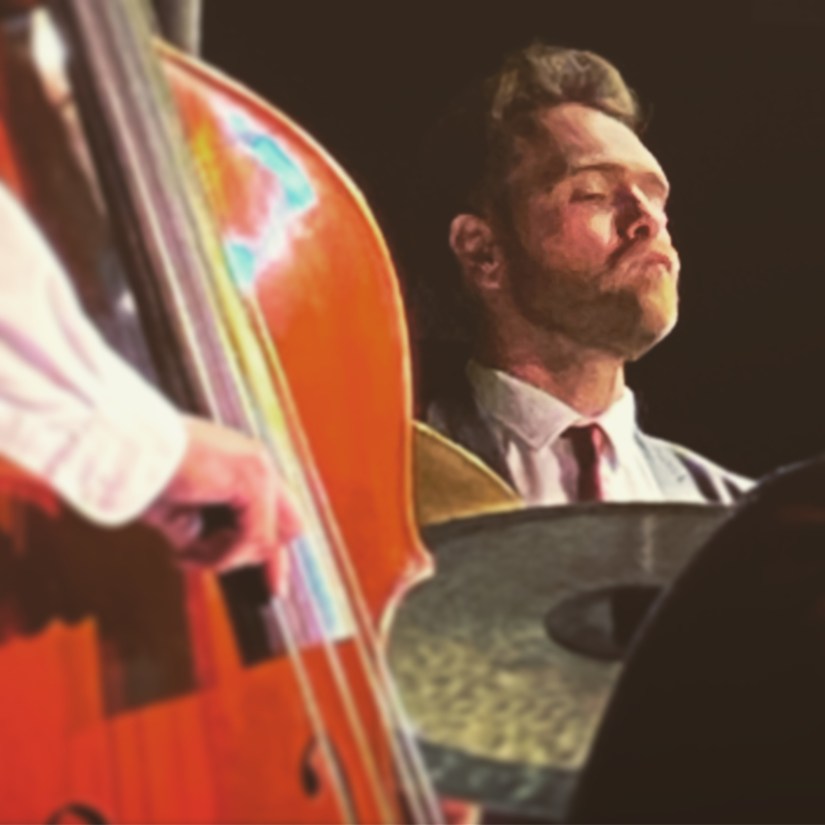
He rifles off rim shots, rides the splash with off-beat tingaling ease, rattles a small cymbal so violently it sounds just like breaking glass. At one point the other three musicans have stopped and it’s just him. He unfurls into the purest, most astonishing polyrhythmic hip hop beat not yet sampled on record. Molley stands off to the side, a wry smile creeping across his face. Jarvie wipes down his instrument in time to the bass ‘n snare ‘n whatever else Popp is employing to make this perfect storm. As he whips up the sound of the charge of the Light Brigade riding head-first into a thunder storm, Benzie on keys is head-nodding in enthusiastic appreciation. It’s wild and rockin’ and easily the equal of any of the drum passages on the just-won-the-Mercury Ezra Collective’s album. Seriously, that great. This is the Harbour Arts Centre in Irvine though. We’re a million miles and a million record sales from Ronnie Scott’s. But fuck that sniffy scene. This is where it’s at.

Despite not one player relying upon electricty for their instrument’s individual sound, the gig was exactly this: electric. Smokin’ hot yet simultaneously ice cool, the Brian Molley Quartet gained at least one new fan on Friday night. Don’t like jazz, mate? Go and see it live. It’ll change your mind forever.

 

Get This!, Gone but not forgotten

Sustain-ability

There’s the clip in Spinal Tap when Nigel Tufnel, all Jeff Beck hair and street punk gum snap, is showing off his collection of vintage guitars. He holds up a Les Paul (of course) – “s’a ’59” (of course) – and, as the interviewer asks him the value of the guitar (of course), Tufnel butts in and implores the interviewer to be quiet and listen to the sustain of his unplugged guitar.

Just listen…the sustayn…just listen to it…it’s faymous for its sustayn…eeaaaaaaahh…

It’s ridiculous and smart and very funny, with Christopher Guest playing it straight and just on the right side of dumb but rich Londoner, and with much of Spinal Tap being cribbed from stories involving real-life musicians, you wouldn’t bet against this being a true story too.

Is it a myth that old guitars sound better? Apparently not. Or maybe that should be apparently knot. Old guitars sing with the release of being played again. It’s a fact. Scientific too.

The science of it all (usually a subject that has me passed out and horizontal in under a minute) decrees that as wood ages, the sap in the wood dries out. So the more the guitar is played, the more the wood vibrates, y’see, and it’s those vibrations that help to speed up the drying out process. It stands to reason that an old guitar that’s been well played – a ’59 Les Paul, say, or my own ’78 Telecaster (most definitely well played rather than played well) – will indeed have a more cultured and refined tone than one that’s just straight from the luthier’s workshop.

Acoustic guitars tend to have a more noticeable improvement with age. There’s no pick-ups for starters, so the sound is made at the source rather than via amplification, and the instrument’s hollow body helps that sound to resonate. The wood the guitar is made from (and that could be alder, mahogany, ash, elder, a combination of some or all…) and the tension of strings used and how regularly it’s been played will all affect its overall tone.

When my dad passed away I inherited his Lag acoustic guitar. It wasn’t a particularly expensive guitar and it wasn’t that old when I fell heir to it, ten years maybe, but the old folkie (and that’s a story in itself) had treated it well and played it regularly enough (at gigs – I told you there was a story) that playing it is a proper joy. The action is low and smooth. There is no fret buzz. The bass notes are rich and reverberating. It handles the capo at the highest of frets, happily stays in tune and it responds really well to Keith Richards open G tuning. Best of all, what I’ve found if I tune it a whole step down, is that it sounds bassy and bluesy and bendy and exactly the sort of pitch and frequency that might have someone like Lee Mavers getting a whole set of songs from.

I’ve kept it in this tuning for over a year and there’s rarely a night when I don’t pick it up for a bit – anything from a few minutes to a few hours – and play it, the dusty ghosts of my dad’s fingers, just below my own, spidering up and down the fretboard and dancing across its six strings as I get to grips with a tricky Johnny Marr passage or a pastoral McCartney number or, this week, The La’s Son Of A Gun. Down-tuned and loose and funky, there’s enough give on the strings to give it soul, enough open strings in the picked verses to ring out naturally between the rhythmic off beats played by the right hand’s finger nails on the scratchplate and enough bass to make the strummed chorus full of fat and full of flavour. Unsurprisingly, The La’s version is also played in this tuning; the tuning of humming fridges and ’60s dust and the Merseyssippi and single bloody mindedness. Look long enough around this blog and you’ll probably find it.

Another guitarist more known for his skewed Telecaster playing than anything else is Blur’s Graham Coxon. He’s a great player too, happily chopping out punkish riffs and wiry leads and art-pop, rule-breaking bridges, employing two Rat distortion boxes simultaneously to devastating effect. What’s perhaps less-well known is that he’s also a fantastically accomplished acoustic player.

Graham CoxonSorrow’s Army

Sorrow’s Army from his 2009 Spinning Top solo album conjures up the spirit of Davy Graham and rattles its way out of the traps like Mrs Robinson on speed, strings snapping tautly – he favours skinny ones, a 9 gauge after some advice from Bert Jansch, every finger on his right hand employed in blurry syncopation, left hand shifting through 7ths and minors with dextrous ease, the squeaks and scrapes of flesh and nail against the strings adding fireside warmth. It’s not Girls & Boys or Popscene or Beetlebum, but when the song’s clattering Magic Bus rhythm announces itself around the minute mark, it all falls into place. The accompanying album is worth investigating too, should this be your kinda thing.

Old guitars, handed down, played forever. Now there’s your sustain-ability. Just listen.


Get This!

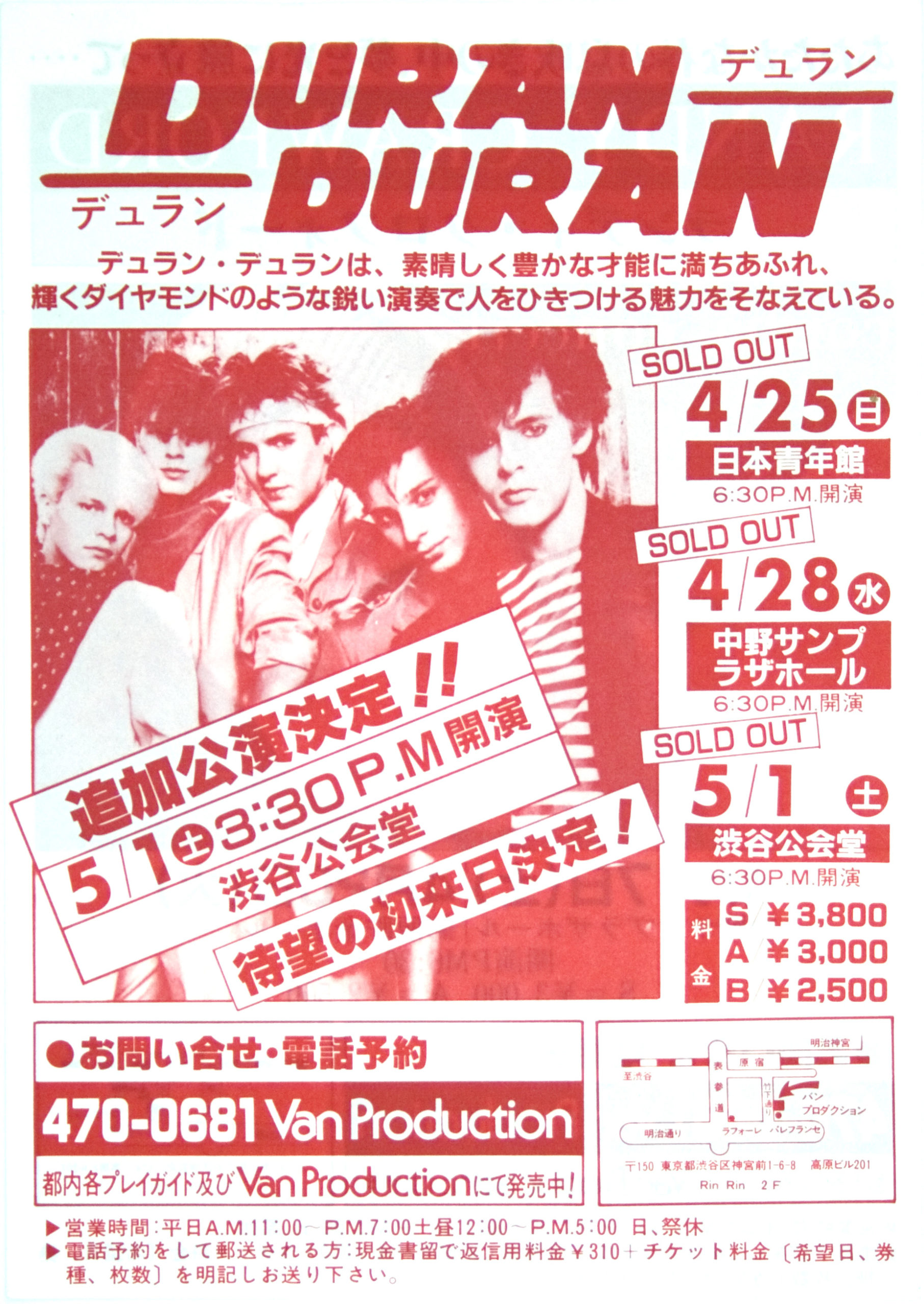
Thinking About Duran Duran

I’ve been thinking a lot about Duran Duran. Don’t ask me why.

I’ve been thinking about the electrified telegraph wire that helicopters its way in at the start of Planet Earth, and its synth hook and its bubbling bass breakdown and its flat, robotic lead vocal and its air-punching bah bah-bah pop refrain and I’ve been thinking that it’s a truly great track that I could never admit to liking at school. Or anytime even really until now.

Duran DuranPlanet Earth

I’ve been thinking about the band name. Duran Duran. It’s good. Runs off the tongue like a little slip of alliterative poetry in a ‘so good we named ourselves twice’ manner. It was cribbed, as you well know, from a character in a comic book series that became a cult movie, just like the literary/cinematic influences of (The) Heaven 17 and Fine Young Cannibals and The Tyrell Corporation, all bands who came after the pioneering Duran Duran.

I’ve been thinking how Duran Duran properly learned their chops and paid their playing dues in the swill circuit of toilet pubs around the Midlands, Bowie obsessives who admired a good cut of suit as much as a good riff, and as such should be correctly thought of in the same way as The Smiths or Dexys or The Specials. You might logically include early Spandau Ballet in the same way, of course, but personally, I…just…can’t…bring…myself…to…admit…this.

I’ve been thinking about how they made the most of their celebrity and their status, flicking casually yet eagerly through catalogues of supermodels in the upmarket agencies of early ’80s London, ordering girls like takeaway food to appear in their glossy, expensive videos and maybe even something more at the post-shoot pool party.

I’ve been thinking about effete Nick Rhodes, a very smart man in his lipstick and his blusher and his exaggerated cheek bones and his highlit Lady Diana blow-dry and his…woah!…totally gorgeous wife. Some guys have all the luck, as the song goes. Maybe he picked her out of one of those catalogues and the after-party went particularly swimmingly.

I’ve been thinking about that ridiculous BBC4 documentary from a couple of years ago where they drive around Birmingham in an old Citroen and discuss their career in those self-assured and rounded Mid Atlan’ic accents they’ve acquired through years of international jet set travel, le Bon’s aloofness and self-importance as inflated as his jowly, hungry-like-the-wolf face (no matter how hard he lemon sucks that affected pout), yet still is always overshadowed by effortless John Taylor and his cheekbones and his hair and his rockstar-on-a-day-off choice of wardrobe.

I’ve been thinking about those terrible, laughable, rich-guys-being-cool versions of 911 Is A Joke and White Lines that they released in the mid ’90s, the world turning to the bow-legged beat of Manchester while Duran Duran try to claim relevance with rap/rock abominations that even the Red Hot Chili Peppers would steer clear of. Don’t Do It, indeed.

I’ve been thinking also that I might need to reappraise that tatty copy of the Rio album that I found in a charity shop, £1, no bag, and me leaving with a face blushing the colour of the album cover itself. It’s filed there, spine-on and untouched since the day it was shamefully saved from the skip, just between Dr Feelgood’s Private Practice and Ian Dury’s New Boots And Panties!, an anomaly of airbrushed designer pop amongst the grit and grime of ‘real’ music.

Duran Duran on this blog? Makes you think, doesn’t it?


Get This!

Whassamatta Witchu Bhoy?

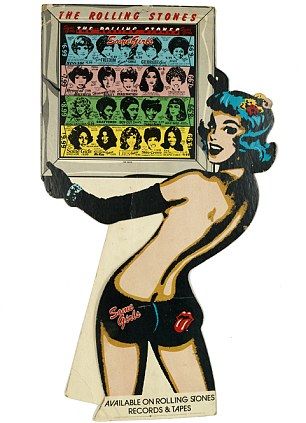
Underneath a handful of PWL singles and some battered old Decca 45s that looked like someone had been trying out a Torvill & Dean routine on both A and B sides, I uncovered a dusty but cleanable copy of The Rolling Stones Miss You in an Irvine charity shop a couple of weeks ago.

Record’s: Big one’s, various price’s. Wee one’s 49p.’

I paid a pound. “But ye kin get twa fur that,” came the reply after me as I left skipping out the door.

Miss You is the Stones at their grooviest, campest, louchest best. From Charlie’s hi hat ‘n four-to-the-floor disco beat, Richards’ slashing, fluid A minors and Wyman’s propulsive, trampolining, head-nodder of a bassline to Jagger’s praw-traahck-tayed delivery, it never outstays its welcome. Folk will point to Gimme Shelter and Tumbling Dice and Paint It, Black and Sympathy For The Devil and We Love You and She’s A Rainbow and Wild Horses and Street Fighting Man and (add your own here ______) but, for me, it’s Miss You‘s Sucking In The Seventies swagger that finds itself at the top of the tree when it comes to listing favourite Stones’ tracks.

Rolling StonesMiss You

Jagger’s vocal on Miss You is borderline ridiculous, a mish-mash of wrongly pronounced vowels held in place by a random selection of unnecessary consonants. His approach to vowels is similar to that of a spin bowler taking a long, slow run up to his delivery at the wicket, with neither the receiving batsman nor, in Jagger’s case, the listener, knowing exactly what twisting and turning pitch they’re about to receive.

Ah’ve bin hangin’ aaat saw laang, ah’ve bin slaypin’ awl alahn, lawd ah miss yeeoow… Wit sum Poo-Ert-Oh-Reekin gihls who jist daaa-yn ta meetcha… And yet, and yet..he somehow finds a fantastically soulful vein during the song’s bridge; Ooh, baby, why you wait so long? Come awn! Come hawm!

Then he goes for some whispered pillow talk, eases his way into the song’s hooky ad-libbed falsetto and comes back to the coda with the same loose approach to vowels as he had at the start. It’s a masterclass in the many faces of Jagger, almost cliche and the blueprint for a hundred tired TV impressionists. Such is Mick’s personality, you can see him act it all out as you listen, the real deal in tiny-waisted satin pants and lemon blouson.

But it’s Wyman though who steals the show here. He’s on a whole other level of playing, conjuring up his greatest fret-spanning bassline on the back of a particularly funky seam of notes that Billy Preston, the Stones’ live keyboardist of the time, had pulled from the ether during rehearsals for some low-key Stones shows in 1977. Wyman aped Preston’s riff and out, it seemed, popped Miss You‘s elastic backbone. The bedrock of the record, yet, such is the way of the Stones, it’s neither credited to Wyman nor his source.

Every Rolling Stones’ track is a Jagger/Richards composition, regardless of how the song came to be. You could argue that Miss You‘s understated, tickled electric Wurlitzer piano track is pretty much indispensable to the record too, hearing the way it unobtrusively winds its way between Richards’ and Ronnie Woods tapestry of freeform guitars, but other than the small print on the credits of the song’s parent album (Some Girls), you’d never know this was the work of The Faces’ Ian McLagan. It would appear that playing on a Stones record is payment enough for anyone who finds themself in the studio with Mick ‘n Keef. And maybe for some it is. And maybe too, that’s why some key members have left through the years.


Cover Versions, Get This!, Hard-to-find

Born Skanky

Them targetted ads, man. You don’t get nuthin’ for free. While you’re scrolling obliviously through social media, Zuckerberg’s and Musk’s analytics monkeys are harvesting your data; your likes and dislikes, the length of time you interact with something, the speed you scroll past, whether or not you click a follow-on link. It’s happening right now as you read – or don’t read – this. It’s all fed into the system and the next thing y’know, your timeline is full of desirables. You knew that already though. Mention car insurance to your significant other and sure as 4th gear follows 3rd, you’ll start to notice car insurance ads on your socials. I was tasked with booking Taylor Swift tickets a month or so ago and almost immediately I was being bombarded with ads for ‘the last remaining’ hotel rooms in Edinburgh. Turns out they were too.

I’m a sucker for well-placed social media marketing. In fact, the moment an eye-catching ad makes itself known, my PayPal account will be engaged before I’m fully aware of what I’m doing. The past couple of months has seen me buy a cord ‘shacket’, trainers, a sweat shirt, a 7″ EP with 4 reggaefied versions of James Brown’s Night Train and (imminently) this…

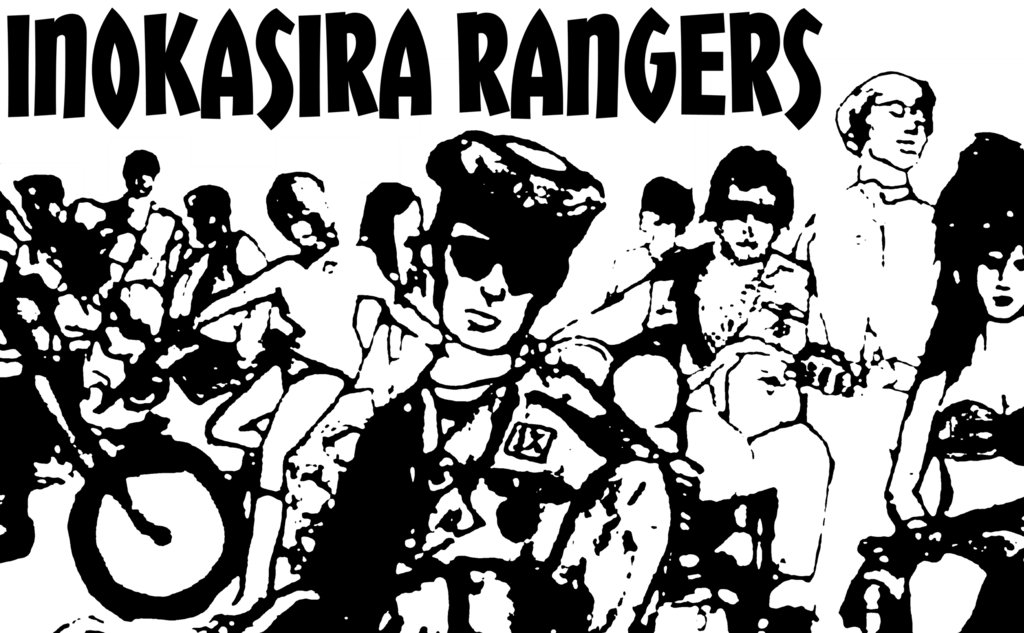
Sokabe Keiichi & Inokasira RangersBorn Slippy

Yes! It’s a cover of Underworld’s relentless clattering techno thumper, used to great effect in Trainspotting and as such, the sound of 1996. You didn’t know you needed a cover of this, did you? Like all the best cover versions, it takes the original’s blueprint, throws it away and recasts the track in totally new light. This particular Born Slippy is slowed down, reworked and reborn as a laidback lilting rocksteady reggae cut from the sunbaked beaches of, eh, Tokyo-by-way-of-Kagawaken. It’s great, of course.

Off-beat organ, chicka-boom drums and scratch guitar, all reggae staples present and correct, but topped off with Keiichi Sokabe’s amazingly cod-Anglified vocals. “She was a lipstick boy, she was a beautiful boyLet your feelings slip, boy, but never your mask, boyLook at me, mum, squatting pissed in a tube hole on the Tottenham Court RoadLager, lager, lager, shouting…” There’s a great wee slide guitar part that wheezes itself off and out in to the ether to introduce the “She smiled at you, booooy!” line, the Edge recast as a dreadlocked Japanese roots rocker. Listen out for it.

Turns out this was a track first released in 2017. The internet being the massive pool of never-ending music it is means that it may well have passed you by in the ensuing 6 years since. Luckily for all, Parktone Japan has just reissued it on 7″. It’s limited, so be quick.

In his day job, Keiichi Sokabe is vocalist in cult Japanese act Sunny Day Service, a band that’s never far from a 12 string jangle or well-worked harmony, and nothing like the track above. It turns out it’s the Inokasira Rangers who are the skank heads here. Back in 2016, the 4-piece ‘Rangers dispensed with a vocalist to play fantastic instrumental versions of the punk/new wave catalogue as authentic as The Upsetters at Black Ark with Lee Perry at the controls. The tracks coulda been straight out of 1972 or 2022, such is the Japanese approach to authenticity. A curio perhaps, but one worth further investigation. Want to hear Geno or Neat Neat Neat or What Do I Get? given similar treatment to Born Slippy above? Of course you do. The internet is your friend…


demo, Get This!

Dress Rehearsal

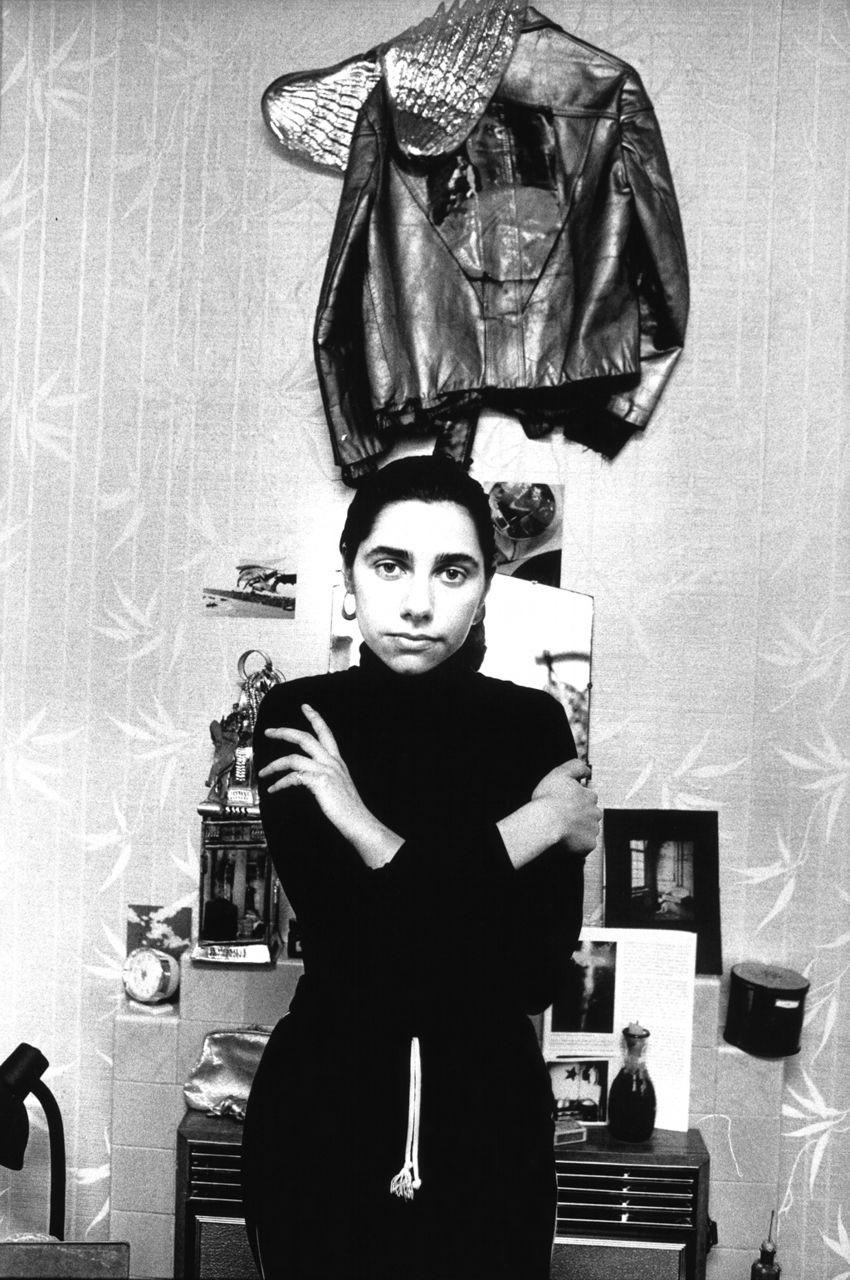
PJ Harvey has a new album just out. Other than one or two tracks from the radio, I’ve not yet heard it, but as I have done with all her records to date, I’ll get to it properly at some point and listen to it from start to finish, uninterrupted by onion chopping or the taxiing of kids, just as PJ would hope for. Ten albums in and Harvey shows no sign of compromise or lack of ideas – the mark of a true original.

She has a whole catalogue worth diving into. From the Patti Smithish Stories From The City to the metallic blooze of Uh Huh Her and the jangling olde worlde and sepia-tinted Let England Shake, Harvey’s output is nothing short of spectacular. Not perhaps instant, not necessarily chart-friendly, not ever the sort of music that’s worried itself with the fads and fashions of the day…and all the more urgent for it.

I’ve always really liked Dry, her debut album. Now 31 years old, it still thrills, its low-slung channelling of the blues sounding primal and sultry, combative and self-assured. Biblical references rub shoulders with filthy thoughts, gothic and strange and unexpected. The whole record is life laid bare, PJ’s life laid bare, to be more accurate. Harvey flung herself into the recording of it, convinced that it would be her one chance at making an album, and man!, it shows. Her first single, Dress, is a foreshadow of what would come on Dry.

PJ HarveyDress

A lone creeping guitar scratches out a rhythm. A snare drum (or possibly a *biscuit tin) dictates the beat. A silvery tambourine rattles haphazardly and the instruments fall into line. A scraping viola tears itself straight outta the grooves of The Velvet Underground And Nico and rips a metre-wide hole in the melody.

PJ sings despairingly about the pitfalls of wearing too-tight dresses, of trying to please the object of her desire even though it’s clear he couldn’t give two hoots about what she’s wearing. A Fall-ish/Pixies-ish one string guitar solo leads us into PJ’s falsetto – there’s not many Harvey tracks where she doesn’t slide up the octaves for dramatic effect – and the whole track now sounds more pressing, more insistent, the viola sawing away at the edges, the jackhammer beat of the rudimentary drum kit pummelling away like Mo Tucker on steroids.

It sounds live, like 3 or 4 musicians playing right in front of you, no fancy Dan production, no vogueish effects, just PJ and her band letting rip before the game is up and she’s ushered out of the studio to make way for another more palatable and chart-friendly artist. Harvey’s longevity would suggest that, thankfully, they knew they were onto something when they let her loose in the studio.

*Bonus Track

Dress Rehearsal!

Here’s the demo of Dress. Just a close-miked Polly and her pheromones, an acoustic guitar for company, occasionally filled out by that same scraping viola and a rough-hewn electric guitar that quite clearly fell off the back of Kurt Cobain’s pick-up truck. Wonderful stuff.

PJ HarveyDress (demo)

* that ‘biscuit tin’ comment was a bit unfair. Rob Ellis, PJ’s drummer of choice at the time, is a fantastic polyrhythmic percussionist and his complex patterns belie the simple structures of those early tunes. There’s not a group who wouldn’t be better if Rob was driving them from the back and that’s the truth.