Everyone’s a singer/songwriter these days. Get yrself a laptop, a looper and a whole lotta misplaced self-belief and you too could be the next big breakout act. It makes sense to a degree; travel as a one-person show with low overheads and you’re the ideal support act – a plug in and play band in a box – and the promoter can get away with paying you much less than they might’ve done had they booked a 5-piece indie rock band to warm the crowd up.
The downside? Well, every bedroom musician sounds the same, don’t they? Don’t they?
Tap-tap-tap-tap goes the foot. Scratch-scratch-scratch-scratch goes the guitar. “1 and 2 and 3 and 4” mumbles the singer inwardly, and they fiddle with something at their feet, silence a rogue guitar line then start again. Second, maybe third time lucky and we’re off. That KT Tunstall has a lot to answer for.
Thankfully, Cathy Jain broke the mould of what it means to be a bedroom musician. Recorded in Autumn 2021, her Artificial EP features the under the radar shimmer of Green Screen.
It’s a great track. Recorded in her bedroom, it shimmers like an Indian summer, all lazy, hazy, laptop psychedelia and slo-mo melodies.
The synths veer from heart of the sun fuzz and Stylophone buzz to filmic and creeping John Barry melancholy. The langorous drum ‘beat’ is forever on the verge of falling asleep, geed up by a climbing chord progression and lovely, spaced out guitar pings. Them, and a fantastic unravelling melody that’s delivered in an exquisite vocal which falls somewhere between a sulky Lana Del Ray and a sultry Phoebe Bridgers. That first chorus, aroud the 45 second mark, where her voice swoops and overlaps itself as it swandives southwards again…I’ll never tire of that.
Cathy Jain was 16 when she recorded this. 16! Who are you, Cathy?! And where are you, Cathy? We need you back.
That politely twanging guitar that heralds the start of the track is, by the angle of its jangle, pure early era R.E.M. Or maybe the Go-Betweens. Maybe even the Hoodoo Gurus. There’s certainly enough blend of country rockin’ low notes and clean chiming chords to suggest it. As it falls into its mid-paced, head nodding plod and the vocal appears, all gargled gravel and forced out phlegm, you could be forgiven for thinking you’ve landed feet-first in some mid-west bar, the overpowering sight of wall-to-wall plaid shirts and faded denim just about drowning out the the clack of balls on the pool table as the singer strains above it all to deliver lines worthy of a low-budget Hollywood movie. ‘Jesus rides beside me, he never buys any smokes,‘ he goes, all resigned and stretching himself above the free-roaming lead guitarist with his hot shot fancy pants riffs just below him in the mix.
As if this isn’t enough, the honeyed tones of the Memphis Horns – yr actual Stax house band, responsible for those hooks and riffs on all those great Otis records…and Al Green’s Let’s Stay Together…and Elvis’s Suspicious Minds – comes breezing in like the warm and rasping ghost of Exile On Main Street to stamp its brassy rash all over the proceedings.
And then you discover that the guitar player is none other than Alex Chilton, himself the titular subject of a track on the very same album where this track resides. A Replacement service indeed. It don’t get much better than that.
Yes, you’re listening to Can’t Hardly Wait by The Replacements – maybe even as it shuffles up randomly while you pound your sorry state around January’s unforgiving streets – and the world is alright.
The Replacements – Can’t Hardly Wait
I was never that sure about The Replacements. I’m still not, to be honest. To me, I think they’re viewed over here the way a band like Teenage Fanclub might be viewed in the States. They’ll have an enthusiastic, fervent fanbase who can’t see past them and everything they do, but the more you move away from the parochial appeal, the less they’ll matter. Unlike, say, Tom Petty, whose widescreen jangling Americana has universal appeal, and certainly not like R.E.M., who changed course and conquered the world, The Replacements just seem like you have to be American to fully appreciate them. They bring to mind teenagers driving noisy gas-guzzler first cars, hopped up high school kids chugging beer, college sophomores getting blasted at frat parties, all that sort of cliched Hollywood America.
Can’t Hardly Wait though. Great players + great points of reference = grrreat track. No arguments here.
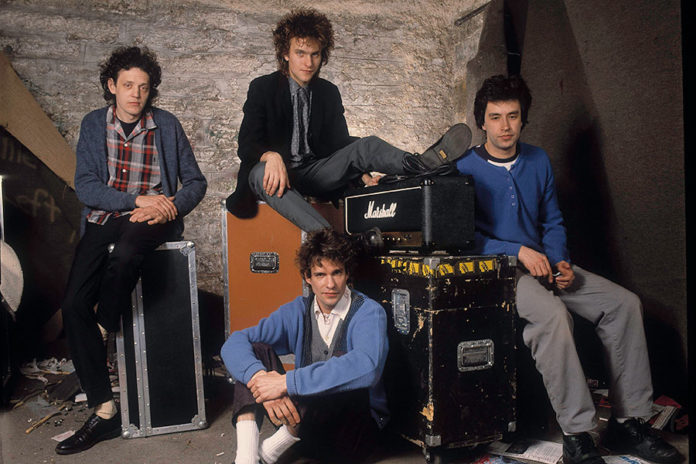
If you were lucky enough to see R.E.M. on their Green tour in 1989, there’s a good chance you saw The Blue Aeroplanes in their capacity as support act. Talk about lucky – The Blue Aeroplanes were booked, so the story goes, by a hapless UK tour agent who’d been instructed to book the Canadian country rockin’ Blue Rodeo but, thinking R.E.M.’s management had got the name wrong, booked the rising Bristolians instead.
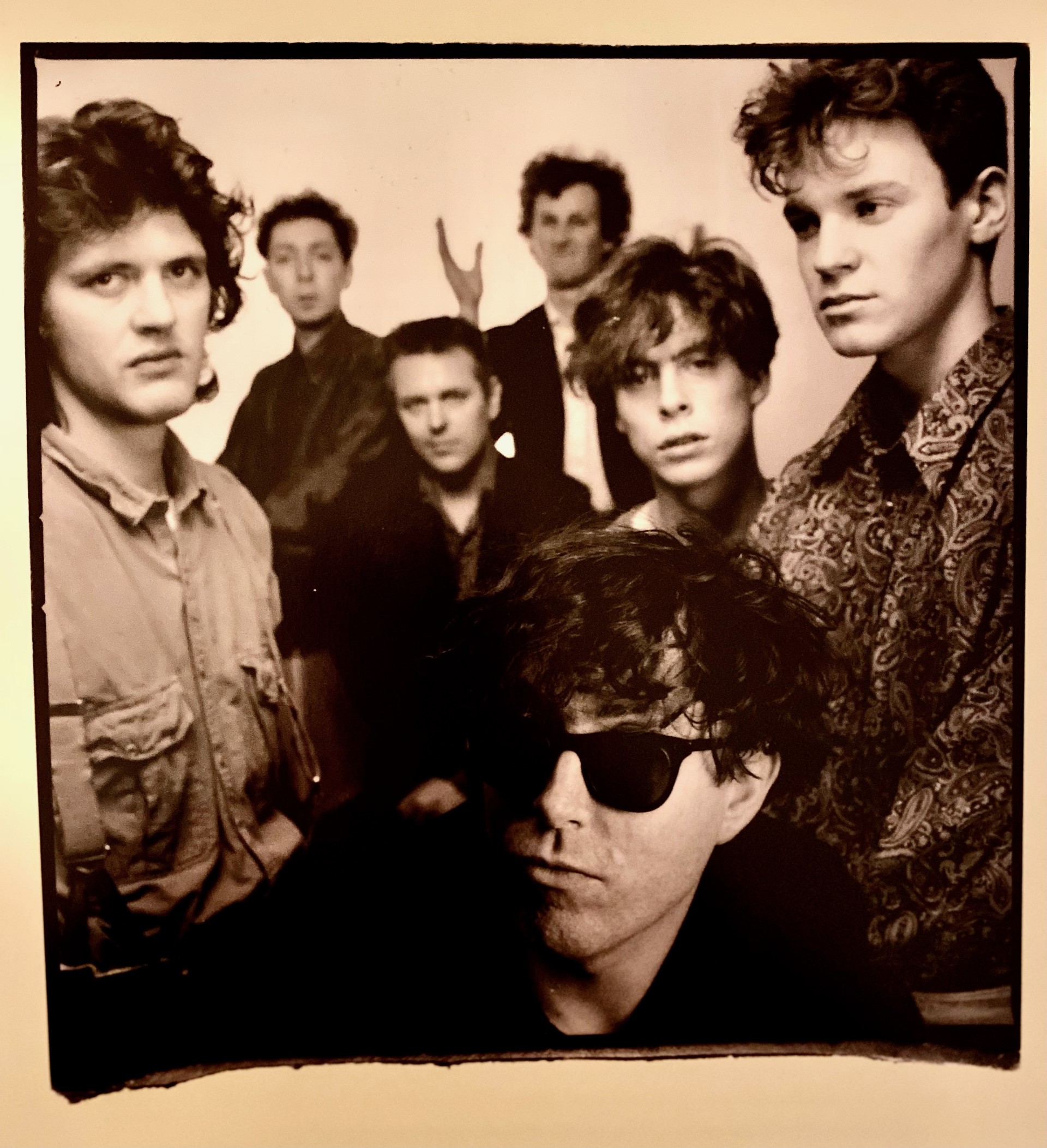
They made a great sight and sound on those big stages, The Blue Aeroplanes, a football team-sized collective of guitar players and singers and guitar players and keyboardists and guitar players and more guitar players, stretched out in front of the headline act’s backline in a semi-circular curve, the singer hanging off the microphone in shades and the beginnings of a Dylan ’66 ‘fro. They even had a dancer – and this was before every group employed a dancer – who twisted and turned and threw shapes in the shadows as the band got on with the task of rattling out their stewing jangle, all open chords and feedback-soaked lead riffs, harmonising counter melodies played high up the frets and low in the mix. They were a good band who required more than one listen before you had the measure of them.
Thankfully for new converts post ’89, their major label debut Swagger was just around the corner. The opening track Jacket Hangs is a good distillation of that live sound that so impressed both R.E.M. and their audiences on the Green tour.
The Blue Aeroplanes – Jacket Hangs
‘Pick a card, any card,’ goes vocalist Gerard Langley, and the band is off and riffing. Jacket Hangs benefits from the group’s multiple guitarists. It’s a chorus pedal-thick gumbo of Rickenbackered low twangs and hanging chords, chattering fret rundowns and swirling arena-sized major chords. The solo in the middle rides the coattails of feedback, searing and soaring out into the great beyond and all the way to number 72 in the charts. Have we no taste, people? February 1990 might’ve found Sinead O’Connor at number 1 with Nothing Compares 2 U, and even The House Of Love had cracked the top 20 with their 93rd re-release of Shine On, but number 72?! Jacket Hangs indeed. (Full disclosure, as they say these days – I never bought it either).
The pace, the spoken vocal delivery, the ‘ohs’ as the verse climbs to the chorus (and again, the high-harmonied ‘oh‘ in the chorus that’s very Mike Mills)…it fairly brings to mind R.E.M.’s E-Bow The Letter if you stop to consider it. I’m wondering now if Peter Buck watched stage-side each night, mentally erasing the unlucky Blue Rodeo from his mind and falling for The Blue Aeroplanes in a big way. Who’s to know?
The next single from the album would fare better, but only by 9 more places.
The Blue Aeroplanes – …And Stones
…And Stones takes its lead from the solo in Jacket Hangs, adds a busily echoing morse code guitar riff and sets the controls for the heart of the sun. Building a proper groove around it – a bassline that, aye, swaggers and a bed of percussion that’s ever so slightly ahead of the game, …And Stones (perhaps in a photo-finish with That Petrol Emotion) subconsciously creates that most lamentable of genres, indie dance. Within months, Flowered Up would base most of their sound on ...And Stones. My Bloody Valentine would borrow its ambience when jigsawing together Soon. Even The Wonder Stuff, yeah, those chancers, would start getting percussive with their Black Country raggle taggle. …And Stones did it all first, and best.
Unsurprisingly, …And Stones came in a variety of remixes. The guitar-heavy Lovers All Around mix bridged the gap between classic indie rock and dance music at a time when the leap into melody-free bangs and crashes was perhaps just too much for the stripy t-shirt wearing floppy hairs from the satellite towns. And I include myself in that. You’ll need to find that online though. Gremlins are refusing to upload it here.
On the 5th of January, Plain Or Pan will turn 17. In preparation, the L plates have been looked out, the insurance has been eye-wateringly hiked and the old banger I’ve been saving for the occasion will finally get a run-out.
I never for a moment expected to still be doing this all these years later, but here we are. Adam over at Bagging Area rationalised it best a few days ago when he said that blogging is a habit that sticks. It really is, plus Plain Or Pan has led to all sorts of unexpected opportunities in recent years…reason enough to keep going still, I think.
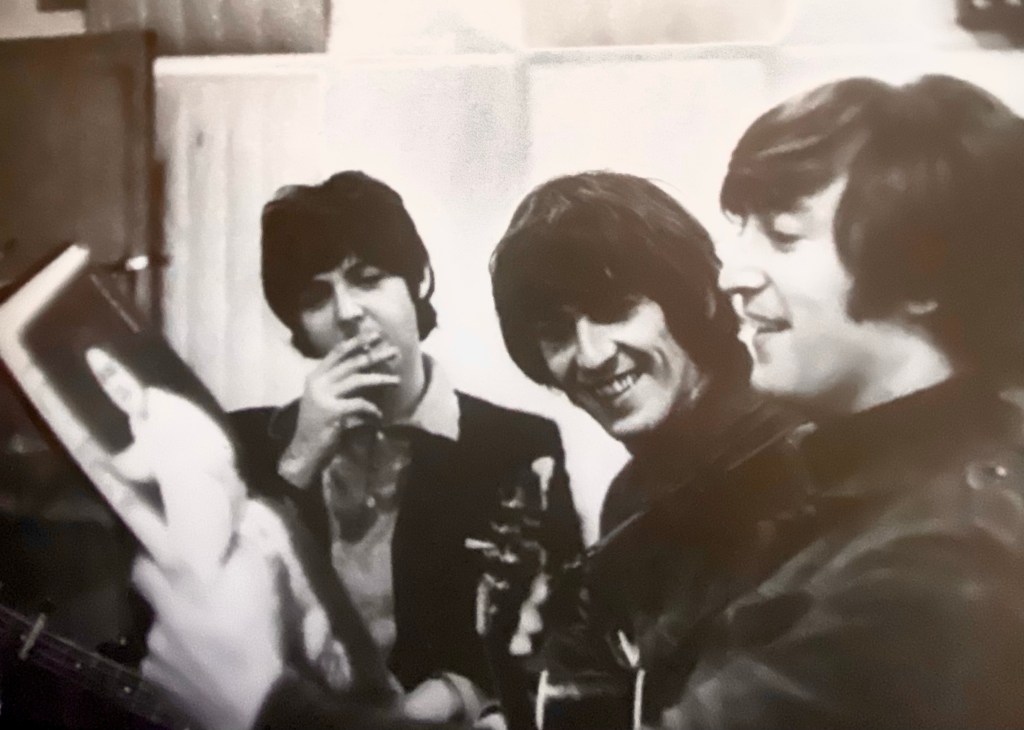
I’m a sucker for a studio outtake and Anthology 2 features the between-takes chatter of The Beatles as they rip their way through the first couple of goes of I’m Down, the track that would eventually find a home on the b-side of the Help! single. “It’s plastic soul, man…plastic soul,” belittles Paul McCartney, a nod to black America’s scathing opinion of Mick Jagger at the time. Considering McCartney’s vocal on I’m Down was full-on Little Richard, it’s a bit of an ironic throwaway line, but tucked away for future use, the phrase would soon turn up in more punning form as the title of The Beatles’ next record.
The second of two albums written, recorded and released by The Beatles in 1965, Rubber Soul would be the bridging link in a run of albums that saw them transition from the pure pop of Help! to the studio-driven Revolver. It’s a pace of change and progress that is unparalleled. Two albums plus assorted singles plucked out the ether and sent into millions of homes before the new year bells? Plus touring, sustaining family commitments and enjoying life as young 20-something Beatles? That’s laughably unthinkable nowadays.
Rubber Soul was put together in little over a month, with recording beginning on the 12th October and its 14 tracks mastered for both stereo and mono on the 15th November. That’s four and a half weeks from the initial writing sessions, via the recording and overdubbing, to the finished article. There are groups these days who take longer perfecting the filter on their Instagram posts. Once mastered, the album was sent to the pressing plants to be in the shops by Christmas. It was. Released on 3rd December along with the group’s first double A-side, the non-album pairing of We Can Work It Out and Day Tripper, Rubber Soul ensured a fab Christmas for all.
The Beatles – Drive My Car
Drive My Car, the album’s opening track, endures as one of the group’s very best. A McCartney-presented idea, Lennon helped shape and polish the lyrics, encouraging the pay-off double entendre (‘You can do something in-between‘) before Paul took it to the others as a track worth working on. Take 4 was the one they were happiest with and that’s the version that the world got to hear.
McCartney sings it like it’s the last song he’ll ever sing on earth, tearing his way through each line like Otis Redding on Otis Blue, John double-tracked and harmonising and hanging on for dear life behind him. That ‘beep beep ‘n beep beep, yeah! is total adlibbed genius nonsense, another hook in the vein of yeah yeah yeah! or I can’t hide! Such a little thing, but such a big part of the song.
The Beatles, knowing a good thing when they hear it, go full tilt on a (plastic?) soul stomper that still thrills in McCartney shows today. With a nod and a half to Aretha’s version of Respect, George copies Paul’s frugging bassline on his fuzzed-up Strat and it’s those two instruments that give the backing track its groove. Ringo is immense as the anchor. His snare takes a proper beating. His fills on the final line of each verse are inventive and varied and he’s nothing less than metronomic throughout.
It’s the clever overdubs that elevate the track even further; there’s a cowbell playing in time (and very high in the stereo mix) to Ringo’s snare, and a rattling pair of tambourines that vary in pattern between verse and chorus. Paul overdubs that loose ‘n funky piano on the chorus – the essential ingredient – and you have a Beatles track that could never be anything other than an album opener. Quite the statement.
It’s hard to believe that Drive My Car first found its way into my orbit through that thumping, discofied and hideous Stars On 45 record all those years ago, but there y’are. It’s also hard to believe that there are people in the world who have yet to find The Beatles. What a journey they are in for. I’m already aware that January 2024 is going to be Beatles month in this house. They’re always there, in the background, in the hard drive of the mind, waiting to be called down like patient little angels, but shining the spotlight on them always makes me hyper-fixated for long spells. Looks like it’s Rubber Soul‘s turn again.
We had big snow here a couple of weeks ago, the proper Hallmark/Hollywood cotton wool stuff. Great for a day or two then a treacherous pest for the rest of the week, it was just too early for Christmas. Snowed in with a classic film and a houseful of food and drink is not a bad place to be. Getting to and from work when your street is an ice rink and it’s barely light in either direction not so much. We’re now back to rain, torrential today, and the sort of wind that can whip your car door straight outta your hands if you’re not expecting it. (It did, I wasn’t. The car parked beside me seemed scarless afterwards though. Quick! Run!)
It’s at least half a week too early for Christmas music on here, so as the days creep ever-shorter to Friday’s Winter Equinox, there’s no better time to blow the dust off of Scott 3 and let it play, softly and gently, as the weather conditions – which they haven’t yet personified with a daft human name – swirl madly outside. Scott 3, Scott Walker‘s third album, funnily enough, is stately and grandiose and packed full of Ivor Raymonde’s searing and soaring string scores, practised on Dusty and perfected deftly with each subsequent Walker Brothers and Scott solo release. If you’ve never experienced it, you must do. If only for the cover art at least, I think you’d love it.
Scott Walker – It’s Raining Today
Eye Tunes
It’s Raining Today is the album’s opener, perfect for our current winter weather and a handy stall-setter for what follows on the rest of the record. It begins with the eerie scrape of high pitched, disconcerting strings – exactly the sort of strings that Jonny Greenwood has taken to employing across The Smile’s and Radiohead’s more outré work – before a pulsing two note electric bass and classically-strummed nylon acoustic offset the jarring with a bit of colour. There is too, you notice, a subtle foreshadowing cascade of icicle percussion, spiking the brain, preparing you for Walker’s tale to unfold. ‘It’s raining today,’ he croons almost immediately, ‘and I’m just about to forget…the train window girl…that wonderful day we met…she smiles through the smoke from my cigarette…‘
The melody rises and falls, ebbs and flows with Scott’s perfect delivery – smooth, slow, almost somnolent – providing a real cinematic cocoon to the world outside. You can wrap yourself right up in It’s Raining Today. Stick it on and you, the listener, are safely sheltered from the storm of life, metaphorical as well as physical.
Then…don’t get too comfy…the strings take a sudden dischordant and unnerving tumble and Walker is lost in a fog of nostalgia and regret, the song’s melody creeping like the coming of winter’s equinox itself, the fingers-down-the-blackboard strings now slow-bowed and majestic, sliding down the scales to the lowest notes possible. They’re the only instruments in the mix until right at the end, when a ripple of piano and the familiar refrain of percussion and edgy strings leads us back to another verse, the titular refrain leading us to cellophane streets and street corner girls and cold trembling leaves. Great imagery.
A few short years before this, Walker and his Brothers were headlining a wonky package bill that included Cat Stevens and the Jimi Hendrix Experience, one of three mis-cast teen idols desperate to cut the puppet strings and call their own shots. By Scott 1, Walker was. By Scott 3 he was deep in the throes of auteurship. Magic stuff.
A film. Bleached out print, grainy in places with muted, filtered, Instagram-to-the-max colours; subtle mustards, pale yellows, murky beige, an occasional dazzling flash of suppressed ochre. The script is suitably gritty and realistic. Adapted from a forgotten and long out of print novella, the producers have secured the services of the era’s hottest shot; a Harry Palmer/Michael Caine type, perhaps, to lead the line and provide the necessary look that’ll pack out the Locarnos and Empires. Tough guy for the boys, eye candy for their dates, all marketing bases covered. The soundtrack is, of course, spectacular. Seven sharp and sudden stabs of brass and away we go. But more of that later.
The key scene – the one that’ll be quoted and re-enacted and ripped-off in tribute down the years – begins with a car chase. The car in front is an open top Triumph. Of course. It is flame red with silver spokes that glint in the low northern winter sun. Driven erratically and far too quickly, its back end swings out as it takes a bend at top speed. While its driver drops a gear to compensate – we never see his face, but it’s the late 60s, so we have to assume it’s a ‘he’ – the leather driving glove would back that up – an oncoming Hillman Minx is forced to swerve. It briefly mounts the pavement, causing a man in a bowler hat to jump backwards. His folded broadsheet falls from under his armpit. A woman pushing a Silver Cross pram stops further down the street, taking in the scene in disbelief.
The car behind the Triumph is a midnight blue Jensen Interceptor and unsurprisingly, it is gaining on the Triumph. The Jensen’s driver has gritted teeth, slightly yellowing, even for a movie star, (and uneven too), that chew on a thin toothpick as he drives. His thick, black-framed glasses fill his handsome face and now and again the camera picks up the reflection of the Triumph in front. Steel blue eyes unblinking, the driver focuses on his prey, mentally calculating how quickly it’ll be before he’ll reduce the gap to zero. The Triumph makes a sudden and unexpected veer to the right, the screech of its tyres heard faintly above the roar of the Jensen and the accompanying soundtrack – momentarily switched to a frantic, four-to-the-floor bass and drum beat, with the tune’s signature brass no more than a short, sharp, intake of breath away.
Gears are changed, oncoming traffic is slalomed around and we’re suddenly in a multi story car park. The Triumph in front is always just disappearing around one of its tight, whitewashed corners, the metal buffers buckled and scraped, warning signs to the dangers of driving above the recommended 5 mph, but the Jensen never loses sight of, or distance, on him. The Triumph will get to the top floor and have nowhere else to run, and our hero in the Jensen knows this. He will happily drive upwards and onwards and wait for his inevitable moment.
But hold on! The driver of the Triumph is getting out! He’s abandoned ship around the next turn and left the door open in his haste to escape. The Jensen driver just catches sight of him as he runs off, a briefcase clasped across his chest and held in place with one arm. The Jensen immediately pulls up into an empty space – the multi story is deserted, of course – it’s probably Sunday – and the lead actor – the tough, the guy eye candy – sets off in pursuit. The man with the briefcase has entered a staircase and our man follows. Briefcase guy takes the stairs two at a time, the belt buckles and tails of his tan Mackintosh billowing behind like sails, the drag factor slowing him down. Just behind, our man, dressed (of course) in a sharp two-button mod suit, remains hot on his heels. His matinee idol hair, generously lacquered to his scalp, remains immovable. Even the windswept quiff is stiff and unswaying. His glasses stick firm to his face. The toothpick too is still clasped between those gritted teeth. He’s not even broken sweat. The bass guitar on the soundtrack pulses with Cold War dread, all der-der-duh-der-der boogie-woogie spy theme menace, each beat thudding out with every step on the staircase. This music actually seems to spur the Triumph’s driver on. Is he getting away from Harry Palmer/Michael Caine? I think he is. Is he?
Is he heck.
We catch a glimpse of our lead actor’s watch – an Omega, naturally – as his left arm stretches out and the leather driving glove tap-tackles his quarry. The man in front slides ungracefully on the stairs, the leather soles of his shoes suddenly unsuitable for hot pursuit, and he tumbles awkwardly. The Mackintosh opens wide as his hand falls from across his chest. The lining – Burberry – flaps wildly as the briefcase clatters to the floor, bursting open and sending a snowfall of classified documents down the spiral staircase; blueprints and Eastern European-language papers that sashay and helicopter downwards in slow motion, a total contrast to the franticness of the cars and their runners just moments before.
“Suddenly it struck me very clear…” sings the vocalist on the soundtrack. Has the volume turned up a notch? There’s no dialogue, but you can hear the breathless grunts of the two actors as they slip and slide and tangle and detangle and ankle grab and kick loose on the metal stairs, a sinewy keyboard line snaking between their huffs and puffs. The contents of the briefcase, by now strewn across the floor, provide another slippy surface – “They can’t have it, you can’t have it, I can’t have it too…” – but Palmer/Caine/the goodie has rumbled and wrestled the Triumph-driving baddy into a corner. As the Locarno crowd go wild for their champion, he pulls (from nowhere) a set of handcuffs and fixes the villain of the scene to the metal hand rail of the stair case.
“Make y’rself comfy, princess,” he sneers, toothpick jiggling up and down with each East London phoneme he spits. “The boys’ll be round in a bit to ‘ave a little word.”
The scene cuts. He’s back in the Jensen, roaring out of the brutalist car park, its dull putty-white concrete backdrop showing off the Jensen’s cool midnight blue finish. Our main man rolls down the driver’s side window. He spits out the toothpick before leaning his right arm on the windowsill. The music picks up again, the tune’s 7-note horn refrain and thumping rhythm section taking us home. “Until I learn to accept my reward.”
Teardrop Explodes – Reward
Julian Cope wanted Reward to sound like a long-forgotten spy theme played by the mariachi trumpets from Love’s Forever Changes LP. He fairly succeeded. And then some. Play loud, as they used to say.
Any directors needing a scriptwriter and/or music synch guy…hit me up, as they say nowadays.
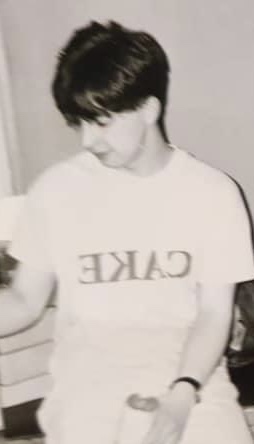
It seems the Trashcan Sinatras will gatecrash the UK top Top 10 Album Chart at the end of this week. Their debut album Cake has been remastered and re-released by Last Night From Glasgow and, 33 years on from its original release on Go! Discs (peak chart placing number 74), it looks like landing at number 10. This decrees the Trashcans’ record to be not quite as popular as those by the Rolling Stones or Elton John, but marginally more so than a handful of Taylor Swift reissues. While the charts maybe don’t mean as much to anyone anymore, the group, you can imagine, is delighted.
Personally, I’m thrilled for them. Someone cleverer than I could probably make something of the serendipity of a 33-year old record taking 33 years to chart. That must be some sort of record (no pun intended), eh?
Back when the reissue was being put together it was suggested that I might write the liner notes to accompany the record’s release. A major honour and thrill, I got stuck right in about it. As I said here a few weeks ago, they were all ready to go, along with a new gatefold sleeve, a lyric sheet, unpublished photos…the full works when, at the final hurdle, the band – wanting to remain enigmatic and mysterious – decided to revert to the record’s original packaging; no lyrics, blurred photos, no liner notes.
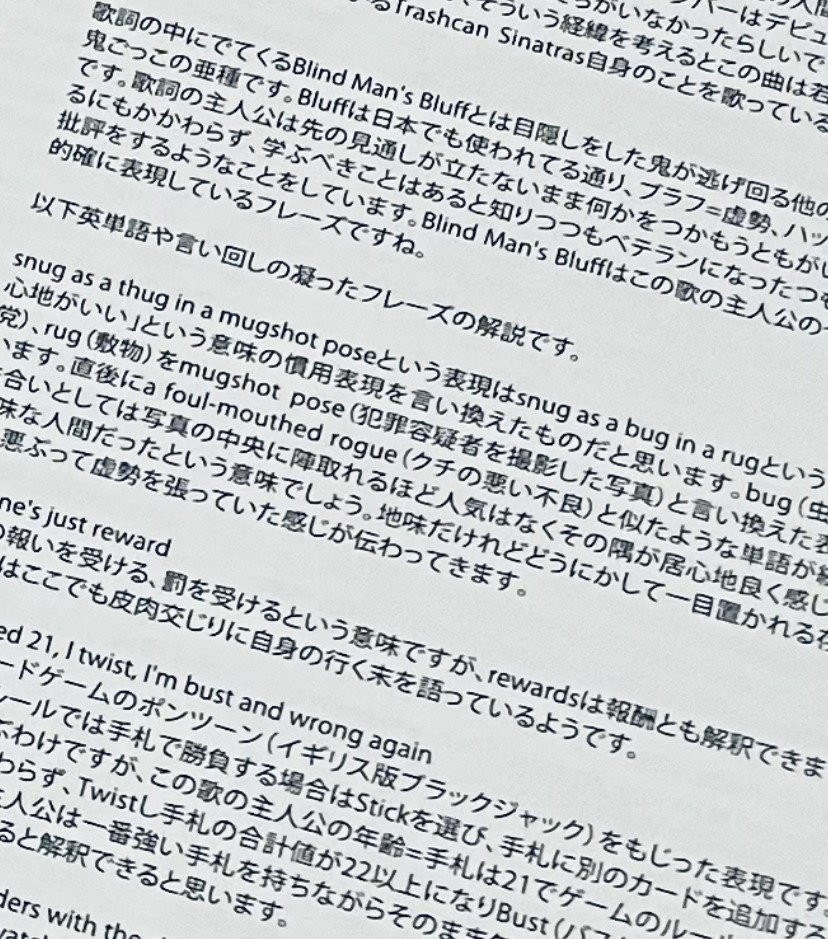
However, in an unexpected twist, the Japanese label got in touch. Such is the Japanese way with care and attention and detail, they wanted to use not only my Cake notes on the inner sleeve of the record, but also a translated explanation of what some of the lyrics and idioms on the debut single mean. Which was nice. I got stuck right into that too.
The Japanese market for LPs is extremely healthy and, as you know, it’s not uncommon at all for releases there to become collectible to fans worldwide on account of an extra track or two or other such addendum – liner notes, perhaps – to enhance the package. The Japanese Cake comes replete with exactly that.
I’m as thrilled about all of this as the group is at their chart placing, make no mistake. For as long as I can remember, I’ve been desperately keen to get my name on a record. My days of dreaming of windmilling through an encore at the Barrowlands have all but evaporated, but this writing gig has finally allowed me the opportunity of achieving this. On such a special album too. I wonder if the record will go Top 10 in Japan?
Trashcan Sinatras – Even The Odd
If the Trashcans are new to you, Even The Odd might make a good introduction; whimisical, melody-rich and coated in a fine shimmer of acoustic and electric guitars, it features skifflish, brushed drums, tasteful feedback and a noisy and reverby breakdown with some era-defining shouty nonsense before it gathers itself together again. Frank’s voice is young-sounding to the point of being helium-powered, perhaps a reason why it’s not a song that stuck long in the Trashcans’ live set-lists. Great track and great production though.
If you want to help the Trashcans shrug off the threat of Swift and overtake Jagger and Elton to make a late push for the top 5, you can do your bit by buying the album before Thursday. Best place to get it would be via Last Night From Glasgow. A host of versions are available from them.
And finally, a message to anyone buying and listening to Cake for the first time: Wait until you hear the next album…
That triptyich of ’90s solo albums which spawned the rebirth of Paul Weller deserves to be looked at again. 1992’s self-titled debut was the result of the artist being given free reign to reinvent himself, with no great expectations from a record company (Go! Discs) simply keen to offer one of our greatest songwriters the platform on which to start afresh. By 1995’s Stanley Road, Weller had entered his third imperial phase; once again a regular botherer of the charts and the elder statesmen to whom the leading lights of the day looked for validation and support. The record in the middle, 1993’s Wild Wood, is perhaps the most interesting – and best – of those three releases.
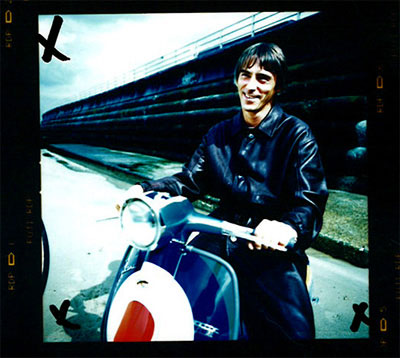
Having ‘done’ inner city angry young man and broadminded European mod, Weller looked to the English countryside for inspiration. Still unsure of who his ’90s audience was, the singer decamped to the Manor, a residential studio in the leafy Home Counties and, surrounded by trustworthy people and a handful of his favourite records, holed up to hang out, play, write and record the tracks that would become the Wild Wood album. The inner sleeve photos on the record suggest the perfect scenario for making a classic record; family and kids on the lawn, footballs, a grinning Weller astride a scooter, a home-from-home environment where inspiration flourished.
Much has been made of Weller’s listening habits during the making of the album, and the acoustic influence of Traffic and Nick Drake has oft been quoted as a source of influence, but I’d consider Wild Wood to be Weller’s Neil Young album. Loud in-the-mix acoustics ring throughout the record, attacked by Weller’s uncompromised strumming and finger picking. He might be playing a Martin, but he’s attacking it with all the fervour he normally reserves for his Casino. This is apparent on Foot Of The Mountain, its minor chord balladry giving way to an ebbing and flowing, sprawling and ragged electric outro, the rest of the band riding his coat tails for dear life. The Young influence is there too in Country‘s close-miked pastoral picking and whispered vocal. ‘Where only love can heal your heart,’ he sings, one eyebrow arched in a knowing nod to whiny old Neil as a woozy Mellotron adds a Fabbish, late sixties hue to the mix.
Wild Wood is an album that, augmented by subtle Hammond, delicate woodwind and thunking great gospel piano, showcases the best of Paul Weller. It’s there in the ferocious riffing of Sunflower and The Weaver‘s thrilling hammer-ons, the pastoral campfire soft shoe shuffle and two note dubby bass of the title track (it’s no wonder Portishead highlighted it as something to twist and turn and send into orbit), to the handclapping and roof-raising Can You Heal Us (Holy Man) and the jazz inflections of album closer Moon On Your Pyjamas.
My absolute favourite from the era though isn’t actually on the initial album release.
Paul Weller – Hung Up
As is his forever forward-thinking way, Weller had barely finished the record when he embarked upon another lap of writing. Too late for the album, Hung Up was released as a stand alone single. All the best bands, as you well know, release magnificent stand alone singles and Hung Up is undoubtedly Paul Weller’s addition to that list (even if, at some point, it was clunkily tacked on at the end of the record when Weller’s popularity began to soar.) It’s a fantastic single, Weller self-assured and riding in on a great chord sequence (C – Fm – Am – Fmaj7) before the band joins him on a chugging, descending Beatlesy progression, crisply distorted and fluidly played. The pace, the playing; perfection.
It’s the song’s bridge though that elevates the track from merely great to simply outstanding. It’s a real cracker, all loose piano and finger-squeezed guitar couplets – pure Small Faces mod-gospel with the vamping ghost of a PP Arnold-alike oozing in on the second line, her sky-surfing vocal lifting the track into orbit. Then we’re into the guitar solo. No fancy pants pedal boards here, it’s simply vintage guitar into vintage amp and the strangulation of a nimbly-rifled solo that’s halfway between Marriot (Steve) and May (Brian – really). And there’s still time for Steve White – there’s always time for Steve White – Wild Wood‘s secret, unsung hero to rattle seven shades of Gene Krupa from his kit with the mother of all drum fills, before it all ends with the singer and his acoustic guitar once again, wrung out, hung out and Hung Up in under three thrilling minutes.
*Bonus tracks!
Paul Weller – Hung Up (Live at the BBC)
Lovely wee bit of studio chatter on this version.
Paul Weller – Wild Wood (Portishead Remix)
Pistol crack snare, clacking, clipped guitar, murky dub. The drunk wasp guitar riff is a beauty. Weller had some great remixes around this period and this is one of the best. Never ever outstays its welcome.
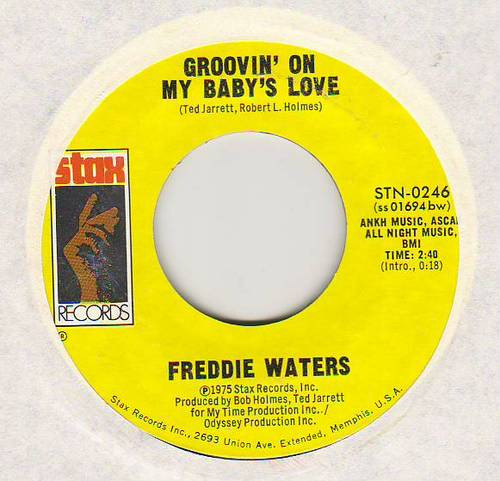
I spent some time in the company of Dodgy’s Nigel Clark at the end of last week. He was up doing a one-man show – all the Dodgy hits, a few of his own solo songs, a smattering of carefully-chosen covers (Tom Waits, Frankie Valli, a spontaneous run-through of the new Beatles single), all interspersed with off-kilter chat and rueful observations on life in 21st century Britain. He’s a massive soul music fan – that would explain the cover of ‘The Night‘ that he ended with, and the various soul covers that constitute those early Dodgy b-sides – and thrillingly, he played a version of a fantastic Stax track from 1975 that was totally new to me. The song found a home in my ear and, after many YouTube plays and before I’d gone to bed in the wee hours of Saturday morning, I’d found a copy of the 7″ online and bought it. I think you’ll like it…
Freddie Waters – Groovin’ On My Baby’s Love
Tinkling Fender Rhodes, descending chords playing against up-sweeping strings, a slow ‘n steady groove of snare ‘n kick drum, a cooing female backing vocalist going against the grain of Waters’ gravelly soul man voice in the chorus…there’s no chicken-scratch guitar or tasteful Cropper-esque blue notes, nor nary a whiff of honeyed brass, yet it has all the necessary ingredients, as Ray Charles one said, in a recipe for soul.
The bridge –‘some people worry ’bout simple things‘ – is pure grits ‘n gravy Memphis soul. In the hands of an Otis Redding or a William Bell or a, yes! Al Green, Groovin’ On My Baby’s Love might’ve bothered the pop charts. And maybe it did, but apparently, very little has been written about either Freddie Waters or Groovin’ On My Baby’s Love so I don’t know about that. I’m certain some switched-on soul brother or sister here will keep me right though. Typically, the track alone should have both singer and song held in far higher regard than the world seems to afford them.
There will, of course, be hundreds of songs like this, floating out in the ether, waiting for the record collector’s butterfly net to catch them as they flutter past. By way of payment, I sent a suitably gobsmacked Nigel a link to Darondo‘s Didn’t I. Featured here a few years back on the recommendation of Gerry Love – another soul-loving beat group employee, as it goes – it deserves another shining of the Plain Or Pan spotlight.
Darondo – Didn’t I
Obscure-ish mid ’70s soul recommendations most welcome. Add them in the comments below.
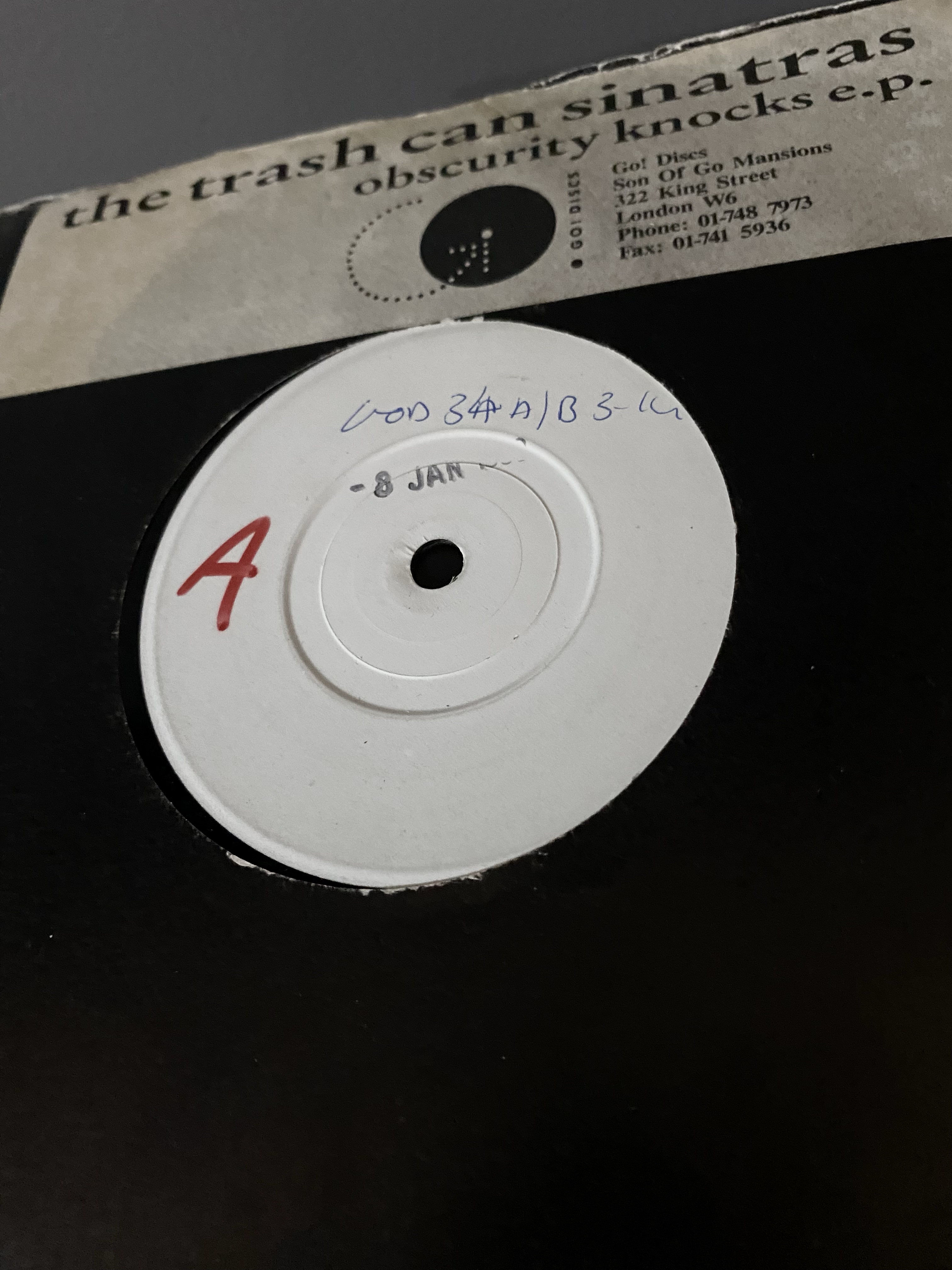
I was contacted recently by the folk responsible for the Japanese version of the remastered reissue of Cake, the Trashcan Sinatras‘ first album. They wanted to know if I could provide an accurate translation of the meaning behind the lyrics to their debut single, Obscurity Knocks.
What, for example, does ‘I’ve turned 21, I’ve twist, I’m bust and wrong again,’ mean? Witty and pun-filled, articulate and alliterative, Obscurity Knocks is a perfect distillation of all that’s good about the Trashcans’ wordplay, but sung in a rich Ayrshire brogue, many of its metaphorical subtleties were lost to the ether.
The Trashcans (wanting to appear enigmatic and mysterious, to Go! Discs continual exasperation) kept most of their words tightly under wraps back then (although they did include Obscurity Knocks‘ lyrics on the rear of the single’s UK cover) and, in the absence of printing them on Cake‘s inner sleeve like other bands might have done, it was left to fans – and often foreign fans at that – to scribble them down as heard and offer their best versions in the rudimentary chat rooms of the nascent world wide web. Gen, my new Japanese pal, has a grasp of English that truly puts my pidgin Japanese to shame and while his understanding of the lyric was fairly accurate, I offered to go directly to the band for an official set of lyrics. A couple of messages later, I had them to hand and Gen in Japan soon had what he needed.
Gen then suggested I write something for the reissue’s sleevenotes – a Plain Or Pan-style article on Obscurity Knocks itself. Now, while that was instantly appealing – and something I immediately set to work on – I suggested going one better. I’d actually written sleevenotes for the brand new UK reissue of the album. They were ready to go, along with a new gatefold sleeve, a lyric sheet, unpublished photos, the full works when, at the final hurdle, the band decided to revert to the record’s original packaging; no lyrics, blurred photos, no sleevenotes. Enigmatic and mysterious, remember?
All of this meant that I had a set of sleevenotes without a home. Would the Japanese label like to use them? After the go-ahead from the TCS themselves, the sleevenotes found a new home in the far east. The start of this week was spent explaining some of the idioms and turns of phrase that Gen had trouble putting into pure Japanese – ‘Muscled their instruments into the mix‘, ‘A welcoming world of non-competitive leg-ups‘, ‘Baw-deep in melody,‘ (I never wrote that last one, but you get the idea) – and there now is, apparently, a set of sleevenotes written by my own fine hand and translated beautifully and lovingly by Gen into Japanese. I really can’t wait to see what they look like.
This now means that I am left with an article on the giddy rush of Obscurity Knocks. Not one to waste things, it forms the rest of this post beyond the track itself below…
Trashcan Sinatras – Obscurity Knocks
Thoughts on ‘Obscurity Knocks’
It’s February 1990. The Trash Can Sinatras gatecrash a smattering of small, switched-on corners of the world with Obscurity Knocks, a bright ‘n breezy strumathon of major and minor 7ths that skirls and skelps and flies straight outta the traps like life itself depends on it – which it very much does. Obscurity Knocks might well be the band’s debut single, yet the Trashcans are already world-weary and wary of a music business that doesn’t quite fit their aesthetic. ‘I like your poetry but I hate your poems,’ they spit, a reference to the many rejections they had before Go! Discs came to their rescue and made them Irvine’s Most Likely To. ‘I’ve turned 21, I’ve twist, I’m bust and wrong again,’ they lament, the poker game a metaphor for their dealt hand in a life already decidedly bleak. ‘The calendar’s cluttered with days that are numbered,’ they complain, an existential crisis poetically stated in alliteration and pun. This band is something special, those words suggest, something articulate and funny and literate. Not since, oh, The Smiths maybe, has such a package come ready-made for the more discerning listener.
It helps too that Obscurity Knocks comes gift-wrapped in the greatest rush of guitars this side of The Clash and The Beatles, not in sound, clearly, but in total attitude and self-belief. That spring-fresh, hip-slung electric guitar and dusted-to-the-knuckles rattling acoustic fuse together perfectly like spit ‘n polished chrome to create a sound that can mellow a decent malt at five paces. A mesh of finger-twisting riffage at breakneck pace, they’re the springboard from which the song’s melody leaps and delights. That lightning-fast solo that pops up midway through? It brings to mind African high line and Roddy Frame and Richard Thompson and maybe even an unexpected hint of Octopus’s Garden, but it’s all over before you’ve even realised it.
Add in the tub-thumping glam stomp of a chorus, the call and response backing vocals, the drop out around the ‘Ba ba bleary eyes’ line, the zinging chords that accompany the final and decisive ‘but I hate your poems.’ Oh man! As far as stall-setting opening statements go, few bands have done better.
Some naysayers might point to Obscurity Knocks’ punning title and suggest it was a prescient fortune telling of what could have followed, but if you’re reading this, you’ll know that the Trashcan Sinatras (just the two words these days) are still very much in the business of writing and recording songs that foam to the brim with inventive guitar lines and clever wordplay. Knock on, Trashcans. Knock on.