Over two million visitors since Jan 07. The material on Plain Or Pan has been downloaded, digested and discussed by every knowing hipster throughout Europe, North America, South America, Australia, Asia and Africa - truly Plain Or Pan-Global! One and a half million thanks to each and every one of you!
There have been many instances of musicians appearing on records without credit or fanfare; Eric Clapton noodling across the top of While My Guitar Gently Weeps on The Beatles’ sprawling White Album. Lennon and McCartney themselves singing backing vocals on the Stones’ version of their own I Wanna Be Your Man. Mick Jagger somewhat ironically providing backing vocals on Carly Simon’s You’re So Vain. Lennon trading vocals with Bowie on the latter’s Fame, itself a track cribbed from James Brown (or perhaps it was the other way around). David Bowie surfing low under the radar on Arcade Fire’s disco stomping Reflektor…….. these examples are the tip of a very deep and very incestuous iceberg.
Whether it be for contractual reasons, record label conflicts or just plain mischieviousness, it’s likely your favourite musicians pop up on many more records than they’d like to let on.
One of the first examples of musical skullduggery though must surely be the case of James Brown and the recording of (Do The) Mashed Potatoes. In 1959, Brown was coming to the fore as a sweat-soaked, soul-wracked, heart-bleeding bawler of gospel-tinged r’n’b. The darling of King Records, it seemed Brown and his Famous Flames band could do no wrong, until that was when Brown tried to cash in on the dance craze that was currently sweeping his neck of the woods. Despite his burgeoning fame it was apparent that no-one wanted to hear his stomping 12 bar instrumental espousing the joys of the doing the Doodle Bee. When the trend moved on to a new dance, James went to his label boss and suggested they cash in by recording (Do The) Mashed Potatoes.
Once bitten, twice shy, King Records refused to put it out so Brown took his idea to the rival Dade Records. They agree, on the condition that it was recorded under an assumed name (Dade boss Henry Stone was terrified of King Record’s Syd Nathan, the Peter Grant of the deep south soul scene), which is why along with seeing the track credited to James Brown and the Famous Flames you’ll also find it credited to Nat Kendrick & The Swans. The same band, the same line-up, the same record.
Nat Kendrick & The Swans – (Do The) Mashed Potatoes
(Do The) Mashed Potato is nothing you’ve never heard before; a standard 12 bar r’n’b instrumental, it’s a 3-button mohair suit kinda record, punctuated now and again by whoops and hollers and ridiculous potato-themed war cries;
Mash’ Pa-Tay-Das, yeah!
Hash Brown Pa-Tay-Das, yeah!
French-Fried Pa-Tay-Das, yeah!
I’ve no idea what they shout in the last part, but they sure sound excited.
It is, of course, thrillingly terrific. A primal slice of tribal us v them floorshakin’ soul. You’re either with us or against us is Brown’s underlying message and by the end of Part 1, I, you, us and them are definitely with him, one nation under a groove. Frustratingly I don’t have a version of Part 2 but I can imagine exactly how it goes.
Of course, when the record proved a success, the steely Syd Nathan insisted on future copies being issued on his label. He also bowed to Brown’s superior knowledge of fads and fashions by allowing him and his Famous Flames to record such future ‘classics’ as Wobble Wobble and The Dish Rag. Good throwaway pop records, it should be said, but neither as thrilling nor as plain daft as (Do The) Mashed Potato.
The duo of Nicolas Godin and Jean-Benoit Dunckel have been making music as Air since 1995. Like Brian Wilson, but with access to all manner of analogue synths and samplers rather then the Wrecking Crew and the cream of the L.A. studio set, they’ve created a unique and focused sound, part space-pop, part ambient electronica, that is instantly recognisable.
The ubiquitous Moon Safari album might’ve brought them to the mainstream – you can find discussions on its merits in places as disparate as MumsNet and the Steve Hoffman music forum – but before it and since you’ll find some of their best work. Top of the pile is Playground Love, the track they recorded for Sofia Coppola’s The Virgin Suicides.
Air – Playground Love
Built around a beautiful chord progression, it starts off with four clicks of the drumsticks before slowly morphing into a stoned and luscious groove. A sleepwalking Fender bass pads softly down the frets. Real drums lollop with all the energy of a fat-tongued dog in front of a Christmas fire. Vibraphones tip toe around the edge of your consciousness, flowing hypnotically like the oil in that old Castrol GTX ad from the 70s. The vocals (provided by Phoenix’s Thomas Mars) are breathy, close-miked and forever on the edge of asleep. Out of the blue, with an extreme burst of lethargy a lazy saxophone meanders in and out of the words and music, sprinkling the track with the same sort of magic dust that was first found on Pink Floyd’s Us And Them.
Playground Love wouldn’t at all sound out of place on Dark Side Of The Moon. Its slow-motioned timelessness is just right for these Autumnal days and dark nights we’ve suddenly found ourselves in, an aural blanket for lost souls and late-night listening sessions. Listen carefully and you can just about see the blue curl of Gauloises snake around the melody of those understated cooing backing vocals like the crumpled ghost of Serge Gainsbourg on heat. It’s terrific stuff.
I’ve been in Italy this week. What’s struck me most is not the plethora of churches, bad driving and graffiti that are on every strada corner but the stylish way in which the Italians go about their daily business.
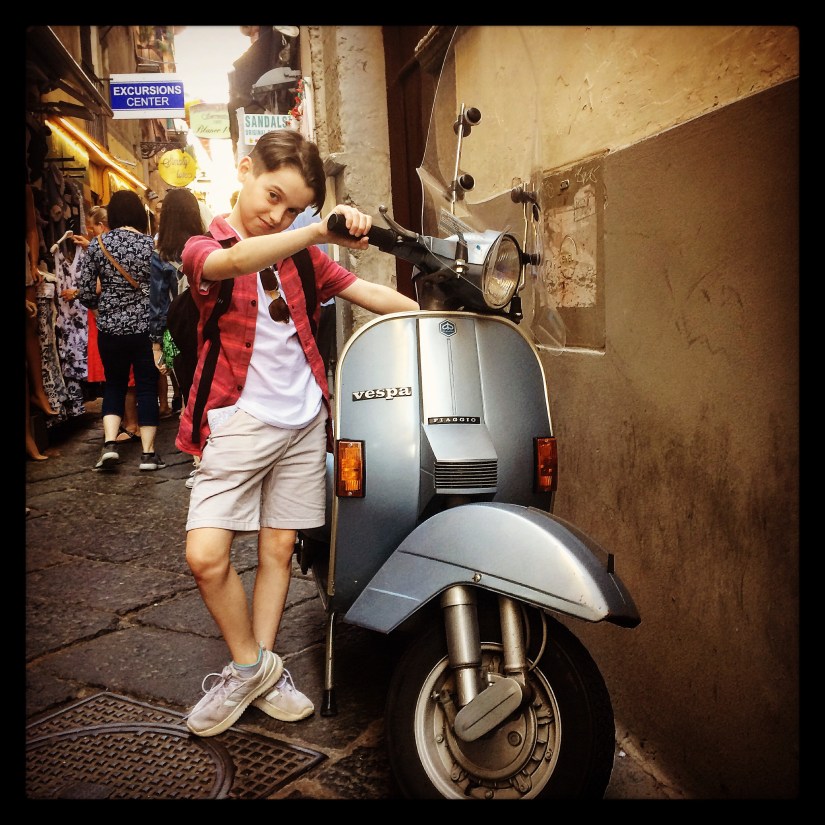
Whether it’s in Napoli and Sorrento in the south or roaming’ further north through Rome and Pisa, I’ve been goggle-eyed at the sheer amount of Vespas on the roads. They’re the great levellers, those wee scooters. Whether you’re a pizza delivery guy or a teenage girl with your boyfriend riding pillion or a businessman in a 3-button suit, open-necked shirt, scarf, loafers and no socks, the best way around town is on one of them.
You’ll hear them everywhere you go, zipping above the noise of impatient klaxons and whistle-happy Polizia, zig-zagging their way to the front of the traffic, edging forward before the lights have instructed them to go and weaving their way around goofy tourists who have one eye trained firmly on the tour guide way up ahead and the other on their bag over their shoulder. That’s been us the past few days.
The tour guides are great. For the most part funny, engaging and knowledgeable they’ll point out various buildings and suchlike in a version of English that far outweighs my knowledge of Italian. Until this week I knew just two Italian words; bella and bella. (That there is a reference to the greatest film ever made.) My vocabulary has now extended to include “Ciao!” which, much to my kids’ embarrassment I’ll say with great enthusiasm to any shop keeper, waiter and bus driver who’ll listen.
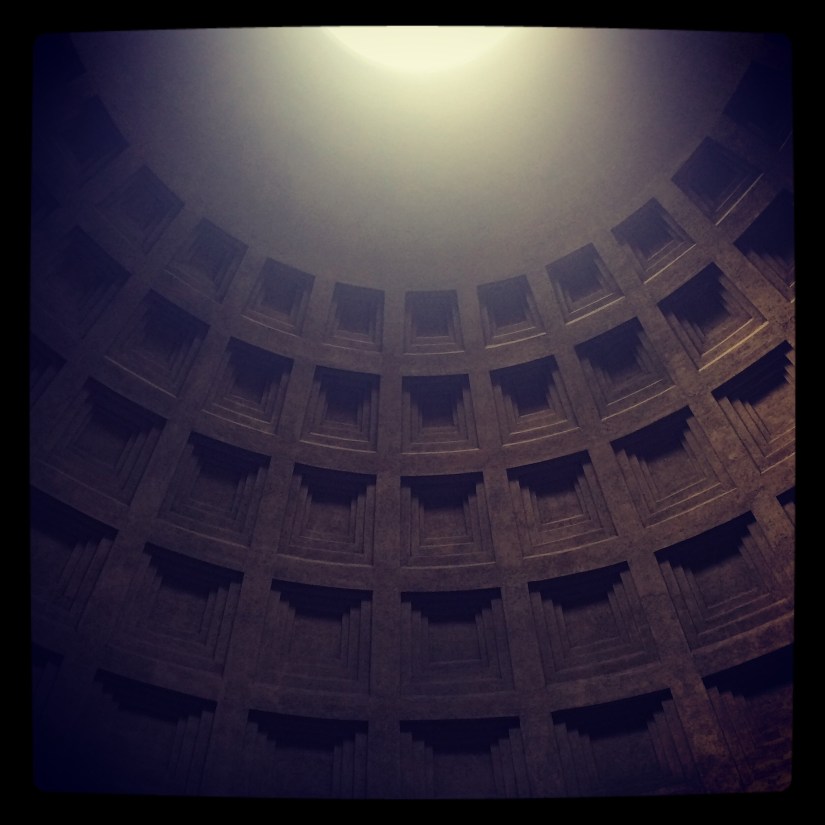
Yesterday in Rome our guide pointed out all the sights. “Behind the small cheeerch to the right is the larger Basilica. Right next to that is another cheeerch, famous for being one of the oldest cheeerches in this district of Rome.” To qualify – I love Roman history. And it’s a terrific city, where every corner turned gives you another breathtaking building to take in.
Built on the foundations of faith and fighting you have to expect what you’ll be shown as you march around the city’s high points. But as we followed our guide I couldn’t help noticing the side streets.
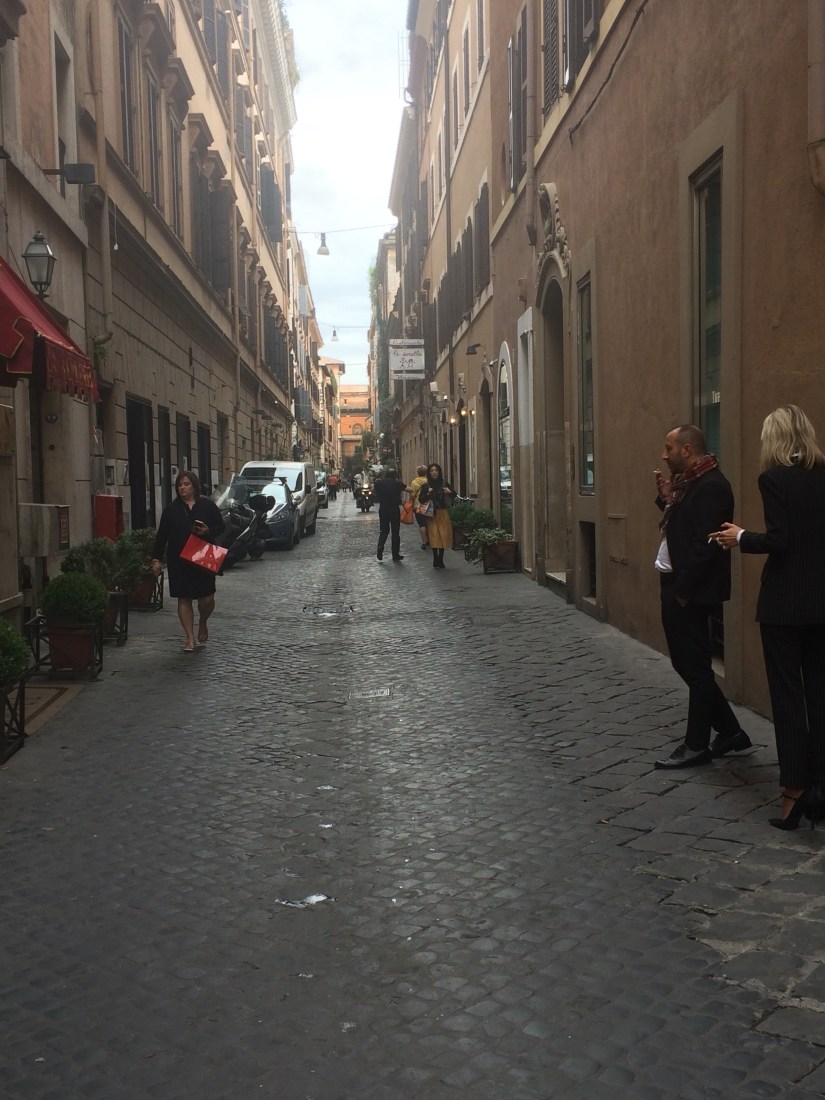
We might’ve been walking the tourist route but what was happening just behind the main event was where real Roman life was going on; ridiculously fashionable men; tanned, healthy, great hair and sock-less, always sock-less, smoking roll-ups while shaking on business deals. Beautiful women in beautiful heels walking beautiful dogs. Snooty teenagers, Armanie’d up like paninaro with significant disposable income hug and air kiss like the beautiful people they are.
The flower delivery van, burping black exhaust smoke in sharp contrast to the multicolours it was transporting stopped suddenly and the driver emerged to shout at 161km/h (that’s about 100mph) to the aproned shopkeeper who was standing nonplussed in the doorway of his store.
An old man, glimpsed through a door ajar onto an alleyway was dressed in a white coat, slowly and patiently sanding wood. Around him were stacked dozens of picture frames and mirrors, a master craftsman at work using the tools and skills of previous generations.
In the fashion district – until we’d been told by our guide that we were now in the fashion district, I’d assumed that the whole of the city was one big fashion district, the side streets offered up furtive-looking Africans selling Michael Kors, Luis Vuitton and Armani bags, belts and bumf, laid out on pieces of rug, ready to be rolled up and ran-off with should any of Rome’s finest happen to wander by. Round the corner the shops were closed-door affairs, opened by appointment only by 7 foot-tall security guards. I’m not much of a fashionista but I did manage to get myself not one but two pairs of Ray-Bans. The second pair the seller did the haggling for me and he gave me them for €5 without me actually saying a word to him. My wife’s convinced they’re just those 3D ones you pick up at the Odeon, with a cheap Ray-Bans transfer on the leg. She may be right but when I’m wearing them, I am Gregory Peck in Roman Holiday, so I’m not bothered.
Talking of which, our tour guide pointed out a poster for the film with Peck and Audrey Hepburn sitting on the Spanish Steps eating ice cream and looking every inch the consummate 50s mods they were aiming to portray. Only half an hour earlier we’d stopped for a gelato by those same Spanish Steps, where my ice cream ran the length of my arm and onto my trousers. Daughter moaned about her salted caramel being too salty. Wife complained about the macaroon they’d stuck in hers. And son had an over-priced can of Coke as he’s allergic to egg and can’t normally go near ice cream. That was our Roman Holiday for you.
Without a word of a lie, I’ve yet to find an ice cream that can stand toe to toe with the one you’ll get in Varani Brothers’ Forum Cafe in Kilmarnock. Maybe tomorrow will prove me wrong.
I write a weekly column for the Irvine Herald and felt it was appropriate to publish a slightly longer version of this week’s piece here. I must begin by stating that there are many others far more qualified than me to write this, John Niven in the Daily Record for one, not to mention the numerous emotional and heartfelt tributes from his pals online, but if you’ve ever encountered Keith he’ll have doubtlessly left his indelible mark on your soul. Not for nothing was his occupation listed as ‘Pyrotechnics’ on Facebook. Once met, never forgotten. Keith, 1983. Photo by Gordon Hay
We begin this week with the sad news that one of our musical brothers has passed away. Keith Martin was a well-known Irvine face respected for his love of music, his strong political beliefs and his uncompromising attitude.
As a teenager, legally still too young to drink, I’d see Keith and his pals every Friday night in the old snug in The Turf, a studied riot of biker jackets, loud opinions and carefully considered hair, exuding the sort of attitude that can’t be faked. I didn’t yet know anyone in bands, but it was clear that Keith and his gang was exactly that. As it turned out, Keith was the focal point of the band, called the Big Gun. Not only that, but John Peel had played their single, Heard About Love, and, making it his Record of the Week, enthused over its infectious, fresh out the box melody.
Big Gun – Heard About Love
Big Gun by Gordon Hay
Over the years, through his circle of pals I got to know Keith a wee bit better and whenever I found myself in his company he would always hold court, his sense of humour as infectious as his willfully argumentative stance on just about anything that was being discussed.
Keith by Basil Pieroni
To paraphrase That Petrol Emotion, Keith was an agitator, an educator, an organiser. An English teacher in Glasgow by day, by night Keith would organise club nights in the city.
For several years he ran the Spitfire Club where the walls shook to Keith’s eclectic taste in music. Agit-punk rubbed shoulders with scratchy post punk, filling-loosening dub reggae and the hardest of hip-hop, a necessary oasis in an era of super clubs and superstar DJs.
If there wasn’t a gig to be had for whichever band he had formed, Keith would create an event to enable them to play. His band Hard Left played a heady hybrid of the swill of sounds laid down by the music policy at the Spitfire Club. If Weatherall had had his name attached to Omerta, I reckon it’d be a considered classic by now.
Hard Left – Omerta
Hard Left by Gordon Hay
In recent years Keith had been the drummer in Dead Hope, a critics’ favourite who’d released an excellent self-funded album from which they gained exposure and airplay on BBC6 Music. I believe too, that discussions are still underway between the band and a prominent indie label to have the album re-released on a larger scale. You’d love it.
Dead Hope – Landslide
Dead Hope played the tiny but perfect Harbour Arts Centre in Irvine back in April this year and stunned their audience into submission with a brutal sonic assault of caustic barbed wire guitars and gravel-throated vocals. The band would play just a couple more times, the last in Glasgow in August, before the cancer that Keith had been battling with began to get the better of him.
Keith passed away last weekend at the age of 51. He will be dearly missed by his wife Allison, his family and his tight-knit circle of pals.
I write this whilst glancing furtively over my shoulder, lest one of the more strong-armed amongst the internet police should apprehend me. You ain’t seem me, right?
Since Prince passed away, bits and pieces of his stellar catalogue have begun peeking around the corner before nestling quietly in some groovy corner of the internet, seemingly far out of reach of the heavies once employed by the wee genius to ensure the world wide web remained totally Prince-free. Quite a task, all things considered, but a task that was strictly adhered to nonetheless. Now that he’s no longer around to crack the whip, it would appear that things are just a wee bit more relaxed when the subject of Prince and his online presence are broached. Which is just dandy for folk like me who are keen to write about the best music whilst providing a non-downloadable soundtrack with which to read by.
In 1983, Prince was at the beginning of an incredible creative streak, a purple patch even. His sprawling and eclectic 1999 album, originally released the year previously as a single album, eventually re-released as the double we know and love today, was still riding high in the charts and on the airwaves and was well on its way to becoming a 4-times platinum album.
Never one to stand still in his kitten heels and bask in the glory of success, Prince set to work on 1999’s follow-up, the soundtrack to Purple Rain. A terrible film – the words vanity project spring to mind – Purple Rain was pardoned thanks to a ubiquitous catch-all soundtrack that genre hopped between funk, rock, soul, electro and perv ballad. The smattering of occassionally filthy lyrics brought it unwanted attention from Tipper Gore, wife of high-profile American politicain Al, and led to Gore creating the PMRC (The Parents’ Music Resource Centre) – the ultra-conservative body who took it upon themselves to lobby for the censorship of ‘inappropriate’ music. Those wee ‘Parental Advisory’ stickers on your Public Enemy albums? That’s Tipper’s doing, that is.
Not that this bothered Prince. He’d go on to record, amongst many, many others, Wonderful Ass and We Can Fuck, tracks that you don’t really need to hear to know how they go. Although, you really should hear them. That’s the beauty of Prince. Disgustingly filthy one moment then pure as the driven Minneapolis snow the next. Tunes flowed from him as freely as water from a tap, most of them brilliant and precious few in the ‘throwaway’ category. He’d be up for days on end, commiting to tape the songs he’d heard in his head minutes before. Band mates were a telephone call away at most and had to be ready anytime for the call. Incredibly productive, it’s no surprise that many of his greatest tracks slipped past almost unknown. Like 17 Days, for example. I was going through some old 7″s a week or so ago and flipped over my crackly old copy of When Doves Cry to listen to its long-forgotten b-side. Thirty-odd years later, it sounds as fresh as the day I first played it as an awkward 14 year old, scared that Prince would reel off a filthy lyric and I’d incur the wrath of my mother, the memory of having to return Dirk Wears White Sox still scarred on my memory.
Prince – 17 Days (The Rain Will Come Down, Then U Will Have 2 Choose. If U Believe, Look 2 The Dawn And U Shall Never Lose) (b-side to When Doves Cry)
To give it its none-more-Prince full title 17 Days (The Rain Will Come Down, Then U Will Have 2 Choose. If U Believe, Look 2 The Dawn And U Shall Never Lose), 17 Days has the classic Wendy and Lisa call-and-response yang to his four to the floor yin. Rubber band basslines compete for attention with descending keyboard riffs and a brilliant shuffling rhythm, Prince’s vocal placed ideally in the middle. And there’s not a pervy lyric in sight. 17 Days grooves along for four pop-filled minutes, a lost gem sparkling from the corner of a jeweller’s shop window.
The passing of Prince has also meant, somewhat contentiously, that his triple-locked Vault has started leaking a little. Did Prince want this music released at all? Was the fact it was locked in the Vault reason enough to respect his wishes never to let it out in public? The first tantalising drips from his life’s work has just been released as Piano & A Microphone, a title familiar to those who’d got themsleves into a frenzy at the proposed tour just a year before Prince died. Two shows in the one day at Glasgow’s Concert Hall? Oh aye! Damn those secondary ticketing sites for making Prince put the kybosh on that particularly fantastic idea. The ‘new’ album features fragments of familiar songs, the odd Joni Mitchell cover, reworkings of some of his deeper cuts…..and the demo version of 17 Days.
Prince – 17 Days (piano demo)
Prince vamps all over it (“Good Gawd!”), loose and funky piano to the fore, with a slight emphasis on the off-beat. It’s got none of the pop/funk sheen of the old b-side, but what it does have is ess! oh! you! ell! SOUL, goddammit! Quite how (or why) Prince turned 17 Days from a free-flowing smoky jazz club number into an arena-pleasing danceathon is, like the man himself, a brilliant mystery.
I suggested to Brendan that we needed selfies behind the kit and candid snaps of our fab four goofing around in the studio like The Monkees, stories of false starts, forgotten parts and flare ups over wrong chords. He encapsulated the whole rehearsal experience in one genius cartoon.
At the beginning of the week, just as I was going to my bed, a message popped up from Brendan O’Hare, one third of the trio of drummers who’ll be keeping Teenage Fanclub in time when they tour their back catalogue in select cities in a few weeks or so. With rehearsals starting imminently, he was hoping to write a diary, a daily update of all things Fanclub documenting what has now become a significant chapter in the band’s history.
Thrillingly, Brendan was keen to share his diary via Plain Or Pan.
O’Hare-brained schemes, themes and ideas were thrashed out. We’d post every day. We’d post at the same time each night and have folk tune in the way they would for a favourite TV show. There’d be film clips, pictures and all manner of Fanclub ephemera. I went to bed beyond excited, far later than expected and unable to sleep.
Radio silence duly followed, and just as I was thinking maybe Brendan’s idea wasn’t going to happen after all, he last night posted a picture on Facebook surmised with a single line. “Woohoo!”
Ah! I had the impression from Brendan that rehearsals would be through the day. Night time sessions would mean we’d always run a day behind, but so what? A peek into the workings of TFC putting their thang together is worth waiting for, aye?
I awoke on Wednesday morning to the message below. So as to help convey the barely concealed excitement Brendan gets from playing with TFC, I’ve hardly edited it.
Holy shit!
Here’s how it went….
….I was 4 hours late, due to a cold and not a demonic fall into boozy business!
The chaps were really nice about it and it went henceley…….
Me: How about we try a song that you and the band I’m in in Essex do? By the Bevis Frond.
Them:
Me: OR we could just fire in from The Concept?
Them: Yes.
Kinda surreal from then on…..I fucking love Teenage Fanclub and it’s so long since I’ve been in them that I absolutely view them from a fan point, which is hilarious for us, the readers. I feel like I’ve won the lottery, getting to play drums on songs that I love.
When we started ‘The Concept’, I felt like, Yeah! I can do this…then about halfway through I was like, hahahaha I’M PLAYING ‘THE CONCEPT’!
Oh yeah… Gerry, Norman and Raymond have put massive baffle boards between each other and are only communicating through me.
It’s tough but I’m doing it for you.
YAS!
Bx
PS. I’m going to do a side angle, based around the lad’s bowel movements; timings, nothing creepy likes. That’s a misplaced apostrophe, by the way.
There was an ancient encased clock, all polished brass and varnished wood, that kept time in the foyer outside the main hall at the old Irvine Royal Aademy. Set into the wall, it was part of the very fabric of the school and when I was a pupil there in the mid 80s it looked as old as the school itself, a building erected in 1901 to replace the original school that had become too small for the growing population of the town. The old clock, they said, had been part of that original school and was moved across as the centrepiece for the new school. Bells rang on the hours it chimed. Exams crawled past in the minutes it ticked. The headmaster’s busy footsteps echoed in time through the hall as each second swung past to and fro on the metronomic pendulum. The old school has long-since closed, converted into turn of the century offices for businesses keen to impress, but I’ll bet the old timepiece still determines when meetings start and finish, when deals are concluded and the working day is over.
The clock, they also said, was the inspiration for Edgar Allan Poe’s The Pit And The Pendulum, his gothic horror story about a prisoner trapped in his cell during the Spanish Inquisition. The pendulum wipes away the minutes of the prisoner’s life as he tries to come to terms with and then escape from his situation. You should probably read it.
Edgar Allan Poe spent time in Irvine and was around when the original school was opened, so I like to think there’s some truth in the ‘they say’ story. If you’re a local or are familiar with the town, Poe stayed in an upstairs room in the building that is now James Irvine’s solicitor’s office at the Cross. Anyway….
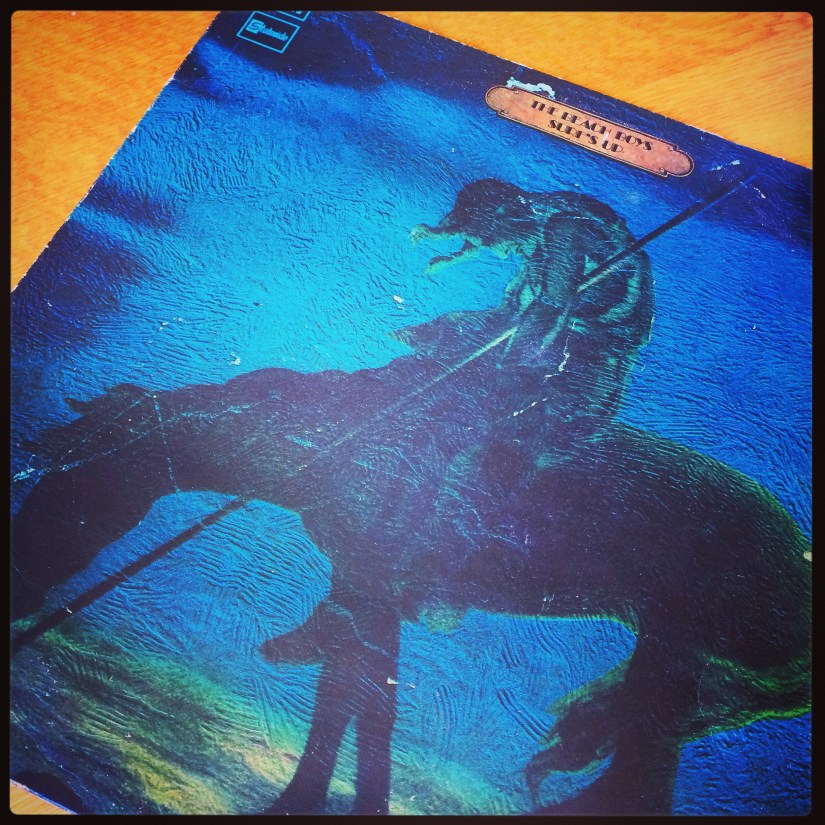
The Pit And The Pendulum also makes an appearance as a line in the Beach Boys’ 1971 under-played classic Surf’s Up. From the album of the same name, the title track is a weird and wonky, dark and dense tour de force. The song’s genesis stretches back to Brian Wilson’s troubled period when he composed on a piano inside a sandpit on his living room floor. With music by Wilson and oblique, stream of consciousness lyrics by Van Dyke Parks (it’s about spiritual awakening, they say), it was to be part of the Smile album, but after that album was shelved, Surf’s Up lay unheard for 5 years before being revived as the titular closing track, a title loaded with inference that the early cars ‘n girls ‘n fun fun fun Beach Boys was very much a thing of the past.
Here’s the Smile demo:
Beach Boys – Surf’s Up (piano demo)
…and here’s the finished version that closed the Surf’s Up album; sleigh bells, percussion that sounds like rattling jewellery and stack after stack of those signature rich, thick Beach Boys’ harmonies in the close-out.
Beach Boys – Surf’s Up
It’s a good album, Surf’s Up. Save the hokey 12 bar blues Student Demonstration Time that closes the first side, it’s packed full of sad melodies, ahead-of-it’s-time eco-friendly messages and home to one of the finest songs in the Beach Boys’ canon, the Bruce Johnston-led Disney Girls (1957).
Beach Boys – Disney Girl’s (1957)
Also worth investiagting if you’ve never heard it before is ‘Til I Die, Brian Wilson’s whimsical, autobiographical address to the state of his health. I’m a cork on the ocean, it goes, floating over the raging sea. How deep is the ocean? I lost my way. It’s soul music, Jim, but not as we know it.
Beach Boys – ‘Til I Die
Here’s Brian in the middle of a Surf’s Up recording session wearing his pyjamas.
Damon Albarn fairly splits opinion. On the one hand, the oikish mockney Cockney wiv an omnipresent Errol Flynn on his boat race, “Oi!, on the other the indie Sting, admirably keen to break out from the expected norm of Blur recordings, releases and tours by teaming up with the Chinese Ensemble, groovy cartoon characters, some of The Clash, the cream of Africa’s elite percussionists and, seemingly, anything else that takes his fancy. Not all of it works, but when it does, the results, such as the recordings he’s made with the elastic-limbed drummer Tony Allen or the West Coast meets East London stylings of his Gorillaz collaborations with Snoop Dogg can be spectacular.
With Blur seemingly no more, it’s as good a time as any to reappraise Music Is My Radar, their 2000 single released ahead of and solely for the purposes of promoting their Best Of album from the same year. Like all the best singles bands – of which Blur are undoubtedly one – Music Is My Radar stands alone as a single without a parent album, save that hits compilation. As such, it’s almost the great lost Blur tune, despite its blink-and-you’ve-missed-it appearance at 10 on yer actual hit parade.
It’s quite the tune, bridging the gap between Pop Blur and Art Blur. The skittering drums and paranoid locked-in groove mooch in like the long lost cousin of early Talking Heads while Graham Coxon’s guitar alternates between oriental expressionist and foodblender set to spin, given free reign to colour the whole thing as he sees fit.
Blur – Music Is My Radar
Damon’s vocals are double, triple tracked, conjuring up melodies and counter melodies that breeze across the top. His repetitive ‘Aah! Don’t stop me!‘ and ‘Do-do-dooh‘ refrains burrow deep into the ear and settle in the frontal lobes to be called up and played on repeat at will. He adds a line namechecking the aforementioned Nigerian Tony Allen – ‘He really got me dancin’, he really got me dancin’,’ yet beneath the surface there’s enough interesting stuff bubbling to keep even the most ardent of anti-commercial indie purist happy.
Nagging wee keyboard refrains jump in and out when least expected, save you were planning on nodding off to the noodling groove. Extra guitar lines weave their way like needles creating the freefrom pattern on one of those Fair Isle sweaters that Sarah Lund wore in The Killing. It’s the bassline though that hits hardest.
That lanky, wanky, foppish twit that plays bass wanders up and down the frets, apeing the guitar line here and there but mainly driving the whole thing forwards with unfaltering purpose and groovy swagger. He fairly surpasses himself and without the bass player on this form, Music Is My Radar may well have been a sloppy, unravelling mess, a bowl of musical spaghetti in need of some glue to hold it together. The cheese maker is that glue, commiting to record his finest four minutes in a Blur shirt.
Interestingly, the released version was shortened from Squeezebox, the original 6 minutes + demo.
Blur – Squeezebox (Music Is My Radar demo)
Probably the correct choice as this version tends to wander aimlessly up a blind alley occassionally. Just shows what a good producer (Ben Hillier on the single version) can do for a band, turning a meh track into a killer single.
Bonus Track
The b-side to the single – actually track 2 on CD1, as was the fashion at the time, is a really great tune, with loads of crackin’ Coxon guitar lines, electric piano and a gospel choir on the chorus, coming in at a lengthy and bluesy 8 and a half minutes. Jason Pierce would kill for a track like this.
Blur – Black Book
Blur b-sides tended to be crappy, experimental, half-arsed demos or unnecessary wonky, skronky remixes. Black Book is neither, a bona fide lost classic in a back catalogue littered with rubbish. Great singles band though.
A dozen or so years ago, a concert celebrating the life and work of Robert Burns took place at Culzean Castle on the South West coast of Scotland, not far from where I’m typing. I’m quite into Burns, in an enthusiastic amateur kinda way. I get involved when it’s that time of year in the schools and organise the school Burns Supper. I’ll put together wee groups of kids who’ll eagerly sing Green Grow The Rashes (the Michael Marra arrangement) while I get to rock out gently with some well-rehearsed finger picking on my guitar. At home, we’ve done Burns Suppers celebrating the bawdier side o’ Rabbie that they don’t teach at school, helped along by the sort of food and drink you’d be hard-pushed to find in a school dinner hall. There are tons of Burns scholars out there who take it far more seriously and who could bore the breeks off most of us with their ability to recite his most obscure work which is why, when the concert was announced at Culzean – with headliners Lou Reed and Patti Smith – I thought I’d give it a miss. “I don’t really fancy hearing Lou ‘n Patti pretend they know the inner workings of Burns’ songbook when they could be doing their own stuff instead,” I reasoned. Big mistake as it turned out, as Lou and Patti by and large did their own stuff, regardless or not of what the promoters had signed them up for. Patti even made the Scottish news on TV the next night for gobbing on the side of the stage, offending those stuffy, ancient scholars I’ve just mentioned. Old punks, eh. What’re they like?
Oor ain Eddi Reader, herself a mad Burns fanatic, was on the bill and in the encore she sang the famous ‘doot-di-doo’ backing vocals for Walk On The Wild Side alongside Patti Smith. I know people who’ll be reading this that have wide-eyed stage-side footage of the moment. Why did I not go? Why?
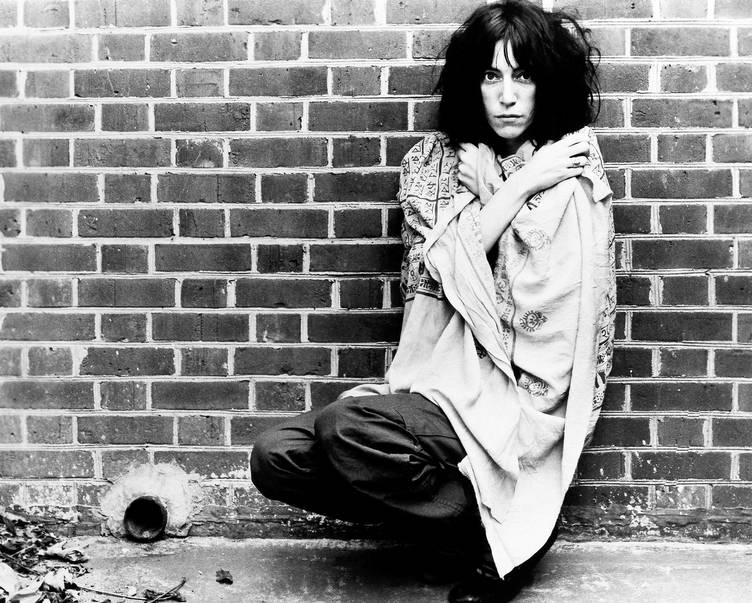
I’ve grown into Patti Smith in a big way. She was always there, a trailblazer for the strong, bloody-minded women from Chrissie Hynde to PJ Harvey who have a place in my record collection, but in recent years I’ve really come to acknowledge her as one of the greats. Morrissey, Michael Stipe and any Maconie-voiced BBC4 documentary will all tell you this of course, but unless you were lucky enough to be there at the time, I’m not sure her importance shines through for generations of mine and since.
Horses is her biggie, of course. A raucous brew of poetry set to music, it’s the sound of flared nostrils and itchy, twitchy jangling nerves riffing on French existentialists, Jesus and the futility of existence – the big stuff, in other words. Wrapped in monochrome with bird’s nest hair, it’s a challenging listen, certainly more difficult to get into than, say, Patti’s contemporaries The Ramones and Blondie who were street suss enough to add some pop to their schlock. The centrepiece of the album is, wonkily, mid way through side 2.
Patti Smith – Land
Land is a free-flowing example of all that Patti does best, over 9 carefully metered minutes of what musicologists might call a triptyche, with 3 parts of music played under the one theme. Every word is enunciated precisely and clearly, given equal gravitas. She howls, she whispers, she duets with herself. She’ll rap on something deeply esoteric one moment and then she’ll be singing about the watusi and Bonie Moronie the next. The words come in floods; pretentious, populist and pure. I can’t pretend to know exactly what she’s on about and I’m not certain that the young Patti in 1975 could’ve told you either. It sounds fantastic though.
Patti has a crack band behind her, rising and falling, ebbing and flowing in time to her carefully-written prose, yet for the entire track they keep it simple. At any moment, Richard Sohl on keys could break into the most heart-stopping piano run, but he doesn’t. Lenny Kaye could easily let fly with an electric burst of pop/punk bloooze, but he doesn’t. There’s ample opportunity over 9 minutes for an Animal-esque freak out on the drums, yet Jay Dee Doherty reigns himself in. With Patti Smith, it’s all about the vocal. The words are everything.
Here’s Piss Factory, her early b-side documenting her time working a crappy job for crappier money.
Patti Smith – Piss Factory
Just Kids, Patti’s autobiography about her life with Robert Mapplethorpe continues this theme. It’s a literary ride on the A Train, taking the reader right into the centre of a mid 70s New York that most of us can only imagine. Their story is played out against a backdrop of the Chelsea Hotel, Max’s Kansas City and Coney Island and features walk-on parts from Andy Warhol, Alan Ginsberg and William Burroughs. Art, music and fashion explode and fuse together and everything and anything is possible, doable and done. Mapplethorpe struggles with a sexual identity that would eventually tear the couple apart but (or perhaps because of this) it’s a beautiful read; a love letter to and for Mapplethorpe and the city that brought them together. There they are up there, an androgynous Keef ‘n Mick for the Blank Generation. Even without the music, Patti’s words are powerful. Read it.
Footnote
It was a conversation with Johnny Marr a few years ago that made me go home and re-evaluate Patti Smith until her genius really sank in. I was charged with taking photos of Johnny and his fans after a gig. The waiting line snaked around long enough that half the folk in it ended up missing their last connection home. At the front of the line was a girl who might’ve been 13 and might’ve been 33. Small, disheveled and unkempt, she’d been first to queue outside the venue at lunchtime on the day of the show and as soon as the doors had opened she’d ran for the front of the stage where she stood holding onto the barrier and never letting go until it was time to meet Johnny at the end. Johnny recognised her straight away. “Hello again darlin’!” he greeted with a hug. “How are we today? Listen – hey, listen! – make sure you get a bed tonight, eh? No more sleeping in doorways, eh?”
“Once, I bunked off the school,” he told me afterwards, “and skipped the train to Liverpool to catch Patti Smith. Sneaked in the stage door! That night I slept in Liverpool Bus Station and it was the most terrifying night of my life. That girl at the front comes to all the shows. She comes alone, leaves alone and always turns up the next day. I kinda worry for her, y’know?”
If artists have such a hold on folk that they’re prepared to forfeit a roof over their head for the night so that they can see them in concert, they’re worth listening to.













 Plain Or Pan