Gone but not forgotten, Hard-to-find

John, Paul, George and Ringwear

The impressively-named Rutherford Chang died a couple of weeks ago.

Who? you say.

What!? I retort. D’you mean you never followed him on Instagram

It’s a fascinating story…

The son of a Palo Alto tech bigwig, Rutherford’s comfortable lifestyle allowed him to forego a normal working routine, instead affording him the time and resources to indulge in high conceptual art; taking the front page of the New York Times and, with all the news that’s fit to print, rearranging every piece of text into alphabetical order; cutting and pasting all of Asian actor Andy Lau’s numerous and varied death scenes into one near-half hour video compilation of death after death after death; editing a George W. Bush State of the Nation speech by removing all of the President’s words and leaving only Bush’s pauses, coughs, breaths, rustles and the crowd reactions in place. Crazy and interesting stuff like this.

A chance teenage purchase of a second-hand Beatles’ White Album in the late ’90s would lead him to his defining concept, one which would bring his name to a wider audience and one which would allow him to fully indulge his need for order, ranking and system within his particularly niche world.

(When I get to the bottom I go back to the top of the slide.)

A while after buying that Beatles album, and noticing that a second copy of the same record in another shop had aged differently, Chang had the masterstroke of all conceptual ideas. He bought that second copy of the White Album and right there and then began to obsessively gather as many copies of the record as he could.  He advertised locally. He trawled record shops. Or stores, as he’d no doubt call them. He pored over Craig’s List. He sought out garage sales. And gradually, he amassed an impressive array of White Albums and only White Albums.

(Where I stop and I turn and I go for a ride.)

Battered, bruised, bashed, beat up, the more so the better. Those copies had more life in them, more unknown stories to tell. Chang was interested in how something that began life so white and pure – and mass produced – could end up discoloured, written on, stained and unique. The journey each record and it’s sleeve had taken was just as important to Chang as the music that filled their grooves.

(Till I get to the bottom)

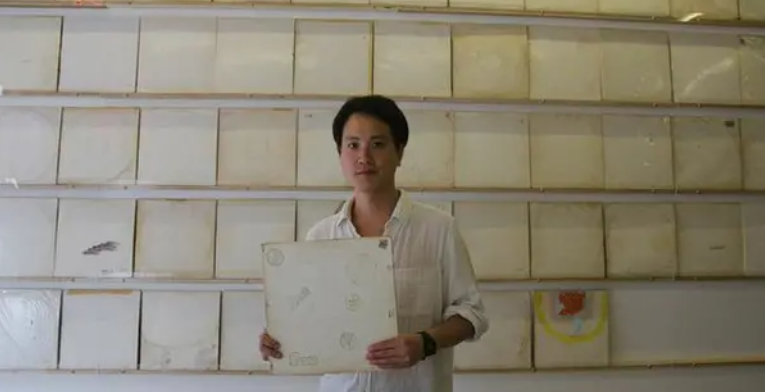
There are three million of them out there,” he said cheerfully in 2013, by which time he owned nearly 700 copies of the album. He played them all too. He set up a gallery space in New York’s Soho, recreated the feel of a classic record shop, stuck a ‘We Buy White Albums’ neon sign in the window and, when he wasn’t bartering with potential sellers, allowed gallery visitors to browse his ‘racks’, select a copy and stick it on the in-house turntable.

It was clear that, as they spun, some of his acquired copies were beautifully pristine. Some sounded like bacon and eggs frying down a well. Some jumped. Some stuck. Some were stereo copies. Some were mono. But all were versions of the same record.

(and I see you again

and again

and again

and again

and again

and again)

By 2014 – a year later, Chang had collected over 1000 copies, buying on average one copy a day since 2013. And, like the most diligent of museum collection curators, he meticulously catalogued them all. Where he’d bought it, how much he’d paid for it, what the stamped number on the front was, was it a mono or a stereo, a first press from the UK or a third press from the US, a seventeenth press from the Phillipines? And once catalogued, the records were displayed in his gallery. Dividers were slotted into bins, arranging the records by serial number or origin or year. Just like a real record shop, only different; this collection was a record of White Albums and the stories they held. Wouldn’t you just love a browse through them all?

He had a rule – hard to believe in 2025 – that no copy should cost him more than $20, but I’m not sure how steadfastly he managed to stick to that rule. He had some pretty low-numbered and interesting copies in there and, regardless of the state of any of them, I’ve sure never been lucky enough to upturn a copy of the record – mono, please, a toploader…with all the inserts, thanks – at anything under three figures. The one I found by chance in a box of records in New York’s Chelsea Market flea sale was a snip at a cool $599 and it looked like it had been well-loved, to be kind to it.

Even my bog standard ’80s reissue (yeah, it has the poster and the four portraits, as well as two slabs of well-looked after stereo vinyl) would fetch £40 on the current second-hand market. Not that Chang would’ve been too keen on securing mine. I appreciate he was all for securing copies that had seen a bit of life but, as long-term readers here may know, I drunkenly relieved myself on my prized copy on the night of my 18th birthday. Some of Rutherford’s copies had coffee stains. Some had food stains. Light brown pish stains though, the colour of an earthy Farrow And Ball paint chart? And this is none of your Greenwich Village hippy stoner pish either, I’m talking primo McEwan’s Lager pish stains from the west of Scotland. I bet Chang never had a copy quite like that. Bog standard, by the way. Pun intended.
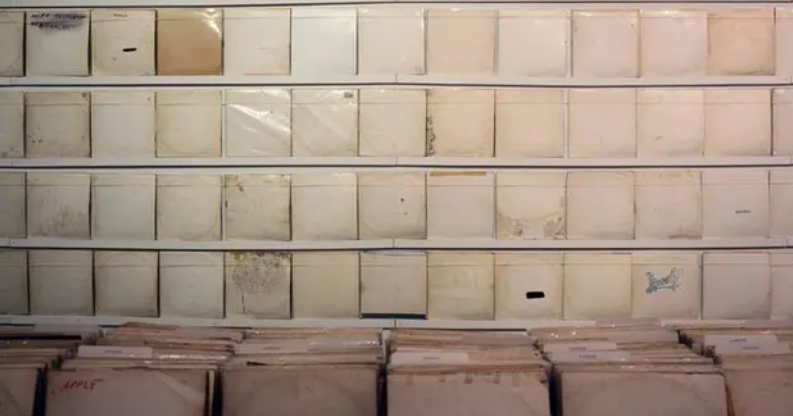
What Rutherford did have was plentiful and interesting enough that his collection would travel to Liverpool to be shown in the city’s FACT art gallery. There, visitors could browse what was undeniably the largest collection White Albums in the world. Sleeves with scribbled names. Sleeves with love letters falling out of them. Sleeves with break-up letters inside them. Soft drugs, soft porn, money… sleeves teeming with the minutae of life. Sleeves teeming with the minutae of life, safeguarding one of music’s most important artistic statements. High concept art.

To accompany his travelling exhibition, Chang took 100 copies from his racks and did two things.

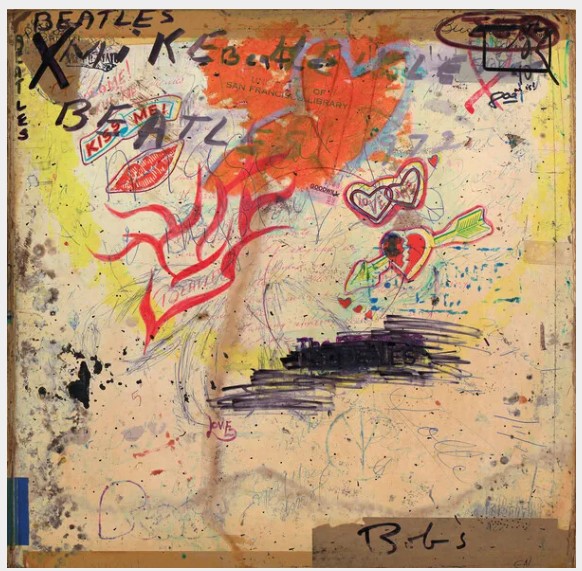
Using trick photography, he superimposed all of the 100 sleeves on top of one another to create a master sleeve that was anything but pure white. In its own way it’s a unique work of art.
He then took those same 100 records and built a wall of sound of the 100 records playing simultaneously. Due to a number of contributory factors; where the needle dropped, the minute variations in belt drive speed of the turntables, the gaps between the tracks themselves (micro seconds of a difference, if at all, but multiply that by 100…), Chang unwittingly produced? built? a proper slice of arty, woozy psychedelia that the Beatles themselves, and indeed, Yoko Ono, would’ve been proud of.

The delay-lay-layed way in which Dear Dear Prudence fades in on Back In The USSR‘s roaring jetstream…Glass Onion‘s sandpaper rumble and oh yeah-yeah-yeah- oh yeah-yeah-yeahs…, Ob-La-Di, Ob-La-Da‘s jittery and jangly piano intro (la la la la life goes on…and on…and on…) …the compressed mayhem of While My Guitar Gently Weeps-eeps-eeps…that bleeds into Warm Gun…Warm Gun Warm Gun…Yeah…Yeah…Yeah…Yeah… It makes for an interesting, occasionally unsettling (and possibly just once in a lifetime) listen. I wonder what Charles Manson would’ve made of it all.

At the time of his death two weeks ago, Rutherford Chang had amassed almost three and a half thousand White Albums. He was only 45 and had many more years of collecting ahead of him. I wonder what happens to the records now? Does someone take the project on? Do the people who sold them to Chang in the first instance get offered a chance to buy their copy back for the $20 they were paid? Rutherford’s detailed records will, after all, have all the necessary contact info. Or, does someone sell them all and rake in a whole load of money? I’m keeping a keen eye on things from over here.


Alternative Version, Cover Versions, demo, Gone but not forgotten, Hard-to-find

By George!

George Harrison, the youngest Beatle, bullied by John and Paul into 2nd tier status in the band, was essentially the runt of the litter yet wrote some of their most enduring songs. When writing sessions were underway ahead of a new Beatles’ recording, poor George had to bide his time while the other two writers hogged the limelight with their latest offerings. Only after they had been given careful consideration would George be allowed to show off what he’d been working on. In any other band, he’d have been the principal writer and held in higher esteem, but in The Beatles he was lucky to get more than one of his tracks onto each album.

 george_harrison_1968

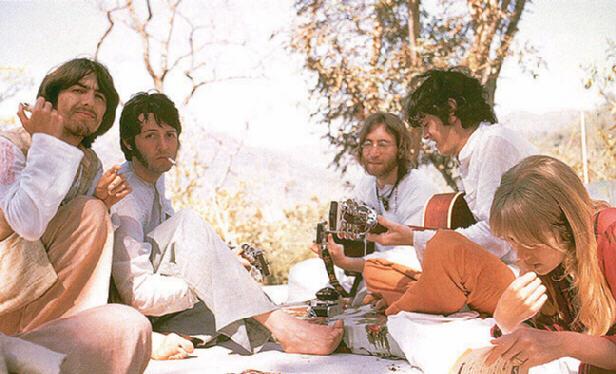
By 1968’s ‘White Album’, George had a handful of future classics under his belt. Writing sessions in Rishikesh in northern India proved particularly fruitful. The Beatles plus associated wives/girlfriends along with a raggle-taggle mismatch of musicians and actors (Donovan, Mike Love, Mia Farrow and her sister ‘Dear’ Prudence) gathered at the feet of the Maharishi to find out the ways of tanscendental mediatation.

1968

The trip was not without incident;  Ringo visited a doctor due to a reaction to the inoculation he’d taken before going, John complained that the food was lousy (Paul and Jane Asher loved it) and the Maharishi, as peace-loving and spiritual as he may have been, turned out to be a randy old man, intent on bedding as many of the female guests as he could.

George was particularly taken with meditation, leading John to quip, “The way George is going, he’ll be flying a magic carpet by the time he’s forty!

Against this backdrop, John, Paul and George wrote many songs that would appear on the new Beatles’ album at the end of the year. Donovan turned John onto a new style of fingerpicking that he’d picked up from the folk clubs and Lennon put it to good use on Dear Prudence. George might’ve been equally inspired, as the descending bass run that characterises Dear Prudence makes it into a couple of his own songs on the White Album.

beatles-india-68

While My Guitar Gently Weeps began life as a downbeat campfire singalong; folk in a minor key, with the ubiquitous descending bass line offest by an uplifting bridge. It’s understated and simple, nothing like the album version.

George HarrisonWhile My Guitar Gently Weeps (demo)

George had to wait an agonising 8 weeks from the start of the album sessions before being given the chance to showcase it. Quite how he kept his mouth shut as John ran through days and days of tape loops creating the arty (but tuneless, let’s be clear) Revolution 9 while Paul completed dozens of takes of the reggae-lite Ob-La-Di, Ob-La-Da and even Ringo had his moment in the spotlight with his honky tonkin’ Don’t Pass Me By is very impressive, but when given his moment (“I always had to do about ten of Paul and John’s before they’d give me the break,”) he rose to the occassion.

george-h-abbey-road-68

The demo of While My Guitar Gently Weeps was used as the blueprint and added to with layer upon layer of guitar and vocals through the use of an 8-track recording machine (the first Beatles’ track to do so) until it was the super-heavy version that appears on the album. An uncredited Eric Clapton was asked by George to play guitar on it. George had been bemoaning the fact that he’d spent hours aimlessly trying to recreate a weeping sound for the track and asked his pal instead to play the solo, which he did with majestic, understated aplomb.

The BeatlesWhile My Guitar Gently Weeps

It’s a perenial favourite, never bettered than when Prince put the other ‘stars’  – heavyweights Tom Petty, Jeff Lynne, Steve Winwood – firmly in their place with his outrageously brilliant cameo at the 2004 Rock ‘N Roll Hall Of Fame. Two questions, the first rhetorical. How overjoyed does Dhani Harrison look when the wee man steps up and takes the song to a whole new level?

Secondly, what happens to Prince’s guitar at the end? Watch….

Hard-to-find

I’d imagined, like, a string quartet after the second verse y’know.

If only I’d had these tracks in 1989! Round about then I taped Paul McCartney‘s MTV Unplugged off the telly and must have watched it about a million times. Well, at least 30. The bit I kept going back to was where he played ‘Blackbird’‘ (or ‘Blackboard‘ as he referred to it on the programme. Ho ho.). I slowly but surely worked out how he played it by freeze-framing the trickier parts, playing the mirror image of what south paw McCartney was playing and rewinding it as soon as the song had finished. I’d then play along to it with my vinyl copy of The White Album on my stereo.

The cover of my White Album technically isn’t white. The bottom left-hand corner and the inner gatefold has a distinct beige look about it. Probably because I pissed on it during the night after my 18th birthday. But that’s another story. Anyway. Freeze-framing and rewinding videos followed by carefully dropping and lifting record player needles at the right points on a record made learning this song a labour of love for me. Kids nowadays have it easy. Whomp ‘Sweet Child O’ Mine’ onto the iPod docking station, fire up UltimateGuitar.com and there it is, 300+ tabs of the same song, all slightly different, mostly all good. In my day you had to earn your guitar stripes. Tsk.

“Tsk!”

When they first started playing guitar, McCartney and George Harrison both learnt to play Bach‘s Bouree in E minor so that they could show off at parties. Looking for some post-Pepper inspiration, McCartney was staying at his farm on the Mull of Kintyre and wrote ‘Blackbird‘ after playing about with Bach’s tune. According to Philip Norman’s book ‘Shout!‘, later that same day he played it to the fans who were waiting outside the gates of his house. 

“A few of us were there. We had the feeling something was going to happen. Paul didn’t take the Mini inside the way he usually did – he parked it on the road and he and Linda walked right past us. They went inside and we stood there, watching different lights in the house go on and off.

In the end, the light went on in the Mad Room, at the top of the house, where he kept all his music stuff and his toys. Paul opened the window and called out to us, ‘Are you still down there?’ ‘Yes,’ we said. He must have been really happy that night. He sat on the window sill with his acoustic guitar and sang Blackbird to us as we stood down there in the dark.”  Fan Margo Stevens, quoted by Philip Norman in ‘Shout!’

It’s been said that the lyrics are about the civil rights movement in America and the struggle for equality. Or it might just be about a wee bird that McCartney saw in his garden one summer’s morning in 1968. Without wanting to sound too glib about it, as a guitar player it was always the finger picking and overall sound of the record that grabbed me.

McCartney and his Martin D28, Abbey Road June 11th 1968

These days, Blackbird has become my Bach and it can now be yours. What you have is a hassle-free way of learning ‘Blackbird”. The tab taken from The Beatles Complete Scores is here, in word document form. And below you have 10 or so in-the-studio crystal clear versions of ‘Blackbird’. Some fast, some slow, some with fluffed lines, some that stop short. There’s some rudimentary piano clanging on one take. There’s also the odd bit of studio chatter between Paul and George Martin. Occasionaly there’s a third voice. That’s a slightly fed-up John Lennon, taking a break from putting together ‘Revolution 9’ in the studio next door.

Blackbird 1

Blackbird 2

Blackbird 3

Blackbird 4

Blackbird 5

Blackbird 6

Blackbird 7

Blackbird 8

Blackbird 9

Blackbird 10

Blackbird 11

All tracks are taken from a Beatles bootleg called ‘Gone Tomorrow, Here Today‘ and were recorded at Abbey Road Studio 2 on June 11th and July 29th 1968, and at Trident Studios on August 28th and 29th 1968. None of the tracks on my bootleg sleeve are marked as being a particular take, so I can’t be any more precise about their origin than that. But this is a good way to learn the song – it’s essentially a work-in-progress session. McCartney repeats the trickier parts and plays it again and again and again, honing it to perfection. Anyway. Take the tab, download the tracks and play along. You’ll have it mastered in no time. You’ll need to add your own foot taps and bird noises. Party piece ahoy!

Piss stain not in shot