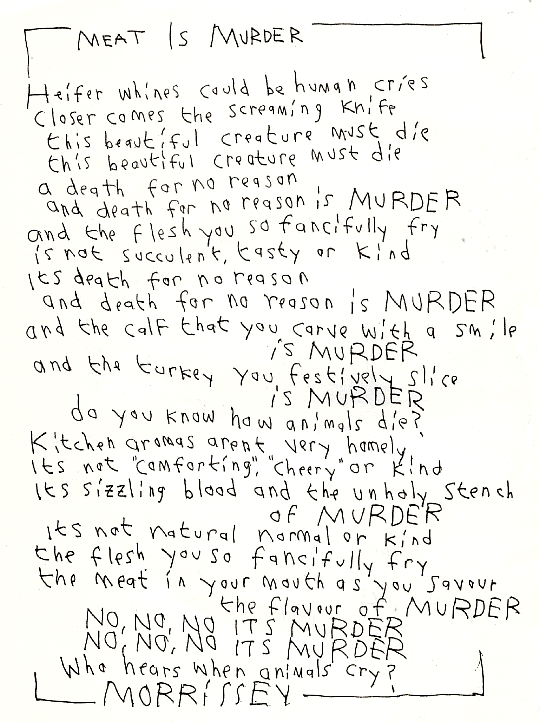
My daughter hates Meat Is Murder, the final track on The Smiths‘ LP of the same name. The grinding slaughterhouse machines battling for ear space with distressed cows has her shouting, “TURN IT OFF!!” every time it comes on. As all good dads should do, I sometimes turn it up twice as loud and make her listen all the way to the end, which she perhaps understandably hates me for.
The Smiths – Meat is Murder
It’s the statement that Morrissey is perhaps most well-known for, and such was his influence at the time, Meat Is Murder turned many teenagers vegetarian. It’s a brilliant track, based around Johnny Marr’s cycling Wythenshawe waltz-time riff and fleshed out (pardon the pun) on record by some understated sparkling piano work from The Smiths’ musical alchemist.
“That was a riff I’d been playing around with for a few days before,” recalls Marr. “Really nasty, in open D. I didn’t know the lyrics but I knew the song was gonna be called ‘Meat Is Murder’ so it just all came together in the take.”
It certainly came together. Meat Is Murder favours mood over melody, and Morrissey’s lines, rhythmic, rhyming and alliterative – ‘The meat in your mouth as you savour the flavour of murder‘ pull no punches.
The song was a staple of The Smiths’ live set for the next year or so, usually performed atop a tape of the abbatoir noises that so horrify my daughter. You’ll find a good version of it, recorded live by the BBC in Oxford on the b-side of the That Joke Isn’t Funny Anymore 12″.
When the band played Irvine on their September ’85 tour of Scottish backwaters, Morrissey introduced it thus;
“Just remember one thing, dear friends. Next time you bite into that big, fat sausage…..YOU’RE EATING SOMEBODY’S MOTHER!!“
I never went to this show, a fact that will haunt me until the day I die. Idiot that I was.
Playing it at the Victoria Hall in Hanley a few months earlier in March, a fan threw a string of sausages onto the stage just as the song began, smacking Morrissey on the mouth.
“They hurled it so accurately that I actually bit into it in the action of singing the word ‘murder'”
Known for walking off stage at the slightest thing these days, I’m not so sure the old grump would be quite as frivolous about such an act nowadays:
*Cook Bernard Matthews
This was inscribed on the run-out groove of The Smiths’ Sheila Take A Bow single. But you knew that already.
William It Was Really Nothing is the sound of The Smiths in miniature. A breathless rush of brilliantly ringing descending arpeggios, bright as brass buttons, topped off with a vocal that distills everything about Morrissey’s much-loved kitchen sink dramas into a handful of lines worthy of Alan Bennett;
‘The rain falls hard on a humdrum town, this town has dragged you down……Everybody’s got to live their life, and God knows I’ve got to live mine……….How can you stay with a fat girl who says, “Would you like to marry me? And if you like, you can buy the ring”……‘
Johnny’s playing is at its most stellar, riff upon riff upon riff of layered guitars nattering and chattering away like Elsie Tanner spreading ghastly gossip about goodness-knows-who over the garden gate. He was in a rich vein of form when he wrote this, was Johnny. He worked the chords out in the back of The Smiths’ van on the M1 somewhere between Manchester and London. Arriving at his flat in Earls Court, he committed his frantically scrubbed faux flamenco pièce de résistance to tape, where it would sit alongside his other new compositions for that weekend, vying for the attention of producer John Porter come Monday morning. That the other 2 new tracks he’d recorded were How Soon Is Now? and Please, Please, Please, Let Me Get What I Want (the tracks that would turn up on the b-side of the single itself) just goes to show how prolific a tunesmith (tune-smith! See what I did there?) the barely 21 year-old Johnny was. Frightening, if you stop to think about it.
William It Was Really Nothing – Peel Session (August 1984)
The Smiths clearly loved William It Was Really Nothing – they played it in concert before recording it (first for Peel, above) and continued to play it throughout the tours of 1984 and 1985. It still had its place in the ’86 setlists when the briefly 5-piece band were at their most rockist and was the second-last song The Smiths ever played live.
When John Porter got ’round to working on it from Johnny’s demo (and who knows how he chose what track to tackle first) he sprinkled a magical dusting of fade-ins and fade-outs, backwards bits and bursts of guitar that are the aural equivalent of one of those time-lapse videos of a flower blooming you see on nature documentaries. It’s just perfect, and even after 30 (gulp!) years, every listen reveals new things.
William It Was Really Nothing – Single Version
William It Was Really Nothing is over and out in little over 2 lean, mean and meat-free minutes, which, if I’ve timed it right, is just about as long as you needed to read this piece. Beat that!
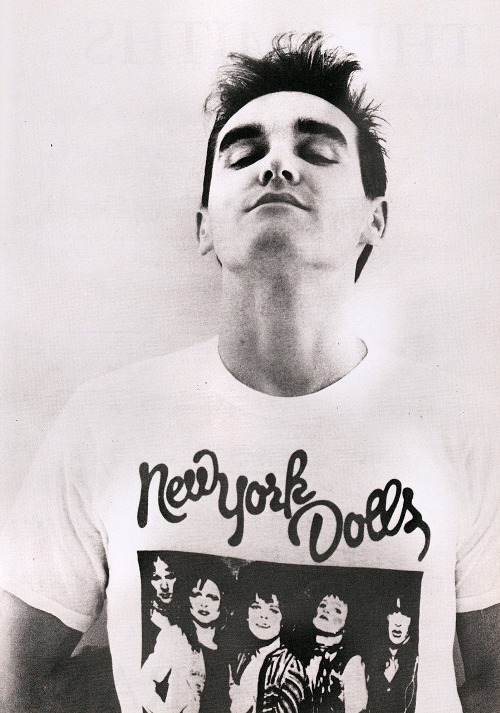
The New York Dolls landed on British telly in November 1973; a sloppy, slutty, Stones-in-slap-‘n-stack heels assortment of misfits and ne’erdowells. Their sound was a thrillingly simple souped-up charge of re-hashed Chuck Berry licks and Noo York street-smart shouted vocals, and in this era of prog rock and ‘serious’ music, immediately divided opinions.
“Mock rock!” dismissed presenter ‘Whispering’ Bob Harris as he waited patiently for his next fix of good ol’ country rock.
“The Dolls gave me a sense of uniqueness, as if they were my own personal discovery,” blurted a foaming at the mouth Morrissey.
Famously, along with being President of the Dolls’ Fan Club, Morrissey had a New York Dolls biography published, which sold steadily in its one and only print. You could argue that The New York Dolls was the catalyst in getting the teenage Morrissey out of his bedroom and into society where he’d meet like-minded Mancunians and ultimately form The Smiths. Now, that may be a bit of a simplified version, but essentially that’s what happened.
On the Doll’s debut album there’s a track called Lonely Planet Boy.
The band’s one attempt (on this LP at least) at acoustic balladry, it teeters metaphorically atop one of Johnny Thunder’s gigantic silver stacked heels, forever on the verge of collapse and falling apart. Coaxed along by a rasping 50s-inspired sax, it was a particular favourite of the young Morrissey. Indeed, a decade or so later when stuck for lyrical inspiration, Morrissey went back to Lonely Planet Boy and appropriated some of the lyrics for the song that would, for some come to define The Smiths.
Oh, you pick me up You’re outta drivin’ in your car When I tell you where I’m goin’ Always tellin’ me it’s to far
But how could you be drivin’ Down by my home When ya know, I ain’t got one And I’m, I’m so all alone
And with that steal, Morrissey had galvanised himself into writing the lyrics to There Is A Light That Never Goes Out.
A great song needs more than great lyrics, of course. I’ve written about the Johnny’s contribution to it before. Below is the shortened version.
“If we needed some songs fast, then Morrissey would come round to my place and I’d sit there with an acoustic guitar and a cassette recorder. ‘There Is A Light That Never Goes Out’ was done that way.”
“Morrissey was sat on a coffee table, perched on the edge. I was sat with my guitar on a chair directly in front of him. He had A Sony Walkman recording, waiting to hear what I was gonna pull out. So I said, ‘Well, I’ve got this one’ and I started playing these chords. He just looked at me as I was playing. It was as if he daren’t speak, in case the spell was broke.”
“We recorded ‘There Is A Light That Never Goes Out’ in 10 minutes. I went on to add some flute overdub and strings and a couple of extra guitars, but really, the essence and the spirit of it was captured straight away, and that normally means that something’s gone really, really right.
(Flute/strings overdubs demo below);
I have a version of that take with just the three instruments and the voice on it – it absolutely holds up as a beautiful moment in time. The Smiths were all in love with the sound that we were making. We loved it as much as everyone else, but we were lucky enough to be the ones playing it.”
“I didn’t realise that ‘There Is A Light’ was going to be an anthem but when we first played it I thought it was the best song I’d ever heard.”
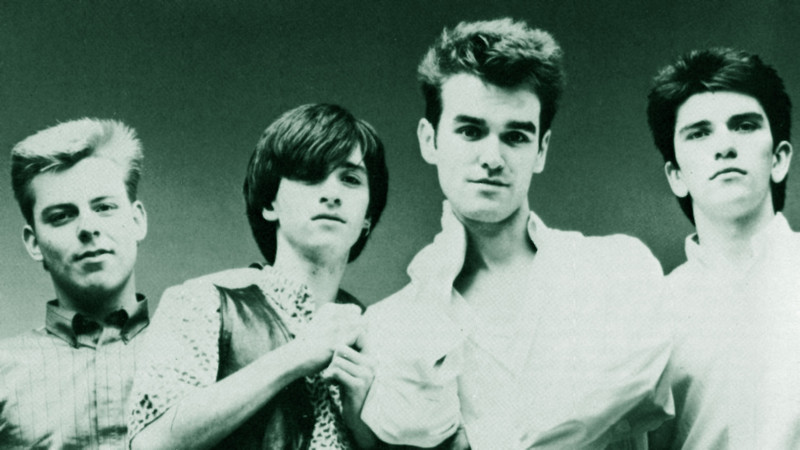
Recorded between London and Manchester almost 30 years ago (September/October 1983), This Charming Man was the record that transported The Smiths up and out of the late-night, Peel-championed margins and into the mainstream, Top Of The Pops and all.
A giddy rush of walkin’ talkin’ Motown basslines and chiming staccato guitar riffs, topped off with Morrissey’s yelping yodel, it still sounds exhilarating to these ears as I type right now. Even the much-maligned New YorkMix, with its none-more-80s ricocheting rim shots and ghostly guitar fade-ins still does it.
The Top Of The Pops appearance (the band’s first of 11) a few months later in November was superb, with Morrissey battering about his oversized bunch of gladioli in a show of high camp, while the other 3 played like seasoned telly regulars in matching M&S polo necks. Save a select, hip few, this was the first time many folk had actually seen The Smiths and the effect was seismic. It’s no surprise that by that weekend, sales of Brylcreem had risen 110%, old men’s barbers up and down the country were queued out with boys wanting flat tops, “but just leave the front bit, thanks” and any number of grannies were wondering what had happened to that nice chiffon blouse they’d been keeping in their wardrobe for that special occasion. Your David’s wearing it, gran. Teamed up with that cheap glass-beaded necklace our Doreen gave you when she was eight. And he’s off to the Red Lion where there’s every chance he’ll get himself half a light ale and a right good kicking. Me? I was still in my bedroom, listening to Frankie’s Relax until the wee small hours.
Much has been made of the speed at which Morrissey and Marr wrote in the early days. This Charming Man was one such song. Johnny had heard Aztec Camera’s Walk Out To Winter on regular radio rotation and felt his band should be getting the same attention. With a John Peel session coming up (14th September, to be aired one week later), Marr pulled out all the stops to write a catchy, radio-friendly tune in a major key (G, if you’re asking, though really A, as he tuned his guitar up one whole step). According to Johnny, the tune took him all of 20 minutes to write, although he would spend far longer with producer John Porter to perfect the sonics in the studio.
“There are about 15 tracks of guitar. People thought the main guitar part was a Rickenbacker, but it’s really a ’54 Tele. There are three tracks of acoustic, a backwards guitar with a really long reverb, and the effect of dropping knives on the guitar — that comes in at the end of the chorus.”
Listen for that wobbly doiiiinnnngg every now and again – that’s the two Johns (Porter and Marr) dropping kitchen knives on an open-tuned guitar. You can’t do that with GarageBand, kids.
Morrissey, on the other hand, was studio shy. He often had to be coaxed into doing more than one or two vocal takes. His lyrics for This Charming Man were impossibly impenetrable to this 13 year old, and to be honest, not much has really changed over the past 30 years. Singing about some sort of clandestine sexual initiation or other, Morrissey’s words were “just a collection of lines that were very important. They seemed to stitch themselves perfectly under the umbrella ofThis Charming Man.” The lyrics were almost certainly taken from Morrissey’s faithful notebook, his collection of words in search of a tune, but they weren’t entirely Morrissey’s own.
The 1972 film Sleuth, starring Michael Caine and Laurence Olivier features a scene where Olivier points a gun at Caine calling him ‘a jumped up pantry boy who doesn’t know his place‘.
The 1961 movie adaption of Shelagh Delaney’s A Taste Of Honey features two characters discussing their evening. ‘Are you going dancing tonight?’ ‘I can’t, I haven’t got any clothes to wear.’ Delaney would prove to be a rich source of material for Morrissey’s lyrics. But more of that another time.
Stolen words or otherwise, what’s undeniable is that This Charming Man ramped The Smiths up a notch or two and set them off on their all-too brief trail-blazing journey through the mid 80s.
Here’s the music:
This Charming Man (London mix)
This Charming Man (Manchester Mix)
This Charming Man (New York Vocal Mix)
*Bonus Tracks!
Howsabout some more of those studio master tape tracks? Below you’ll find the bass, the guitar, the vocal and a guitar/percussion track. Isolated parts, perfect for your inner George Martin. Or indeed, inner John Porter.
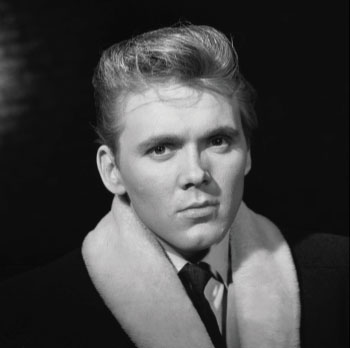
Billy Fury. Your granny knows him from such staple Hit Parade fodder as ‘Halfway To Paradise’, ‘Wondrous Place’, ‘Last Night Was Made For Love’….. do I need to go on? Billy and Cliff Richard battled it out for the dubious tag of ‘British Elvis’, but the more sussed among us really knew that Elvis was in fact the ‘American Billy’.
Upturned collar? Check. Lip curl? Check. Half-collapsed quiff? Check. Forget the songs listed above and instead listen to this. ‘Ain’t Nothin’ Shakin’ But The Leaves On The Trees‘ is a hand clappin’ enhanced primal rocker that could’ve sat neatly on any Nuggets-type compilation you care to mention. How Fury got from garage band howling blues to slush like ‘Colette‘ is anyone’s guess but, wow, when he was on form there was clearly no-one like him. His manager obviously gave him his stage moniker round about this time, otherwise he’d have been forever known to the world as Billy Ballad. Incidentally, The Beatles version of ‘Nothin’ Shakin’…‘ can be found on their ‘At The BBC’ album. It sounds pish.
Morrissey was a big fan, so much so that he nicked half his look from Fury. Look here. As too are those talented wee fuckers in The Last Shadow Puppets. They stuck their own version of ‘Wondrous Place’ on the b-side of their ‘The Age Of The Understatement‘ single. Understated indeed – a churchy organ, some brooding bass, a top vocal and some Duane Eddy twang halfway through. What I like about this lot is that they all look similar, they even sound similar when they sing and they are clearly very talented. A bit like The Beatles. But then, obviously nothing like The Beatles. I’ve already posted their version of Bowie‘s ‘In The Heat Of The Morning’ (here) and if they keep up their high standards of self-imposed quality control I think these two youngsters could be around for years to come. A bit like The Beatles. But then, obviously as I’ve already said, nothing like The Beatles as well.
2 more decent UK garage band rockers to follow. These days, Dave Berry may be more comfortable touring the country in those terrible 60s nostalgia shows alongside such 3rd divison outfits as The Swinging Blue Jeans and The Tremeloes. Back in the day he was equally comfortable blasting out tough R&B tunes as he was crooning pop ballads. One such record was July 1964’s‘The Crying Game’ (number 5, fact fans), much later also a hit for Boy George. The A-side was the pop ballad. The B-side was something else entirely. Along with his backing band The Cruisers, he came up with this proto-punk snarling rabid dog of a record. ‘Don’t Give Me No Lip Child’ is a belter, and given that the Sex Pistols strangled and choked it into something resembling a cover version, John Lydon thought so too.
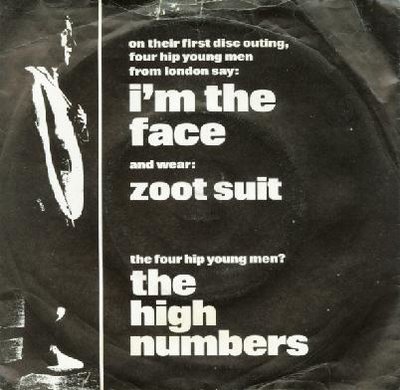
Before they became The Who, The High Numbers released ‘I’m The Face’. The sound of Swinging London, it was written by Peter Meaden, their amphetamine-fuelled manager stroke publicist. This tune is essentially Slim Harpo‘s ‘Got Love If You Want It’ with new lyrics designed to reflect the culture of the times – a classic mod-stomper of a record that was a paen to all things Modern (not modern). Of course, as is more often than not the way with fantastic records, the single was a flop. According to some sources, the only copies that were actually sold were bought by Meaden himself, in a crap attempt at chart rigging. Ivy League jackets. Buck skin shoes. I’m the face baby, is that clear? Clear as crystal, little Roger!


 The song was a staple of The Smiths’ live set for the next year or so, usually performed atop a tape of the abbatoir noises that so horrify my daughter. You’ll find a good version of it, recorded live by the BBC in Oxford on the b-side of the That Joke Isn’t Funny Anymore 12″.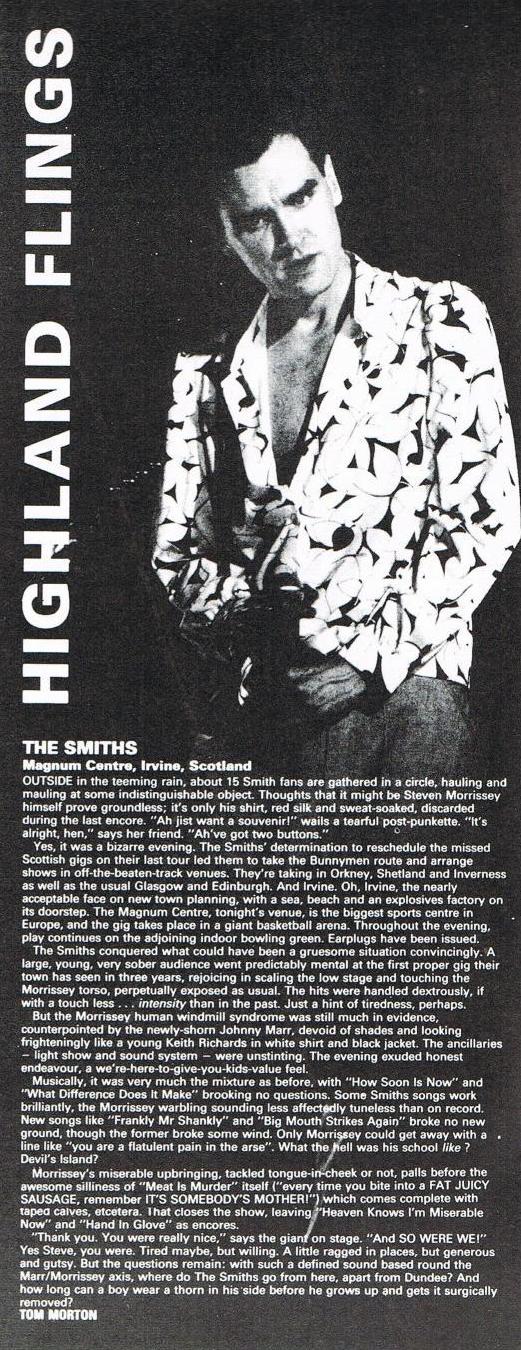
 *Cook Bernard Matthews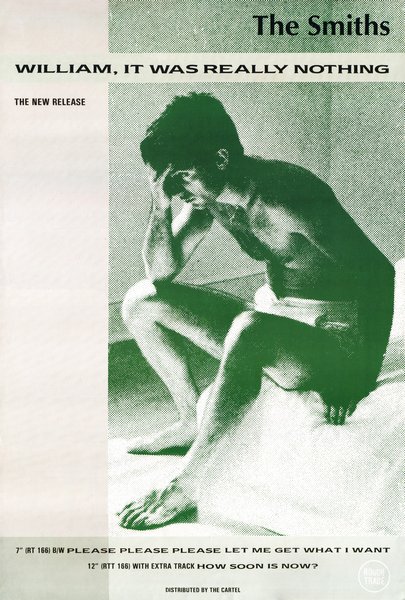





 Plain Or Pan