Alternative Version, Gone but not forgotten, Hard-to-find, Live!, Sampled

Introducing The Band

A few months ago I posted about the burst of classical music that The Smiths used to signify they were taking the stage. Walk-on music, when used as effectively as The Smiths did it, is an integral part of the live experience. Those in front of the stage have their senses heightened…quicksilver adrenaline courses through the collective mass… eagerness is fit to burst and, as one, they peak when their heroes take the stage. In the article linked above, Mike Joyce talks about the prickling of the hairs on his arms as Sergei Prokofiev’s music reaches its climax and the group emerge from the shadows and onto the stage. Intro music is pure theatre and high drama, powerful in its effect for audience and band alike.

The recent death of Mani had me revisiting the Stone Roses catalogue and reminiscing about the Stone Roses gigs I’d been at. I say gigs, but Stone Roses shows were more of an event than a mere gig. The minute the group began to pick up traction, they eschewed the usual circuit of venues and instead put on ambitious landmark concerts.

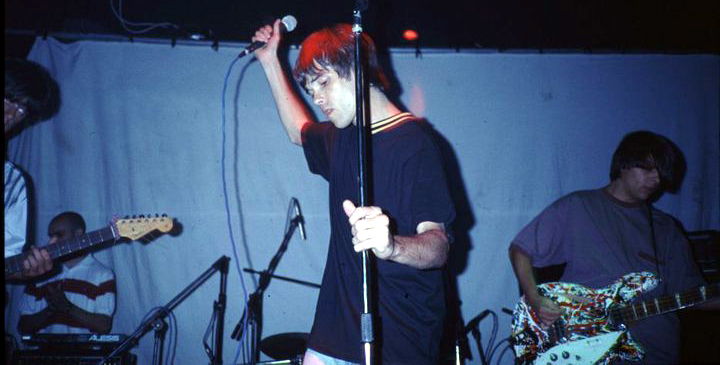
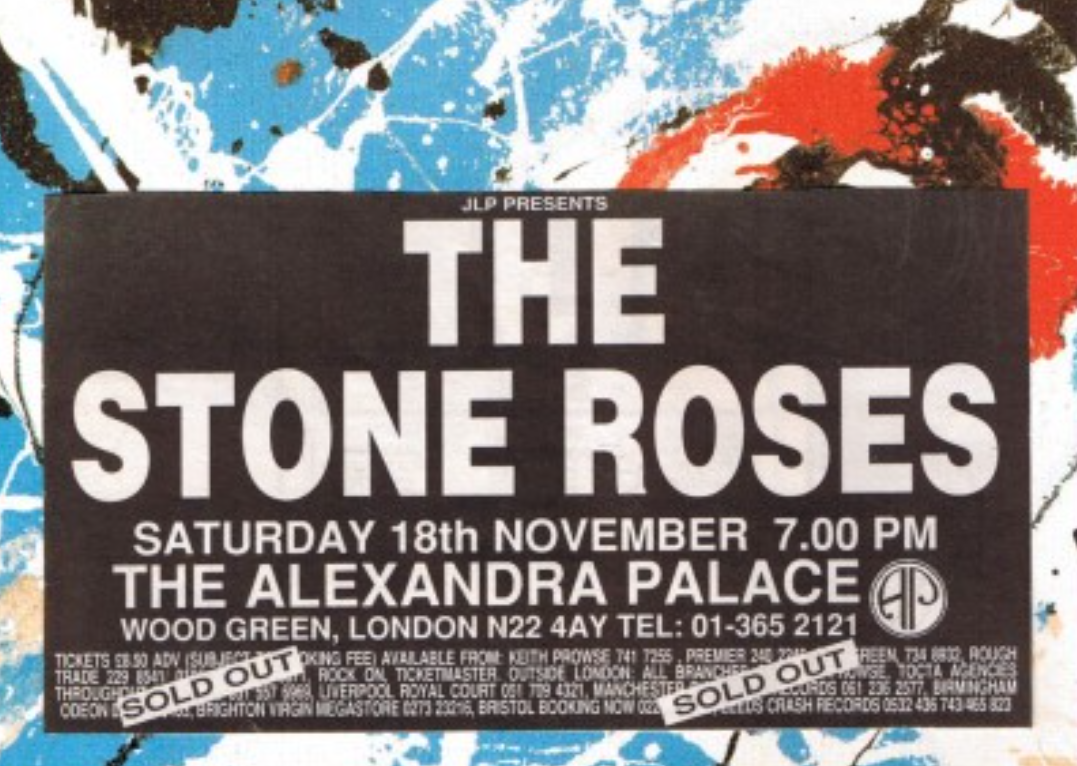
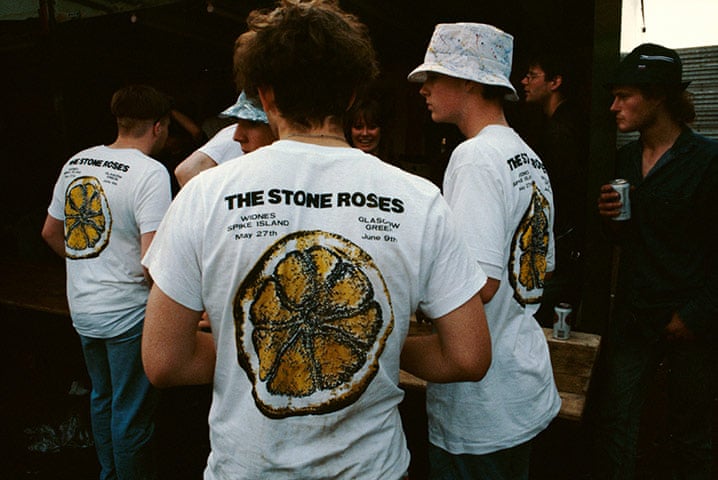
In the space of five rapid months in 1989, Stone Roses went from Glasgow Rooftops (above) – part of the touring circuit for bands of a certain size – to the Blackpool Tower Ballroom to a November show for 7000 rockers and ravers in London’s Alexandra Palace, at the time known as the broadcasting birthplace of the BBC and scene of some of those trippy 24-hour Pink Floyd and Soft Machine ‘happenings’ of the late ’60s, but certainly not the usual venue any bands might think to try and fill. Nowadays of course, any two-bit act with a bit of a following can add a date or two in the airy north London glasshouse, but in 1989 the Stone Roses’ choice of venue was genuinely inspired.

Fast forward another six months and the group would set up stall on Spike Island, a windswept and chemically-polluted estuary of the Mersey. Two months later they’d play their final show (for then, anyway) in a huge tent on Glasgow Green, 10,000 rockers, ravers and by now bucket-hatted bampots witnessing the band at the peak of their powers. The travelling tent idea is also now fairly standard practice for bands of a certain size these days. (Spike Island less so.)

As the band’s popularity grew, they went from the standard idea of support act plus half an hour of playlisted music to an actual rave culture-inspired show, the group just one element of a spectacle that would involve guest DJs dropping crashing house beats and hip hop on the P.A., lasers and strobes on the lighting rig, mass E communion in the audience and generally good vibes all round. These shows were a million miles from watching Gaye Bykers On Acid from a cider-soaked corner of Glasgow Tech or the Wedding Present at the QMU or any other touring guitar band of the era you care to mention. Yes, even you, Primal Scream. In 1989, Bobby was still looking for the key that would start up their particular bandwagon. (It was somewhere down the back of his Guns ‘n Roses leather trousers, I’m led to believe.)

All of those shows mentioned above (I was at three of them) began with I Wanna Be Adored. Since writing the song, or at least since the release of that debut album, has there ever been a Stone Roses show that didn’t start with it? I don’t think so. I Wanna Be Adored is, in its own way, a senses-heightener, a quicksilver surge of electricity, an early peak in a set full of peaks, but in the live arena, it too would come rumbling from out of the corners, fading in as an intro tape heralded the group’s imminent arrival.

Stone Roses intro music:

I’ve spent 35 years convinced that this music was made by the Stone Roses themselves, an abstract piece of art thrown away in the same vein as those backwards experiments they put onto b-sides, played for fun, recorded then used sparingly but appropriately. Certainly, the thunking, woody bassline is pure Mani. The hip-hop beat pure Reni. The sirens a clear extension of John Squire’s clarion call at the start of Elephant Stone.

Hearing this from Ally Pally’s carpeted floor minutes after Sympathy For The Devil is still strong in the memory. Hearing it again in the sweat-raining big top on Glasgow Green, many there unaware that this was not mere incidental rave music but Stone Roses’ call to arms (but we knew, oh yes, we knew, and excitement was immediately at fever pitch) still provokes a conditioned response in 2025.

It wasn’t made by Stone Roses though. Turns out it’s a piece of obscure-ish hip hop from 1987, looped, tweaked and added to by the Stone Roses team. The original – Small Time Hustler by The Dismasters – is immediately recognisable from that Stone Roses intro. Really, all the Stone Roses did was stick a few sirens on top of it…but combine that with Ally Pally’s echoing rave whistles and Glasgow Green’s surge of euphoria and it makes for high drama.

I wonder how many folk knew – truly knew – the source of that Stone Roses intro tape back in 1989?

Cover Versions, Gone but not forgotten, Hard-to-find

A Good Start!

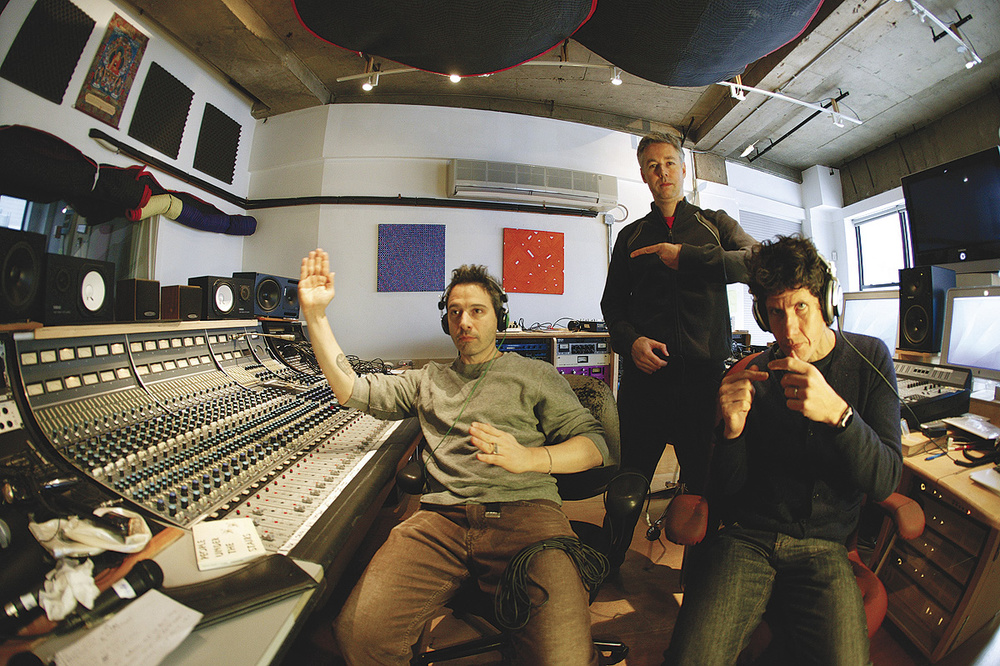
There’s a story that Adam Horowitz tells – kinda preposterous, but totally believable (it’s the Beastie Boys, right?) – where waaaay back in the early days of the Beastie Boys he’s hanging out at a friend’s rather than be at school that afternoon when, from the TV, comes the unmistakable slow ‘n low DIY beats of his group’s own ‘Beastie Revolution‘, the flip side of their debut single Cooky Puss. Somehow, some way, British Airways had picked up on the track and used it to soundtrack a TV advert. Quite what the ad executives were thinking (or were on) by adding the Beasties’ track – lo-fi-Pass-The-Dutchie-as-recorded-by-Lee-Perry – to go hand in hand with an advert for global business travel is anyone’s guess, but there it was. Ad Rock couldn’t believe it. They had to ask for permission, didn’t they?

It so happened that Mike D’s mum had a friend of a friend of a friend who worked for a Manhattan law firm, and so, a young lawyer fresh out of law school and with the bit between his teeth was assigned to take on the Beastie Boys v British Airways in his first case. The four Beastie Boys (Kate Schellenbach was still a part of the group at this point) were subsequently awarded $10,000 each, an astronomical amount for a young person in 1983. Adjusted for inflation, it’s the equivalent of over $32,000 (£30,000) in today’s money. The money would go some way to helping the group establish themselves with decent equipment, accomodation and rehearsal space.

Ad Rock did what any music-obsessed teenager would do: he took himself straight to Rogue, Midtown Manhattan’s music store. He had his eye on a black Rickenbacker, ‘the same one that Paul Weller from The Jam played‘ and had the $250 out to pay for it when, from the corner of his eye, he spied the new-to-market Roland TR-808 drum machine. Dilemma! He rationalised – he had a perfectly good guitar already…all the best, freshest records of the day were built on processed beats…here was his chance to own a real guitar…here was his chance to be cutting edge and adopt the brand new technology of the day…guitar?…beats?…guitar?…beats?… The 808 won out. Serendipitously, it would end up providing much of the backbeat for that first million-selling Beastie Boys album, after which Ad Rock could buy as many Rickenbackers as he fancied. A good decision, as it turned out.

It’s no secret that Beastie Boys have a hardcore punk thing at their roots, but when I first read the story above, I was suprprised that they were fans of The Jam. Of all the guitar-based bands to be into, they’d seem to be the most quintessentially English. The lyrical content, the suits, Weller’s undeniable accent…maybe that was the appeal.

In 2000, Fire And Skill, a tribue album to The Jam was released. It’s an eclectic (ie ropey) album and alongside the names you’d expect to be there (Liam Gallagher, Steve Cradock) were outliers such as Garbage, Buffalo Tom…and the Beastie Boys.

Beastie BoysStart!

Beastie Boys

Their version of Start! is terrific. It’s cut from the same lightly toasted cloth that many of those groovy Beastie Boys instrumentals are cut from. There’s no immediate Taxman-aping thumping bass. There’s no frazzled, trebly guitar solo. There are hardly any vocals. Instead, it’s built on a bed of bubbling Jimmy Smith organ, a woozy melodica playing Paul Weller’s vocal melody, with skittery, hip-hoppish drums and splashing cymbals nailing the groove to the floor. Miho Hatori of Grand Royal labelmates Cibo Matto pops up to sing the ‘if I never, ever see you/what you give is what you get‘ refrain, but other than that, this is Beastie Boys doing what they do best – grooving on a soul jazz soft shoe shuffle for fun and out of sheer respect for the music.

In Dancing Through The Fire, Dan Jennings’ excellent re-telling of the Weller story from pre-Jam to the present day, there’s a story of the aeroplane-averse Weller travelling six hours by car between shows, playing the Beasties’ version of Start! over and over and over again. I hope Adam Horowitz gets to read about that.

Hard-to-find

Hopelessly Devoted

I was chatting to big Greg a couple of months ago about the lasting legacy of Paul Weller, the pair of us soft shoe shuffling to Shout To The Top as it blasted at ear-pleasing volume in Glasgow’s Buff Club. One of these shores’ greatest-ever songwriters, the shouted (to the top), garbled consensus we arrived at seemed to confirm that PW has undeniably earned his place at the top table with that other Paul (McCartney)…and possibly, contentiously, seated at a table set just for two. Drink had been taken in the lead-up to this conversation, but I ask you – who else has had the craft, the clout and, indeed, the cojones to form not one, but two celebrated – idolised – groups whilst ploughing a distinct and unique solo career with added sideways steps? Take a minute to ponder and add your silly suggestions in the comments below. You’ll be wrong though*.

Musical Magpie

The great thing about Paul Weller’s back catalogue is that, unless you’re a buy-everything-on-day-of-release fiend for his stuff (and that may well be you – I was up until a point), you’ll occasionally come across a previously unheard track the likes of which drives home that notion, that theory, of PW’s mega-greatness. Last summer I came into a small fortune and so naturally bought some new (ie not second hand) records, including Will Of The People, his 3-album companion set to Fly On The Wall (his triple-plattered gathering of assorted b-sides from the first few albums) and steeped myself in its heady pot pourri of odds and sods; Pet Shop Boys remixes, reworkings of album tracks, way-out excursions in African-inflected dub-laden psychedelia…it’s all there and available to slowly digest as an album (rather than a collection of b-sides) in its own right. It’s a right great listen.

It was the pastoral and sprightly Devotion that, for a long time, was my go-to Weller tune.

Paul WellerDevotion

A planned co-write with Richard Hawley that never happened, Devotion seems to arrive and land in the time it takes its writer to put hand to chord, pen to paper. It skips its way across the verses sounding like the very thing McCartney might’ve written when he was recording Ram, just Weller and an acoustic guitar strummed brightly and with purpose…but augmented in the studio with oohing and aahing backing vocalists, unexpected whistling and synthesised strings that soar in direct correlation to the heart as you listen.

There’s some lovely, rootsy Ronnie Lane bass and enough going on in the background to suggest that, throwaway the track may be, its writer spent a bit of time arranging it into a perfect stand alone song. See those folk that only know Weller from You Do Something To Me and (uh) ‘Pebbles On A Beach‘… they’d love this song, so they would.

Songs are open to all sorts of interpretation, but Devotion could almost be a Weller pep-talk to himself where he outlines the reasons he’s still driven to produce great and interesting music.

Devotion is the key to the lock that holds your dreams…

Devotion gets you up on those mornings in the dark…

There you go, with your headful of ideas

It shows there’s a purpose in your feet 

And you know, that you better get it right

It shows there’s a purpose, day and night

It’s no Shout To The Top. It’s no Town Called Malice. It’s nowhere close to Hung Up‘s power and glory, but Devotion is another in a very long line of great Weller songs. If it’s a new one to you, I hope you get from it the same thrill and need to repeat that first enveloped these ears when they first heard it. I’ve listened to it a dozen times since beginning to write this piece. It never tires.

*Yeah, yeah. Bowie. I hear ya.

Cover Versions, Hard-to-find, Studio master tapes

House Champion

There’s a decent case to be argued for Paul Weller being England’s equivalent to Neil Young. Both started young and both found instant success with their first real bands – Buffalo Springfield in Young’s case and The Jam in Weller’s (like you didn’t know already). Both these bands released era-defining tracks and tapped in to the consciousness of youth. And just as Young left Buffalo Springfield to forge a solo career packed full of instantly-regarded classic albums, side steps peppered with choice collaborations and sudden left turns towards new and unexpected musical directions (the ‘Ditch Trilogy‘, Trans), Weller too defiantly broke new ground, alienating some fans, richly rewarding others, side stepping his exquisitely-shod feet through the decades with interesting and quirky one-off collaborations and the odd soundtrack thrown in for good measure. Weller, like Young, lives, breathes and drinks music. He creates seemingly every day, tours regularly and (unlike Young nowadays) releases albums with a high quality control and impressive frequency that suggests if he doesn’t get them all out of his system as and when they’re ripe for recording, he’ll wither and die. Prolific? Paul Weller is the very definition of the word.

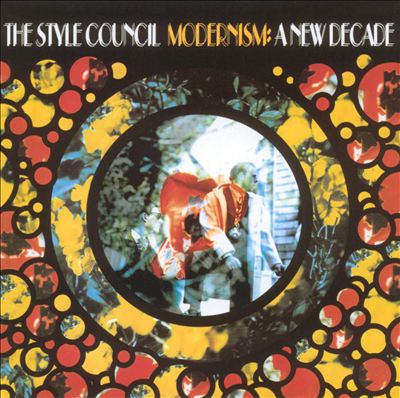
In 1989, the Style Council was coming to an end. The law of diminishing returns coupled with a changing musical climate saw to it that only Weller’s most enthusiastic fans were still with him. The pop charts may have been filled mainly with total rubbish (Jive Bunny, New Kids On The Block, Jason Donovan) but the underground was bubbling up nicely. Happy Mondays and Stone Roses were a Joe Bloggs flare flap away from ubiquity. Effect-heavy guitar bands were filling a post-Smiths void. Acid house and electronic dance music was soundtracking sweatboxes and switched-on clubs, yet still to be sanitised for the mainstream.

Weller, ever willing to embrace the new and the now, and with a perma-finger totally on the pulse of the zeitgeist, was heavily into Chicago house music. He’d heard and loved Joe Smooth’s Promised Land and recorded a faithful reworking of it before even Joe Smooth’s original had a UK release date (eventually releasing it on the same day). A song of unity and hope, it’s no different in sentiment to, say, Walls Come Tumbling Down, but whereas that was a Hammond heavy gatecrashing crie de guerre, Promised Land rode the crest of an E-kissed rolling and tumbling 808 wave. Blind loyalty pushed it to number 27 in the charts, but beyond that it failed to grasp the imagination. Hindsight of course has shown it to be a terrific mark in time.

Style CouncilPromised Land

It was almost inevitable that when the Style Council presented Modernism: A New Decade to Polydor, the label would baulk at its hit-free content. There was no angry and spitting politico Weller, no Euro-continental jazz to soften the edges, none of the classic songwriting they’d come to expect from their talented young charge (Weller being just 30 at this point). Modernism: A New Decade was a pure house album, filtered through English notions and sensibilities, but a pure house album all the same. It favoured programmed rhythms and sequenced electro basslines over, y’know, actual bass and drums. It flung the guitars away and replaced them with weaving and shimmering synth lines. It was long and meandering with chants and shouts in place of a more traditional approach. Toundly rejected by Polydor, it would remain in the vaults for 20 years, only seeing the light of day when the all-encompassing, warts ‘n all Style Council Box Set was released at the end of the millennium.

And yet…

Modernism: A New Decade has its moments. Hindsight will show that its creator was frustratingly ahead of his time, that eventually Joe Public could and would groove to machine-driven, guitar-free music. Hindsight will show too that he really meant it, maaan. Just as he’d tackled the spiky Funeral Pyre with bile and aggression beforehand, and just as he’d go on to knock seven shades of shit from his guitar on Peacock Suit, Weller approached Modernism with nothing less than 100% of his cock-sure conviction.

Love Of The World‘s morse code intro and gospelish diva on backing duties…Sure Is Sure with its Italo house piano and Rotary Connection stacked vocals…a nascent That Spiritual Feeling, a track Weller would re-record as a solo artist – and a track that still finds a place in his live set to this day, usually as a refrain to the whacked-out and slightly psychedelic version of Into Tomorrow that normally closes his set, the proof – if it were needed – that its writer holds the material in high regard and that we, the listener, just need more time to appreciate it all.

The World Must Come Together is the perfect example.

Style CouncilThe World Must Come Together 

Its message of unity and hope could’ve been written specifically for the times we currently live in, and Weller’s high and soulful vocal goes a long way to conveying its idea. Channelling his inner Marvin Gaye, he chants the title in the chorus, slipping into falsetto in the verses. Synthesised strings sweep across its clattering and steam-powered rhythm. Electro hand claps punctuate the end of lines. Sampled spoken word pops up in the gaps. A jangling Roy Ayers-ish vibraphone provides the break, but we’re soon back to the titular refrain, a parping, recurring hookline coming and going as the textured cadence of the beat rolls ever forward. It’s a bit of a slow burner, but I’d suggest that, if this were to appear as a new track on a Weller solo album next week, it would be roundly applauded.


Hard-to-find

Si. Oui. Ja. Yes!

It’s bombastic, booming and utterly brilliant. The Beethoven’s 5th of that awfully-named Britpop era.

It’s the drums.! Fucking great echoing and cavernous drums, like Hal Blaine on Hulk-sized steroids, forearms like Popeye as he nails the four to the floor. Tambourines ride the hi-hats, percussive and metallic, clattering toms tumble like the walls of Jericho. Biblical, as a bow-legged frontman of the times was wont to proclaim.

It’s the strings! The total antithesis of the era’s coke-flecked guitar bands’ syrupy and de-rigueur, bolted on after-thoughts, these are fucking great strings, soaring and sweeping and swooning their way through the summer of ‘95 with graceful elan, the way they might’ve done 30 years previously had The Beatles been commissioned to write a smash hit for Dusty Springfield;

Oh, the guitars! It’s the great guitars, the fucking great guitars, electrified and fried, feedbacking and freewheeling, searing and tearing and twanging and chugging their holy and wholly amplified way from uproarious beginning to spent out end. Six nickel-wound and steel strings never sounded so alive and so essential before now.

It’s the incidentals; the way the guitar slips through the gears, taking those gliding vocals with it, the pause mid-way through when the guitar player plays some hammer ons around open chords (just the way he did in his previous band) before the expectant and fantastic lift-off as the vocalist breaks free and tears off out into the great wide open, hand claps and drum beats and gospel soul backing doing their best to hold on to his coat tails. What a fucking arrangement!

Oh yeah. The vocals. It’s all about the vocals. Great octave-leaping things of joy that neither you nor I, regardless of how often we’ve opened our hopeless holes and sung along, will ever be able to get close too. They start down here, somewhere around the diaphragm, and end up waaaay out there, somewhere north of the moon, beyond God and all the greats who’ve gone before. Fucking stratospheric and then some.

What. A. Fucking. Record.

It’s Yes, by McAlmont & Butler, if you haven’t worked it out already.

I noticed that, from Bernard Butler’s Instagram feed, Yes had somehow turned 30 this weekend.

I had a conviction from the moment of conception in the summer of 1994…make a piece of music that transcends…it had to make you feel the exhilaration of how sound and song can transform your experience of being a human.

It is totally ramshackle, noisy and out of tune (is it!?!) and that is how we all are flying through the universe…

I can visualise me and Mako (drums) in the cellar of Mike Hedges chateau, screaming at each other, David across the ballroom straining for every ridiculous key change without a concern.

We were all on fire and that’s what you hear.”

They could do it pretty spectacularly in the live setting too:

There’s a part in John Niven’s viciously brilliant Kill Your Friends when two A&R guys are shamelessly scouring the small print in the charts in Music Week to find the ideal hit-making producer required for one of their new signings.

Mike Hedges…his mixes are just too middle-y. Not enough top or bottom end.”

Stelfox, the main protagonist, rolls his eyes in exasperation at the cluelessness of his A&R partner. It’s not informed knowledge that’s important in the A&R game, it’s having a view. Everyone must have a view, thinks Stelfox, even if your view is of no consequence at all.

Exhibit One: Mike Hedges manned the mixing desk when McAlmont & Butler recorded Yes, capturing forever the sound of pure magic via his fingertips and faders. (see above)

Exhibit Two: Mike Hedges would use his own blueprint within the year when helping the Manic Street Preachers construct A Design For Life, another of the decade’s stand-out tracks. (a future post for sure)

A record that’s both out of its time and forever timeless, Yes is an undeniable classic in anyone’s language.

Hard-to-find, Kraut-y

Ill-Thought-Out

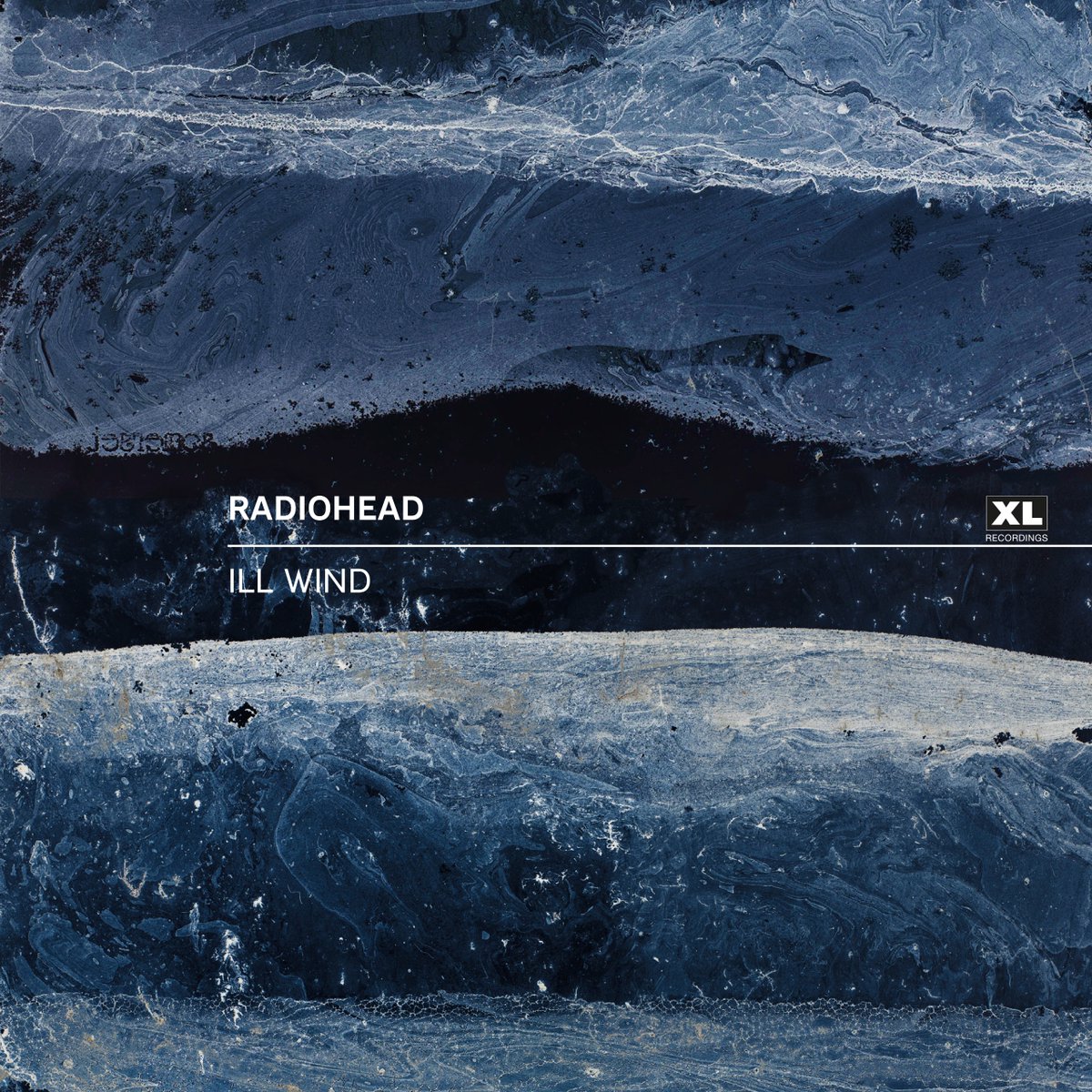
Ill Wind by Radiohead is, to use the parlance of the day, a particularly deep cut. Recorded during the sessions for what would make up the last Radiohead LP, A Moon Shaped Pool, it was ultimately shelved and saw the light only as a fleece-the-fans cash-grab bonus track on the album’s deluxe edition.

RadioheadIll Wind

It’s a pity that, out with a fervent fan base, Ill Wind isn’t wider known. Being a late-era Radiohead track, it bounces along on the jazziest Fender Rhodes ‘n Fender Tele groove this side of the Krautrock-heavy ’70s and has, in its rolling and tumbling paradiddles, a particularly spectacular and free-form drum pattern. Eerie Star Trek-y keys (or is it Ed on ambient space guitar?) and sequenced bleeps begin to to lift the whole thing skywards, Jonny’s tapestry of vintage synths fizzing to a crescendo midway through before eventually falling by the wayside as Thom’s super-falsetto maunders its way back to the fore. The Radiohead rhythm section is doing all the heavy lifting here, wee Colin wrestling with his bass and gnarling his way up and down those wide and woody frets, Phil’s drums ka-bamming and ker-planting like a stone skillfully skiffing across still waters. Great stuff.

In a statement of equity and uniformity, the tracks on A Moon Shaped Pool were, as I’m sure you know, sequenced alphabetically. Ill Wind could’ve easily slotted its way on there between the glitchy Identikit and the unspooling The Numbers without upsetting the balance or flow of an album which has, over time, slowly grown to be a far more substantive record than these ears perhaps first gave it credit for. Time for reappraisal, I think.

As if proof were needed that the Radiohead vaults harbour many of the band’s greatest tracks, here’s another session track that only saw the light of day as a, yes!, fleece-the-fans cash-grab bonus track on the album’s deluxe edition.

RadioheadIf You Say The Word

If You Say The Word was recorded in the sessions that brought the two-album wham-bam of Kid A and Amnesiac to unsuspecting masses but only appeared on 2021’s Kid A Mnesia set. Hindsight has been kinder to these albums than many of the critics at the time, but back then both records left many fans high and, er, dry at the unexpected embracing of jazz and electronica and uneasy listening effect of it all. I know this to be true as I was a foot soldier on the counter of Our Price at the time and Kid A especially saw record returns – no pun intended (it was all CD sales back then) from quizzical fans looking for yr more anthemic guitar anthem version of the ‘Head. By the time of Amnesiac, Radiohead’s audience had shrunk to the hardcore and the more open-minded of folks and those people were, of course, rewarded with some fairly spectacular music; challenging at times, hard to wrap your head around at first, but interesting in a soundscapey and proggy way and with great tunes that eventually showed themselves after a few listens. Pay yr dues as a listener and you’ll be rewarded ten-fold. Today’s instant world of skip, delete, next… would find this era of Radiohead a real challenge were it to be newly released in 2025.

I don’t know if If You Say The Word would’ve been more appealing or not to those who never bought into Kid A, but it shows itself to be a fantastic piece of Radiohead mood music. Lush, melancholic, ambient and jazzy (there’s the ‘j’ word again) it slowly envelopes itself around the lugs, worming its way in there after a few plays like all the best tracks do. And it’s a track, not a song in the traditional sense. Thom Yorke’s voice, coated in reverb and echo and sounding like it’s being sung from high and right down a wind tunnel, is an instrument here in the same way that the percussion and the strings and the ambient electronica are constituent instrumental parts of the track; understated in the verses, soaring and stretching in the chorus, wandering free and taking you to new places.

There’s a Radiohead immersion coming my way. Can’t stop it. Wouldn’t want to anyway.

Gone but not forgotten, Hard-to-find

John, Paul, George and Ringwear

The impressively-named Rutherford Chang died a couple of weeks ago.

Who? you say.

What!? I retort. D’you mean you never followed him on Instagram

It’s a fascinating story…

The son of a Palo Alto tech bigwig, Rutherford’s comfortable lifestyle allowed him to forego a normal working routine, instead affording him the time and resources to indulge in high conceptual art; taking the front page of the New York Times and, with all the news that’s fit to print, rearranging every piece of text into alphabetical order; cutting and pasting all of Asian actor Andy Lau’s numerous and varied death scenes into one near-half hour video compilation of death after death after death; editing a George W. Bush State of the Nation speech by removing all of the President’s words and leaving only Bush’s pauses, coughs, breaths, rustles and the crowd reactions in place. Crazy and interesting stuff like this.

A chance teenage purchase of a second-hand Beatles’ White Album in the late ’90s would lead him to his defining concept, one which would bring his name to a wider audience and one which would allow him to fully indulge his need for order, ranking and system within his particularly niche world.

(When I get to the bottom I go back to the top of the slide.)

A while after buying that Beatles album, and noticing that a second copy of the same record in another shop had aged differently, Chang had the masterstroke of all conceptual ideas. He bought that second copy of the White Album and right there and then began to obsessively gather as many copies of the record as he could.  He advertised locally. He trawled record shops. Or stores, as he’d no doubt call them. He pored over Craig’s List. He sought out garage sales. And gradually, he amassed an impressive array of White Albums and only White Albums.

(Where I stop and I turn and I go for a ride.)

Battered, bruised, bashed, beat up, the more so the better. Those copies had more life in them, more unknown stories to tell. Chang was interested in how something that began life so white and pure – and mass produced – could end up discoloured, written on, stained and unique. The journey each record and it’s sleeve had taken was just as important to Chang as the music that filled their grooves.

(Till I get to the bottom)

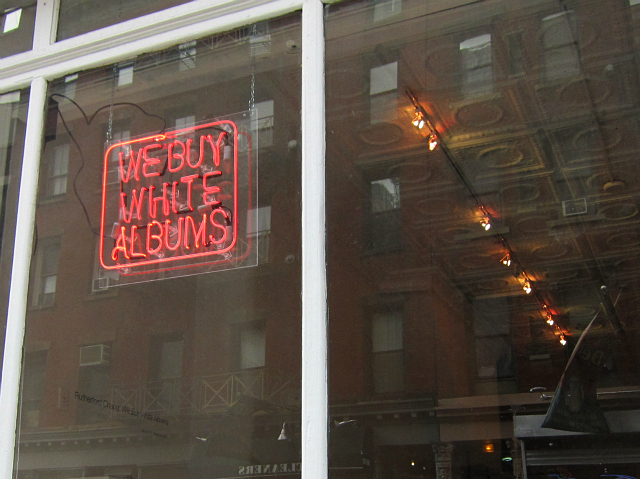
There are three million of them out there,” he said cheerfully in 2013, by which time he owned nearly 700 copies of the album. He played them all too. He set up a gallery space in New York’s Soho, recreated the feel of a classic record shop, stuck a ‘We Buy White Albums’ neon sign in the window and, when he wasn’t bartering with potential sellers, allowed gallery visitors to browse his ‘racks’, select a copy and stick it on the in-house turntable.

It was clear that, as they spun, some of his acquired copies were beautifully pristine. Some sounded like bacon and eggs frying down a well. Some jumped. Some stuck. Some were stereo copies. Some were mono. But all were versions of the same record.

(and I see you again

and again

and again

and again

and again

and again)

By 2014 – a year later, Chang had collected over 1000 copies, buying on average one copy a day since 2013. And, like the most diligent of museum collection curators, he meticulously catalogued them all. Where he’d bought it, how much he’d paid for it, what the stamped number on the front was, was it a mono or a stereo, a first press from the UK or a third press from the US, a seventeenth press from the Phillipines? And once catalogued, the records were displayed in his gallery. Dividers were slotted into bins, arranging the records by serial number or origin or year. Just like a real record shop, only different; this collection was a record of White Albums and the stories they held. Wouldn’t you just love a browse through them all?

He had a rule – hard to believe in 2025 – that no copy should cost him more than $20, but I’m not sure how steadfastly he managed to stick to that rule. He had some pretty low-numbered and interesting copies in there and, regardless of the state of any of them, I’ve sure never been lucky enough to upturn a copy of the record – mono, please, a toploader…with all the inserts, thanks – at anything under three figures. The one I found by chance in a box of records in New York’s Chelsea Market flea sale was a snip at a cool $599 and it looked like it had been well-loved, to be kind to it.

Even my bog standard ’80s reissue (yeah, it has the poster and the four portraits, as well as two slabs of well-looked after stereo vinyl) would fetch £40 on the current second-hand market. Not that Chang would’ve been too keen on securing mine. I appreciate he was all for securing copies that had seen a bit of life but, as long-term readers here may know, I drunkenly relieved myself on my prized copy on the night of my 18th birthday. Some of Rutherford’s copies had coffee stains. Some had food stains. Light brown pish stains though, the colour of an earthy Farrow And Ball paint chart? And this is none of your Greenwich Village hippy stoner pish either, I’m talking primo McEwan’s Lager pish stains from the west of Scotland. I bet Chang never had a copy quite like that. Bog standard, by the way. Pun intended.

What Rutherford did have was plentiful and interesting enough that his collection would travel to Liverpool to be shown in the city’s FACT art gallery. There, visitors could browse what was undeniably the largest collection White Albums in the world. Sleeves with scribbled names. Sleeves with love letters falling out of them. Sleeves with break-up letters inside them. Soft drugs, soft porn, money… sleeves teeming with the minutae of life. Sleeves teeming with the minutae of life, safeguarding one of music’s most important artistic statements. High concept art.

To accompany his travelling exhibition, Chang took 100 copies from his racks and did two things.

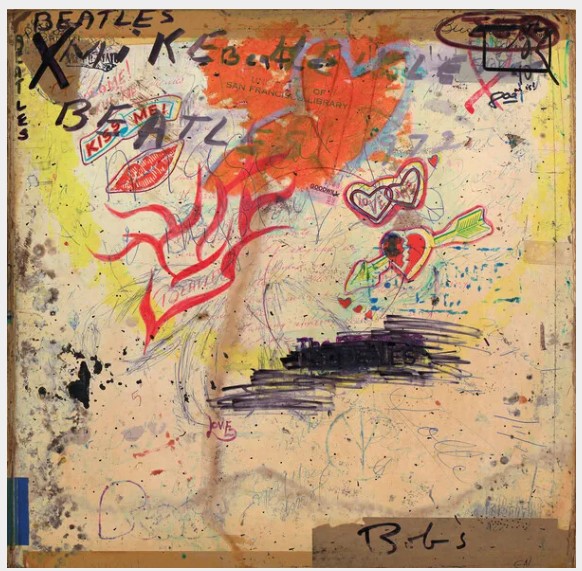
Using trick photography, he superimposed all of the 100 sleeves on top of one another to create a master sleeve that was anything but pure white. In its own way it’s a unique work of art.

He then took those same 100 records and built a wall of sound of the 100 records playing simultaneously. Due to a number of contributory factors; where the needle dropped, the minute variations in belt drive speed of the turntables, the gaps between the tracks themselves (micro seconds of a difference, if at all, but multiply that by 100…), Chang unwittingly produced? built? a proper slice of arty, woozy psychedelia that the Beatles themselves, and indeed, Yoko Ono, would’ve been proud of.

The delay-lay-layed way in which Dear Dear Prudence fades in on Back In The USSR‘s roaring jetstream…Glass Onion‘s sandpaper rumble and oh yeah-yeah-yeah- oh yeah-yeah-yeahs…, Ob-La-Di, Ob-La-Da‘s jittery and jangly piano intro (la la la la life goes on…and on…and on…) …the compressed mayhem of While My Guitar Gently Weeps-eeps-eeps…that bleeds into Warm Gun…Warm Gun Warm Gun…Yeah…Yeah…Yeah…Yeah… It makes for an interesting, occasionally unsettling (and possibly just once in a lifetime) listen. I wonder what Charles Manson would’ve made of it all.

At the time of his death two weeks ago, Rutherford Chang had amassed almost three and a half thousand White Albums. He was only 45 and had many more years of collecting ahead of him. I wonder what happens to the records now? Does someone take the project on? Do the people who sold them to Chang in the first instance get offered a chance to buy their copy back for the $20 they were paid? Rutherford’s detailed records will, after all, have all the necessary contact info. Or, does someone sell them all and rake in a whole load of money? I’m keeping a keen eye on things from over here.


demo, Gone but not forgotten, Hard-to-find

You’re Breaking My Heart

When Elliott Smith was making records, his output shot off in a rapid and upward curve of brilliance. From lo-fi scratchy beginnings to Beatles-great, full bhoona productions, his six albums in five years dazzle with deft fingerpicking and unusual chords, unravelling melodies and unwavering lyricism, every one of his great, great songs double-tracked and knee deep in melancholy and, often, total and utter sadness. And sad music is, as you know already, the best kind of music.

The posthumous world of Elliott Smith though? Bar a couple of noise-for-noise’s-sake thrashers and half-arsed unfinished sketches, it’s a proper treasure chest of rarely-heard/never intended to be heard nuggets. Often these are the equal of, and sometimes even better than, the songs released during Elliott’s lifetime.

The couple of official post-death releases in his discography have uncovered some real gems; New Moon‘s Looking Over My Shoulder and Whatever (Folk Song In ‘C’) are the picks in a ragbag full of alt versions and unreleased session tracks from across his earlier years. From A Basement On A Hill collates material from his later era major label recordings; better recorded, better produced, often overdubbed with multiple guitars, a rhythm section and, as has been said already, Beatles-level vocal arrangements. Twilight. Let’s Get Lost. A Fond Farewell. Look them up…but wallow first in the depths of Pretty (Ugly Before). It’s a real beauty.

Elliott SmithPretty (Ugly Before)

It begins with a wobbly keyboard droning the song’s melody behind a chiming, inverted Gmaj7 chord, it’s openness hinting at widescreen Elliott rather than introverted Elliott…

Sunshine. Keeping me up for days, sings Elliott in that breathy, gossamer-light voice of his.

Ah shite,” you realise. “Elliott is back on the heroin. This can’t end well.” Yep. References to getting high, destruction, no nighttime – only a passing phase, confirm what you think.

The song unfolds with a gentle drum roll into a piano-backed mid-paced ballad, all chugging electrics and deft bass runs, unexpected chord changes and piano trills. By the end of the second chorus, Elliott has found the key to unlocking the track’s true potential. There’s a minor chord, a tightly jangling and country twangin’ 12 string that mimics his vocal melody (how very George), some politely slashing chords, a splash of cymbals and, on the turn of a 7th chord, the resolve. In the angle of Elliott’s exquisite jangle we have lift-off. When his singing returns, he’s double-tracked (how very John) and harmonising with himself, stretching out some very John and Paul backing vocals – ‘Ug-lee-bee-fore‘ – until the song fades its way into the sunset on a squiggle of backwards tape and wonky noise. How very brilliant. And how very Beatles. Such a great tune for a ballad about being a helpless junkie.

There is, far deeper down the Elliott rabbit hole, a bootleg album called From A White Basement On The Hill (Beatleish nod ahoy!) A reimagined fan-compiled album, its setlist is culled from poring over interviews with Elliott, discussions on fan forums, interactions with Elliott’s closest musical collaborators… a real and honest labour of love by all concerned. Dancing On The Highway. Memory Lane. Strung Out Again. Look them up…but wallow first in the depths of Cecilia-Amanda. Like Pretty (Ugly Before) above, it too is a real beauty.

Elliott SmithCecilia-Amanda

It’s another drug song, inevitably, with a heart-breaking pay-off in the final verse.

Elliott plays a great liquid mercury acoustic guitar riff at the start – grab a cheapish guitar, tune down half a step and replicate it if you can – the snare rat-a-tats the group into action and from outta nowhere comes the greatest lurching and woozy keyboard motif this side of the seventies. Unexpected and totally hooky, it sounds like drugs. The wrong kinda drugs though.

Black and blue from passing around…I don’t want to see you like you got before…dancing on a permanent scratch…. Elliott, man . Why d’you have to get involved with all of that? What a waste.

Elliott eases into the bridge, his voice reaches for the high notes, his snare drummer rattling him along. Big bassy piano notes anchor it all together before Elliott brings forth that great acoustic riff (and that woozy, lysergic keyboard) and he leads us into the final verse’s heartbreaking line;

You got a little baby, I don’t want to see you round here no more.”

Elliott’s mastery of his voice and his instrument, his arrangement and his ear for a tune are never more apparent than on songs like the two featured above. If you’re new to Elliott, start somewhere in the middle – Either/Or was the album where he became less lo-fi and more produced, XO the album after was his major label debut and a spectacular one at that. There’s a lifetime of great songs just a-waitin’ to be discovered.

Hard-to-find

True. And Gold.

Fly on the wall telly is nothing new, but the brilliance of those Beatles documentaries of recent years has had any old half-baked documentarian with an eye on the prize rooting around behind the sofa for forgotten scraps of footage from yesteryear. Currently on the iPlayer is a near four decades-old film of the day Band Aid‘s Feed the World was recorded. Why it’s never been seen in its entirety until now is anyone’s guess, but it’s good that it’s out there. Why? Because forty years later it makes for really great telly.

Feed the world, let them know it’s Christmas time.’ These days you can virtue signal the song’s lyric and you’ll not find too many folk in a 70% non-Christian world disagreeing. Bono’s big ‘tonight thank God it’s them instead of you‘ line always sounded wrong, even to my slowly awakening 15 year old ears. The sentiment of the song was honest and well-meant though, even if a quick root around online turns up all manner of suggestion that the majority of the money made from the record and the following summer’s big gig never quite made it to the intended recipients. No one knew that though when Midge ‘n Bob – very much a tag team, even if the legend has marginalised wee Midge whilst elevating Saintly Bob’s role in it all – were sitting in a tiny home studio welding Geldof’s sombre verses to Ure’s hooky chorus.

The documentary begins with the pair of them sketching out the demo, Midge’s guide vocal a necessary placeholder in absence of the stars who’d come to adorn it. They’re not long in turning up. Simon and John from Duran Duran (and their bouffants) bounce out of a surrounded car, each sporting three outrageous haircuts in one, Le Bon’s suit jacket sleeves rolled up to Don Johnson levels of rad, Taylor casually chic in a Duran Duran chunky knit tour sweater. Somewhere in the background are the three other Duranies, but being less good looking or important, they’re shoved straight out of the road of the camera lens, never to reappear until the big group shot at the end.

Tony Hadley arrives, blown in on a waft of silk blouse and pure self belief. There’s a squeal and a scream from the waiting fans – nowadays, social media would see to it that several thousand screamers would turn up and block the street – as Hadley and his pirate-legged leather trousers sprint to the safety of Sarm Studios.

A bored Bananarama spill out of their taxi, a heart-stopping riot of fags and frowns and misshapen, hole-ridden jumpers, straight outta bed (or up off a friend’s couch), the three of them each sporting a different third of John Taylor’s ozone-threatening do. Paul Weller with his slick back Euro mod hair style walks unselfconsciously to the studio. He’s caught on camera, stylishly as ever, in selvedge denim, ankle length Crombie…and a walking cane. They weren’t called (snigger) the Style Council for nuffin’.

Midge and a permanently flat cap-sporting engineer commandeer the desk, Bob chips in with unhelpful suggestions and the whole thing slowly comes to life. Hadley is one of the first up, his nostrils flaring, his eyebrows dipping, his eyes squeezed shut with one hand to the can on his ear to reinforce his emotive and real soul credentials. He cannae sing for toffee. This is both True and Gold, as, naked and on tape, his flaws and flat voice are laid bare for all. ‘Let’s maybe try the chorus now, Tony‘ sighs Midge in exasperation. It’s looking like a long day ahead.

Wee Bono and his hat appear, but not the kidney-infected Edge, and we have our first unlikely quartet gathered around a microphone. The U2 man, seven months shy of total ubiquity, stands aside a proper singer in Paul Young, hapless Hadley the seven foot haddie, and George Michael. Done up in full Lady Di blow dry and silently miffed that he’s recording the song that will deprive Wham their coveted Christmas number one, George is nonetheless just about the humblest in the room. There’s no ego there at all. He runs through the lines a couple of times and listens as Headmaster Geldof offers his advice.

Make it quite an emotional thing, George. Really emphasise the fact that there’s no snow – NO SNOW! – in Africa. NO SNOW! That’s the most important line, George.” George looks on, emotionless. Midge slides a fader. They go again.

I’m struggling to sing this part powerfully, Midge,” admits George at one point. “If you wouldn’t mind changing the musical notation slightly, I can start up here (raises flat hand) rather than down here (lowers palm).”

Sure, go for it, George,” encourages Midge, and both his and Geldof’s eyes light up when, first time, George nails the song’s bridge. “But say a prayer…and pray for the other ones...” It’s instantly recognisable as the take used in the final version, a great moment captured on film as it’s being born.

That other great George, the Boy, turns up fashionably late but put him in front of the microphone and he’s as terrific and dazzling as his self-fashioned make-up. “Just turn it up in the headphones and I’ll sing it,” he demands, exasperated at a faffing Midge at the desk…and turns in an astonishing vocal that’s soulful, gritty and note-perfect. He plucks that famous ‘woah-oh oh!’ ad-lib straight outta the pop star-heavy air and vanishes to hang at the back with Marilyn.

You’re coming in too early, Tony,” interrupts Midge from the control room, “And you’re marginally late, Sting.” The Police man gives the opinionated Bob a cold, deathly stare as the production team focus their attention on Phil Collins’ drum part. He nails it in one, sweat lashing from under his Fair Isle tank top as his steady, tribal beat rolls on. Sting stares at Geldof, coldly. Calculating.

Hadley? He shuffles uncomfortably in his blouse and leather pantaloons and slopes off to ponder a new career in pirate-themed pantomime.

Elsewhere, Status Quo and their unintentional Spinal Tapisms try and fail to add any vocals of note to the song. Maybe it’s the lack of the Quo boogie in the backing track, maybe it’s because they’re surrounded by the great and the good of the day, maybe it’s simply because they’ve clearly got half the GDP of Columbia stuffed up their beaks, but Rick ‘n Francis are rotten singers.

Listen closely to the record the next time you happen to hear it. Just in the background, around one and a half minutes, there’s a slow and steady leathery crrrrreaaaakkk. It’s underneath one of those clanging chimes of doom lines, not obvious at first, but it’s there. It’s not, would you believe, the Quo duo. It’s Hadley, doubling back on his intended early exit, the leather trousers creaking at the sudden turn of events as Mr Spandau realises he’s no longer the worst thing about the record. Both True, and Gold, as they say.

It’s around this point in the film when you start thinking, ‘where are all the women?‘ Even Glenn Gregory is in on the action, visibly wondering how the fuck it was he got here as he gets down to microphone business alongside Bono, Paul Young and fabulous George Michael.

It’s a men’s club, this Band Aid thing. Male producer, male writers, male movers and shakers, male voice choirs, a bossy and opinionated Trevor Horn. And Tony Hadley. Bananarama haven’t been seen since they arrived, not required apparently, until the grand finale. The ladies are everywhere though. Look beyond the mixing desk. Between the cameras. Behind Geldof’s ego and there they are. Being the ’80s, they’re in the background; Mrs Sting, Paula Yates, Mrs Trevor Horn, holding the babies, running after the children, doing what women did back then. Leave it to the lads, girls, thanks very much.

You should make it your business to watch this documentary as soon as possible. Despite the presence of Sting. And Bono. And Hadley. There’s no need to be afraid. You’ll love it.

Get This!, Hard-to-find

D Lux

You’ll love this. You might be familiar with it already, but I’d be surprised. It’s not new, it’s not that old either, and the chances are that if you missed it when it first peeked out from behind 2021’s curtain of noise (100,000 Spotify uploads a day and rising) then it’ll have completely passed you by.

It’s called Duty Of Care by the impressively posh-sounding David Luximon-Herbert. Dropping the second half of his double barrelled surname has done little to shoot David’s name into the collective conscience of the music listening public…and that’s a real pity.

Crashing waves cede to crashing chords. Orchestral strings fight for ear space with cacophonous timpani. An earwormy woo-oo-ooh vocal centres the attention, fuzz guitar climbs the frets…then the drop out. The vocal comes in. Something about arrival and survival. More woo-oo-oohs and then a lovely spoken word section, Luximon’s properly Scottish burr well to the fore. “It’s not a manifesto or a benediction,” he goes, and, in a wave of bah-bah-bahs, the guitar takes us skywards again. The track rises and falls for five spellbinding, world-stopping minutes and you find yourself diving back in, time and time again, to bathe in its golden magic.

Luximon clearly put this all together with meticulous care, the way you or I might if we’ve a head full of radical ideas and been offered only one recording session in our entire lives in which to capture it. Duty Of Care is lush, full and perfectly realised, in the same way McAlmont & Butler’s Yes and Pet Shop Boys/Dusty Springfield’s What Have I Done To Deserve This? are lush, full and perfectly realised.

It’s no fluke.

Duty Of Care‘s parent album ebbs and flows beautifully, a wholly (holy) realised amalgam of fantastic orchestration melded to stinging electric guitars, rippling jazz piano and terrifically skittering and booming Axelrod-ish drums. Shimmering Hammond gives way to proggy synths, which drop out to allow slide guitar solos to wheeze themselves out into the thin air. Tremelo-heavy tracks weave their way into one another, no beginnings and no endings. Was that some bird song appearing in the gap there? Burbling water between the finger scrapes on acoustic strings? It’s so all that, this record.

The album in full is stunning. Part Virgin Prunes, part pastoral folk, totally immersive, Duty Of Care‘s tracklist reads like the titles of projected Coen Brothers’ films still to be made; Nothing Ever Good Happened Down By The River, The Town That Dreaded Sundown, Datsun Cherry. It’s super-produced by Olly Betts, long-time drummer in melodic noise-smiths The Duke Spirit and requires a proper listening session. No telly on in the background. No inane social media scrolling. No household chores while it spins. Just you, an armchair and a receptive pair of ears. Play it once and you’ll find yourself returning to it daily until you’re familiar with every nook and cranny of its perfectly nuanced sound. I think you’ll like it. A lot.

Listening to Luximon may well have you reassessing the boundaries of what good music actually is. This is great – like What’s Going On and Pet Sounds levels of great. How many other artists amongst those 100,000 other noise makers are making music as considered and vital as this? We’ll never know.

David Luximon‘s Duty Of Care is easily one of the finest records to grace the Last Night From Glasgow imprint. You can buy it here.

Bonus Track

There’s also a pretty great Max Harris Project/Ashley Lockdown remix of Care Of Duty out there. Track 2 above, it features added helicopter noises, stripped back Orb-y ambience and, quite possibly, the quiet sound of Richard Ashcroft weeping at where it all went wrong. Ol’ twiggy Ricky, he of the Axelrod pretensions and delusions of grandeur, would quite gladly forego his comfy Oasis support slots for an ounce of Luximon’s skill and gravitas. A bittersweet symphony indeed.

The remix was released as a ‘pay-what-you-want’ single, all proceeds going to Age UK/Age Scotland during the Covid crisis. Remember that?