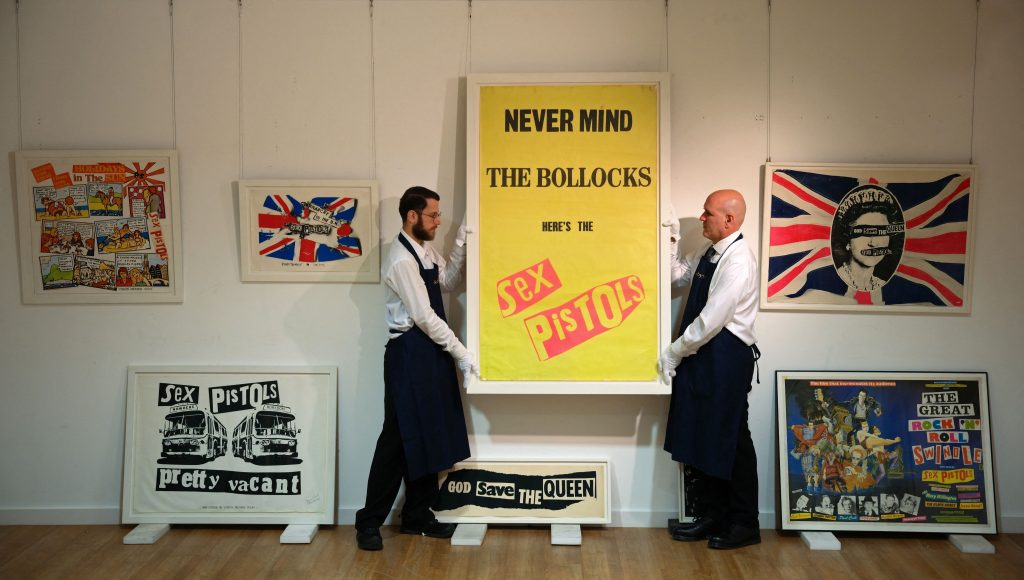
Gone but not forgotten

pUNk’s DeAd

You can hear sound in pictures, can’t you? The slick, spitting whoosh of a car’s tyres on a wet road, the rush of wind in the ears as a hawk circles the sky. I can hear sound and music when I look at art. A far-off accordion on a Parisian arrondissement when I look at Van Gogh’s Starry Night. The gentle chirping, breezy sound of the Italian countryside in the background of the Mona Lisa. Low level muttered chatter, barely audible, when studying Hopper’s Nighthawks. Even if the current Banksy exhibition in Glasgow wasn’t soundtracked by background beats, I’d expect to hear fragmented hip hop, cut-up DJ Shadow-type rhythms as I observed Banksy’s highly intelligent mish-mash of politically-charged street art.

Jamie Reid’s art that went hand in hand with punk screams loudly at you. Ransom notes cut out from newspapers, laid off line with no regard for placement of capital letters was the perfect encapsulation of a scene at odds with the conventions of society. The ultimate statement – sticking a safety pin through the top lip of the Queen during Jubilee year – was perhaps his – and punk’s – defining moment.

If you’ve never heard a Sex Pistols’ record, I can imagine that Jamie Reid’s art tells you all you need to know about the noise that’ll fly off the grooves. Loud, in your face, unconventional, provocative, new, exciting…all these things relate to both the Pistols’ output and the artwork that it came wrapped in.

Sex PistolsGod Save The Queen

Other artists and labels have formed perfect marriages of visual to audio – the Factory Records catalogue, that run of unmatchable Smiths singles, Vaughan Oliver’s metaphorical interpretations of Pixies’ unholy racket, but without Jamie Reid’s redefining of what sleeve art could be, these bands’ and labels’ releases might have looked very different. Other than Prog, which had Hypgnosis and Roger Dean creating grand, sweeping and highly stylised visions of far-off lands and fantastical creatures that mirrored the widescreen and grandiose ideas of the music within, much music up until punk came wrapped in company sleeves or bog-standard band photos. I’m not sure, pre punk, bands had such things as logos. No band since punk would be seen without one.

With Malcolm McLaren dead and, more recently, Vivienne Westwood, Jamie Reid’s death has seen the end of punk’s holy triumvirate, its trio of agitators and prrrovocateurs now gone forever. Their art, their style, their influence lives on. No future? I don’t think so.


Cover Versions, Dylanish, Gone but not forgotten, Live!

Everyone Wants A Pop Star But I Am A Protest Singer

I feel that having a No. 1 record derailed my career. It seems to me that being a pop star is almost like being in a type of prison. You have to be a good girl. The media was making me out to be crazy because I wasn’t acting like a pop star was supposed to act.

My tearing the photo put me back on the right track.”

I thought about not posting this. There’s been a flood of Sinéad O’Connor posts since the middle of last week, and the internet probably doesn’t need another one. But her sudden death had me scrambling back to Rememberings, her fascinating and brilliantly-written autobiography, and, by association, to some of her greatest music; the time-stopping Thank You For Hearing Me, the Thatcher-baiting Black Boys On Mopeds, the dubby majesty of her collaboration with Jah Wobble on Visions Of You. Social media threw up many others – deep cuts, as they say nowadays – that shone new light on under-appreciated songs sung by an under-appreciated artist. Morrissey, so often the bigmouth who strikes again, seemingly got it right with the statement he released the following day. I could have picked any of those tunes and pulled together a decent blog post, but the book had me scurrying around for unforgotten yet buried video footage that, coupled with Sinead’s written account of the events became the only thing worthy of my words.

As she notes in Rememberings, there were two Sinéad O’Connors. The almond-eyed suedehead who cried real-time tears in the video for her definitive version of Prince’s Nothing Compares 2 U and the one who came after that; the misunderstood protestor who fought a tough war against the wrongs of the world and was condemned to hell for it.

It’s 1992 and down near the Bowery, where New York’s Avenue A meets St Mark’s Place, O’Connor frequents a ‘juice bar’ and has befriended its Rasta owner. Over time they become close enough friends that the night before Sinéad will be filming for an appearance on Saturday Night Live, he confides in her that his life will end abruptly and soon. He’s been running guns and drugs, using school kids as mules and moved his young couriers into a rival’s patch. Sinéad is horrified. “The fucking treacherous bastard,” she seethes. She draws parallels with Pope John Paul II, a far more prominenent figurehead than her Rasta pal, but one who also appears to condone the abuse of children. She thinks back to Bob Geldof ripping the poster of John Travolta and Olivia Newton-John live on Top of the Pops when the Boomtown Rats finally topple their reign with Rat Trap, and how she has always intended carrying out the same act with her mother’s photo of the pope, a photo that’s hung in the family home since John Paul’s visit to Ireland in 1982.

“(The photo) represented lies and liars and abuse. The type of people who keep these things were devils like my mother. I never knew when or where I would destroy it, but destroy it I would when the right moment came.”

For her Saturday Night Live performance, she’s wearing a dress that once belonged to Sade. It hangs ladylike, “a dress for women to behave badly in.” She hasn’t told anyone, but she’s going to change the words to Bob Marley’s War, dropping some of the lines – taken from a United Nations speech given by Haile Selassie – and replacing them with some lines of her own.

It would be a declaration of war against child abuse. Because I’m pissed at Terry (her Rasta friend) for what he told me last night. I’m pissed he’s been using kids to run drugs. And I’m pissed he’s gonna be dead on Monday. I’m also pissed that I’ve been finding brief articles buried in the back pages of Irish newspapers about children being ravaged by priests but whose stories are not believed by the police or the bishops their parents report it to. So I’ve been thinking even more of destroying my mother’s photo of John Paul II.

And I decide tonight is the night. I bring the photo to the NBC studio and hide it in the dressing room. At the rehearsal, when I finish singing ‘War’, I hold up a photo of a Brazilian street kid who was killed by cops. I ask the cameraman to zoom in on the photo during the actual show. I don’t tell him what I have in mind for later on. Everyone’s happy. A dead child far away is no one’s problem.”

Maybe now you can appreciate what was firing through her mind in the run up to the show. Clever and calculated and willfully confrontational, this wasn’t a spontaneous act. This was years of built-up rage – rage at the Catholic church, at her own mother, at authority who ignored the cold truth – and she was using her status to highlight it.

I know if I do this there’ll be war. But I don’t care.”

Afterwards: “Total stunned silence in the audience. And when I walk backstage, literally not a human being is in sight. All doors have closed. Everyone has vanished. Including my own manager, who locks himself in his room for three days and unplugs his phone. Everyone wants a pop star, see? But I am a protest singer.”

Two weeks later, Sinéad is booked to appear at New York’s Madison Square Garden, just one singer in a dazzling array of stars who will be gathered to celebrate her hero Bob Dylan’s 30 years in music. This time, she’s wearing a dress that she hates (‘bouffant, shoulder pads, Dynasty…I look ridiculous and underweight.‘) Introduced by Kris Kristofferson, the crowd turns an ugly shade of redneck, booing her from the moment her name is announced.

I actually think it’s the outfit, because in my excitement at being part of the show, I’ve forgotten about the pope-photo incident on SNL.

Then the other half of the audience begins cheering to fight off the booers. And there ensues a noise the likes of which I have never heard and can’t describe other than to say it’s like a thunderclap that never ends. The loudest noise I’ve ever heard. Like a sonic riot, as if the sky is ripping apart. It makes me feel nauseous and almost bursts my eardrums. And for a minute or two I’m not sure the audience members aren’t going to actually riot. They’re clashing so badly already with their voices. How do I know what else might happen?

She’d planned to sing an arrangement of Dylan’s I Believe In You – a song that means the world to her and on more than one occasion, her band (assorted Booker T/MGs) attempts to strike up the opening notes and lead her into it, but the ferocity of the ugly crowd in front of her has forced Sinéad to stare them out defiantly instead, arms by her side, doe eyes blinking into the vast arena, a waif-like David against the ugly Goliath of the Garden masses.

I look at Booker T’s beautiful face. He’s mouthing the words ‘Sing the song’, but I don’t. I pace awhile onstage. I realise that if I start the song, I’m fucked, because the vocal is so whispered, both sides of the audience’s battle are going to drown me out. And I can’t afford not to be heard; the booers will take it as victory.

Kris Kristofferson arrives by her side. He’s been told to get her off the stage, but looking at the film of it, you wouldn’t know. “I don’t need a man to rescue me, thanks.” As he returns empty handed, Sinéad gets her instruction instead from God. With her voice wavering then settling into something strong and powerful, she yanks out her in-ear monitors and rages once again – “the biggest rage I can muster“- into an aggressive and impassioned version of War, emphasising her own fingerpointing lines about child abuse.

She leaves, only after the briefest of defiant, eyeballing glances at the audience, her sharp exit a metaphor for what would follow, Stateside at least. It’s an astonishing, powerful, uncomfortable event, captured forever on this outtake from the official film of the concert. Outtake? There was no way this was going on the official release.

Afterwards, her father (he’d been in the audience) suggests she rethink her career prospects as she’s just destroyed the one she has. And she feels let down by Dylan. It should have been him, not Kristofferson, she reasons, who came out and told the audience to let her sing. So she gives Bob the evil eye as he sits in the wings. Bob stares back, baffled and handsome. Sinéad calls it ‘the weirdest thirty seconds of my life.’ Quite the claim in a life packed with incidents and accidents, rage and regret.

Now go and read the book. It’s fantastic.

Sinéad O’Connor. A true one-off.

Cover Versions, demo, Gone but not forgotten

Moz ‘n Rockers

The Hand The Rocks The Cradle was the first track Morrissey and Marr composed together, not long after Johnny “with my hair like a loaf of French bread” knocked on Morrissey’s door and suggested they try and write some songs. What the legend doesn’t say is that Johnny was accompanied by a pal to keep him company on his walk across Stretford, but three’s a crowd in romantic stories, and so Johnny’s pal was quickly written out of the fairy tale.

Anyway.

Johnny presented Morrissey with a looping instrumental motif with shaky origins in Patti Smith’s Kimberly and the singer surprised the guitarist by producing a set of fully formed lyrics and mumbling quietly to himself while the mercurial Marr sketched out the basis of what would become one of the key tracks on The Smiths’ debut album, still a twinkle in its fathers’ eyes and a good 17 months from its February ’84 release. Those words of Morrissey’s had been written a couple of years previously, biding their time until fate intervened and a delighted Morrissey twisted his initial melody to fit Johnny’s guitar part – a move that would prove to be something of a feature throughout The Smiths.

The version of the track which closes the first side of that debut album sparkles with woven multilayers of spring rain guitar and overdubbed acoustics, the track chrome-polished, light and airy and at odds with the heaviness of the lyric. The version you really want to hear though is this early John Porter mix from October 1983.

The SmithsThe Hand The Rocks The Cradle (John Porter monitor mix, 1983)

It’s dense and atmospheric, Marr’s 12 string Rickenbacker rarely straying from the 5th fret, his arpeggiated A chord and ringing open-strings splashing occasional light on the otherwise gothic ambience. Andy Rourke, playing foil on the bass guitar, has the space to move the root notes through the chords with typical melodic aplomb, playing his trademark hiccupping half notes between the beat yet keeping the groove steady and in time to Mike Joyce’s heavily reverbed snare drum. It takes real discipline to keep this up for nearly five minutes and resist the urge to break out a solo or rest for a bar to change the dynamics. On this track, the three musicians are locked in and playing tightly for one another, an early signpost of how great The Smiths would become.

The first thing you notice about the John Porter version above though is, unlike 99% of The Smiths’ catalogue, not the usual dazzling array of guitars but the voice. Lone and mournful yet confidently soulful, it’s the sound of Morrissey coming out of his shell with a sympathetic producer on coaxing duties. He’s great here, is Morrissey. There’s no chorus, no melodic hook, no repeated refrain, yet he draws you in, has you zooming in on those words he carefully sculpted as a teenage bedroom hermit, the group almost (almost) not mattering for the moment. Heavy on poetic cadence and alliteration – ‘a piano plays in an empty room‘, ‘ceiling shadows shimmy by‘, ‘tease, torment, tantalize‘ – the song’s title was the initial working name for the debut LP, dropped possibly only after the song’s message of protective fatherhood and adult/child relationship was open to skewed accusations of paedophilia. All nonsense of course. Much has been said of Morrissey in recent times, but not even he is capable of such horrific ideas.

*Bonus Track

Sinead O’ConnorThe Hand The Rocks The Cradle (venue, date unknown)

As this piece went to (cough) press, the death of Sinead O’Connor began to filter through. In the aftermath of The Smiths, Rourke and Joyce provided Sinead with a rhythm section for a handful of shows, where they played a nice arrangement of The Hand The Rocks The Cradle in the encores, closing the show with Sinead’s favourite Smiths track. Typically, I can’t track down a version with Rourke and Joyce backing Sinead, but I did find this solo version, Sinead playing straightforward open chords to give the whole thing the feel of some ancient Irish folk song, something I imagine The Smiths, with strong familial roots in Ireland, would approve of.

Gone but not forgotten

Sweet Jane

If I’d been born 20 years earlier, or maybe 30…or maybe even 40, if I’d allowed the curling blue smoke of a couple of dozen pre-breakfast Gauloises to lick the nostrils of my beaky turtle nose and embed the fuggy scent into a greasy hair-do that had never met the acquaintance of a comb (yet still looked sensational), if I’d fallen out of bed and into last week’s roll neck and last year’s trousers (‘Underwear? We don’ need no underwear‘), if I’d swallowed daily the equivalent of the English Channel in brandy without spilling a drop on the upholstery of my imported Mini Cooper, if I’d been invited to scuff my Chelsea boots along red carpets and into art house cinema nouvelle vague premiers, if I’d been the genius auteur of psychedelically-tinged native language chansons that proved to be culturally significant to the land of my birth, I reckon there was a fair-to-strong chance that Jane Birkin would’ve gone out with me. I really do. She might even have agreed to join me for some heavy breathing and aural sex on a groovy record I’d been curating, the airy spaces between the woody, staccato bass, and lights-dimmed-low keyboard motifs just perfect for our ménage a deux. Alas, those bastard sliding doors of history proved unkind. Je t’aime, Jane Birkin, je t’aime. Auld bug-eyed, hooked-nosed, garlic-breathed Serge must’ve been tres charismatique, non?

Serge Gainsbourg feat Jane BirkinJe t’aime… Moi non plus


Gone but not forgotten, Live!

Gabba Gold

Wunchewfreefo’! I listened to my 38 year old copy of RamonesIt’s Alive today and it reminded me just how much of a force the live Ramones were. From the first wunchewfreefo’! onwards, they blast forth from the stage a tidal wave of lightning-quick chord changes and precision drum breaks and concrete slabs of bass, the strange and unique voice of Joey – kinda strangled in some parts, grizzled in others, Queens-heavy accent ever-present – riding the musical surf and hanging on to its leather-jacketed coattails for dear life. To face Ramones in full flight was akin to standing in front of the biggest, loudest hairdryer in existence and letting it blast you full on. It’s Alive captures this over four sides of loud-cut vinyl that should be required listening at least once a year.

Wunchewfreefo’! Recorded in London’s Rainbow Theatre as 1977 rolled into 1978 (with crowd noise flown in from the Glasgow Apollo show 12 days earlier) it captures the group at a very early peak. Still just a band and not yet a brand, It’s Alive gathers the songs – all of them, I think…every last one – from their opening trilogy of albums (Ramones, Leave Home, Rocket To Russia) and adds a handful of Ramonesified ’60s radio standards to take the set closer to the hour and a half mark they were expected to play.

Wunchewfreefo’! Punk’s strike quick before anyone notices attitude saw to it that Ramones would release their first three records in a heady 20 month spell between April ’76 and November ’77. That’s a strike rate of one album every 27 weeks…and every one a greatly influential record at that. By the time they were touring the UK in December ’77, Ramones knew those songs better than they knew the backstreets of the Bowery and had honed a live set that was loud and fast, breathless and relentless, yet as choreographed – in hair and costume as much as movement – as anything Legs ‘n Co might’ve put together for Top of the Pops.

Wunchewfreefo’! Johnny and Dee Dee step forward in the verse, right foot first. Step back in the chorus, left foot first. Crossover here. Head-down boogie there. And they never miss a beat or drop a note or fluff it up. Ah, they say, but that’s cos what they’re playing is easy. Simple. Dumb. Dumb songs with dumb chords and dumb delivery. Anyone can do that.

Wunchewfreefo’! No they can’t. It’s hard being dumb in music, trust me. If you’ve ever played in bands you’ll know what I mean. Even the worst of bands can’t sound dumb. There’s always one flash Harry in the group who wants to be heard that wee bit longer, that wee bit louder than the others. Spoiler alert: it’s usually the guitar player. Any guitarist knows their way round a couple of barre chords, but no guitarist is happy churning out barre chords on stage for half an hour. Even Bonehead felt the need to fling in a teeny tiny wee widdly bit somewhere, and he got nosebleeds whenever he ventured beyond the bottom three strings. Ramones were genius. Bass plays this part, guitar plays the same. The exact same. Disciplined and regimented, they come at you like a denim and leather tank. Brutal and unforgiving. For every song. It’s Alive is the perfect distillation of all that was great about them.

RamonesSurfin’ Bird

Weeeelll! Ev’rybudyzHurdAbatThaBurd’! I’m a total sucker for Ramones’ take on The Trashmen’s Surfin’ Bird. A bona fide garage band classic, Ramones take the bucket punk of the original and hotwire it with a blowtorch scorch, a pummelling A chord hammered relentlessly to the face of the listener with nary a change in the song’s first minute. Thunka-thunka-thunka-thunka-thunka-thunka-thunka-thunka. Ba-ba-bird, bird iz tha wurd, ba-ba-bird, bird iz tha wurd. Over and over and over and over. Until the breakdown.

Sur-fin-baaaard! A ba-ba-ba-ba-ba-ba-ba-ba-ba-ba...A mam-mam, ba-ba…mam-a-mam.

Terrifically goofy stuff.

Wunchewfreefo’! Now do yourself a favour and block off half an hour of your time to watch the surviving footage of the Rainbow gig. As much a social history document as a film of a gig, look out for parka-wearing schoolboys in the front row, balding proggers in cheesecloth and beards and clenched-fist pumping bucket-hat-wearing pogoers…all youth tribes present and correct and getting off on the uncontrollable electricity flying from the stage. Not many girls, you’ll note.

Gone but not forgotten, Live!

Fab Fortress

This photo of George Harrison appeared last week, initiating from Paul McCartney’s private collection and whizzed onto the internet, never to be private again.

It comes from an unseen collection of Beatles photographs, lost and found and gathered together in a new book – and later in the year, to be an exhibition at the National Portrait Gallery – all taken by McCartney over a 3 month period as Beatlemania took hold in Liverpool, London, Paris and during their life-changing US tour in ‘64; the limousine chases, the Ed Sullivan Show, the girls outside the hotels, all of that.

McCartney calls it a Beatles’-eye view of the world and it certainly places the viewer in the epicentre of what must’ve been a fucking great time for four virile and desired young men with the entire planet orbiting around them.

The picture of George was taken in the Miami sunshine. The use of colour film is no mistake, McCartney wanting to impress just how welcome the Florida sun was on the back of the harsh and monochrome New York winter. The composition too is deliberate, George’s female companion framed from the neck down, perhaps to protect her identity, but more to shine the spotlight on George.

Even in his shades and bare chest and surrounded by palm trees, George is still very much a Beatle. He might’ve shorn the Douglas Milling Beatle suit but the hair and enigmatic expression remains. Being a Beatle is a full time job, it says, even when mysterious young bikini-wearing women are bringing you generous measures of scotch and cola as you smoke yourself silly.

Is it any surprise that Paul would later write about flying in from Miami Beach, BOAC and not getting to bed last night? In Paul’s photo, George has a slightly self-aware ‘I can’t believe I’m getting away with this’ look on his young face. I bet he quickly got used to it.

The shot of the cameramen in Central Park is interesting, McCartney the hunted turning hunter to capture two of the press guys who’ve chased him and his three pals around New York City non-stop since they landed.

I love poring over period-defining photos of New York. Since being there last October, I’ve had a bit of a thing for bleached out and grainy Polaroids of Greenwich and Brooklyn in the ‘70s and ‘80s. From the buildings in the background, I can tell that the photo of the press above is taken next to the Central Park pond at the East 59th Street entrance. It’s a famous photo shoot stop-off location. Both Dylan and Mick Jagger have had their pictures taken here. Coincidentally too, it’s not far from the Dakota Building where Lennon would live out his final years.

I’ve found myself somewhat obsessed over the photo taken out of the back window of The Beatles’ limousine, a photo snapped from literally inside the Eye of the Storm, as the book is called. It shows the Beatles chased by a handful of determined fans as they speed away from the Plaza Hotel on New York’s Fifty-Eight Street, cutting across 6th Avenue, just a stone’s throw from that Central Park photo shoot.

Chased by winter coat-wearing youngsters, all mile-wide smiles and mad intent, The Beatles zip away, up a slight incline and never to be glimpsed in the flesh by these admirers again. Looking back over his shoulder at the scene The Beatles have somehow found themselves involved in, McCartney clicks the shutter on his camera. A great photo. The wide-grilled and chromed cars are a portal to a time gone by, the purpose of the buildings they drive past now different – trust me, I’ve checked. ‘I’ve been there!’ I think, and straight away I’m Google-mapping the exact location. ‘I wonder if I’ve stepped on the exact spot where that Beatles car was?’ Anything to align you in anyway at all with the Fabs, y’know? Turns out I haven’t. Next time I’m in New York I must try and remedy that.

The BeatlesAll My Loving (Ed Sullivan Show, 9th Feb 1964)

Ringo sets up on the Ed Sullivan show, Feb 9th 1964. Photo by Paul.

McCartney counts us in with a “One, Two, Three, Four, Five!” and off we go, 73 million Americans hearing – seeing! – The Beatles for the first time. Despite the hysterical screams anytime the three front Beatles step up to sing in close harmony, there’s a spectacular melding of voices around the 1.16 mark, just after rockin’ George’s twanging guitar break. Two voices (Paul and George), one golden moment, the protagonists not distracted in the slightest by the madness unfolding around them.

Buy the book, support the artist.

Gone but not forgotten, Hard-to-find, Studio master tapes

When Pop Stars Die

The unexpected news of the death of Andy Rourke from cancer flooded my social timelines this morning. From his old pal Johnny’s numb statement onwards, the outpouring was long and plenty. Lauren Laverne was playing William… as I pulled into the car park at work and despite having heard its 2 min 12 seconds of pathos and sparkle a million times, I stayed put until it had played out, paying particular attention to Andy’s trebly, melodic bass runs because, well, that’s what everyone tuned to 6 Music at that point was doing. After work, catching up with the minutiae of life on my phone, the roll call of people paying tribute – fellow musicians, pals, strangers – was never ending. No one had a bad word to say, not even Morrissey, whose well-worded tribute seemed genuine and sincere and a million miles from the sneering auld grump he’s become.

It’s quite amazing that someone who was only a quarter part of a group who burned brightly but briefly for roughly just 6 years should leave such an indelible mark, but that’s the power of the formative years for you.

The Smiths meant the world to many, me included, and were a lighthouse on the rocky shores of mid ‘80s music. I wasn’t disenfranchised or marginalised or trying to find myself or any of those clichés. I just needed a break from bad hair and bad productions and jaggy guitars and what was being sold to me and my peers as essential listening. The Smiths, with their pint-sized and elfin guitar wizard and singer with funny – that’s funny, not depressing – lyrics came along at the right time. They jangled, yeah, and they wailed, but there was far more to them than that, as you well know. There was a proper toughness to their sound, driving and thuggish and tough as nails – see Handsome Devil and Hand In Glove as evidence, but there was a proper tenderness too. A real musicality. Listen to This Night Has Opened My Eyes or later tracks such as I Won’t Share You for proof. Much of this is down to Johnny’s mercurial way with an augmented chord and a hellbent mission to overdub everything with tracks and tracks of smirry, smartarsed guitar, but the bedrock for Johnny’s free form colouring comes from Andy’s solid and steady playing, a duo playing in simpatico as only old pals can. A band ain’t nuthin’ without their rhythm section and The Smiths were blessed to have Andy pinning it all to the floor.

Many today have spotlit Andy’s magnificently trampolining workout on Barbarism Begins At Home, an early Smiths track so packed with Chicisms and the funk, so out of step with their material that it took until album two before they’d release a recording of it, as proof of Andy’s greatness. And they’d be correct. But look, there’s not a bassline on any Smiths track that isn’t considered, clever, unique and so obviously Andy. Whether he was dripping in elasticated funk or slapping out rockabilly or meandering like McCartney around the melody, he left a mark as distinguishable as the haircut he kept for all those years. Johnny today pointed to Andy’s contribution to The Queen Is Dead’s title track, saying that as Andy recorded it, he knew it was a moment he’d remember forever. Rock solid, reliable, dead centre, a bass player who could play in the background yet step out as lead instrument when required.

Check out the Motown-by-way-of-Moss Side twang of his isolated bass runs on This Charming Man. Rubber bandy Andy.

This Charming ManAndy’s Isolated Bass

When the news of any pop star’s passing is announced, it’s perfectly natural to feel something, especially if you’re a fan of their work. When Andy’s news gatecrashed my newsfeed this morning, a little bit of me, a little bit of every fan of The Smiths, died too. Memories of times soundtracked by The Smiths came blazing straight into sharp focus, along with the sudden realisation that while the memories remain, the principal player in creating those memories is gone. 59. No age at all, as they say.

God only knows what it’ll feel like when Johnny himself or, brace yourself, McCartney goes.


Get This!, Gone but not forgotten

Beat Writer

Or, There’s Always Been A Jazz Influence To My Writing. Not in the true ‘Beat’ sense, you understand. Not like Kerouac or Ginsberg or Burroughs who lived in it, lived through it, wrote from the eye of the howling storm and emerged many hundreds of pages later, daddio, with hardened personality traits and track marks and publishable manuscripts to show for it. Nah, that’s not me. In the months and years since lockdown, I’ve taken to soundtracking any and all working from home sessions with jazz; piano-led and in the background or with ear-splitting horns in the foreground, vocal-free and meditative or with a heavy bossa nova boogaloo breakdown, it doesn’t matter. I’ll never know the thrill of being waited upon in the smoky and claustrophobic environs of a late ’50s/early ’60s Village Vanguard or Birdland but I just might get to imagine it through the music that sustains. I’ve plenty of jazz records and CDs to pick from, and pick from I do.

I’ve a soft spot for the accepted classics – A Love Supreme (uh-huh) and Getz/Gilberto (obvs) and Mingus Ah Um (of course) and Kind Of Blue (Come away in! – What took you so long?!) – but I’ve a growing appreciation of other artists and albums, many of which would very probably feature on a ‘Seriously?! 20 Obvious Jazz Albums‘ kinda list; Wayne Shorter’s meandering and highly sampleable Speak No Evil is a great ‘get your act’ together record. By the end of the first side, you should find yourself engrossed and focused on the task at hand. Cannonball Adderley’s Somethin’ Else is the ideal ‘take me to lunch’ but finish this bit off before we get there record. Sonny Clark’s Cool Struttin’ works best as a post-lunch kick-starter, all high brass and big band grooves  – a proper afternoon slump destroyer. And if you find yourself against a tight deadline with tea time fast approaching and no-one to rustle it up but yourself, stick on Money Jungle, Duke Ellington’s bruising one take riffathon where tracks are played/improvised and recorded in the one go.

The story goes that the trio – Ellington, double bassist Charles Mingus and multi-limbed drummer Max Roach – were given freedom to play in whichever way they saw fit, so side one begins slowly as the trio eke out a style and pattern of play, then fall into a groove somewhere before the end of that side, continue in the same wildly original fashion on side two before eventually ending in an inevitable all out sonic assault – atonal notes, dissonant chords, drum fills that sound like the Eastenders’ theme being pushed off a cliff, basslines that sound like the annoying guy at the back of maths who’s twanging his ruler off the end of his desk while the teacher tries to explain a particularly challenging strain of calculus – because by this point in the session the three players had worked out that they didn’t particularly like one another and were communicating exactly that through their instruments. See yr Troggs tapes? Zilch in comparison.

If, like me you’re a sleevenotes ‘n credits reader, you’ll notice the same musicians cropping up on one another’s recordings all the time. John Coltrane and Cannonball Adderley add their blues-flecked signatures to Miles’ Kind Of Blue. Across his ouvre, Miles himself gives piano roles to Wayne Shorter, Gil Evans and Herbie Hancock. Cannonball’s Somethin’ Else allows Miles and drummer Art Blakey to step out of the shadows and stamp their not insignificant presence across the grooves.

You play on my album and I’ll play on yours would appear to be the mandate of jazz. When it works, like on Kind Of Blue, great. When it don’t, (Money Jungle, maybe) eurgh. In rock music terms, it’s a bit like having Alex Turner guest on a Bobby Gillespie album where St Vincent and Johnny Marr swap guitar riffs while Zak Starkey and Viv Albertine pin down the groove, their respective management thrashing out the publishing rights with the various labels involved. Art v’s publishing? It’s exactly why, unless you’re the Style Council, this sort of stuff doesn’t really happen in ‘rock’ very often. Weller, man, he really was influenced by the jazzers in more ways than you realise.

Someone who wishes he was influenced in the same way is the aforementioned Bobby Gillespie. A walkin’, talkin’, stick-thin cliché, you’re never far away from an achingly hip point of reference when his mouth starts spouting the same StonesWhoPistolsClashDubFunkPunkSkunk jive that he’s whiffled on about since 1990. Just what is it that you want to do, Bob? Smash the system? Or sell-out to the M&S advert makers? It’s your call, clearly. The kids’ school fees must be due. Loaded, indeed.

At the Ayr Pavilion in 1994, Gillespie was mid duet with Denise (it may have been during Give Out But Don’t Give Up) and, as the band took it down – “Take it down, Throb, take it down!” – see?, the cliché kills – he starts to scat: ‘A love supreme, a love supreme, a love supreme…‘ over and over, leading the band higher and faster and louder to the song’s conclusion. The guy next to me turns to his pal and says earnestly,  “Davie! He’s daein a Will Dowling cover!” (Google it if you need to). Very funny. An appalled Bobby would’ve split his skanky leather breeks if he’d heard them.

John ColtraneA Love Supreme, Pt. 1 (Acknowledgment)

John Coltrane‘s A Love Supreme record is, cliché klaxon alert, meditative (honk!) and spiritual (Honk!) and contemplative (HONK!) and religious (HONKETY-HONK!), and it’s wonderful for it. Built around a core of four notes – dum, dum, dah-dum, and four syllables – A-Love-Su-Preme – Coltrane and the rest of his quartet fly far and wide, to Marrakesh, to Tangiers at times, Elvin Jones thrashing the hell out of his kit, McCoy Tyner hammering the ivories one moment, feather dusting them the next, Jimmy Garrison’s double bass walking the long road home at every opportunity. Coltrane and his tenor sax plays it all; hard boppin’, slow burnin’, furious riffin’, ee-long-gay-ted mood swings.

The quartet always comes back to the core though. Whether it’s Tyner on the keys or Garrison’s bass, or even Jones’ cymbal splashes, they always come back to the four note core.  It’s premier league jazz, A Love Supreme, Haaland and Rashford and Trent and Billy Gilmour in a special meeting of minds when their four distinct personalities create something even greater than the sum of their parts, a record as essential as any other record you might care to offer up.

Gone but not forgotten

Jingle Jangle Mourning

There’s a great writer you may already be aware of and read and enjoy. If not, you must remedy that forthwith. Adam Turner blogs regularly at Bagging Area, a blog that’s been an internet sensation almost as long as Plain Or Pan. While the world twitches impatiently and slowly loses the ability to focus on something for longer than 3 seconds at a time, us elder statesmen and women of blogging (and there are a few of us scattered out there) fly the flag for words and a more genteel pace of online engagement. Adam’s blog contains the odd bit of crossover with the music that features here, but mainly Bagging Area is steeped in electronic music, new releases and remixes and things that bang and beat. There’s rarely a week goes by when I don’t find myself investigating further an artist that I’d previously been unaware of. Pay his blog a visit. Even if the music is not for you, I think you’d like it.

In the past 18 months, Adam has taken the brave – and clearly cathartic – decision to write about his son Isaac. In November 2021, Isaac lost his life due to complications brought on by Covid and Adam writes clearly and honestly about a life now steeped in grief; the anger, the rage, the black hole of helplessness, the sudden unexpected triggers of a Facebook memory or unanticipated postal delivery that brings it all to the fore again. Isaac’s death is an all-consuming thing, an ever-present in he and his family’s life – of course it is – and when Adam writes about his son, his words are nothing less than spectacular. Anyone who’s a parent will feel every nuance in the turns of phrase and dignity with which Adam writes, words that I’m not sure Adam would’ve thought himself capable of conjuring up a couple of years ago while writing enthusiastically about an Andrew Weatherall remix or another ACR Manchester show. I mean that as a compliment. Writing about frivolous stuff is one thing. Emoting plainly and matter-of-factly over the big stuff is quite another. Adam’s writing is unmissable.

I’ve written not long ago about musical triggers; songs or lyrics or riffs that set off immediate Proustian rushes and have me scampering back to a time, place and people that made me who I am today. True Faith and Mark, Baker Street and my dad, Age of Consent and Derek. Not long after I’d read Adam’s latest blog, I was foutering about the house, REM‘s Reckoning album playing just that bit too loudly as I busied myself with the bins and the washing and what have ye. Don’t Go Back To Rockville started playing and, man, stone me if another one of those memories didn’t gatecrash my evening. As Peter Buck leans into his Rickenbacker, it’s suddenly and quite unexpectedly 1991 and Derek Reid and myself are in Grant’s dad’s living room. We’re in the process of putting together what will be the definitive line-up of Sunday Drivers, the greatest band that never was, and Derek and myself are sussing one another out, aiming for common ground and a base upon which to build our (cough) twin axe attack. He’s showing me the chords to Rockville and as we fall into it together, Grant stands disgusted behind Derek’s Jazz Chorus amp and scowls at us. He says nothing though, not even when Derek pulls off the flashy riff after the chorus – and as it plays tonight, I’m seeing Derek – goofy grin, Marti Pellow hair, ‘what d’ye think a that?‘ look on his face as it flies from his lovely yellowing Telecaster. It’s one of the songs that was played as the room filled up for his funeral and I saw him then too.

REMDon’t Go Back to Rockville

Right,” says Grant as we run out of steam. “Jist tae be clear – ah’m no’ singin’ in a fuckin’ country-rockin’ jingly jangly band, right? Yous can stop that pish right noo.”

We stopped that pish right there and then, found our fuzz pedals and the rest was(n’t) history.

I don’t go looking for musical triggers, but when they creep up on you and slap you clean on the face, it’s strangely comforting and somewhat brilliant.

Now, go and visit Adam at Bagging Area.

Cover Versions, Gone but not forgotten, Hard-to-find

Sisters

It’s not the first time Chris Bell‘s I Am The Cosmos has been mentioned round here, but it’s the first time (surely not!) that I’ve shone the spotlight on the single’s flip side, You And Your Sister.

The only solo material released in his lifetime, the 7″ is the perfect distillation of Bell’s loose and melancholic approach to his music. On one side, the imperial I Am The Cosmos, a sky scraping anthem dressed to kill in revved up ringing guitars and double tracked harmonies. You don’t need me to point out that it would prove to be something of a lightning rod for many ambitious bands around the Glasgow area.

Chris BellI Am The Cosmos

On the other side, the naked and raw You And Your Sister, teenage angst set against highly strung and gently picked acoustics, sighing cellos and voice-cracked harmonies. Sadness in a bottle and sold back to the heartbroken with a keen ear to the musical underground.

Chris BellYou And Your Sister

If this is your kinda thing – hi, Norman! Hi Gerry! Hi Raymond! – you could do worse than track down I Am The Cosmos, the album that was pieced together posthumously from Bell’s scattered demos and rough recordings. Most of I Am The Cosmos is frazzled and low-slung, packed full of beaten riffs played on beaten guitars and very much in the acoustic/electric vein of the single…or indeed Bell’s previous band, Big Star, a teasing glimpse into what coulda/shoulda been had the artist not crashed his car and died.

I’ve been playing the record a lot recently, coming to it on the back of This Mortal Coil‘s contentiously superior version, a track that jumped back into my conscience after a misheard acoustic guitar strum on an advert had me convinced the advertisers had borrowed it. They hadn’t, thankfully.

This Mortal CoilYou And Your Sister

With knee-weakening vocals from Kim Deal and Tanya Donnelly, This Mortal Coil’s take is something of a breathy cry from the heart and fairly leaps out against the arty, Euro-goth torch songs that make up much of Blood, the album from which it is taken.

With intertwined voices and fingerpicked acoustics blending into one stop-for-a-moment recording, it’s plaintive and pastoral and pretty much the definitve version. Sung from the female perspective, the ‘your sister says that I’m no good‘ line takes on a whole new slightly sinsiter perspective when you hear it. I’m sure there are whole Guardian pieces on such things. For now though, enjoy a great version of a great song.