Over two million visitors since Jan 07. The material on Plain Or Pan has been downloaded, digested and discussed by every knowing hipster throughout Europe, North America, South America, Australia, Asia and Africa - truly Plain Or Pan-Global! One and a half million thanks to each and every one of you!
There’s a clip that’s been doing the rounds recently of The Waterboys in session for Chris Evans on Radio 2. They’re tearing their way through a terrific version of Purple Rain, Mike Scott competing for centre stage with an electric violin that thankfully sounds more Hendrix than Nigel Kennedy. If you’ve not seen it you should head off to the usual places forthwith. You can thank me later.
Mike Scott is quite a complex character. From Ayr in south-west Scotland, just down the road from Plain Or Pan Towers, he’s done well to maintain the image of the scruffy-heided beatnik poet hippy who’s the androgynous offspring of Mick Jones and Patti Smith, both in look and musical/poetic vision.
In reality, he’s quite a switched-on guy; arguably more Rambo than Rimbaud. Stories abound that he’s a sound engineer’s nightmare (“A little less reverb on the snare, thanks, more flange on the subwoofer and can we keep the room temperature to a steady 18 degrees?“) and a promoter’s worst headache (only the very best hotels, with a room as far away as possible in all directions – up and down and either side – from select members of whoever constitute The Waterboys on that particular tour, a strict macrobioticveganwheatfreeglutenfreewhatever diet and a propensity to change the goalposts at the last notice). A perfectionist, then. Or difficult to deal with, you might say.
1985’s This Is The Sea is the real deal though, and any and all of his quirks and imperfections can just about be excused because of it. Full of literal references to the Great God Pan, the healing powers of spiritualism, a kinship with socialism and liberally sprinkled with poetic references alongside the odd Beatles line, it comes bolted onto a steel girders-massive production that Scott himself tagged ‘The Big Sound’. The album is truly epic on a widescreen scale; a heady mix of acoustic and electric guitars, keys, strings and a liberal dollop of Celtic Clarens Clemons-ish saxophone.
The big hit from the album was of course The Whole Of The Moon, but, essential as The Hit is, there’s far more to the album than that.
Be My Enemy fairly rattles along in double-quick cow punk time, a skifflish, raggle-taffle distant cousin of Dylan’s Maggie’s Farm and most of The Clash’s early back catalogue.
The Waterboys – Be My Enemy
Scott is on scorching form, smoothing his ‘rs‘ as he spits as angrily as a posh boy from South Ayrshire can about mainframes shaking, cellars full of snakes and nazis on his telephone. The whole thing kicks like a particularly angry mule and is essential listening. Terrific stuff.
Medicine Bow is a howling storm-warning for some near-future apocalyptic event or other, electric guitars clashing with discordant violins and an out of control piano player.
On the album, it faded to a whisper, but a few years ago a warts ‘n all version of This Is The Sea was released, with the rage in excelsis, full-length version of Medicine Bow included. The Waterboys – Medicine Bow (Full-Length Version)
…and here’s The Pan Within. Over 6 minutes of cosmic folk/rock spiritualism. Come with me on a journey beneath the skin, indeed.
1985. 15 years old. Too young for pubs (I looked about 12) and too old for weans’ stuff like skating and swimming at the Magnum, it was the worst of times. My pals and I started going to a youth club every Sunday night at the church. There was table tennis and pool and a cheap tuck shop. Nice-looking girls went and everything. Now and again you’d have a hormone-filled and hormone-fueled shaky game of pool with a lassie you had absolutely no chance of getting anywhere with, but it certainly brightened the times.
There was one stipulation to attending Youth Fellowship: once a year you had to represent the church in the area Bible quiz. For 50 weeks of the year you got cheap Cola and stilted access to fanciable girls as long as you agreed to mug up on the finer points of the Good Book and answer questions in front of an audience. My one and only participation in this was a truly enlightening moment, though probably not for the reasons the church would have liked.
The quiz always took place in one of the ante-rooms or small halls upstairs above the Grand Hall in Kilmarnock. This particular year, the quiz took place the same night as The Pogues were playing downstairs. I had never heard of The Pogues, didn’t know they were playing until we arrived in the church mini bus, but when I saw the queue snaking round the corner, I knew where I’d rather be going. All manner of youth tribes were there; pasty-faced, back-combed goths (I recognised one girl from school who looked nothing like she did on an ordinary day. The guy she was with looked at least 17 years old and she pretended not to see me. Pfffft), old punks with daft-looking triple-pronged mohicans and bondage trousers, a couple of teddy boys and a whole army of Docs ‘n leather and denim jackets, interspersed with the odd Celtic top. I had no idea why folk would wear a football top to a gig, but it wouldn’t be long until I made the connection between the green and white hoops with MacGowan and co.
Anyway, we shambled upstairs into the stuffy confines of the small hall where we’d be quizzing that night. After a few formal introductions from a tweedy man who looked as old as the Bible itself, we got underway. It was all fairly straightforward to begin with; “Who cut Samson’s hair and deprived him of strength?“, “Which Sea did Moses part?“, “What occupation did St Andrew have?“, all that sort of stuff. Then, as the wheat began to separate from the chaff and the questions got tougher, The Pogues took the stage.
“In which Book of the Bible….”
“S’calledstreamsofwhiskeyanditgoeslikethis…”
“…did Daniel….”
“Kscscscscshhh..thump thump thump….”
(Raising his voice a little) “…meet the Lion?”
“stampstompstamp…YOU BASTARD!”
(cue nervous giggling and shuffling of feet).
This Pogues lot sounded like just the thing I’d been looking for. The rest of the quiz was punctuated by a whole host of punky, rootsy, rebel shouting, banshee wailing and liberal swearing coming from the floor below, slightly dulled and muffled, but clear enough for all of an offended nature to hear. It was this event that led me to believe in the power of live music. So, thank you Youth Fellowship, for making sure I never missed out.
A year or so later I found myself browsing in Walker’s Record Shop at Irvine Cross. It was the best wee record shop bar none. The two elderly ladies who worked there had an extensive knowledge of music and knew exactly where to find what you were looking for. Years later, when I worked at Our Price and had a good understanding of the mechanics of ordering and returning stock, I realised that Walker’s was so good because they never returned any un-sold stock, so over time the shop had become an Aladdin’s Cave of waiting-to-be-discovered classics. Flicking through the racks one day I chanced upon The Pogues ‘Poguetry In Motion‘ EP. With memories of the previous year’s Bible quiz/Pogues swear fest still fresh in my mind I bought it. My first Pogues record, but certainly not my last.
It’s a tremendous EP, a Pogues in miniature for the short-of-attention.
Side 1 kicks off with London Girl, the ‘poppy’ one, all skirling accordion and battered snare, a chicken dance for those folk in Docs ‘n denim I’d seen in the queue the year before, MacGowan growling his way through the London A-Z with youthful abandon.
The Pogues – London Girl
This is swiftly followed by A Rainy Night In Soho, another London-referencing song, one I didn’t immediately take to (it was too slow for this hopped-up teenager) but in time I’ve come to accept it as the classic it now is.
The Pogues – A Rainy Night In Soho
A romantic, (aye, romantic! That drunk ‘singer’ could fair write a love song, eh?) lilting, waltzing gem of a song, it’s the equal of anything Tom Waits might have written had he been an Irish immigrant in London rather than a Californian who lived on the Mexican border. It always annoyed me how MacGowan sings the “now this song is nearly over” line twice, once mid-way and one when it is in fact nearly over, but I like to think his lyrics on the recorded version were a work in progress that he never quite got around to changing. We’ll maybe never know.
Flip the record over and it starts with a thrilling rush of double-speed playing, penny whistles competing with a snarl of shouting and swearing and a tumble of military drums. There’s a great story in the lyrics and the juvenile in me regresses to that night at the Bible quiz every time I hear it. Who knows if it was played that night in the Grand Hall, but I’d bet it was. For its sheer ramshackle stomp, The Body Of An American remains my favourite ever Pogues track.
The Pogues – The Body Of An American
The last track on it is an instrumental two-fingered salute to the Irish traditional musician Noel Hill. He famously called The Pogues music ‘a terrible abortion to Irish music’. ‘Planxty’ is an old Irish pub shout, said the way we say ‘Cheers!’ nowadays. So, the band were saying Cheers! Noel Hill, ironic, like, before launching into a breakneck instrumental with wheezing accordions and marching band drums punctuated by the occasional war cry. Wake up, garandad, they (literally) say. This is where Irish music is at nowadays!
The Pogues – Planxty Noel Hill
It might surprise you to know that the first version of Fairytale Of New York was recorded at these sessions. Producer Elvis Costello had clearly caught The Pogues in a rich vein of form. You may also be surprised to know that Costello and MacGowan had a long-running argument over the arrangement of A Rainy Night In Soho. Shane eventually won, with his choice of flugelhorn solo taking precedence over Costello’s favoured oboe solo. Spinal Tap, eh? Pogues completists amongst you will also be aware that the Costello mix of A Rainy Night In Soho went on the American version instead.
Perhaps the biggest surprise though in all of this is that, in a year where our greatest living musical heroes are no longer actually living, Shane still walks among us, an advert for a debauched way of life that even Keith Richards would balk at.
Pogues completists will also be aware of this….Shane MacGowan having his own religious experience, just in front of Mick Jones as The Clash rage on stage:
In the early 90s, there was no finer sight in music than when the three frontmen from Teenage Fanclub stepped up to the mic as one and filled the room with honey-coated harmonies that surfed across the top of their ramshackle fuzz. Lest we forget, in the year that saw both REM’s Out Of Time and Nirvana’s Nevermind released and racking up gazillions of sales, Teenage Fanclub’s Bandwagonesque sat proudly at the top of Spin Magazine’s ‘Albums Of The Year‘ list. And rightly so. Bandwagonesque is classic Fanclub; a welding together of God-sent melodies with a clanging calamity of sweet-sounding guitars. To achieve the overdriven sound that defines much of the album, the band had the amps turned up as loud as they would go, put behind a closed cupboard door and close mic’d up. The effect is a cobweb-dusting thing of beauty, but you knew that already.
On account of their ability to conjure a slightly wobbly three-part harmony out of thin air, fans of the band renamed them The Bellshill Beach Boys. Lazy writers at the time were less generous, waxing lyrical about the band’s obvious debt to the three Bs – The Beatles, The Byrds and Big Star.
This was the first time I (and I suspect many others) had ever encountered the names ‘Big Star‘ or ‘Alex Chilton‘ and the hastily re-released #1 Record/Radio City twofer that followed on the heels of Bandwagonesque confirmed that Teenage Fanclub had indeed tipped their hat in the particular direction of their 70s idols. Other bands are guilty as charged when it comes to blatant sticky-fingered plagiarism, but Teenage Fanclub were clever enough not to steal whole songs, lock, stock and barrel from Big Star. The overall mood though of Bandwagonesque, from the mid-paced strumming and guitar sound to the uplifting melancholy that sticks itself to many of the tracks (The Concept is essentially a sad song, but it’s sky-scrapingly magnificent. Likewise, December and Guiding Star) is very Big Star. Nowt wrong with that of course.
Patronising idiot.
Bandwagonesque remains an early high point in a discography embarrassingly rich in high points. Will the new album ‘Here‘, released in just over a month, have the same impact? Going on the strength of the lead single I’m In Love, with its trademark harmonies, fancy chords and Thin Lizzy-ish guitar solo, the early indications are good, but let’s remember that Bandwagonesque was released a quarter of a century ago. That Teenage Fanclub are still releasing records to an always-appreciative audience is fine in its own right.
Alex Chilton and Teenage Fanclub would play a few shows together. They also released a limited single via the NME, where Alex was backed by TFC on one side, and TFC were backed by Alex (kinda) on the other. At some point or other, (I’d like to imagine it was during the sessions for the NME single, though we’ll maybe never really know), Alex and TFC ran through a gloriously ragged live take of Bandwagonesque‘s Alcoholiday.
Alex Chilton – Alcoholiday
The track is credited purely to Chilton, but if you listen carefully between the clanging chords and underneath Alex’s world-weary, 30-a-day Marlboro-coated voice, you’ll be able to make out Norman Blake’s ooing and aahing backing vocals. It’s a beautiful thing. Perhaps even more beautiful than the original….
Teenage Fanclub – Alcoholiday
Teenage Fanclub have also dipped more than a toe into the extensive Chilton back catalogue. An early US-only single from around the time of Bandwagonesque saw them zip through a brilliant version of Free Again, replete with a kazoo solo, a key change and seemingly, the kitchen sink.
Teenage Fanclub – Free Again
Free Again is a post Box Tops Chilton three chord boogie that would first see the light of day on 1977’s The Singer Not The Song EP, from a period in time when no-one seemingly gave a damn about Alex. Given the shambolic mess that made up the EP, this was also a period in Chilton’s life when he seemingly didn’t give a damn about folk either, but that’s another article for another day.
Van Morrison‘s Astral Weeks is a critics’ wet dream of an album, consistently frothed over and placed at the upper reaches of ‘Best Albums Ever’ lists. It’s a particular kind of album; a heady mix of rock, folk, jazz, and soul which doesn’t always hit the mark for me, but, when it does, bullseye!
The critics considered The Way Young Lovers Do to be the stand-out track, but, they reasoned, for all the wrong reasons.
Reviewing Astral Weeks, self-styled barometer of hip opinion Clinton Heylin said it “sticks out like Spumante at a champagne buffet.”
Pffffft! What does he know? Compared to the brevity and substance of the majority of the tracks, The Way Young Lovers Do is light and airy. It features a lyric that you don’t need a degree in English and/or codebreaking to decipher. It is, ‘serious’ music fans, a 3 minute pop song. For me, The Way Young Lovers Do is the stand-out track, but for all the right reasons.
It skitters along on a weird time signature of jazzy triplets played on a lightly brushed drum kit that’s doing it’s best to keep up with a frantically scrubbed acoustic guitar. The musicians on the track, all time-served jazzheads, were delighted to find they’d be given free reign to play as they fancied. The stand-up double bass player can’t quite believe his luck. He’s all over the track like a free-form be-bop rash.
Not one to labour over the small details in the studio, Van sketched out the track on his acoustic guitar and encouraged the others to fall in behind him. Going against the grain of late 60s studio work, Van didn’t prepare chord charts or musical scores. Instead, the whole thing was kept together with head nods, subtle glances and the unspoken telepathy that happens between seasoned pros. What was recorded for posterity is essentially the first run-through of the track.
Van Morrison – The Way Young Lovers Do
And what a track!
Van scats and scooby-dos like a hard-boppin’, finger-poppin’ Celtic Louis Armstrong, wailin’ those words with a phrasing and maturity that belies his 23 years. Stabs of brass more usually found on a primo slice of Stax soul puncture the ambience like an accusing finger in the face of a non-believer. “Whaddayamean you’ve never bin in love, ell, yoo, vee…..”
A vibraphone shimmers like one of those self-same young lover’s hearts, while the strings (overdubbed later) swoon and sweep as the melody rises. This is pure joy abandon, as good as it gets, really.
On this track alone, Van really is The Man.
Contrast Van’s original with Jeff Buckley‘s extended, improvised take. Borne out of the cafe culture that fashioned his sound, Jeff’s version is just him with his beautifully-toned Telecaster playing through a Fender Twin Reverb amp, a combination of delicate, ringing picking, muted riffing and high intensity. A staple of his live shows, he never seemed to play it or sing it quite the same way twice. Jeff’s version often exceeded the 10 minute mark, with some versions approaching Zeppelin-esque proportions. Here’s an incredible version from the Bataclan in Paris taken from the European release of the same name. Intense, moody, stratospheric. You might even say it’s funky.
Jeff Buckley – The Way Young Lovers Do(Live from the Bataclan)
And then we have Starsailor. Currently residing alongside Toploader and Embrace in the Rewind section of Poundland, here was a band that pinned their flimsy influences to their poorly-tailored sleeves. Naming the band after an obscure Tim Buckley album, they took his vocal leaps and phrasings, welded them to the guitar stylings of the boy Jeff and had the sheer cheek to do their own version of The Way Young Lovers Do with all the grace (no pun intended), all the soul, all the nuance and style stripped from it. It’s a well-produced version, just not very good.
Elvis Costello played Glasgow through the week there. One of the few greats I’ve still to catch in concert, the extreme burst of half-arsed lethargy with which I greeted the sale of the tickets ensured this was a fact that remains so today. There have been some great reports of the show and of course, I now wish I’d made more of an effort and gone. Maybe next time…
Like many folk of a certain age, my first encounter with Elvis came via him playing Oliver’s Army on Top of the Pops. A Buddy Holly for the Sniffin’ Glue generation, this knock-kneed, open-mouthed twitching nerd in turned-up drainpipes and his Dad’s old suit jacket (a ‘look’ I would make something of my own a decade later), replete with a Fender guitar that was too big for him and a massive pair of defining National Health skelpers (were they actually NHS-issued?) confirmed Elvis as geek chic before such a thing existed.
Oliver’s Army is literal and wordy and at the age of 9, something I couldn’t care less about. It was catchy, he had a funny voice and it mentioned Oliver, not a name I’d ever heard sung in a pop song before. He sang about the Mersey and the Thames and the Tyne and white niggers, whatever they were. As it turns out, the song is partly about the skilled workforce that was needed during the war effort. If you had a particular skill, Oliver Lyttleton, Churchill’s Trade Secretary, made sure you did your bit for him, not with a gun but with your hammer or screwdriver or whatever.
Elvis wrote the song quickly after visiting Belfast at the height of The Troubles and seeing first-hand how young the soldiers in the firing line were. “They always get a working class boy to do the killing,” he remarked wryly. Those working class boys were the boys from the Mersey and the Thames and the Tyne.
Elvis Costello – Oliver’s Army
The inspiration for the tune’s grown-up and none-less-punk arrangement? Elvis and the Attractions were on tour in the US and driving through the American mid-west, radio playing, when Elvis was struck by the lightning rod of creativity. Abba’s Dancing Queen was currently drifting across the airwaves and its descending piano motifs between the lines proved to be the catalyst that turned a good song into a great record. They’d make the perfect opener for his new song when they came to record it, Elvis considered. And, as it turns out, they did. So arguably, without Dancing Queen there’d have beenno Oliver’s Army. (Incidentally, without George McCrae’s Rock Your Baby, there’d be no Dancing Queen, but that’s another story).
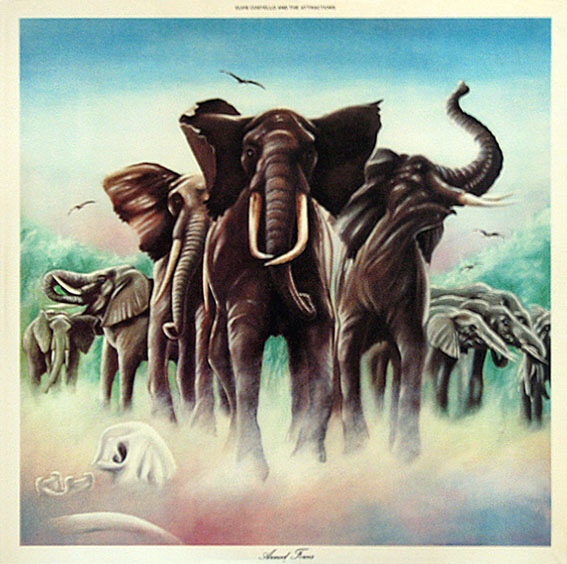
Oliver’s Army‘s parent album, Armed Forces was my first introduction to Elvis the artist, as opposed to Elvis the pop star. Again, it was wordy and literal, but offset by twitchy, synthy, noo-wavey, skewed guitar pop. You’ll know that already though.
I had no idea what any of it was about but it sounded terrific. It starts with ‘Accidents Will Happen‘, another brilliant piece of Elvis pop that just bursts in, as if you’re listening to the song half way through. Wherever that idea came from, or whoever he half-inched the notion from, it’s a masterstroke.
Elvis Costello – Accidents Will Happen
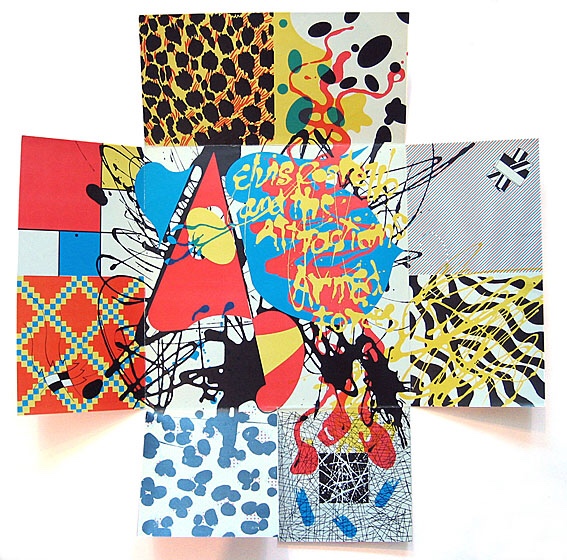
Armed Forces came in a great fold-out Barney Bubbles-designed sleeve too, all pop-art graphics and technicolour. It’s an album I come back to now and again – indeed, it was spinning just last night- and in the days before iTunes counts or any of that nonsense that gets in the road of a good listen nowadays, I must’ve played it from start to finish at least, oooh, I dunno, 37 times.
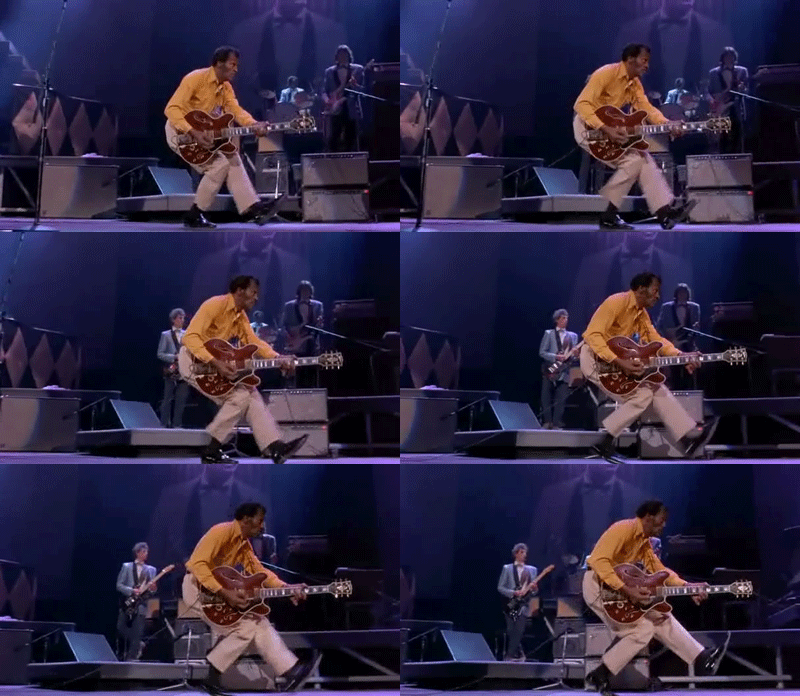
The blues had a baby and they called it rock ‘n roll. Standing expectantly with the forceps may have been Ike Turner, and on hand with the hot water and towels was Little Richard, but there, straight outta the womb came a duck walkin’, smart talkin’ Chuck Berry, sly grin on the side of his mouth and holding a cherry red Gibson with a hand span as wide as the Mississippi.
He sang of motorvatin’ in shark-finned Cadillacs, of Coolerators and TV dinners, of a life so technicolour and otherworldly and sci-fi that he couldn’t fail to capture the imagination of anyone with half a feel for the beat. It’s no wonder that future legends like Keith Richards and Eric Clapton embraced him so keenly. Young Keith was still playing with rats on Blitzed-out bomb sites in a post-War Britain living in severely austere times, and here was Chuck, singing quite literally about the promised land.
Chuck Berry – Bye Bye Johnny
I’ve always loved Chuck’s Bye Bye Johnny, a follow-up in sorts to Johnny B. Goode, a story song where the protagonist leaves home in search of fame and fortune. First time I heard it though was on Status Quo’s epic triple box set ‘From the Makers Of‘. For years I assumed it was a denim-clad Quo original. With it’s 3 chord chugga-chugga boogie and heads down, no-nonsense approach it could well have been a mid 70’s Quo classic.
Status Quo – Bye Bye Johnny
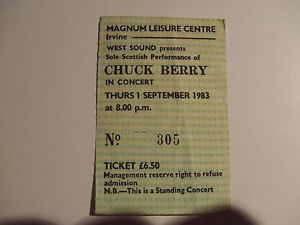
Back in the early 80s, (September ’83), around the time I’d have been headbanging myself into stupidity with a tennis racquet and Status Quo blaring in the background, Chuck and a pick-up band played my hometown of Irvine. I never went. Why? Because I was a daft wee boy who was in denial about music from the past. If my parents liked it, I didn’t. It was as simple as that.
Found on t’internet
The promoter of the concert, Willie Freckleton, booked all the bands that came through the town, from Chuck and The Clash to Oasis and Bjork. In later years he told me the story of how Chuck wouldn’t play until he’d been given his fee in a brown paper bag stuffed with good ol’ fashioned American dollars. For a man who’d been ripped off from the moment he’d picked up a guitar, this was probably a smart move, albeit a little cold. After the main set, where Chuck had of course wowed the audience with his 3 minute symphonies and wide-legged stage antics, he left to frenzied applause.
“That was great, Chuck!” cheered Willie to his idol from the side of the stage. “Are you going back on? Give the audience a wee bit more, eh?”
You can’t write a piece about him without pointing out the fact that Chuck Berry is, by all accounts, an appalling human being.
Not just for the money-in-the-bag story (that’s so routine in Chuck’s world now, it’s almost as much a signature move as the Johnny B. Goode riff) or the dubious lyrics that reference young girls and carnal acts dressed up in all manner of metaphors.
There is the 3 year jail sentence for transporting a 14 year-old across State lines for ‘prostitution’ and immoral purposes’. You can’t dress that up in metaphor, Chuck. Or maybe you did?
More recently, there is the story of him having a hidden camera in the female toilets in his restaurant. Charges were only dropped after he agreed to pay financial compensation to the 200+ victims who came forward.
Flawed genius? Perhaps. Or just not a nice man.
Broadcaster Andy Kershaw does a really terrific stand-up routine, based around his autobiography ‘No Off Switch‘ – it’s a brilliant read, and part of his show is based around his distaste for Berry as a person alongside the unbridled joy of listening to Promised Land.
“If you want to travel across America, don’t do Route 66. That’s the accepted route, but believe me, unless you’re into farming and grain containment, you won’t find a more boring road in the whole of America. If you want to find out about the real America; the grit, the dirt, the soul of the country, take Uncle Chuck’s advice and follow the lyrics of Promised Land.”
Kershaw then impressively reels off the lyrics. Breathless poetry about a land that captured the imaginations of all those post-War wannabe guitar players. It’s a beautiful thing….
Chuck Berry – Promised Land
I’ve always had a soft spot for the late 70’s Elvis version.
Listen closely and you can hear his lard ass a-wobblin’ out the seams of that ridiculous white jump suit as he breathlessly tries to keep up with the rest of the band. Heck, you can practically see the sweat flying over the top of the gold aviators as The King staves off the heart attack for a few more weeks. Essential listening, of course.
‘You Just Haven’t Earned It Yet, Baby’ is the sound of The Smiths at their chiming, ha-ha-ho-ho-hollering, twin guitar attack peak. Written, as the band usually did, quickly and as part of a triptych that also included ‘London’ and ‘Half A Person’, it was considered as the follow-up single to ‘Ask’ before being passed over at the last minute in favour of ‘Shoplifters Of the World Unite’, a move regarded as travesty by many Smiths devotees at the time.
The ‘Shoplifters…’ single included both ‘London’ and ‘Half A Person’, the tracks on the b-side connected through the subject matter of moving to London, with the former a noisy glam racket that sticks two fingers up to those who are too spineless to leave and make something of themselves, and the latter a brilliantly put-together melancholic rumination of how just a move can go so wrong – “I went to London and I booked myself in at the YWCA…” The noisy and the melodic, the tragi-comedy of The Smiths on the same record.
Marr & Morrissey, Rough Trade stockroom, 1983
But the best of the three tracks written in that early October session, ‘You Just Haven’t Earned It Yet, Baby’ was left alone on the shelf marked ‘Great Smiths Tracks That Would’ve Made Great Smiths Singles’. The band had high quality control values – theirs is a perfectly-formed 4 studio album and 17 single discography, untarnished by stop-gap filler material or substandard releases; the perfect group. Not that there’s anything wrong with ‘Shoplifters…’ – I’m particularly partial to Johnny’s open-wah rockist guitar solo – but better single material than ‘You Just Haven’t Earned It Yet, Baby’? Nah. They got that one wrong, I think. Even if, as it turns out, Johnny thinks ‘Shoplifters…’ is the better song.
The Smiths – You Just Haven’t Earned It Yet, Baby (The World Won’t Listen mix)
Keen eagle-eared Smiths enthusiasts at sadly-departed Smiths treasure trove Smiths Recycled spotted that the mix on The World Won’t Listen ran a touch too fast, so with the aid of modern technology and whatnot re-pitched the track at the speed it would’ve been playing at when The Smiths recorded it. clever fellas, those guys. Spot the difference…
The Smiths – You Just Haven’t Earned It Yet, Baby (The World Won’t Listen mix – Repitched Version)
The track eventually saw the light of day on ‘The World Won’t Listen’ compilation, the catch-all, semi follow-up to ‘Hatful Of Hollow’ that gathered together all the odds ‘n sods ‘n ‘As ‘n Bs from the 2nd half of The Smiths career. It also appeared in slightly different form (if you turn up the EQ on your Morrissey-endorsed NHS hearing aid, subtle nuances in the mixing can be heard, if you’re that way inclined) on the American compilation ‘Louder Than Bombs’.
The Smiths – You Just Haven’t Earned It Yet, Baby (Louder Than Bombs mix)
Those same Smiths enthusiasts at Smiths Recycled also corrected the pitch on this too…
The Smiths – You Just Haven’t Earned It Yet, Baby (Louder Than Bombs mix – Repitched Version)
The song itself was borne out of in-band fighting and the politics that would eventually lead to Johnny leaving the band. Booked for 5 days in London’s Mayfair Studios, Morrissey was keen for the band to work with upcoming wunderkid producer Stephen Street. Johnny preferred the tried and tested John Porter and in the end a compromise of sorts was agreed – Street would work the first day and Porter would do the other four. To add complication to the mix, 5th Smith Craig Gannon, who’d accompanied the band on their recent US tour but had never really been fully accepted into the group , was only just hanging on to his status in The Smiths by the finest hair on his bequiffed head. History shows that the Porter sessions would be the last time Gannon would work with the band.
Johnny’s tune is a classic Marr composition, tumbling in on a breath of fresh air, packed full of double and triple-tracked guitars as clear and ringing as Edinburgh Crystal, chiming, capo’d and open-stringed arpeggios and stinging counter-melodies, wrapped up and driven by a trampolining bass line and a stomping, Glitter band thud of drums in the chorus. That Johnny still plays it live in concert to this day, something The Smiths themselves never did, is testament to the longevity and beauty of the song.
The title and lyrical refrain is attributed to Rough Trade supremo Geoff Travis who uttered the words at Morrissey after the singer asked him why he wouldn’t treat The Smiths with the importance that their status deserved. Morrissey had a point – The Smiths almost single-handedly allowed Rough Trade to flourish as a label. All money made from the band went back into other artists, many of whom would never have had a record deal and subsequent success without Rough Trade’s money – the money that came directly from the healthy sales of Smiths’ product. Morrissey was clearly still feeling aggrieved a few months later when he recycled the title as a lyric in ‘Paint A Vulgar Picture’, The Smiths’ scathing deconstruction of the music business. It’s possible that, after hearing ‘You Just Haven’t Earned It Yet, Baby’, and stung by its lyrical content, Travis overruled the band’s decision to release it as a single.
“Obviously Geoff was staunchly against it,” said Morrissey, in highly dramatic fashion when quoted in Simon Goddard’s essential ‘Songs That Saved Your Life’. “Because he thought it was a personal letter addressed to him.“
A couple of years later, Marr would play on Kirtsy MacColl’s faithful remake of ‘You Just Haven’t Earned It Yet, Baby’, the original’s multi-tracked guitars replaced by a choir of Kirsties; airy, whispering, cooing and making it something of her own.
Kirsty MacColl – You Just Haven’t Earned It Yet, Baby
It’s all slightly plodding, truth be told, a stodgy, sticky pudding compared to the floating on air joie de vivre that carries the original. That’s by far the best version, of course.
A couple of weeks ago I was looking for a favourite hoody that wasn’t in its usual place. Turning my wardrobe inside out I discovered, hidden behind a Paul Smith shirt that I can’t bare to part with, bought long ago BC (‘Before Children’) when disposable income was such a thing, a brand new vinyl copy of ‘Searching For The Young Soul Rebels‘ by Dexys Midnight Runners.
Result!
With Father’s Day looming, I had given a list of LPs to Mrs Pan and the kids (“D’you not need a new pair of slippers?” she’d asked in all seriousness – I do, but still…) in the hope that they’d turn up something from the list. The good news was that they had, and as a bonus they’d got the LP I secretly really wanted – I have (or rather, had) an old C90 somewhere with a home-taped version of the album when I borrowed it from Irvine Library some time in the mid 80’s, but I didn’t have the ‘real’ version. The bad news was that I’d have to wait two weeks until I could play it. And act surprised when the kids gave it to me.
So on Sunday morning, I duly acted surprised (I genuinely was, they’d bought me other stuff as well – that’s the stakes raised for next year’s Mother’s Day) and, when the time came, I listened to Dexys’ debut for the first time in many years.
It all came flooding back. As the LP spun, I was transported back to my teenage bedroom, headphones on, ignoring the shouts from downstairs that my tea was ready. The album’s opening radio static bursts of Smoke On The Water crackled into the Sex Pistols’ Holidays In The Sun which gave way to The Specials’ Rat Race, before Dexys themselves took centre stage with ‘Burn It Down‘, a re-recorded version of ‘Dance Stance‘, their debut 7″. Not that I could’ve told you that back then. What a great start to an album! Here’s a band laying their influences out for all to see before sweeping them aside – “Burn It Down!” with their own pretty unique take on brass-led soul/punk.
Every track burns bright and true, honeyhorn-coated soul anthems wringing in attitude. The elephant stomp of ‘Geno‘ thunks throughout the house, prompting insistent requests to “Turn it down!” Rather than ‘Burn It Down‘, the song as heavy yet hooky as Slade in their heyday. Closing track ‘There, There My Dear’ burns brightest and brassiest, an anthem that puts the boot into the murky mechanics of the music business – at the time of writing the album, the band were being royally ripped-off by their label to the extent that the mastertapes of the album were stolen by the band and held to ransom until better royalty rates were agreed.
The big surprise for me though was ‘Seven Days Too Long‘, opening track on side 2. Now, I must’ve heard this track a gazillion times, but never once have I equated it with the original northern soul version by Chuck Wood. Back in the day, I was an avid reader of sleeve notes and writing credits, so I must’ve spotted that the track wasn’t a Dexy’s original. In the days/weeks/months/years/decades since I last played my old Dexys tape, I’ve accumulated plenty of ‘Bluffers Guides To Northern Soul‘-type compilations, and the Chuck Wood original is a regular, welcome addition to the track list on most of them.
Chuck Wood – Seven Days Too Long
That Dexys do a version makes sense. Formed out of youth culture and tribalism and named after Dexedrine, the ‘speed’ favoured by the dance-floor fillers on the Northern scene who could keep going into the wee small hours, Dexy’s pay a respectful homage to the sax-blasting original.
Dexys Midnight Runners – Seven Days Too Long
Dexys still have it. Their One Day I’m Going To Soar LP from a couple of years ago is a masterclass in how a concept album should sound and still regularly rotates round these parts.
I’ve not heard the new one yet, though. I’ve been put off by the title, ‘Let The Record Show: Dexys Do Irish & Country Soul’, which smells a little too much like Too-Rye-Ay, the fiddly-dee ‘n dungarees package that gave them their best-known hit, and also by the fact esteemed music critic and Dexys’ champion Everett True has suggested it should be considered less a Dexys’ album and more as the follow-up to Kevin Rowland’s poorly-received mid 90s solo LP, you know, the one where he’s unashamedly cross-dressing on the cover. I’ll get around to it eventually. Maybe in 40 years time, as that’s just about how long it’s taken me to accept the true genius of the Searching For The Young Soul Rebels.
Men of a certain age last night/this morning exhaled a collective breath as wide and expansive as a pair of vintage 27″ Joe Bloggs, as the second coming of the third coming of the Stone Roses proved to be ace.
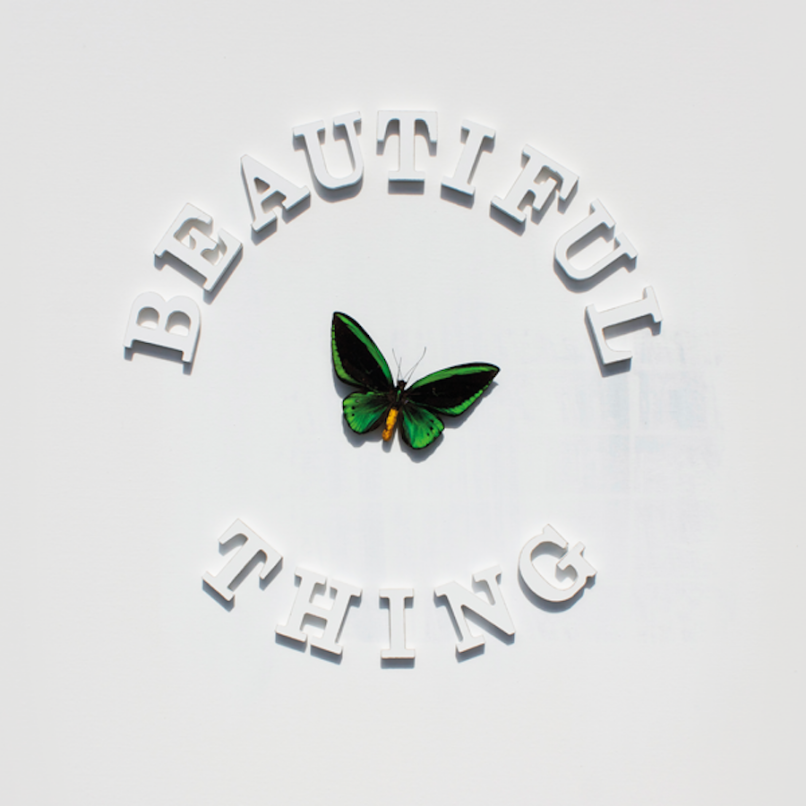
Following the sloppy, ill-advised ‘All For One‘ come-back single a few weeks ago, the new single ‘Beautiful Thing‘ has, mercifully, all the hallmarks of vintage Stone Roses. It grooves in on a Funky Drummer shuffle, a welcome old friend who’s been AWOL for the past two or so decades, coated in backwards vocals and trippy guitar. As the beat kicks in, we’re straight into the vocals; light and airy, Brown riffing about the crucifixion, so-so sooooky vampires and all manner of alliterative mumbo jumbo – “sister musta missed ya, method to my madness, reason to my rhyme…” As it plays, I can see him standing there in the classic apeman pose, shaking a pair of those stick tambourines he’s favoured since the comeback of a couple of years ago. I can also see Reni, head down and bobbing like a nodding dog in the back of a Ford Capri, eyes shut and lips pursed in the knowing pout of someone who knows they’re doing a fine, fine job.
Stone Roses – Beautiful Thing
Squire’s guitar is excellent. The tone, the choice of effects, the sugar coating on top is perfect. A track like this requires dollops of full-fat funk and here he is, splashing shades of wah-wah across the top, breaking it down with wee backwards bits reminiscent of those old, classic b-sides and bringing it, kicking and screaming into the present day with a lightning flash guitar solo. At the breakdown there are even those wee reverby, echoey dang dang dangs that made Fools Gold the futurefunk record that it was. Mani’s bass is still too low in the mix, if y’ask me, but we can’t have it all. Comparing this record to the last one is like comparing a paper aeroplane to a rocket. One flimsy and rubbish, the other up and out there, powerful and rumbly.
The whole thing lollops along for 7 sublime minutes. ‘It’s too orangey for crows‘, I’m thinking. ‘It’s just for me and ma dawg...’ (80s reference there, for those of you of that certain age). When you get to the end, you can’t help thinking “Fools Goldmark II, or at least Breaking Into Heaven without the generous dusting of cocaine,” but it’s ripe, absolutely ripe for segueing into yer actual Fools Gold. The wee drum break at the end is just itching to pick up the pace slightly and get into it. What’s the betting this is what they do at the summer gigs?
I like this current Stone Roses tactic of guerilla gigging and event releases and whatnot. Imagine if they’d shoved Beautiful Thing out unannounced a couple of weeks ago instead of the one that sounds like Shed 7 in a rehearsal room? After its 3rd play at almost 1 o’clock this morning, I’d already played the new one twice as much as that particular clunker. Had I been a couple of shandies to the good, I might even have been tempted to sell my soul for a ticket for one of the enormo-dome shows they’re doing soon. Might have been. At least now I, and many others, have renewed faith that the album will be worth the wait.
Majestic, magnificent, mid-80’s New Order. Is there anything better?
3 ½ of New Order by Kevin Cummins
Long before the running of the Hacienda that seemed to take priority over the music and the inter-band fights that ultimately led to their sorry downfall, the band were imperial. Their 3rd album, 1985’s ‘Low-Life‘, tracing paper sleeve ‘n all, is a high point in a full-fat discography choc-full of high points. It’s the album where post-punk morphed into dance rock – stadium house for floppy fringes and German Army surplus, if you like.
Side 1 closer ‘Sunrise‘ is New Order’s collected output in miniature; the elegant minor key keyboard swells in the intro giving way to one of those Peter Hook basslines that you kinda just always took for granted – fluid and high up the frets, and dripping with liquid quicksilver from the fingers of the Viking alchemist. It’s window cleaner-whistleable and never lets up the entirety of the song.
Hooky by Kevin Cummins. Of course.
New Order – Sunrise
Barney’s guitar is forever on the verge of being out of tune, playing a demented take on a Spaghetti Western twang, fizzing and wheezing its way through the song between vocal lines, crashing to a frantically-strummed crescendo somewhere around the 6 minute mark when the ‘F’-shaped chords rattle out like Nile Rodgers fronting the Buzzcocks. Even his vocals, never his strong point, let’s be honest, hang on in there, straining at the high notes before being drowned out by his furious strumming.
It’s a beauty.
Heads down, no nonsense.
Even more of a beauty is last year’s homage to Anthony Wilson, St Anthony: An Ode To Anthony H Wilson. The brainchild of Manchester poet Mike Garry who’d performed the poem, beat poet-style in Manchester’s hipper venues, it was offered to a local composer who added large elements of New Order’s ‘Your Silent Face‘ to the spoken-word track, creating a gorgeous, lush, string-laden track that runs an alliterative A-Z of all that makes Manchester great.
The Arndale…Acid House…Bez, The Buzzcocks, The Bouncing Bomb, The beautiful Busby Babes…. Curtis, Cancer, Crack…. Dance, Design, Durutti, Devoto… I could list it all, but it’s better to just listen to it and soak it all up for yourself.
St Anthony: An Ode To Anthony H Wilson (Andrew Weatherall mix)
Saint Anthony himself
When it came out last August I was totally obsessed by it. Although the original version is the one I heard first, the Weatherall remix is a 9 minute monster. Motorik, relentless and repetitive, it’s the one you want to hear first.
I’m no audiophile, but when the New Order back catalogue was re-released by Warners a few years ago, there was a huge outcry over the shoddy mastering of the music. For a band steeped in technology and futuresound, the music on the discs was tinny, weak and flimsy when compared to the original vinyl. My LP is currently spinning as I type and I can attest to this. Don’t let that put you off though – if you like the 2 New Order tracks featured here and are hearing them for the first time, just imagine how terrific they sound when played on the right format. In fact, you should probably pop down to your local record shop (every town has one nowadays) and buy them.