Get This!, Kraut-y

Rock Goes To Collage

The Beta Band will forever be defined by Dry The Rain, the first track on their first EP that most-famously soundtracks one of the most memorable scenes in High Fidelity. That EP, Champion Versions, introduced the band’s music at a time when dumbed-down indie rock was ubiquitous, predictable and in need of a good kick square in the haw maws. The big bang of Brit Pop had long-since fizzled to a watery fart and the Big Two led the lethargic charge towards mediocrity and meaningless. Oasis was a bloated beast, cocksure with misplaced arrogance merely by being super-popular. Their music, once a glorious melding of rabid snarl and Mersey melodies – the Sex Beatles, if y’will, was now bloated, irrelevant and plain old rubbish. Blur was midway to nowhere, somewhere between slumbering, opiate-enhanced recording sessions and making cheese whilst living in actual very big houses in the country. Others limped on to ever decreasing returns; Supergrass, Gene and Elastica, for example, who’d eventually disappear down the same black hole that had claimed Marion, Menswear and Mansun before them (although some would find their way back out now and again for one last hurrah. Watch Supergrass go in 2020.)
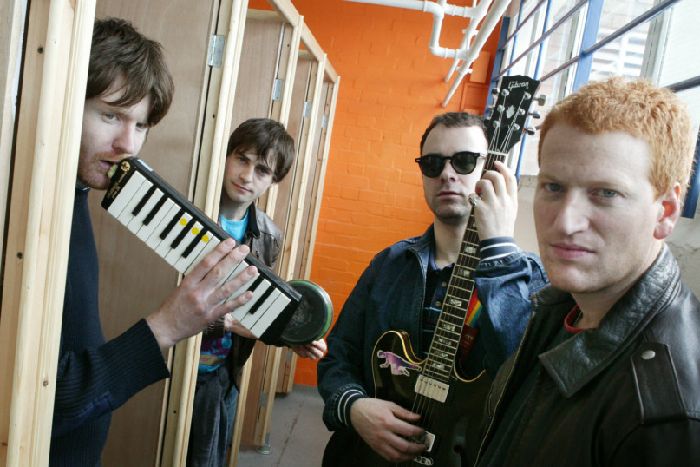
In 1997, music was ripe for interesting change. Radiohead led the way and The Beta Band followed close behind. Dry The Rain may well be the band’s signature tune, but it’s their second EP, The Patty Patty Sound, that does it for me. Across the four tracks that constitute The Patty Patty Sound you’ll find enough weird ‘n wonky, dubbed out, clubbed up soundscapes to sate your more out-there moods. With knowing nods towards aural sculptors Can, the greats of dub reggae, the rhythms of the Stone Roses and the folky introspection of John Martyn, it’s quite something. Given its time and place, the EP really was the in-sound from way out.

It’s the opener that does it for me.

Beta BandInner Meet Me

Inner Meet Me is a solid piece of sampled and looped acoustic beat music, a cut ‘n paste sonic collage of odds ‘n sods ‘n found sounds designed to astonish and astound. It begins simply enough, with some electric bleepery and studio static before a repeating vocal plays just behind the sound of a lone pigeon cooing its way into the mix. As you might know, The Beta Band was originally going to be called The Pigeons, and after a year or so, founding member Gordon Anderson left the band soon after they relocated to London and began recording as Lone Pigeon. In a nod to their early roots, the pigeon sample is something of a band in-joke.

When it really gets going, Inner Meet Me positively swings. Acoustic guitars are played throughout with the same sort of focused gusto normally reserved for the poor soul whose job it is is to work a Brillo pad into burnt-on mince in a two day old pot. As the chord changes, the song moves into gear. The drums kick in, accompanied by percussive shakers and what sounds like a decent set of Le Creuset pots and pans being clattered on the off-beat. As you settle into it, arcade machine electro bloops and whooshes colour the mix, a reminder that Beta Band are forward-thinking retro revisionists. No-one else was doing this kinda thing in 1998 and 20-odd years later, I still think it/they sound brand new.

The EP continues with two epic sound collages – the self-descriptive House Song that, once it’s going, kicks like a mule, carried by a really great bassline and sounding like DIY lo-fi indie house, and The Monolith, a near-16 minute folktronica jam that incorporates backwards samples from their own Dry The Rain, African chanting, chiming, cascading, waterfalling guitars and plenty of birdsong. It’s not Be Here Now, that’s for sure.

Beta Band She’s The One

Closer She’s The One is closest in sound and spirit to the opener. A scrubbed acoustic jam replete with random bursts of noise and a twangin’ Jews’ harp, it’s indie hoedown relocated from a creaky porch in the deep south to a cramped St Andrews student flat. It’s all about the layers and the rhythms. Vocals and vocals, multitracked to the max create a circular, hypnotic groove, ever propulsive, ever moving forward.

Their next EP, Los Amigos Del Beta Banditos featured more of the same, a document of a peerless band ahead of their time, out of their minds and out of this world. It’s The Patty Patty Sound though that marks The Beta Band as more than just the ‘Dry the Rain‘ band.


 

Get This!

Sound Aphex

Aphex Twin is a true pioneer of electronic music, a self-taught and home-schooled, hands-on manipulator of sound. His first keyboard wasn’t of the electronic variety, but the piano that the teenage ‘Twin regularly took apart in order to play and record the strings inside the case rather than the keys themselves sparked a curiosity in reworking sound that has continued for the best part of 40 years.

Part musician and part engineer, Aphex was confident enough to dismantle and deconstruct the instruments available to him and then reconstruct them into strange new sound-carriers. Utilising a heady combination of boxfresh ZX Spectrum and pure brainpower, he worked out a way to record the static from a de-tuned TV and turn it into exotic soundscapes. With ease, he went from bedroom prospector to the goldmine of techno, DJing at underground events around the south of England during its heyday before eventually making his own music that he’d segue into his playlists.

His debut album, Selected Ambient Works 85-92 is properly ground-breaking. On release, nothing quite like it had been heard. By late ’92, techno was in full flow and fell into two camps; novelty and nosebleed. The novelty stuff (such as Sesam E’s Treet) popped up like an uncontrollable rash on Top Of The Pops every other week. The nosebleed stuff occasionally punctuated the strange airwaves betwixt and between the Mudhoney and Misty in Roots records on the John Peel show, sometimes (they tell me) even playing at the correct speed. It was something I learned to tough out, as the rewards on the show far outweighed the odd filling-loosening clunker in-between. But you knew that already…

Aphex Twin’s album was purely electronic, but it was head music rather than hedonistic music. With massive nods to Brian Eno and only very occasional forays into ear-splitting nosebleed nonsense, it was an album in the true sense of the word; it ebbed, flowed, peaked and troughed, taking you on a journey. It made for perfect headphone music then and it still does now. Stick it on as your subway train rattles through Glasgow’s underground and it’ll make the journey truly cinematic. Cue it up for a 20 mile cycle and the subtle percussive parts will work their way into the outside mix, hi-hats complementing the smooth groove of a well-oiled chain making its way through the sprocket. The fact it was all jigsawed together on Aphex Twin’s strange collection of hybrid keyboards and sequencers rather than in a state of the art studio makes it all the more special and unique.

Aphex TwinXtal

The opener Xtal is fantastic; smooth-rolling ambience, ghostly, synthy vocals, a beat that’s almost a hip hop breakbeat and multi-layers of subtle percussion. There’s a real flotation tank depth to the bass too, making the whole thing airy and spacious and, well, magic.

The phonetically troubling Ageispolis builds on the opener’s blueprint with synth washes, wandering basslines and a little keyboard motif that the unkind amongst you might snigger at for being too close to pan pipe to take seriously. Listen if you will…

Aphex TwinAgeispolis

This variation of techno music was subsequently everywhere, with Leftfield and Underworld adopting the atmospherics and spirit for their own gain, St Etienne remixes bearing the undeniable stamp of the ‘Twin and every anonymous contributor to the Café Del Mar series taking their jumping-off point from Ageispolis especially.

All fine records and artists, but there’s something that makes Aphex Twin’s stuff just that little bit extra-special. Maybe it’s the punk spirit in him that resonates. Making such beautiful, insular music in an era when everyone around him was off their nut and dancing bare chested to 180 bpm bangers is to be applauded. Punk in spirit, hippy in execution, those early Aphex recordings still sound groundbreaking today.

Gone but not forgotten

реальный хорошо

Viddy Well, Devotchkas And Malchicks, Viddy Well.

That Bowie fella was a clever droog. In death he created one of his greatest pieces of art. The songs that make up Blackstar contained an outpouring of coded references to the pancreatic cancer that he would succumb to two days after its release. The benefit of such short hindsight allowed even the blindest of Bowie lyric decoders to join the dots and see the bigger picture. Only a small handful of folk knew, but Dave was terminally ill when he wrote and recorded his 25th album and scattered across the tracks were the clues that became so obvious in the days that followed. You know that already though.

Look at me, I’m in heaven. I’ve got scars that can’t be healed.”

Something happened on the day he died.”

Why too dark to speak the words?

If I’ll never see the English evergreens I’m running to, it’s nothing to me.”

I’ve got nothing left to lose…I’m so high it makes my brain whirl.”

Hope I’ll be free.”

I know something is very wrong.”

I can’t give everything away.

He maybe didn’t give everything away, but he gave a huge part of himself. The font used to display the tracklisting on the back? A relatively obscure one called Terminal, funnily enough. Even the sleeve itself is a perfect artefact. Bereft of it’s contents and held to the light, it reveals a galaxy of stars that shines with all the wonder of the cosmos. A certain, intentional metaphor for Bowie’s omnipresence, it’s his final gift to us all.

Blackstar wasn’t the easiest of albums to digest at the first sitting. Much of it is skewed and, unsurprisingly, doom-laden, carried by skittering drums and the sort of skronking jazz that’s only recently found itself on the margins of the mainstream thanks to the occasional rotation of acts such as The Comet Is Coming and Polar Bear on BBC 6 Music. Be it glam or electronica or new romanticism or even speed garage, Bowie was forever at the front of the queue whenever a new musical direction was being charted, in both senses of the word.

There are stellar moments, of course, some of which take half a dozen or more plays before they’ve worked their way into your head, by which point you’re revelling in one of Bowie’s most complex, most complete albums. Blackstar may not’ve been for everyone – my local independent seller was scathing of it upon release, but for those that get it… wow! There are truly brilliant moments on Blackstar, as euphoric as Absolute Beginners, as arty as anything from Low and as essential as the rest of the high rollers that immediately spring to mind when you’re asked for your favourite Bowie albums.

This week’s highlights: the song-within-the-song moment midway through the title track…the crashing guitars that colour the none-more-Bowie vocal on Lazarus….the jerky paranoia of Sue (Or In A Season Of Crime)…..the straightforward piano and electric guitar ballad of Dollar Days, an album highlight that sounds most like the Bowie of old, whatever that means. It features a great sax line too, played, I imagine (I hope) by Bowie himself. Meandering, mournful and slowly unfolding, it’s the stately sound of Bowie facing death with stiff upper-lipped dignity. In a back catalogue of fantastic highs, Dollar Days is right up there as one of his very best.

David BowieDollar Days

Best of all though, arguably, is Girl Loves Me, a song smartly written in a mish-mash of two made-up languages, Polari and Nadsat.

Polari was the coded language (more decoding!) used by gay men in the 50s and 60s as a way of finding like-minded companions. With conversation based around combinations of slang and interpolated foreign words, gay men had the perfect means to hide in plain sight. Polari even made it onto the BBC when, unknown to the bosses, it was used extensively on Round The Horne.

In more recent times, Morrissey went through a short phase of adopting Polari. Piccadilly Palare, for example;

The Piccadilly Palare
Was just silly slang
Between me and the boys in my gang
“So bona to vada, oh you
Your lovely eek and
Your lovely riah”

His Bona Drag compilation album too. Translated from Polari, it means ‘good clothes‘. Anyway, I digress.

Alongside his adoption of Polari, Bowie borrows heavily from Nadsat, the half-Russian, half-English language that Anthony Burgess used in A Clockwork Orange. The Russian word for ‘good‘, for example, is ‘khrosho‘, pronounced ko-ro-sho. In keeping with the book’s theme of wanton, casual violence, Burgess cleverly twisted this into ‘horrorshow‘, so whenever a character in the book refers to something as ‘real horrorshow‘, they’re expounding on how great it is. It took me a while to work this out when I first read it, as of course, four pilled-up and violent teenagers giving an old guy a kicking really is a proper horrorshow. I’d no idea for many pages that they considered a ‘horrorshow’ to be a good thing. Jeez.

As a result of it’s lyrical styling, Girl Loves Me sounds weird, wonky and other-worldly. It’s real horrorshow, in fact.

David BowieGirl Loves Me

Cheena so sound, so titty up this Malchick, say
Party up moodge, ninety vellocet round on Tuesday
Real bad dizzy snatch making all the homies mad, Thursday
Popo blind to the polly in the hole by Friday

Where the fuck did Monday go?
I’m go to this Giggenbach show
I’m sailin’ in the chestnut tree
Who the fuck’s gonna mess with me?

Girl loves me

Despite the fantastic imagery that the lyrics throw up, the refrain of “Where the fuck did Monday go?” sticks out a mile for me. When I watched my dad pass away through cancer, he’d lie in a morphine-induced sleep for days at a time. When lucid, he had no idea what day of the week or time of year, or indeed, what year it was. For us carers, minutes turned to hours which turned to days which turned to weeks. Where the fuck did Monday go indeed. It’s the perfect line. Of all the death-related ones on Blackstar, it’s the one that resonates most with me.

Bowie has been gone four years now. He’ll live on forever though.


Get This!, Live!

Just Dragonflies

Codex by Radiohead is, to these ears, the greatest track the band recorded in the decade just gone. A bold claim given the kite mark of quality assurance that comes with each Radiohead release, but given the briefness and brevity of the Radiohead back catalogue in the tenties I’m struggling to name another track from the two records and small handful of one-off releases in that period that still sounds as fresh and timeless and, well, just plain classic with each listen – and I’ve listened to it, them, a lot over the years.

RadioheadCodex

Codex is suspended, slo-mo, flotation tank music, a song about being immersed in water that sounds exactly like its subject matter. Starting off on a wonkily-edited snippet of vocal, it ambles in on a repetitive three chord piano motif (C-Bb-Dm, if y’were wondering) before a flugel horn? A trumpet? makes itself known, the distant cousin of Johnny Marr’s eerie slide part on How Soon Is Now?, elongated and understated, the perfect precursor to one of Thom Yorke’s greatest vocals. Bathed in pathos and regret, it’s just so spot on and faultless. Those finger pointers who stab accusingly towards ol’ wonky eye and claim he can’t sing would be stopped dead in their tracks if they’d made it this far into the Radiohead ouvre.

What Yorke’s actually singing about is open to interpretation. You don’t have to look too far into the internet’s abyss to find thousands of theories regarding the lyrics, where references abound to spirituality and soul cleansing and suicide.

Sleight of hand
Jump off the end
Into a clear lake
No one around
Just dragonflies
Fantasise
No one gets hurt

You’ve done nothing wrong
Slide your hand
Jump off the end
The water’s clear
And innocent
The water’s clear
And innocent


A quietly heart-beating drum thumps its muffled way throughout the track as the horns build and the piano is soaked in an ambience last heard on Eno’s Music For Films album. Gentle strings emerge from the fog, the heartbeat louder by now and then, suddenly….it’s over. Did he jump? Did he turn around? Quietly chirping birds bring the track to a close and you’re left to make up your own mind. It’s an incredibly sad track, as filmic as Fellini and just as beautiful and timeless.

Here’s the version Radiohead did when they played the entirety of King Of Limbs on Nigel Godrich’s From The Basement show.

RadioheadCodex (TKOL From The Basement)


The King Of Limbs was something of a slow burner of a record to begin with; self-indulgent, insular, moody…. but like all the best albums by all the best artists, you benefit through continual listening and reappraisal. Perseverance even. Codex pops up between the glitchy, jerky dubstep of the superb Lotus Flower and the pastoral, acoustic Give Up The Ghost – a potted distillation of everything that’s great about Radiohead in three successive tracks, a triumvirate on an album that’s without a doubt a top 3 Radiohead record.