
I’m re-reading Haruki Murakimi’s The Wind-Up Bird Chronicle just now. Along with Stephen King’s The Stand, it’s become something of a summer holiday tradition; long novels that require patience and time are best left for the days when you can neglect all other duties and fall freely into the pages. The weekend just gone was, as you know, pooled in fantastic sunshine and properly Mediterranean temperatures – perfect reading weather, as it goes. For reasons we’ll come to, no reading was done on Saturday, but I awoke early on Sunday – with more than a shade of a hangover – and plonked myself at a decent spot in the garden and, neglecting all household and husbandry duties, continued with where I’d left off in The Wind-Up Bird Chronicle. If you don’t know the story, it’s set in early ’90s Japan and follows the existential ups and downs of a lawyer’s assistant, Toru Okada. There are lost cats, missing wives, mysterious women, strange dreams and uber-violent flashbacks to the Japanese army in WWII. Told in 3 parts, I’m currently about a third of the way through, in the middle of Part 2, and although I know how the story goes, I’m enjoying re-reading Murakimi’s poetic and slow-paced way with words. Less than five minutes reading and you’ll find yourself sucked straight into the storyline – and that’s the secret to a good book.
At some point, my eyelids grew heavy and I put the Kindle to the side to ‘rest my eyes’, as my dad said before me. The toils of the previous day had caught up with me and I was soon in a deep and unflattering sleep, slouched awkwardly on the garden furniture by the back wall in full view of any neighbours who might have been looking. I’ve no idea how long I was out for (ten minutes? Half an hour? An hour or more, even?) but the only reason I woke up was because a fat dollop of rain had slapped me square on the forehead. Initially I thought it might’ve been a bird (gads), then maybe a drip from the leaf of a plant above my head, but no…it really had started raining. It was still warm, but in the time I’d fallen asleep, the sky had turned from spotless Azurian blue to dappled slate grey. Against the backdrop of the dulling sky, five midges hovered crazily at a forty-five degree angle from my resting head. I watched as they bashed wildly into one another, scattered rapidly then regrouped again, like a tiny (but no less deadly) squadron of Apocalypse Now helicopters. Just as I’m thinking that they’re sizing up both me and my alcohol sweats, from outta nowhere, a wasp streaked towards the midges. Zzzzeee-owww! Like a zip opening up the sky it flew rapidly to the centre of the five insects. Immediately they scattered, and when they regrouped there were just four of them, back in formation, hovering crazily and back to bashing into one another. Then! Zzzzeee-owww! The wasp again! Scatter…regroup…three midges left. It’s the circle of life, playing out right above my head. As I get up to begin packing away the cushions and things I don’t want getting wet, the three remaining midges scatter somewhere into a tree, a Mexican stand-off between wasp, human and midges temporarily averted. I start to wonder – does this sort of stuff play out above our heads regularly? An insect Star Wars saga that can only be seen if you stop, look up and pay attention? Maybe it does. Maybe I have too much time to think. Or maybe I was still half-cut from the Saturday night.
Ah yes, the Saturday night.
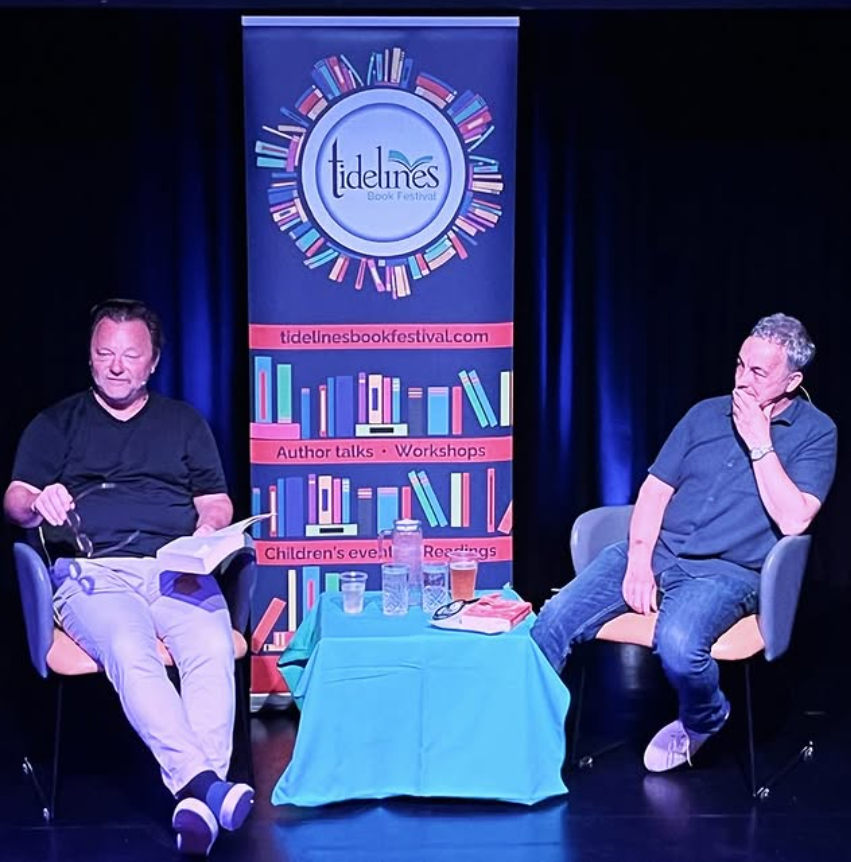
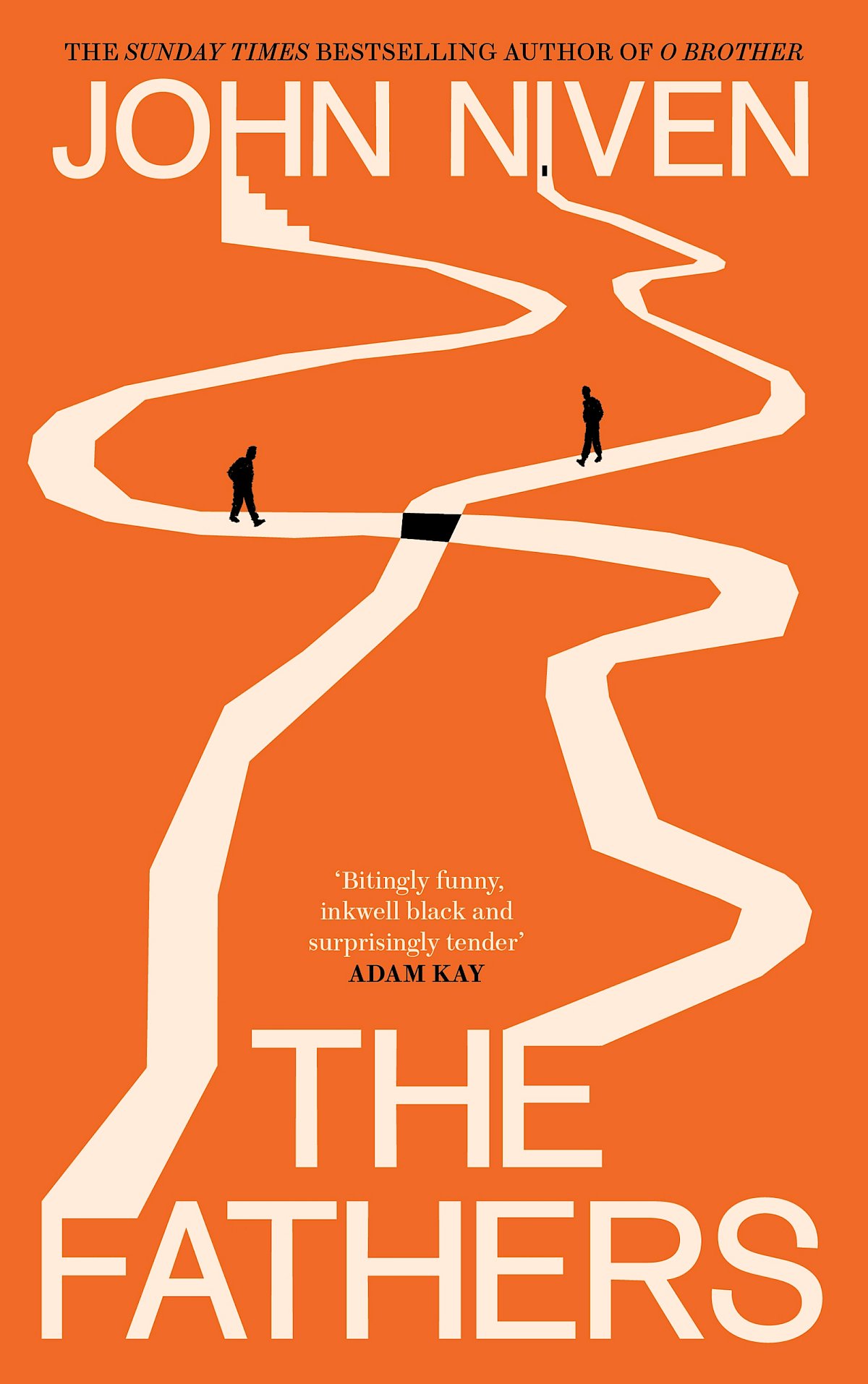
Writer, bon vivant and quick-witted antagonist John Niven was back in his home town of Irvine. Booked as part of the town’s Tidelines Book Festival, it was to be the opening night of a book tour to promote his new novel, The Fathers and he’d asked me if I’d chair the event. “You’ll be great,” he said. “It’ll just be us, talking about my book and shit. S’easy.” A proof copy of the novel duly arrived and armed with a highlighter pen and a stack of post-it notes, I jumped right in.
The Fathers tells the story of two dads who meet outside the maternity hospital as their respective partners give birth to two sons. One dad (Dan) is affluent, socially-conscious and successful (if bored) in his job. The other (Jada) is a ned, a bam, a ne’er-do-well with one eye permanently scanning for opportunity, the other forever looking over his shoulder for trouble. The two protagonists’ paths cross, the story takes a (very) dark turn (we’re reading a John Niven novel, after all) and things begin unravelling from every direction for all concerned. It’s a real page turner, as it turns out. It’d be ideal material for a three or four part TV series, something that is already being discussed, John tells us.
Very quickly I was highlighting and bookmarking words and phrases, whole paragraphs, entire pages of perfectly-scribed text. It struck me immediately how brilliantly evocative the writing in it is.
The air so fresh and cold that all you could do was sip at it.
A mouthful of ruined dentistry, of mixed nuts and raisins wreathed in blue smoke.
If you’re a parent you’ll recognise the terror Dan feels when first putting baby and car seat into the car for the drive home from the hospital, a moment in time perfectly captured in measured prose. Or the moment when Jada bonds with his son, ‘his wee rabbit heart‘ beating fast against his chest. When writing from the perspective of Jada, Niven’s writing is laced with acerbic Scottishness.
‘Hey, some cun-‘ he remembered the baby, ‘some bastard’s goat tae pay fur aw this!’
‘Still, wi’ a wee boy, you’ve only the wan cock tae worry aboot, eh?’
If you’re from these parts, you’ll absolutely recognise the people who deliver those zingers.
Given John’s background in the music business, you’ll maybe spot one or two hidden references to groups or songs. A Teenage Fanclub lyric leapt off the pages at me. Likewise a Grant McLennan line. There’s even a nod to Status Quo at one point. The proper, loud ‘n heavy ’70s Quo, of course. You wouldn’t clog up a brilliant piece of writing with a reference to Francis ‘n Rick’s parody years, would you?
And it’s all written from experience. Dan lives in an area of Glasgow familiar to both author and reader. He uses his Notes app on his phone whenever Jada says a line that Dan might be able to crowbar into the script of the TV show he works on. As John says on Saturday night, a writer is always writin’…the reason too why this piece you’re reading has seen the light of day. How can I write about that? I was thinking afterwards. And here it is.
John Niven is a very funny guy to have at an event. He can hold court unbroken for an hour, easily. I had planned to structure our chat around some of the points above, but, of course, when John Niven is in the room, there are no plans. My notes were left untouched as Niven rightly remained the centre of attention, reading aloud sections of rib-tickling prose from the book, the audience groaning and gasping at the appropriate parts. My mum – the same mum who’d complained about every second word in Bob Mortimer’s novel being the ‘f’ word (her copy is now in Irvine’s Cancer Resarch charity shop) – queued happily for a signed copy of The Fathers at the end. Quite what she’ll make of ‘gobble’ and ‘dung funnel’ is your guess as good as mine.
The Fathers is a terrific, contemporary – and very Scottish – novel. Like The Stand it too is long enough to fill out a week or more in the sun. And like The Wind-Up Bird Chronicle, it too is set in three parts. I reckon I’ll be returning to The Fathers on an annual basis. I hope that hoped-for TV adaptation does it justice.
The Fathers is published this Thursday (17th July) by Canongate. You must read it.
Token Music:
Echo & the Bunnymen – Read It In Books
The Teardrop Explodes – Read It In Books
Two versions of the same song, co-written by Ian McCulloch and Julian Cope then recorded by their respective groups after the pair of them stopped working together. It’s like a post-punk Drifters. Which one’s the real deal?! They’re both great; the Bunnymen’s version is circular, nagging and insistent, an updated Dancing Barefoot for the switched-on, the Teardrops’ take swirly and Nuggetsy and garagey, an updated Iggy/Stooges for mushroom connoisseurs. Essential, obviously…just like The Fathers.
Check John Niven’s socials for details of his book tour, coming to a town near you right now!
 Plain Or Pan