
Plain Or Pan turns 18 this weekend. An adult. Already a veteran of blind-eye pubs and blinding hangovers, it’s time for the blog to move on out, move on up and enrol in a college course that’ll stave off the threat of actual work for the next few years. The world’s your oyster at 18. Plain Or Pan is no different. It’s invincible. It can do whatever it likes. The 18 years’ worth of writing spread across these pages is diary-like, kinda autobiographical and extremely therapeutic in process. It is, as Van Morrison once remarked, too late to stop now. Not that I want to.
I’ve written before about my hometown of Irvine and its characters; the creatives and thinkers and drinkers who, through art and literature and music, put our wee speck of a town on the world map. I’d like to write now about the environment – or more specifically, the planned environment – in which these schemes and dreams were allowed to play out.
Irvine in the early 1970s was like any other wee town. It had shops and green spaces and transport links to bigger places. It was separated by the River Irvine, the areas of the town either side of the river linked by an old arched bridge. Toy shops and pubs and shoe shops and pubs and hardware shops and pubs and men’s and women’s outfitters and pubs dangled their tempting wares to those crossing the bridge from either side of the town. It was, in a world not yet bloated by megastores and Amazon, a busy, vibrant and thriving place to live.
The town had two football teams. West of the river, towards the harbour, was the industrial Fullarton area where Irvine Victoria huffed, puffed, scuffed and occasionally scored. Across the river and located in the residential area of what your true parochial local might call ‘real Irvine’ was the more well-known and successful Irvine Meadow. They had Scottish Cups and a grandstand to prove it. Where you lived and were brought up dictated which team you followed, and that was it set in stone for life. To this day, whenever the Vics and Meadow clash, a healthy partisan crowd of good natured locals is drawn together, the spoils of bragging rights in the pub afterwards the ultimate prize.
When, in 1966 Irvine was designated to be Scotland’s fifth and final New Town, grand plans were drawn up. Eventually published in 1971 as ‘Irvine New Town Plan’, the plans heralded in a brave new futuristic town of modernism, opportunity and progression. Irvine was an old industrial town. It was ripe for redevelopment and rehousing. It would be a family-focused satellite town for Glasgow, offering clean air and the seaside to any Glaswegians keen (or forced through regeneration schemes) to uproot and start anew. Brand new areas would be developed for housing, modern functional living set amidst landscaped estates. Castlepark. Bourteehill. Broomlands. Pennyburn. You’ve seen Gregory’s Girl? Filmed in the New Town of Cumbernauld, that’s a fair signifier of what these areas would come to look like once built and populated.

Within half a decade, the old bridge and its neighbouring commerce had been knocked down and swept aside, replaced by a state-of-the-art shopping centre spanning the River Irvine. The planners called it the Rivergate Centre, but to any Irvinite, it’ll be forever referred to as ‘The Mall’ (to rhyme with ‘pal’, rather than ‘ball’, Americanisms not yet being a thing.) The Mall was to be the focal point of the town, stretching from the old Irvine Cross all the way to the scrub of grassland near the beach that would soon be landscaped and adorned with a boating pond, a pitch and putt course and a ‘trim track’ and rebranded as The Beach Park. But we’re getting ahead of ourselves here.
At the top end of the Mall, at the old town centre end, was a sub level pub (The Argyle) and below that again, in the guts of the Mall, a disco. Amanda’s was like any other provincial discotheque of the time. It played chart music only, it tolerated underagers and the air was thick with Brut and Old Spice, Anais Anais and Charlie, sexual tension and the never far away threat of a punch on the nose. Until you found your own tribe and a place where your own sort of music was not only tolerated but blasted at ear-splitting volume (hello, The Attic), Amanda’s was a necessary rite of passage. Once, when our band Sunday Drivers was playing one of Amanda’s Sunday afternoon live band slots, I shamelessly pilfered a white label 12” of Electronic’s Getting Away With It from the space laughingly referred to as a dressing room. “They’re never gonnae play this anyway,” came my reasoned argument for its liberation. I still play it to this day. That wee 12” got lucky, I tell you.
Forty or fifty shop lengths away at the other end of the Mall was its centrepiece. (I know it was this many shops away because I worked for several years in Our Price and we were number 25 and midway down the Mall.) Down there, where out of town shoppers gained access to the multi-story car park, a huge pair of rotating water wheels were placed outside Boots the Chemist, the first occupants of the Mall. Boots got in there quick. Phase 1 of the Mall’s development saw to it that this would be the prime location. On the corner and across from the big water feature was to be the epicentre from where the Mall’s intended future expansions would converge and spread; Phase 2 promised more undercover shops all the way to the train station, where you might catch a handy monorail to the beach, with its theme park, ski slope and gigantic leisure centre.

At some point, the water wheels stopped turning. Then they were taken away altogether. A metaphor for a stalled idea, finances and politics and what not decreed that there’d be no Phase 2 of development. Or, at least, there was a very reduced version of Phase 2. The Beach Park became a thing, a place to go and run and golf and boat, maybe even fly a kite. The leisure centre, the famous and world-renowned Magnum arrived. You’d get wet though, walking there, or going for a train. There would be no covered walk to the station. Ski slope? Forget about it, Klaus. Boots is still there today, at the arse end of a Mall that promised so much to so many.
I first saw the Irvine New Town Plan lying around at home at some point in the late ’70s. I remember it lying on the dining table beside a pile of buff coloured folders from my dad’s work. My dad was a surveyor, so it makes perfect sense that he’d be interested in this plan – an actual hard back book, with groovy blue and green lines on its cover (blue sky, blue water, ample green spaces – psychology, innit?) and terrific architectural plans inside. In the last few years, and increasingly so since my dad died, I’d become a wee bit obsessed with finding the book. It’s very likely still in my mum’s house somewhere, but no amount of raking at the back of cupboards has uncovered it. Finding teasing samples of it online only increased my obsession, to the point where I set up an eBay notification.
And guess what!
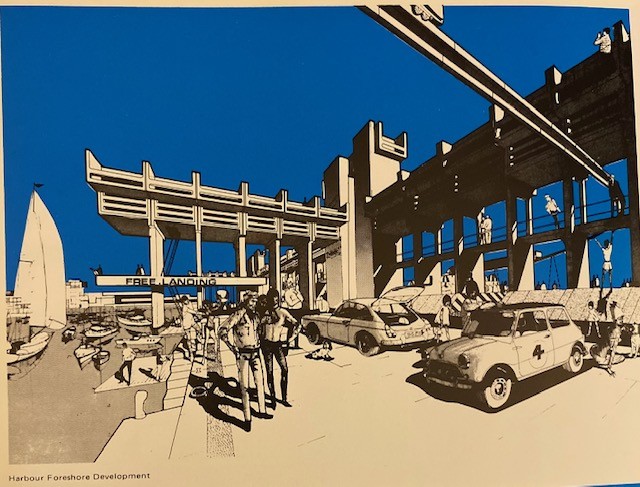
The images you see here are all taken from the book. A month or so ago, an architect was selling off a load of books and the Irvine book happened to be amongst his things for sale. Up it popped in my notifications and, with a hefty thud, in it dropped through my letter box.
It’s a portal to a time when anything seemed possible. In print, the future Irvine looks sensational, full of hope and promise and desirability. Gone is the black and white industry of old. In is a Mediterranean bright and white town of the future, right here, new and now. The town planners reckoned on the town’s population quadrupling in size to 120,000 by the mid ’80s. Alongside our showcase Mall and leisure centre – the biggest in Europe at the time of opening – there’d be a proper transport infrastructure, hotels to house the tourists, a boating marina, myriad leisure pursuits, even a University out in the green fields beyond Perceton. Who wouldn’t want to live in a groovy, fashionable place like this?

None of that arrived, of course. You can finger point in all the right directions, but it’s a sad fact of life, as this 18-year old is beginning to learn, that economics will always win out over ambition.
Despite this, Irvine was a fine place to grow up. Great, even, at times. Don’t let anyone persuade you differently. Maybe, with its massive Asda and massive Tesco and massive Sainsbury’s and empty town centre with charity shops and vacant units and never ending variety of fast food outlets, it still is for some. Not so long ago though, we had cinemas. We had world-famous touring bands rolling into town every other week. We had youth organisations and sports teams, decent shops, decent restaurants and decent pubs, places to cycle and fish and lark around in. But we also had unemployment and neglect, shutters pulled down and rusted tight forever, a metal and steel curtain drawn in on a town full of decent people and lofty ambition.

Here’s The Jam – just one of many world-famous bands who played Irvine – with, given the subject matter of this article, a proper, eh, Gift of a track; steel drums, aural sunshine and a strange, helium-strangulated Weller vocal. Town Called Malice this ain’t.
The Jam – The Planner’s Dream Goes Wrong

Billy Connolly – one of those megastars who appeared in Irvine more than once – makes that joke about Partick – “‘or Partick nil,’ as they’re known in England.” Many people, thanks to The Proclaimers, know of Irvine as “Irvine no more.” When the Reid brothers sang in ‘Letter from America‘ of Scotland’s industrial decline and our population’s emigration to foreign lands of opportunity, they were putting Irvine on the map for all the wrong reasons.
Irvine no more, Craig ‘n Charlie? Irvine, what could’ve been, I’d counter.
 Plain Or Pan