
I ain’t no mariner. Approaching ancient maybe, but these legs work best when firmly planted on dry land. I don’t need the stars to guide me (I wouldn’t know where to start), yet without even the use of an iPhone app, I know my norths and souths. If I stand on Irvine beach with Arran to the left of me, I’m facing north. To Troon and Prestwick behind me is the beautiful south. Everywhere inland is east. The old Sleeping Warrior 20 miles out into the Firth of Clyde is west. The sun rises in the east and sets in the west. That’s easy. Schoolboy stuff. Everybody knows that. At the right time of year, our corner of the world is flooded in golden light as the blazing sun rolls its way lazily behind the far tip of Arran and under the sea. It’s one of the pleasures of living by the coast in Ayrshire.
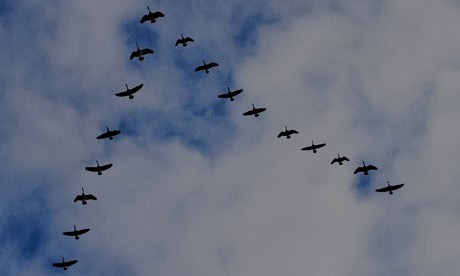
I thought it was also a given fact that as winter approaches, the geese fly south; to warmer climes, to mate, to hang out in the southern hemisphere, to barbecue and party and do whatever it is the geese do at this time of year.
Recently, the skies above Ayrshire have been full of noisily honking geese, wings beating simultaneously in tandem, flying purposefully in that efficient, energy-conserving V-formation that they’re famous for. I saw them on Friday. And yesterday. And again today. Maybe it was the same flock, cos on Friday they were most definitely not flying south. Yesterday they were heading in the same direction as the day before – which was roughly in the direction of Glasgow Airport, a short half hour’s drive north east from here. This afternoon though, they’d about-turned and it looked like their internal sat-navs had finally aligned to point them in the right direction. Or maybe they’d simply diverted and picked up a few Glaswegian pals who fancied coming along for the ride. ‘Can we no’ swing past Davie’s hoose, skipper? He’s only 20 miles up the road from here…that’s nuthin’ when yer aboot tae fly a thousand miles or so tae the sun.’
So, yeah. I’m not sure the geese are always flying south, but I do think eventually they do. Who’d want to spend the next few weeks flying 1000+ miles to end up spending six months in Greenland when you can point yourself in the opposite direction and, by flying the same distance, end up in the more favourable temperate climes of northern Africa. Geese might not always find south first time, but they ain’t that daft. The heat, the sun, the laid back way of life, not to mention the plentiful food brought on by the warmer climate wins out every time.
Geese, the band, are a bit of an enigma to me too. I want to like them. I kinda do. But equally, I’m kinda annoyed by them. The singer’s voice takes a bit of getting used to, mainly, but I like their off-kilter approach and experimental noise approach, especially as they bring everything back to the essence of song. It might have a tricky polyrhythm welded to a guitar forever on the verge of being in tune. It might have a noodling bassline and a vocal that sounds like it’s been sung by a drunk yodeller from inside a cardboard box, but it’ll still have a verse and a chorus and a hookline and a pile-on of discordant piano and ooh-ing and ah-ing backing vocals that’ll carry it to its momentous and car-crashing finale. Even if this ancient mariner is late to them, the young ones tell me they’re great, daddy-o.
Geese – Au Pays du Cocaine
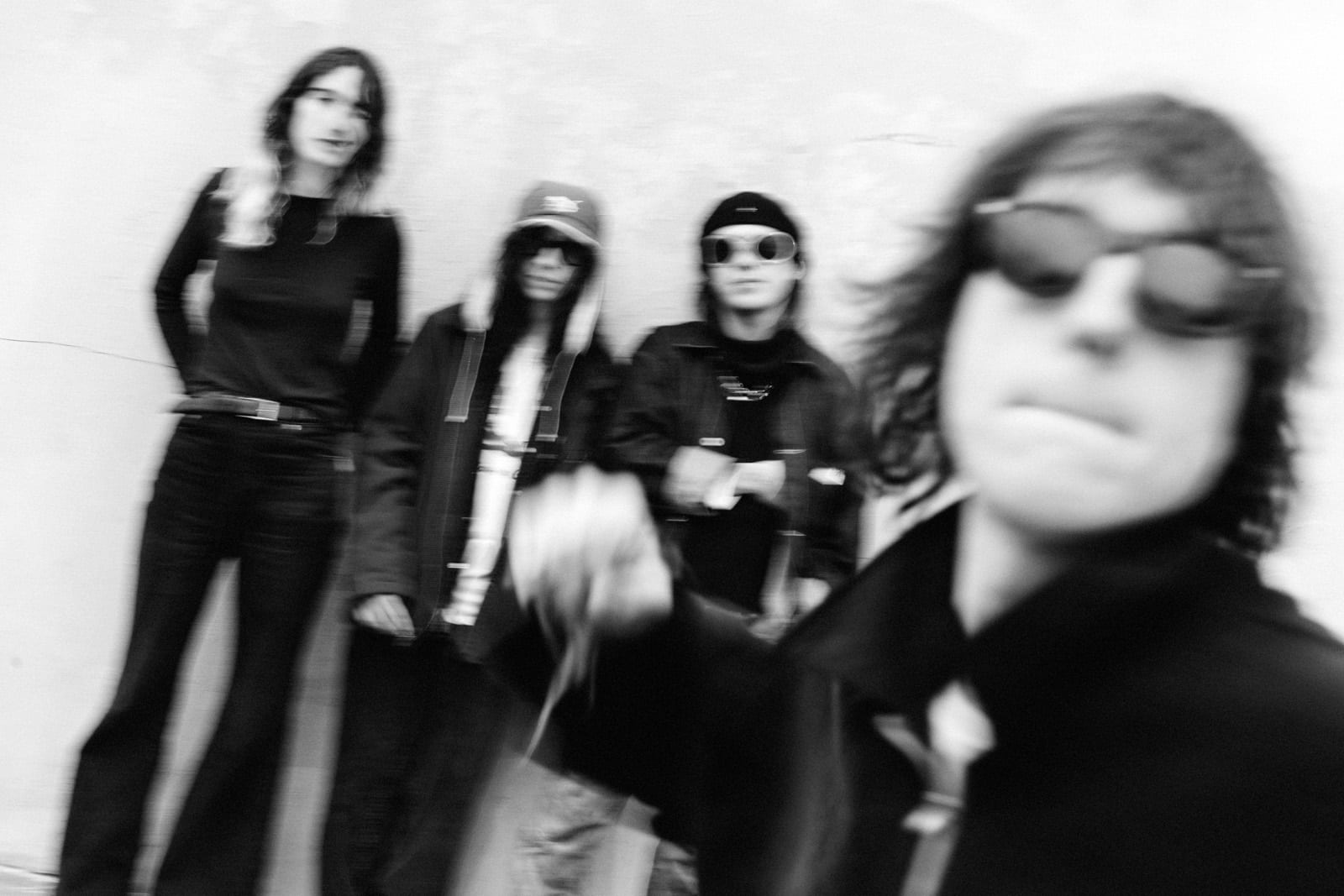
Chiming and fragile, with a mid-period Beach Boys bass line thunking through the length of it, Au Pays du Cocaine is literate, cultured and suitably arty. Not for Geese the easy and shallow option of singing of last night’s shenanigans. The Brooklynites have taken note of Dutch painter Pieter Bruegel and his depiction of excess Au Pays du Cockagne (The Land of Plenty.
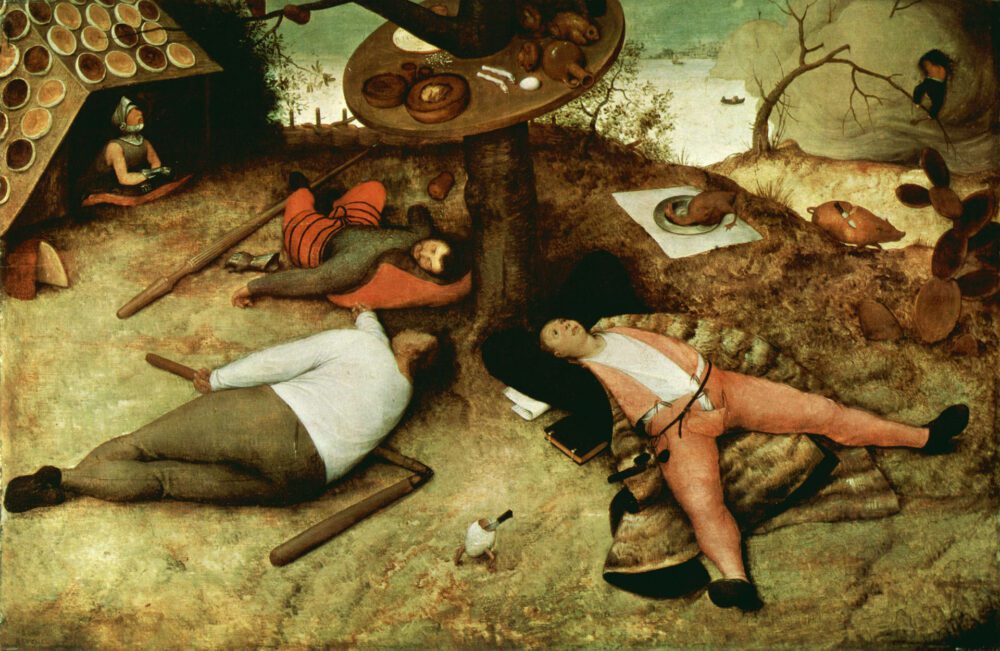
Painted over 450 years ago in 1567, Bruegel’s painting shows three main characters laid out after feasting like pigs for an afternoon. Indeed, a skewered pig wanders around, unable to do anything other than await the inevitable. Knives, forks, half-eaten eggs, the detritus of a meal are scattered around, the men’s work (a ledger, ink and pen, a lance) lie unused beside them. From underneath a roof covered in pies peeks a soldier, his mouth open in expectation of a soon to come meal. You can find all sorts of metaphorical theories with a quick Google search, should 16th century art be of particular interest, or you can draw parallels to Geese the band’s own suggestion that we in the 21st century are on a fast-track to excess and self-destruction.
‘Like a sailor in a big green boat,’ they sing, ‘You can be free and still come home.’ A bit like those south-bound, V-flying Ayrshire geese, as it turns out.

