Hard-to-find, Peel Sessions

Boiling Point, Top League

I interviewed Martyn Ware once. It was 5 days after Paul McCartney’s show at Hampden Park, should you wish to date it, and I was still flying high, buzzing on seeing a two and a half hour benchmark set of hit after hit after hit, faithfully and loudly reproduced to within an inch of the songs’ original sound and feel.

Yeah, to us, The Beatles were shit,” he sniffed in his mellow Yorkshire accent. In the mouth open, dead air gasp of disbelieving shock that followed, he continued. “They meant nothing to my generation of musicians. Nu-thing. We looked to Germany, to Kraftwerk and beyond, for our inspirations. Guitars were dead to us, even with the influx of punk groups that were springing up everywhere. To us, the guitar stood for excess and Led Zeppelin and private jets and symbols of phallic insecurity. Not all of The Beatles music was rubbish, but I wasn’t a fan and they certainly weren’t year zero for any of the people I was making music with. Punk, and the possibilities it threw up, was our point of reference. In Sheffield especially, we chose keyboards over guitars…and I think we all made a pretty good go of it.”

Had this conversation been carried out on Zoom – still a twinkle in some Silicon Valley digital developer’s eye – I’d have seen the wry, upturned smile that followed. Ware and his pals certainly made more than a good go of it. His DIY, learn-as-you-go aesthetic, first with the Human League and then with Heaven 17 and later with BEF, saw him involved in the production of some of his generation’s most well-known yet decidedly idiosyncratic tunes.

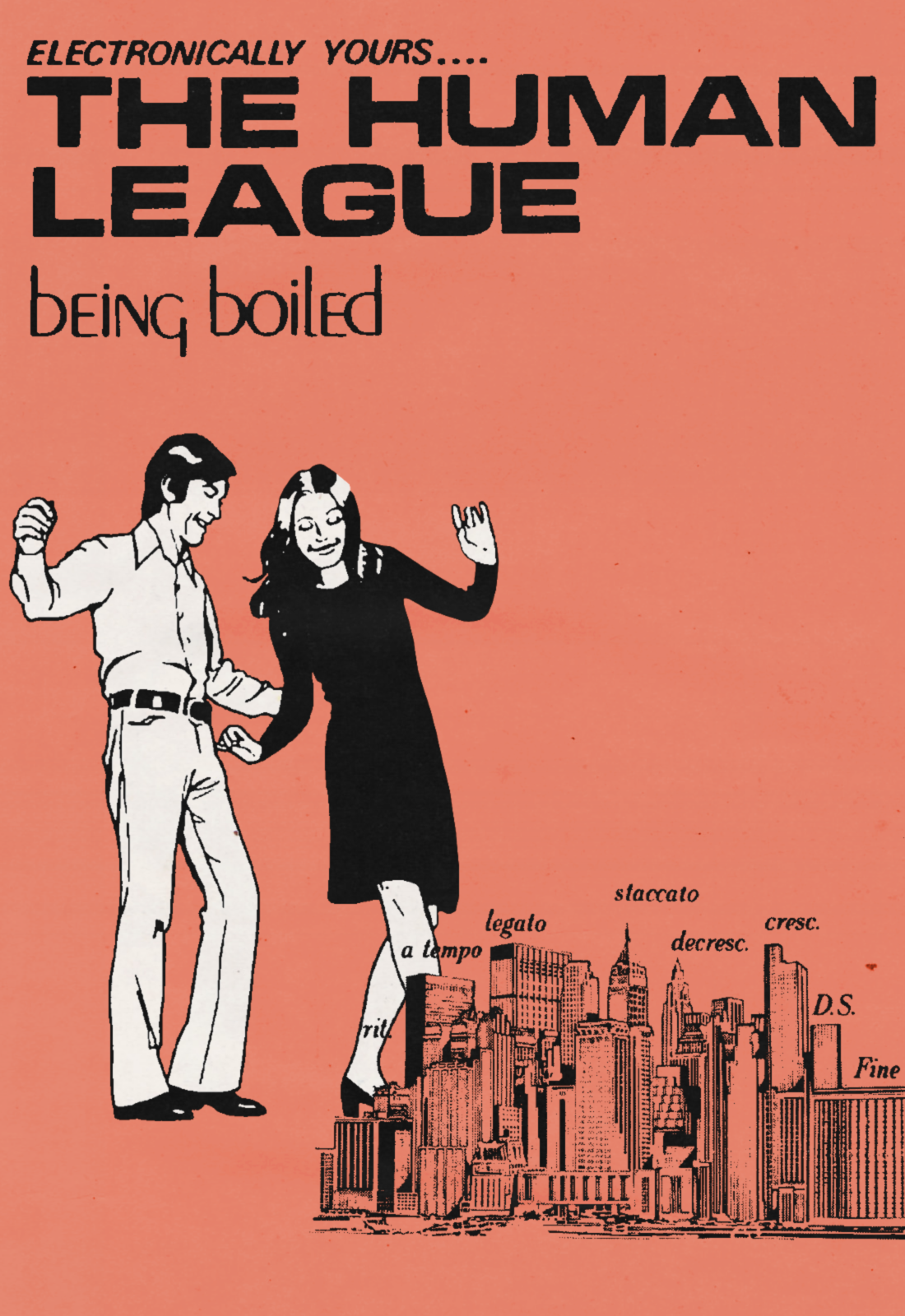
The Human League’s first single, released way back in 1978, is a case in point.

The Human LeagueBeing Boiled

It’s futuristic sounding, even now. A hissing, spitting, fizzing, electronic groove, all metronomic synthesised hi-hat and piston-powered forward propulsion that’s as industrial-sounding as the city from whence it came. Its rubberised electro bassline, part Bootsy Collins, part Larry Graham, adds requisite pop charm, offset somewhat by Phil Oakey’s monotoned vocal.

Listen to the voice of Buddha‘ he deadpans, while the rest of the band make music from anything they can plug in. Morse code dots and dashes of synth ping pong and teleprompt their way across the electrified airspace. The clickety-click of computerised clockwork maintains the tempo – slow and steady, never speeding up, never slowing down – while gently popping bubbles of Prophet and Korg and Moog coalesce nicely in the ether, the ghosts of Kraftwerk and side 2 of Bowie’s Low hanging heavy in the analogue fug. It’s a brilliant debut single, some would say never bettered, by a band who, with a different approach and new line up, would go on to ubiquity and massive chart success.

Being Boiled has long-been a favourite of mine, right up there with the nothing-like-it-at-all Mirror Man and its Supremes-ish ‘Ooh-ooh – ee-oohs’ that take me right back to a time and place. If I was a betting man, I’d wager that Steve Strange was a big fan of Being Boiled too. There is, obviously, in Visage’s Fade To Grey, more than a whiff of similarity in those vibrating, humming chord changes.

*Bonus Track!

For maximum hard boiled analogue thump, you need the Peel Session version from August ’78. It’s, like, out there!

The Human LeagueBeing Boiled (Peel Session 8.8.78)


By the way, never trust anyone who says they don’t like The Beatles. It’s all for show. Whether it’s the throwaway Yellow Submarine or the avant gardisms of Revolution 9, The Beatles have a tune for everyone. You knew that already though.

Cover Versions, Football

Grim Fairytale Avoided

To enjoy the feast, you must first experience the famine.

That’s me misquoting Chick Young, BBC Sport Scotland’s football reporter, a man much-maligned but one who seemingly has a soft spot for the wee teams and community clubs who win little in the way of silverware and league titles, but who continually go to-to-toe with the commercial nous of the big two Glasgow clubs.

In something of a role reversal, it was my team Kilmarnock who were considered the big team, the big scalp, this season. Relegated a year ago in front of 500 socially-distanced supporters, we’ve huffed and puffed in a Championship where we were expected to take the game to our under-funded and under-supported opponents each week and sweep them aside in a display of breathless, free-flowing, attacking football. I’d say each Saturday, but, being the big team, many of our games were televised on the Friday night; games in which we regularly self-imploded by contriving to lose an early goal and then frustratingly fail to break down the opposition. Twenty minutes away to our bitter rivals Ayr aside, where we were three up before anyone’s pie had gone cold, breathless, free-flowing, attacking football was rather thin on the ground.

And yet, we found ourselves top of the league and by Friday night we would wrap up the title if we could only beat Arbroath, the tiny part-time team who had continually out-fought, out-thought, out-played and out-pointed every other team in the league.

Managed by the ‘charismatic’ and ever-quotable old-school manager Dick Campbell, Arbroath were everyone’s second-favourite team. Just as Scotland go head-to-head with Ukraine soon in a match that no-one outside of Scotland wants to see Scotland win, Killie found themselves in the position of being the panto villains, the party spoilers, the most-hated team in the country. If you weren’t wearing blue and white stripes, you were wishing and hoping that wee Arbroath could pull off the (not really a) shock required. In our three previous encounters, Kilmarnock had failed to score a single goal and had they scored one more than us on Friday night, they’d have leapfrogged us into first place with one game remaining. Everyone; the BBC commentators, Rangers fans, neutrals, all wanted an Arbroath fairytale win.

Arbroath did their bit, aided by a poor referee who saw nothing wrong in a bad tackle on the edge of the Arbroath box, and, as the Kilmarnock players remonstrated, an Arbroath player ran the length of the pitch, squared the ball sideways and a cool tap in saw the perfect conclusion to their counter-attacking breakaway. Killie 0 – 1 Arbroath.

The game was turgid, Killie dragged into playing long-ball football and frustrated by a team who slowed the game down at every opportunity, wasted time and employed every level of shithousery known in the name of anti-football football. Effective, though. Outside of East Ayrshire, the country celebrated and dreamed. By half time, the fairytale was within touching distance, but a fired-up Killie would sweep aside any notions of upset in a fly-past and one-sided second half. We left it late. Very late.

Wee Burke came off the bench. Off-form since being injured early in the season, this was rumoured to be the veteran’s last game. If so, he kept his best performance for a night when 10,000 home fans would be chanting his name in delight at the drive, determination and dribbling skills he had in his last twenty minutes locker. He sent over dangerous corner after dangerous corner and, after Shaw had seen his powerful downwards header sclaffed off the line,Taylor followed it up and slammed it into the roof of the net. The 80th minute equaliser was met with an explosion of noise heard as far away as deepest, southest Ayrshire. One goal wasn’t enough to win the league though. Continual Killie pressure prevailed. The Arbroath goalie was playing the game of his life, clearly injured yet turning shots round the post, over the bar, like Dino Zoff in his prime. Real Roy of the Rovers stuff. We battered and battered his goal. A winner would surely come.

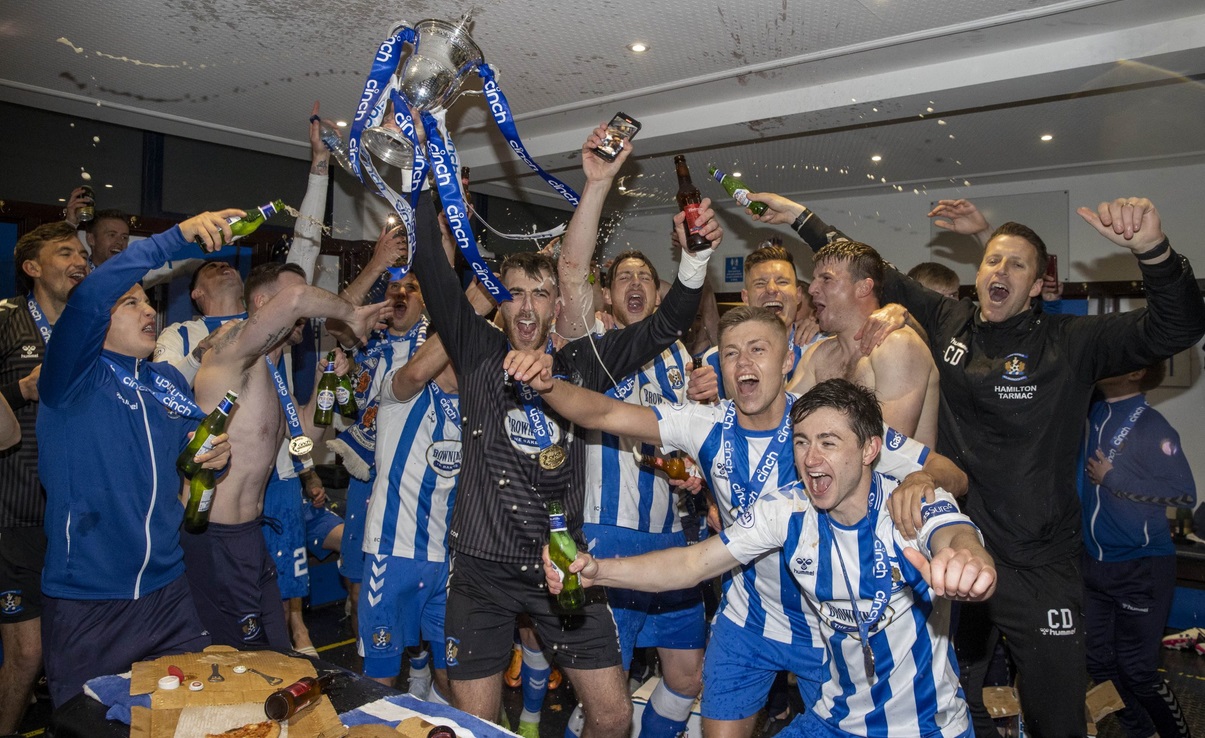
It did. Late in the 89th minute, a beautifully-weighted long ball down the right saw Lafferty cooly control and pass it in one sweeping movement. Shaw, our number 9 controlled on the edge of the box and, as the clock turned to 90 minutes, laid it off for the on-rushing Alston, an attacking midfielder who for most of the season has come in for an unfair amount of stick. Alston shifted the ball smartly from left foot to right and, without breaking stride, stroked it home. Bottom right corner, the keeper static. Alston’s top was off and windmilling wildly above his head before the ball had even nestled properly in the net. The entire team, the subs behind the goal, even Hemming our goalie, displaying a Bolt-like sprinting ability to run the length of our hated plastic pitch, piled on Alston the hero. Watching back on the telly, I spotted a former pupil, a ball boy for the night, right in the middle of the celebrations. Scenes, as they say. A real, scripted, Hollywood ending, even if, for most of the country, the wrong team won in the end. Grim fairytale avoided.

Killie last won the league in 1965. Since then, they’ve been relegated to the lowest league, worked their way back up through the ’80s – never winning a title, always going up as runners-up – and, until last season, had spent 28 years in the top flight. It’s not often then that Killie fans see their team win a league. Any league. It’s great to be back where we belong.

Otis ClayThe Only Way Is Up

Many (most?) folk assume that The Only Way Is Up was written for Yazz. Not true. Matt Black and Jonathan More – Coldcut to you and I – had a microscopic knowledge of rare and under-appreciated soul and recognised the potential in Otis Clay’s 1980 little-known original. Adding snatches of samples and a busy, train-like rhythm to a glossy, hi-nrg house production, they sat back in their swivly producers’ chairs and watched as it rattled and thumped its way to the top of the charts.

The original bears all the hallmarks of classic soul; chicken scratch guitar, sweeping disco strings and stabbing brass. If you didn’t know better, you could be be convinced it’s a street-smart cover of a ubiquitous ’80s pop classic, when in fact Clay’s version is the original. You knew that already though.


Get This!, Gone but not forgotten

Ford Escorts

Nothing will ever prepare me for the speed of the passing years quite like a memory linked to music. A quick brain-frying calculation tells me that March 1994 was over 28 years ago. Twenty! Eight! Years! That this happened almost three decades ago yet is still fresh and ripe in the memory is testament to the power of pals and music and the inter-linked way in which my brain (and possibly yours too) relates everything in life to some musical reference point or other.

Primal Scream were playing in Ayr, the end of the same week, as it happens, when Give Out But Don’t Give Up was released. Not quite the epoch-defining masterpiece of its predecessor Screamadelica, the gig was nonetheless sold out to the point of being over-sold. Long-starved of decent touring acts, half of the county, and roughly 95% of every Ayrshirite under 25 was in attendance, rammed in, shoulder to shoulder and desperate to hear what may well have been the country’s greatest ‘underground’ band at the time. We were ‘Scream veterans (naturally), having seen them at least three times previously around Screamadelica, although as much as anyone might like to claim otherwise, none of the five of us had been hip enough to have seen them play Vikki’s in Kilmarnock, a venue so compact it would make King Tuts feel like an arena in Kansas.

Ayr Pavilion though was a good venue; smaller than the Barrowland, more clubbier in feel, with a balcony ripe for Quadrophenia-style derring-dos and a nicely sprung dancefloor on which to zone out and get down to the Scream Team’s E-fuelled and vaporised MC5 jams. That huge acid-fried sun logo hung from the back of the stage and Screamadelica material still featured heavily in the set – I mean, why wouldn’t it? – with Denise Johnson taking just as much and possibly even more of the vocals than the stick-thin Bobby Gillespie who, at one point, pointed to my Keef ‘Stones Slay The States‘ t-shirt and gave me a fat, flat, tongue-out gesture of solidarity and acknowledgement.

Bobby shaking his perfect Jeff Beck crow’s nest mop and breaking into a mile-wide smile before making a real-live Stones logo just for me isn’t though the first thing that springs to mind whenever I think of Primal Scream in Ayr.

Nope.

It’s Orange Juice.

We all went, the five of us, in Derek’s Escort. As usual, I was squashed in the middle of the back seat between two of my larger pals, who moaned all the way to Ayr that there was no fuckin’ room for three of us in here, Derek. Stopping at the petrol station, Derek shook us loose for spare change – if that doesn’t date this story, nothing will – filled the car and off we went. One of our party had returned from the forecourt with a magazine liberated from a shelf that I certainly couldn’t have reached, your honour, even on tip toe, and this different sort of Escort was flung around between us, pages torn loose and stuck to the dashboard, the windows and Derek’s sunvisor without his asking. Har-de-har har! You can imagine. We were in our early twenties. It was the era of Loaded. And Loaded. We wanted to be free, we wanted to have a good time, we knew not what we were doing. Shameful harmless fun. Wince.

Derek was in charge of the tunes. He had a box of cassettes under the passenger seat and one was already in full flow by the time he picked me up. Some Velvet Underground. Some Jungle Brothers. Lloyd Cole and The Commotions. Urban Cookie Crew’s The Key, The Secret. Derek loved that. A carefully considered mix of classic and contemporary for discerning listeners such as us. As we pulled away from the petrol station, the snaking, Eastern-tinged 12 string riff of Orange Juice‘s Breakfast Time wandered on.

Orange JuiceBreakfast Time

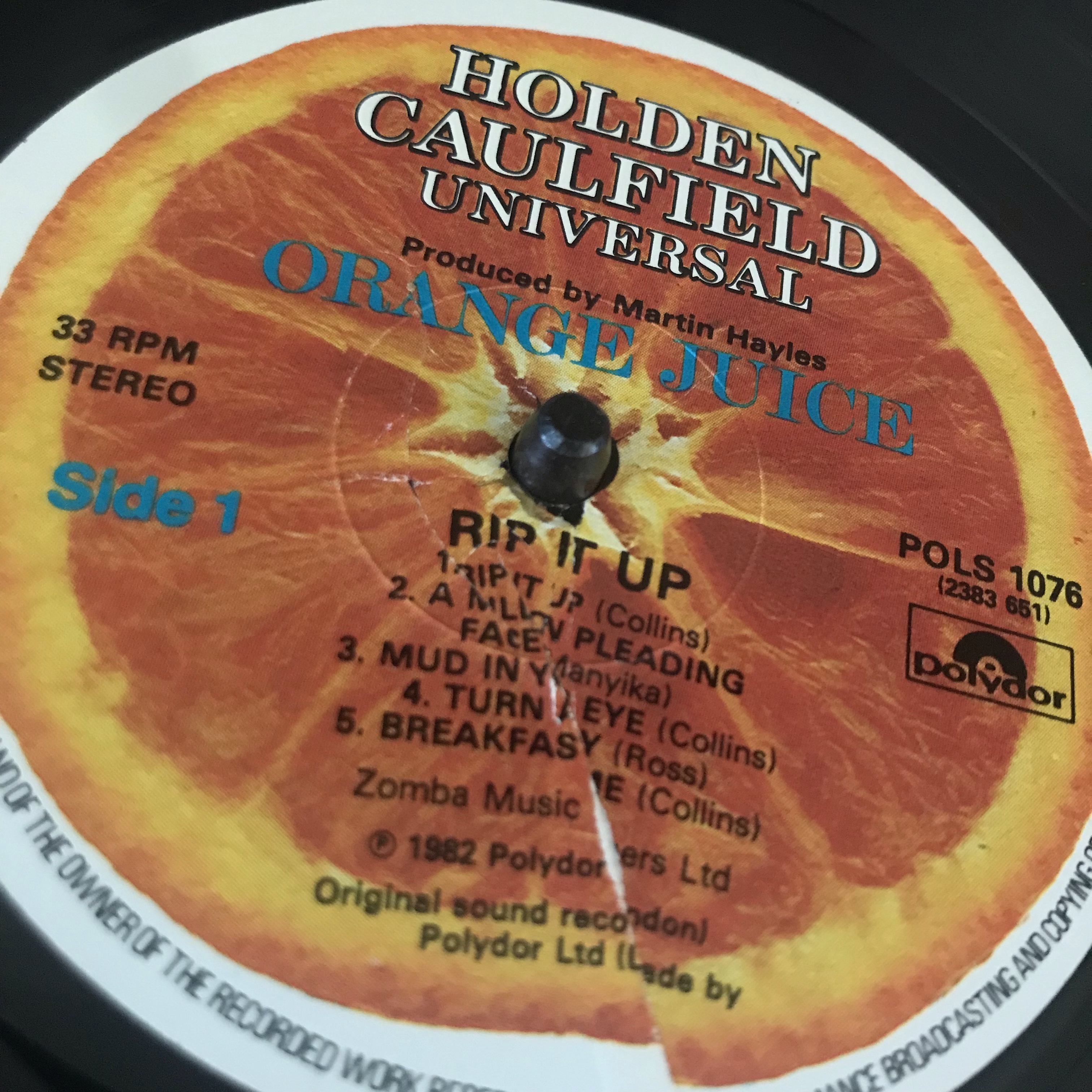
Ripped up Rip It Up label

Tune!” shouted Derek and cranked the volume that wee bit higher. The bassline boinged its way across the car’s plastic interior, rattling the windows, shaking close-ups of vulvas and nipples loose and free.

Breakfast time!” sang Colin in his best Edwyn-voiced impression. “Brrrreakfast time! The hands that tell me, five to nine!” Hands tapped on cold, hard, door cills, dashboards, anything, in unison to its cod-reggaed offbeat. Heads subtly nodded. Feet no doubt tapped. I played hi hat with my fingers on my thighs and joined Colin in the chorus? bridge? I’m never sure. “…souls entwine! Souls entwine! Souls en-twiiinne!” D’you know that bit in Wayne’s World when they all start singing individual lines and then headbang to Bohemian Rhapsody? Yeah, well, it was nothing like that. We were far too cool for that sorta shit.

When the song finished, Derek rewound, overshot the mark, and landed instead on the last half minute of De La Soul’s Magic Number. Now every time I hear Breakfast Time, it’s inextricably linked to a snippet of De La Soul’s daisy-aged hip hop. Funny how it works, isn’t it? By the third time of rewinding though, Derek was able to land the starting point right on that opening guitar riff – “Check that ya dobbers!!” – and we’d all be off and grooving once more. Breakfast Time was the soundtrack to the entire journey from that petrol station in Dreghorn to Ayr…and back. Without exaggeration, we must’ve listened to it 17 times or more.

The achingly hip – the kinda people who saw, possibly even supported, Primal Scream at Vikki’s – point to Orange Juice’s Postcard output as being the high watermark of their undiluted quality. Sensible folk will highlight You Can’t Hide Your Love Forever and point out that, despite being on a major label, it’s the album the band always wanted to make. The smart folk though will direct you to Rip It Up, the second album and parent to The Hit Single of the same name. Falling somewhere between the brass and rhythms of The Jam’s Gift album and the ambitious mass-market appeal of dazzling guitars married to raggedy-arsed soul, it took Orange Juice from the margins to the mainstream.

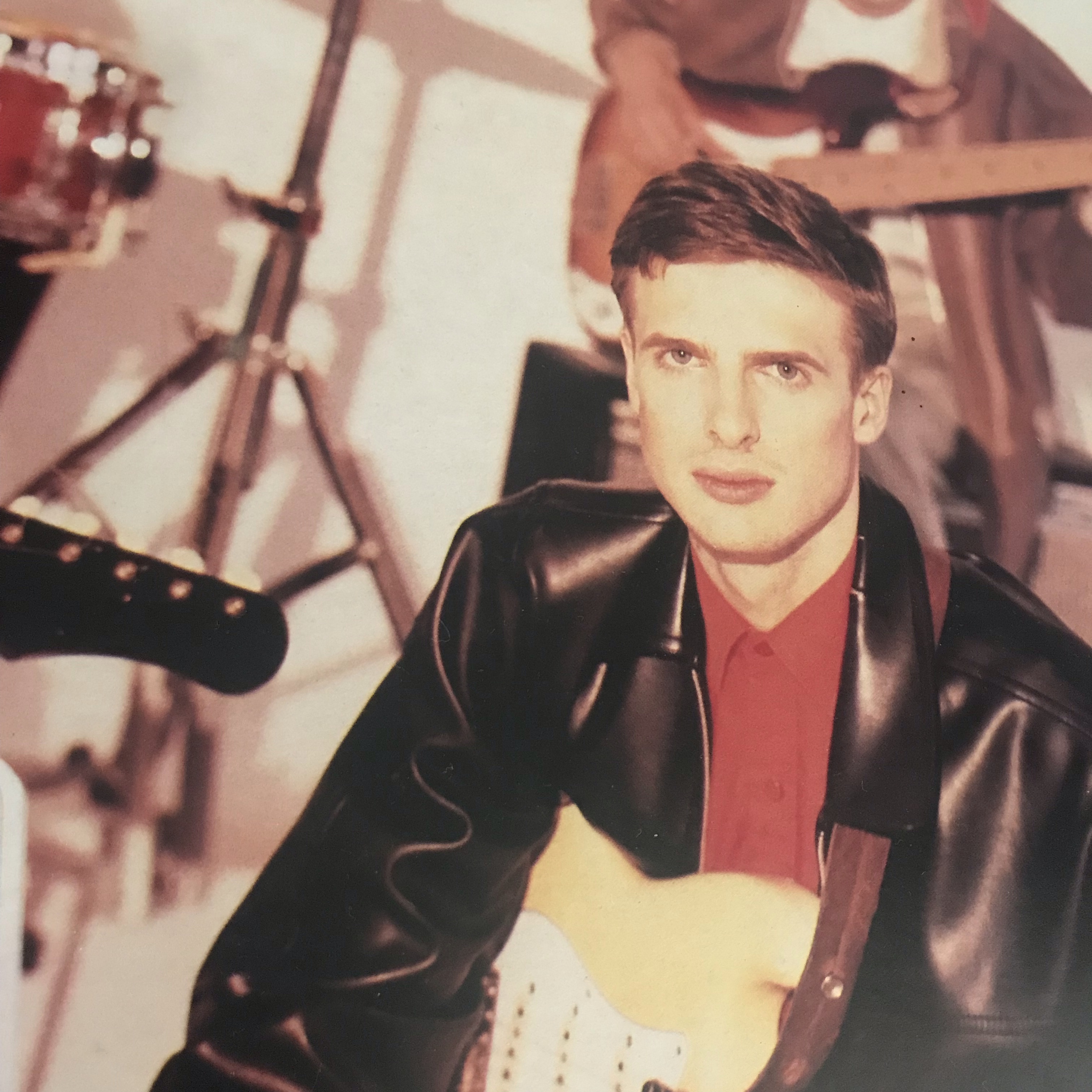
It’s just as well they looked so goddamned wonderful on the cover. Malcolm Ross sits with a lovely, yellowing Strat, a shiny leather jacket and a defined jawline so sharp it might cut your finger if you hold the record sleeve in the wrong place. Sharp indeed. Edwyn is wearing not one but two perfectly-contrasting stripy t-shirts and cheap, Asda-priced Raybans. And he looks a million dollars for it. Young, self-assured, film-star handsome. Such smooth skin.

His hair – it was always his hair – is beautiful; a collapased quiff mixed with RAF bomber pilot side shed and sheen. ‘Can I have an Edwyn, please?‘ you might’ve asked George at Irvine Cross as you sat down and his scissors clickety-clickety-clicked in 100 mph readiness. And he’d have told you no, it was impossible, no-one gets to have hair as great as Edwyn Collins; not you, not that guy who’s up after you, not even even Nick Heyward, who was clearly keenly listening and looking. Maybe it was the fact that his name was another word for ‘steal’, but he now had his winning blueprint for Haircut 100 and Smash Hits and teenage girls’ walls and a ubiquitous chart success that would somehow elude the masters. Despite the lack of success, Orange Juice had both style and substance. Talking of substance, what about that Primal Scream gig? I’d forgotten all about that. Oh, as the featured song goes, how I wish I was young again.

Get This!, Hard-to-find

Jumpy Record

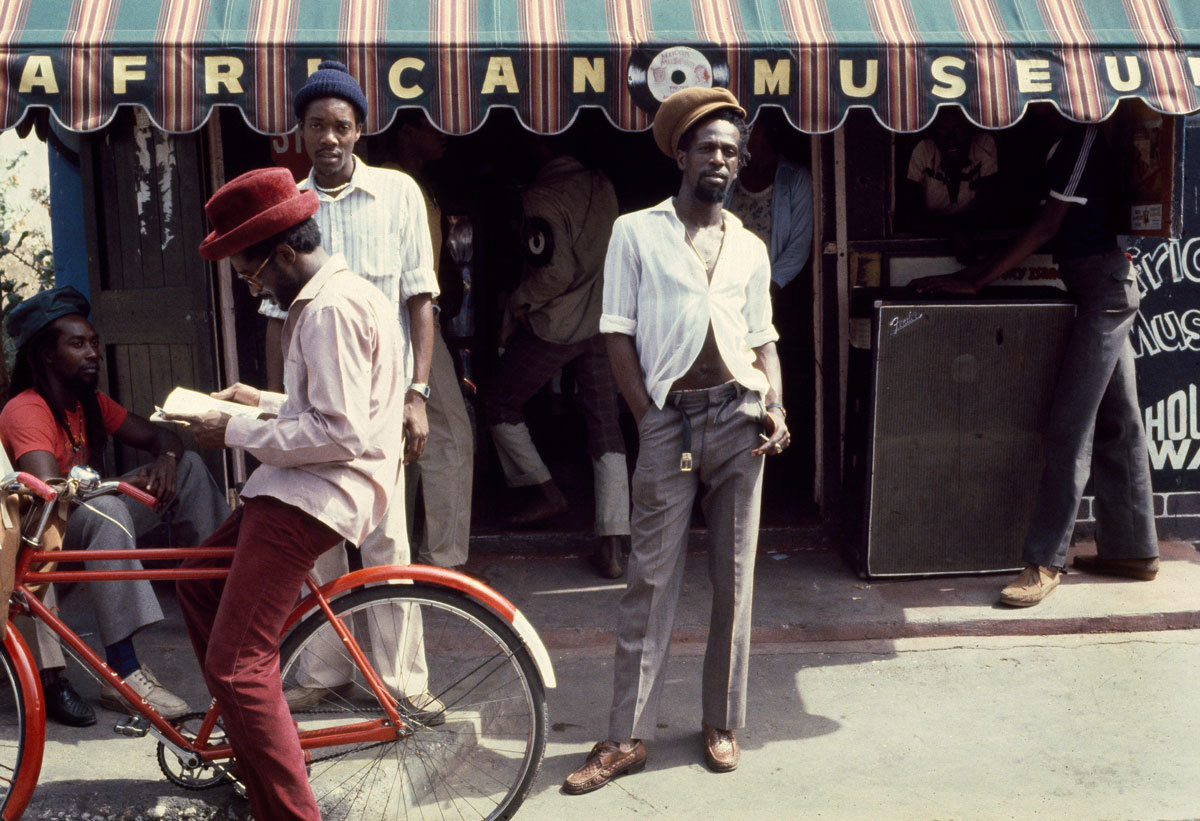
Feel Like Jumping by Marcia Griffiths is a perfect slab of baked in the sun pop-reggae. In 1968, a few years before she was one of the I Threes, providing backing for Bob Marley and The Wailers during his imperial, ubiquitous phase, she was a young hopeful, given the chance to make her own mark on Jamaican music. Signed to the mighty Studio One and produced by Coxsone Dodd, Feel Like Jumping was written by Griffiths’ partner Bob Andy, so prolific a writer that you might call him the Lieber AND Stoller of that early reggae scene.

Marcia GriffithsFeel Like Jumping

Breezing along on a wave of jaunty, rasping brass and Motown-ish ‘woo-hoo-hoos’, Feel Like Jumping has the same great 1, 2, 1-2-3 bassline that first appeared on The Ethiopians Train To Skaville, powered Toots and the Maytals’ 54-46 Was My Number and, 20 years later, would pop up again, sampled and looped by Double Trouble to form the bedrock upon which the Rebel MC proved just how Street Tuff he was. I’m sure Paul Simonon was more than familiar with the rhythm and feel of its ten note pattern as well. Sped up, it wouldn’t sound out of place on any of The Clash’s more caustic ramalamas. Slowed down, it makes the ideal anchor for dub.

Griffiths does a brilliant call-and-response vocal with her backing singers, la-la-laing and woo-hoo-hooing her way throughout the record as the band plays head-noddingly and disciplined behind. Clipped guitars, barely-tickled hi-hat, that joyful vocal loud and centre. If music had facial features, Feel Like Jumping would be a big, round, smiley face.

Griffiths’ backing band was effectively a version of The Skatalites, known by 1968 as Sound Dimension, Studio One’s in-house version of The Wrecking Crew or The Funk Brothers. In their own right, Sound Dimension cut some brilliant instrumental records, like the whacked-out dub of Granny Scratch Scratch

Sound DimensionGranny Scratch Scratch

If Talking Heads hadn’t been listening to this before coming up with Slippery People I’ll eat my oversized white suit in shame. C’mon Byrne, ‘fess up.

As much as they were a crack unit worthy of their own album release, the musicians in Sound Dimension were encouraged more to provide the backing tracks for Studio One’s solo stars – Marcia, John Holt, Ken Boothe, Dennis Brown and others. Any of those artists’ records from 1967 onwards – Young, Gifted And Black, Ali Baba, Everything I Own, Money In My Pocket – songs that you will know, love and play on repeat – feature the combined, tight ‘n taut talents of Sound Dimension.

I go through phases of playing reggae and ska non-stop (usually at the first sign of sunlight) then sicken myself to the point where I send it all back into hibernation again. It’s always the perennial Feel Like Jumping that pulls me back in and has me turning the bass notch on my amp clockwise an extra notch or two. Here we go again.

Get This!, Hard-to-find

Purified Soul

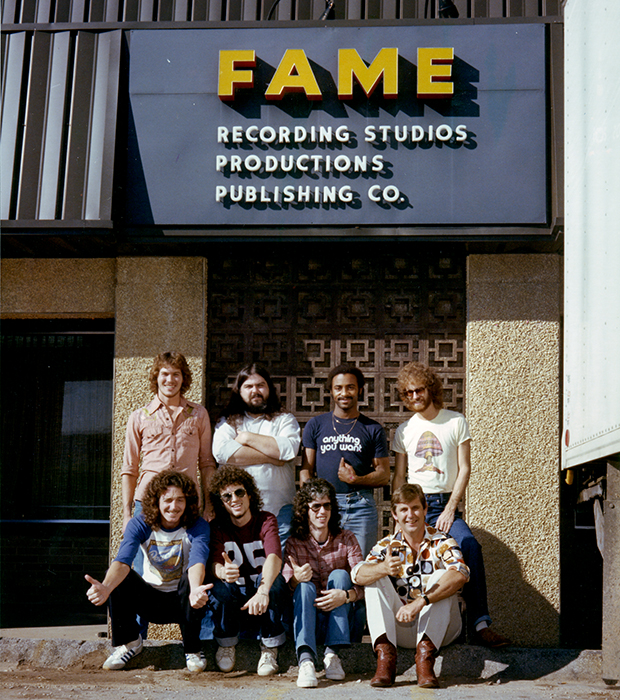
If Motown was hit factory-produced street-smart pop and Stax was its rougher round the edges punkish southern soul sister, then Fame was the mongrel hybrid of both. A studio with a hit-making pop sensibility that retained its southern fried Muscle Shoals identity, Fame was responsible for recording some of the greatest under-the-radar soul music in recorded history.

At this point, musical trainspotters and soul aficionados will roll their eyes and reel off a list of 20 essential Fame tracks that everyone should know immediately, but as a label, Fame is relatively undervalued; the Hollies to the Beatles and the Stones, the Inspiral Carpets to the Roses and the Mondays. Great, yet overshadowed by more greatness.

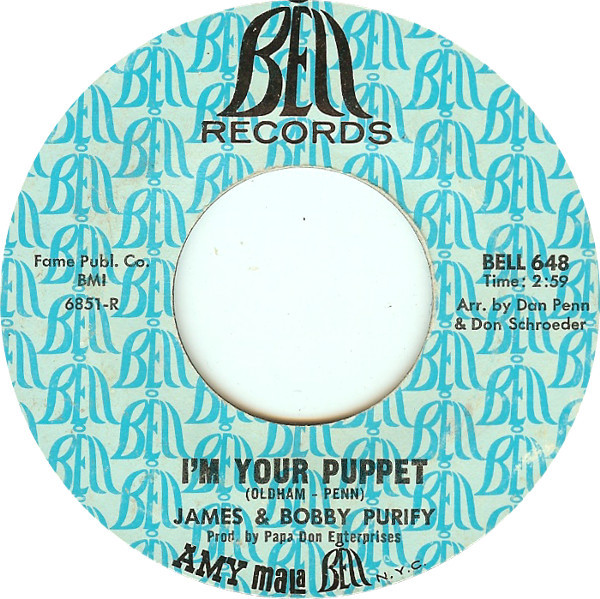
Released on Bell Records in 1966, I’m Your Puppet was written by the gigantic combined talents of Dan Penn and Spooner Oldham (the pair of songwriters responsible, as you know, for such titans of popular song as The Dark End Of The Street and I Never Loved A Man (The Way I Love You)). Penn’s version was released first, but it was the version by James & Bobby Purify that really connected with radio stations, and ultimately record buyers.

I’m Your Puppet – James & Bobby Purify

It’s a wonderful song, with a lyric of helpless puppy-dogged affection that will ring true with anyone who’s ever fallen hard for someone else. And that’s everyone, right?

Pull the string and I’ll wink at you…

Snap your fingers and I’ll turn you some flips…

I’ll be wonderful, just do what I’m told…

Treat me good and I’ll do anything…

I’m yours to have and to hold…darlin’, you’ve got full control of your puppet

In a handful of verses, it runs the whole gamut of what soul music is; a universal theme welded to four chords of gently lilting musical accompaniment, all tinkling pitched percusssion and clipped guitar, slightly out of tune piano runs and honeyed sax for added emphasis, always, always just a notch lower in volume than the vocal sung sincerely and with requisite tear-jerking pathos and emotion. Then there’s the major to minor key change in the bridge, the call and response section, the parts where James and Bobby trip over one another to get their own vocal adlibs in… the very definition of what soul music is.

Oft covered, it’s exactly the sort of track that Alex Chilton could’ve mastered with Teenage Fanclub back in the early ’90s when they briefly showed up as his backing band, Norman and Gerry providing the close-knit harmonies atop Chilton’s choppy guitar riffage and world-weary delivery. For a couple of reasons, this will forever remain an unfulfilled wish.

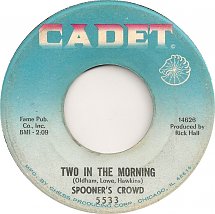
Another underheard Fame beauty is Two In The Morning by Spooner’s Crowd.

Two In The MorningSpooner’s Crowd

Cut live in the studio, Two In The Morning is, as the label suggests, the Fame house band led by Spooner Oldham grinding their way through a mod/soul/r’n’b groover that owes a great deal to Green Onions and any number of those great swinging mid ’60s finger-clickers.

Cut to sound like the listener is entering some nudge-nudge, wink-wink members’ only club or other, it’s a proper full-on strut of a record, big loose ‘n funky bass notes on the piano playing just off the beat, primitive fuzz organ supplying the melody and a “say, honey…wild!” spoken word interlude straight outta the Cotton Club or Peppermint Lounge for added bona fide authenticity.

Ideal music for kick-starting a late night on lively tunes….and, just like the studio from where it was born, sufficiently unknown as to be underplayed and under appreciated.

Get This!

Power. Passion.

True story: At the tail end of the ’80s, a musician pal of mine shared not only management but a hotel with Debbie Harry. Different rooms, just to be clear, although I suspect that’s what you were thinking anyway. Weren’t she and Chris Stein an item at that time? I digress…

D’you want to meet her?” asked the manager.

Damn right I do,” said the musician.

Calls were made, diaries were checked, his people talked to her people and, in the lobby of one of New York’s more salubrious hotels, my pal was introduced to Debbie Harry, all chiseled cheekbones and Cupid’s bow red lips, grown-out bottle blonde bob and a dazzling mile-wide smile; classic Harry, in other words.

Very pleased to meet you!” he said aloud.

“(I used to masturbate to you!)”, he thought internally, “(…and with this very hand!)”, his palm finally coming into contact with the object of his decade-long lust.

He-eeeyyy! Great t’meet yoooouuu toooooo!” drawled Debbie with effortless ennui, shaking his hand loosely, the vowels trailing off like verbal ellipses into the night, quickly followed by her gaze as she scanned the room for someone, something more interesting. She’d carried out this sort of shit for longer than she cared to remember. Over and done with in less time than it takes to mouth “Atomic!“, with a flick of the bob and turn of the designer heel, she was gone.

I licked my hand after, but!” he offered as a way of winding his story up. “I could still taste her an hour later.” One day he’ll maybe ask me to ghost write his life story. There are plenty stories, he assures me, just like this one.

Union City Blue is Blondie on steroids, in widescreen.

Blondie Union City Blue

The airy spaces between those twanging electrified notes that play its signature riff are just as crucial to the feel of the record as the notes themselves; tension and release in an intro that’s become immediately recognisable – “I’ll name that tune in one!” – as Clem Burke’s Moonisms on the drum kit propel the whole thing forward.

The story goes that when Blondie recorded Heart Of Glass, producer Mike Chapman forced Burke to play to a click track as a way of ensuring he kept to its strict and rigid disco beat. Burke, being a Brit Beat-obsessed mod, hated the controlled regimentation of it. But on Union City Blue, he’s allowed to cut loose, and as a result, the whole tune from the intro forward is carried along on a wave of flailing arms and splashing cymbals, Chelsea-booted kick and rifle-sharp rattling snare. He loves his drums, but he hates his drums, knocking seven shades of shit from the skins like there’s no tomorrow; the reason it’s his favourite Blondie song to play live. Young Clem is almost the star of the show…until Debbie makes herself known.

Oh oh, oh oh, what are we gonna do?

The juxtaposition between the melancholic melodrama in her voice and the controlled riot of the band behind her is what makes it. And that’s before we get to the key change.

Tunnel to the other side, it becomes daylight, I say he’s mine.’

Debbie’s voice is loud and central, the incontestable star of the show. You could fall in love with her just for her opening couplets on this song alone. Such is their power and engrained Proustian effect, I am immediately transported back by her breathy romantic yearning to a game of Subbuteo in my bedroom with Graham Crichton, my newly-bought copy of The Best of Blondie rotating continually (as he flicked to kick and I didn’t know).

It doesn’t matter that the lyrics are a load of nonsensical rubbish, it’s the sound of it that matters…the joy and freedom and soar as it reaches for the stratosphere and shoots far beyond. There are reign-ins (‘Power! Passion!‘), rock outs (‘Arrive! Climb up four flights...”) and drop outs; that little rev of bass at the 2 minutes and 3 seconds mark… it never fails to hit the spot.

Beyond their punk roots, beyond the jerky new waveisms of Parallel Lines, far beyond any of their peers at the time, Union City Blue is possibly Blondie’s finest moment. The video, a windswept Debbie in mirrored helicopter shades and orange jumpsuit, the band behind playing it straight and giving the lion’s share of the lens to the singer, only serves to enhance it.


Get This!, New! Now!

Sweeter Gabriel

Ten years ago, Jacob Lusk was one of the many big-voiced, big-hopes talents on American Idol that hung onto the fading coat tails of his dreams week on week until finally being eliminated at the top 5 stage. A decade later, dreams seemingly smashed, he’s back under the name Gabriels, signed to Parlophone and recording gospel-tinged soul that sounds authentically vintage but is as box fresh as a new pair of Air Jordans. American Idol’s loss is very clearly authentic, soul-stirring, respectable music’s gain. 

Sneaking out at the very end of last year, Love And Hate In A Different Time is the lead track from a long sold-out 6 track EP that’s already selling at eye-watering online prices. A low-key soul belter, Love And Hate… is all pounding rhythm, call-and-response, take-it-to-church vocals and snapping handclaps wafted straight off of some talc-dusted floor in a forgotten northern Mecca. Clomp your Weejuns at the appropriate time and you’ll convice yourself it’s 1975 and you’re hopped up on stolen Dexies in the Wigan Casino. It’s the sort of track that I know many of you will be familiar with and love already.

The music is great, on point as a long-lost 45 from the gospel/soul crossover era, the sort of thing Aretha Franklin’s early advisors might’ve had her lined up to sing on. It’s retro sounding, but brought right up to date with those wee synth whooshes – ‘eee-wooo!‘ – that separate the soul fug like a zip running up the middle of a mohair jumper. Not quite right on first impressions, yet unique, individual and totally acceptable once experienced.

The musicianship is one thing; those on-the-one cinematic string slides, the loose ‘n effortless jazz club piano and a snare beat that’s absolutely ripe for sampling, but it’s the vocal that elevates the track to greatness.

Having been pigeonholed as a Temptations’ covering, Luther Vandross loving crooner, those daft judges on the telly couldn’t hear Jacob’s true voice for all it was worth. With a tone that’s soft and rounded, he sounds not unlike Antony/Anohni channeling the spirit of Billie Holliday. Falsetto, yes, but with filling-loosening bass tenor when required, and dusted in the smoky undertone of a God-fearin’, spiritual-hollerin’ veteran.

Free from the naff pigeonholing shackles of mainstream TV and a need to compromise and fit in, he’s able to talk freely of his Christianity without alienating half his TV audience or making those slaves-to-sponsors telly executives jumpy and twitchy. Consequently, Jacob is much happier in the skin he’s in…and he’s unwittingly revealed himself as the most authentic soul singer since…well, add your name of choice here: __________ .

A recent run of UK ‘club’ dates, as they say, was abruptly cancelled recently, including a show at King Tuts. Shame that. No doubt greedy agents and double-crossing promoters are lining Gabriels up for headline shows in grander venues. Catch them before they become too big is what I say.

Get This!, Hard-to-find

Cullen Card

We asked 100 people to name a musical duo from Scotland.”

With a TV audience of millions watching and a five or six-figure jackpot prize hanging on your answer, the chances of a clued-in contestant offering up Boards Of Canada, let alone finding them in the list of Family Fortunes‘ half a dozen top answers would be slim to non-existent.

The Proclaimers!” Ding!

The Alexander Brothers?” Ding!

Eh… Arab??… eh… Strap??” Ding!

But not, never, Boards Of Canada. !Klax-on!

Boards Of Canada rarely make videos. Hardly ever (and possibly never) do press. Haven’t played live in over 20 years. The likelihood of them popping up between Phil and Ally to provide an alternative, modern-thinking, left-of-centre soundtrack while Jackie Bird brings in the bells from Edinburgh Castle is about as likely as a statue of Margaret Thatcher being erected in Auchinleck town centre. They are low-lying to the point of anonymity, and I suspect that’s the way, uh-huh uh-huh, they like it.

Formed in 1995 by brothers Mike and Marcus Sandison in the north east seaside town of Cullen, their music has given the world four albums and a handful of EPs. All are different yet all are fairly recognisable as the work of a band steeped in analogue production, vintage synths and the use of unfashionable and outdated technology as a means to produce warm, ambient electronic music that boils and bubbles with all the warm blooded soul of a beating human heart.

2006’s Trans Canada Highway EP may well be the missing link between Radiohead’s more adventurous excursions in electronica and My Bloody Valentine’s self-indulgent guitar manipulation.

Dayvan CowboyBoards Of Canada

Opening track Dayvan Cowboy is the band in miniature, its looping whitewash of fuzzed guitars, skeletal percussion and layered windrush of synths nestling murkily inside your head before the musical clouds part and, two minutes and seven seconds in, a bright light of aural sunshine sweeps the room. In dance terms, you would call this ‘the drop’. In Dayvan Cowboy, it’s the drop in reverse, the equivalent of coming up for air after a deep sea dive, a gasp of clean oxygen at the end of a journey living on borrowed air.

Gently broken hip hop beats rattle and ricochet, synthesised strings sweep across the ambient electronica, more rushing wind, more tinkling percussion, lovely wee doorbell-like chimes every now and then; head music for the soul as it peters out to its untimely multi-layered end. Someone should make one of those ultra slowed-down 3-hour versions and stick it on the internet for full-on effect. I suspect it would be just as brilliant.

All in, it’s lovely stuff and it makes even more sense in (slightly edited) video form:

Elsehwere on the EP you’ll find Left Side Drive – (LSD?) – yet more ear-burrowing, creeping electronica that features a borrowed rhythm that may well be a processed version of the beats in Massive Attack’s Karmacoma melded to slo-mo flotation tank music that very possibly was recorded in a dimly-lit bedroom or basement, with a couple of lava lamps and a copy of Pink Floyd’s Meddle for company, perhaps even the fragrant fug of Morocco’s finest curling tantalisingly around the nostrils.

Left Side DriveBoards Of Canada

Interestingly, or incredulously even, Solange Knowles – Beyonce’s wee sister – recorded a totally unofficial track that features her breathy soulful vocals floating across Left Side Drive‘s wafty ambience. It’s not the best track you’ll hear this week, but nor is it the worst. Chances are, given that it first surfaced in 2011, you’ve heard it before.

So there y’go; a track that links pop R’n’B superstar Beyonce to Scotland’s under the radar electronica pioneers Boards Of Canada. Who knew?!

Gone but not forgotten

I Don’t Understand This Thing At All

A work colleague pointed me in the direction of Tunnel 29, Helena Merriman‘s brilliant docu-novel of life in Cold War Berlin as the wall went up and it split into the Americanised west and Soviet-controlled east. The parallels with the war in Ukraine are never far from the mind as you read; the under-the-radar planning and meticulous thinking that kick-started things…the sudden, desperate need to escape the iron fist of Russian rule…the sheer numbers of Soviet troops surrounding the area; heavily armoured, well-drilled, seemingly impervious and always advancing, greedy for land and territory at any cost…with the unholy whiff of war crimes following their every leader-sanctioned move. If you didn’t know, the book might read like a Ukrainian refugee’s diary from this morning.

Merriman’s collected stories refers to a famous picture that I wasn’t aware of until now.

In the picture, taken in 1961, 19 year old Konrad Schumann, a recently-recruited member of the Bereitschaftspolizei (the riot police), is seen leaping the barbed wire fence that separates east Berlin from the west. Konrad is in mid-air, throwing off his gun, literally in the process of defecting from state-controlled aggression to the freedoms of the west; hamburger joints, rock and roll, education, opportunity.

It’s a powerful picture, with the blurry group of gossiping east Berliners looking pensively on and the half-hidden image of a West Berlin TV cameraman capturing it forever on film as young Konrad springs from the barbed wire he had been surreptitiously tramping down in the hours and minutes leading up to his leap to freedom.

The ‘wall’ was only three days old at this point. Put up without warning in the middle of the night, it snaked and scarred its way through Berlin, right down the middle of roads, across gardens, between houses, separating friends and family wherever they happened to be. Men and women who worked in the factories of West Berlin were suddenly cut-off from their terrified and confused families in the east. Men and women who worked in the factories of East Berlin were suddenly cut-off from their terrified and confused families in the west. Neighbours could look out at one another from across the barbed wire, but they were forbidden from talking to one another. They weren’t supposed to wave, acknowledge one another in any way at all. It fell to hastily-recruited border guards like Konrad to put the necessary muscle on them to ensure they complied. People in the east who were caught talking to their loved ones in the west were taken away by the Stasi, the secret police. Tensions were high.

West Berliners contrived to assist their eastern friends to escape. The less-guarded spots on the fence became escape routes, until more guards were added. Under cover of dark, many east Berliners swam the 30-yard wide stretch of River Spree to safety on the west bank. When the authorities found out, they simply dragged barbed wire under the water and blocked any opportunity of escape by river.

The guards on duty were very quickly the focus of abuse. As he paced his patch, Konrad was called a pig, a facist, a concentration camp enabler. The day before the picture was taken, a thousand-strong mob of protestors had been driven back by bayonet-wielding Soviet troops, but Konrad knew they’d be back.

He began to formulate a way of escaping without capture or punishment. One wrong move meant the end of his life. His decision process was sped up on day three with the sudden and unexpected arrival of concrete posts and steel plates. Quite rightly, the Russians had realised that their concertinaed barbed wire was insufficient in keeping easterns inside. Something more discouraging, more permanent was required.

For two hours, whenever no one was watching, Konrad would stamp and tramp the wire down to jumping-over height, building himself up to the state of mind where he’d be ready to leap. A few bystanders on the west picked up on what he was doing. When he was approached by one, Schumann faked a “Get back or I’ll shoot!” cry, before whispering to him that he was going to jump.

News of his planned escape travelled across west Berlin. A newsman appeared. A couple of photographers. A police van. The police in the west were friendly. They would help Konrad, but he needed to act fast. A crowd of westerners over the fence was not unusual, but they were encouraging him rather than decrying him. At some point, Konrad’s superiors would discover what was going on.

At 4pm, he flicked his half-smoked cigarette to the Soviet-controlled pavement, stepped back and faced the wall of barbed wire, took a run up and leapt. In mid air, he discarded his submachine gun, an unintentional but beautifully-timed metaphor. Photographer Peter Leibing, also 19, froze the moment forever. It remains an iconic photograph of late 20th century war.

Taken to safety by the police, Konrad was interrogated until found to be an ally. He was given a plane ticket to Bavaria, where he started a new life as a winery worker.

Konrad Schumann in 1981

However, it didn’t end well for Konrad. He was deeply distressed at what might happen to his family as a result of his defection. He felt shame at abandoning his comrades whilst saving his own life. Having broken the oath he swore upon when joining the police, he lived with the constant fear of death around every corner. He waited for bangs on doors than never came. He lived in anxiety-driven paranoia that he was being followed by Stasi agents wherever he went. He would read stories of eastern defectors who had been captured and tortured and never seen again. Even after 1989 and the fall of the wall, Konrad couldn’t face his family. His former comrades wanted nothing to do with him.

In 1998, suffering severe depression, Konrad hung himself in his Bavarian orchard.

The Sex Pistols proved just as divisive as the wall Johnny Rotten sang off on the jackbooted sturm und drang of Holidays In The Sun. A howl of guitars and relentless razor-sharp attack, it never sounds anything less than insistent, urgent and now.

Sex PistolsHolidays In the Sun

I’m lookin’ over the wall/and they’re lookin’ at me!

I’m gonna go over the Berlin wall

I’m gonna go under the Berlin wall

I don’t understand this thing at all


Gone but not forgotten

The ‘F’ Word

There’s a whole rabbit hole of stuff waiting for you should you choose to follow Fairport Convention‘s well-trodden path across folk, blues and raga-tinged drones. The ‘f’ word can be off-putting…sweat-inducing, even, conjuring mental images of fisherman-jumpered bawlers, red-cheeked and jowly-faced and singing heartily of measles and maidens and mirth-filled merriment. With a finger in the ear and a slap of a corduroyed thigh, throaty voices conjoin in rousing, rasping harmony as a small army of six string plank spankers in real, tangled, crumb-encrusted beards – none of those uber-oiled hairy beehives that hang silkily from the faces of the tattooed hipsters down your local vegan supermarket – bash their way to a rousing, rabbling conclusion.

Book Song, from Fairport’s second album, 1969’s What We Did On Our Holidays, debunks that stereotypical cliché and then some.

Fairport ConventionBook Song

A lilting waltztime ballad, it’s exactly the sort of track that Teenage Fanclub might’ve chosen to cover – or even craftily rewrite and pass of as one of their own – around that peerless time in the mid ’90s when b-sides were pouring from them as freely as the water from a tap. Imagine it sung by Gerry Love, with Norman coming in on pitch-perfect backing vocals. Not so far out of the question, really, especially as on the back cover, Fairport look exactly like a melding together of Bandwagonesque-era Fanclub and White Album-era George Harrison, all collar-bothering hair and close-fitting denim, archtop semi acoustics and Les Pauls. Cool as folk, as some might say.

Double (triple?) tracked harmonies float across a bedrock of zinging Eastern sitars and hammered acoustic guitars, a heady blend of eyes-closed, close-knit vocals, a gently wandering bassline carrying the tune towards the uhming and ahing adlibs. There’s a short but exquisite electric guitar break, all effect-heavy psychedelics and wide-eyed out-thereness, vying for earspace with weeping pedal steel and a screeched whiff of Romany violin. It’s a blink and you’ll miss it moment, but listen out for it then repeat and you’ll never forget it.

Sandy Denny singing alongside Simon Nicol and/or Richard Thompson is as natural, honest and unpretentious a vocal as you might ever hear. Falling somewhat like Nico jigsawing herself to The Byrds, the vocal is the light dusting of icing on a particularly groovy cake; rich in content, ideal in small pieces, just enough to leave you wanting more.

The entire album is packed full of organic, rootsy, honest (again) music. Wrapped in a sleeve that unveils new things every time you study it – proper pint pots! The Furry Freak Brothers (and Sister) of folk shaking some action! – the music within is as good a microcosm of Fairport’s ouvre as you can get; Meet On The Ledge, Fotheringay, a cover of Joni Mitchell’s Eastern Rain, a handful of traditional reworkings… Worth investigating.

Also there between the Island pink-labelled grooves is Fairport’s terrific version of Dylan’s I’ll Keep It With Mine, a slowly unravelling thing of quiet majesty that was first brought to these ears on the personal recommendation by the afore-mentioned Gerry Love. What more of an endorsement do you need?

Fairport ConventionI’ll Keep It With Mine