Gone but not forgotten, Hard-to-find

Ennio Where You Go

In the Venn Diagram of melodic rock, the circles formed by Fleetwood Mac, Teenage Fanclub and maybe even the Beautiful South (or Paul Heaton as they’re called these days) intersect at the point of Crowded House. Seemingly perennially unhip, Crowded House have the casual knack of crafting ear-friendly songs that spool out like unravelling McCartney melodies; wistful, super-melodic and always with an unexpected yet beautiful chord change to dazzle and tug at your heart. But you knew that already.

They played Glasgow’s Hydro last night, a metal and multicoloured goldfish bowl of an arena designed, seemingly, to suck both the money out of your pocket and the soul out of the music you’re there to hear. As a concert venue I hate it. I watched from the second tier as the audience on the floor had the time of their life dancing to Prince doing his freaky greatest hits-heavy thang. I watched from the very back row – nothing behind me but breezeblock and Govan sky – as the snow fell below us during Paul McCartney’s festive set addition. I watched, invited, from a VIP box – happy in the haze of a drunken hour or two – as Travis rattled out a decent set of their greatest hits, but as four static dots half a mile away. My best Hydro experience was for Paul Weller; standing, near the front and with a bristling Weller on fine, back cat-trawling form. Looking back in that dead space before the encores, you could see the dreaded curtained sections rising behind the first tier of seating. I’m sure PW noticed the blackout curtains too, for he’s never been back. One night in a vacuum-packed Hydro vs two nights in the Barrowlands? No competition really.

It would take someone really special to coax me back, and the price of those Crowded House tickets wasn’t doing much to sway me, but with the date looming I did what any self-respecting tight arse would do and headed for the resale sites. Refresh. Refresh. Refresh. At lunchtime yesterday, about 5 hours before doors opening time, Twickets turned up trumps. Section 2, y’say? Row U? That’s almost McCartney-levels of nose bleedingness. I’ll take ’em!

Taking away the horrible venue and last-minute seating, you can’t fail to be impressed by Crowded House. Despite also suffering from lower than expected sales – it’s packed, but two large blacked-out areas and a closed tier 3 would suggest that (kinda ironic for a band called Crowded House), they play the hits, they dive into their extensive back catalogue and they bring out buried beauties to give them their rightful place. They can rattle off a jingling, jangling and Byrdsyian Weather With You straight from the kick off, first number in, because the strength of what will follow is just as great. Even Don’t Dream It’s Over is played before the half hour mark. Two stone cold classics that would round off most bands’ sets gifted early, the inference being that there are even better things around the corner. And there are.

A wonderfully woozy Private Universe, all ambient guitar and dubby percussion proves to be the fulcrum upon which the set rocks and rolls. A delicately brushed Fall At Your Feet…a skiffly Four Seasons In One Day…a roof-raising It’s Only Natural which gives way to the rockin’ liquid gold of Distant SunNeil Finn has quite the gift. Sure, you can split hairs about what’s missing – there’s no Nails In My Feet, for example (boo!), no brooding Into Temptation or swooning Not The Girl You Think You Are, but when, in the encore, you’re gifted Some Greater Plan, a mini masterpiece that will eventually be considered the equal of any of Finn’s greatest work, no one will complain. Tell me I’m wrong.

Crowded HouseSome Greater Plan (For Claire)

What’s really great about the Crowded House live experience is that, even though it’s a heavily-produced arena show, there’s room in the setlist for spontaneity. Most bands of this stature nowadays play identical sets night after night, sets programmed to ebb and flow and match the light show that accompanies it. Crowded House change their sets up. You don’t really know what you’ll get from night to night. I’m not sure the band does either. The group like to take the piss out of one another at every opportunity. There’s humour aplenty. Neil Finn makes up songs on the spot. He busks an unplanned There Goes God purely for a fan in the front row who’d requested it. And he singles out all of us who are up there in the back rows, turning the lights on us and asking if we’re OK. As a thousand mobile phones light up, he rattles off another impromptu song about the place being filled with fireflies. We’re maybe in a different postcode to the drum riser, but the band make sure we know they know we’re there. They’re good eggs, are Crowded House.

The best bit?

That may well have been the intro. Bowie’s Five Years marches to a close, the lights go down and a brilliantly-atmospheric Ennio Morricone track fills the venue. It’s Romanza Quartiere, Morricone’s theme score for Quartiere, a late ’80s film that I must confess to never having seen, but if the film is anything like its soundtrack, I’ll be rectifying that soon.

Ennio MorriconeRomanza Quartiere

Morricone’s theme is classic Ennio. Big, elongated strings that weep and sweep, a recurring motif that is melancholic in extremis, tastefully and exquisitely played from shimmering start to stately finish. It’s a remarkable piece of music. Coupled with the instant pop rush of Weather With You, it makes for an electrifying one-two.

Frustratingly, the version played immediately before Crowded House entered also featured a clanging dulcimer – the ghost of John Barry running with a set of skeleton keys – and some tasteful Mediterranean bouzouki that replicated Morricone’s motif. I’ve searched the internet from corner to corner and can’t seem to turn this version up. There’s a chance, I’ve read, that Crowded House have taken the original and overdubbed it with these other percussive and melodic instruments of their own. If so, more power to their talented elbows. I’d LOVE to hear a studio version.

Cover Versions, Hard-to-find

Skippery People

If y’know yr Bible, you’ll know that the ‘wheel inside a wheel’ idiom first appears in the book of Ezekiel. A phrase used to describe something that’s complex, maybe even over-complicated, it could well be applied to Slippery People, the Talking Heads track that hollers the words repeatedly in the song’s chorus. Not that Slippery People is over-complicated. It’s a straightforward groover of a pop song, but it’s certainly complex in arrangement, especially in its live incarnation.

The definitive version taken from Stop Making Sense was part of the holy trinity of 12″ records that soundtracked my mid-teens. Alongside Blue Monday and I Travel, it rattled on repeat from parents’ tinny living room stereos, its graphic equalisered grinding funk the foreground noise to teenage nonsense and Holsten-powered hijinks. My copy – an instant conduit to 40 years ago – has seen far better days. Low in gloss and sticky with fingerprints, it’s covered in Torvill and Dean-esque gouges of war, played to the point of death yet hanging on in there.

“…that gun, this part is simp…that gun, this part is simp…that gun, this part is simp…” (nudge) “try to recognise what is in your mind.”

“…What’s the matt…him…alright…..seven times five…come t..life…your eyes…” (and off it comes).

My Slippery People sticks and skips half a dozen times and has done for years, to the point that I should really take a Sharpie to its battered sleeve and rename it Skippery People. It’s unlistenable hell, truth be told. Any time it pops up anywhere other than on my own turntable, it really throws me when it plays through without interruption. Funny, that.

For clarity, let it to be said; that live version is a tremendous record.

Talking HeadsSlippery People (Stop Making Sense version)

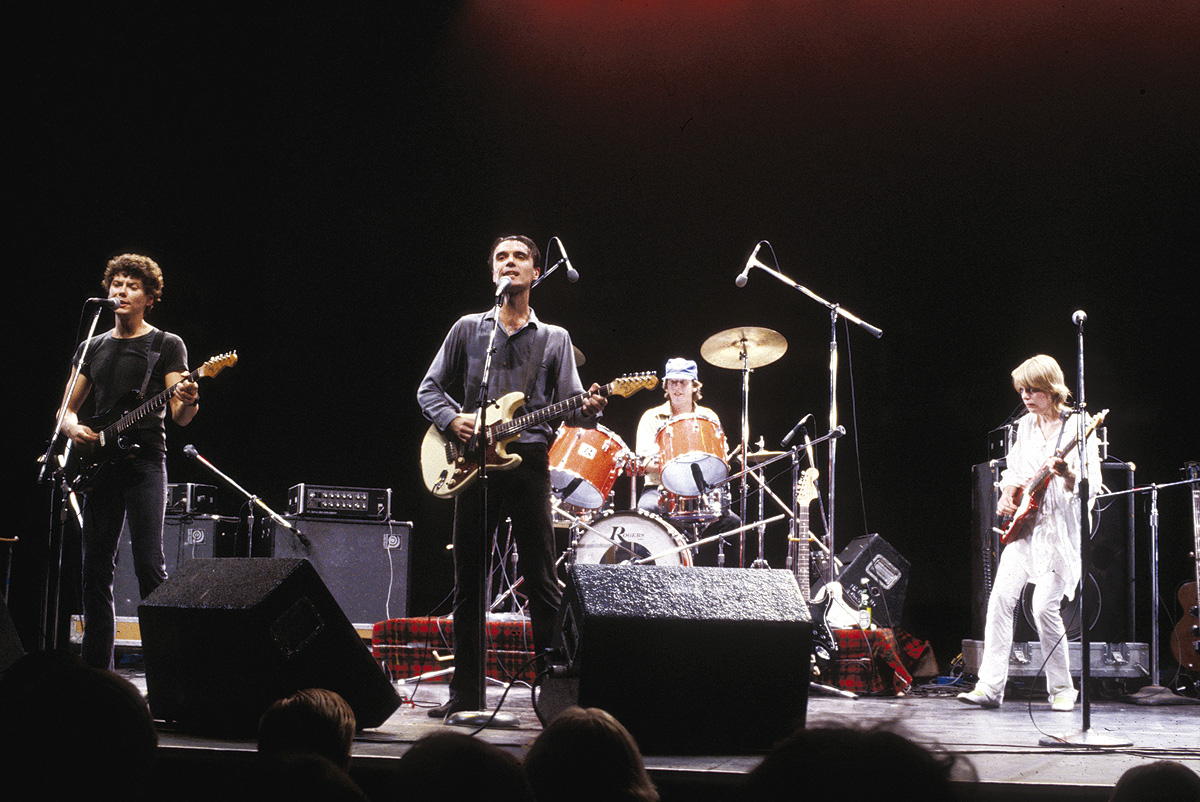
The four principle Talking Heads are augmented here by bongos, bare-boned funk and minimal, morse-coding keyboards. Jerry Harrison on synth falls into a groove with David Byrne’s dirty funk guitar while Chris ‘n Tina, the husband and wife rhythm machine, play out a steady tune within the tune (wheel inside a wheel?).

On drums, Chris swings like Holger Czukay in a straightjacket, metronome-perfect, the solid bedrock that allows Tina to freestyle her bubbling offbeat notes up and down the frets as she sees fit. Clearly, there are grrreat bass players and then there’s Tina Weymouth. But you knew that already.

There’s ting-a-ling high notes on the keys, breakdowns that sound like faraway Coney Island ice cream vans in a July heat haze and Afrobeat levels of percussive flow from start to finish. The two backing singers who mirror Byrne’s spasmic jerks and respond to his “Whatsamattawithhim?” calls with enthusiastic “He’s alright!” shouts elevate the flatlining and linear studio version up, out and into the stratosphere.

Though these days he might have an ego matched only by the massive suit he wore on stage at the time, David Byrne’s gulping and hiccupping refrain remains the song’s key identifier. Magic stuff.

Compare and contrast with the science lab sterile studio version. I’ve warmed to its coldness in recent years, but having been spoiled by the live version first, it’s a clear second best to Stop Making Sense‘s polyryhthmic jamboree.

Talking HeadsSlippery People (12″ version)

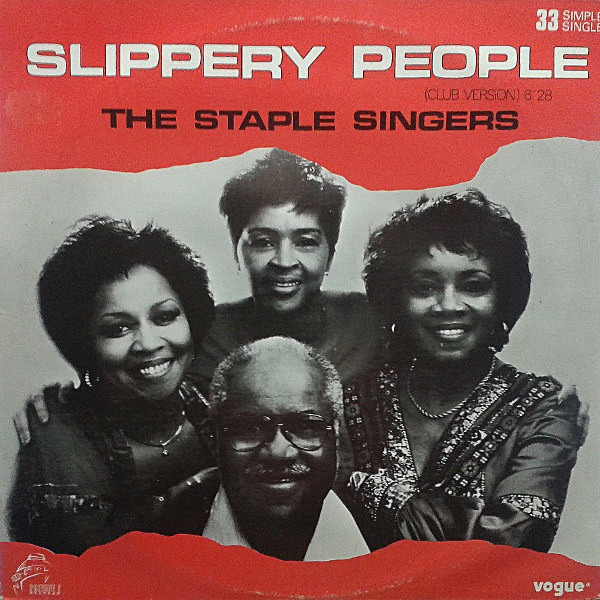
The Staple Singers first had a go at Slippery People on a 1984 episode of Soul Train. Here, they emphasised the religious symbolism in the lyrics, pushed the girls’ gospel voices to the fore and turned it into a churchy song of high, high praise. Some switched on studio executive immediately had the quick thinking to frogmarch them straight into a studio where they then cut their own extended club version of the track.

Staple SingersSlippery People (Club Version)


It’s fairly phenomenal, relying on Talking Heads’ studio original (and Burning Down The House‘s electro drum rolls) as its jumping off point, its overlapping synths and crashing drum machines set to maximum volume for ultimate ‘in the club’ effect. The guitars are, unusually for a Staples’ record, bereft of Pop’s usual wobbling tremelo but are instead suitably gritty and grindy. The bass line bends and bubbles in sympathetic harmony with the original. And the call and response refrains between the girls and their dad are joyful – listen to Pops deliver his lines and tell me he’s not having fun.

Backslidin’, how did we do? Pretty good, Pops. Pretty good.

Hard-to-find

Sample Minds

Lagging behind the curve again, I’ve only recently read Themes For Great Cities, Graeme Thomson’s exquisitely researched and expertly written account of Simple Minds‘ early years. The book stretches from the band’s formation on Glasgow’s southside through their infatuation with Eastern Europe and closes on Don’t You Forget About Me, the Once Upon A Time album and imminent ubiquity, and, like all the best music books, it has you scurrying back to the music with new perspectives.

It’s those early albums that are most interesting to me and, I’d assume, you too, and Thomson leaves nothing unturned in his quest to unravel the song writing secrets. How exactly does a post-punk act from Glasgow arrive at I Travel? Or the Teutonic goosestep of This Fear Of Gods? Or Sweat In Bullet‘s chrome-coated punk-funk? While their peers constructed traditional verse/chorus/solo songs, Simple Minds preferred instead to coax and tease free-flowing soundscapes from straight out of the ether, seemingly structure-free, but yet not.

Singer and de facto leader Jim Kerr freely admits he can’t play an instrument, so he’d sit in the corner as the band jammed on a riff for hours at a time, a turned-to-the-wall ghetto blaster recording it all. When the band downed tools, his work would truly begin. He’d pore over the tapes, listening out for an interesting section or bass run, guitar riff or drum beat, hone in on it and return the next day with instructions for the band on what to play. While they got on with re-learning the tune, Kerr would sketch out a lyric and the songs would slow-boil their way into being. Painstaking and longform, it’s about as far away as possible from, say, someone like Ian McCulloch turning up to the Bunnymen’s rehearsal rooms with his ego and a near-complete Killing Moon.

Kerr’s jigsawing of parts reaped rewards. Much of New Gold Dream – the thinking man’s favourite Simple Minds album and you know it – was pieced together from snippets of extended jams, not that you could necessarily tell from listening to its sinuous, gossamer textures. Charlie Burchill might be the band’s guitar player, but he barely plays two chords in a row the entire time. Instead, he conjures up a light coating of feedback here, a sequence of sustained notes there, a Chic-inspired half riff or, as on the pop-smart Glittering Prize, a wobbling Jazz Chorus-ed refrain. Like no other guitar player before or since, Charlie leaves whole blank spaces of nothing, the band’s melody carried instead by shimmering synth or inventive drumming, Kerr’s hooks or, especially, Derek Forbes’ formidable, fluid bass. With the focus always on Kerr and Burchill, Forbes was left to quietly get on with his job away from the spotlight and it is he, when placed front and central to the mix, who is Simple Minds’ secret ingredient.

Simple MindsPromised You A Miracle

On Promised You A Miracle, the band’s specifically written for the Top 20 hit, Charlie dazzles with echoing snatches of guitar in the verse before a sparkling and fizzing (and rare for him) solo, but it’s Forbes’ quivering and magic mushroom-powered playing that provides the song’s bedrock. After every chorus he judders and jolts the verse back into being, the band holding on to his higher than high coattails for dear life, the song’s keyboard motif grounding the listener with its familiar motif. Just how familiar though would depend on how clued up you were on your House music at the time.

Bad GirlsToo Through

In October ’81, Simple Minds found themselves in New York and listening to Kiss FM. Recently-recruited drummer Kenny Hyslop became obsessed with the slap-happy and frequently-aired Too Through, recording it on his Walkman and playing it non-stop on the tour bus. Seeking more jamming inspiration, the band played along to it at their next writing session and, latching on to its keyboard hook while ignoring Jocelyn Brown’s self-assured vocal, constructed Promised You A Miracle around its disciplined yet funky framework.

Although you’ll spot Miracle-ish parts to Too Through (or should that be Too Through-ish parts to Miracle?), the end result is nothing like the inspiration. Proof, should it be needed, that that the very best bands take disparate influences and turn them into something that is uniquely them.

If you too are slow to catch on to the best music books, you’ll probably now want to read Graeme Thomson’s Themes For Great Cities. You can find it in all the usual places, but especially from the link via here.


Hard-to-find

Art Drop

The drop. In dance music it’s the anticipation created by the build up. The speeding rattle of the snare. The increasing intensity of the beat. The frenzied hysteria of the vocal. And then…pause. And whack! If you’ve done yr job right, the track lifts off beyond the stratosphere and out into deep space. Euphoria is fever pitch. Synapses jangle and race like bumper cars around the body. Limbs reach outwards and upwards and we. Have. Lift off. Chemical Brothers. Fat Boy Slim. Faithless. Especially Faithless. All masters of the drop.

It’s a bit different in London’s Tate Modern. Its vast, echoing atmosphere might be exactly the sort of cavernous space where filling-loosening beats and skyscraping vocals wouldn’t be out of place at all, but someone decided three decades ago to fill it with art you look at rather than dance to…and unwittingly created a visual version of the dance drop.

Take the escalator to the second floor (the tension builds), enter Viewing Room 1 (anticipation strains on the invisible leash connected to your brain), browse the rows and rows of exquisite art (the synapses start to jangle) and then…Baaam! There’s the drop.

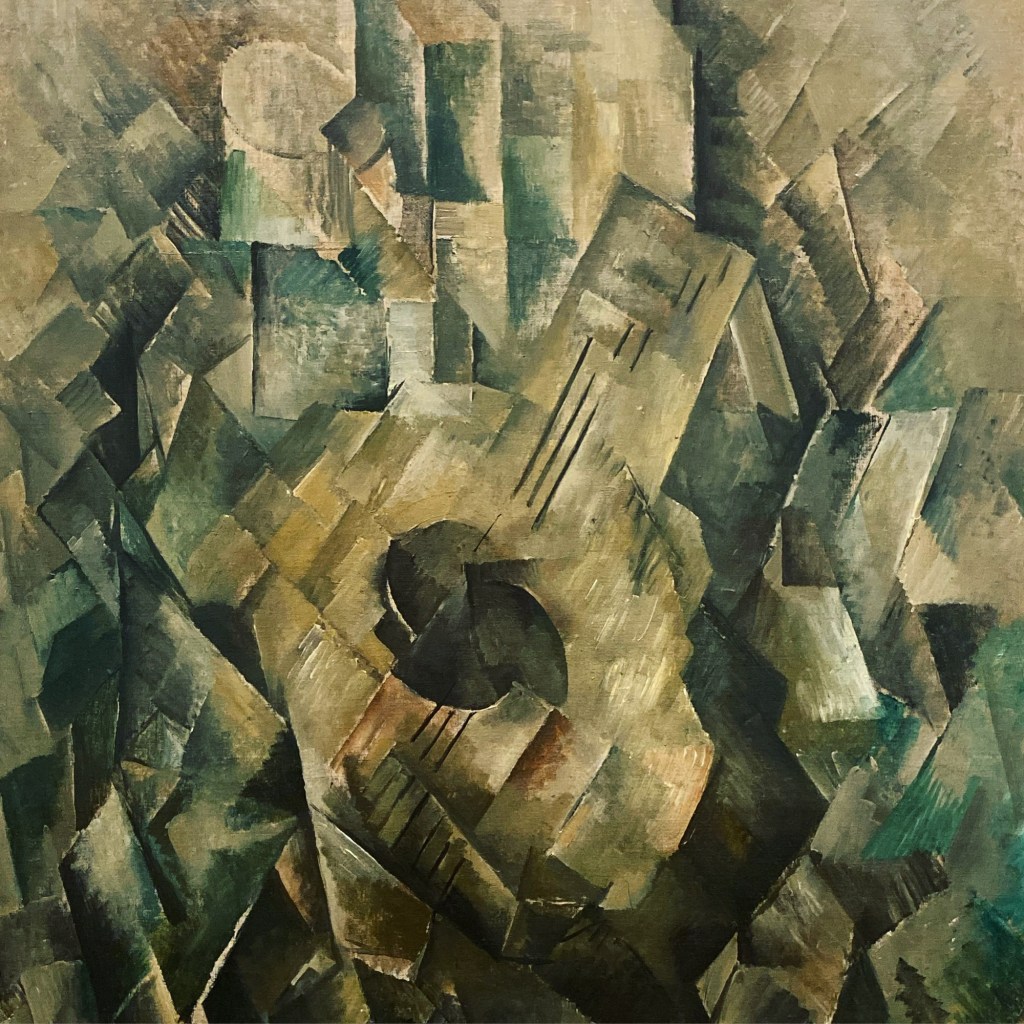
First, it’s Georges Braques‘ ‘Mandora‘. That’s yr actual cubism, mate, in muted browns and ochres. It’s over 100 years old but still looks like the future. The guitar in the painting rings and sings and vibrates out of its actual canvas, pulling you in for a closer look, holding you there as you inspect its watery brush strokes, the detail in shaping the musician playing it and the sheer volume of sound they’re emiting. How do you go about painting something like that? Where d’you even start? What a skill to have.

Follow your nose and instinct and you’ll soon find something else worthy of special attention. There’s a whole slew of Joel Meyerowitz prints of New York; some atmospheric post-911 shots, some random photographs of brownstones and stoops and interesting people, then…Thwack!! A photograph of a Cape Cod porch at sunset that has all the isolated soul and melancholic tone of a Hopper painting. Really sensational. You’ll need to see that for yourself though. I never photographed it. Live in the moment and all that.

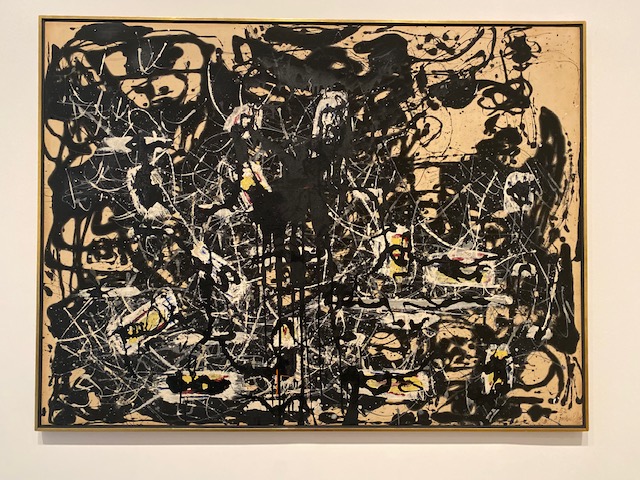
Turn the corner into another open gallery space and there at the back wall is…KAPOW! a Jackson PollockYellow Islands from 1952, as the information card next to it tells me.

We’ve all seen Pollocks, of course. I’ve grown up wiv ’em, mate (sniffs). You can thank the Stone Roses for that. It’s a large, wall-filling painting, Yellow Islands. Possibly not Pollock’s largest, and defintely not his best, but to truly appreciate it you first need to stand back and take it all in; muted browns and ochres (again, funnily enough), but with dark inky blues and deep sea black chucked aggressively across the top of it. Move closer in and you’ll begin to appreciate the dripping white spatters of paint that run in random rivers across it. Closer still and little streaks of red appear, afterthoughts perhaps, or mistakes left in. There are too occasional light-catching sparkles – sand, I really hope. I read years ago that Jackson was fond of topping off his artwork with a sprinking of sand or ground down glass, and sometimes even a light spraying of his own blood. Maybe that’s what the red was. That would be wishful thinking though.

There’s more.

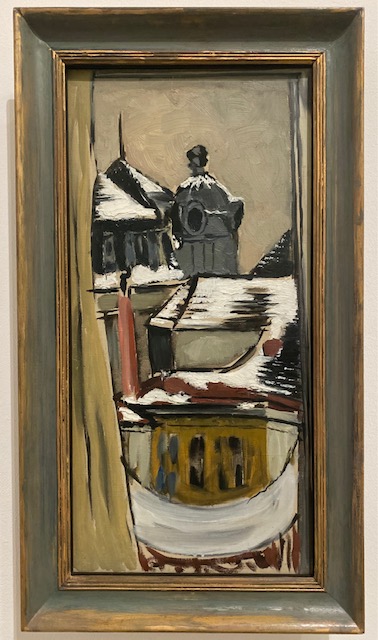
There’s (bam) a Magritte and (baam!) a Matisse and (baaam!!) a Picasso and then, baaaam!!! this absolute cracker, by an artist the luddite in me must admit to never having heard of. It’s called ‘View From The Window, Vienna‘ and was painted 99 years ago by Marie-Louise Von Motesiczky, an Austrian-born British painter.

It’s a beauty, eh? Thick oil applied to canvas, buildings topped in a dusting of snow and ice, an everyday view from a window captured forever.

The drop isn’t ordinarily a thing that guitar bands get their knickers in a twist over, but The Bug Club seem to have it sussed. Great band, The Bug Club. Take the repetitive intensity of the Velvet Underground, add some of Jonathan Richman’s mid-tempo nerdy and spoken-word swagger, add a generous portion of self-deprecating humour and then…pause. And screeee! Stomp on the Big Muff – or, as Sam did when they played Irvine at the start of ’23 – swiftly nudge the overdrive dial on the amp as far as it will go and fry those six strings in needles-in-the-red fuzz. Exactly 1 min 7 seconds for the drop…

The Bug ClubIt’s Art

It’s Art is one of many great tracks on Green Dream In F#, the second album proper from one of the most prolific bands around; one-off singles, 12″ ‘singles’ with an album’s worth of unlisted bonus tracks on the flip side, limited live releases, compilation albums of early singles – of which there are many. They’re only four years old, The Bug Club, but already they’re a completist’s nightmare.

Thrillingly, they’ve recently signed to Sub Pop. Their non-stop touring might now be more manageable on a bigger budget. They might find themselves on a decent support slot. They might even crack some sort of chart or other. What’s clear is that they’ll keep writing great wee songs. And great wee short songs. Upwards of two minutes veers into nosebleed territory for the band. No frills, no fat. Guitar, bass and drums played with sonic flair, the see-sawing, call-and-response vocals singling them out as uniquely different from the others.

It’s all art, innit.

Hard-to-find

London Crawling

A few years ago, pre-lockdown, I was involved in putting on a spoken word show with Alan McGee. At that moment in time McGee had decamped to Wales and had entered something of what you might call his Brian Wilson phase; tracksuits, unkempt beard, generous spare tyre around a once-svelte waist. It was quite an eye opener from the burned-in mental images of the skinny, ginger-headed, McLaren-esque string-puller of all that was great in British music and the suited ‘n trainered cultural envoy that shook hands with Tony Blair in Downing Street.

When lockdown arrived, McGee, by now relocated to the city, took to wandering the length and breadth of London, conducting business calls as he went. He’d saunter for anything up to 20 miles a day, walking and working, working and walking. Working and, as it happened, working out. The weight dropped off fairly dramatically. A picture of health, if you’ve seen any recent pictures of Alan McGee, you’ll know that he’s managed to sustain the weight loss. More power to him.

I can understand the appeal in this form of exercise. We’ve just returned from four days in London, the money hoovered clean from our pockets, our hair and clothes still dirty with all that the city has thrown at us, and we’ve also done more than our fair share of walking. Between checking in and checking out, we’ve walked combinations of Southbank to Borough Market to Elephant & Castle…Westminster to Trafalgar Square to Covent Garden to Soho…Embankment to Little Venice to St John’s Wood to Abbey Road to the Regent Canal to Camden…Greenwich to Waterloo to Brick Lane to Shoreditch to Pudding Mill Lane…the West End to St Paul’s to the Tower of London to Tower Bridge to the Tate…and back again. We’ve averaged 30,000 steps a day, which Google tells me is close to 14 miles each time. Not quite McGee levels of endurance, but it’s up there.

Walking upwards of 50 miles over a long weekend must do you good, you’d think. London has something interesting to see on every wall, on every street corner, standing at every bus stop or sitting at every pavement cafe, that many miles walking around its rich and multicultural environs provides more pleasure than pain. It’s certainly more pleasurable than running, I’ll tell you that. I’d a fancy notion that I’d maybe get some running in along the Southbank near our hotel. Each school summer break I run five days a week, aiming for that magical (and this year so far unattainable) 5K target. When I return for the new school year, my trousers fit better, my shirts don’t pull at the chest, I can button the collars…running works, it seems.

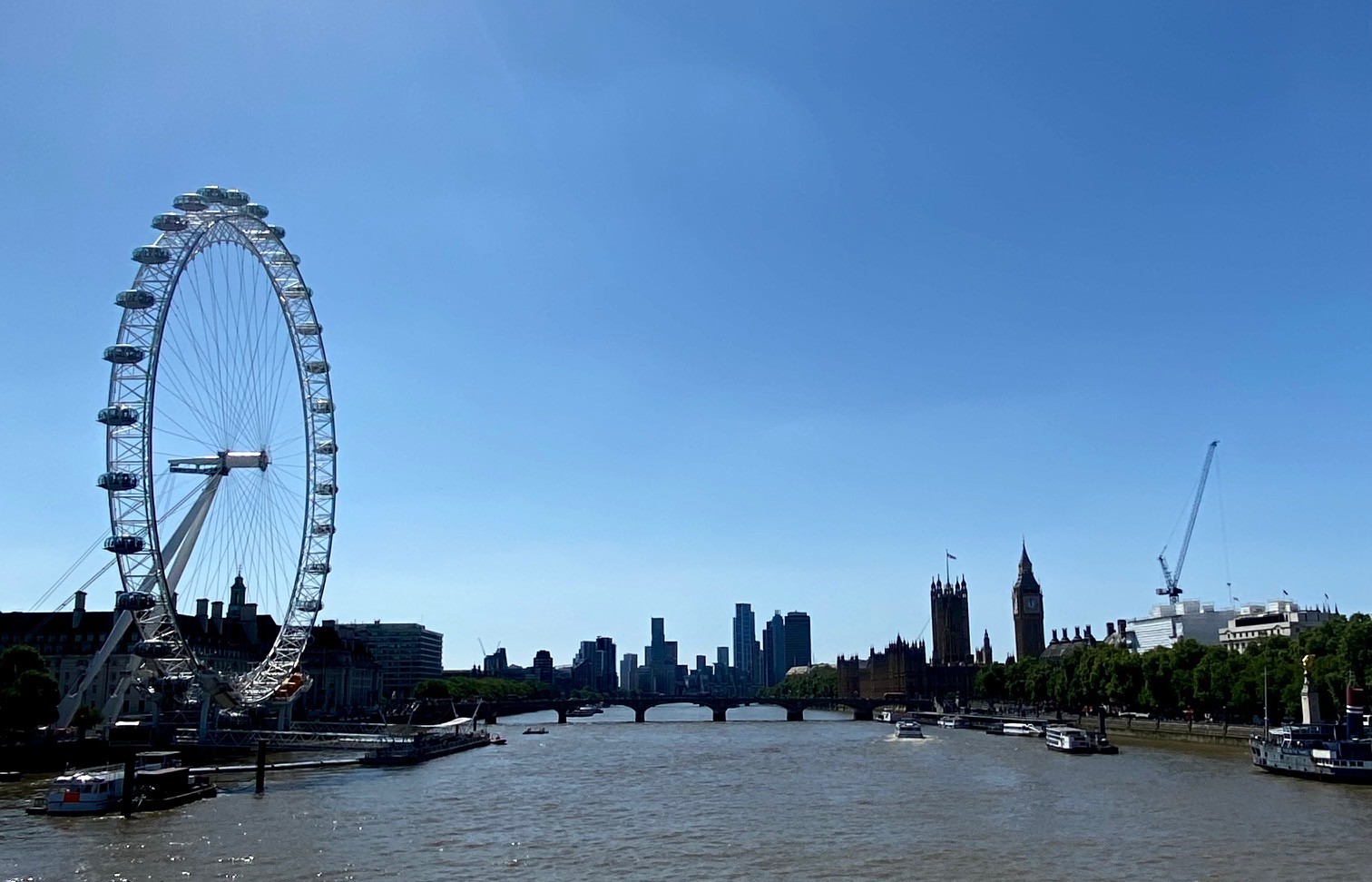
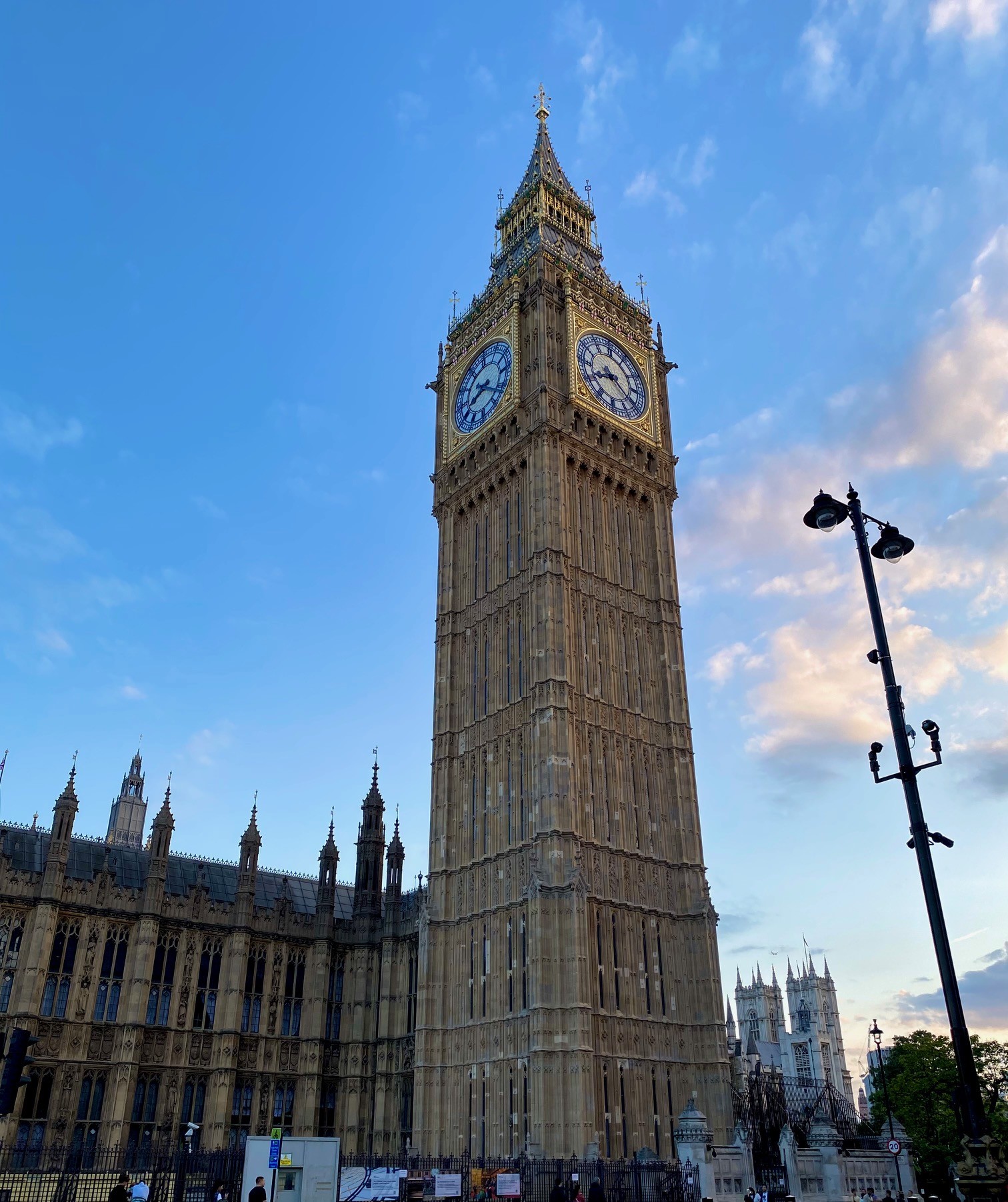
I set off on Saturday morning just as the city was waking up; early bird tourists with heavy agendas and places to be, the street vendors setting up stall for the day against a backdrop of haar evaporating from the brown murk of the Thames. Dirty old river indeed. Over the water, Big Ben was chiming eight times. It’s funny, but these days we’re that used to looking up – The Shard! Look up!, The Gherkin! Look up! – that Big Ben (or Elizabeth Tower, to give it its proper name) seems like a scale-model matchstick replica of the real thing. Have another look the next time you’re there – it’s really not that tall anymore.

So, yeah, the city, in all its manky old glory and juxtaposed modern construction thrills, but the runners here would burst you. Perma-tanned, perma-smiling. Not one bead of sweat on their baseball-capped heads. Arms pumping, sinews glistening as they and their expensive running shoes glide silently and effortlessly past immoveable objects such as yourself. More than one pack of runners emerge head on, wafting silently out of the morning’s heat like a well-drilled army pack; weighted vests, water packs on their backs, dark, sweaty University alma mater across the chest. These aren’t students that you’d expect to find face down in last night’s kebab. These are the elite of today, the Olympians of tomorrow, men and women who think nothing of calling on a few mates to get a quick 20km in before their guava smoothies and iced lattes. And they can do all of this while holding a conversation, nary dropping a single breath nor swallowing for much-needed air.

Ten mins. Bosh. Job done, mate.

Ya. Pippa told me.

I’m thinking we do Clerkenwell then back.

Now, I normally ‘run’ with music playing, but not today. That made it ideal for taking it all in, fellow runners ‘n all, but the panting! Jeez! I had no idea at all. Is that how loud I am?! The shame of it…and me in a public place, too. On my wheezy way towards the Oxo building and onto the Tate, I squeezed another slow coach gear from somewhere and, with jet stream pouring lazily from the heels of my Asics, actually overtook another jogger.

Only the briefest of stops outside the Tate’s Yoko Ono advertising flag allowed me to catch my breath before turning to head back the way I’d come to complete a lung-busting 3K round trip. I passed the same runner again, still on his gut lord marching, wobbly and knock-kneed way towards the Oxo building. I gave him a cheery wee nod. Which gave me a sense of enormous wellbeing.

BlurParklife (demo)


Hard-to-find

Good Grief

I sold my car today. No big deal, really, as folk sell cars all the time. Except, this one is kind of a big deal. The car I drove before this one packed in and died exactly the day after my dad died so, with the family’s blessing, I took my dad’s. I’ve been driving it ever since and I’d come to think of it as an old warrior, a diesel-guzzling battleship of the road, with battle scars and miles on the clock and age-defining rust to go with it.

Mechanically it was mainly sound. In recent times, the boot has become sticky to the point of being stuck, despite me YouTubing it, replacing first a fuse and then buying a part before giving up at the baffling complexity of it all. I’d only have made the issue ten times worse, so I just got used to having a boot that couldn’t be used. You shoulda seen me that day in the car park at work, in front of all the parents, climbing through the folded down seats and underneath the still-attached parcel shelf to get to a box of books. A particular low, that was.

Adam & The Ants – Car Trouble

My daughter is buying her first car, so I suggested to the garage that mine might make a reasonable down payment as part of a trade in. After the car salesman had stopped laughing at the age and mileage of my old car – the car that gets me here to there every day without so much as a hiccup (apart from the random squeal that comes from the back offside on occasion, or the time the heating failed to work and I had an actual hypothermic episode while driving in the snow one winter) – he offered me little more than the cost of my season ticket for the football. “It’s missing a bumper trim,” he happily pointed out, as if that was the reason the car was seemingly worth so little.

That bumper trim nearly cost me my life a couple of Novembers ago, when I zigzagged around a big plastic barrel that had fallen from a lorry, only to drive straight across the top of the second and third ones. Rrrrrrippp went the underside of my car as I ground to a halt at the Moorfield roundabout and held up all the traffic trying to get in and out of Kilmarnock during rush hour. It was a passing policeman who tore the half-on bumper trim off. “That’s useless, mate,” he said helpfully. Apparently it’s not that useless when you come to sell it though. Appalled at the cheek of the salesman’s offer, the minute he and my daughter had left the forecourt on a test drive of what will be her new car,  I logged straight on to a well-known car dealer who pride themselves on buying any car and booked an appointment.

Their valuation was significantly higher. Then they saw the car, with its dings and pings and musty smell and moisture inside one of the headlamps. Their valuation dropped considerably, yet the maximum price was still better than what the garage had offered. It wasn’t enough though. I had a price in mind and my car – my dad – was worth more than either of these grinning bandits were willing to give me.

Paul McCartneyCheck My Machine

Anyway, after some internet research and an online car auction. I had a buyer. He turned up and straight away began looking the car over. I stood there like a spare part as he ran his finger along the body, peered into the engine and looked it over the way an Amsterdam tourist might check out the wares in the windows before deciding to part with their cash. This old girl had a noticeable bumper scratch – a crack, if I’m being honest – the result of a bad reverse a year ago. The prospective buyer noticed it but didn’t address it. We went for a drive. Mercifully, neither the offside squeal or the soft tyre warning light came on – I’ve two slow punctures on perfectly roadworthy tread-heavy tyres and I was damned if I was replacing them – and the old battleship drove as smoothly as the day it first left the forecourt. There was a bit of haggling from him, of course, and eventually an acceptance from me; an acceptance not only of the sale price but of the fact that the last physical remains of my dad are going.

When tidying out the car at the weekend, I unexpectedly found a couple of my dad’s old capos. How I hadn’t found them in the 7 years I’ve driven the car is anyone’s guess, but there they were, two wee remnants of my dad’s life as a travelling folkie, lying in a wee cloth bag at the bottom of the boot (I discovered last week that you can open it manually with a screwdriver should you wish). One is a banjo capo, so that’s useless to me. The other, a guitar capo, has already been tested and is doing a fine job. It seems the auld fella is still here, reassuringly right at the end of my fingertips as I look out to an empty driveway.

Hard-to-find

Heavy. Lifting.

This post comes half on the back of a Facebook share the other day, with a posting of a great clip featuring some of this country’s greatest Lanarkshire-based songwriters, musicians and hip young gunslingers playing together as a sort of supergroup for an early 90s BBC Scotland show. The group, led by an unusually instrument-free Norman Blake tear their way through a faithful and loud version of The Kinks Till The End Of The Day. It had me quite rightly scampering back to the original version and for today at least, it’s been blaring out the patio windows and entertaining any neighbours within earshot.

It’s a proper Kinks stomper.

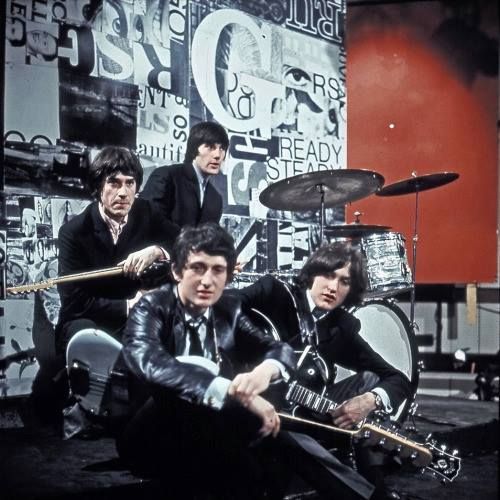
In those early-ish days, you could roughly categorise yr Kinks recordings into two distinct camps. On the one side you had the slashing, F-shaped proto-punk riffing, made more menacing and crucial with Dave Davies’s unplanned razor blade attack on the speaker cone of his Elpico amp. In those feral, thrilling early Kinks stompers – You Really Got Me, All Day And All Of The Night, I Need You et al – you can hear in their livewire guitars and monophonic thunk the birth of the Stooges and all that followed. They are undeniably influential, but more important than that, they are extremely exciting records.

On the other side you had the more reflective songs. Waterloo Sunset, Well Respected Man, Dead End Street and Dedicated Follower Of Fashion ring with brightly scrubbed major-to-minor acoustic guitars behind whistleable electric riffs, shifting the mood with their descending woody basslines and carefully worked out whimsical backing vocals. It’s these songs – every one of them a solid gold standard – that set Ray Davies apart from the leaders of any other beat groups bar The Beatles.

Some of their songs straddle both sides. The choppy riffing and wistful reflection of Set Me Free and the meaty yet melancholic Where Have All The Good Times Gone? spring straight to mind. The Kinks had the golden touch of fusing muscle with melody. Till The End Of The Day, as you well know, falls firmly into the former camp.

The KinksTill The End Of The Day

Three lightly vibratoed guitar chords, almost at the edge of Vox-ish breaking point, almost in tune, precede a Ray Davies line that’s totally at odds (as it turns out) with his actual frame of mind. “Baby I feel good!” he announces brightly, before the other Kinks fall in behind him like the beat group to end all beat groups. Guitars clang and buzz and see and saw, their choppy rhythm held in place by the tumbling of heavy furniture and silver cutlery that announces the drums’ arrival. The band gives it their all from start to finish, playing as if this might be the last time anyone allows them inside a recording studio, and it’s a riot.

The Kinks – and this being the murkier end of showbiz, so that might mean Clem Cantini or Jimmy Page or Nicky Hopkins as well as/instead of the actual Davies brothers and Quaife and Avory – do their fair share of the heavy lifting. It’s all in the incidentals. The drum fills are spectacular, ride and crash cymbals splashing golden metallic sunshine on the high end before taking the whole thing to heaven in double time for the closing seconds. The electric guitars are supremely disciplined, squeezing out chunky chords in the verses then galloping at a hundred miles an hour at the end of each fourth line. Dave Davies (?) rattles off a fat-free solo, the thin single coils of his Telecaster cutting through the stew for a dozen ear-splitting seconds.

If you can shake free of the heavy riot that’s unfolding around them, then it’s the backing vocals that are especially worthy of your undivided attention. Ray sings those opening lines – “Baby I feel good…right through from…” and then immediately, someone – Dave, I think, as he has that Davies family tone to his voice (and surely Ray won’t have double tracked himself on the 4 tracks, or however it was they recorded this holy riot) harmonises with a perfect “mo-or-ning“…and at the same time, the other two Kinks underpin the harmony with an almost buried descending “oooh-ooh-ooh” harmony. Four Kinks, doing their equal share of the heavy lifting. Here they come again in the bridge…and again at the end of the first verse…and anywhere else they can fit a harmony or a double-tracked key word to the proceedings. The Kinks: a beat group who can arrange the fuck out of a simple set of chords.

So, yeah, it’s essentially the band’s own All Day And All Of The Night recast as if the group had continued playing long after the needle had buried itself in that single’s dead wax, but man! It’s a ripper, a properly great modish stomper that’s as electric as The Who, as melodic as The Beatles but with a beating r’n’b heart the equal of anything the mid ’60s Stones put out. What’s maybe surprising is that it was written to order. The Kinks’ management had no sympathy for a writer suffering a rare bout of writer’s block and sent American songwriting heavyweight Doc Pomus to his door in an attempt to shake him out of it. It seems to have worked. A song that ended up with a lyric about someone feeling trapped and frustrated in a relationship was essentially Davie’s autobiographical dig at his management.

And that Bellshill Beatles Norman Blake-fronted cover that’s had me digging out my old Kinks Kompilation these past few days? I like to think that particular supergroup tackled The Kinks track purely because their hero Alex Chilton was such a fan. Chilton was certainly around that circle of musicians at the time and his influence can’t be underplayed. Should you wish, you can find Big Star’s version of Till The End Of The Day on the expanded CD of Third/Sister Lovers, but – heresy!- I much prefer the late 00’s version that Alex recorded with Ray Davies.

Alex Chilton & Ray DaviesTill The End Of The Day 

Some shimmering Hammond, some great Alex ‘n Ray harmonies, a rockin’ Chilton solo that maybe even outdoes the original; it’s a great cover.

Hard-to-find

There Goes The Fear(gal)

It’s 1990. Or maybe 1989. Maybe even 1991. That kinda timeframe though. It’s a Wednesday night. Not a night we’d normally be in the Crown, but there we were. I’m guessing it was during the holidays, when some of us were free of studies and had a decent stretch of summer ahead of us. Or maybe it was in the middle of winter but we had a gig looming and had squeezed in an extra rehearsal in addition to our usual Monday night slot. Either way, and for whatever reason, we were wedged in around one of the Crown’s circular tables, up there at the back, in our usual spot with all the other like-minded Irvine hipsters of the day, pints in hand and conversation flowing around the exclusive subjects of music, films and football.

Assorted Surf Nazis and Sunday Drivers in the back of the Crown, 1989.

One of us comes back from the pub’s spartan toilets with the unlikely but true news that none other than Feargal Sharkey is presently at the bar. Nowadays Feargal is everyone’s favourite political activist, but back then he was Fucking! Feargal! Sharkey!, parka-clad vocalist in The Undertones, laterally the suave, Ferry-haired-and-suited crooner of A Good Heart and (even better) You Little Thief; a genuine pop star and hero to every single one of Irvine’s assembled guitar stranglers and tune botherers that frequented the Crown. Why would Feargal Sharkey be in the Crown? In Irvine? On a random Wednesday night?  A rumour creeps up to our table and taps us on the shoulder.

Apparently, he’s up to check out a band for Polygram. I’ve been told they want to sign the Surf Nazis.” The rumour looks at me with a smirk. “It won’t be the fucking Sunday Drivers, I can tell you that for nothing.” Everyone is watching Feargal, supping his pint at the bar with all the casual indifference of any of the hardened locals. “It might be the Thin Men he’s after. They say loads of labels are after them.” The Thin Men are from Stewarton, not Irvine, and that prickles. As it goes, a few years down the line, they’d change line-up and name and become Baby Chaos. Happy Mondays’ manager Nathan McGough would look after them, Warners would sign them and they’d have minor success. But anyway. Back to Feargal.

No sooner has the rumour sloped off to the next table, than the bold Paul Forde, always on the right side of being slightly pished, makes his way to Feargal. We watch as our self-appointed diplomat and representative strikes up a conversation that’s over and done with between two sips of Feargal’s pint.

I told him that Wednesdays weren’t particularly good for him,” says smart-arsed Paul, referencing The Undertones’ Wednesday Week, “and then asked him what the fuck he was doing in Irvine.”

As he finishes telling us this, Feargal downs the last of his pint and vanishes, ghosting out just as invisibly as he ghosted in. We never did find out why the fuck he was in Irvine, in our pub, in the middle of the week, in a room full of eager musicians but with no live band playing. Sorry if you were expecting a punchline. Not much of a story really, but a big story for Irvine.

Fast forward to 2015. It’s a Thursday night this time. October 15th. But that’s not important. I’m in Kilmarnock’s Grand Hall. The sainted Johnny Marr has finished a storming gig and I’m given the job of taking pictures on all his fans’ cameras as they line up to meet him. His tour manager has set up a wee wireless Bose speaker and cued up a playlist, carefully curated by Johnny himself. Chic’s rinky dink disco rattles out of it. Some early Talking Heads. Wire. Johnny patiently pouts and preens for his people, occasionally nodding his head in time to the beat in the background. Clang! A Hard Day’s Night rushes past in a riot of melody and guitars and vocals and Fabness. Next, Buzzcocks cut loose. “I hate Fast Cars,” sneers Pete Shelley, the iPhone in my hand silently click-click-clicking as Johnny pulls plectrums from the wee right hand pocket in his jeans and gives them to the girls.

Then, a brief 5 note electric guitar riff, edged in feedback and promise eases in, and even before the drummer’s clatter has signified the true start of the song, both Johnny and myself have been stopped in our tracks.

The UndertonesYou Got My Number (Why Don’t You Use It)

Must dust this

Oh yeah!” says Johnny with a smile and, like any true fan of music, indulges in a little unexpected air guitar as the song’s punkish riff runs its way across the fretboard. Within seconds, his enthusiasm has caught on and I’m bobbing along to the bounce of the beat, Johnny grinning at me with his recently-whitened teeth. ‘Well, this is all quite surreal and magic,‘ I’m thinking.

It’s a great track, full of hooklines and riffs, dumb-but-essential ‘duh-dit‘ backing vocals and that terrific call and response ‘if you wanna wanna wanna wanna wanna have someone to talk to‘ line between the singing Feargal Sharkey and John O’Neill on guitar. It’s stoppy-starty, it has just the merest hint of Louie Louie-type stabbing keyboard towards the end and it’s all over in a metallic crash of symbols and Feargal’s definitive “WHY DON’T YOU USE IT!” shout at the climax.

Listen and repeat. Listen and repeat.

Listen and repeat.

Listen.

Repeat.

When you tire of The Undertones, you tire of life.

Hard-to-find

The Grand Old Loop Of Bjork

Human Behaviour by Bjork is, perhaps unbelievably, now 31 years old. A massive, booming and echoing timpali rhythm attached to a dry-as-a-bone rattlesnake shake percussion, it sounds like an amalgamation of smoky Parissienne jazz club and total jungle funk, topped off with a lyric inspired by watching a David Attenborough documentary and delivered as only Bjork can. Stop and listen and contemplate it for a moment. It’s a bit of a forgotten classic, I’d say.

BjorkHuman Behaviour

Originally written while Bjork was still in the Sugarcubes, it was wisely held back until the singer inevitably broke free. Quite what Sugarcubes, with shouty Einar and his expressive yet rudimentary trumpet might have done to it is anyone’s guess, but by the time Bjork had a solo record ready for release, Human Behaviour had been lined up as the lead single with which to promote it.

Her voice, always the key magical ingredient in Sugarcubes is perhaps even more out there on here. She whispers some of the verses, her Icelandic voice edged in Londonisms, then rasps and glides her way into those signature high registers, free-flowing and joyous and unlike anyone else on the planet. There are plenty of unique female vocalists scattererd across the genres, but I bet most of them wish they had the tone and timbre of prime time Bjork. There are little sections in Human Behaviour where her voice causes my skin to goosebump in exhilaration. Adele ain’t never done that for me, no siree.

Does Human Behaviour pre-date trip hop and all of that genre’s signifiers? It certainly rides the zeitgeist of 1993’s underground to overground sub-culture, but whereas those contemporaries chose to blunt things up and slow things down, Human Behaviour is forever propulsive and travelling, a head-nodding linear groove with music for the feet and lyrics for the head. Much of the track is built around a few looped seconds of an obscure 1970s jazz sample – of course – twisted and tweaked and dubbed and dropped into position by go-to producer Nellee Hooper.

Ray Brown OrchestraGo Down Dying

I’d wager that few people if any were familiar with the Ray Brown Orchestra‘s Go Down Dying, but it popped up, recommended to me on a shuffling Sp***fy playlist recently and, appearing out of context, it blindsided me. The intro, filmic and groovy, with the suggestion of danger between the notes; where did I know it from? Bjork’s Human Behaviour, that’s where. A quick internet check confirmed it, but by then, Go Down Dying was taking on an unexpected life all of its own. Its fantastic shuffling groove, part Reni, part Roy Budd really carries it. The brass floods into it like a slow-spreading, discordant brassy rash, all honeyed hue and rasping anxiety. There’s even a riff-copying electric guitar that stings its way offa the grooves with all roads leading to Portishead. By the time the flutes have fluttered their way to the outro, Dead Man Dying sounds nothing like Human Behaviour at all, save for that keen-eared loop of Nellee Hooper’s within the first few seconds. Clever folk, those in-demand producers, and for good reason.

Underworld, another of those zeitgeist surfing acts took Bjork’s original and lengthened it to an impressive and essential 12+ minutes.

BjorkHuman Behaviour (Underworld mix)

The polyrhythms that kick start it, all falling over themselves processed beats and steady tambourine jangle give way to the exact sort of rhythm track that helped make Dubnobasswithmyheadman one of the best – the best? – albums of the decade. It’s relentless and percussive and simple enough to allow for Bjork’s extraordinary voice to soar above it. Bereft of the Ray Brown sample, the lyrics become easier to hear.

If you ever get close to a human

and human behaviour

be ready to get confused

There’s definitely definitely definitely no logic

to human behaviour

yet it’s so irresistible

They’re terribly moody…then all of a sudden turn happy

But to get involved in the exchange of human emotions

Is ever so satisfying

And still the beat goes on. Electronic whirrs. Random sampled, walkie-talkied voices fading in and out. The beats start becoming emphasised every few bars. Cymbals splash. Bleeps, bloops, synthy filters weave in and out. The rolling and tumbling electrobeats of Mmm Skyscraper I Love You revisited. And Bjork returns. And still the beat goes on.

Back in 1993, it was de rigeur that acts spread a variety of remixes across the single releases. What a scoop to get this one!


Hard-to-find

Set A Course

There’s an elephant in the room. Not in everyone’s room though. Your neighbour who’s out washing and polishing his car every weekend won’t have seen it. Your afternoon telly and Ben Shephard-loving mum won’t have seen it, and it’ll never step into the eyeline of your line manager with their WhatsApp groups and casual hot desk racism, but if you’re of a certain vintage, with a penchant for guitar bands in thrall to a certain vintage, now that I mention it, it’s likely blocking your view of the Euros this very minute. You can’t miss it, with its trunk and ears and denim jacket, goofy stoned smile painted on its face, the gift of melody enveloping its body like an invisible comfort blanket. Stare at it for long enough and it’ll confirm the truth that you’ve never wanted to hear spoken aloud. “Teenage Fanclub,” it trumpets ruefully (in three-part harmony), ‘have kinda lost it.’

It’s been diminishing returns since Gerry departed. I know that, you know that, heck, even they probably know that. There are good recent tunes to be found ‘n all, but not great tunes. Tunes that are on good albums…but not great albums. Albums that I might not have invested in had it not been for my only-recently wavering loyalty to one of the very best groups. Albums that just never grabbed me by the short ‘n curlies the way Bandwagonesque and Grand Prix and Songs From Northern Britain and even Thirteen and even, even Man Made grabbed me. All bands, especially ones with the longevity of Teenage Fanclub change and adapt and what not, and that’s absolutely hunky dory, but post-Love (and it’s been, what? six years now?) an essential ingredient has been found lacking. It’s unlikely, on recent evidence, to return. That’s the undeniable truth. Just ask the elephant.

For me, Teenage Fanclub came to prominence in the very early ’90s on the back of a support slot on a Soup Dragons tour. They were funny and sloppy and carried a definite identity; denim, long hair, great guitars, battered Converse and desert boots. Man, they were everything I wanted my own band to be. They looked and played with a raggedy-arsed approach. Songs would collapse in the intro and require restarting. Songs would spool out in the ending with no-one knowing quite how to stop them. In funtime Brendan, they had a lead drummer, but they didn’t have a lead singer. They had three alternating vocalists who’d take turns at singing lead while the other two (and occasionally the drummer as well) provided harmonies that got neater and sweeter with each release, coaxed out of them from under their Bandwagonesque fringes by a smart-thinking Don Fleming to enable Teenage Fanclub as we know and love them to begin their true ascent. They were, as you know already, a fantastic band.

Teenage FanclubEverything Flows

O Brendan, Brendan! Wherefore art thou Brendan?

Those essential ingredients aren’t quite all there yet on Everything Flows, but from its woozy lurch into the opening chords and onwards, the group’s debut release is a stall-setting melting pot of the band’s influences blended through the principle players’ collective filter and thrown back to an audience that yawned and woke slowly to its charms. The mid-paced chugging major to minor chords that evoke the spirit of Crazy Horse…the wailing signature riff that rips Dinosaur Jr-shaped holes in yr heart…the ‘I’ll never know which way to flow, set a course that I don’t know‘ chorus refrain that springs to mind the existential poetry of John Lennon…Everything Flows is a cracker.

Norman takes the lead vocal, low, possibly in the wrong key for him, a somewhat shy and self-conscious version of the voice that handled the tender Cells and towering Neil Jung – to name but two of a gazillion other gilt-edged Blake beautieswith far more self-assured aplomb a few years down the line. There is no obvious vocal backing from the band, but I dare say they’re in there somewhere, buried below the meshing interplay of Gibson (Norman) v Fender (Raymond and Gerry), nimble fingers fret-travelling groovily. Not fast, not flash, just right. There’s bit in the extended outro, after the last chorus, when Norman does this wee run that starts on the low bass strings before being strangled and mangled on the third string somewhere around the twelfth fret. Trainspotters will no doubt point out that, as free-from and spontaneous as that outro appears, Norman still plays that same razzle-dazzle note-by-note riff today. Don’t meddle with near-perfection. There’s a reason the band – yeah, even the Gerry-free version – finish every set* with it.

*Apart from Motherwell in 2008 when it appeared 4th song in. Unbelievably, I had acquired a set list before the band took the stage and I was this close – this close – to shouting out for the songs in advance of them playing them.