Get This!

TV Eye

Diggin’ through the debris of daytime TV so you don’t have to.

I’ve been unwell and off work last week and this, and I’ve lacked a real oomph to do anything other than sit on the couch and watch TV. At the prospect of this, lots of folk in my situation might rub their hands together, fire up a Netflix series and settle in for the duration, but I’ve not had the mental scope to involve myself in anything quite as cerebral. Up and down the channels my attention span and I have gone, from the glossy national networks – apparently the retirement home for old pop stars and athletes with a neat line in self-reinvention – and where, for £2 plus standard network charges, you can text in and maybe win yourself a £6 million super-home in the Cotswolds, to the up-the-numbers, non-HD, +1 channels that spit out their drivel in between frequent ad breaks for animal charities, JML multi-purpose tools that you can’t buy in shops and actual lift (as in elevator) systems for the home. I doubt even your most hardened of daytime TV watcher knows this sort of stuff exists. It’s a real carnival of nonsense when you venture through the cathode glass.

You can break your daytime TV schedule into four handy genres:

  1. Upcycling and recycling of old tat for profit, sometimes charitable profit, but never profit of more than a few pounds. Whether it’s the well-spoken lady who waits by the recycling centre then asks if she can rummage through the boot of your car for anything interesting, or it’s a posh old classic car-driving English guy with pink chinos and mustard teeth zig-zagging his way across middle England’s antique shops, or it’s a former soap star turned DIY expert, the concept is the same. A bit of spit ‘n polish and the auction house will help you shift this shiny new old tat to its next gullible owner who, in 10 years or so, will turn up at the recycling centre with the same old piece of crap. It’s the circle of life, as Elton once sang.
  2. Home shows. These fall into two categories; fixer uppers/mover on-ers or secondary homes in the country (can’t do Spain anymore, mate, Brexit innit?!) for Home Counties twonks (also often in pink chinos) with more money than they know what to do with. “Yah. We’ve a budget of two hundred and forty-two, but we can p’raps stretch to two fifty for the right place.” Oh, fuck off.
  3. Human interest shows. Neighbourly disputes, people who’ve overcome the odds to get on in life, ordinary people ripped off by bogus tradesmen, relationships that cross boundaries, borders and age gaps, menopausal women discussing their sex lives. It seems we’re a nation of nosey so and sos, eager to find out the gossip whatever it may be.
  4. Quiz shows. Loads of them. I don’t mind a good quiz show….but in the middle of the day, a good quiz show is hard to find (Countdown excepted). Wooden presenters and stupid contestants do not good telly make. Have you seen Tenable? Or Lingo? Or that Ross Kemp one? Oh boy! And yet…the thicker the contestants, the better the prize money. Mind boggling.

I don’t actually mind some of the upcycling shows either – the posher the host, the brighter the chinos, the wonkier the teeth, the more outrageous the combo of hat and cravat the better the show, but I’ve learned very quickly to draw a thick and divisive line at Storage Hunters UK.

As the title suggests, this is a franchise show, brought in this instance from America, with a rude US presenter who switches to a ridiculous rrrrrapid fi-rrrre vocal style when he hits the auction sections of the show. The premise, if you don’t know – and why would you, you’re all highly intelligent people, possibly in full-time employment, who wouldn’t ever consider watching such trashy telly – is simple; Our American host gets access to a storage unit where the previous renter has defaulted on payments to the point where the container’s contents can be sold at auction. A merry band of modern-day pirates and hawkers follow the US host around as his muscled-up heavies break locks, allow the potential bidders a minute or so to look inside – No touching! No removing of covers! – and then put the contents up for auction there and then as a job lot. If you think the host is rude, that’s nothing compared to the Cock-uh-knee wide boys and resting bitch-faced wimmin and aggressively-stanced baying motley crew who make up the show’s regular ‘cast’ who, with barely a glimpse of the leg of a potential Queen Anne chair, or the sight of the corner of a stuffed pigeon, or a milk float, or a hint of arcade machine behind a mountain bike, or a dumb bell sticking out an old box can instantly tell that there’s money – pwopah wodge – to be made in this ‘bin’. It’s all scripted of course, but the bidders all hate one another and often provoke an adversary into dropping out or – even better – bidding waaay over the odds for a storage unit of shit. After sitting through six episodes over three days in a row last week, I gained the courage to go for a long-needed shower. Never again.

I hit rock bottom this morning, the absolute peak of the nadir, when I stumbled on, then downloaded to watch from the start, an episode of Undercover Boss USA. You know the score with this, right? The self-made CEO of a mid-west burger franchise chain or similar goes back to the ground floor as a new employee to find out what makes his company click and what makes his company clunk. Between sweeping floors and flipping burgers he’ll encounter bully bosses, hard working staff with multitudes of personal problems (but they just gotsta keep workin’ for ya), faulty machinery that makes the job three times as difficult, at every turn meeting a real cross-section of the people who represent his company. By the end of it, the bullies are told they don’t demonstrate the family values of the company and are removed, the temperamental machinery is fixed and the teary-eyed hard workers who’ve just been told who the ‘new guy’ really is are rewarded with promotion and/or cold hard cash and/or a school fund and/or a new car and/or a fully-paid holiday. Like Storage Hunters, it’s heavily scripted. Unlike Storage Hunters, it’s highly watchable.

Today’s episode was a break from the norm. Billed as Celebrity Undercover Boss USA, it featured the singer Seal incognito with wig, facial hair and a flimsy story about making a film about the music business with three struggling artists. Seal calls himself Victor and visits the three artists in turn; New York, Chicago and L.A., hearing stories of broken vans, broken lives, working multiple jobs, getting multiple rejections, yet all still with a burning desire to turn dreams of singing for a living into a reality. Seal, of course, sees a piece of himself in each of these hopefuls, torturing himself with the notion that he can’t yet break his cover and help them. He plays guitar for one of the unsuspecting singers at one point – “Hey! You pretty good, Victuh!” and it’s only after he brings the three singers together for a show as part of his ‘documentary’ finale that he reveals his true self. Do 20-something Americans even know who Seal is? Apparently they do.

Hey Victuh!” calls one of the girls at the show. “We wanna hear you sing first!

With a shrug of calculated bashfulness he instructs the assembled band – there just so happens to be an assembled band – to fall in as he plays Kiss From A Rose, his Billboard Hot 100 number 1 record that featured on a Batman movie and won multiple Grammy awards. The camera pans the small crowd and films as Seal hits the high notes in the chorus. Bay-bee! His three starlets eye-pop in amazement at their documentary maker’s previously unknown vocal skills. Should I compare you to a kiss from a rose…? You can see it dawning on most people by the end and, after rapturous applause, game old Victor rips the wig off his head and the prosthetics from his face to reveal yr actual Seal, exactly as he’s known to the world.

It’s box office telly. You really should look for it.

I really need to get back to work.


Wild, feral, hot-wired punk blooze, TV Eye is the real jolt you need to get back to normality after falling into the trap of daytime TV.

Seek out that Seal show though…!

Get This!, Gone but not forgotten

Trailer Swift

I’ve fallen out with BBC 6 Music in the morning. It’s all gone a bit too Radio 1 for me; no Lauren Laverne + 1 very sterile playlist x Nick “yawlraight?” Grimshaw ≠ a good start to the day. Since the turn of the year I’ve been using the daily commute to catch up with Guy Garvey’s Sunday afternoon show. Depending on the traffic and if I’m able to fast forward through days’-old news bulletins whilst driving, I can listen to the I’m Guy Garvey From Elbow Show in 8 or 9 chunks – almost a perfect week of soundtracked commuting. Guy Garvey From Elbow plays a decent mix of old and new, from the unheard and unknown to the overplayed and overblown, but there’s usually something every three or four records that really piques the interest – and that’s a high kite mark and very good personal ‘hit’ ratio by any show’s standards.

A couple of shows ago, Guy Garvey, the Elbow singer, played this. I was instantly grabbed.

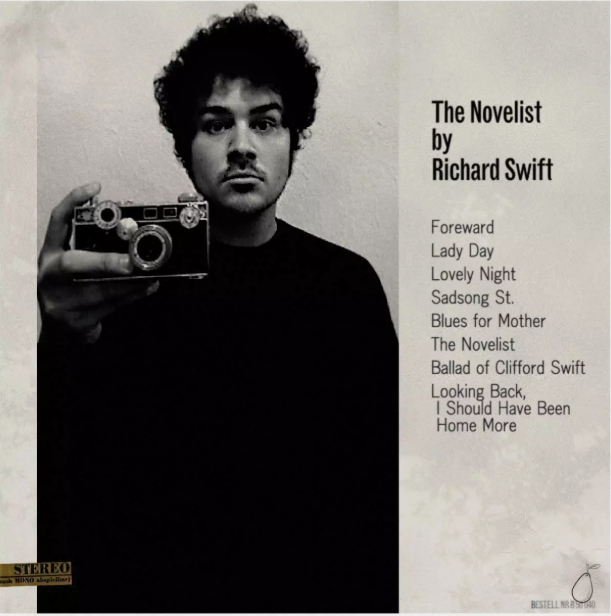
Richard SwiftLooking Back I Should Have Been Home More

What a tune! From its opening clip-clopping barroom piano via its sunstroke cymbal splashes and Swift’s gear-shifting vocal in the chorus, right to the bit at the end when the wind instruments swirl and dance around the melody in a none-more-Beatles way and the backing singers go, “Woo-ah-ooh-ah-oo-oo!” until the fade out has been, gone and vanished, I knew this was a track that I’d be playing on repeat for the rest of the journey…and the rest of the next week, as it came to it.

Repeated immersion in the song revealed some lovely touches; little piano trills and triplets at the end of occasional lines…a horizontal drummer (very probably Swift himself) with exactly the right wee small hours feel… a drop out and a build up… a great chord change in the ‘hold on…’ section of the chorus…but most of all the greatest of all unravelling melodies, delivered in the basking warmth of the singer’s homely tone – breathy and reedy in the main but with requisite crack and crumble for the many sad parts (the title is the great giveaway here). It’s just about the greatest song I’ve heard this year, and it’s taken from an album that was released 20 years ago.

I don’t know how I missed out on Richard Swift until now. Looking Back… ambles along like some of those great Ed Harcourt / Cherry Ghost tracks from 20+ years ago, tracks I formed a mild obsession with at the time and I’m certain Guy Garvey From Elbow will have played Richard Swift in the past. I guess my antennae hadn’t been fully receptive until now. It turns out that (of course) Guy Garvey, the Voice of Elbow, is great friends with Richard Swift.

Or, rather, was friends with him.

In a sad twist of affairs, it turns out that back in 2018, Richard Swift was an alcoholic who very slowly and very methodically and, it seems, somewhat deliberately, drank himself to death.

A musicians’ musician, he was a touring member of The Shins and The Black Keys, a foil and touring support act for Jeff Tweedy and Wilco, someone equally at home blasting out southern-fried Strokes with the Kings Of Leon as he was when putting together his own bible belt southern soul gospel-tinged records. A studio obsessive since his early teens, he famously had a trailer in his back yard where he maintained a cluttered but inspirational studio that he modelled on the creative chaos of Lee Perry’s Black Ark space and called National Freedom. It was here that Swift summoned the magic that went into his songs and onto record. He’s got a whole catalogue out there, most of it conceived in National Freedom, and I’m looking forward to jumping in head (and ears) first. Better late than never.

Coincidentally, I saw David Hepworth on Instagram tonight talking about his record collection – “or rather an accumulation of records…records that followed me home over the years and got filed away,” and how he’d picked out a 45 year-old Brian Eno album that he’d never listened to until this week that he now can’t get enough of. “Don’t pursue the music,” he advised. “The music will find you at the time when you’re ready to hear it. Sometimes it can take 45 years…and that doesn’t matter.” Good advice, that. And spot on too. Guy Garvey From Elbow’s show on BBC 6 Music is proof of that.

Just search for The Guy Garvey From Elbow Show and you’ll find it all in one click.

You can find Richard Swift’s music on Bandcamp and Secretly Canadian.

Get This!, New! Now!

Tailoring Swift

18 years in and I’m going to have to change that tagline at the top. Outdated Music For Outdated People, it apologises, a phrase heavy in inference and suggestibility; if you’re an old and set in your ways sort who seeks comfort in the familiar, this might just be the place for you. If however, you came here to find the latest in box-fresh new sounds, you might leave disappointed.

Not today though.

In the words of the perennial Billy Sloan, I can exclusively reveal that Fellow Mortals have a debut album on the way…an album that for its originality and uniqueness, sonic qualities and unfurling melodies will quickly become one of your favourites of the year. And Plain Or Pan is the only place on this planet where you can hear it for now.

Fellow whit? Fellow who? Fellow huh?

Hang on, hang on. We’ll come to that in a minute.

Albums, as you well know, come in all varieties. There are those that are rush-released on the back of a surprise hit single, a hastily put-together studio version of the group’s live set then sold as the hot new thing. Yeah, Wet Leg, I’m looking at you (wherever you are these days).

There are those that arrive from nowhere, so fully realised and still perfect all these years down the line. Hello, The Stone Roses. Take a bow, Blue Lines.

There are those that come as complete packages, spinning, like life, with ebbs and flows and ups and downs, each play pulling the mask back and pulling the listener in. That’s you, OK Computer. And you too, Rumours. These are the albums that tend to stick. ‘Classic albums’, to use a well-worn phrase. With real depth and substance (and substance misuse in some cases), they have proper gravitas.

Then there are the albums that hang teasingly in the air, slow-burning beauties waiting to be discovered by generations of switched-on ears long after conception and release. Talk Talk’s The Colour Of Spring would be one of those records. John Grant’s Pale Green Ghosts another. Midlake’s Van Occupanther album… Ultramarine’s Every Man And Woman Is A Star… XTC’s Skylarking… brilliantly cohesive records from start to finish. Organic, proggy, and conceptual in vision and execution, these too are albums with depth, substance and gravitas; modern-day classics to all in the know.

Fellow Mortals take their cue from such records, as well they should. Conceived aeons ago before even lockdown was the year-zero thing by which we mark our lives, and tectonically jigsawed together through transatlantic file sharing, that forthcoming album of theirs, ‘Stella’s Birth-day‘, thrums with electronica, hums with melody and comes, like all the best albums before it, as a complete package (in every sense).

Born in the busy mind of Noonday Underground’s Simon Dine, Stella’s Birth-day takes its inspiration from a series of poems written by Jonathan Swift 300 years ago. The poems map out the relationship between the poet and Stella, his muse many years his junior – a loving relationship certainly, perhaps bordering on clandestine and romantic…or even marriage (it’s a grey area that’s kept Swiftly scholars debating for years). For seven years, from 1719 until her death in 1727, Swift would write Stella a poem and send it to her on her birthday. The album focuses on the final two poems.

Swift would write to Stella of her intellect and astuteness, her qualities as a human being. He confides his innermost thoughts and worries in her. And this he does with a sharp Anglo-Irish wit that’s prevalent, from Behan and Beckett to Wilde and Morrissey, in many corners of Irish-bred literature to this day. As he and Stella age, the tone of Swift’s writing changes. The poet looks back on times gone by, becoming more reflective with each passing stanza, one eye trained on the horizon and looking towards the inevitability of death.

Not your usual sort of source material for an album, then. You don’t need me to tell you that musicians have often drawn on literature for stimulus – there’s Wuthering Heights, for starters. Bowie’s 1984. Venus In Furs. Much of Morrissey, obviously. There’re plenty more when you stop and think about it (even more if you cheat and Google), but what sets Stella’s Birth-day apart is the way in which Swift’s poetry is used.

Focusing on those poems from 1725-1726, Swift’s words are sonically brought to life through the voice of Francis Reader, a long-term collaborator of Dine and most likely known to you as the vocalist in the Trashcan Sinatras. Reader has a terrific voice; part croon, part swoon, and he delivers his lines with total respect to Swift’s words. The poetry is lifted, line by line, stanza by stanza and tailored to form the songs’ verses and choruses. It’s quite the skill to twist and shape someone else’s ancient and studied words into new forms…and Fellow Mortals have done this brilliantly.

The album flows across 14 short ‘n sweet tracks; tracks that flash past in the time it takes you to read the poems, yet tracks that are rich in melody and idea and sheer scope. The voice and the words are centre stage, but all sorts of wizardry is happening in the background. There are nods, perhaps, to the string work on some of Scott Walker’s ’60s material. There are soft shoe waltz-time heartbreakers. There are rippling harps and fairground melodies and never-ending tapestries of rich instrumental backing. There are even electric guitar-furnished pop songs of the sort that would have your average Trashcans fan foaming at the mouth.

Indeed, released today, March 13th, (on what would’ve been Stella’s 344th birthday – how’s that for slick marketing?!), the first teaser for the album, A Better State, features Trashcan guitarist Paul Livingston to great effect. All shimmer ‘n twang, looping piano and synthetic, shuffling backbeat, it’s a very good signifier of what to expect from the album in full. I think you’ll like it.

Fellow MortalsA Better State


Another single will follow in May, by which time Stella’s Birth-day will be available for pre-order. As befits such a project, initial pressings will see a 10″ record bound by a book of the poetry. This, if you didn’t know, is the version you’ll want.

Arcane and archaic in source, yet modern and now in execution, the album package promises to be a sort of grown-up Disney read-while-you-listen page turner for the more discerning and cultured listener out there – Updated Poetry For Outdated People, even.

Get This!

Leaner, Greener

I have terrible existential dread. It probably comes from the rapid advancement of years and the musical milestones by which I mark them; that the time from Bo Diddley to My Bloody Valentine’s Loveless (35 years) is less time than the time between Loveless and now. That Johnny Marr had started and finished The Smiths and all the sparkling magic that he created in between before he’d had his 25th birthday. This place is littered with such examples that might question your own worthiness and contributions to society.

A friend recently shared a video clip of the opening of an art exhibition of his. It wasn’t dated, but it was dated; the grainy transfer of VHS to digital, with intermittent wobbly white lines descending the screen. The fluffy sound. The hair. The clothes. The people in it who are no longer with us. As the camera panned around the assembled art-praising masses of Irvine, two folk stuck out. There was my mum, an employee of the library at the time and invited probably because of that. Next to her, my dad. Sensible suit, grey hair neatly side-combed, ubiquitous moustache Souness/Selleck-full and eye catching. As I started to do the rough maths it dawned on me – my dad in this clip is younger than I am right now. Jeez. My mum is still very much with us, pushing 80 and only just about beginning to slow up. My dad is gone though. And the image of the man who looked the same to me my whole life is a stark reminder that I am entering – or have already wandered into – my autumnal years. It’s (hopefully) still early autumn, but it’s undeniable.

You’d think I’d want to do something about it. Travel, maybe. Join a walking football team. Plan retirement.

Or eat rubbish.

This time last year I had this thing going, a bad habit you might call it, of budgeting £40 for the petrol station every time I needed to fill up, but spending exactly (and with well-practised deft precision) exactly £38 on the fuel. The other couple of quid I’d lavish on Haribo Jelly Babies and Cadbury’s chocolate – one of those big bars that not that long ago cost a round pound instead of the £1.35 and more they’re currently asking for them. I’d leave the goodies in the semi-secret glove compartment down by the steering wheel and spoil myself rotten whenever in the car alone.

The spiralling fall-out of this dim-witted pampering was two-fold. Firstly, my car used to run on £40 a week of fuel, but by filling it up with only £38 worth, it would mean that every now and again I’d need to refuel before a Sunday night; so more frequent trips to the petrol station and even more stashing/guzzling of sweets and chocolate while commuting – never on the way to work though (I’m not a total disappointment), only ever on the way home as a reward for a hard day on the chalk face.

Secondly, my waistline expanded in direct proportion to my weekly skimming of the fuel budget. Funny that. I’d eventually run a chunk of it off in the summer holidays, with a daily target of running 5K my self-administered punishment for being addicted to sugar-filled car journeys. But not all of it was shifted. Much of the unwanted flab is still there as I type right now, a wee wobbly reminder of my Alan Partridge years. It is reducing though…and there’s good reason for this.

More recently, the old car has gone the way of all cars of a certain vintage and I’ve come to be the owner of an electric car (and none of your Tesla nonsense either – who wants to be seen in one of them?) I can charge the car at home. I can charge the car at work (if I’m the lucky electric car owner that day). There are now no more trips to the petrol station and, believe it or not, the result is twofold: not only does my belt go an extra notch again, there’s nary a whiff of sugar within five metres of the car. All those crumbs on new upholstery? Sticky fingers on the handles? Empty wrappers on the passenger seat? Of my new car?!? I wouldn’t want that.

I’m leaner, I’m greener. Everyone’s a winner, baby.

Everything’s Gone Green, baby.

New Order at their experimental, boundary-pushing best. Psychedelic dance music for the post-punk generation. I see my future before me. And it’s no longer Cadbury and Haribo.

New OrderEverything’s Gone Green


Dylanish, Get This!

Strait Up

In the future, historians of popular culture and those who gatekeep the ancient art of music blogging will point to this date – the 9th of February, in the year of our Lord two thousand and twenty-five – as the day that Plain Or Pan, that once-great leading music blog, began its slow but steady and inevitable terminal decline. The reason? Dire Straits.

There was a great old Top Of The Pops episode on BBC4 the other night. Presented by a smug ‘n smooth Simon Bates, it featured the hits of this week from 1981; a jumpin’ and’ jivin Stray Cats, their outrageous quiffs riding the crest of the rockabilly revival wave; Blondie’s Rapture on video, a blue eye-shadowed Debbie in shorts and not much else, her mile-wide smile bordered in bright red lipstick and stirring something in me even then as an 11 year old; the much-lampooned (’round here at least) Spandau Ballet, dressed ridiculously – jackets worn over the shoulders, layers and layers and layers of fabric, billowing blouses and baggy breeks and what looks like Hunter wellies and woolly socks turned over the top of them – a proper fashion student’s juxtaposition of NOW!, transplanted straight from the Blitz club direct into your suburban and beige living room.

The highlight of the Ballet? The Spands? is, as always, The Hadley. He’s got a bit of a beard going on here, highlighting his (admittedly impressive) razor-sharp jawline. His hair though is a disaster; teased, lank and greasy it’s swept to one side like an unfortunate outgrown Adolf do, (Spandau, eh? Makes y’think), his skinny mic technique and gritty voice cementing his pure soul credentials to those lapping it up at crotch level in the studio’s front row. Behind him, the band – his band –  pose and preen and pretend to play like it’s the last time they’ll ever be allowed on the telly…which really should’ve been the case. It’s quite an astonishing performance. Should you wish to see it, here y’are:

Daft one hit wonder Fred Wedlock comes and goes, thankfully, in the short time it takes to fix yourself a top up before the hard-rockin’ Rainbow show up on video; tight tops, tight red jeans, bright white guitars. A splash of satin. A dash of bubble perm. Proper music for proper people, y’know.

And then there’s Dire Straits.

They’re a good four years from ubiquity, Dire Straits, but look! The red sweatband that would be used to hold Knopfler’s mullet in place at some point down the line is right here, right now. There it is, strapped round his right wrist as he picks the opening to Romeo And Juliet on his Brothers In Arms National steel guitar. Just as that guitar was elevated from mere Top Of The Pops studio prop to cover star on their massive hit album four years into the future, that sweatband clearly grew in direct proportion to Dire Straits’ record sales too.

They’re not a Top Of The Pops act, Dire Straits, and don’t they know it.

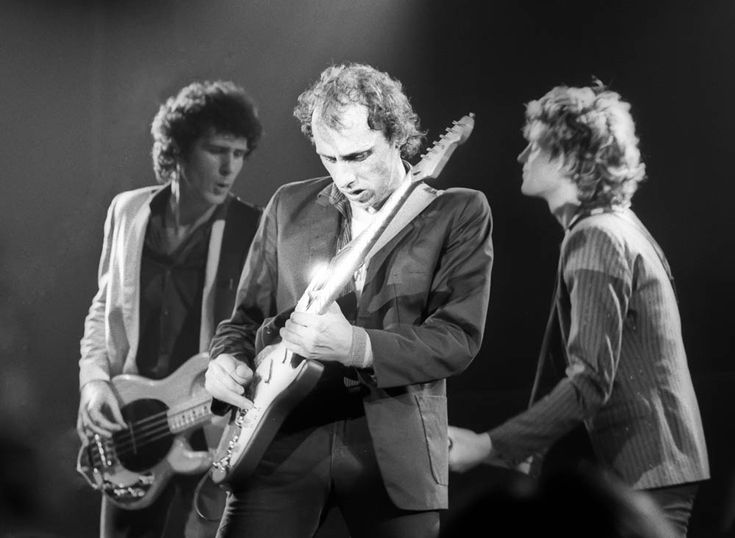
Someone has had the gumption to get them to a tailors before recording. For a bunch of four un-popstarry guys, they look surprisingly great. Knopfler is wearing a dark blue pinstripe suit jacket atop a white tee – he hasn’t yet found his penchant for vests – and he looks like a groovy English teacher doing a wee slot at an end of year school assembly; self-conscious, smiling nervously but with the chops in his fingers to validate his being there.

The group behind him is supremely stylish. Like, if someone showed you a picture of them and told you this was The Strokes, you wouldn’t be a fool to believe them. John Illsley on bass is tall, angular and moody. Chiselled of cheekbone and dark of brow, he wraps his massively long fingers around the neck of his massively long Fender Precision bass and plays it effortlessly, precisely even, pouting on all the right notes, looking into the middle distance for added appeal. He has slightly more buttons undone on his shirt than is exactly necessary, but then, the bass players are always the ladies’ men, are they not?

The guitar player – is it Mark’s brother David? – plays a hot Strat that may well have been borrowed direct from that there Rainbow. His vivid blue suit jacket sleeves are rolled up, Crockett and Tubbs-style, his large triangular collar mirroring the sharp edges of his Illsley-rivalling cheekbones. He too seems to have forgotten that shirts button all the way to the Adam’s apple.

The drummer? He’s in a capped sleeve t-shirt. Clearly, the band budget stretched to the three Straits who’d be standing directly in front of the camera. There’s a piano player stuck somewhere in the shadows too, but who’s bothered about him? Not the Top Of The Pops cameraman, that’s for sure.

Romeo And Juliet, but.

There used to be that ‘guilty pleasures’ trend a few years ago, y’know, where uber-cool folk – or, rather, folk who thought they were uber-cool, admitted to liking Rock Me Amadeus and Eye Of The Tiger and stupid stuff like that. I blame Brett Easton Ellis for his irony-free fashioning of Huey Lewis And The News in American Psycho for giving sensible folk the idea of ‘the guilty pleasure’. What nonsense! Music is music. It’s either good or bad, right? Soft rock, never fashionable amongst any demographic, is well represented in guilty pleasures circles. Anything by Stevie Nicks (Rooms On Fire! Edge Of Seventeen!) Steely Dan’s Do It Again. Kim Carnes’ Bette Davis Eyes. They’ll never fail to hit the spot. Them….and Dire Straits’ Romeo And Juliet.

It’s a fantastic record; expectant, storytelling verses, tension building pre-choruses, heart-melting choruses. It’s also a fantastically well-produced record. Dire Straits may well be a guitar band, but listen especially to the drums! Four to the floor tambourines. Unexpected snapping snares. Rocksteady rimshots. Hi-hat ripples and end-of-line paradiddles. Those patterns are exquisite! In the verses. In the bridge. In the choruses. Subtle and inventive, they elevate Romeo And Juliet from mere singer/songwriter ballad into brave new territories. Pay attention to those drums the next time Romeo And Juliet enters your orbit.

Everyone knows that the Knopf is a fantastically idiosyncratic guitar player; strictly no plectrum, a thumb and fingers style of playing, slow and lazy chord changes, snapping and twanging solos, and it’s all over Romeo And Juliet. But it’s his vocal delivery that really does it here. In the verses, he half speaks in that languid Tyneside Dylan drawl of his, but occasionally he slips into a vocal cadence that’s pure Lou Reed. Play Street Hassle or New York Telephone Conversation then play Romeo And Juliet and tell me I’m wrong. You and me babe, how about it? Pure Lou. It’s 1981, right? Kinda makes sense, like it or not.

So, yeah. Romeo And Juliet by Dire Straits. On Plain Or Pan. You can unsubscribe on the right there, any time you like.

Get This!

It’s Not Important Now

It’s 1981. By now, my record collection is taking shape. I’ve got a great wee collection of crucial 7″ singles, not yet donated in shame because of a haranguing Bob Geldof. I’ve begun to dip a toe into the adult world of albums. The first non-compilation album I’d buy would be Kings Of The Wild Frontier. Actually, the first album I bought full stop was Kings Of The Wild Frontier. Albums, being pricier, are more of a risk. They require investment, both financially and emotionally and this 11-year old didn’t have the capacity for that. Three singles, one track that could’ve been a single and a bunch of filler. Ouch, £3.99 is a big deal. You expect payback. So now, I’ve gone for playing it safe. I’ve bought the Best Of Blondie. And Queen’s Greatest Hits. And The Beatles A Collection Of Oldies. There’s an old Rock ‘N Roll hits compilation in there too – which, if my maths is correct is no different to an 11-year old today running out to buy a compilation of hits from the early 2000s. Who on earth would want to do that?

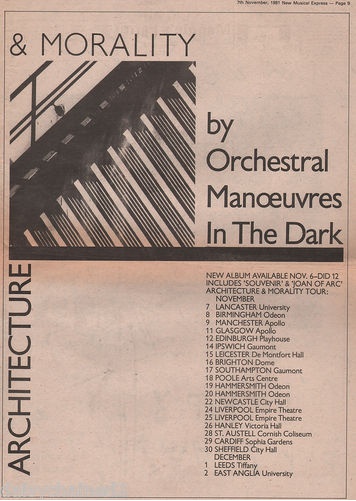
As it turned out, Kings Of The World Frontier is far greater than the sum of the singles released from it. I suspect you knew that already though. The same can also be said for Architecture And Morality, Orchestral Manoeuvres In The Dark‘s breakthrough album, although it took me right until today to work that one out too.

I loved those singles that came from it so much that I took the leap to ploughing my collection of coppers and silver into the album. There were two completely different songs that both referenced Joan Of Arc, which may have been some sort of band in-joke, but to Radio Clyde DJs and pre-teens like me was just plain confusing. And there was Souvenir.

Orchestral Manoeuvres In The DarkSouvenir

Souvenir is masterful. Hooky, poppy and bathed in sorrow and melancholy, it drapes its wistful and hangdog, almost feminine vocal across a signature keyboard motif. Synth drums beat softly, a choir of overdubbed voices add depth to the refrain – my feelings still re-main – and it plays out for three and a half dejected yet uplifting minutes. This is the sound of sadness, to misquote Paul Simon. “Is this the Cocteau Twins?” asked the boy tonight as it was playing. Dream pop before such a term was conceived, you can kinda hear what he means too.

Built on a bed of slowed down looped choral vocals, Souvenir is so evocative – a great example of a pioneering synth band breaking new ground. Hindsight shows OMD to be a great, great singles band but it’s possibly fair to say that OMD never got the kudos they deserved at the time. Too arty for pop yet too pop for the arty crowd, they straddled this weird limbo ground, and Souvenir‘s parent album is a great example of this.

Housed in a die-cut Peter Saville sleeve, all dull industrial tones and brutalist architecture, the record’s grooves fizz and hiss and clank and clunk with the sound of machines whirring into action, ambient found sound and musique concrète. Amongst all of this sat the pop singles. It’s a strange thing to remember, but straight after buying it, I ran not to my room to play it, but instead put it on my dad’s record player downstairs. As I sat back to get into it, my mum came in and sat down and listened with me. (Go away mum. This is a personal ritual that can’t be shared).

Hisssss. Sccccratcchhh. Sccccrraaaape. Thud thud thud. Rattle rattle rattle. Echoey voices. Biscuit tin snare drums. Wonky production. It’s a sound that I now recognise to be that of an experimental synth band embracing the anything-goes spirit of post-punk and running with it in their own idiosyncratic direction.

Did you waste your money on this rubbish?” my mum tutted, getting up and leaving. Instant shame.

I struggled into the second song. £3.99 for this!? Where were the singles? Ah….here comes Souvenir. And here comes my mum. “Dah dah dah-dah-dah-dah dah dah!” she sings, mimicking (wrongly) the keyboard refrain. Man! She’s ruined the hard to like stuff AND NOW she’s ruining the single too.

I can’t say I played the record more than once ever again.

Fast forward a couple of years. Alex Aitken has a new turntable, hi-spec and booming, and he has designs on my long-forgotten OMD record. And I, with hormones pinging, have designs on the cover of a Sheena Easton album that he’s been playing. Not the music. That’s extremely pish. Just the cover. Sheena is covered in some sort of robe, sitting with one leg up, a bit too much caramelled thigh on display, her full-bodied lips smack in the centre of the image, her eyes boring into my teenage boy’s overloaded head. “I’ll swap you the Sheena cover,” Alex says conspiratorially, “Just the cover – not the record – I’m keeping that, for your copy of Architecture And Morality.”

Don’t speak to me about morality, Aitken, ya chancer.

Done deal, of course. OMD? OMG more like. What was I thinking?!

Architecture And Morality disappeared from my collection for the next 40 years, until a few months ago when a kindly neighbour had a loft clear out and turned up at my door with a handful of records; some old 12″ singles, an ace Ace Records soul compilation and OMD’s Architecture And Morality. It was like welcoming back a child I had abandoned at birth…before I filed it cruelly away to sit amongst my own stuff – Orange Juice – Orb – Orbital – Orchestral Manoeuvres In The Dark – The Other Two, a shelf padder; a good looking and possibly hip shelf padder, but a padder nonetheless.

Last week I was rearranging some records and pulled it out. I stuck it on, instantly transported to our living room in 1981. Couldn’t handle it. I lifted the needle from the first track and dropped it onto Souvenir. Ah. That’s better. I’d heard it fairly recently, in Irvine’s Harbour Arts Centre before a BMX Bandits show. Duglas had curated a pre-gig mix ‘tape’ and between the Dana Gillespies and Jigsaws and Peter Skellerns and what have you, Souvenir came rolling out. It sounded great in the HAC. It sounded great in 1981. And it still sounded pretty fantastic coming from my own decent set up in the here and now.

This morning I reached for the album again and this time I played it from start to finish. Dared myself not to get up and move it on. This time, it made sense. It was, yep, the sound of an experimental synth band embracing the anything-goes spirit of post-punk and running with it in their own idiosyncratic direction. But it’s not half as weird as I’d convinced myself it was. Arty, but supremely poppy too. A couple more listens this coming week and I reckon I’ll be fully converted. It’s never too late, as it turns out.

I wonder if Alex still has my copy…still plays my copy? His Sheena sleeve has long gone of course, but I still have the internet should I be inclined to look it up. Of course, if I’d had the internet back then, I’d never have needed to swap a cool and arty record for the over-styled sleeve – sleeve! – of an overproduced slice of 80s slop-pop. Unlike my faded attraction to oor Sheena, for Souvenir my feelings still remain.

Cover Versions, Get This!

I Put A Spell On You

I know nothing about Chappell Roan. I doubt I’m slap bang in the middle of her? their? demographic anyway…but I do know the one big song. It was ubiquitous for a bit there and there’s no way you haven’t heard it and fallen for its hooky charm either. Pure pop and catchier than that flu that’s been doing the rounds recently, it hangs its hookline on its spelt out titular refrain. ‘Aitch Oh Tee-Tee Oh Gee Oh-oh, You can take me Hot To Go-oh!’ It was the first great example of spelling in a pop song since Gwen Stefani Hollabacked to tell us that, indeed, that shit was bananas, Bee-Ee-En-Ae-En-Ae-Ess, back in 2025.

It’s nothing new, spelling in songs. Otis and Aretha, of course. And The Kinks. And plenty of others. From Van’s gruff Northern Irish burr wrapping its way around Gloria (“Gee-Ell-Oh-Are-Aye-Ae“) to Patti’s wired and speeding East Village take on it; From Weller’s angry young punk spitting of “Ae-Pee-Oh-Cee-Ae-El-Wy-Pee-Ess-Ee-APOCALYPSE!” at the end of ‘A’ Bomb On Wardour Street to Faith No More’s long-shorted and muscular ‘Be Aggressive! Bee-Ee! Aggressive! Bee-Eee-Ae-Gee-Gee, Are-Ee-Ess-Ess-Eye-Vee-Ee!‘; from Al (then Edwyn) serenading us with ‘Ell-Oh-Vee-Ee Love‘ via little Johnny Thunders’ drawling nod to The Shangri-Las, ‘When I say I’m in love you best believe I’m in love, Ell-Yoo-Vee!” to Hall ‘n Oates’ blue-eyed ‘M-E-T-H-O-D-O-F-L-O-V-E‘, a bit of spelling goes a long way to providing the hook. Hot Chip employed the technique on Over And Over. Len’s Steal My Sunshine includes the line, ‘L-A-T-E-R that week.’  None other than the cryptic and idiosyncratic Mark E Smith sang about a ‘C-R-E-E-P’ when the song demanded it. Even our greatest writers are under the, eh, spell.

Which brings us to Warpaint.

The oil-on-water, slow dissolve approach they take to their own Billie Holiday is supreme.

Bee-Eye-Ell-Ell-Eye-Eeh-Aitch-Oh-Ell-Eye-Dee-Ae-Wah-ay.

It’s a sparse track. Cleanly picked guitars, some ambient, soft-touch bass, understated keyboards, a gentle snowfall of toms and cymbals, the overlapping vocals stirring the dusky, twilight air around it. That’s the work of a moonlighting John Frusciante, manning the desk and capturing the band exactly as they’d hoped. 

When the singing starts on the verses proper, you – as a pop scholar with an A+ in every one of your pop scholarly exams – will have immediately noticed they’re singing the verses to Mary Wells’ My Guy. But whereas Mary’s original is all frothing teenage effervescence, rattling along on excitable handclaps and giddy, upwardly climbing girl group vocals, Warpaint take the opposite approach. Theirs is languid and soporific, breathy and downbeat. Nothing you can say can tear me away from my guy, they exhale, with all the enthusiasm of the downtrodden and disenfranchised. If someone were to tell you this was a thinly disguised plea for help in a domestically abusive situation, you wouldn’t be that surprised. Nothin’ you could do cos I’m stuck like glue to my guy. Jeez.

Surely not.

Bee-Eye-Ell-Ell-Eye-Eeh-Aitch-Oh-Ell-Eye-Dee-Ae-Wah-ay.

In comes the refrain again, four voices melded as one, the group inching the song ever forward. Unspooling and unwinding in slo-mo, it stretches for over six sleepy and bleary-eyed minutes, voices drowning in reverb, guitars swimming in chorus and phase, the percussion being tackled with a little more muscle but no less finesse. Disciplined and majestic to the false ending and beyond.

Why Billie Holiday?

Apparently, the lyric was a place holder, the five syllable phrase borrowed from a poster in the band’s rehearsal space and utilised in song until a better set of words was arrived at. Couple that with the appropriation of My Guy and you have the notion of a fledgling band landing on their sound and trying quickly to find their feet. Great record, eh?

Get This!, New! Now!

Lists Schmists. Missed.

Lists are everywhere at this time of year. I’m never that fussed by the music ones. They mainly serve to remind me just how out of touch I’ve become with the musical landscape of the day, or how underwhelming I find the best albums of the year to be. Beyoncé one of the best five albums of the year? Really, NME? Really, Guardian? Sabrina Carpenter? Gimme a break. Where’s Making Tapes for Girls by The Pearlfishers? Where’s A Dream Is All We Know by The Lemon Twigs? Where, even, is Paul Weller’s 66? This definitely says more about me than them. I’ll freely admit to never knowingly have heard so much as a note of Charli XCX’s Brat. It’s been universally lauded as the very best album of the year in almost every list going, so I can only be missing out. Watch me rave about it in 2027…

Very occasionally the lists confirm that, despite my advancing years and stubborn ears, I’ve still got a lukewarm finger on the pulse of whatever beats the nation’s collective heart.

Bill Ryder-Jones Iechyd Da was in amongst it in all the lists that matter. Released way back in January, it announced itself as an early contender for Album of the Year and hung on in there, month after month until the close of the year. With its sad melodies and wraparound blanket of melancholy, it was, despite the heaviness of its subject matter, a thrilling listen; well played, well produced, little pocket symphonies of sorrow and grief that hit you right where Ryder-Jones wanted them to land. It’s a terrific album.

It’s a terrific album, yes, but it’s second only to Cutouts by The Smile.

Scanning the lists, I was amazed to see little love for it. It’s a pretty fantastic record and, if this blog carried any clout at all, all forthcoming issues of the record would come with a hype sticker letting the world know that it’s Plain Or Pan’s album of 2024. “Album of 2024!” (Plain Or Pan) It’s pretty fantastic! Love it or your money back! 

Cutouts was, after Wall Of Eyes (also notable by its absence from many lists), The Smile’s second album of the year. It is to that album what Radiohead’s Amnesiac is to Kid A – the leftovers, the cutouts if you will, from the sessions that spawned the earlier album, reorganised and whipped into a genre defying ten track cracker. It’s orchestral and rockin’, claustrophobic yet dizzy, propulsive and loud, slow and stately and quiet; super-textured, in other words, with each play revealing new layers of unspooling melodies and dazzling musicianship.

Jonny Greenwood dresses his guitars in sheets of Andy Summers chorus. Thom Yorke plays finger-bothering groovy bass. Tom Skinner rattles and rolls crazy time signatures from his polyrhythmic kit. Strings scratch and scrape and shimmer their sheen on nearly every track. Vintage synths parp and fizz their minor chords across the top, archaic and arcane, phantasmal and utterly fantastic.

The SmileZero Sum

It’s those unspooling melodies that dazzle most, though. It’s only after the third? Twenty-third? play that you truly begin to hear them for what they are. Zero Sum, with its jerky “Windows 95” vocal and frantic, skittering morse code guitar lines. Instant Psalm‘s funereal, majestic splendour. No Word‘s bullet train propulsion. The creeping spy theme of Don’t Get Me Started… If this record had ‘Radiohead’ printed prominently on the cover rather than ‘The Smile’, the list makers and taste shapers would’ve been falling over themselves to make it album of the year.

Plain Or Pan knows though.

Album of 2024!” (Plain Or Pan) It’s pretty fantastic! Love it or your money back! 

Get This!, New! Now!

Only With The Falling Of Dusk

I was out the back door a few nights ago. We’d given the shrubbery a festive, twinkly make-over and the remote control to turn the lights off had stopped working from the lazy comfort of inside the house, meaning I had to move closer to them and, y’know, actually go outside to turn them off…half cut…at 2am…wearing pink Crocs (not mine). As I moved closer to the lights, a sudden and loud flapping noise – total Attenborough nature documentary in sound – broke the still Ayrshire silence. I froze. Almost immediately, from the big tree behind my fence, an owl began hooting.

How great!

We’re not country dwellers by any means, the Glasgow train line runs behind us, down the hill behind that big tree, but we’re right on the fringes of the town where it meets its ever-shrinking green belt and we’re clearly close enough for unexpected wildlife. It’s not been back since, but I’ll be listening out for that owl any time I happen to be awake in the small hours. Or wee hours, given how regularly I make the broken sleep stagger to the bathroom these nights.

The one owl I can I hear any time I like is this – the most interesting, most unique and unarguably the greatest track that’s graced these ears this past year.

The TenementalsThe Owl of Minerva:

Early in the 19th century, the German philosopher G.W.F. Hegel wrote that “The owl of Minerva spreads its wings only with the falling of dusk.” It’s a line that suggests that true historical understanding only comes with hindsight – a phrase that could very much apply to Glasgow’s foundations in slavery and clashing religious intolerance; a reawakened city, perhaps, but one that’s still in conflict with itself.

Both inspirational and educational, The Owl of Minerva is delivered in a rich, actorly, Glaswegian brogue atop a clatter of guitars, like an electric shocked Public Service Broadcasting riding on the sort of sludgy, serrated, repetitive riff that Iggy Pop might be inclined to drop his trousers for. A fly-past of Glasgow’s streets and their history, it’s terrific. And immediate. And supremely poetic.

Mungo’s children lie in slumber, in ballrooms of pleasure and Bars of L, silent forges of production… The cantilevered roost of the Finnieston Cran(e)…  Red Road in ruin…  Broken bricks of Utopia…  Carnivals in Castlemilk conjuring a constellation…  Hills of Hag…  The rapids of revolution…  The highway of historical time…  Beyond the Black Hills…  Proddy John…  Commie John…  Bible John…  Poppers John…  Bengal/Donegal…  Gorbals teens/Glasgow Greens…  New futures/New presents/New pasts…  And still the river flows.

This is not the soft focused, rain-soaked Glasgow of the Blue Nile. Nor is it Simple Minds’ idea of the Clyde’s majestic past writ large in Waterfront‘s filling-loosening bassline. Nor is it Alex Harvey’s sense of menace and theatre. Or Hue and Cry’s shoulder padded and reverential Mother Glasgow. It’s all of this and more, a Glasgow song that’s scuffed at the knees yet literate and informative and vital for the 21st century. And it’s seemingly arrived straight outta the blue, an unexpected blazing comet for our times.

The Tenementals crept onto my social media feeds at some point late October/early November and the by the time I’d wandered off piste and hauf pissed to properly check them out, I had, typically, missed their Oran Mor album launch show by one night – a free entry gig too, where you had the chance to buy the album and it’s thrilling lead track.

If they don’t look like yr average group of skinny jeaned, facially haired, too cool for school gang of guitar stranglers, that’s because The Tenementals aren’t really any of this. Lead vocalist David Archibald is Professor of Political Cinema at Glasgow University. They’ve collaborated with Union man and political agitator Mick Lynch. Their record label is called Strength In Numbers. Socialists to the core, their self-given job is to enlighten their listeners to the plight of the suffragettes, the beauty of La Pasionaria and the warped, cruel and beautiful history that forged the place from where they sprung.

The rest of the album is equally as thrilling, by the way. See them become more prominent in 2025.

Get This!, Gone but not forgotten

The Story Is Old, I Know

But it goes on.

It begins, most unSmiths-like, with a near-two minute piano prologue; a doom-laden, melodramatic affair of dark, clanging minor chords and suspenseful apprehension, Johnny’s delicately elfin fingers stretching out for notes he hasn’t yet found and ghostly, wafty sighs from a far-off Morrissey with one keen eye already on a solo career, the intro’s violent and disconcerting soundbed – striking miners clashing with police – creating the perfect tension before the release of that crashing E minor and the new dawn shining light on what would be the group’s swan song. All great bands need to go out in style and grandeur, and with Last Night I Dreamt That Somebody Loved Me, The Smiths constructed the finest curtain closer and epilogue on a recording career that lasted barely five years.

The SmithsLast Night I Dreamt That Somebody Loved Me

From its title in, Last Night I Dreamt That Somebody Loved Me is nothing other than sensational.  It’s a very Morrissey title and the singer delivers a terrific, detractor-baiting vocal line; he gives in to no hysterics that such a title might demand, but instead delivers a slow and measured soul baring over Johnny’s repeating chord sequence before, as the strings rise and swell, he eases himself into a howl at the moon falsetto. The Smiths never ever played this in concert, but had they, a sated and spent Morrissey would’ve been bent backwards over the stage monitors as the front row tore strips from his shirt, you can guarantee that.

Just about the last track recorded for Strangeways, the song originated in the back of the band’s tour van after a show five months previously in Carlisle. Johnny arrived on the song’s chord sequence, “ecstatic…I couldn’t work out how my fingers were playing it…holding my breath in case I lost it,” and by the following Thursday evening, the three instrument-playing Smiths had forged it into a dark and brooding Gothic masterpiece. Johnny, a hundred and seventeen guitar overdubs later, shifted his attention to the Emulator, last used on There Is A Light, and gave birth to the song’s sweeping string motif. Nowadays, any indie band with a bit of clout will call in a symphony orchestra to do the heavy lifting for them. The Smiths, being both insular and skint, chose to do it themselves.

The track’s heaviness is due, in no small part, to the rhythm section. Mike Joyce attacks it from start to finish, punctuating the end of each measure with scattergun abandon, playing the verses with solidity yet swing. In  keeping with the track and its status, this may well be Joyce’s finest performance across The Smiths’ canon.

Dependable Andy weighs in with a trademark wandering yet low-key and rumbling bass line, filling any gaps in the proceedings with little octave jumping runs, always anchoring the song with root notes. Just before the second verse, he plays a lovely and subtle bass line that hints at Morrissey’s melody to come, minutae the likes of which many of you here will know of already or appreciate all the more once you spot it.

Last Night I Dreamt That Somebody Loved Me is perfect Smiths. From Johnny’s not forgotten chord sequence in the back of a van to Morrissey’s one-take vocal in Somerset’s Wool Hall Studios a few months later, the stars aligned…and then some. Mike Joyce himself said on these very pages a few years ago, with some understatement, that it was ‘pretty good‘. Both Morrissey and Marr are on record as saying it’s their favourite Smiths track. Even recording stars as disparate as David Bowie and Andre 3000 held/still hold it in equally high esteem.

Not so the record-buying public. Despite it being billed as ‘The Last Single’, it fell into the charts at number 34, limped its way to number 30 the following week and, seven days later dropped straight back out of existence. What the fuck were people buying instead? If you can’t have drama and existential angst in early December, when can you have it?