Get This!, Gone but not forgotten

This Ain’t Livin’

I was punishing myself on the cross-trainer of death the other morning, slick rivers of sweat pooling in my hair and under my double chin, a dark, damp South America-shaped land mass of perspiration creeping slowly down my t-shirt, the ear buds on my ancient iPod slippy with wetness and falling continually out of my ears, when this came on.

Marvin GayeInner City Blues (Make Me Wanna Holler)

Its perfectness stopped me dead in my tracks.

Resting, I listened through gulped breaths of fresh air as it spun its golden sound from those stupid wee plastic things in my earholes, into my brain and down into my hands and vocal chords, where wee finger snaps were joined by spontaneous, harmonised ‘daddle-ah-dah-dahs’ from my own fair voice. It’s just as well for all concerned that I was the sole occupant of the gym at the time.

As far as socially-conscious music goes – and such fury stretches the decades from Billie Holiday to Kneecap – nothing comes close to Marvin Gaye‘s flawless 1971 masterpiece What’s Going On. Perhaps its greatest moment is the album closer Inner City Blues (Make Me Wanna Holler).

Since that rare moment in the gym (and you can take that in more than one way), I’ve listened to the track on repeat – properly, as Marvin intended, continually dropping the needle on a record spinning on a loudly-amped turntable – swimming in its headspin of lyricism and musicality, soaking in its every nuance and never once tiring of it.

It begins with the original clanging chimes of doom, four reverberating E flat minor 7th piano chords, stately and symphonic and setting you up for what follows. Nigel from Spinal Tap once claimed that there’s no sadder key than E minor. Nige, mate, try E flat minor. Then pair it with Marvin’s finger pointing lyric of despair; beat poetry set to fantastic music, its message addressing the frivolousness of the space race, the pointlessness of young men dying in war, race riots, increasing taxes and decreasing standards of living. Half a decade earlier, its author was too busy thinking ’bout his baby. Suddenly, he’d grown a beard and grown up.

Rockets?!? Moon shots?!? he asks incredulously.

Spend it on the have-nots!

And we’re off, congas and ting-a-ling percussion adding light to the shade of those piano chords.

Money. We make it.

Before we see it, you take it.

Oh, make me wanna holler, the way they do my life. 

This ain’t livin’.

Question: D’you zoom in on the lyric first, or is your attention grabbed by the lush orchestration of funk that oozes from every note?

Answer: You take in both, simultaneously, (it’s called multi-tasking and even men can do this) but this requires repeated plays to allow the whole stew to sink properly in.

Inflation. No chance

to increase finance.

Bills pile up, sky high

Send that boy off to die

Oh, make me wanna holler, the way they do my life. 

It’s the bassline that does it for me. A looping, call and response five note exercise in restrained and understated funk, it’s the bedrock upon which the whole thing swings. By this point in the track, muted brass is punctuating Marvin’s key words, a shimmer of strings has subtly turned up the ante and a sashay of bah-bah-bah-backing vocals is smoothing the edge from the words that continue to rain down. Imagine being in the room when this was being created. Imagine!

Hang ups. Let downs.

Bad breaks. Set backs.

Natural fact is

I can’t pay my taxes

Oh, make me wanna holler, throw up both my hands. 

The way Marvin harmonises with himself, one voice rich and low, the other pure and high, his wee adlibbed yows delivering the requisite soul…it’s all tremendous stuff. (As if you need me to tell you that.)

Violence increasin’

Trigger-happy policin’

Panic is spreadin’

God knows where we’re headin’.

A key change. That’s where we’re headin’.

Perfectly-placed within the track, it’s heady stuff and it elevates the listener further still. Flutes waft their way in like Gil Scott-Heron’s groovy cousin and the track takes a turn into new, yet familiar territory, as it refrains the mother mother lines from the album’s title track, a jazz trumpet winding in the melody as it all fades out, the perfect bookend on the perfect album.

What’s Going On? Is it a question to the listener or is it a statement to the world, a marker of the times? In Marvin’s case, it was a definite statement piece, an artistic declaration that’s become a key document of the times in which it was made.

For a pop label like Motown to allow – or rather cede – to its artist’s wishes of producing a whole concept of socio-political funk when it would rather have been churning out two and a half minute pop/love songs, is amazing. That they let Marvin do this paved the way for Stevie Wonder to take auteurship of his catalogue from then on in…and we all know how fantastic that particular run of albums would be.


Cover Versions, demo, Get This!

Page-Turners

I’m re-reading Haruki Murakimi’s The Wind-Up Bird Chronicle just now. Along with Stephen King’s The Stand, it’s become something of a summer holiday tradition; long novels that require patience and time are best left for the days when you can neglect all other duties and fall freely into the pages. The weekend just gone was, as you know, pooled in fantastic sunshine and properly Mediterranean temperatures – perfect reading weather, as it goes. For reasons we’ll come to, no reading was done on Saturday, but I awoke early on Sunday – with more than a shade of a hangover – and plonked myself at a decent spot in the garden and, neglecting all household and husbandry duties, continued with where I’d left off in The Wind-Up Bird Chronicle. If you don’t know the story, it’s set in early ’90s Japan and follows the existential ups and downs of a lawyer’s assistant, Toru Okada. There are lost cats, missing wives, mysterious women, strange dreams and uber-violent flashbacks to the Japanese army in WWII. Told in 3 parts, I’m currently about a third of the way through, in the middle of Part 2, and although I know how the story goes, I’m enjoying re-reading Murakimi’s poetic and slow-paced way with words. Less than five minutes reading and you’ll find yourself sucked straight into the storyline – and that’s the secret to a good book.

At some point, my eyelids grew heavy and I put the Kindle to the side to ‘rest my eyes’, as my dad said before me. The toils of the previous day had caught up with me and I was soon in a deep and unflattering sleep, slouched awkwardly on the garden furniture by the back wall in full view of any neighbours who might have been looking. I’ve no idea how long I was out for (ten minutes? Half an hour? An hour or more, even?) but the only reason I woke up was because a fat dollop of rain had slapped me square on the forehead. Initially I thought it might’ve been a bird (gads), then maybe a drip from the leaf of a plant above my head, but no…it really had started raining. It was still warm, but in the time I’d fallen asleep, the sky had turned from spotless Azurian blue to dappled slate grey. Against the backdrop of the dulling sky, five midges hovered crazily at a forty-five degree angle from my resting head. I watched as they bashed wildly into one another, scattered rapidly then regrouped again, like a tiny (but no less deadly) squadron of Apocalypse Now helicopters. Just as I’m thinking that they’re sizing up both me and my alcohol sweats, from outta nowhere, a wasp streaked towards the midges. Zzzzeee-owww! Like a zip opening up the sky it flew rapidly to the centre of the five insects. Immediately they scattered, and when they regrouped there were just four of them, back in formation, hovering crazily and back to bashing into one another. Then! Zzzzeee-owww! The wasp again! Scatter…regroup…three midges left. It’s the circle of life, playing out right above my head. As I get up to begin packing away the cushions and things I don’t want getting wet, the three remaining midges scatter somewhere into a tree, a Mexican stand-off between wasp, human and midges temporarily averted.  I start to wonder – does this sort of stuff play out above our heads regularly? An insect Star Wars saga that can only be seen if you stop, look up and pay attention? Maybe it does. Maybe I have too much time to think. Or maybe I was still half-cut from the Saturday night.

Ah yes, the Saturday night.

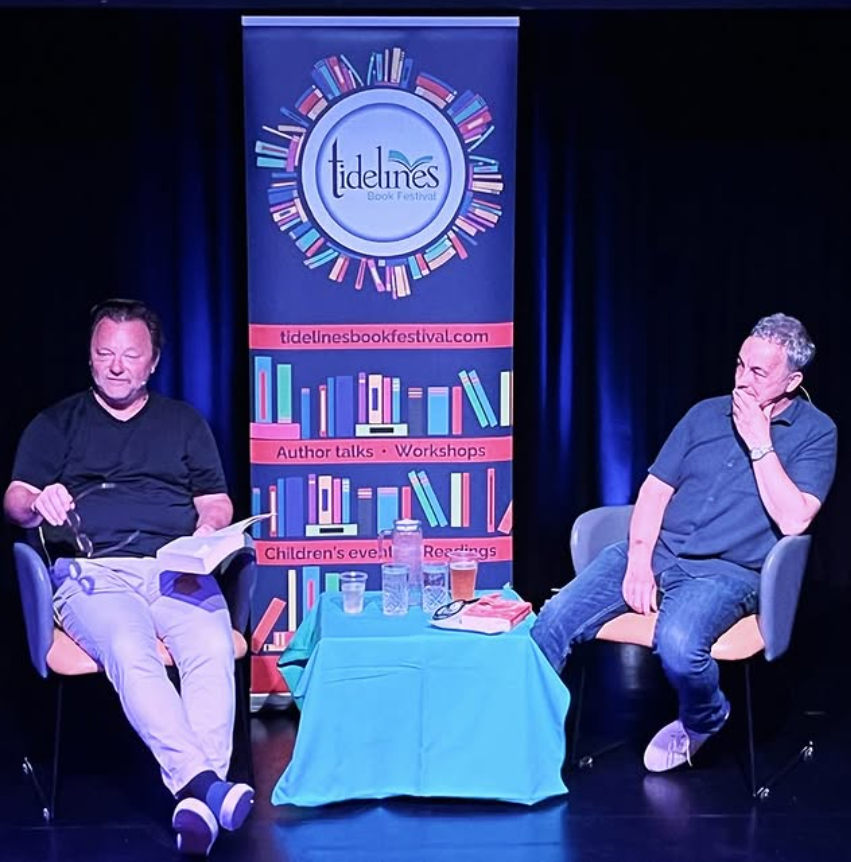
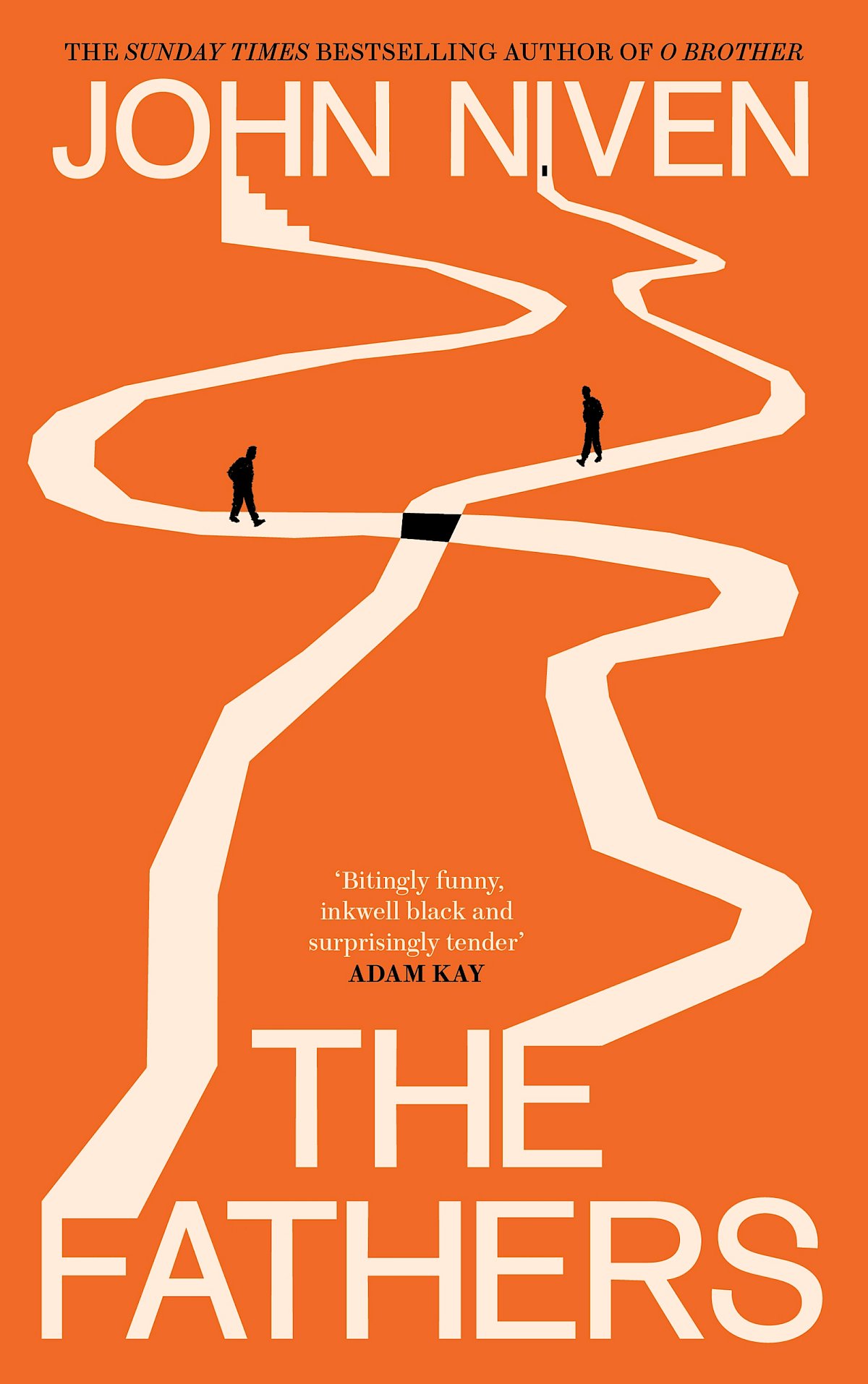
Writer, bon vivant and quick-witted antagonist John Niven was back in his home town of Irvine. Booked as part of the town’s Tidelines Book Festival, it was to be the opening night of a book tour to promote his new novel, The Fathers and he’d asked me if I’d chair the event. “You’ll be great,” he said. “It’ll just be us, talking about my book and shit. S’easy.” A proof copy of the novel duly arrived and armed with a highlighter pen and a stack of post-it notes, I jumped right in.

The Fathers tells the story of two dads who meet outside the maternity hospital as their respective partners give birth to two sons. One dad (Dan) is affluent, socially-conscious and successful (if bored) in his job. The other (Jada) is a ned, a bam, a ne’er-do-well with one eye permanently scanning for opportunity, the other forever looking over his shoulder for trouble. The two protagonists’ paths cross, the story takes a (very) dark turn (we’re reading a John Niven novel, after all) and things begin unravelling from every direction for all concerned. It’s a real page turner, as it turns out. It’d be ideal material for a three or four part TV series, something that is already being discussed, John tells us.

Very quickly I was highlighting and bookmarking words and phrases, whole paragraphs, entire pages of perfectly-scribed text. It struck me immediately how brilliantly evocative the writing in it is.

The air so fresh and cold that all you could do was sip at it.

A mouthful of ruined dentistry, of mixed nuts and raisins wreathed in blue smoke. 

If you’re a parent you’ll recognise the terror Dan feels when first putting baby and car seat into the car for the drive home from the hospital, a moment in time perfectly captured in measured prose. Or the moment when Jada bonds with his son, ‘his wee rabbit heart‘ beating fast against his chest. When writing from the perspective of Jada, Niven’s writing is laced with acerbic Scottishness.

‘Hey, some cun-‘ he remembered the baby, ‘some bastard’s goat tae pay fur aw this!’

‘Still, wi’ a wee boy, you’ve only the wan cock tae worry aboot, eh?’

If you’re from these parts, you’ll absolutely recognise the people who deliver those zingers.

Given John’s background in the music business, you’ll maybe spot one or two hidden references to groups or songs. A Teenage Fanclub lyric leapt off the pages at me. Likewise a Grant McLennan line. There’s even a nod to Status Quo at one point. The proper, loud ‘n heavy ’70s Quo, of course. You wouldn’t clog up a brilliant piece of writing with a reference to Francis ‘n Rick’s parody years, would you?

And it’s all written from experience. Dan lives in an area of Glasgow familiar to both author and reader. He uses his Notes app on his phone whenever Jada says a line that Dan might be able to crowbar into the script of the TV show he works on. As John says on Saturday night, a writer is always writin’…the reason too why this piece you’re reading has seen the light of day. How can I write about that? I was thinking afterwards. And here it is.

John Niven is a very funny guy to have at an event. He can hold court unbroken for an hour, easily. I had planned to structure our chat around some of the points above, but, of course, when John Niven is in the room, there are no plans. My notes were left untouched as Niven rightly remained the centre of attention, reading aloud sections of rib-tickling prose from the book, the audience groaning and gasping at the appropriate parts. My mum – the same mum who’d complained about every second word in Bob Mortimer’s novel being the ‘f’ word (her copy is now in Irvine’s Cancer Resarch charity shop) – queued happily for a signed copy of The Fathers at the end. Quite what she’ll make of ‘gobble’ and ‘dung funnel’ is your guess as good as mine.

The Fathers is a terrific, contemporary – and very Scottish – novel. Like The Stand it too is long enough to fill out a week or more in the sun. And like The Wind-Up Bird Chronicle, it too is set in three parts. I reckon I’ll be returning to The Fathers on an annual basis. I hope that hoped-for TV adaptation does it justice.

The Fathers is published this Thursday (17th July) by Canongate. You must read it.

Token Music:

Echo & the BunnymenRead It In Books

The Teardrop Explodes – Read It In Books

Two versions of the same song, co-written by Ian McCulloch and Julian Cope then recorded by their respective groups after the pair of them stopped working together. It’s like a post-punk Drifters. Which one’s the real deal?! They’re both great; the Bunnymen’s version is circular, nagging and insistent, an updated Dancing Barefoot for the switched-on, the Teardrops’ take swirly and Nuggetsy and garagey, an updated Iggy/Stooges for mushroom connoisseurs. Essential, obviously…just like The Fathers.

Check John Niven’s socials for details of his book tour, coming to a town near you right now!


Get This!, New! Now!

Warp Records

I love this. It’s been playing on the more discerning radio shows in recent days and has me hankering for the day when I can buy it – something that doesn’t tend to happen as much as I’d like.

It’s called Pharaoh, by Modern Nature.

Steady paced and understated, it’s a lovely unfolding slice of pastoral indie guitar music, the same sort of thing that Teenage Fanclub have politely gone about writing and recording in their Gerry-free autumnal years… only (sorry, Norman) better. Much better.

The vocals might lack TFC’s honeyed harmonic suss, but they’re equally as warm. Close-miked and musing philosophically, snippets of phrases leap out. ‘hedgerow…granite…leaves….mountains…coastal miles…heavy choices…‘ Andrew Weatherall, having played early Modern Nature material on his NTS radio show, was seemingly a big influence on the writing of the track, his ‘fail we may, sail we must’ mantra pushing group leader Jack Cooper to dizzy new heights. Cooper has said that the track is about the people who inspire us to think differently.

It’s the heady combination of voices and guitars that had me from the off.

The two guitar players on Pharaoh mesh and meld, knit and weave, never tying themselves in knots, always creating space for the other player to play in and around. With the combination of woody, humbuckered semi-acoustic and single-coiled Telecaster, there’s a hint of Television in the way the players freeform and switch between fret climbing and chord deconstructing. That’ll be the jazz influence, perhaps.

Pharaoh is, you gotta think, a reference to the spiritual, rule-breakin’/rule-makin’, free-jazz saxophonist Pharaoh Sanders. Inspirational people, remember. But where TV’s Lloyd and Verlaine – also undoubtedly inspirational – slash and tear at their machines like there’s no tomorrow, Modern Nature’s guitars bubble away like a mountain stream on a spring day. A choppy major chord here, an arpeggiated minor there, an insistent and unfaltering signature riff between them, everything clear and ringing like steel drums in the summer sunshine. If you’re like me, it’ll take just one play before the track wends and winds its way quietly into your subconscious.

Modern Nature is a new name to me. It’s always great to find a group that you can work backwards on before going forward with each subsequent record.

Pharaoh is from Modern Nature‘s new album The Heat Warps, released by Bella Union at the end of August. I’ll be ordering it via the band’s Bandcamp page here.  Some of you here will, I predict, do likewise.

Get This!, Gone but not forgotten

God Vibrations

There are by now tons of pages and hundreds of thousands of words out there in tribute to the just-passed Brian Wilson, leader of the Beach Boys and conduit of some of the greatest creative pop music we will ever be blessed with. Many of those words, having been written by people who are far more qualified than me, will carry gravitas and authenticity, grandiloquence and authority. I’m on hat-tipping terms with a couple of lucky folk who interviewed him at various points in time, both of whom have proper Wilson-related stories that they’ve shared in recent days. Me, I’m just a fan with a typewriter.

Wilson’s compositions have affected me since first hearing them; safe and politely rockin’ hot rod and surfing anthems, love songs to unattainable caramel-skinned girls on sandy beaches, the actual sound of a summer that’s strangely alien to any Ayrshireman, set out in giddy four-part harmony to a rock ‘n roll back beat. The Beach Boys could make California seem like the promised land, and in that formative era when the most exciting TV was American (Starsky & Hutch, the Six Million Dollar Man, Dallas even), it all fed into the idea of an ideal world.

At some point I alighted on Pet Sounds, the album which was painstakingly made by Wilson in the midst of a full-on marijuana and LSD awakening. Like many of you here, I went properly nuts for it. The box set, the original mono vinyl, multiple tickets for the various Pet Sounds tours in the early ’00s. There’s not a bad track on it and every play throws up – cliche alert – new things still. It’s the record that proves – to use another well-worn cliche – Brian Wilson’s genius.

Genius. It’s thrown around a lot these days. And here’s me doing it too. What does the word even mean? If you look at the dictionary, it defines it as ‘exceptional intellectual or creative power or other natural ability.’

So, yeah, with his natural grasp of melodic structure and chord progressions and multi-layered harmonies and interesting musicality and fantastic arranging abilities and creative production techniques and ability to carve a heart-stopping melody from outta nowhere, Brian Wilson is an undisputed genius. Was an undisputed genius. Man, he’s in the past tense now.

Pet Sounds is the critics’ choice, the easy pick in many ways, but to these ears it’s where the Beach Boys (or Brian Wilson really, as by now he was the undisputed architect of the group’s sound) broke free of traditional pop music structures (verse/chorus/verse) and conventions (electric guitars, four to the floor drums, sax breaks) and ushered in a brave new sound that was created as much to get one up on The Beatles as it was to challenge himself and his audience.

There’s a run of Beach Boys albums at the end of the ’60s into the ’70s that’s the equal of any of those ‘classic’ album runs you read about in the usual places. Wild Honey – Friends – 20/20 – Sunflower – Surf’s Up – Carl and the Passions – Holland (plus the long-delayed Smile project at the start of it all). There’s not a bad album amongst them. Sure, there are occasional clunkers within the tracklistings (Surf’s Up‘s absolutely honking Student Demonstration Time for one, Wild Honey‘s How She Boogalooed It, the sore thumb in an album that’s otherwise soulful and considered being another – both bog standard 12 bar blues tracks, as it goes), but there’s not a record collection on the planet that wouldn’t be enhanced by the addition of any one of these records.

Off the top of my head:

Surf’s Up‘s Feel Flows, Disney Girls and Til I Die. Oh, and Long Promised Road‘s mid-section. And the title track. It’s a work of art, that album.

Sunflower‘s All I Wanna Do and Forever.

Friends’ Little Bird

20/20’s Never Learn Not To Love

Holland’s Sail On Sailor and Funky Pretty

Wild Honey’s Darlin’ and Let The Wind Blow

Carl and the Passions’ Marcella and You Need A Mess Of Help To Stand Alone

The entirety of Smile (Heroes & Villains…Cabinessence…Vege-Tables…Child Is The Father Of The Man…Good Vibrations)

You get the drift.

Not everything was written by Brian. As the band fell into more comfortable clothes, grew out their hair and turned beardy and weirdy, all members stepped up a gear to keep pace with their leader’s unblinkered vision. But everything came stamped with Wilson’s kite mark of quality – the arrangements, the incidental music, the high floatin’, gravity-defyin’ harmonies; a singular vision achieved with the help of willing participants, even if his group members didn’t always immediately ‘get’ Brian’s grand ideas.

The Beach BoysTil I Die

Til I Die‘s wafty and woozy vocal is perfect. Is it autobiographical?

I’m a cork on the ocean…how deep is the ocean…I lost my way…

It most certainly is, Brian pondering his insignificance in an ever-evolving musical landscape, the musicians behind him tinkling tastefully and respectfully until the world catches up. The slowly unspooling and overlapping stacked vocals, the major 7ths, the glockenspiels and chimes, the Fender bass that roots it all… it’s the sound of complete contentment and the perfect summation of Brian Wilson as a composer.

Musical fashions change like the Scottish weather. Hair, clothes, guitars, synths, the in, the out. Brian Wilson cared for none of that. The world at large didn’t always appreciate his vast talents, but you and I and countless others did. What a loss.

Get This!

Puddle Hopper

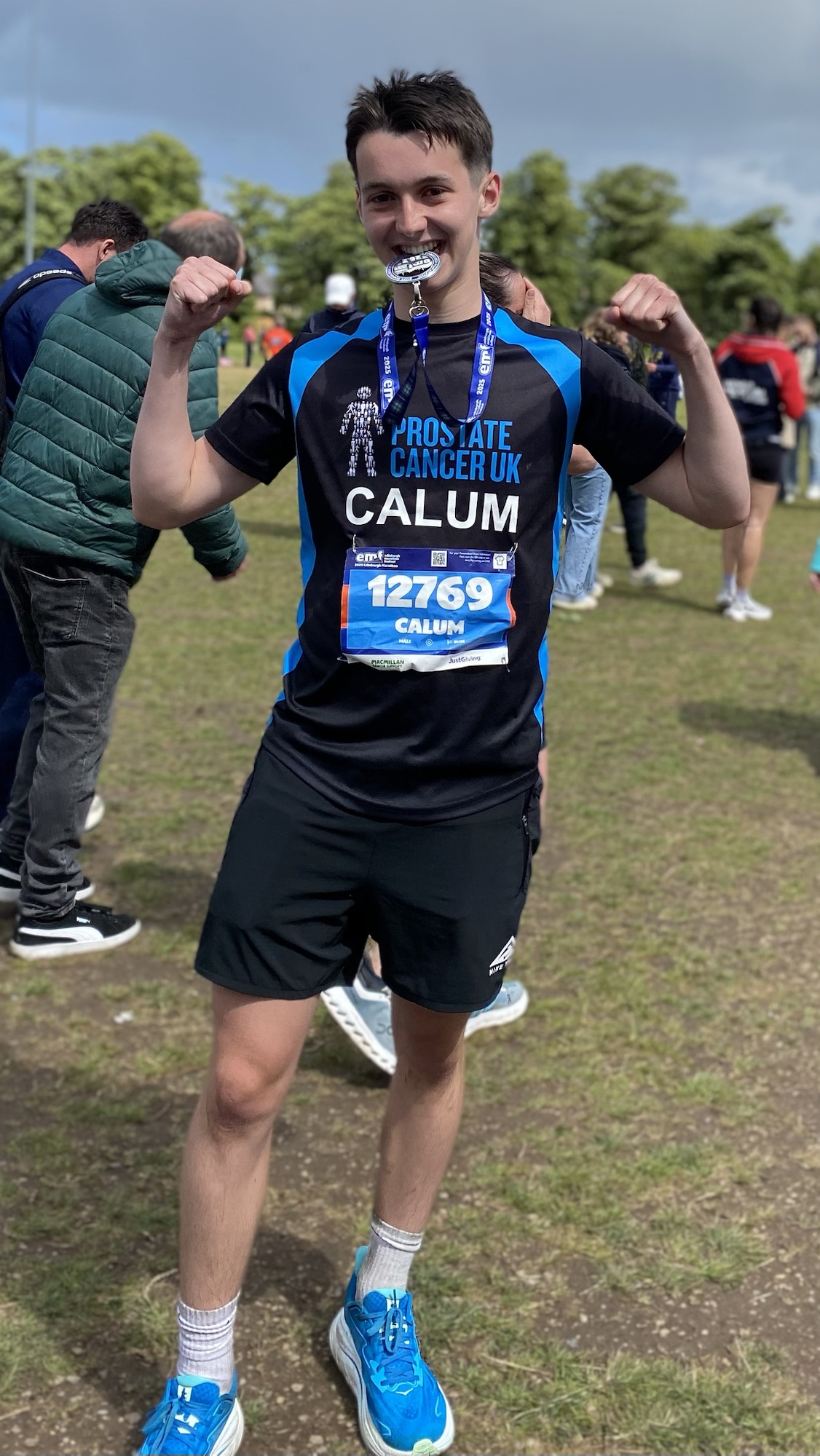
It began as an angry release from teenage woes, a swift early January 5k in the howling rain the antidote to the blues that beget all young folk at some point in their lives. The next night, another 5k, quicker and slicker and, dare we say it more enjoyable. Then 10k… then 10k in under an hour… under 50 minutes… pushing 40 minutes. Minutes and seconds shaved from personal bests as regularly as left foot follows right on the nightly pound around the streets. Proper running.

“I’ve applied for the Edinburgh Marathon,” announced the boy, one night in February.

“This year’s marathon?” we asked, not really believing him.

“Yeah. It’s in May.”

“What, this May?” we ask. “As in three months from now?”

“Yeah. Nae danger,” he shrugged.

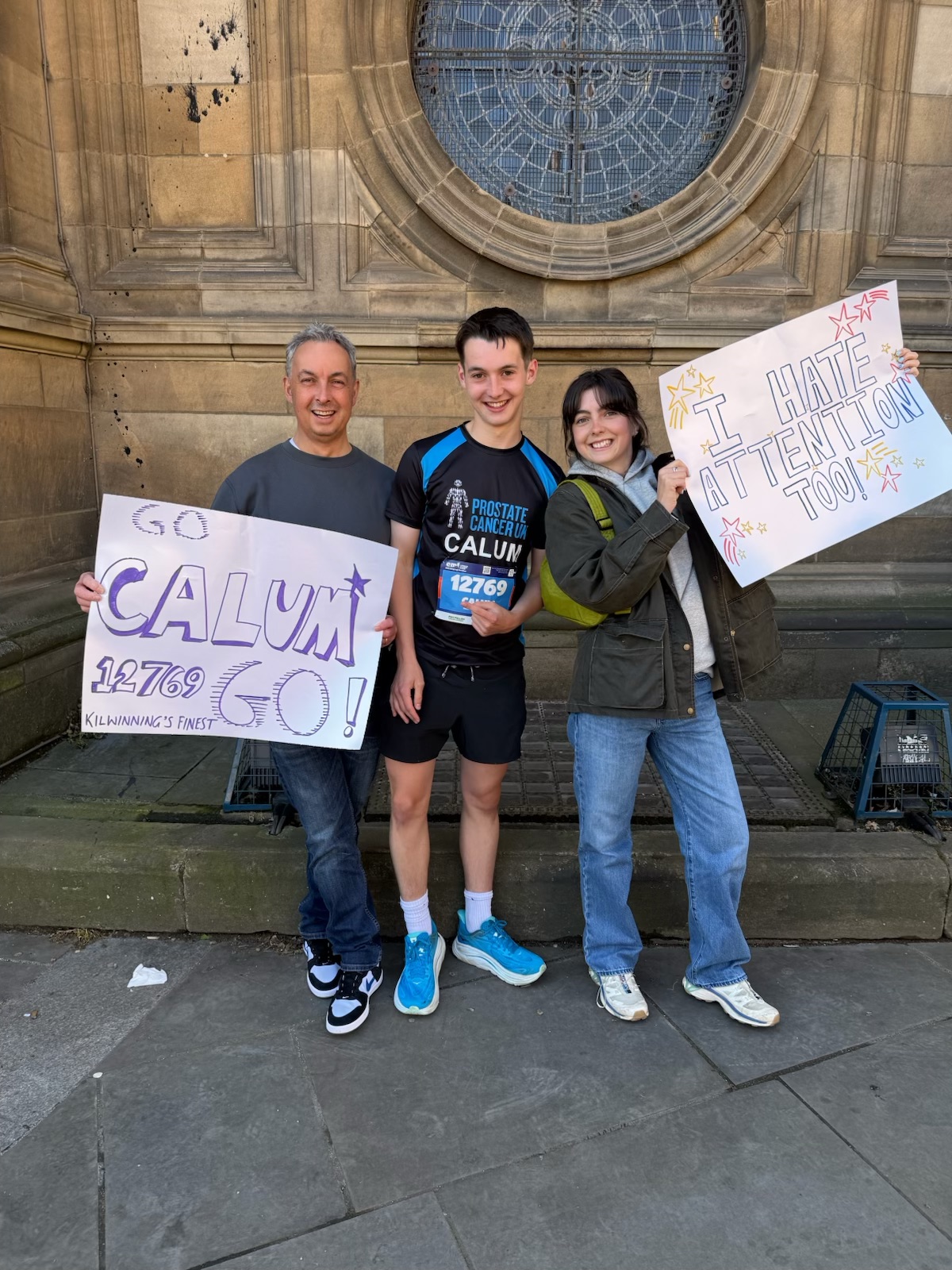
He’s already set up a Just Giving page. He’ll run for Prostate Cancer UK, in recognition of the illness that took my dad’s – his papa’s – life.

He has sponsors, he has a training plan, he has it all sorted out without any help from us.

Young folk and their gung ho-ness is really something to be amazed at.

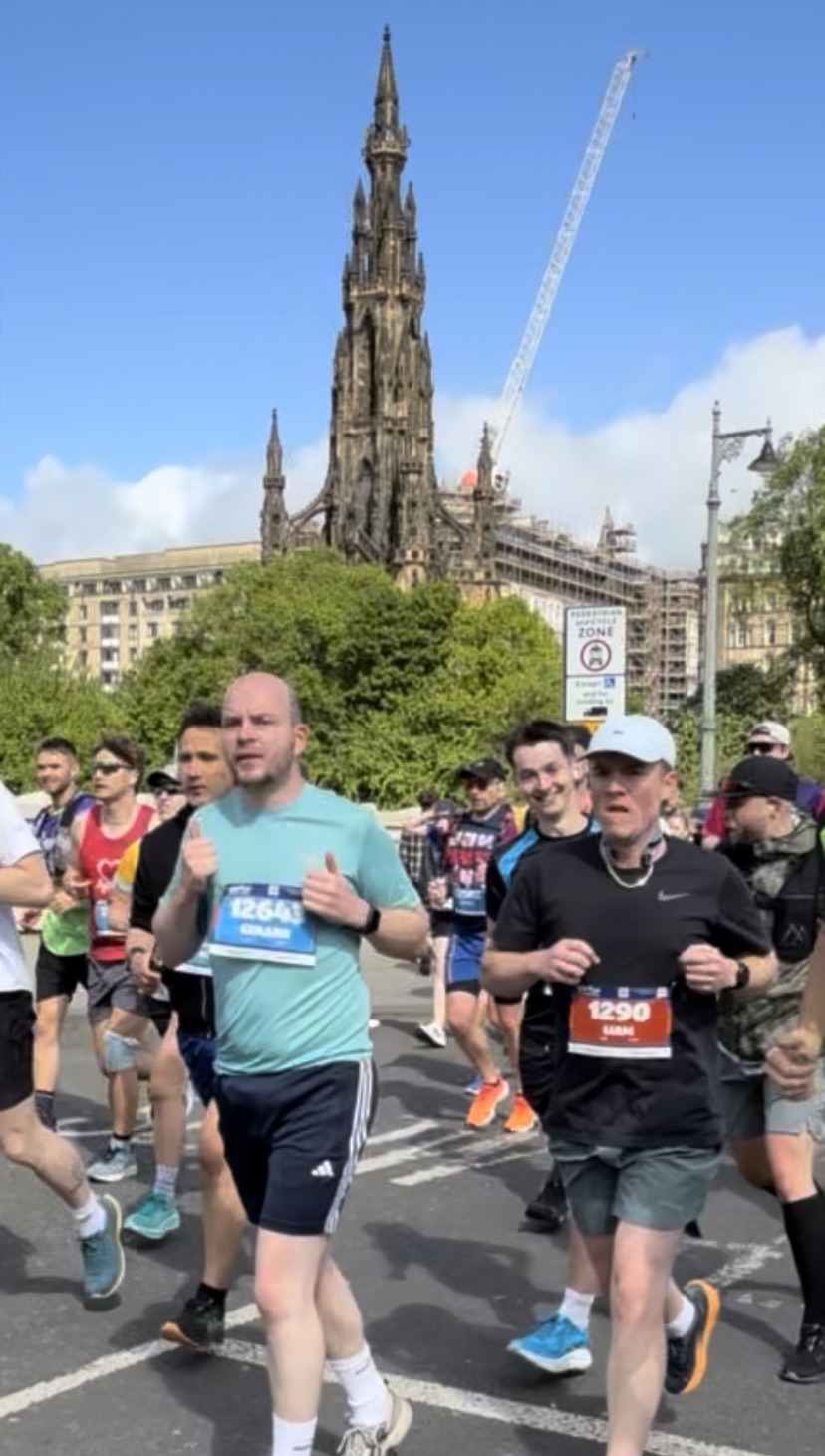
And so, we (mum, dad, big sister) found ourselves in Edinburgh on Sunday, watching all manner of ordinary people do an extraordinary thing. Old folk, young folk, middle aged crisis-averters, the lanky, the limbless and the laudable all coalesced in one giant, humming and thrumming, stretched out line, pounding the cobbles of Edinburgh’s Old Town and out….waaay out…beyond the coastal holiday resort of Seaton Sands to Prestonpans then back again to cross the finish line at Musselburgh Race Course.

We see Calum off at the starting pen then hot foot it to Waverley Bridge to catch him at the one mile mark. It’s a slow mile, he tells us later, given the sheer number of runners boxing one another in, but by miles 3, 4 and 5, the lines begin to stretch.

Our plan…and that of thousands of others, as it becomes apparent, is to get the North Berwick train and get off at Wallyford to cheer the boy on at mile 13. But the trains are ridiculously oversubscribed and ScotRail really isn’t much help. We can’t get on our intended train and are herded onto another one which won’t be leaving for an hour. We sit, packed in at our table and track the boy on our phones, watching his digital icon crawl across our screens as it makes its steady pace towards the half way mark. Of course, by the time we’re there, we’ve missed him. Our train has slow-snaked its way out of Waverley Station and despite our best efforts to get to the crucial mark on time, he’s two miles further up the field.

That’s good, I suppose.

He’s making excellent progress, despite the weather, which has in typical Scottish fashion been warm and sunny but windy to the point of gale force, then calm and still and punctuated by a stinging 10 minute attack of hailstones, to pure golden sunshine and torrential rain then back again. He’d confidently predicted he’d finish somewhere between 4 and 4 and a half hours and it looks as though he’s on course for that sort of time.

As mile 13 also doubles as mile 25, we leave and aim to get as close to the finish line as possible. By mile 26 the crowd is three-deep at the barrier. We find a spot 150 yards or so from the end, where the route turns into its final stretch and watch the blur of runners going past.

Some are as fresh as the moment they leapt out of bed that morning. Tattooed hipsters with unravelling man buns and glistening, rain speckled beards throw their arms aloft to elicit mass hysteria from the crowd and testosterone-pumping bursts of hidden speed from their sleek, muscular legs. Runners in wraparound glasses and backwards baseball caps coast past like the supreme beings they are. Runners with jaws set in stone and jutting at 90 degree angles push their very limits to new, far-put places. Teeth are gritted, facial muscles are stretched to sinew-snapping levels. Pain – pure pain – is etched on many faces. D’you know these Peter Howson paintings of hard-working industrial guys from the small towns of Scotland? Just like that. Everyone in the crowd, many of us who will never experience what running a marathon is actually like, shouts out the names of these strangers that are on the final stretch.

“Go on Samantha!”

“You can do it, Luca!”

“Keep it going, Abigail!”

Two younger men walk/slow-jog past with an elderly man propped up between their shoulders. The man in the middle is out of it. His legs don’t work and he’s unaware of where he is, but his two helpers are making sure he’ll cross that line.

A guy in his twenties rounds the bend, zig-zagging like a drunk man at closing time on Christmas Eve, left to right to left to further left and back again. His arms flap loosely by his side, he staggers to fall, lurches and rights himself at the last second. The crowd will him on.

“Come on Kenny, son! One last push, big man!”

It’s cliche central, but what else d’you say in times like this? I really hope Kenny made it.

There are at least 3 hot dogs running. A dragon, a chicken, a handful of fairies not far behind them. And then…

…the boy!

He’s almost past us…in fact, he is past us by the time I shout his name.

“Calum! Calum!! CALUM!!! GO ON SON!!!!”

Erin shouts his name. Anne shrieks. Calum looks back, smiling widely and delighted to see us.

And I burst into tears.

Proud barely begins to cover it.

The boy clocks a very impressive 3 hours 57 minutes, a sub-four, in marathon speak. It’s an extremely impressive time for a first marathon, for an 18-year old who only started running out of frustration a few months ago at the bum hand life was dealing him at the time.

Calum had a playlist made up, the idea being that he’d cross the line to Vangelis’s Chariots Of Fire (!), but because he was faster than anticipated, he ended up finishing to Sigur Ros’s atmospheric, anthemic and yet quietly restrained Hoppipolla. As you know already, ‘Hoppipolla’ in Sigur Ros speak means ‘puddle hopper’, a very apt track given the soaking roads and puddle-heavy route in places. A fitting tune to cross any line to, let alone that 26.2 mile line. I bet this sounded epic!

Sigur RosHoppipolla

Get This!, Peel Sessions

Senses Working Overtime

Ever since the Electric Prunes mixed their mojo and told us they’d had Too Much To Dream Last Night, licence was given to your more outré groups – the ones who perhaps make a riot of layered noise with a pop sensibility at the core – to mess with your mind and get all psychedelic on yr eyes ‘n ears.

Yo La Tengo come, like Frank Sinatra before them, from Hoboken in New Jersey, but they’ve as much in common with Ol’ Blue Eyes as I do. Sinatra croons. Sinatra swings. Yo La Tengo swoons. And occasionally, Yo La Tengo stings. The groups’ group, they have a tidy way with minimalist backing and a bah-buh-bap backing vocal. They can weave silk worm-like tendrils of unwinding melody, gossamer-thin and stretched out for miles, and they know how to hook you in with a Bacharach-like parping horn and finger-clicking beat, but it’s when they’ve ingested the good stuff –  when they’ve had too much to dream last night – that Yo La Tengo becomes a different beast entirely.

Yo La TengoI Heard You Looking (Peel Session)

I first came to I Heard You Looking via Teenage Fanclub in the mid ’90s. Theirs is a faithful interpretation that had me scampering backwards to see what I’d missed out on, and as much as I really like YLT tracks such as My Little Corner Of The World (the Bacharach one) or the locked-in groove of Autumn Sweater (like Spacemen 3 writing for St Etienne), I always return to their original version of I Heard You Looking.

Maybe it’s because they’ve spent their time looking across the Hudson at Manhattan’s skyline that the tune – and it is a tune, in all senses – is massive. It builds from the very foundations like a skyscraper itself being constructed. A hesitant electric guitar creeps in with an upward-moving riff, all sliding chords, open strings and nerve-jangling expectation. Splashes of ride cymbal wash across crackling, electrified, open-miked airwaves. The drummer scratches his Noo Joisey ass and yawns his lazy way in. The bass player falls in line with both his drummer and the riff-playing guitarist and the group lock in to begin their slow jam.

Subtle shifts in the ambience – there’s two guitars interplaying by now, one sticking to the motherlode riff, the other wandering gaily up the frets, free-soloing and feedbacking and pulling the group ever-northwards – lift the volume and the intensity to the max. One guitarist has enough of the straightjacket approach and breaks loose in vivid technicolour, John Coltrane with an offset Fender and seemingly free reign to do whatever. The group surges and pulses in waves of electric guitar, pushing and pulling, ebbing and flowing, tearing the ears and the heart and the head in an unspooling of structure and frame. Then, an unseen nod of the head between the assembled musicians and the shards of white-hot noise and scattergun Moonisms are brought crashing back to earth by the anchor that is the riff.

And the group goes again.

And again.

For almost ten headswimmingly magic minutes.

…..

Another group who are no strangers to the effect of a noisy and epic jam is Mogwai.

When Stuart Braithwaite’s book came out a couple of years ago, the chapters fell into easy chunks;

I formed a band. I got really wasted. I listened to The Cure.

I rehearsed with the band. We got really wasted. We went to see The Cure.

We got really good. We got reeeally wasted. The Cure asked us to support them.

We got really, reeeally wasted. We got really, reeeally wasted with Robert Smith.

Life is complete.

C’mon Stuart! Life might be great cos you get to get up to shenanigans with Robert Smith every once in a while, but life is really complete because you happened to record, amongst a back catalogue of well-thumbed and well-spun albums, the most perfect track somewhere along the way.

For all of Mogwai’s loud/quiet/hailstorm of anvils that they’ve committed to record, none of it – none! – sounds so thrilling as The Sun Smells Too Loud. It really is the greatest track Mogwai have stuck their name to.

MogwaiThe Sun Smells Too Loud

Electro pulse. Shimmering twang. Whammy bar action. A great second chord. And a great third chord. A fantastic sliding up and up and down guitar riff, the group surfing the action in the background. The Sun Smells Too Loud is a hazy, woozy end of the night beauty. Great for cycling to too.

Repeated listens (and there’s been more than a few since parent album The Hawk Is Howling first appeared) throw up new melodies and counter-melodies within the spaces, not to mention tinkling milk bottle percussion and vintage, droning synths, but more importantly, The Sun Smells Too Loud throws up an aching melancholy. It’s all heart, all soul and all good. It might simply be non-organic electric guitar music played atop a rudimentary beat box, but The Sun Smells Too Loud is as soulful as Sam Cooke. It just is.

Sometimes, as on nights like this, the electric guitar, in all its variances and guises, is all y’need. Turn up to 10, as they used to say on the run out grooves.

Get This!

Tune In, Turn On, Cop Out

Davy Henderson is something of a Scottish music totem. Any record fortunate enough to have his involvement tends to be interesting, inventive and entirely idiosyncratic. From his time in the rattlin’, jerky Fire Engines through the pop-focused chart attack of Win to his role in the Nectarine No. 9 and beyond, Henderson has maintained a distinctive sound and style that is recognisable from first play onwards.

He’s a bit of a drawler, is Davy. A sliding and elasticated singer with more tone than technique and more whine than refine, he’s high in pitch and not averse to stretching a vah-ah-ah-owel beyond its natural length. His vocals might fall short of inclusion in the category that yr average DAB radio listener would consider ‘Classic Vocalist’, but then, you and I are no average DAB radio listeners. It can’t just be me who thinks that, with his style, delivery and unpretentious soul at the heart of the voice, he’s far more appealing to listen to than any pitch perfect but plastic warbler. In this wee corner of the world where we celebrate the unique, the marginalised and the one-offs, Davy Henderson is a King.

The Sexual ObjectsHere Come The Rubber Cops

Released in 2008, Here Come The Rubber Cops was produced, perhaps surprisingly, by the enigmatic and oh so secretive Boards Of Canada. It was released in such limited numbers (300 7″ singles) that you’ll be hard pushed to find a copy. Which is a real shame, as it’s a beauty.

Ringing in on the sort of descending major 7th chord progression that a band like Camera Obscura might use to good effect, it oozes and woozes, lo fi and Velvets-like, and packs an awful lot into its 5 and a bit minutes of skewed guitar-based alt. pop.

Asthmatic synths, hissing hi-hats, eternal hand claps, highly strung jangling yet watery 12 string guitars… such is the pure self-belief the assembled musicians have in the power of their record, we’re just short of a kitchen sink on the bingo card for the complete ‘Legit Post-Punk’ full house.

Tambourine? Tick.

A tapestry of guitars that blend rattle with roll? Tick.

Major to minor chord changes and plentiful hooky riffage? Tick.

Shouty pre-choruses and and a singer duetting with himself? Tick.

Forever teetering on the edge of falling apart? Tick.

A ‘pure sunshine’ moment when a cascade of overlapping ‘ooh-la-lala’ backing vocals arrive to ride the record out into the sunset? Tickety-tick.

There’s no denyin’ the right-on and groovy influences that have informed Here Come The Rubber Cops a (VU, obvs, Lovin’ Spoonful, Orange Juice, all those other Davy Henderson bands themselves) and the record is all the better for it. Tune in, turn on, cop out.


Get This!

Dig Mac

Born long after you or I, Mac DeMarco began releasing records in the strange, unclassifiable wilderness years of the 2010s. Unlike the ’70s (disco, punk) or the ’80s (new wave, electronic creativity), or the ’90s (grunge to begin with, Britpop mid-decade and a million genres afterwards) or the ’00s with its Strokes/Arctic Monkeys fixation the yin to reality TV’s yang, the 2010s were a bit all over the place. Fractured and cast to the wind, the music of the times formed less of a cohesive scene and more of a seeping splurge of internet-powered musical hopefuls, delivered like sewage directly to the listener via algorithms and targeted playlists whether you wanted them or not. And it’s mainly been like that ever since. There’s a lot to get through before you find the good stuff…and who’s got time for that these days?

You rely on tip-offs. A clued-in pal. A decent radio show such as Riley and Coe. A right time, right place support act. The cream rises slowly but surely.

Neon Waltz, a band I thought might really make it – whatever that is these days – turned me on to Mac DeMarco. In a local paper interview with them a good few years ago, their vocalist Jordan Shearer mentioned that I, with my fondness for a well-played twanging guitar, should look him up. Good advice, as it turned out.

Ode To ViceroyMac DeMarco

No one does lazy, hazy, somnolent guitar quite like Mac DeMarco. Cleanly picked and beautifully amped, his guitar oozes and woozes, tripped out and discombobulated, wobbbbbling and bending the notes right around the fretboard and back again; Kevin Shields without the fuzzbox. DeMarco utilises chorus and vibrato and rides a floating tremelo arm the way you or I might row a boat or attempt to use a chopstick on a chunk of Chinese chicken; up, down, in, out, fast, slow, seemingly rudimentary (but definitely not) and highly effective. It’s called style. Knopfler has that clean-picked glassy solo sound. Marr has the excitable arpeggiating riffage. DeMarco has an amalgamation of the two, jigsawed to drunk whammy bar action through a Roland Jazz Chorus amp. Unique and individual, it’s lovely stuff.

Ode To Viceroy is a song about the simple pleasure of smoking. Millennials, I thought, were health-conscious, gym-going, body image-conscious pictures of health. Not DeMarco. And it suits him. He sings with a yawn. He scratches his nether regions as he does so. Drags his hands through unkempt hair before reaching for his headwear. Pulls on his battered Converse. Might even tie them. The most important thing for Mac first thing in the morning is a good long drag on a Viceroy cigarette. Who’s going to begrudge him that?

Lo-fi and flirting with the idea of being in tune, DeMarco might come across as some sort of skip cap-wearing slacker dude, but he knows his way around an amp setting and a fretboard. That little descending run he plays in the outro is terrific, something that, with slightly different effect settings, John Squire might’ve got decent mileage from. His chosen sound is both signature and soulful, and if I had been born maybe 20 years later, I might have gone totally nuts for him in a way that this tired old cynic hasn’t. I could see myself trying to ape that sound and style – a sound and style, like all the best original guitar players, that is tantalisingly out of reach of mere copycats and wannabees such as myself.

He’s worth investigating, is Mac DeMarco. You don’t need a tailored playlist or an aggressive algorithm to tell you that, trust me. In something of a role-reversal, I’m now off to skim through my daughter’s records and borrow the DeMarco album that I know is nestled somewhere in there.


Get This!

It’s Never Too Late For The Earlies

When that Beta Band comeback was announced a few weeks back, my initial thought (much as I love that band) was to think about The Earlies. Like most ‘scenes’, when you have a leading act, you need secondary acts to create that scene and The Earlies were The Hollies to the Beta Band’s Beatles.

Anglo-American (I think), The Earlies were very much an early ’00s band. They merged tradition with technology to create the sort of beat-driven laptop folk that was precisely the product of musicians eschewing old-fashioned 4-track TEAC demos in favour of Apple-powered multi-track home recording. Their debut album, 2005’s These Were The Earlies features this slice of machine-driven psychedelic folk. If you’ve never heard it before, prepare to be dazzled.

The EarliesMorning Wonder

Looping in on a head-nodding, sampled and twisted Jew’s harp, it might remind you of Lemon Jelly or one of those other progressive dance music acts of the time, but a tight ‘n taut Telecaster riff twangs its way to the fore, its snapping single coils sending any notions of ‘dance’ into the ether. The beat is human heart slow and steady, the twang relentless, the tune unspooling and hypnotic. A cut ‘n pasted keyboard riff becomes a recurring motif, a high up the frets woody riff plays on the guitar, a gliding G-funk refrain wheezes the whole thing skywards and then…

…the most glorious of woozy Beatle-ish harmonies – proper John and Paul and George and Ringo on Revolver harmonies, y’know, the best sort – fill the space. A high lead vocal sings about Mother Mary (Beatles again, yeah yeah yeah) before giving way to a repeated “It’s alright, bay-bee” vocal which is eventually overlapped with a “Take me home” refrain that carries us until the song’s conclusion. Before all that though, it ebbs and flows, rises and falls, aural sunshine bursting through the quiet parts, the fade-out in the vocals drawing your attention to that relentless and free-flowing backing track. It’s a bit Beach Boys, a bit Tuung, a bit smart-arsed and scratchy beard…but a whole lot of great.

Morning Wonder is music as patchwork quilt – a little bit of this, a little bit of that, sewn together, melded and welded and presented as a jigsawed collage of sound. It’s quite possible that at the track’s conclusion, you’ll take it straight back to the start for a second listen. I know I did, and still do. There’s a lot going on here and repeated plays reward the most keen of listeners. I should know, it’s played in the background all week.

As far as repetitive, earwormy and extremely Beatles-ish tracks go, Morning Wonder is right up there. Not for The Earlies the hair or the clothes or the riffs or the stance… they’ve taken that most singular of Beatles references – the Fabs’ vocal stylings – and twisted them into something uniquely their own. As much as I’m looking forward to seeing the Beta Band later this year, I’d really love to hear this played live.


Get This!

Everything Is Possible

The BAFTA-nominated Lee Stuart Evans is a comedy writer of some repute. You’ve probably laughed at his jokes as they’ve been delivered to devastating effect on Harry Hill’s TV Burp, or by Frank Skinner, Julie Walters or any number of celebrity faces you’ll care to recognise on the multitude of comedy panel shows that fill the night time slots. He’s even had the honour of one of his jokes being read aloud in Parliament. A full time writer for over 20 years, Lee’s second novel Pleasantly Disturbed was published last year.

It was following a post I’d written about Themes For Great Cities, Graeme Thomson’s excellent Simple Minds biography, that Lee got in touch. Would I like to review Pleasantly Disturbed, a novel that had Simple Minds at its core?

Lee’s book arrived, along with a kind note from him, and I sat it on my ‘to read’ pile – you know that ever-growing tower of books on the bedside table? And there it sat for ages. And ages.

And ages.

And eventually I started to read it.

Then I dived head-first into a work-related Open University course which was extremely reading-heavy….and Lee’s book went back to the ‘to read’ pile again.

But this week, off work but now well enough to function on basic tasks, I picked up Pleasantly Disturbed, slightly ashamed at myself for neglecting it for as long as I had, and restarted from the beginning. I tore through it in two days. It was, to quote the Trashcan Sinatras, an easy read. The review that follows is my attempt at one of those 200-word Mojo/Uncut/Q reviews from the back of the magazine – this ain’t music, per se, they suggest, but it has music as a central theme and with you being of a particular demographic, it’s something you might enjoy reading.

Pleasantly Disturbed by Lee Stuart Evans

There’s more to life than cars and girls, as someone once sang. But not much for our protagonist Robin. Only Simple Minds gets the better of them in the holy hierarchy of life’s staples, yet all three are intertwined in a story that takes in organised crime, reality TV and the foibles of the equestrian set.

Set in the English Midlands, it finds late teen Robin Manvers (and possibly our author himself) dreaming of being Jim Kerr. ‘Divorced’ from his dad and living with his mum and sister in a shabby house, Robin needs a way out. Knowing that even the most kohl-eyed and esoteric of rock stars have to start somewhere, malleable Robin takes on an apprenticeship at a local garage. This gives him the necessary funds to buy clothes, records and tickets to Simple Minds Mandela 70th Birthday show at Wembley, a show he plans to take in with girlfriend Fliss.

Fliss comes from the other side of the tracks; she’s horsey, she comes from an extremely wealthy family and she has a Kate Bush obsession the equal of Robin’s hero worship of Jim Kerr. It turns out too that Fliss has a buried musical talent not heard since Wuthering Heights first fluttered its way into the nation’s collective consciousness – a talent that everyone but Fliss herself can see, but a talent that, should the stars align, might well take her all the places Robin can only dream of.

Fliss’s father, a golf clubbing Rotarian happens to be friends with Robin’s boss at the garage…they are similar people…they have similar business interests…a shared interest in cars… and gathering pace quicker than you can shout “Speed your love to me!”, the storyline unspools, shoots off in unexpected directions and gathers together again neatly at the end.

All the correct cultural reference points are here; the allure of Susannah Hoffs, Minder, nods to up and coming bands, the unspoken kinship with Gregory’s Girl and the films of John Hughes, and the story is told with the same fast-paced humour that Evans has developed across his numerous TV scripts. I particularly liked how the final chapter time-jumped to the present day, so we found out how everyone’s lives turned out.

If you’re looking for a page turner to while away the Easter holidays or read and re-read until Simple Minds hit their run of UK summer shows, you might want to find a copy of Pleasantly Disturbed.

You can Pleasantly Disturbed by Lee Stuart Evans in all the usual places, but especially from here.