Hard-to-find

There Goes The Fear(gal)

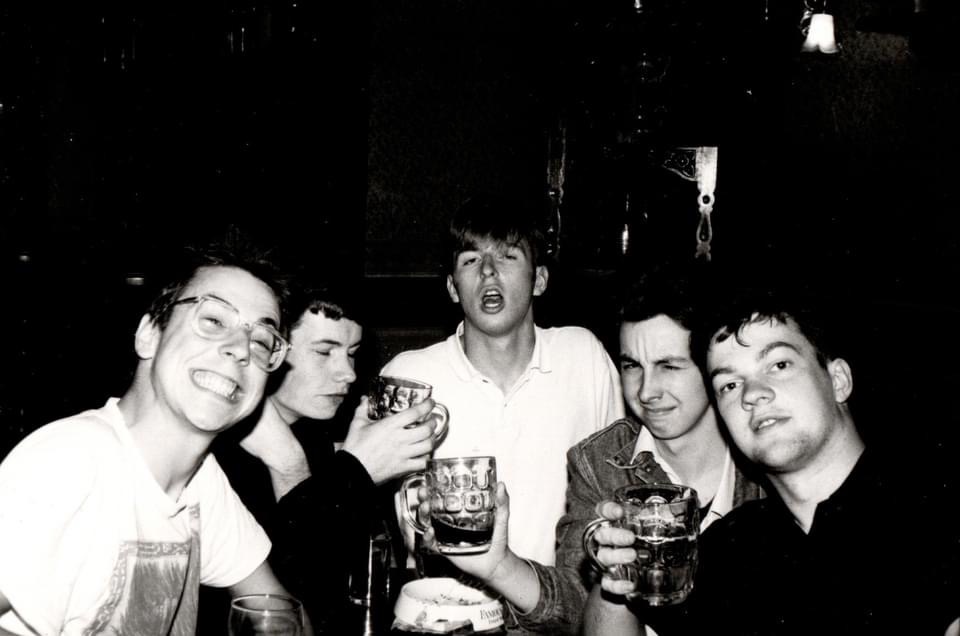
It’s 1990. Or maybe 1989. Maybe even 1991. That kinda timeframe though. It’s a Wednesday night. Not a night we’d normally be in the Crown, but there we were. I’m guessing it was during the holidays, when some of us were free of studies and had a decent stretch of summer ahead of us. Or maybe it was in the middle of winter but we had a gig looming and had squeezed in an extra rehearsal in addition to our usual Monday night slot. Either way, and for whatever reason, we were wedged in around one of the Crown’s circular tables, up there at the back, in our usual spot with all the other like-minded Irvine hipsters of the day, pints in hand and conversation flowing around the exclusive subjects of music, films and football.

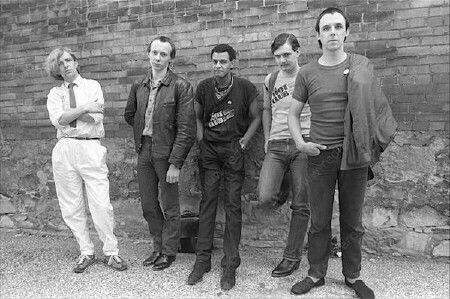
Assorted Surf Nazis and Sunday Drivers in the back of the Crown, 1989.

One of us comes back from the pub’s spartan toilets with the unlikely but true news that none other than Feargal Sharkey is presently at the bar. Nowadays Feargal is everyone’s favourite political activist, but back then he was Fucking! Feargal! Sharkey!, parka-clad vocalist in The Undertones, laterally the suave, Ferry-haired-and-suited crooner of A Good Heart and (even better) You Little Thief; a genuine pop star and hero to every single one of Irvine’s assembled guitar stranglers and tune botherers that frequented the Crown. Why would Feargal Sharkey be in the Crown? In Irvine? On a random Wednesday night?  A rumour creeps up to our table and taps us on the shoulder.

Apparently, he’s up to check out a band for Polygram. I’ve been told they want to sign the Surf Nazis.” The rumour looks at me with a smirk. “It won’t be the fucking Sunday Drivers, I can tell you that for nothing.” Everyone is watching Feargal, supping his pint at the bar with all the casual indifference of any of the hardened locals. “It might be the Thin Men he’s after. They say loads of labels are after them.” The Thin Men are from Stewarton, not Irvine, and that prickles. As it goes, a few years down the line, they’d change line-up and name and become Baby Chaos. Happy Mondays’ manager Nathan McGough would look after them, Warners would sign them and they’d have minor success. But anyway. Back to Feargal.

No sooner has the rumour sloped off to the next table, than the bold Paul Forde, always on the right side of being slightly pished, makes his way to Feargal. We watch as our self-appointed diplomat and representative strikes up a conversation that’s over and done with between two sips of Feargal’s pint.

I told him that Wednesdays weren’t particularly good for him,” says smart-arsed Paul, referencing The Undertones’ Wednesday Week, “and then asked him what the fuck he was doing in Irvine.”

As he finishes telling us this, Feargal downs the last of his pint and vanishes, ghosting out just as invisibly as he ghosted in. We never did find out why the fuck he was in Irvine, in our pub, in the middle of the week, in a room full of eager musicians but with no live band playing. Sorry if you were expecting a punchline. Not much of a story really, but a big story for Irvine.

Fast forward to 2015. It’s a Thursday night this time. October 15th. But that’s not important. I’m in Kilmarnock’s Grand Hall. The sainted Johnny Marr has finished a storming gig and I’m given the job of taking pictures on all his fans’ cameras as they line up to meet him. His tour manager has set up a wee wireless Bose speaker and cued up a playlist, carefully curated by Johnny himself. Chic’s rinky dink disco rattles out of it. Some early Talking Heads. Wire. Johnny patiently pouts and preens for his people, occasionally nodding his head in time to the beat in the background. Clang! A Hard Day’s Night rushes past in a riot of melody and guitars and vocals and Fabness. Next, Buzzcocks cut loose. “I hate Fast Cars,” sneers Pete Shelley, the iPhone in my hand silently click-click-clicking as Johnny pulls plectrums from the wee right hand pocket in his jeans and gives them to the girls.

Then, a brief 5 note electric guitar riff, edged in feedback and promise eases in, and even before the drummer’s clatter has signified the true start of the song, both Johnny and myself have been stopped in our tracks.

The UndertonesYou Got My Number (Why Don’t You Use It)

Must dust this

Oh yeah!” says Johnny with a smile and, like any true fan of music, indulges in a little unexpected air guitar as the song’s punkish riff runs its way across the fretboard. Within seconds, his enthusiasm has caught on and I’m bobbing along to the bounce of the beat, Johnny grinning at me with his recently-whitened teeth. ‘Well, this is all quite surreal and magic,‘ I’m thinking.

It’s a great track, full of hooklines and riffs, dumb-but-essential ‘duh-dit‘ backing vocals and that terrific call and response ‘if you wanna wanna wanna wanna wanna have someone to talk to‘ line between the singing Feargal Sharkey and John O’Neill on guitar. It’s stoppy-starty, it has just the merest hint of Louie Louie-type stabbing keyboard towards the end and it’s all over in a metallic crash of symbols and Feargal’s definitive “WHY DON’T YOU USE IT!” shout at the climax.

Listen and repeat. Listen and repeat.

Listen and repeat.

Listen.

Repeat.

When you tire of The Undertones, you tire of life.

Hard-to-find

The Grand Old Loop Of Bjork

Human Behaviour by Bjork is, perhaps unbelievably, now 31 years old. A massive, booming and echoing timpali rhythm attached to a dry-as-a-bone rattlesnake shake percussion, it sounds like an amalgamation of smoky Parissienne jazz club and total jungle funk, topped off with a lyric inspired by watching a David Attenborough documentary and delivered as only Bjork can. Stop and listen and contemplate it for a moment. It’s a bit of a forgotten classic, I’d say.

BjorkHuman Behaviour

Originally written while Bjork was still in the Sugarcubes, it was wisely held back until the singer inevitably broke free. Quite what Sugarcubes, with shouty Einar and his expressive yet rudimentary trumpet might have done to it is anyone’s guess, but by the time Bjork had a solo record ready for release, Human Behaviour had been lined up as the lead single with which to promote it.

Her voice, always the key magical ingredient in Sugarcubes is perhaps even more out there on here. She whispers some of the verses, her Icelandic voice edged in Londonisms, then rasps and glides her way into those signature high registers, free-flowing and joyous and unlike anyone else on the planet. There are plenty of unique female vocalists scattererd across the genres, but I bet most of them wish they had the tone and timbre of prime time Bjork. There are little sections in Human Behaviour where her voice causes my skin to goosebump in exhilaration. Adele ain’t never done that for me, no siree.

Does Human Behaviour pre-date trip hop and all of that genre’s signifiers? It certainly rides the zeitgeist of 1993’s underground to overground sub-culture, but whereas those contemporaries chose to blunt things up and slow things down, Human Behaviour is forever propulsive and travelling, a head-nodding linear groove with music for the feet and lyrics for the head. Much of the track is built around a few looped seconds of an obscure 1970s jazz sample – of course – twisted and tweaked and dubbed and dropped into position by go-to producer Nellee Hooper.

Ray Brown OrchestraGo Down Dying

I’d wager that few people if any were familiar with the Ray Brown Orchestra‘s Go Down Dying, but it popped up, recommended to me on a shuffling Sp***fy playlist recently and, appearing out of context, it blindsided me. The intro, filmic and groovy, with the suggestion of danger between the notes; where did I know it from? Bjork’s Human Behaviour, that’s where. A quick internet check confirmed it, but by then, Go Down Dying was taking on an unexpected life all of its own. Its fantastic shuffling groove, part Reni, part Roy Budd really carries it. The brass floods into it like a slow-spreading, discordant brassy rash, all honeyed hue and rasping anxiety. There’s even a riff-copying electric guitar that stings its way offa the grooves with all roads leading to Portishead. By the time the flutes have fluttered their way to the outro, Dead Man Dying sounds nothing like Human Behaviour at all, save for that keen-eared loop of Nellee Hooper’s within the first few seconds. Clever folk, those in-demand producers, and for good reason.

Underworld, another of those zeitgeist surfing acts took Bjork’s original and lengthened it to an impressive and essential 12+ minutes.

BjorkHuman Behaviour (Underworld mix)

The polyrhythms that kick start it, all falling over themselves processed beats and steady tambourine jangle give way to the exact sort of rhythm track that helped make Dubnobasswithmyheadman one of the best – the best? – albums of the decade. It’s relentless and percussive and simple enough to allow for Bjork’s extraordinary voice to soar above it. Bereft of the Ray Brown sample, the lyrics become easier to hear.

If you ever get close to a human

and human behaviour

be ready to get confused

There’s definitely definitely definitely no logic

to human behaviour

yet it’s so irresistible

They’re terribly moody…then all of a sudden turn happy

But to get involved in the exchange of human emotions

Is ever so satisfying

And still the beat goes on. Electronic whirrs. Random sampled, walkie-talkied voices fading in and out. The beats start becoming emphasised every few bars. Cymbals splash. Bleeps, bloops, synthy filters weave in and out. The rolling and tumbling electrobeats of Mmm Skyscraper I Love You revisited. And Bjork returns. And still the beat goes on.

Back in 1993, it was de rigeur that acts spread a variety of remixes across the single releases. What a scoop to get this one!


Hard-to-find

Set A Course

There’s an elephant in the room. Not in everyone’s room though. Your neighbour who’s out washing and polishing his car every weekend won’t have seen it. Your afternoon telly and Ben Shephard-loving mum won’t have seen it, and it’ll never step into the eyeline of your line manager with their WhatsApp groups and casual hot desk racism, but if you’re of a certain vintage, with a penchant for guitar bands in thrall to a certain vintage, now that I mention it, it’s likely blocking your view of the Euros this very minute. You can’t miss it, with its trunk and ears and denim jacket, goofy stoned smile painted on its face, the gift of melody enveloping its body like an invisible comfort blanket. Stare at it for long enough and it’ll confirm the truth that you’ve never wanted to hear spoken aloud. “Teenage Fanclub,” it trumpets ruefully (in three-part harmony), ‘have kinda lost it.’

It’s been diminishing returns since Gerry departed. I know that, you know that, heck, even they probably know that. There are good recent tunes to be found ‘n all, but not great tunes. Tunes that are on good albums…but not great albums. Albums that I might not have invested in had it not been for my only-recently wavering loyalty to one of the very best groups. Albums that just never grabbed me by the short ‘n curlies the way Bandwagonesque and Grand Prix and Songs From Northern Britain and even Thirteen and even, even Man Made grabbed me. All bands, especially ones with the longevity of Teenage Fanclub change and adapt and what not, and that’s absolutely hunky dory, but post-Love (and it’s been, what? six years now?) an essential ingredient has been found lacking. It’s unlikely, on recent evidence, to return. That’s the undeniable truth. Just ask the elephant.

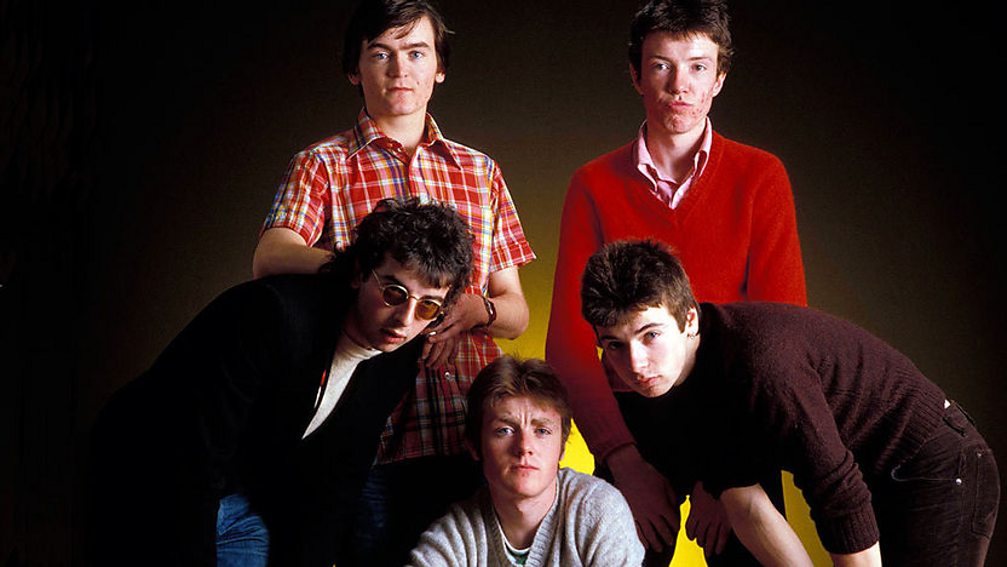
For me, Teenage Fanclub came to prominence in the very early ’90s on the back of a support slot on a Soup Dragons tour. They were funny and sloppy and carried a definite identity; denim, long hair, great guitars, battered Converse and desert boots. Man, they were everything I wanted my own band to be. They looked and played with a raggedy-arsed approach. Songs would collapse in the intro and require restarting. Songs would spool out in the ending with no-one knowing quite how to stop them. In funtime Brendan, they had a lead drummer, but they didn’t have a lead singer. They had three alternating vocalists who’d take turns at singing lead while the other two (and occasionally the drummer as well) provided harmonies that got neater and sweeter with each release, coaxed out of them from under their Bandwagonesque fringes by a smart-thinking Don Fleming to enable Teenage Fanclub as we know and love them to begin their true ascent. They were, as you know already, a fantastic band.

Teenage FanclubEverything Flows

O Brendan, Brendan! Wherefore art thou Brendan?

Those essential ingredients aren’t quite all there yet on Everything Flows, but from its woozy lurch into the opening chords and onwards, the group’s debut release is a stall-setting melting pot of the band’s influences blended through the principle players’ collective filter and thrown back to an audience that yawned and woke slowly to its charms. The mid-paced chugging major to minor chords that evoke the spirit of Crazy Horse…the wailing signature riff that rips Dinosaur Jr-shaped holes in yr heart…the ‘I’ll never know which way to flow, set a course that I don’t know‘ chorus refrain that springs to mind the existential poetry of John Lennon…Everything Flows is a cracker.

Norman takes the lead vocal, low, possibly in the wrong key for him, a somewhat shy and self-conscious version of the voice that handled the tender Cells and towering Neil Jung – to name but two of a gazillion other gilt-edged Blake beautieswith far more self-assured aplomb a few years down the line. There is no obvious vocal backing from the band, but I dare say they’re in there somewhere, buried below the meshing interplay of Gibson (Norman) v Fender (Raymond and Gerry), nimble fingers fret-travelling groovily. Not fast, not flash, just right. There’s bit in the extended outro, after the last chorus, when Norman does this wee run that starts on the low bass strings before being strangled and mangled on the third string somewhere around the twelfth fret. Trainspotters will no doubt point out that, as free-from and spontaneous as that outro appears, Norman still plays that same razzle-dazzle note-by-note riff today. Don’t meddle with near-perfection. There’s a reason the band – yeah, even the Gerry-free version – finish every set* with it.

*Apart from Motherwell in 2008 when it appeared 4th song in. Unbelievably, I had acquired a set list before the band took the stage and I was this close – this close – to shouting out for the songs in advance of them playing them.

Hard-to-find

Bjorn To Boogie

Where popular music leads, others quickly follow. After Oasis came galloping into existence like the twin-headed horse of the apocalypse, labels quickly snapped up any old ham-fisted cock-sure oiks with a couple of Adidas tracksuit tops and a recently-purchased copy of The Beatles’ Blue album between them, stuck them in a studio, created a scene and flung the tepid results out for the gullible to swallow. TFI Friday was awash with one word groups grabbing hold of the Gallagher’s corduroy coat tails and seizing the opportunity before the world woke up to the fact that, beyond one and a half albums, they weren’t any good. It’s always been this way; Elvis then Cliff. The Beatles then The Hollies. Zeppelin/Sabbath/Purple. Happy Mondays/Flowered Up. Imitation is the greatest form of flattery, etc, etc, etc. It still goes on today with Yard Act/Deadletter, Idles/Shame and a million others, all of whom stole something – an idea, a shouty vocal line, a guitar tone – from someone further back on the timeline and managed to find some sort of success of their own.

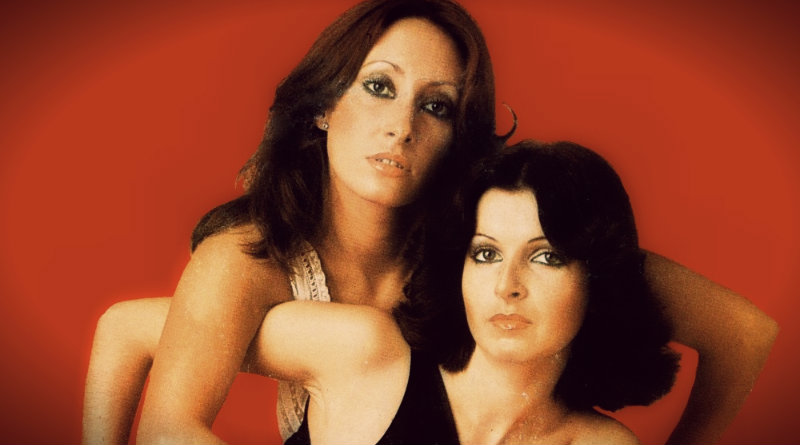
Baccara  – Yes Sir, I Can Boogie

Yes Sir, I Can Boogie is nowadays a Tartan Army party tune, propelled into a collective Caledonian consciousness thanks to dressing room footage of the Scottish football team celebrating qualifying for the last Euros in 2020 (played in ’21, as it would turn out) by congaing their daft selves into a giddy and hysteric state as it rattled its tinny rapture through an iPhone. It’s belted out on trains, murdered in foreign fountains, sung in mass communion following Hampden wins. We’re now at the stage where the song is ubiquitous and synonymous with the Scottish football team. It wasn’t always thus.

The tune came out in 1977 when the Eurovision demographic was mad for Abba and you can hear, in its twin female vocal and string swept disco beat, that its writers took the Swedish blueprint and ran with it like a set of DIY flatpack instructions from Ikea all the way to Fuerteventura to kidnap a couple of local flamenco dancers before bundling them into the nearest recording studio, doors locked until they had a hit in the can.

That sultry, whispered and very European verse line, all hand on hip wiggle and sensuous promise of what might follow – “Mee-ster, your eyes are full of hezi-tay-zhun” – is pure Agnetha and Anni-Frid. That hi-hat, all discofied aerosol shine and four to the floor groove is George McCrae’s Rock Your Baby times ten, itself the key to the beating heart, admit Bjorn and Benny, of Abba’s mighty Dancing Queen. The chorus, when its double-tracked vocal soars out of the verse in direct proportion to the climbing string section is uplifting melancholy and deliriously magic and Abba to the max. It’s fairly easy to understand the correlation between the euphoria of a three goal victory and the song’s super soaraway chorus. That it’s also defiant in defeat is quite handy if you’re a Scottish football supporter these days.

Then there’s the breakdown where the girls ooh and coo and a clavinet line squiggles away like a mid 70s Stevie Wonder himself. And the guitar, especially at the start, which shoots wee lightning bolts of disco funk out into the ether. And a bassline that bubbles away like Bernard Edwards with a bottle of Matey in each hand. There’s a lot going on in Yes Sir..., and although in recent years it’s been kinda cool in an ironic way to like Baccara’s one big hit, I’m transported back to more innocent times whenever I hear it, when Abba, and by association Baccara, soundtracked my childhood with no pretence or embarrassment whatsoever.

Another track heavily influenced by Abba would be 1978’s Substitute by all-girl South Africans Clout.

All the ingredients are there; the understated verse with low-key vocals, the restrained hysterics that you, the listener, know are going to slide up and out into the stratosphere very shortly…

CloutSubstitute

…and there they go. From pre-chorus into chorus, backed by brilliantly produced drums and piano trills, the vocals move through the gears with overlapping Beatles harmonies – “If she doesn’t come back…if she doesn’t come BACK!” – a wee falsetto woah-woah hook between chorus lines for good measure… Substitute is pure Abba and another unashamed favourite from my past.

It was only years later that I discovered, interestingly, that Substitute was a radically-altered cover of an old Righteous Brothers ballad, written by none other than Willie Nelson. What?! Yeah! What, right? Listen here:

The Righteous Brothers sound like they’re wading through ten feet of treacle by comparison, a 45 at 33 rpm, but amongst the slo-mo despair you can hear Wille Nelson, there in spirit through the Brothers’ (but not brothers) countrified phrased twang in their arrangement. Not a patch on Clout’s full-on, late ’70s Abba approximation though. No Substitute, in fact.

Hard-to-find

I Mean, Good Manners Don’t Cost Much, Do They?

There’s an adjective used to describe music of a certain ilk. If it’s lengthy, self-indulgent, meandering and sounds great in the middle of the night with a massive doobie wedged between your yellowing fingertips…if it’s carried along by slow-swelling synths and fringed by hints of electronica…if the guitars are massive and clean and reverberating one moment then fragile and tiny and weeping the next…if the vocals are half-sung, half-sighed and rounded in posh middle England burr…if side one of the record is 17 and a half minutes of the one track…or comprised of a suite of interlinked songs where there are no discernible beginnings and endings…if a female backing vocalist coos and aahs at significant moments…if the whole thing seems to lift itself straight offa the grooves and out into orbit…it’s Floydian, man.

There are two Pink Floyds. There’s The Pink Floyd, the definitive article spearheaded by Syd and his off-kilter melodies and subject matter. And there’s the Floyd, man. Long of hair and longer of solo, sonic architects and soundscapers more than straightforward songwriters, album chart squatters throughout the seventies and mainstays in seemingly every record collection from Accrington to Arkansas. Johnny Rotten may well have declared his distaste of the band through the medium of t-shirt, (and Mrs Pan, rather more vocally when I was playing Dark Side Of The Moon recently) but me? In a quiet sort of way, I kinda dig the Floyd, man.

These days, it’s Dark Side’s Us And Them that’s continually floatin’ my boat.

Pink FloydUs And Them

Lengthy and self indulgent? Yep. Meandering? Aye. Slow-swelling synths? Well, it’s Hammond in this case. The bedrock of many a great record, the Hammond organ. Massive, clean, beautifully played guitars? You better believe it. That arpeggiated riff that plays throughout is a beauty. Half-sung vocals that teeter on the verge of somnambulism? ‘Us (us…us…us…us) and Them (them…them…them…them)…‘ There they are! Skyscraping female backing vocalists? Here they come! Meandering and epic, out there yet melodic, Us And Them is Floydian to the absolute max.

With a Roger Waters lyric that decries the senseless nature of war and an increasingly consumer-led, materialistic society – yeah, even back in ’73 we were discussing such things – Us And Them is the centrepiece of DSOTM’s second side, placed straight after Money (and that’s no coincidence, eh, Roger?) before segueing itself seamlessly into the rambling and hippy Any Colour You Like, Roger the Hat (Pink Floyd’s roadie) leading us there with some spoken word mumbo jumbo.

The sax solo that blows its way between the cracks of consumerism and commerciality is a lovely and understated thing, at odds with Floyd’s more overblown sections, yet totally in simpatico with the delicate nature of the track. With freedom to roam, its honeyed notes seep everywhere, always warm, always welcome, an essential ingredient to one of Pink Floyd’s best tracks.

Some typically slow-paced footage here:


It’s a sound that seems to have found its way to Air’s Playground Love, a track so long and meandering and delicate and intense and Floydian, yeah, Floydian, as anything that might appear on Dark Side Of The Moon itself. Recorded after their groundbreaking Moon Safari album, Playground Love was used as the theme music for Sofia Coppola’s The Virgin Suicides.

AirPlayground Love

Sleepwalking Fender bass atop a beautiful chord progression…stoned and luscious groove…hypnotic slo-mo vibraphones…breathy, half-asleep vocals, lethargic saxophone given freedom to roam from the middle onwards…totally Floydian, man.

Hard-to-find

Magazine Article

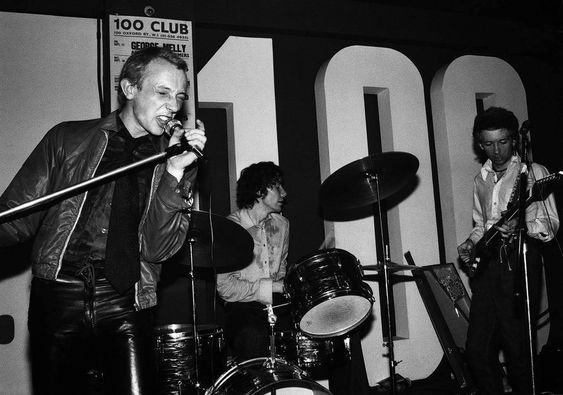
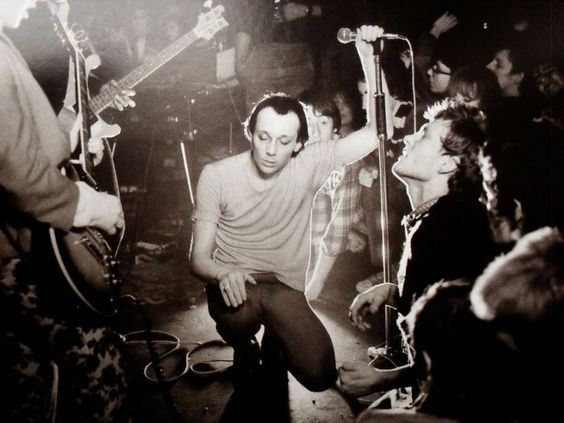
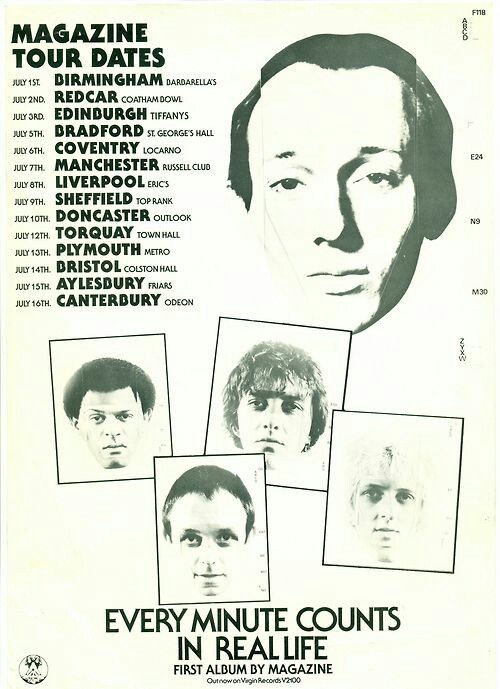
Howard Devoto was one forward-thinking guy. He gets the Sex Pistols up to Manchester for two shows. Is responsible for turning the whole of the city onto punk and, by default, is the catalyst for creating all the most important Mancunian acts in history  – every one of ’em. As leader of Buzzcocks, he creates and releases possibly the first-ever DIY single (Spiral Scratch, of course) and then, at the sharp razor’s edge of punk, calls time on his position in Buzzcocks and leaves to form Magazine, his Wings to Buzzcocks Beatles, the first post-punk act on the planet. Nowadays ‘post-punk’ is a term thrown at any old band post ’79 with a tinny guitar and a clever lyric, but without Howard having the foresight to leave Buzzcocks at such an early stage – in 1978! – when he could already see where punk was heading (Buzzcocks notwithstanding) – we might never have had the term ‘post-punk’ in the first place.

Anyway, Magazine. In Magazine, Howard pulled aside the ramalama of punk’s guitar attack and gave us a peek at what was hiding behind the scars; music that was arty, cerebral, clever. They’re a good band, Magazine. Quite possibly a great band. Those records – the first three especially – hold up strongly against anything released then or since.

Is there a better track out there than first album Real Life‘s The Light Pours Out Of Me? I think not. As much as I’ve been long-familiar with its buzzsaw riff and keyboard sheen, I heard the track at the weekend there as part of the warm-up music for the little-known Caezar – an anthemic Scots act with a neat line in soundscaping guitars and electro-throb bass – and, played loud in an empty room, it knocked the socks clean off me.

The sound engineer was playing around with the band’s intro playlist before doors opened – some Bowie (A New Career In A New Town), some early Talking Heads – and he happened to prick my ears by alighting briefly on the Magazine track. When he’d finished balancing sound levels, the room now empty of both engineer and, as yet, ticket holders, I jumped back on to the mixing desk to cue up and play The Light Pours Out Of Me, in full, with no interruptions…at ear splitting volume. It sounded glorious.

MagazineThe Light Pours Out Of Me

It’s a masterclass in studied repetition. Opened by a simple military two-step drum beat that never wavers or strays until almost – count ’em – the third minute, it’s joined by a strutting bass line, all sleek black cat purr and prowling menace, John McGeoch’s signature six note creeping riff surfing atop. With the group locked tightly together and playing the same thing over and over, we’re only then introduced to singer Devoto. High of fringe and high of ideal, he half sneers, half camps his vocal line, enunciating each lyric straight down the barrel of the mic.

Time flies…time crawls

Like an insect…up and down the walls

The light…pours out…of me

A chink in the repeating blackness of the riff, McGeoch switches to sliding barre chords then back to The Riff. That’ll be yr tension and release (and tension again). The jackboot stomp of the bass continues to mangle all who gets in its way. The drummer drums that same pattern, solid and steady, eyes front and focused. He could choose to scattergun the odd Moonism or two, of course he could – they all did that in the punk days, after all…but this is post-punk. Repetition is discipline, to quote another Mancunian trailblazer. The group soldiers on relentless and regardless.

The conspiracy…of silence ought

To revolutionise…my thought patterns

The light…pours out…of me

There’s another verse. Another two line chorus and then RAT-A-TAT-A-TAT the drummer rattles into action, McGeoch glides up the frets for some alterantive riffage, Barry Adamson switches his bass from sleek black cat to concrete block and briefly, the track soars, powered by glistening keyboards and Devoto’s wide-open imagination.
You’ll want to find yourself somewhere that you can blast this for all it’s worth. The Light Pours Out Of Me is a good track through a phone. A great track on record. An absolute killer through a proper P.A. With Magazine (McGeoch, Adamson et al), volume is king. Turn it up and play it loud.


Hard-to-find

Lou Read

It’s a fact that, at the age of 54 and a half and having lived half my life (or two thirds of it, most likely…) I find myself getting increasingly nostalgic, and especially for the ’70s. I have no particular affiliation with the ’70s other than I lived the most carefree years of my life in that period. I genuinely had no worries whatsoever other than would I ever have that elusive Teófilo Cubillas sticker that would complete my Argentina ’78 sticker book. (I did…and it eventually went in a skip when I moved house in 2006. Regrets, I’ve had a few, as someone once sang). It’s a decade I remember only with fondness; endless summers of tree-splitting sunshine, track-suited pals and balls and bikes and Jimmy Hoolis, the actual bona fide Johnny Ramone bowl-cut New Yorker cousin of a neighbour who showed up mid-decade in his tube socks ‘n satin shorts ‘n skateboard to loudly rename me Craigee Baybee for the duration of his vacation before tipping his oversized baseball cap in my direction one last time and disappearing out of my sheltered Irvine life forever. What a whirlwind! I wonder where Jimmy is now.

Nostalgia hits hard.

Whenever I hear Gerry Rafferty’s Baker Street, I’m back in the garden of the old house, my dad frying French toast in the kitchen as the Hit Parade forces its way through the sizzling cloud of airborne fat and into my ears by the carrot patch.

Whenever I hear Walk On The Wild Side, I’m straight back in my ‘aunt’ Susan’s battered 2CV, squashed in with apparently 17 other kids as we barrel our way downhill to a bout of hayfever in Eglinton Park.

Whenever I hear an Abba track or a quiet and sensitive singer songwriter – Melanie, maybe, or Joni Mitchell – I have a vision of my ‘aunt’ Eveline in a floaty orange and brown Biba dress and large tan-tinted sunglasses leading us out of Mr Hynd’s corner shop with a handful of chocolate tools for my brother and Graeme and I (my sister would’ve been too wee) and a couple of Fry’s Turkish Delights for her and my mum – the added extras to go with the picnic my mum was rustling up in the kitchen on a particularly spontaneous mid ’70s summer day.

Gimme Big Yellow Taxi and tell me to close my eyes and I’m right back there. Except that both my dad and Eveline are no longer with us. Nor, as it goes, is Gerry Rafferty or Melanie. Or Lou. Lou Reed? Deid, as they say in Ayrshire. Joni? She’s just about hanging in there by all accounts.

Slap bang in the middle of the decade, Lou released Coney Island Baby. Do yourself a favour (or favor, as Lou would have said) and look it up. If you’ve gone no further than the Velvet Underground and Transformer (and maybe Berlin if you’re feeling dangerously outré), treat yourself and be surprised.

Coney Island Baby is a really great record. In that most fertile of decades, when hair grew longer in direct proportion to the guitar solos and keyboard suites of the rock stars of the day, Lou surrounded himself with some of the era’s finest players and rattled off a straight-up soft rock album; no left turns, no arty edginess, no atonal cheesegrater guitars or disturbing lyrical content. Given that ol’ Lou was the godfather of punk and that the CBGB’s scene was already in full effect, it’s possibly the most punk thing he could’ve done.

From the album cover onwards – Lou in camply-tilted bowler hat and bow tie – you get the idea that Lou is more than comfortable in the skin he’s in. It’s an album of love songs birthed from his relationship with his transvestite romantic partner Rachel Humphreys. Nostalgia packed, in lyrical content as well as musical style, it’s Reed’s most straight-up record.

Hot on the heels of the baffling (make that unlistenable) Metal Machine Music, you can’t help thinking that Lou was having real fun at the expense of his exasperated audience. Anyone who’d stuck by Lou though was richly rewarded.

Wheezing, countryish slide guitars ease their way off the grooves like the Eagles themselves. Floaty Beach Boys arrangements pepper the most melodic sections. Brooklyn stoop doo-wop arrangements waft across the choicest parts. One chord grooves and chugging, meandering Velvets guitars pop up at the end of side 1. No candy floss indeed.

I’m just a gift to the women of this world,” he croons modestly at the start of A Gift, the track that opens the second side.

Lou ReedA Gift

It’s a doe-eyed, soporific beauty. With its ringing guitars and lazy, relaxed groove, it’s proto-Pavement or Mac DeMarco, out of step slacker rock in a world not yet fully conversant in speed freak punk. Reed half sings, half talks – Gift rapped? – slowly enunciating and phrasing the words as only he can, and the whole thing wanders to a lovely ending.

The faint noise you can hear behind its steady beat and sprinkling of ocarina (or is it flute?) is that of New York’s punk scene rushing up to boot its sepia-tinted nostalgia rudely into touch. Lucky for me, I can find myself back in the mid ’70s just by looking at this record. Seek it out.


Hard-to-find

Key Margo

I don’t know if Margo Guryan ever appeared as a branch on one of those intricately-detailed Rock Family Tree illustrations of Pete Frame, but if she did, you’d find her interconnected (if a wee bit tangled) between Laura Nyro, Bobbie Gentry and Glen Campbell, the Wrecking Crew, Ornette Coleman, Don Cherry and the hepcat jazz musicians of late ’50s New York and the symphonic soul of Brian Wilson’s restless mind.

A native New Yorker, she grew up in an open-minded household, surrounded by the music of the day and encouraged by her parents to play and create. She studied jazz at Boston University until her mind was blown wide open by God Only Knows. She soon found herself recording demos for Atlantic with Tom Dowd and Ahmet Ertegun and became a staff writer at the label. She had some success – her song Sunday Mornin’ was recorded by a handful of artists and charted several times, but success as a singer in her own right seemed to elude her. In a world of strong female vocalists, Margo Guryan simply failed to stand out.

And yet…

Her track California Shake is a mid-late ’60s beauty that – particularly in the Age of Aquarius – should’ve had its turn in the spotlight…especially when you realise that the track was only ever considered a work-in-progress demo! Woah! There’ll be people out there, proper scholars of pop who will know this song inside out – Bob Stanley and Pete Wiggs, I’d imagine, Duglas T Stewart very probably, but if you’ve never had the pleasure, brace yourself for a real treat.

Margo GuryanCalifornia Shake

Coasting in on a frugging groove and a rich tapestry of interlocking, sunshine-blues acoustic guitars – listen to the interplay! – her voice breathes gentle melancholic air across a love letter to the American west coast.

The chords twist and turn, frazzled electric guitars creep between the cracks, Margo’s voice rises up as the tune resolves on the titular refrain and then we’re off again, clip-clopping rhythms, more fancy-pants guitar licks and everyone – yeah, even you – is doing the California Shake, California Shay-ee-ake! I could listen to this record all day and never get bored of it…

…and while the sun’s out on this particular west coast, I just might.

Margo GuryanSunday Mornin’

Here’s Margo’s own version of Sunday Mornin’, recorded and charted by (amongst others) Julie London, Spanky And Our Gang and, as a duet between Bobbie Gentry and Glen Campbell. It’s very much of its time and place and would fit perfectly between, oh, I dunno, Porpoise Song and Stoned Soul Picnic, The End Of The World and Straight Shooter, Orange Skies and Darlin’ Be Home Soon… I can feel a playlist being built.

Hard-to-find

Homeboys

An electric guitar motif, lightly jazzy, hammered-on and partially chorded, plays over and over. A flute flutters in. There’s some ambient noise in the background, a sniff from an actor, as it turns out. A spoken word dialogue comes in; filmic and scene-setting, alliteratively criminal in nature – ‘pimps, pushahs, prostitoots‘. The jazz refrain continues, the flute freestyling above it.

Willie HutchBrothers Gonna Work It Out

A girl sashays her way in. “Brothers gonna work it out,” she suggests, offering her observations to the dilemma of those two conversing actors. The flute replies sweetly to her melody. We’re two minutes in before the tempo kicks in. A descending harp glissando, a sharp sweep of strings, then a paradiddle of tribal drums. The “Brothers gonna work it out” refrain returns, call and response this time between male and female voices, as a ubiquitous wah-wah struts the rhythm underneath a splashing hi-hat. We have lift off.

Brothers Gonna Work It Out is widescreen sociofunk, cut from the same loose-fitting cloth as Curtis Mayfield, as hard-hitting as an Ali right hook but as danceable as disco. Cut for the soundtrack to mid-’70s blaxploitation film The Mack, it brought its creator out from behind the scenes (he’d been a Motown staffer, writing lyrics for the Jackson 5 amongst others) and slapped him bang in the middle of a musical movement that was smoothing at the edges as it transitioned from uptown to midtown, from Harlem’s Apollo to Manhattan’s Studio 54.

Brothers Gonna Work It Out straddles that dividing line effortlessly and coolly. It’s a groove, as they say.

The Chemical Brothers know a good line when they hear it. They took the ‘brothers gonna work it out‘ refrain and recast it as something of a manifesto – Dust Brothers to Chemical Brothers – for their first release to promote debut album Exit Planet Dust.

Chemical BrothersLeave Home

Leave Home is a stall-setting cris de guerre. ‘The brothers gonna work it out‘ hookline is in your face straight away. So too is a snaking bassline and a window-rattling snare. It’s relentless and full on, full of squelchy 303s and rat-a-tat-tatting 808s. A four-to-the-floor big beat headthumper, it has, for good measure, divebombing electronic whooshes, random voices and breakdowns that lead inevitably to The Drop, when it all picks back up and comes in twice as furious as before.

Leave Home also has the dirtiest bassline this side of Bomb The Bass’s Bug Powder Dust, a real key ingredient which in parts sounds like a motorbike grinding through the gears as it overtakes you at 108mph, or 108 bpm if you’re being smart. Elsewhere it provides head-nodding grooveability, the concrete flooring upon which the ‘Brothers go about their business of working it out. Young folk these days might call this a banger. A Tom ‘n Ed Banger, even.


Hard-to-find

‘Life On Mars’ Ain’t Just A Song

Beatles or Stones? Bowie or Bolan? Taylor or Lana?

Yeah – Taylor or Lana, man?

Street-smart Swift clearly takes all the press these days (and all of the world’s money, it would seem) but gimme Lana any day.

Elizabeth Woolridge Grant (her eloquent and grand name by birth) may well conjure up images of a windswept, colonial America and tightly-strained, Gone With The Wind bodices, but despite giving herself an extraneous stage name, Lana has managed to maintain an element of that same dramatic and vampish elegance of yesteryear.

Blue Jeans. High By The Beach. Video Games. Brooklyn Baby. Say Yes To Heaven. Every one of ’em a silver-screened slo-mo unravelling of pathos and regret, old school forties Hollywood set to a music steeped firmly in the girl groups of the sixties; three majors and a minor, overlapping, crashing, crushing melodies, with the merest hint of a twanging surf guitar and a trilling doo-wop piano, a broken heart and the odd f-bomb never far from the stew.

You don’t need to watch her videos to see the tumbling hair and scarlet lips, the tear-soaked pillows and empty rooms. If you watched them though, you’d also see the freeways and the free spirit, the goofing around with her girlfriends, the rolling around with her boyfriends. As urban American as James Ellroy’s stylised noir, she may be rooted, music-wise, in the past but that’s juxtaposed with all the signifiers of contemporary L.A.; the hip-hop and helicopters, the Converse and Corvettes. She’s so modern, as someone once sang.

At some point this year Lana will release her 10th album which, if my mental maths is up to scratch, is an album every 16 months since 2010’s self-titled debut. She’s certainly prolific – as prolific as Swift, as it goes, although she’s not needed to re-record any of her old records – and the quality control she has sees to it that there are no clunkers out there. Everything with her name on it is a grade A mini masterpiece that benefits from repeated plays, possibly in the small hours with minimal lighting and a glass of something decent to accompany it. The strings! The arrangements! The sultry undertones to her voice! She’s magic.

Lana Del ReyThe Greatest

The Greatest‘ from 2019’s Norman Fucking Rockwell! is quite possibly the finest melody to by-pass Paul McCartney and land fortuitously in someone else’s lap. It’s pure late-era Fabs, the melancholic brass ceding the air space to a gently caressed baby grand, all rising chords and spine tingling expectation. There are Beach Boys references, guitar swells, drop outs and build ups to a killer chorus – “I’m way-ay-ay-ay-ay-aysted!” – where Lana harmonises with herself as the melody unspools into a George Harrison-by-way-of-L.A. guitar refrain. At this point there are still three more minutes to go, three minutes of sparse and delicate music where you can smell the Pacific Ocean salt spray, three minutes of melodrama and horns as fuggy as the late summer Californian air, three minutes of music as bleached out and atmospheric as a roll of seventies Kodachrome film.

Three minutes where you’re already thinking, ‘I don’t want this to end’.

Introspective, reflective and melancholic to the max, it ain’t called The Greatest for nuthin’. Now, go and listen to it again without any distractions and tell me it ain’t the best ‘new’ thing you’ve heard this year.