
The uncracked, ochre-washed spine of a book leapt out at me from the shelf of an Irvine charity shop recently, followed immediately by a shuddering Proustian rush of deja vu. The offending novel, David Coventry’s The Invisible Mile was something I’d tackled – slowly and painfully – a decade or so ago. Based on a true story, it’s set in the very early years of the Tour de France and follows the fortunes of an Antipodean rider as he winds his way up and down and all the way around France, breaking sweat and breaking his bike and finally reaching breaking point itself. As synopses go, I’m sure there are a few of you here who’d take a chance on a novel like that.
Far from me to be critical of another writer, but the prose in the book was so heavy, so unbreachable, so smart-arsed in its smug use of a metaphor or unnecessarily long prose that it was a properly punishing read, a totally gruelling slog from beginning to end; a bit like the Tour itself. And then, when I got to the end – because, like those riders, I was damned if I was giving up – I was left none the wiser. There was no true conclusion. The protagonist didn’t win. He wasn’t last. He was just one of many who’d made it to the end, bruised and confused and absolutely certain that this was something he’d never want to do again; a bit like reading the book, as it happens. It wasn’t a surprise to find the book in such a Waterstones-friendly condition. I can’t ever bring myself to stop a book early, but chapeau to the reader who got one page in and had the foresight to bail out.
I’ve always had a thing for Kraftwerk‘s Tour de France. Like listening to The Beatles in mono, the only way to fully appreciate any Kraftwerk is via the full-length German-language version.
Kraftwerk – Tour de France (German version)
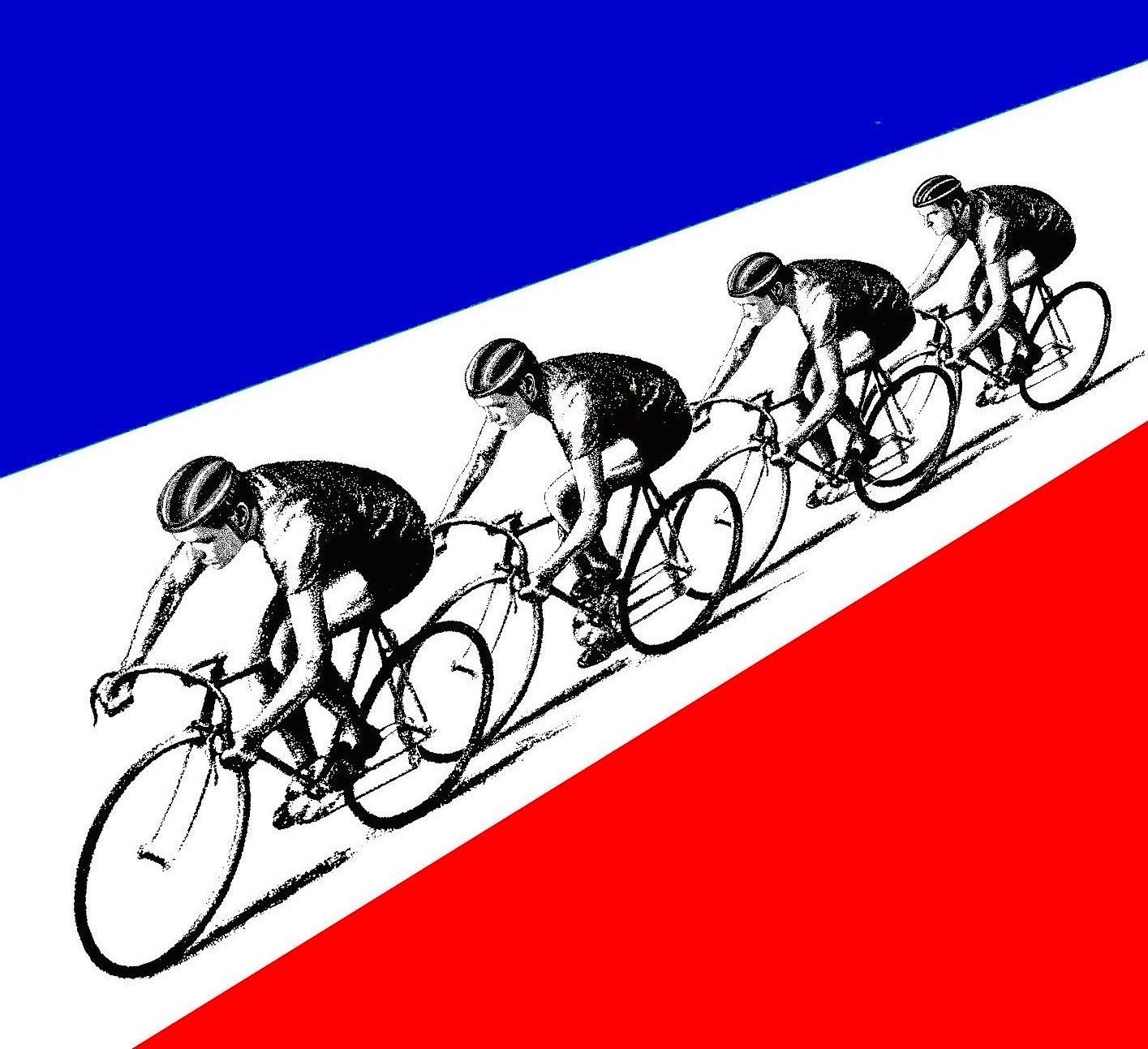
Written by the group’s resident cycling enthusiast, Ralf Hutter, it was recorded and released back in 1983 to commemorate the 80th anniversary of Le Tour. It’s a properly great approximation of cycling set to music.
Tour de France falls in on a rhythm of panting, peloton-pacing voice, the pitter-patter of instrumentation sounding just like a well-oiled chain running through greased and grit-free sprockets, the track propulsive and forward-moving. The keyboard motif brings to mind those parts of a cycling trip when you allow your mind to wander and the countryside and scenery by the roadside sweeps past in a blur of lovely greenery and nature. The robot voice pulls you back to the present, with its uphills and granny gears, the thigh burns and tiny tears. Then the heavy panting again. And more smooth, mechanical synthetic percussion, the clean, wind-at-your-back soundtrack carrying you home, pure German precision, chromium-clean and vacuum-sealed for science lab freshness, Kraftwerk pedalling effortlessly in top gear. There is not one misplaced or irrelevant part to this record. It is perfect.
The first time we were in New York, we went, as everyone does, to Manhattan’s Staten Island ferry port. The trip to Staten Island is a great way of seeing Manhattan from the East River, especially if you time it to travel back from Staten at golden-hour sunset. Perhaps even more impressively, the round-trip is absolutely free of charge – about the only thing in the whole of New York that is both entertaining and entirely free. Anyway. Outside the ferry port, a wee posse of breakdancers had set up; properly uniformed-up in matching Adidas tracksuits and shell toes, outdoing one another with a series of headspins and handsprings and robotic jerks. They had with them a massive ghetto blaster (of course). Their breaking tune of choice? Tour de France. Nearly 17 years later, I’m still able to play it in my mind’s eye, recalled from the section of my brain marked ‘random trivial shit.’ Which, of course, it ain’t.


I too am a fan of the Staten Island Ferry at that time of day for same similar. It’s fun taking public transit down to the Battery Park and then fumbling around trying to find the Ferry Terminal and make the ride across. Land on Staten Island and discover there’s maybe 1 bar within walking distance of the Staten Ferry Terminal. Get a drink, and then ride back again. IT is F-U-N.