
It’s a well-written fact over the years that Tomorrow Never Knows was the first track The Beatles recorded for Revolver. Barely out of short trousers, The Beatles turned to studio-as-instrument and created a thumping and droning kaleidoscope of looped sound – an aural collage a million miles from, yet merely 33 months since, they’d released She Loves You; inarguably, yeah (yeah, yeah), a fantastical leap of lightyear proportions. Waiting for that great leap forward, Billy Bragg? It had already happened a couple of decades prior.
Tomorrow Never Knows – The Beatles
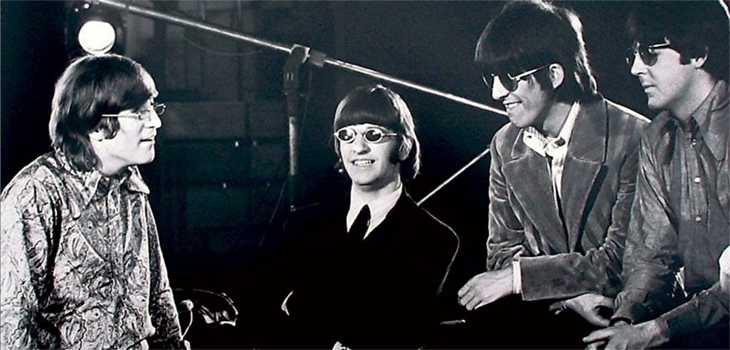
Tomorrow Never Knows and its ground-breaking, rule-breaking appeal has been utilised well in the intervening years. Without its influential template, Harry ‘friend of Lennon’ Nilsson may have felt the need to employ more than one chord on his rockin’ Jump Into The Fire single. Adam Yauch might not have taken to threading metres of recording tape around his kitchen via nothing more than broom handles and a prayer when experimenting with drum loops before the Beastie Boys’ first album. The Chemical Brothers’ looping, thumping, kaleidoscopic Setting Son possibly/probably/most definitely wouldn’t exist. Paul Weller has used Tomorrow Never Knows as an intro at live shows and it never fails to sharpen the senses, keen the expectation and lift the roof off before he’s even arrived. In 2026 – sixty years down the road, Tomorrow Never Knows still sounds like a dazzling, just around the corner future.
It’s interesting, then, to hear Junior Parker’s 1972 version.
Tomorrow Never Knows – Junior Parker
Parker, one of the original dust bowl blues/harmonica guys, disassembles the original of its thumps and crashes, its fuck-off whooshes and fairground whirrs and recasts it as a tremolo-heavy, late-night torch song. There’s a token heartbeat of muffled percussion and ricky-tick stick action during one of its more urgent moments, but mainly one lone twanging, reverberating guitar measures the music as Parker delivers his solemn vocal. Heavy-eyed and somnolent, Parker comes across like a stoned-immaculate Jim Morrison backed by no-one but Robby Krieger on downers. It’s a fairly essential recording, all things said, and one which the Chemical Brothers (of course!) have used in concert before segueing into their own Setting Son. Now there’s a circulatory thing if there ever was one.
Junior Parker, as you well know, is also the writer of that great standard, Mystery Train.
Mystery Train – Junior Parker

Recorded in Sun Studios in 1953, it was brought to Elvis’s attention in 1955 by Sam Phillips, the studio/label owner/producer who just so happened to have given himself a writing credit for the track. Elvis took Parker’s r’n’b heavy version and hotwired it to an electric shock of helium-high hillbilly country, creating possibly his first essential recording.
Mystery Train – Elvis Presley

It’s the sparsest of recordings – the very antithesis of that Beatles session just a mere decade away – with Scotty Moore on electric guitar, rockabilly pickin’ and riff stealin from another Parker tune (Love My Baby) to great effect. Bill Black playing stand-up bass – the same instrument that would later be owned by Paul McCartney, a birthday gift from Linda – slappin’ and walkin’ his way through the song’s foggy ether. It features a sparse percussion track that makes the action on Junior Parker’s version of Tomorrow Never Knows seem like the pounding work of John Bonham by comparison. And on top of it all, Elvis’s cu-hu-huntry bu-hoy schtick and his own scuffed ‘n scrubbed acoustic guitar. Nothing more, nothing less. And all the more essential for it.
By the way, that Mystery Train riff has been copped a thousand times since, but Scotty Moore’s chicken-picked original remains the standard for all players. Simple yet deceptive, a heady mix of left hand pressure. right hand nimbleness and decades-old hot-wired electricity will get you some of the way there.
There you are. From The Beatles to Elvis via Junior Parker and the Chemical Brothers. Not for nothing does the tagline above read Outdated Music For Outdated People. Read on, oldies.


Another terrific piece, Craig. I am in awe to your phenomenal music knowledge and how well you get it written down.
Thanks! Very kind of you to say so.
Thank you for introducing me to the Junior Parker cover of Tomorrow Never Knows, what a stunning track.
It’s a real cracker, isn’t it!