Get This!

Leaner, Greener

I have terrible existential dread. It probably comes from the rapid advancement of years and the musical milestones by which I mark them; that the time from Bo Diddley to My Bloody Valentine’s Loveless (35 years) is less time than the time between Loveless and now. That Johnny Marr had started and finished The Smiths and all the sparkling magic that he created in between before he’d had his 25th birthday. This place is littered with such examples that might question your own worthiness and contributions to society.

A friend recently shared a video clip of the opening of an art exhibition of his. It wasn’t dated, but it was dated; the grainy transfer of VHS to digital, with intermittent wobbly white lines descending the screen. The fluffy sound. The hair. The clothes. The people in it who are no longer with us. As the camera panned around the assembled art-praising masses of Irvine, two folk stuck out. There was my mum, an employee of the library at the time and invited probably because of that. Next to her, my dad. Sensible suit, grey hair neatly side-combed, ubiquitous moustache Souness/Selleck-full and eye catching. As I started to do the rough maths it dawned on me – my dad in this clip is younger than I am right now. Jeez. My mum is still very much with us, pushing 80 and only just about beginning to slow up. My dad is gone though. And the image of the man who looked the same to me my whole life is a stark reminder that I am entering – or have already wandered into – my autumnal years. It’s (hopefully) still early autumn, but it’s undeniable.

You’d think I’d want to do something about it. Travel, maybe. Join a walking football team. Plan retirement.

Or eat rubbish.

This time last year I had this thing going, a bad habit you might call it, of budgeting £40 for the petrol station every time I needed to fill up, but spending exactly (and with well-practised deft precision) exactly £38 on the fuel. The other couple of quid I’d lavish on Haribo Jelly Babies and Cadbury’s chocolate – one of those big bars that not that long ago cost a round pound instead of the £1.35 and more they’re currently asking for them. I’d leave the goodies in the semi-secret glove compartment down by the steering wheel and spoil myself rotten whenever in the car alone.

The spiralling fall-out of this dim-witted pampering was two-fold. Firstly, my car used to run on £40 a week of fuel, but by filling it up with only £38 worth, it would mean that every now and again I’d need to refuel before a Sunday night; so more frequent trips to the petrol station and even more stashing/guzzling of sweets and chocolate while commuting – never on the way to work though (I’m not a total disappointment), only ever on the way home as a reward for a hard day on the chalk face.

Secondly, my waistline expanded in direct proportion to my weekly skimming of the fuel budget. Funny that. I’d eventually run a chunk of it off in the summer holidays, with a daily target of running 5K my self-administered punishment for being addicted to sugar-filled car journeys. But not all of it was shifted. Much of the unwanted flab is still there as I type right now, a wee wobbly reminder of my Alan Partridge years. It is reducing though…and there’s good reason for this.

More recently, the old car has gone the way of all cars of a certain vintage and I’ve come to be the owner of an electric car (and none of your Tesla nonsense either – who wants to be seen in one of them?) I can charge the car at home. I can charge the car at work (if I’m the lucky electric car owner that day). There are now no more trips to the petrol station and, believe it or not, the result is twofold: not only does my belt go an extra notch again, there’s nary a whiff of sugar within five metres of the car. All those crumbs on new upholstery? Sticky fingers on the handles? Empty wrappers on the passenger seat? Of my new car?!? I wouldn’t want that.

I’m leaner, I’m greener. Everyone’s a winner, baby.

Everything’s Gone Green, baby.

New Order at their experimental, boundary-pushing best. Psychedelic dance music for the post-punk generation. I see my future before me. And it’s no longer Cadbury and Haribo.

New OrderEverything’s Gone Green


Cover Versions

Something Good

Stevie Wonder’s trajectory is quite the thing. From Little Stevie Wonder to Motown hit machine, synth pioneer and auteur of funk to socio-political commentator, God-fearing introspective soulster and syrupy ’80s balladeering duetter to his undisputed status as one of the greats, his vast (and decidedly patchy) back catalogue has the lot.

Patchy it may be, but his run of albums in the early ’70s, from ’72’s Music Of My Mind to ’76’s Songs In the Key Of Life is a collection of hard-hitting, hit-packed and ideas-filled records matched only by David Bowie’s outpouring in the same spell. We tend not to say these sort of things while the artist is still with us but wait for the clamour when Stevie passes and that incredible run – five albums in four years – will be quickly elevated to Essential Album status.

What’s all the more amazing is that during this time, Stevie was writing not only for himself but for others too. He threw Superstition in Jeff Beck’s direction before immediately realising the error of his ways and (much to Beck’s annoyance) reclaiming it for himself. He produced an album for his ex wife, Syreeta Wright, worth seeking out if only for ‘Cause We’ve Ended As Lovers; heartbreak laid bare on record (and a track that Jeff Beck would go on to reinterpret to devastating effect).

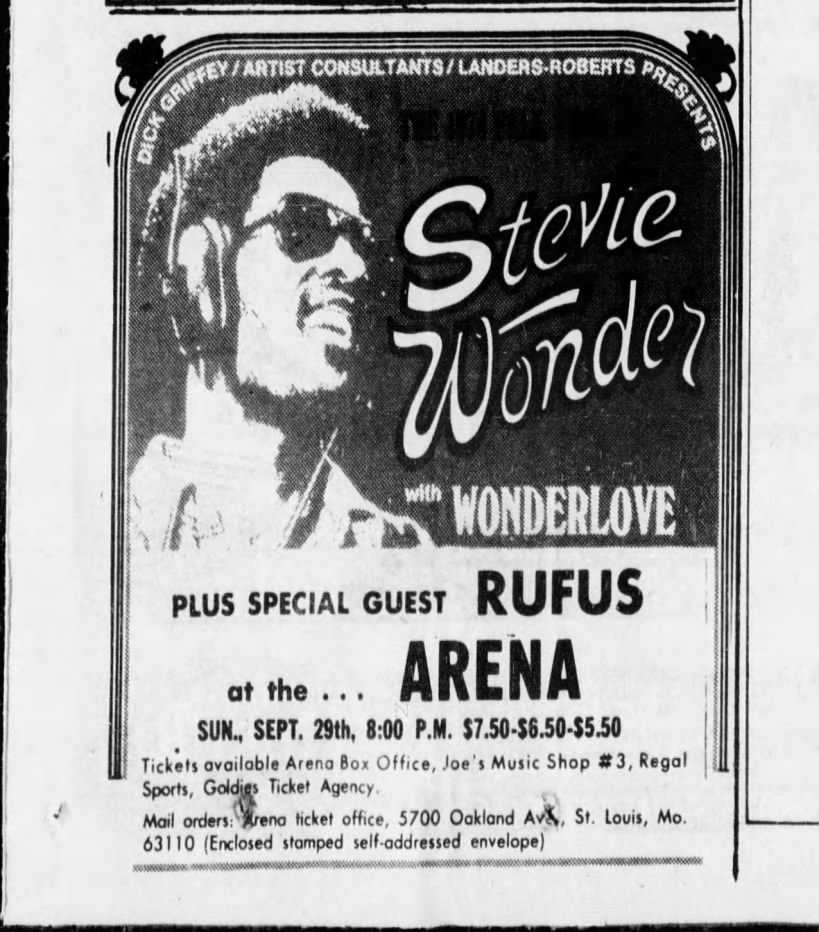
And he wrote Tell Me Something Good for Rufus.

Have a watch at this smokin’ hot live version, from American TV.

Despite Wonder being nowhere near the record, it still bears all the hallmarks of prime time Stevie; whipsmart wakka-wakka clavinet, inventive and tuneful drumming, space between the notes for the funk to brew and on top of it all, a singer who packs a proper soulful punch.

The clip above is outrageously brilliant. For one, it’s played totally live and in the moment; no overdubs, no lip synching, not a bum note in earshot. Chaka Khan sits in the pocket, metaphorically and visually, occupying the space between the guitar players, a pocket dynamo in era-defining flared jeans, her sparkly top shooting laser beams of studio light straight outta the TV screen and into young and immediately hypnotised American minds. But don’t let the clothes and the hair and the looks detract from the fact that she tackles the vocal with everything she has; gritty and low, octave-jumping, quiet and sultry, skyscrapingly dramatic – the whole gamut of soul, in other words.

The players flanking either side of her swagger with a pure coked-up arrogance. The wild-eyed guy on voicebox is playing dripping wet funk on a Fender Musicman – Fender’s budget-friendly, entry-level electric guitar, his high-waisted trousers meeting the point where his shirt begins to button. The bass player, all bicep and lip curl and eye-catching crucifix (S’OK, mom and pop, I’ll have her back before midnight y’all) plays with pure instinctive feel. He knows he’s good too. The self-assured heavy breathing in the pre-chorus is, seemingly, right up his particular street. The bass face he pulls and those little self-satisfied gurns he does when he drops in a particularly funky line completes the look. His hands barely move, yet the groove thuds out in simpatico with the tight but loose drummer in dungarees. Either side of the drummer, the keys players drive it forward, clavinet morse-coding the melody, Fender Rhodes holding down the tune. And on top of it all, Chaka, delivering the sort of blistering vocal performance you’ve maybe only heard up until now on a Family Stone track, or perhaps that PP Arnold TV performance where she duets with Steve Marriott on that great ’68 performance of Tin Soldier. Seek it out…

So, yeah, it’s a great performance of a great song. A few months beyond this, Rufus would become Rufus and Chaka Khan, testimony, should it be needed, that the vocalist was perhaps the strongest piece of an extraordinarily soulful and funky jigsaw.

Gone but not forgotten, Hard-to-find

John, Paul, George and Ringwear

The impressively-named Rutherford Chang died a couple of weeks ago.

Who? you say.

What!? I retort. D’you mean you never followed him on Instagram

It’s a fascinating story…

The son of a Palo Alto tech bigwig, Rutherford’s comfortable lifestyle allowed him to forego a normal working routine, instead affording him the time and resources to indulge in high conceptual art; taking the front page of the New York Times and, with all the news that’s fit to print, rearranging every piece of text into alphabetical order; cutting and pasting all of Asian actor Andy Lau’s numerous and varied death scenes into one near-half hour video compilation of death after death after death; editing a George W. Bush State of the Nation speech by removing all of the President’s words and leaving only Bush’s pauses, coughs, breaths, rustles and the crowd reactions in place. Crazy and interesting stuff like this.

A chance teenage purchase of a second-hand Beatles’ White Album in the late ’90s would lead him to his defining concept, one which would bring his name to a wider audience and one which would allow him to fully indulge his need for order, ranking and system within his particularly niche world.

(When I get to the bottom I go back to the top of the slide.)

A while after buying that Beatles album, and noticing that a second copy of the same record in another shop had aged differently, Chang had the masterstroke of all conceptual ideas. He bought that second copy of the White Album and right there and then began to obsessively gather as many copies of the record as he could.  He advertised locally. He trawled record shops. Or stores, as he’d no doubt call them. He pored over Craig’s List. He sought out garage sales. And gradually, he amassed an impressive array of White Albums and only White Albums.

(Where I stop and I turn and I go for a ride.)

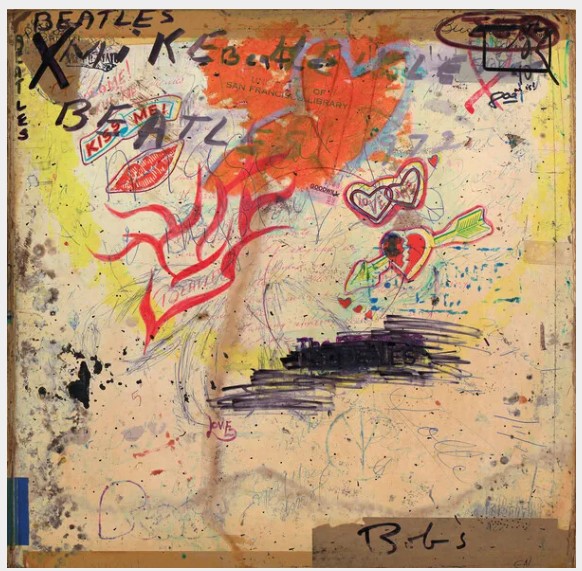
Battered, bruised, bashed, beat up, the more so the better. Those copies had more life in them, more unknown stories to tell. Chang was interested in how something that began life so white and pure – and mass produced – could end up discoloured, written on, stained and unique. The journey each record and it’s sleeve had taken was just as important to Chang as the music that filled their grooves.

(Till I get to the bottom)

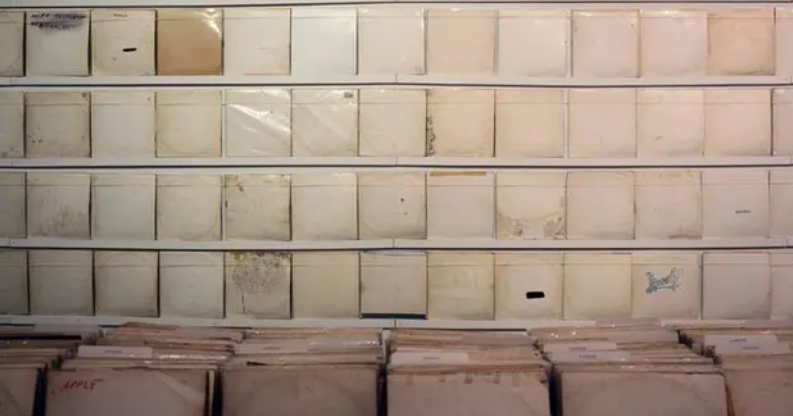
There are three million of them out there,” he said cheerfully in 2013, by which time he owned nearly 700 copies of the album. He played them all too. He set up a gallery space in New York’s Soho, recreated the feel of a classic record shop, stuck a ‘We Buy White Albums’ neon sign in the window and, when he wasn’t bartering with potential sellers, allowed gallery visitors to browse his ‘racks’, select a copy and stick it on the in-house turntable.

It was clear that, as they spun, some of his acquired copies were beautifully pristine. Some sounded like bacon and eggs frying down a well. Some jumped. Some stuck. Some were stereo copies. Some were mono. But all were versions of the same record.

(and I see you again

and again

and again

and again

and again

and again)

By 2014 – a year later, Chang had collected over 1000 copies, buying on average one copy a day since 2013. And, like the most diligent of museum collection curators, he meticulously catalogued them all. Where he’d bought it, how much he’d paid for it, what the stamped number on the front was, was it a mono or a stereo, a first press from the UK or a third press from the US, a seventeenth press from the Phillipines? And once catalogued, the records were displayed in his gallery. Dividers were slotted into bins, arranging the records by serial number or origin or year. Just like a real record shop, only different; this collection was a record of White Albums and the stories they held. Wouldn’t you just love a browse through them all?

He had a rule – hard to believe in 2025 – that no copy should cost him more than $20, but I’m not sure how steadfastly he managed to stick to that rule. He had some pretty low-numbered and interesting copies in there and, regardless of the state of any of them, I’ve sure never been lucky enough to upturn a copy of the record – mono, please, a toploader…with all the inserts, thanks – at anything under three figures. The one I found by chance in a box of records in New York’s Chelsea Market flea sale was a snip at a cool $599 and it looked like it had been well-loved, to be kind to it.

Even my bog standard ’80s reissue (yeah, it has the poster and the four portraits, as well as two slabs of well-looked after stereo vinyl) would fetch £40 on the current second-hand market. Not that Chang would’ve been too keen on securing mine. I appreciate he was all for securing copies that had seen a bit of life but, as long-term readers here may know, I drunkenly relieved myself on my prized copy on the night of my 18th birthday. Some of Rutherford’s copies had coffee stains. Some had food stains. Light brown pish stains though, the colour of an earthy Farrow And Ball paint chart? And this is none of your Greenwich Village hippy stoner pish either, I’m talking primo McEwan’s Lager pish stains from the west of Scotland. I bet Chang never had a copy quite like that. Bog standard, by the way. Pun intended.

What Rutherford did have was plentiful and interesting enough that his collection would travel to Liverpool to be shown in the city’s FACT art gallery. There, visitors could browse what was undeniably the largest collection White Albums in the world. Sleeves with scribbled names. Sleeves with love letters falling out of them. Sleeves with break-up letters inside them. Soft drugs, soft porn, money… sleeves teeming with the minutae of life. Sleeves teeming with the minutae of life, safeguarding one of music’s most important artistic statements. High concept art.

To accompany his travelling exhibition, Chang took 100 copies from his racks and did two things.

Using trick photography, he superimposed all of the 100 sleeves on top of one another to create a master sleeve that was anything but pure white. In its own way it’s a unique work of art.

He then took those same 100 records and built a wall of sound of the 100 records playing simultaneously. Due to a number of contributory factors; where the needle dropped, the minute variations in belt drive speed of the turntables, the gaps between the tracks themselves (micro seconds of a difference, if at all, but multiply that by 100…), Chang unwittingly produced? built? a proper slice of arty, woozy psychedelia that the Beatles themselves, and indeed, Yoko Ono, would’ve been proud of.

The delay-lay-layed way in which Dear Dear Prudence fades in on Back In The USSR‘s roaring jetstream…Glass Onion‘s sandpaper rumble and oh yeah-yeah-yeah- oh yeah-yeah-yeahs…, Ob-La-Di, Ob-La-Da‘s jittery and jangly piano intro (la la la la life goes on…and on…and on…) …the compressed mayhem of While My Guitar Gently Weeps-eeps-eeps…that bleeds into Warm Gun…Warm Gun Warm Gun…Yeah…Yeah…Yeah…Yeah… It makes for an interesting, occasionally unsettling (and possibly just once in a lifetime) listen. I wonder what Charles Manson would’ve made of it all.

At the time of his death two weeks ago, Rutherford Chang had amassed almost three and a half thousand White Albums. He was only 45 and had many more years of collecting ahead of him. I wonder what happens to the records now? Does someone take the project on? Do the people who sold them to Chang in the first instance get offered a chance to buy their copy back for the $20 they were paid? Rutherford’s detailed records will, after all, have all the necessary contact info. Or, does someone sell them all and rake in a whole load of money? I’m keeping a keen eye on things from over here.


Dylanish, Get This!

Strait Up

In the future, historians of popular culture and those who gatekeep the ancient art of music blogging will point to this date – the 9th of February, in the year of our Lord two thousand and twenty-five – as the day that Plain Or Pan, that once-great leading music blog, began its slow but steady and inevitable terminal decline. The reason? Dire Straits.

There was a great old Top Of The Pops episode on BBC4 the other night. Presented by a smug ‘n smooth Simon Bates, it featured the hits of this week from 1981; a jumpin’ and’ jivin Stray Cats, their outrageous quiffs riding the crest of the rockabilly revival wave; Blondie’s Rapture on video, a blue eye-shadowed Debbie in shorts and not much else, her mile-wide smile bordered in bright red lipstick and stirring something in me even then as an 11 year old; the much-lampooned (’round here at least) Spandau Ballet, dressed ridiculously – jackets worn over the shoulders, layers and layers and layers of fabric, billowing blouses and baggy breeks and what looks like Hunter wellies and woolly socks turned over the top of them – a proper fashion student’s juxtaposition of NOW!, transplanted straight from the Blitz club direct into your suburban and beige living room.

The highlight of the Ballet? The Spands? is, as always, The Hadley. He’s got a bit of a beard going on here, highlighting his (admittedly impressive) razor-sharp jawline. His hair though is a disaster; teased, lank and greasy it’s swept to one side like an unfortunate outgrown Adolf do, (Spandau, eh? Makes y’think), his skinny mic technique and gritty voice cementing his pure soul credentials to those lapping it up at crotch level in the studio’s front row. Behind him, the band – his band –  pose and preen and pretend to play like it’s the last time they’ll ever be allowed on the telly…which really should’ve been the case. It’s quite an astonishing performance. Should you wish to see it, here y’are:

Daft one hit wonder Fred Wedlock comes and goes, thankfully, in the short time it takes to fix yourself a top up before the hard-rockin’ Rainbow show up on video; tight tops, tight red jeans, bright white guitars. A splash of satin. A dash of bubble perm. Proper music for proper people, y’know.

And then there’s Dire Straits.

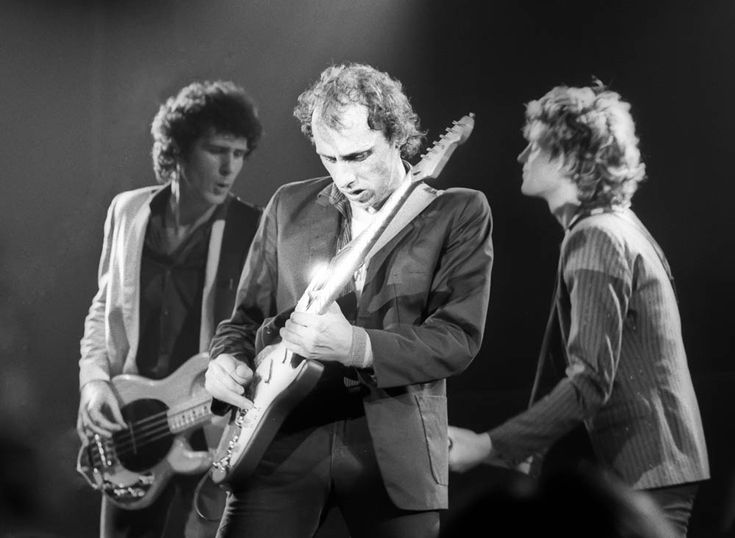
They’re a good four years from ubiquity, Dire Straits, but look! The red sweatband that would be used to hold Knopfler’s mullet in place at some point down the line is right here, right now. There it is, strapped round his right wrist as he picks the opening to Romeo And Juliet on his Brothers In Arms National steel guitar. Just as that guitar was elevated from mere Top Of The Pops studio prop to cover star on their massive hit album four years into the future, that sweatband clearly grew in direct proportion to Dire Straits’ record sales too.

They’re not a Top Of The Pops act, Dire Straits, and don’t they know it.

Someone has had the gumption to get them to a tailors before recording. For a bunch of four un-popstarry guys, they look surprisingly great. Knopfler is wearing a dark blue pinstripe suit jacket atop a white tee – he hasn’t yet found his penchant for vests – and he looks like a groovy English teacher doing a wee slot at an end of year school assembly; self-conscious, smiling nervously but with the chops in his fingers to validate his being there.

The group behind him is supremely stylish. Like, if someone showed you a picture of them and told you this was The Strokes, you wouldn’t be a fool to believe them. John Illsley on bass is tall, angular and moody. Chiselled of cheekbone and dark of brow, he wraps his massively long fingers around the neck of his massively long Fender Precision bass and plays it effortlessly, precisely even, pouting on all the right notes, looking into the middle distance for added appeal. He has slightly more buttons undone on his shirt than is exactly necessary, but then, the bass players are always the ladies’ men, are they not?

The guitar player – is it Mark’s brother David? – plays a hot Strat that may well have been borrowed direct from that there Rainbow. His vivid blue suit jacket sleeves are rolled up, Crockett and Tubbs-style, his large triangular collar mirroring the sharp edges of his Illsley-rivalling cheekbones. He too seems to have forgotten that shirts button all the way to the Adam’s apple.

The drummer? He’s in a capped sleeve t-shirt. Clearly, the band budget stretched to the three Straits who’d be standing directly in front of the camera. There’s a piano player stuck somewhere in the shadows too, but who’s bothered about him? Not the Top Of The Pops cameraman, that’s for sure.

Romeo And Juliet, but.

There used to be that ‘guilty pleasures’ trend a few years ago, y’know, where uber-cool folk – or, rather, folk who thought they were uber-cool, admitted to liking Rock Me Amadeus and Eye Of The Tiger and stupid stuff like that. I blame Brett Easton Ellis for his irony-free fashioning of Huey Lewis And The News in American Psycho for giving sensible folk the idea of ‘the guilty pleasure’. What nonsense! Music is music. It’s either good or bad, right? Soft rock, never fashionable amongst any demographic, is well represented in guilty pleasures circles. Anything by Stevie Nicks (Rooms On Fire! Edge Of Seventeen!) Steely Dan’s Do It Again. Kim Carnes’ Bette Davis Eyes. They’ll never fail to hit the spot. Them….and Dire Straits’ Romeo And Juliet.

It’s a fantastic record; expectant, storytelling verses, tension building pre-choruses, heart-melting choruses. It’s also a fantastically well-produced record. Dire Straits may well be a guitar band, but listen especially to the drums! Four to the floor tambourines. Unexpected snapping snares. Rocksteady rimshots. Hi-hat ripples and end-of-line paradiddles. Those patterns are exquisite! In the verses. In the bridge. In the choruses. Subtle and inventive, they elevate Romeo And Juliet from mere singer/songwriter ballad into brave new territories. Pay attention to those drums the next time Romeo And Juliet enters your orbit.

Everyone knows that the Knopf is a fantastically idiosyncratic guitar player; strictly no plectrum, a thumb and fingers style of playing, slow and lazy chord changes, snapping and twanging solos, and it’s all over Romeo And Juliet. But it’s his vocal delivery that really does it here. In the verses, he half speaks in that languid Tyneside Dylan drawl of his, but occasionally he slips into a vocal cadence that’s pure Lou Reed. Play Street Hassle or New York Telephone Conversation then play Romeo And Juliet and tell me I’m wrong. You and me babe, how about it? Pure Lou. It’s 1981, right? Kinda makes sense, like it or not.

So, yeah. Romeo And Juliet by Dire Straits. On Plain Or Pan. You can unsubscribe on the right there, any time you like.

Get This!

It’s Not Important Now

It’s 1981. By now, my record collection is taking shape. I’ve got a great wee collection of crucial 7″ singles, not yet donated in shame because of a haranguing Bob Geldof. I’ve begun to dip a toe into the adult world of albums. The first non-compilation album I’d buy would be Kings Of The Wild Frontier. Actually, the first album I bought full stop was Kings Of The Wild Frontier. Albums, being pricier, are more of a risk. They require investment, both financially and emotionally and this 11-year old didn’t have the capacity for that. Three singles, one track that could’ve been a single and a bunch of filler. Ouch, £3.99 is a big deal. You expect payback. So now, I’ve gone for playing it safe. I’ve bought the Best Of Blondie. And Queen’s Greatest Hits. And The Beatles A Collection Of Oldies. There’s an old Rock ‘N Roll hits compilation in there too – which, if my maths is correct is no different to an 11-year old today running out to buy a compilation of hits from the early 2000s. Who on earth would want to do that?

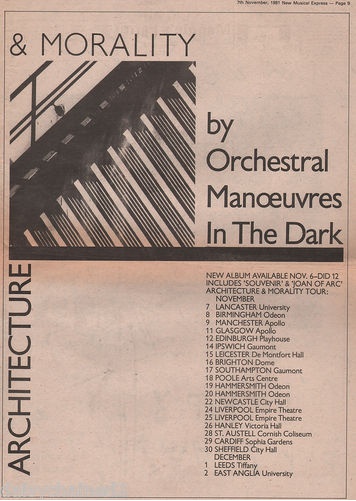
As it turned out, Kings Of The World Frontier is far greater than the sum of the singles released from it. I suspect you knew that already though. The same can also be said for Architecture And Morality, Orchestral Manoeuvres In The Dark‘s breakthrough album, although it took me right until today to work that one out too.

I loved those singles that came from it so much that I took the leap to ploughing my collection of coppers and silver into the album. There were two completely different songs that both referenced Joan Of Arc, which may have been some sort of band in-joke, but to Radio Clyde DJs and pre-teens like me was just plain confusing. And there was Souvenir.

Orchestral Manoeuvres In The DarkSouvenir

Souvenir is masterful. Hooky, poppy and bathed in sorrow and melancholy, it drapes its wistful and hangdog, almost feminine vocal across a signature keyboard motif. Synth drums beat softly, a choir of overdubbed voices add depth to the refrain – my feelings still re-main – and it plays out for three and a half dejected yet uplifting minutes. This is the sound of sadness, to misquote Paul Simon. “Is this the Cocteau Twins?” asked the boy tonight as it was playing. Dream pop before such a term was conceived, you can kinda hear what he means too.

Built on a bed of slowed down looped choral vocals, Souvenir is so evocative – a great example of a pioneering synth band breaking new ground. Hindsight shows OMD to be a great, great singles band but it’s possibly fair to say that OMD never got the kudos they deserved at the time. Too arty for pop yet too pop for the arty crowd, they straddled this weird limbo ground, and Souvenir‘s parent album is a great example of this.

Housed in a die-cut Peter Saville sleeve, all dull industrial tones and brutalist architecture, the record’s grooves fizz and hiss and clank and clunk with the sound of machines whirring into action, ambient found sound and musique concrète. Amongst all of this sat the pop singles. It’s a strange thing to remember, but straight after buying it, I ran not to my room to play it, but instead put it on my dad’s record player downstairs. As I sat back to get into it, my mum came in and sat down and listened with me. (Go away mum. This is a personal ritual that can’t be shared).

Hisssss. Sccccratcchhh. Sccccrraaaape. Thud thud thud. Rattle rattle rattle. Echoey voices. Biscuit tin snare drums. Wonky production. It’s a sound that I now recognise to be that of an experimental synth band embracing the anything-goes spirit of post-punk and running with it in their own idiosyncratic direction.

Did you waste your money on this rubbish?” my mum tutted, getting up and leaving. Instant shame.

I struggled into the second song. £3.99 for this!? Where were the singles? Ah….here comes Souvenir. And here comes my mum. “Dah dah dah-dah-dah-dah dah dah!” she sings, mimicking (wrongly) the keyboard refrain. Man! She’s ruined the hard to like stuff AND NOW she’s ruining the single too.

I can’t say I played the record more than once ever again.

Fast forward a couple of years. Alex Aitken has a new turntable, hi-spec and booming, and he has designs on my long-forgotten OMD record. And I, with hormones pinging, have designs on the cover of a Sheena Easton album that he’s been playing. Not the music. That’s extremely pish. Just the cover. Sheena is covered in some sort of robe, sitting with one leg up, a bit too much caramelled thigh on display, her full-bodied lips smack in the centre of the image, her eyes boring into my teenage boy’s overloaded head. “I’ll swap you the Sheena cover,” Alex says conspiratorially, “Just the cover – not the record – I’m keeping that, for your copy of Architecture And Morality.”

Don’t speak to me about morality, Aitken, ya chancer.

Done deal, of course. OMD? OMG more like. What was I thinking?!

Architecture And Morality disappeared from my collection for the next 40 years, until a few months ago when a kindly neighbour had a loft clear out and turned up at my door with a handful of records; some old 12″ singles, an ace Ace Records soul compilation and OMD’s Architecture And Morality. It was like welcoming back a child I had abandoned at birth…before I filed it cruelly away to sit amongst my own stuff – Orange Juice – Orb – Orbital – Orchestral Manoeuvres In The Dark – The Other Two, a shelf padder; a good looking and possibly hip shelf padder, but a padder nonetheless.

Last week I was rearranging some records and pulled it out. I stuck it on, instantly transported to our living room in 1981. Couldn’t handle it. I lifted the needle from the first track and dropped it onto Souvenir. Ah. That’s better. I’d heard it fairly recently, in Irvine’s Harbour Arts Centre before a BMX Bandits show. Duglas had curated a pre-gig mix ‘tape’ and between the Dana Gillespies and Jigsaws and Peter Skellerns and what have you, Souvenir came rolling out. It sounded great in the HAC. It sounded great in 1981. And it still sounded pretty fantastic coming from my own decent set up in the here and now.

This morning I reached for the album again and this time I played it from start to finish. Dared myself not to get up and move it on. This time, it made sense. It was, yep, the sound of an experimental synth band embracing the anything-goes spirit of post-punk and running with it in their own idiosyncratic direction. But it’s not half as weird as I’d convinced myself it was. Arty, but supremely poppy too. A couple more listens this coming week and I reckon I’ll be fully converted. It’s never too late, as it turns out.

I wonder if Alex still has my copy…still plays my copy? His Sheena sleeve has long gone of course, but I still have the internet should I be inclined to look it up. Of course, if I’d had the internet back then, I’d never have needed to swap a cool and arty record for the over-styled sleeve – sleeve! – of an overproduced slice of 80s slop-pop. Unlike my faded attraction to oor Sheena, for Souvenir my feelings still remain.