Hard-to-find

All The Way Fey Bearsden

fey

Pronunciation: /feɪ/

adjective (feyer, feyest)

  • 3 archaic, chiefly Scottish fated to die or at the point of death.

Orange Juice were the feyest of the fey. Their Velvets-by-Chic approach to music was terrifically exciting; a ramshackle beauty forever teetering on the fringes of falling apart. They remind me of teaching my kids how to ride their bikes. One minute you’re bent double and holding on to a wobbly stabiliser-free frame to stop them bothering the tarmac, the next you’re running behind them silently willing them to not turn round in amazement at what they’ve already managed, but to focus on the road ahead and zig-zag safely to a stop.

orange juice bw

Pick any song at random from the early Orange Juice catalogue and you’ll find the sonic equivalent. At any given moment, things might unravel and the whole thing could come stuttering to an ungracious ending. On some of those records, you can practically see the 4 band members give one another excited nods of encouragement as they play their way out of the first chorus and back to the verse. (If you’ve ever had the good fortune to play in a ‘promising local band‘ (copyright Irvine Times, July 1989), you’ll know exactly what I mean). Not for OJ the mask of distortion that many a youthful band will use to cover up all manner of mistakes. Their almost-to-the-point-of-being-in-tune cheesewire-thin guitars rattling off fancy-pants major 7ths and suspended 4ths were played to sound just as Leo Fender and Friedrich Gretsch intended – clean and ringing and with a nice touch of reverb. For Orange Juice, it was always about the angle of the jangle. But you knew that already.

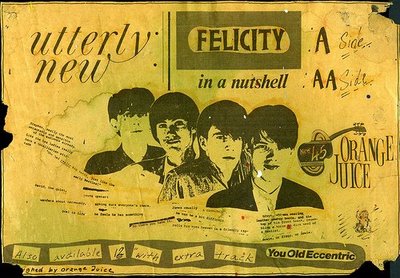
One of the very finest in a fine, fine back catalogue is (To Put It) In A Nutshell. You’ll find it closing out the end of their debut LP, You Can’t Hide Your Love Forever. A perfect set-closer from an imperfect album, In A Nutshell was Edwyn Collins’ first (first!) attempt at a ballad. Another that sounds like it’s about to come undone at the seams, it was originally conceived as a duet with Nico. Shame it never quite came to fruition. Her rounded, one dimensional Germanic  chamber folk vocals would’ve sounded terrific. “I looked deep within my pockets“, “You’re a heartless mercenary“, “Can I pay you in kind?” etc etc. I bet you’re singing them in faux German right now. Even the sh-sh-sh-shoo-doo bits.
orange juice

I empathise with Edwyn – that ‘promising local band‘ once wrote a letter to Michael Stipe asking if he’d like to contribute backing vocals to one of our non-smash non-singles. What the fuck were we thinking? You won’t be surprised to learn he never wrote back, but ever since the demise of REM, I’ve often wondered if he’d still be up for it, 24 years later.

Anyway, back to Orange Juice.

Here’s the earlier Postcard Records version of In A Nutshell:

And here’s a rare instrumental version. Put on a German accent and go all Nico for a few minutes. So audacious, jah?:
orange juice badge

Cover Versions, Get This!, Hard-to-find

Bad Cover Version/Good Cover Version

There’s a strange bit of serendipity to this post. I’d spent a night last week putting some stuff together for my weekly article and then on his Sunday Service show on 6 Music, Jarvis Cocker played the very track I was planning to write about. In itself, that’s a happy coincidence. But the fact that I’d planned to introduce the record (which has nothing to do with Jarvis) by writing a wee bit about Pulp beforehand was a bit weirder. So, as you read this, imagine the Twilight Zone theme playing away ad infinitum in the background.

If you drew a trajectory charting the popularity of Pulp LPs, there’d be a massive, Everest-sized spike where Different Class appeared and sadly, not much else. Pulp were a proper, fully-formed album band, but save for their brief flirtation with mainstream success, not many (common) people would really know. Indeed, many folk probably consider them a bit of a one-hit wonder. Their last album, 2001’s We Love Life is one of Pulp’s very best. Crashing in at number 6 on the album chart, before crashing straight back out and never to be seen again a mere 3 weeks later, it was a real blink and you’ll miss it album. If you’ve never had the pleasure, you should make some time to acquaint yourself with it.

One track, Bad Cover Version, is a terrifically thought-out ballad that draws parallels between a failing relationship (“a bad cover version of love is not the real thing“) and the 2nd rate dopplegangers we often accept in place of the real deal – Top of the Pops compilation LPs (“the bikini-clad girl on the front who invited you in”), the Stones since the 80s, later episodes of Tom & Jerry when they could talk, the last episodes of Dallas, the TV series of Planet of the Apes, and so on. Amongst the things Jarvis lists is “the second side of ‘Till The Band Comes In’“.

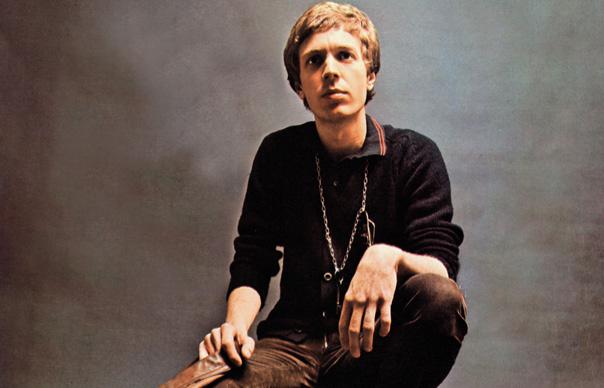
Till The Band Comes In was the much-maligned and undersold 5th LP by Scott Walker (his 6th, if you count his Sings Songs From His TV Series LP). Much like We Love Life, the critics had the artist pegged as ‘past his best’, it too was a bit of a flop and never really got the attention it deserved. The line about the second side of Till The Band Comes In was a joke at Walker’s expense, given that it was he who produced We Love Life for Pulp. Are you still hearing The Twilight Zone music in the background? It’s a circle of life, as one piano player once remarked.

scott walker 70

Scott Phwoar

Back in the day before he was producing other people’s flop records and long before felt the need to create an approximation of melody from bashing hanging lumps of meat, Scott Walker reveled in making orchestral-rich pop songs. Like a baritone-rich Serge Gainsbourg he sang of syphillis, sailors and suicide and was nothing at all like yer average teen heart throb. On Till The Band Comes In, you’ll find Little Things (That Keep Us Together). Almost a companion piece to his own version of Jackie, though with less gallop and more gasp, Little Things finds Scott clinging to the coat tails of a melody as jabbing strings and tumbling toms race one another to the finish line. It’s great.

And as if that’s not thrilling enough, here come the Trashcan Sinatras, back in the days when they were The Trash Can Sinatras, faithfully gatecrashing Walker’s tune with all the ramshackle beauty of a wooden-legged man hurtling haphazardly down a hill and into the neighbour’s hedge while being chased by an angry slevvery dug. Which, metaphorically at least, the Trash Cans were round about then. They fairly clatter into Little Things; the old Roland Jazz Chorus set to maximum wobble in a thrilling rush of knee-trembling, reverb-soaked, John McGeogh-esque post-punk while a breathless Frank hangs on to the vocals for dear life.

My first recollection of the Trash Cans doing this was for a Billy Sloan session on Radio Clyde around ’91 or ’92. Like most of the Trash Can’s unofficial output from those days, I have it on a hissy, taped-off-the-radio C90 somewhere, but the version above is taken from the b-side of 1993’s How Can I Apply single. A lost nugget of a record from an era when every Trash Can’s release was packed-full of top quality songs from an apparently never-ending production line that put every other band to shame. But you knew that already.

tcs 93TCS, Shabby Road, 1993

*Trashcans fact!

Long before John started wearing the famous stripey t-shirt, he was awfy fond of a t-shirt bearing the cover of Scott 1. No pictures exist. Believe me, I’ve looked…

elliott smith, Get This!, Gone but not forgotten

Happily Everly After

Happily Everly After. It sounds like a throwaway Stanley Unwin line. Perhaps something he’d have spokey-woke on the deeply joyous Small Faces’ Ogden’s Nut Gone Flake album. Or perhaps not. In any case, I’m referring to Phil and Don, The Everly Brothers. But you knew that already.

everly brothers 1

The Everlys were so close to the front of the queue at the birth of rock ‘n roll they were practically the midwives. Little Richard might’ve been around pounding his piano to welcome this kicking and screaming new born thing into existence, and Chuck Berry would’ve been somewhere by his side, but it was the Everlys who sat by the bed mopping the fevered brow and shouting perfectly harmonised words of encouragement. A close-knit singing duo with a dual love of country music and a twangin’ guitar, they created a vocal style like no-one else. Big brother Don sang the low parts. Phil, two years his junior, did those keening highs. Added to a rattlin’, rollin’ skiffle rhythm, they suddenly had a sound and found themselves at the forefront of the late 50s music explosion. The Beatles were huge fans, approximating the vocal style of the Everlys’ Cathy’s Clown onto their own Please Please Me like the fanboys they undeniably were.

Paul McCartney’s love for the Everlys went as deep as writing On The Wings Of A Nightingale for them in the mid 80s, giving them a hit single long after they’d been confined to the dustbin of yesteryear and oldies radio.

The Everly’s legacy was cemented not by what they did well, but by what they failed at.  Between them, Phil and Don had six children and went through half a dozen divorces – five from actual matrimonial wives and one colossal split from one another. To say they didn’t really get on with one another would be something of an understatement, but nonetheless they muddled through for a good few years, their warm harmonies disguising the icy coldness each felt towards his sibling.

Like many acts of their era, they suffered the somewhat obligatory bad management/bad label deal in the late ’50s.  Their golden early 60s period was knocked off the rails, initially by the advent of Beatlemania and latterly through their failure to capture the mood of a nation during the Vietnam War. This led to drug and alcohol problems, which led on to other issues…..the loathing and hate that each felt for his brother reached its peak in 1973 when Phil threw his guitar down mid Cathy’s Clown and walked off stage. To paraphrase Don (I can’t find the actual quote)  – “The Everly Brothers are dead…..though we died 10 years ago.” Despite possessing fine musical skills and supreme singing voices, a lukewarm and half-arsed approach to what constituted their individual solo ‘careers’ meant that the Everlys became obsolete in the singer-songwriter-rich’70s. Save their father’s funeral, it would be a decade before they spoke again, brought together by Albert Lee who produced their Live At The Albert Hall comeback show, and a mediating McCartney and his gift of the hit single a year later.
ev bros

Proper musicians’ musicans, the Everlys have left an influence far and wide throughout popular (and not so popular) music.

Anthony Red Hot Chili Willi Kiedis named his son Everly. Thanks, Dad.

Paul McCartney (again) namechecks them on Wings’ Let ‘Em In; Sister Suzie, brother John, Martin Luther, Phil and Don…

Neil Young brazenly nicks the riff from Walk Right Back, slows it down a touch, and with the aid of some good ol’ homegrown, writes Harvest Moon and bags himself a proper critic-pleasing return to form in the process. Contrast and compare:

Walk Right Back:

Harvest Moon:

Elliott Smith‘s eye-wateringly perfect Waltz #2 opens with the couplet; First the mic, then a half cigarette, Singing “Cathy’s Clown”. 

And tucked away on the b-side of Lloyd, I’m ready To Be Heartbroken (in itself a we’re not worthy bow-down to Lloyd Cole), you’ll find Camera Obscura‘s lilting countryish ballad, Phil And Don, bathed in pathos and regret and sounding like the heartbreaker it really is.

*Bonus Track!

Here’s the Everlys doing When Will I Be Loved. A microcosm of all that is good about the Everly Brothers – twangin’ guitar riff, skiffley backbeat and harmonies like glue.


Now grab your coat and go and get yourself a copy of an Everly Brothers Greatest hits compilation. No home should be without one. And get yerself a Camera Obscura album while you’re there. You’d like them.

Everly-Brothers-Atlas-Sound(crop this image carefully and you’ve got a Smiths 7″ sleeve that never was)

Hard-to-find, Peel Sessions, Studio master tapes

Punctured Bicycles, Desolate Hillsides And All That Jazz

Recorded between London and Manchester almost 30 years ago (September/October 1983), This Charming Man was the record that transported The Smiths up and out of the late-night, Peel-championed margins and into the mainstream, Top Of The Pops and all.

smiths this charming man

A giddy rush of walkin’ talkin’ Motown basslines and chiming staccato guitar riffs, topped off with Morrissey’s yelping yodel, it still sounds exhilarating to these ears as I type right now. Even the much-maligned New York Mix, with its none-more-80s ricocheting rim shots and ghostly guitar fade-ins still does it.

The Top Of The Pops appearance (the band’s first of 11) a few months later in November was superb, with Morrissey battering about his oversized bunch of gladioli in a show of high camp, while the other 3 played like seasoned telly regulars in matching M&S polo necks. Save a select, hip few, this was the first time many folk had actually seen The Smiths and the effect was seismic. It’s no surprise that by that weekend, sales of Brylcreem had risen 110%, old men’s barbers up and down the country were queued out with boys wanting flat tops, “but just leave the front bit, thanks” and any number of grannies were wondering what had happened to that nice chiffon blouse they’d been keeping in their wardrobe for that special occasion. Your David’s wearing it, gran. Teamed up with that cheap glass-beaded necklace our Doreen gave you when she was eight. And he’s off to the Red Lion where there’s every chance he’ll get himself half a light ale and a right good kicking. Me? I was still in my bedroom, listening to Frankie’s Relax until the wee small hours.

Much has been made of the speed at which Morrissey and Marr wrote in the early days. This Charming Man was one such song. Johnny had heard Aztec Camera’s Walk Out To Winter on regular radio rotation and felt his band should be getting the same attention. With a John Peel session coming up (14th September, to be aired one week later), Marr pulled out all the stops to write a catchy, radio-friendly tune in a major key (G, if you’re asking, though really A, as he tuned his guitar up one whole step). According to Johnny, the tune took him all of 20 minutes to write, although he would spend far longer with producer John Porter to perfect the sonics in the studio.

“There are about 15 tracks of guitar. People thought the main guitar part was a Rickenbacker, but it’s really a ’54 Tele. There are three tracks of acoustic, a backwards guitar with a really long reverb, and the effect of dropping knives on the guitar — that comes in at the end of the chorus.”

Listen for that wobbly doiiiinnnngg every now and again – that’s the two Johns (Porter and Marr) dropping kitchen knives on an open-tuned guitar. You can’t do that with GarageBand, kids.

smiths 83

Morrissey, on the other hand, was studio shy. He often had to be coaxed into doing more than one or two vocal takes. His lyrics for This Charming Man were impossibly impenetrable to this 13 year old, and to be honest, not much has really changed over the past 30 years. Singing about some sort of clandestine sexual initiation or other, Morrissey’s words were “just a collection of lines that were very important. They seemed to stitch themselves perfectly under the umbrella of This Charming Man.” The lyrics were almost certainly taken from Morrissey’s faithful notebook, his collection of words in search of a tune, but they weren’t entirely Morrissey’s own.

The 1972 film Sleuth, starring Michael Caine and Laurence Olivier features a scene where Olivier points a gun at Caine calling him ‘a jumped up pantry boy who doesn’t know his place‘.

The 1961 movie adaption of Shelagh Delaney’s A Taste Of Honey features two characters discussing their evening. ‘Are you going dancing tonight?’ ‘I can’t, I haven’t got any clothes to wear.’ Delaney would prove to be a rich source of material for Morrissey’s lyrics. But more of that another time.

Stolen words or otherwise, what’s undeniable is that This Charming Man ramped The Smiths up a notch or two and set them off on their all-too brief trail-blazing journey through the mid 80s.

Here’s the music:

This Charming Man (London mix)

This Charming Man (Manchester Mix)

This Charming Man (New York Vocal Mix)

*Bonus Tracks!

Howsabout some more of those studio master tape tracks? Below you’ll find the bass, the guitar, the vocal and a guitar/percussion track. Isolated parts, perfect for your inner George Martin. Or indeed, inner John Porter.

Andy’s bass track:

Johnny’s lead guitar part:

Morrissey’s vocals:

Guitars/percussion track:

charming charlie