Hard-to-find

Bangers

Son of a gun is an ancient turn of phrase that can be applied in both the positive and negative. “Why, you old son of a gun, you!” they’ll say in Westerns and Hollywood golden-era classics, a phrase of surprise to indicate that one of the protagonists has gosh darned gone and done it, whatever that may be. “You son of a gun,” one character might snarl to another, an indication that they’ve really said, “son of a bitch,” but the writer or vocaliser (or studio) has thought this too crass to say aloud. Centuries ago, in nineteen hundred and eighty-six, I can remember using that self same phrase in my Higher English exam, stopping short of using the word ‘bitch’ but hopeful that whoever was marking it would read between the lines. I got an A, so I’m thinking they did.

It’s a phrase that dates back 300 years and more, to the time of sea-faring clippers and naval gunships, to an era when it was standard practice to allow married couples to be together at sea. When the women invariably fell pregnant, they’d be forced to give birth in the space between the cannons on the ship, the widest space available. Being in this space allowed the naval men to go about their business of firing at the enemy or hauling away or scrubbing the deck without the unnecessary distraction of falling in or sliding around afterbirth. Subsequently, boys born in this manner were known as sons of guns. I’m assuming they drowned the girls, or had them working in the galley by the time they could walk. Happy to be proven otherwise though.

Son Of A Gun opens The La’s only album. A record that isn’t anything as shite as Lee Mavers would have you believe, it nonetheless would’ve benefited from the inclusion of some of the multiples of session tracks that have subsequently crept out, rather than the odd flat take or two that made up the official tracklisting. To get The La’s, Jim, you’ve got to magnetise them in the first take or two. That’s where the magic happens, when the song is still cooking and the band is still feeling their way around the melody and vibe of it all.

The La’sSon Of A Gun (Take 2)

Their second recorded take of Son Of A Gun is proof. Long before Steve Lillywhite was drafted in to jigsaw Mavers’ abandoned album together, Jeremy Allom was tasked with manning those ’60s dust-covered faders. The group responds, rattling out a skifflish and rootsy version, full of air and life and that mystical, non-descript ingredient that makes The La’s unique.

The downtuned guitar picks out a clip-clopping rhythm, all bite in the high notes and snapping twang in the low. Mavers’ sing-songy voice floats across the melody, his sidekick John Power harmonising those ‘run rabbit run‘ lines in the chorus. A lovely wee guitar run plays behind the chorus, up and down the scales and back out of consciousness by the time Mavers has begun harmonising with himself. That’ll be double-tracking, Lee. We’ll not be having much more of that nonsense.

Anyway.

The sun is currently out here in North Ayrshire and, as is tradition in this house when that happens, the Trojan reggae gets blasted. Presently Trojan’s Tighten Up Volume 2 is making the heavily scarred wooden flooring vibrate, causing ripple effects in my daughter’s mug of tea and thudding its easy skanking bass off and out through the patio doors and into the back garden, maybe even entertaining the neighbours as it floats its way across the railway tracks to be vapourised by the ball of fire in the sky.

Rudy MillsJohn Jones

What I know about Rudy Mills would easily fit into the 1 cm run out groove of this late 60s beauty, and the internet can’t tell me much more. What I can tell you is that John Jones is a fine example of rocksteady.

A mid-paced groover, it has all necessary ingredients for a rockin’ good time; squeaky organ, repeating four chord riddim, slightly wobbly backing vocals and a soulful, honest delivery that leaves you in doubt of its authenticity as a bona fide roots reggae classic. Not as well known, perhaps, as other tunes and artists from the era, it’s one that belongs in your ears, for today at least. Oh yeah – and it features a ‘son of a gun‘ lyric too, as it should for a song about a low down, lying, woman-stealing ne’erdowell.

Get down on it.


Cover Versions, Live!

Stomp! In The Name Of Love

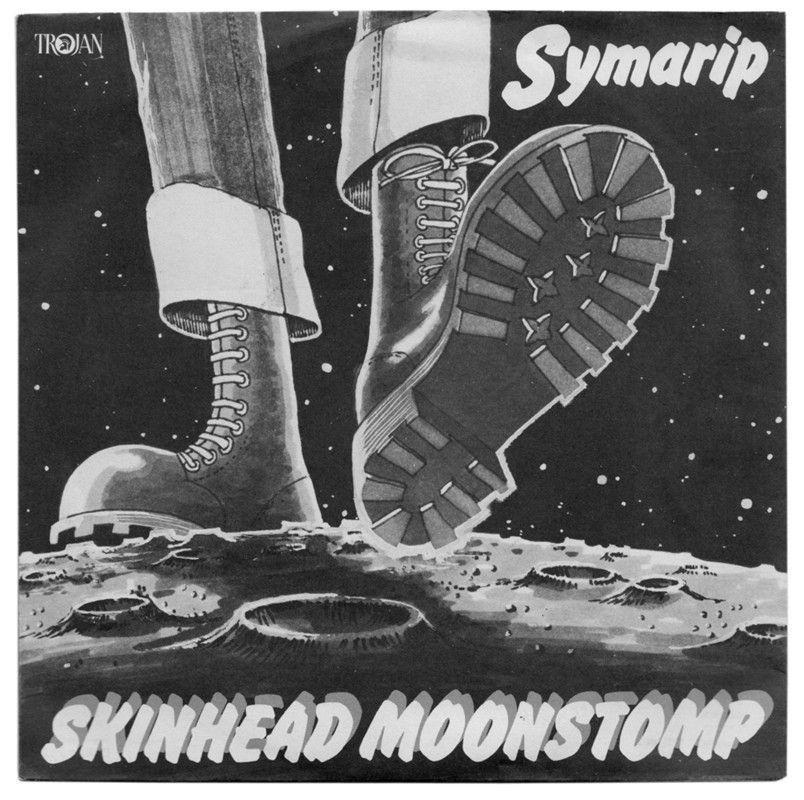
Skinhead Moonstomp by Symarip is like a rocksteady Slade; a 14 hole high bovver-booted ‘n braces metaphorical boot to the haw maws, all squeaky organ and call and response football terracing vocals. If it fails in its mission to have you skanking awkwardly from the waist down you should take yourself immediately to your nearest A&E and ask for a shot of something even more uplifting, should such a thing exist. And if you do find anything more uplifting than this terrific record, say now.

SymaripSkinhead Moonstomp

Released on Trojan in 1970, Skinhead Moonstomp was nothing more than a cult classic, a grinding, two chord call to arms to take to the dancefloor with all like-minded brethren of the subculture. It would be the 2 Tone craze at the end of the decade that brought the record to wider attention when on its re-release the record crept inside the Top 60. It was even packaged in a suedehead-friendly picture sleeve.

Skinhead Moonstomp‘s popularity continues to this day, belying the lowly chart position and being ever-present on ska and reggae playlists. If you ever find yourself at a ska night, you can be certain you’ll hear it before the night is out. You might also hear Derrick Morgan‘s Moon Hop played immediately before it.

Derrick MorganMoon Hop

As is the way with many reggae hits, Skinhead Moonstomp is based around an older record. If you were being kind you might suggest Symarip recorded their version in strict homage to the original. If you were being cynical you might suggest they unearthed a hidden gem of the genre and released ‘their’ record to an uneducated public. The Specials Too Much Too Young is simply a sped-up take on Lloyd Terrell’s Birth Control, after all. You knew that already though.

The SpecialsSkinhead Moonstomp

As is also the way with great reggae records, Symarip’s version provided the gateway for the next generation. Those self-same Specials on that self-same Too Much Too Young EP stuck a live medley on the b-side that was based around their take on Skinhead Moonstomp. I’d wager the more sussed and streetsmart Specials’ fans quickly tracked down those two tracks that The Specials had been listening to. Me? I was too busy getting my burgundy Sta-Prest and Y cardigan from Irvine market to consider anyone but The Specials had written such a stomping, marginally violent track. Imagine the baffled confusion of discovering many years later that Madness didn’t in fact write One Step Beyond and then the thrill of discovering Prince Buster on the back of it.


Cover Versions, Get This!

You Can Call Me Al

Green and Brown. My colour blindness wasn’t apparent until Primary 7 when, as you do in Ayrshire schools, the class created a Robert Burns Tam O’ Shanter frieze. My job was to do the tree next to the bridge where poor Tam’s horse has her tail yanked off by the pursuing witch. My tree had, yes, brown leaves and a green trunk and I had no idea why I was the laughing stock of the school for the next few weeks. An official colour blindness test proved this a few months later. Now I know.

al green

Here I Am (Come And Take Me) was a top ten hit for Al Green in 1973. A brilliant piece of tight ‘n taut southern soul, producer Willie Mitchell has the uncanny knack of making it sound as if the drums are playing right there in the room with you. A warm Hammond vamps throughout, mixed in just behind the brass section while the Reverend’s vocals flit across the top, emotion squeezed out of his voice the way you or I might wring the last remaining drops of juice from a real lemon when following a Jamie Oliver pasta recipe to it’s fat-tongued conclusion. Got. To. Get. Every. Last. Drop. Out. Of. It. Cost. Me. Forty. Nine. Pee.

Green

Al Green’s track is terrific. Of course.

al brown 7

Here I Am Baby was a superb rocksteady version of Green’s track by his skankin’ namesake Al Brown. My version comes from one of those excellent Soul Jazz Records Dynamite compilations (300% Dynamite, I think) that really ought to be in everyone’s record collection. Many of the tracks featured are rubadub reggae versions of popular soul hits – the Jamaican musicians tuning into US radio would hear the originals, get the band together, roll a fat one, play it at half speed and claim it as their own. Al Brown was no different. Dubby bass, chukka-chukka backbeat and a Casio keyboard player with his (or her) own idea of what constitutes a meandering solo, it’s a rather spliffing made-in-the-shade perfect partner;

Brown

Ironically, Al Brown would go on to make a name for himself in The Paragons, whose The Tide Is High would somehow filter its way back across the airwaves to New York where Blondie were fortuitously tuning in. And that folks is how the music world goes around.