
If y’know yr Bible, you’ll know that the ‘wheel inside a wheel’ idiom first appears in the book of Ezekiel. A phrase used to describe something that’s complex, maybe even over-complicated, it could well be applied to Slippery People, the Talking Heads track that hollers the words repeatedly in the song’s chorus. Not that Slippery People is over-complicated. It’s a straightforward groover of a pop song, but it’s certainly complex in arrangement, especially in its live incarnation.
The definitive version taken from Stop Making Sense was part of the holy trinity of 12″ records that soundtracked my mid-teens. Alongside Blue Monday and I Travel, it rattled on repeat from parents’ tinny living room stereos, its graphic equalisered grinding funk the foreground noise to teenage nonsense and Holsten-powered hijinks. My copy – an instant conduit to 40 years ago – has seen far better days. Low in gloss and sticky with fingerprints, it’s covered in Torvill and Dean-esque gouges of war, played to the point of death yet hanging on in there.
“…that gun, this part is simp…that gun, this part is simp…that gun, this part is simp…” (nudge) “try to recognise what is in your mind.”
“…What’s the matt…him…alright…..seven times five…come t..life…your eyes…” (and off it comes).
My Slippery People sticks and skips half a dozen times and has done for years, to the point that I should really take a Sharpie to its battered sleeve and rename it Skippery People. It’s unlistenable hell, truth be told. Any time it pops up anywhere other than on my own turntable, it really throws me when it plays through without interruption. Funny, that.
For clarity, let it to be said; that live version is a tremendous record.
Talking Heads – Slippery People (Stop Making Sense version)

The four principle Talking Heads are augmented here by bongos, bare-boned funk and minimal, morse-coding keyboards. Jerry Harrison on synth falls into a groove with David Byrne’s dirty funk guitar while Chris ‘n Tina, the husband and wife rhythm machine, play out a steady tune within the tune (wheel inside a wheel?).
On drums, Chris swings like Holger Czukay in a straightjacket, metronome-perfect, the solid bedrock that allows Tina to freestyle her bubbling offbeat notes up and down the frets as she sees fit. Clearly, there are grrreat bass players and then there’s Tina Weymouth. But you knew that already.
There’s ting-a-ling high notes on the keys, breakdowns that sound like faraway Coney Island ice cream vans in a July heat haze and Afrobeat levels of percussive flow from start to finish. The two backing singers who mirror Byrne’s spasmic jerks and respond to his “Whatsamattawithhim?” calls with enthusiastic “He’s alright!” shouts elevate the flatlining and linear studio version up, out and into the stratosphere.
Though these days he might have an ego matched only by the massive suit he wore on stage at the time, David Byrne’s gulping and hiccupping refrain remains the song’s key identifier. Magic stuff.
Compare and contrast with the science lab sterile studio version. I’ve warmed to its coldness in recent years, but having been spoiled by the live version first, it’s a clear second best to Stop Making Sense‘s polyryhthmic jamboree.
Talking Heads – Slippery People (12″ version)

The Staple Singers first had a go at Slippery People on a 1984 episode of Soul Train. Here, they emphasised the religious symbolism in the lyrics, pushed the girls’ gospel voices to the fore and turned it into a churchy song of high, high praise. Some switched on studio executive immediately had the quick thinking to frogmarch them straight into a studio where they then cut their own extended club version of the track.
Staple Singers – Slippery People (Club Version)
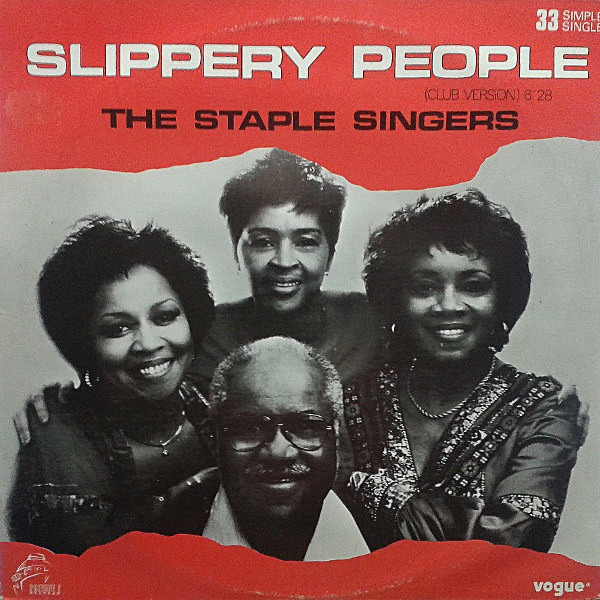
It’s fairly phenomenal, relying on Talking Heads’ studio original (and Burning Down The House‘s electro drum rolls) as its jumping off point, its overlapping synths and crashing drum machines set to maximum volume for ultimate ‘in the club’ effect. The guitars are, unusually for a Staples’ record, bereft of Pop’s usual wobbling tremelo but are instead suitably gritty and grindy. The bass line bends and bubbles in sympathetic harmony with the original. And the call and response refrains between the girls and their dad are joyful – listen to Pops deliver his lines and tell me he’s not having fun.
Backslidin’, how did we do? Pretty good, Pops. Pretty good.
 Plain Or Pan