Get This!

It’s All Right Marr, I’m Only Bleeding

I got my first real six string when I was 16. Bought it second hand from a wee guitar shop in Irvine that disappeared the day after I paid my £30 for it. The guy who ran it was never seen again. About 2 days later, indulging in a spot of fat-fingered She Sells Sanctuary riffing, the pick-up gave me an electric shock and a temporary Sid Vicious haircut.  That guitar was a right temperamental block of wood, but I loved it. I played it till my fingers bled. To paraphrase even further, it was the Summer of ’89. That’s when I realised I’d never be Johnny Marr.

I’ve always loved Johnny Marr. In The Smiths, he wrote an obscene number of brilliant, inventive tunes. Lazy writers would go on about his ‘chiming‘, ‘jangly’ guitar sound, but there was far more to his arsenal than that.  There was always, even in the Smiths’ most tender moments a bite to his guitar. He could fingerpick. He could play inventive chord patterns. He could fingerpick and play an inventive chord pattern underneath it at the same time. With 10 fingers sounding like 25. ‘Like Lieber and Stoller piano lines playing alongside the guitar‘, to misquote him from the early days in The Smiths. Then there were the open tunings, the Nashville tunings, the hitting strings with knives to get the desired effect. He reinvented the wheel.

Johnny was (and probably still is) my idol. Even though he dyes his hair. And runs over 50 miles for fun each and every week.

Slightly on the wrong side of cocky (and so would you be if mercurial quicksilver tunes like those fell off your fingers and onto the fretboard as effortlessly as a bride’s knickers), he’s not much older than me, yet he’s done a ridiculous amount of music. Previous posts on here have gone on at length about all the non-Smiths stuff he’s done. There’s literally hundreds of things he’s been involved in. Not always up there with the vintage riffing of yore, but always fresh-sounding and never anything less than interesting. Clearly, he’s the guitarists’ guitarist, the one they call when they need a bit of magic sprinkled on top.

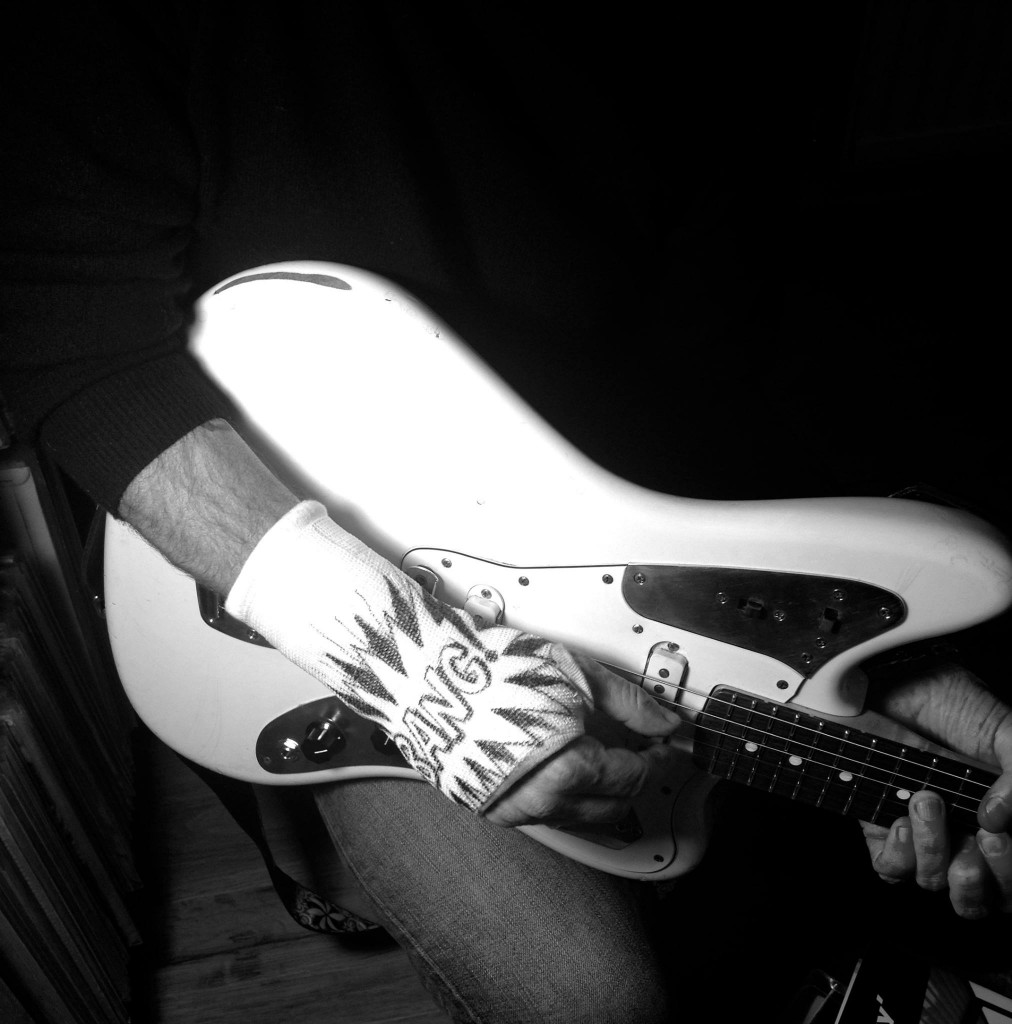
Last week when he broke his hand, my first thought was, “I wonder if I can play ‘Some Girls Are Bigger Than Others’ better than him now?

Probably not, is most definitely the answer. One of my favourite non-Smiths Johnny moments is on Electronic‘s Forbidden City, from the patchy Raise The Pressure LP released in (gulp) 1996.

It runs the whole gamut of Johnny’s guitar attack. A heady rush of major and minor chords played on an acoustic guitar here and electric guitars there, Johnny picking his trademark arpeggios atop some mid-paced strumming. He plays terrific little 2-string run-downs and fills between the singing that are concise and snappy and perfect. On the chorus he lets the right notes ring out at the right times. In a lesser pair of hands, it all might sound a wee bit lumpen. But Johnny knows just how to make his guitar sparkle and sing. By the middle eight, he’s flung in a backwards bit and dooked the whole lot in a bath of feedback before coming back to the song in a ringing, shimmering blaze of glory. The whole track is, of course, carried along brilliantly by a Bernard vocal that recalls New Order at their uplifting, melancholic best. And I believe that’s Kraftwerk’s Karl Bartos on drums as well.  What’s not to like?
johnny marr bang

In a typically Marresque coda to all of this, Johnny’s broken hand was put into a special sling that’ll allow him to perform his day job without compromise. Broken hand or not, no-one plays guitar like Johnny.

Hard-to-find, Peel Sessions, Studio master tapes

Punctured Bicycles, Desolate Hillsides And All That Jazz

Recorded between London and Manchester almost 30 years ago (September/October 1983), This Charming Man was the record that transported The Smiths up and out of the late-night, Peel-championed margins and into the mainstream, Top Of The Pops and all.

smiths this charming man

A giddy rush of walkin’ talkin’ Motown basslines and chiming staccato guitar riffs, topped off with Morrissey’s yelping yodel, it still sounds exhilarating to these ears as I type right now. Even the much-maligned New York Mix, with its none-more-80s ricocheting rim shots and ghostly guitar fade-ins still does it.

The Top Of The Pops appearance (the band’s first of 11) a few months later in November was superb, with Morrissey battering about his oversized bunch of gladioli in a show of high camp, while the other 3 played like seasoned telly regulars in matching M&S polo necks. Save a select, hip few, this was the first time many folk had actually seen The Smiths and the effect was seismic. It’s no surprise that by that weekend, sales of Brylcreem had risen 110%, old men’s barbers up and down the country were queued out with boys wanting flat tops, “but just leave the front bit, thanks” and any number of grannies were wondering what had happened to that nice chiffon blouse they’d been keeping in their wardrobe for that special occasion. Your David’s wearing it, gran. Teamed up with that cheap glass-beaded necklace our Doreen gave you when she was eight. And he’s off to the Red Lion where there’s every chance he’ll get himself half a light ale and a right good kicking. Me? I was still in my bedroom, listening to Frankie’s Relax until the wee small hours.

Much has been made of the speed at which Morrissey and Marr wrote in the early days. This Charming Man was one such song. Johnny had heard Aztec Camera’s Walk Out To Winter on regular radio rotation and felt his band should be getting the same attention. With a John Peel session coming up (14th September, to be aired one week later), Marr pulled out all the stops to write a catchy, radio-friendly tune in a major key (G, if you’re asking, though really A, as he tuned his guitar up one whole step). According to Johnny, the tune took him all of 20 minutes to write, although he would spend far longer with producer John Porter to perfect the sonics in the studio.

“There are about 15 tracks of guitar. People thought the main guitar part was a Rickenbacker, but it’s really a ’54 Tele. There are three tracks of acoustic, a backwards guitar with a really long reverb, and the effect of dropping knives on the guitar — that comes in at the end of the chorus.”

Listen for that wobbly doiiiinnnngg every now and again – that’s the two Johns (Porter and Marr) dropping kitchen knives on an open-tuned guitar. You can’t do that with GarageBand, kids.

smiths 83

Morrissey, on the other hand, was studio shy. He often had to be coaxed into doing more than one or two vocal takes. His lyrics for This Charming Man were impossibly impenetrable to this 13 year old, and to be honest, not much has really changed over the past 30 years. Singing about some sort of clandestine sexual initiation or other, Morrissey’s words were “just a collection of lines that were very important. They seemed to stitch themselves perfectly under the umbrella of This Charming Man.” The lyrics were almost certainly taken from Morrissey’s faithful notebook, his collection of words in search of a tune, but they weren’t entirely Morrissey’s own.

The 1972 film Sleuth, starring Michael Caine and Laurence Olivier features a scene where Olivier points a gun at Caine calling him ‘a jumped up pantry boy who doesn’t know his place‘.

The 1961 movie adaption of Shelagh Delaney’s A Taste Of Honey features two characters discussing their evening. ‘Are you going dancing tonight?’ ‘I can’t, I haven’t got any clothes to wear.’ Delaney would prove to be a rich source of material for Morrissey’s lyrics. But more of that another time.

Stolen words or otherwise, what’s undeniable is that This Charming Man ramped The Smiths up a notch or two and set them off on their all-too brief trail-blazing journey through the mid 80s.

Here’s the music:

This Charming Man (London mix)

This Charming Man (Manchester Mix)

This Charming Man (New York Vocal Mix)

*Bonus Tracks!

Howsabout some more of those studio master tape tracks? Below you’ll find the bass, the guitar, the vocal and a guitar/percussion track. Isolated parts, perfect for your inner George Martin. Or indeed, inner John Porter.

Andy’s bass track:

Johnny’s lead guitar part:

Morrissey’s vocals:

Guitars/percussion track:

charming charlie

Gone but not forgotten, Hard-to-find, Sampled

It’s Chic Co. Time

Jeez! Plain Or Pan used to be all about Beta Band outtakes and multiple versions of La’s demos, the odd foosty soul survivor and long-forgotten obscurios by long-forgotten oddballs. It still is, of course, but just not today.

I have a long-time love of disco. To these ears, it doesn’t matter that it’s considered kinda naff and uncool, which, when placed next to any amount of other musical bits n’ pieces, it may well be. In the mid-late 70s, when straddled by the ugly, oiky twin-headed monster of glam and punk, it was certainly the musical choice for the straight-laced amongst society. Folk who bought one single a year bought Saturday Night Fever. Folk who bought one single a week owned the entire back catalogues of The Sweet and Sham 69. What I like about disco is the musicality of it all. If the Floyd (man) and Can (man) are head music, disco is most definitely music designed for below the waist. Rock music is, they say, ‘proper’ music. But so is disco! Made on proper instruments and played as well as or even better than the patchouli-smelling long hairs in afghan coats from bygone eras, disco is all about a slick riff, a fluid bassline and a four-to-the-floor, hi-hat enhanced beat that never lets the lyrics get in the way of a good groove.

The difference between rock and disco is that rock music has the virtuosos, the soloists and the guitar heroes. Who’s Pink Floyd’s guitarist? Easy, eh? But if I asked you to tell me who played the slick riffs on Night Fever or Rock Your Baby, chances are you’d be struggling. You could probably have a good stab at naming half the members of Can. But asked to tell me who played the fluid basslines on Car Wash or Young Hearts Run Free and chances are you’d be asking the audience or phoning a friend who answers to the name of Mr Google. Disco, for one reason or other has been ridiculed and put in its place as someway unimportant. Of course there are exceptions to the rule.

Nile Rodgers was developing serious Class A substance abuse at the age most of us are just getting to grips with the technicalities of Eagle-Eyed Action Man. Passed back and forth at a young age from East Coast to West Coast on a succession of Greyhound buses between his drug-addicted prostitute mother and far-off, far-out aunts and uncles on the other side of America, it’s a wonder he thrived at all. But thrive he did. Playing in a variety of  covers acts, reputation enhanced by his ability to read music, fate lead him to Bernard Edwards and eventually Chic were born. It was watching an early Roxy Music show that gave Nile his band’s manifesto: The clothes were as important as the music. The women on the record sleeves would give the band glamourous identity. Chic would be a company. An organization. Singers would come and go, but the core of Rodgers and Edwards would remain the constant. They’d write songs for other artists. They’d discover knew ones. Like an East Coast Family Stone, in sharp suits rather than hippy garb, but fuelled by the same high grade white powders, Chic and their music would rule the world. You know the songs. You know the stories. You can read all about it in Nile’s excellent ‘Le Freak‘ autobiography.

It’s worth noting that the Nile Rodgers’ guitar sound has been appropriated by the musos that form white rock’s guitar untouchables. Edwyn Collins’ blatant homage to the sound can be heard all the way from the opening bars to the fade out of Orange Juice’s Rip It Up (perhaps even more so on the strangulated none-more-80s 12″ mix). Johnny Marr was so enraptured by Nile that he based his guitar line on the second verse of The Boy With The Thorn In His Side on those wee choppy rinky-dink Chicisms. Johnny turned up earlier on in the year playing Le Freak on stage with Nile. And just in case you missed the point, he even named his son Nile. Dance records over the past decade or so, proper dance records, made by machines and everything, often stray close to the Chic sound. Modjo’s Lady for one. Spiller’s Groovejet another. And Stardust’s The Music Sounds Better With You. Chicesque, the three of ’em. Even Da Funk by Daft Punk is built around that clipped guitar sound. Ubiquitous. Is that not what they say?

Here are some of the Chic Organization’s wonderful world-ruling results. Every one features Bernard’s ripe-for-sampling, slap-happy, fluid-as-mercury bassline and Nile’s trademark 3 string rinky-dink guitar, chattering away incessantly in the background like a couple of old ladies clacking their false teeth at one another down the Mecca on a Saturday night. It might just be my favourite sound in music.

ChicGood Times

Norma JeanSorcerer (12″ mix)

Diana RossUpside Down (original Chic mix)

Sister SledgeThinking Of You (Dimitri From Paris mix – officially sanctioned by Chic, it’s a cracker)

Carly SimonWhy (12″ mix)

And the influence of Good Times et al lives on, seemingly forever…