
It’s 1981. Buzzcocks come together to begin working on their fourth album, Martin Rushent in the producer’s chair. The band is broke, both financially and creatively. Pete Shelley, stuck in a deep rut of writer’s block, brings a handful of half-finished songs left over from his pre-Buzzcocks days. The others bring nothing much at all. With the sessions quickly collapsing, Rushent suggests to the group that Buzzcocks take a break. The producer and singer though, they alight in Rushent’s state-of-the-art studio to work on some of Pete’s tracks.
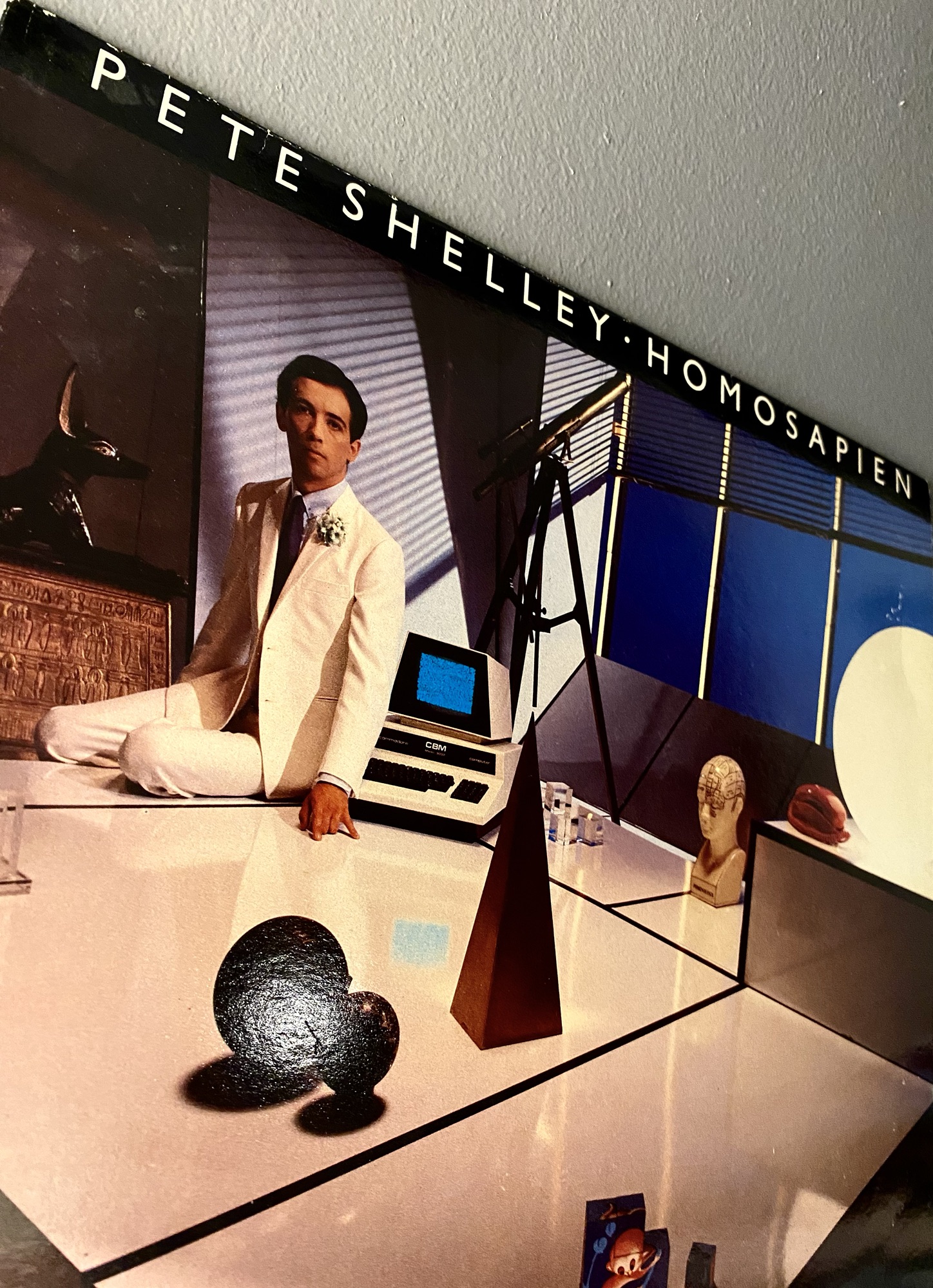
Pete Shelley’s resultant *debut album Homosapien might’ve spun with the same spiky frothiness as the act he’s most associated with, but it was glossed in a sheen of Rushent-powered machinery; synths, drum machines and programmed sequencers that were very much in keeping with the musical landscape of 1981. The cover tells the story – a careful placement of arcane artefacts and cutting edge technology that dates it somewhere in a near future where Kraftwerk might meet Blake’s Seven around the boardroom table for a healthy discussion on the merits of analogue vs digital. The result, if we’re being honest, was a bit of a mixed bag. The eponymous lead single though? That’s a stone cold cracker.
Homosapien judders and jars its way in on the same motorised rhythm as Buzzcocks’ Something’s Gone Wrong Again, all mid-paced bounce, effect-heavy 12 string acoustic guitars, their swirling chords slashed and stabbed. It makes for a great sound. It even finds space to add an undercurrent of I Wanna Be Your Dog-giness in the verses…verses that borrow heavily from the sequenced bassline that throbs its way through Abba’s Does Your Mother Know? Play them back to back yourself and tell me I’m wrong. I bet Rushent knew exactly what he was doing here. Why wouldn’t a producer keen for a hit want to borrow a hint of DNA from pop music’s greatest contemporary hit makers?!
For all the producer’s sprinkling of magic though, it’s the singer who’s the real star of the show here. Shelley’s delivery is, as ever, terrifically sneery and archly camp, double tracked at the end of lines and even more so all over the chorus, adlibbing up and up the scales as the record fades out. It’s once you focus on the words being sung that the gravity of the record becomes crystal clear.
‘Shy boy, coy boy, cruisers, losers’.
‘Homo superior in my interior‘
‘I don’t wanna classify you like an animal in the zoo‘.
‘I just hope and pray that the day of our love is at hand‘.
‘You and I, me and you, will be one from two, understand?‘
Adding such a transparent lyric was for sure a real, eh, ballsy move by Shelley, but once it had found the ear of a jobsworth radio researcher, the record was promptly banned by the BBC. The organisation who beamed Larry Grayson into millions of living rooms every Saturday night was aghast at the record’s ‘overt references to homosexuality‘.
Exhibit A, m’lud: ‘Homo superior in my interior‘.
What a zinger of a line but.
With the era of diversity and acceptance still just a formative if growing movement on the horizon, Homosapien is perhaps the first pop song to use non-coded lyrics to get its message across. It’s brave stuff to be writing, singing, recording and releasing in 1981.
No Homosapien, no Smalltown Boy perhaps. No Smalltown Boy, no open discussions around the living room telly during Top of the Pops as its video plays for the umpteenth time. In its own small way, Homosapien is a groundbreaking record. It’s almost a bonus that it sounds utterly fantastic, and more so 40+ years later.
*We’re not counting Pete’s pre-Buzzcocks 1974’s experimental, instrumental album Sky Yen, are we? Are we?
 Plain Or Pan