
Underneath a handful of PWL singles and some battered old Decca 45s that looked like someone had been trying out a Torvill & Dean routine on both A and B sides, I uncovered a dusty but cleanable copy of The Rolling Stones Miss You in an Irvine charity shop a couple of weeks ago.
‘Record’s: Big one’s, various price’s. Wee one’s 49p.’
I paid a pound. “But ye kin get twa fur that,” came the reply after me as I left skipping out the door.
Miss You is the Stones at their grooviest, campest, louchest best. From Charlie’s hi hat ‘n four-to-the-floor disco beat, Richards’ slashing, fluid A minors and Wyman’s propulsive, trampolining, head-nodder of a bassline to Jagger’s praw-traahck-tayed delivery, it never outstays its welcome. Folk will point to Gimme Shelter and Tumbling Dice and Paint It, Black and Sympathy For The Devil and We Love You and She’s A Rainbow and Wild Horses and Street Fighting Man and (add your own here ______) but, for me, it’s Miss You‘s Sucking In The Seventies swagger that finds itself at the top of the tree when it comes to listing favourite Stones’ tracks.
Rolling Stones – Miss You

Jagger’s vocal on Miss You is borderline ridiculous, a mish-mash of wrongly pronounced vowels held in place by a random selection of unnecessary consonants. His approach to vowels is similar to that of a spin bowler taking a long, slow run up to his delivery at the wicket, with neither the receiving batsman nor, in Jagger’s case, the listener, knowing exactly what twisting and turning pitch they’re about to receive.
Ah’ve bin hangin’ aaat saw laang, ah’ve bin slaypin’ awl alahn, lawd ah miss yeeoow… Wit sum Poo-Ert-Oh-Reekin gihls who jist daaa-yn ta meetcha… And yet, and yet..he somehow finds a fantastically soulful vein during the song’s bridge; Ooh, baby, why you wait so long? Come awn! Come hawm!
Then he goes for some whispered pillow talk, eases his way into the song’s hooky ad-libbed falsetto and comes back to the coda with the same loose approach to vowels as he had at the start. It’s a masterclass in the many faces of Jagger, almost cliche and the blueprint for a hundred tired TV impressionists. Such is Mick’s personality, you can see him act it all out as you listen, the real deal in tiny-waisted satin pants and lemon blouson.
But it’s Wyman though who steals the show here. He’s on a whole other level of playing, conjuring up his greatest fret-spanning bassline on the back of a particularly funky seam of notes that Billy Preston, the Stones’ live keyboardist of the time, had pulled from the ether during rehearsals for some low-key Stones shows in 1977. Wyman aped Preston’s riff and out, it seemed, popped Miss You‘s elastic backbone. The bedrock of the record, yet, such is the way of the Stones, it’s neither credited to Wyman nor his source.
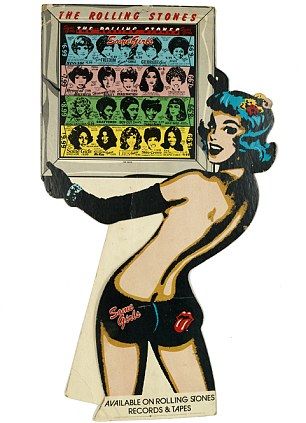
Every Rolling Stones’ track is a Jagger/Richards composition, regardless of how the song came to be. You could argue that Miss You‘s understated, tickled electric Wurlitzer piano track is pretty much indispensable to the record too, hearing the way it unobtrusively winds its way between Richards’ and Ronnie Woods tapestry of freeform guitars, but other than the small print on the credits of the song’s parent album (Some Girls), you’d never know this was the work of The Faces’ Ian McLagan. It would appear that playing on a Stones record is payment enough for anyone who finds themself in the studio with Mick ‘n Keef. And maybe for some it is. And maybe too, that’s why some key members have left through the years.


 Plain Or Pan