Live!

Rocket Boost

In a massively popular band. Breaks them up and forms misunderstood follow-up group. Subsequently begins third phase of career and releases everything under his own name. There are side projects, guest appearances, mentoring roles with younger musicians, low-key soundtrack work…all the while maintaining a very decent public image.

Are we talking about Paul McCartney here, or are we talking about Paul Weller?

The statement applies to both, of course, but there’s inarguably a considered difference that whereas McCartney’s solo work is – and will always be – massively overshadowed by his first band’s output, Weller’s solo output is nothing less than the equal of – and possibly even greater than – what’s gone before. Yeah! Fight me! I’m talkin’ to you, you with the tragic, balding feathercut and too-tight Gabicci top. Let’s clear the air ya silly auld mod.

Never was this clearer than mid-set in the Barrowland Ballroom last night, when in a quadruple wham-bam, thank you ma’am, Weller reeled off Hung Up into Shout To The Top into Start! into Broken Stones – two of his finest solo works bookending two of the finest releases in his first two groups’ recorded output, all played to within an inch of their note-perfect lives. You don’t need me to tell you how great Welller’s Small Faces infatuation makes itself known in Hung Up‘s soulful and gospely middle eight. You don’t need reminding of the joy of living breeziness that burls Shout To The Top to its stabbing and symphonic conclusion. You already know how tough-sounding and razor-sharp his SG sounds on Start!, its Beatlesy psychedelia never more obvious than when shoved in your face at maximum volume. Or how Broken Stones as it’s played tonight could have been arranged with a prime time Aretha in mind.

Weller is a magpie. He takes all the good stuff, boils it into a groovy stew and makes something new and equally vital from it. He started like that, way back when, when nicking Motown riffs for Jam songs. He continued this with the all-in policy of the Style Council; Blue Note to new note, whether you liked it or not. And he continues to this day, releasing with unbelievably metronomic regularity interesting and unique records; records stuffed to the gunnels with crackling electronica, frazzled guitars, deep house grooves, neo-classical ambience and whatever the fuck he likes. He surrounds himself with proper players who can help him achieve his sonic vision. He tours relentlessly. He’s one of our very best and we should never take him for granted.

I was going to review last night’s show but, to be honest, I’d already written the review three years ago, when Paul Weller was last at the Barrowlands. On early and off right at the stroke of curfew, back then he played the sort of back-cat trawling and sprawling set that might have Springsteen looking over his shoulder in apprehensive appreciation. Old favourites sat shoulder to shoulder with new stuff, guitar wigouts sat next to piano ballads, smash hit singles made way for indulgent jams. The set then was perfectly paced, as it was last night; Have You Ever Had It Blue? sounds terrific in the old ballroom. Headstart For Happiness, Changingman, Village, the old, the new, side by side and never sounding better. A gnarling, spitting Peacock Suit has, like the singer himself, proper bite. There’s political charge. A pro-Palestine speech garners a healthy swell of solidarity from the never less than right-minded Glaswegian audience.

But it’s the encore that floors me.

We’re expecting That’s Entertainment and Town Called Malice, his chosen double knock-out show-stoppers for the past couple of tours, but before he gets to these, Weller breaks into Rockets, the closing track from On Sunset, an album that’s already four years old and, as I’ve began to appreciate, matured nicely since being released. Rockets, it transpires later, isn’t on the set list. Weller, in a fit of spontaneity rarely present in live shows these days, pulls it out of the air for the first time on this tour. As it unspools, it dawns on both Mrs Pan and I that Rockets is Weller’s Bowie moment.

Paul WellerRockets

It’s slow and acoustic, the singer accompanying himself in front of some tastefully understated percussion. He shifts from major to minor key and a churchy organ shimmers its way in, Weller’s voice woody and hollow and powerful. Man, it’s powerful! By the second verse, Steve Cradock has joined in, his clipped fuzz guitar accentuating the beat. The bass player is all eyes a-closed and playing by feel, lost in the music as the Barrowlands’ glitter ball shoots little diamonds of light across a gobsmacked audience. Jacko Peake eases in, his bah-bah-bah-baritone sax punctuating the pauses in the vocals. The stringsĀ  – synthetic in the Barrowlands, full-on symphonic on record – glide in, carrying us home. Weller’s melody is slowly unravelling towards a coda where the Bowie feel is total and wonderful and complete. Singing over, the track swells to a long and stately close, little Stevie Cradock playing some cracking morse code notes and, between furtive gasps of his vape (!), some lovely elongated slide guitar parts. It was all fairly breathtaking, it has to be said, and that’s before Weller’s sock it to ’em one-two encore that followed immediately afterwards.

I seem to write this every time I review Paul Weller, but I’ll say it again; if he’s within 200 miles of where you live, find a ticket and go, go, go! Paul Weller is at the absolute peak of his game right now and you don’t want to miss him.


New! Now!

This Ain’t No Wind-up

This is new. This is now. This is right up yr street.

Did your teacher ever stare blankly whenever you opened your mouth? This is The Wind-up Birds
Is it hard to get served at the bar? This is The Wind-up Birds
Do you get confused in heavy traffic? This is The Wind-up Birds
Do people invade your personal space every minute of the day? This is The Wind-up Birds

Any press release from a band called The Wind-up Birds that starts thus is going to grab your attention, right? The Wind-up Bird, as the cultured among us know, is a novel by Haruki Murakami; a time-shifting page turner that features lost cats, a man trapped down a well (that’s lost bloody cats for you), a flashback to the Japanese army and a man skinned alive. All the best bands have literate minds, of course, so The Wind-up Birds had me before I’d knowingly heard a single note.

Their penchant for well-written words is all over that press release, that’s for sure (although – sorry ’bout this – but these days I’m quite often the teacher who stares blankly at what comes out of some folks’ mouths. Not all the time, mind.) The band’s words continue in stellar, stall-setting fashion.

The Wind-up Birds are from Leeds.

The Wind-up Birds are not from Leeds (as in, United, Harvey Nics and Moyles).

The Wind-up Birds are from Leeds (as in, David Peace, Alan Bennett, Jake Thackray, The Wedding Present and Gang of Four).

They’re named after a book by Haruki Murakami. (Told you!) They write songs about car parks, and songs about pubs, and songs about work, and songs about escape.

In an era where you wonder if you’ll ever again find a band with something to say, the kind of insight, perception and wit that The Wind-up Birds toss our way is almost embarrassing. Their song titles say it all: Ignore the Summer, Long Term Sick, That’s Us Told, There Will Be No Departures From This Stand, Families of the Disappeared, Slow Reader – like all great bands, The Wind-up Birds reflect and transcend the mundanities of the times they exist in. Vocalist/lyricist Paul Ackroyd has the scathing satirical bite of Mark E Smith, the warmth and pathos of Alan Bennett, the forensic observations of Jarvis Cocker, the kitchen-sink emotional clout of Morrissey; it’s all there, set to a cathartic post-punk racket that’s as unflinchingly messy and beautifully ugly as life itself.

So. In gnarly guitar music and existential Japanese literature, The Wind-up Birds have all the right reference points covered. On record they sound extraordinary; scorching and caustic, Cribs-y guitars (what is it about Yorkshire?), a band banging on and hanging on for dear life – together (always together) – as their singer vocalises about moral panic and telling good guys from bad, shouting in all the right places but knowing when he needs to take it back.

The Wind-up BirdsGuards

Guards, their new single/focus track (gads) sounds like the sort of thing I might’ve unwittingly taped off of the John Peel Show while letting the tape run on after capturing the latest Inspiral Carpets session, a track that I’d then spend the next 35 years trawling the corners of the internet in the vain hope of finding out more about. No need to spend half a lifetime wondering what that great new track was – these days it’s always Guards by The Wind-up Birds. Not out until mid-November, you can play it repeatedly here. Listen out for it on the more discerning radio shows of your choice. And watch them go. Fly, even.


Live!

Normal Rockswell

I dunno if you’re aware of Pop Spots NYC, but you really should be. For anyone with even a passing interest in pop culture – or, if like me, an unhealthy obsession with New York and all it can throw at you – you can lose hours between its pages. They take a well-seen image of a group or an artist – Dylan in the Village, the Ramones scowling on some Bowery corner or other, the Beatles in Central Park, the building used for the cover of Physical Graffiti etc etc – and superimpose the original image with a shot from modern times. The effect is satisfyingly great; a black and white and youthful Mick Jagger ghosting through a colour image of yesterday’s trees, the tall points of the buildings in the backgrounds of both images layered, gossamer-like, on top of one another. It’s a very clever concept. I’d suggest that if you’re planning a trip to NYC and are keen to root out the iconic locations of your favourite photo shoots, album covers and artists’ haunts, it’s pretty much the only guide you’ll need.Ā Ā 

I was sitting watching Norman Blake soundcheck in Irvine’s Harbour Arts Centre on Friday night. As part of the Freckfest team, I help to run the gigs and it’s always a privilege to sit in as artists tweak their sound, adding more reverb to the monitors, dialling back the treble in the acoustic guitars and sometimes launching sporadically into a snippet of a favourite song. A seated Norman started unselfconsciously playing and singing The Cabbage, a somewhat restrained and homely version compared to Thirteen‘s fizzing and thumping guitar overload, but nonetheless a song that enabled instant time travel. As he sang it, my mind was transported back to an early King Tuts gig, the four members of Teenage Fanclub thrashing their way merrily through the song, a riot of limbs and denim and hair as long and tangled as the guitar solos that unwound from their Jazzmasters. I began to ‘see’ them on the HAC’s tiny ‘stage’, superimposed, Pop Spots NYC-style, across the top of the seated, spectacled and short-haired Norman. I began to think, ‘wouldn’t it be great to see a full-flight Fanclub in a place as tiny as this again?’ and then I checked myself. This, THIS!, in the here and now, was pretty spectacular. Norman, I noticed for the first time, was playing some unusual chords. I made a mental note to remember them. His voice, one of our country’s finest and no mistake, was warm and honeyed, hitting the high notes like it was 1993 again. Loud, live and in your face, a youthful Teenage Fanclub was quite something, but so, as it’s immediately clear, is Norman on his own.Ā 

The gig itself unravels brilliantly. a 21-song set of Fanclub high points (I Don’t Want Control Of You, Planets, The Concept, What You Do To Me, It’s All In My Mind et al) interspersed with sharp left turns to the darkest corners of Norman’s output. There’s a thrillingly Kinksish piano-led take on recent TFC album track Self Sedation. There’s a folksy and uptempo cajole through Baby Lee. There’s a lovely understated take on Circling the Sun… a heart-tugging Did I Say, surely the greatest contract-filler ever… a sad and lilting I Left A Light On… a campfire version of Everything Flows. Best of all, perhaps, is the zipping and fly away He’d Be A Diamond, not on the setlist but delivered spontaneously with a gusto and oomph that delights all in the room and leaves distraught the long line of men of a certain age who’d gone to the toilet just prior. Miss our Norman at our peril!

All of these are delivered, as is usually the case in the HAC, to a hushed and pin-drop quiet audience. It’s a million miles from any number of your favourite Teenage Fanclub gigs of yore, but no less thrilling and no less life-affirming.

Sitting noticeably in the audience is Duglas Stewart, and for the encores it’s no surprise to anyone when the increasingly long-haired Bandit and his kazoo accompany Norman for some comedy chat, interspersed with a few choice numbers that’ll send us home happy.

Lynsey de Paul’s Storm In A Teacup breezes past in a light and airy display of finger points and hand gestures, Duglas yet again confirming his status as guardian and custodian of forgotten songs. Daniel Johnston’s Do You Really Love Me is given its usual full Bandits’ treatment, the chords ringing out on a Martin guitar signed by Daniel himself.

The big moment is kept for the finish, when Norman and Duglas turn the clock back with a terrifically raucous Serious Drugs. It might be minus those sliding George Harrisonisms and multi-stacked and overlapping vocals that make the recorded version so essential, but, as the night has proven so far, a great song is a great song is a great song. Dressed in bass and drums or stacked with overlapping harmonies or just plain laid bare, the song will always shine through. Luckily for us, Norman Blake (and his many pals) have them by the bucketload.Ā 

BMX BanditsSerious Drugs

Sail on Norman and haste ye back.

Alternative Version

PL A.I. N OR PAN

I don’t quite know how I feel about this. It’d be interesting to hear your thoughts and opinions. The creative in me says it’s the worst thing ever; anodyne and beige, a wee bit dead behind the eyes. The luddite in me goes wow! How on earth is this even possible?!

My pal Supersonic Mark works in marketing – Supersonic Marketing – and is deeply involved in the world of podcasting. He chats all things food and drink to all sorts of interesting people – Roger Daltrey, Fatboy Slim and, this week, Michel Roux – and his podcasts regularly make the lists of the best things to listen to that week. He’s long said I should do a podcast version of Plain Or Pan, but, y’know… time, desirability, the fact that I definitely don’t sound like Richard Burton whenever I bark the nonsense that passes for pop trivia from my gub. I’ve been on the radio. I’ve guested on other people’s podcasts. I know exactly how unpodcast-like I sound. Clearly, these are all good enough reasons to maintain the typing over talking approach that has served this place well for 17 and a half years.

Recently, Mark was shown how a fairly basic version of AI can turn text into spoken word, and he trialled the approach on one of my blog posts. I woke up last week to a version of the Crowded House post I’d written, presented as a podcast between two chummy American chat show hosts. It was, frankly, mindblowing in the way it’d taken my original post, summed up the gist of it and spat it back at me as a two-way conversation in third person. By the time I’d arrived at work, I’d listened to it half a dozen times, my mind racing with the good, the bad and the ugly of it all. Would this replace the blog as I currently present it? Would it write long-winded pieces on old music for me? Could I monetise it?

Plain Or PanAI version of the Crowded House post.

Hey, AI, make me a picture of Neil Finn from Crowded House checking out the Plain Or Pan review of his Glasgow show whilst he strums his guitar in his living room.

Weird, eh?

Interesting? Annoying? The future of everthing or just plain wrong?

The things I like about it: it’s novel, it’s quirky and it’s a nice, concise, five minute snapshot of my 1000+ words.

The things I don’t like about it: The voices. I’m sure that can be changed. I’d rather have Scarlett Johansson read my words to you (and me), thanks very much. And it presents some of my opinion (the Paul Weller section, for example) as fact. For anyone listening who hasn’t read the article first, they’d leave being mis-informed.

Overall though, I kinda like it, I think, but in answer to those three questions from earlier:

No, it won’t replace Plain Or Pan in its current form. I might follow-up future blog posts with the odd ‘podcast’ though, if I can convince an AI Scarlett Johansson to take the mic.

I could never use it to do the writing for me. That’s the bit I enjoy. I like to think I have a style that no amount of fancy pants AI could recreate. I’m probably wrong about that though.

Can I monetise it? I’m an artist, baby. Money is so crass.

What d’you think of it all?

Gone but not forgotten, Hard-to-find

Ennio Where You Go

In the Venn Diagram of melodic rock, the circles formed by Fleetwood Mac, Teenage Fanclub and maybe even the Beautiful South (or Paul Heaton as they’re called these days) intersect at the point of Crowded House. Seemingly perennially unhip, Crowded House have the casual knack of crafting ear-friendly songs that spool out like unravelling McCartney melodies; wistful, super-melodic and always with an unexpected yet beautiful chord change to dazzle and tug at your heart. But you knew that already.

They played Glasgow’s Hydro last night, a metal and multicoloured goldfish bowl of an arena designed, seemingly, to suck both the money out of your pocket and the soul out of the music you’re there to hear. As a concert venue I hate it. I watched from the second tier as the audience on the floor had the time of their life dancing to Prince doing his freaky greatest hits-heavy thang. I watched from the very back row – nothing behind me but breezeblock and Govan sky – as the snow fell below us during Paul McCartney’s festive set addition. I watched, invited, from a VIP box – happy in the haze of a drunken hour or two – as Travis rattled out a decent set of their greatest hits, but as four static dots half a mile away. My best Hydro experience was for Paul Weller; standing, near the front and with a bristling Weller on fine, back cat-trawling form. Looking back in that dead space before the encores, you could see the dreaded curtained sections rising behind the first tier of seating. I’m sure PW noticed the blackout curtains too, for he’s never been back. One night in a vacuum-packed Hydro vs two nights in the Barrowlands? No competition really.

It would take someone really special to coax me back, and the price of those Crowded House tickets wasn’t doing much to sway me, but with the date looming I did what any self-respecting tight arse would do and headed for the resale sites. Refresh. Refresh. Refresh. At lunchtime yesterday, about 5 hours before doors opening time, Twickets turned up trumps. Section 2, y’say? Row U? That’s almost McCartney-levels of nose bleedingness. I’ll take ’em!

Taking away the horrible venue and last-minute seating, you can’t fail to be impressed by Crowded House. Despite also suffering from lower than expected sales – it’s packed, but two large blacked-out areas and a closed tier 3 would suggest that (kinda ironic for a band called Crowded House), they play the hits, they dive into their extensive back catalogue and they bring out buried beauties to give them their rightful place. They can rattle off a jingling, jangling and Byrdsyian Weather With You straight from the kick off, first number in, because the strength of what will follow is just as great. Even Don’t Dream It’s Over is played before the half hour mark. Two stone cold classics that would round off most bands’ sets gifted early, the inference being that there are even better things around the corner. And there are.

A wonderfully woozy Private Universe, all ambient guitar and dubby percussion proves to be the fulcrum upon which the set rocks and rolls. A delicately brushed Fall At Your Feet…a skiffly Four Seasons In One Day…a roof-raising It’s Only Natural which gives way to the rockin’ liquid gold of Distant SunNeil Finn has quite the gift. Sure, you can split hairs about what’s missing – there’s no Nails In My Feet, for example (boo!), no brooding Into Temptation or swooning Not The Girl You Think You Are, but when, in the encore, you’re gifted Some Greater Plan, a mini masterpiece that will eventually be considered the equal of any of Finn’s greatest work, no one will complain. Tell me I’m wrong.

Crowded HouseSome Greater Plan (For Claire)

What’s really great about the Crowded House live experience is that, even though it’s a heavily-produced arena show, there’s room in the setlist for spontaneity. Most bands of this stature nowadays play identical sets night after night, sets programmed to ebb and flow and match the light show that accompanies it. Crowded House change their sets up. You don’t really know what you’ll get from night to night. I’m not sure the band does either. The group like to take the piss out of one another at every opportunity. There’s humour aplenty. Neil Finn makes up songs on the spot. He busks an unplanned There Goes God purely for a fan in the front row who’d requested it. And he singles out all of us who are up there in the back rows, turning the lights on us and asking if we’re OK. As a thousand mobile phones light up, he rattles off another impromptu song about the place being filled with fireflies. We’re maybe in a different postcode to the drum riser, but the band make sure we know they know we’re there. They’re good eggs, are Crowded House.

The best bit?

That may well have been the intro. Bowie’s Five Years marches to a close, the lights go down and a brilliantly-atmospheric Ennio Morricone track fills the venue. It’s Romanza Quartiere, Morricone’s theme score for Quartiere, a late ’80s film that I must confess to never having seen, but if the film is anything like its soundtrack, I’ll be rectifying that soon.

Ennio MorriconeRomanza Quartiere

Morricone’s theme is classic Ennio. Big, elongated strings that weep and sweep, a recurring motif that is melancholic in extremis, tastefully and exquisitely played from shimmering start to stately finish. It’s a remarkable piece of music. Coupled with the instant pop rush of Weather With You, it makes for an electrifying one-two.

Frustratingly, the version played immediately before Crowded House entered also featured a clanging dulcimer – the ghost of John Barry running with a set of skeleton keys – and some tasteful Mediterranean bouzouki that replicated Morricone’s motif. I’ve searched the internet from corner to corner and can’t seem to turn this version up. There’s a chance, I’ve read, that Crowded House have taken the original and overdubbed it with these other percussive and melodic instruments of their own. If so, more power to their talented elbows. I’d LOVE to hear a studio version.

Get This!

No Way To Control It

Automatic by the Pointer Sisters is primo ’80s skeletal synth-funk; as slinky as Prince at his grubbiest but as pop as it comes at the same time. Built around pitter-pattering drum machines and a gulping, rubberised bassline that bulges and bounces in all the right places, it hinges itself on its 5 note synth refrain, an instant earworm from the 5th bar and regularly ever after.

Pointer SistersAutomatic

That repetition of the hook-line in the intro is a much-borrowed idea, an old Motown trick that Berry Gordy would always insist on. By the first chorus, he noticed, listeners knew the tune and could sing it. And that, as his bank manager would point out, is yr instant hit single appeal right there.

The writers of Automatic weren’t shy in their appropriation of a great idea. They were by no means alone. Stock, Aitken and Waterman would come to rip the arse out of the idea in the short years afterwards. Whitney Houston’s writers would too. Even the Human League were partial to a bit of it. Listen out for the chorus-melody-as-intro the next time you find yourself landing on Heart 80s when you finally acknowledge 6 Music is losing its daily appeal. Automatic, like all great pop music, makes sure you know the chorus the minute it’s slapped you firmly between the ears. Take that, Mary Anne Hobbs.

Google tells me that lead Pointer Ruth’s coffee and caramel vocal is a contralto. The lowest of all female singing voices, it starts somewhere south of her ankles and snakes its way up her body as the verses make way for the familiar chorus. Sisters Anita and June add the high parts, harmonising like a puzzled Supremes relocated to some terrible mid ’80s chrome and neon video bar. You don’t need to see the video to know the trio sashay in tight dresses and back-lit hard-lacquered hair in time to the song’s sheath-like melody. Big ol’ vintage synths fizz and spark behind them, futuristic and space age even now. A rinky-dink guitar plays the melody high up the frets, like James Brown (but easier chords), Prince (again) with less flash ‘n sass, the briefest of six-string interludes in what is primarily machine-based funk music.

“Au!-Toe!-Mah!-Rhic!” go Anita and June, stretching out in simpatico, harmonies locked tighter than those dresses they’ll pour themselves into for the video.

“Automatic,” goes Ruth, sullenly dragging the words up from her solar plexus to put the full stop on things.

It’s a great record, Automatic. One that could easily have sloped off the first side of the new Janelle Monae record forty minutes ago, let alone the Pointer Sisters’ 10th album, all of forty years ago.


Alternative Version, Peel Sessions

Primary Education

I’ve got a strained relationship with The Cure. They are, unarguably, one of our greatest singles bands; poppy, hooky and melodic yet strange and idiosyncratic, a band out of step with everything around them, stubbornly unique and brilliant because of it. Just Like Heaven…Hot Hot Hot!!!…Caterpillar…Close To Me…Lovecats…In Between Days…Lullaby…Why Can’t I Be You?… Friday I’m In Love…The Walk…Pictures Of You…A Forest…there’s a perfect playlist right there.

It’s the albums I struggle with. If the singles are 10 second hundred metre sprints, the albums are triathlon levels of endurance by comparison. Meandering, dark, twisty, self-indulgent – all the things I like, as it goes – I find it’s too much of an effort to properly enjoy a Cure album. There’s nothing light and airy about them, and I say that as someone who’ll listen to Radiohead until the day I die. I just slowly detach and find myself drifting off. ‘Is this nearly finished?’ I’ll ask myself as Robert and co sleepwalk their way, treacle-like, into into only the third track. It makes the thought of a live show almost too much. Even Springsteen, I bet, would find himself yawning at the two hour mid-point. My loss, I dare say.

Primary though. There’s a great track. The sole single release from 1981’s Faith album, Primary starts with a rattling, ear-splitting snare drum, played with all the finesse of a ham-fisted one-armed man. Bash! Bash! Bash! Bash! Bash! Bash! Bash! Ker-bash! If you can separate the individual instruments and voices on the record, you’ll hear that from first bash to last, the drummer never wavers from his incessant 8-bar beat.

The CurePrimary

Backing firmly in place, Robert makes excellent use of his chorus and phase pedals, coating the track in a thick metallic swamp of rapid, scraping downstrokes and swirling chunky notes. It might sound just like his National guitar set to stun, but on this track Smith actually plays bass. As does Simon Gallup. Being unique and idiosyncratic sorts, two bass guitars on the one record is perfectly normal. While Smith maintains the song’s rhythm and muscle, Gallup wanders up and down the frets like Peter Hook in eyeliner. Perhaps surprisingly, there are no guitars on Primary at all.

It’s an intense sound, Primary. Shouty, swirly and relentlessly clattering, it finds The Cure out of step with their peers, and not for the last time. 1981 was the year when the synth became the de facto pop instrument of choice. End of year lists were populated by the Human League and Soft Cell. OMD were making inroads towards household name status. Ultravox’s Vienna was ubiquitous. Kim Wilde was doing her English version of Blondie while Clem Burke jumped drum stool to moonlight with Eurythmics. Esoteric and different, The Cure stick out as stubbornly as the Dennis the Menace haircuts they employed at the time.

The CurePrimary (Peel Session)

Two bass guitars, one snare drum, a double-tracked voice and a whole load of imagination across three minutes – or six if you can track down the elusive 12″-only mix. Primary is a weird wee single, not afforded the status of anything in that stellar list in the opening paragraph above, but something that’s just as deserving of a place at The Cure’s top table.


Get This!

Everything’s Gone Green

This is late night music. Not upbeat, party starting music, but post-midnight meditation, meant for those wee hours that fall somewhere in the slither of space that exists just before the crack of dawn. Spun finely from ether-borne gold and slowly spooled into seamless being, the singer’s voice aches and breaks and cracks, his hot-shot band playing slow and steady, majestically understated so that the song is best served. It’s not, perhaps, the first track you’ll think of when Al Green is mentioned, but it may well come to be one of your favourites. A random shuffling of it on the iPod yesterday had me scrambling about for my battered old copy of I’m Still In Love With You, the Al album it appears on, and since then, he’s been soundtracking the weekend. Everything’s gone Green, you might say.

Al GreenSimply Beautiful

It isn’t, by any standard of imagination, what you’d call an in-your-face soul track. There’s no stomping beat, no rasping brass section, no hysterical lead vocalist hollering tears of pain down the microphone. A lot of that has to do with Green’s controlled delivery – close-miked and delivered straight from the heart – but much of the track’s introspective feel is due to Al Green’s secret weapon; the Hodges brothers.

Stax had that crack in-house band with Steve Cropper, Duck Dunn and co driving the label’s sound. Motown grooved to the four to the floor beat of the Funk Brothers. Hi Records had the Hodges Brothers. Never doubt that they’re just as influential, just as essential to the development of soul music.

The record’s producer Willie Mitchell could’ve been forgiven for flying in a female gospel trio to flesh out the song’s hook lines. He may even have thought to employ a tenor sax and a couple of trumpets to replicate that descending four note signature riff that helps anchor the song, but with the Hodges brothers on board, none of that was necessary.

Teenie Hodges

I’ve written about Teenie Hodges before. The guitarists’ guitarist and then some, Teenie is an integral part of the Al Green sound. Never brash or flashy, Teenie’s range of finely-picked arpeggios and jazz chords are the perfect foil for his vocalist’s voice. Hodges doesn’t ever get in the road of things. On Simply Beautiful, he plays very little, but what he plays – Robert Johnson-ish acoustic blues licks, cascading nylon-stringed ripples of melody and gently sliding chords – is supremely considered and tasteful and, as is the way of his playing across Al Green’s catalogue, damn-near perfect.

His brother Leroy on bass is equally economical here. Shaking himself into thudding a doe-eyed root note that lands on the same beat as the kick drum, his playing is languid to the point of being horizontally laid back. Brother Charlie on drums and/or keys (the album credits aren’t too clear) is no different. The drum pattern begins with some metronomic hi-hat and kick drum…and stays there for the duration of the track. There’s no doubt at all that Charlie (and Leroy, for that matter) could play the absolute shit out of their instruments should it be called for, but Simply Beautiful is all about The Song and they masterfully serve it.

Behind Green’s exquisitely lithe delivery you’ll hear some lovely warm Hammond, underscoring the sort of shimmering string section that made Portishead’s Dummy such a unique listen. On Simply Beautiful, the strings are equally as subtle, perfectly-placed in the background and a gazillion miles away from any of those string-driven soul stompers that you might routinely shake yr tailfeather to. This’ll allow you to listen closely between the song’s plentiful spaces where you’ll hear the overdubs of Al interjecting with himself; a spoken word here, a gravelly moan there, a high sliding falsetto to complement the main vocal. The whole thing is a masterclass in understatement, the trio of Hodges playing in simpatico to let the song breathe naturally. Simply Beautiful indeed.

Listen on repeat for maximum effect, of course.


demo

The Queen Is Dead Annoyed At Johnny

We’re night four into a two week Vegas residency. An option for a third week has been pencilled in, but not yet committed to. The audio-visual wonderland that is The Sphere was mentioned from the outset, but by opening night we’re in the Colosseum inside Caesar’s Palace, its stage decked out in the most ostentatious floral display that can be mustered in a city not known for the understatement. 4000 hopped-up Anglophiles in cardigans and suit jackets stand on its velvet seats in a vulgar display of phoney rebellion, the turn-ups on their jeans almost as brazen as the bare-faced front of the singer they’re here to idolise.

Early reviews have been mixed, and that’s being kind. ‘Lumpen drums’, a bass player ‘devoid of the original’s flair and fluidity’ and, most damning of all, guitars that are ‘far more darkle than sparkle’. The singer too is getting it tight. His once collapsing quiff has collapsed to the point of thinning. He has a noticeable paunch, tucked into the high waistband of a shit pair of parallel jeans and his voice is gone gone gone. ‘Miserable Lie‘, a brave addition to nights’ one and two’s setlists has been swiftly dropped for the easier to reach ‘Jeane‘, but the guitar player – a hired LA rock guy and most definitely not Johnny Marr – can’t resist soloing between Morrissey’s lines. The knives are out and being sharpened by the encore. Johnny watches from across the Atlantic and shakes his head, his Ron Wood mod crop flopping in frustration. This is The ‘Smiths’ reunion and it stinks.

Back in his 2016 autobiography, Johnny Marr mentioned that he and Morrissey had met up and, over a pint or two, tip-toed delicately around the idea of a Smiths reunion. It was Johnny’s idea seemingly, and while Morrissey was initially on board, Morrissey being Morrissey then broke contact. Ghosted Johnny, as the young folk say these days.

If you’ve even half an eye on music, you’ll know that in the near-decade since, Johnny has built quite the profile. His live shows are sold out and celebratory, he pops up with a near Grohl-esque regularity – can we still mention him? – on the stages of his peers (James, Pearl Jam, The Pretenders, The Killers et al) and he’s collated a coffee table book featuring well-chosen words and arty shots of his arsenal of guitars. He’s often on hand to lend a quote on a matter of cultural or political importance. He even popped up on one particularly memorable edition of Would I Lie To You?

Johnny, should you need confirmation, is a Good Guy.

It seems that in far more recent times – in June just gone – Morrissey returned to his old sparring partner, suggesting that their previously-discussed Smiths reunion might in fact be (ker-ching!) not a bad idea after all. Corporate behemoth AEG, an umbrella company that owns multiple sports teams, the Coachella brand and many arenas across the globe had put an offer of a 2025 Smiths World Tour to Morrissey and Marr, and ol’ Moz, he of the ever-decreasing record sales and ever-increasing right wing tendencies, was quite keen on the idea.

It turns out that Johnny was somewhat less than enthused. It’s not for nothing that when asked by a fan on Twitter if he’d consider doing an Oasis and get The Smiths back together, Johnny simply Tweeted a shot of Nigel Farage. Matter closed.

Cue pissed off Morrissey and a statement.

And cue retaliatory statement from Johnny.

Until Johnny’s management released these words, the internet had been in a daft panic over the thought of a Johnny-fronted Smiths heading out on tour. Complete nonsense of course. That just wouldn’t ever happen. We both know that no Johnny or Morrissey = no Smiths. And there’s already no Andy. Mike? I’m not sure which horse he’d back in this one horse race. There’s no doubt at all that Johnny Marr had got wind of the possibility of Morrissey rounding up any old gang of bequiffed janglers and goose-stepping them across Europe and the States next year to celebrate the return of ‘The Smiths’.Ā  Johnny, wisely, has made moves to ensure this never happens.

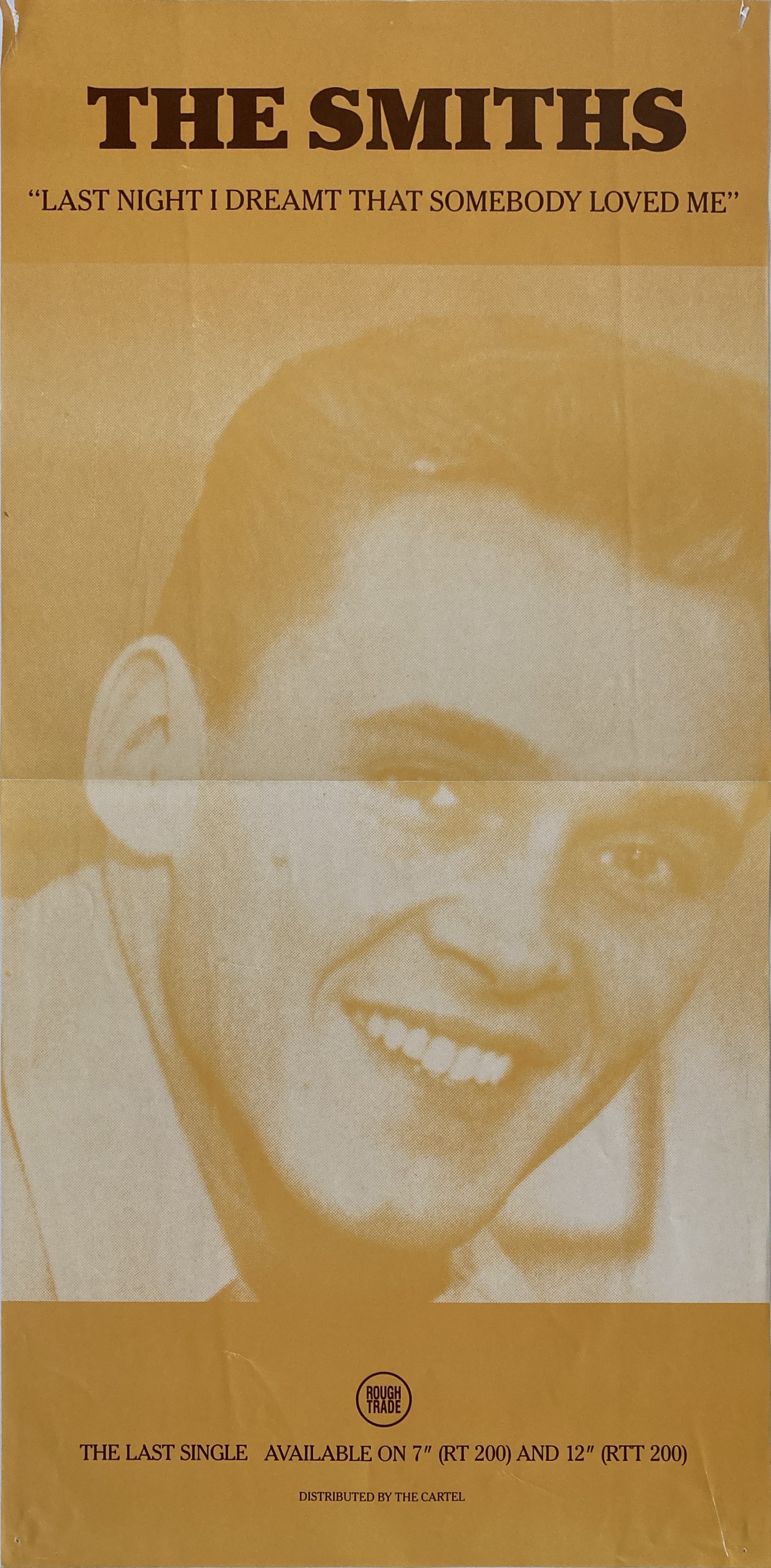
The tour would have come on the back of a box set and Shirley Bassey-housed Hand In Glove reissue celebrating The Smiths debut album plus that crappily-titled ‘Smiths Rule OK‘ compilation, and Johnny, as the statement goes, has put his foot down at that idea too. How many Smiths compilations does one household need anyway? (Bizarre fact – there are more Greatest Hits compilations of boy band Blue than there are studio albums by them. Reissue, revalue, repackage ‘n all that jazz.)

Look at any Smiths record, be it 7″, 12″ or LP, and you’ll recognise it as a work of art in its own right. Old movie stars tinted in turquoise and gilded in greens, heroes and heroines presented in burnt umbers and off-yellows. The fonts stately and bold, the back sleeves always listing the principle Smiths and what they’ve played on it. Never mind what they sound like, that Smiths catalogue is one of the most iconic-looking collections in guitar-driven pop.

The SmithsThis Night Has Opened My Eyes (June ’84 demo, unreleased)

In any case, the artwork for the intended new Best Of is, by any stretch of the imagination, a disaster. It just wouldn’t do. How Morrissey, with such an eye for detail and the importance of the seemingly small stuff that folk like us obsess over could give the green light to a proposed sleeve that looks like a ten minute rush job at the end of a long Friday is anyone’s guess. It’s just as well Johnny is switched on and still cares about his band’s legacy.

This might come at a cost though. With one key Smith keen to improve his already-handsome income and the other happy to ensure his group’s back catalogue isn’t tainted, that debut album box set looks set to be shelved. For obsessives that’s a bit of a disaster. The Troy Tate tapes in fabulous hi-fi. That Cookies’ cover. An early live show with the young feral Smiths stamping their mark on guitar-driven pop. Whatever was lined up for the box set may now be confined to the dusty library shelves of the archives.

That reunion idea though. Absolutely vile, as the song goes.

One last thing before I go. That third party in 2018. The one who tried to take control of The Smiths name. Who was it?

Get This!

Some Mothers Do ‘Ave ‘Em

In what might be a discarded Only Connect question, as a starter for 10 can you tell me who links Paul Weller, Sylvester and Joe Satriani?

Anyone?

A clue: he’s the same guy who links Whitney Houston, Starship and the odd Disney soundtrack or two.

No?

Bongo Bob is your answer. Bongo Bob.

A Latin Jazz aficionada, Bob worked out of San Francisco’s Bay Area in the ’80s and beyond and was the percussionist of choice for anyone needing a polyrhythmic smattering of exotica across their music. But don’t let the nickname fool you, for Bob was also the go-to guy when it came to programming computers once studios began moving from analogue to digital. One Step Ahead Bob, that’s what they shoulda called him.

That’s Bob’s computerised percussion smoothly rattling away in a none-more-’80s fashion behind Whitney as she glides through the octaves getting “so emoshunal, baybee.” His programming is all over much of Joe Satriani’s output, the sympathetic and understated backing that allows Joe to flow to his ear-bleeding max. There he is too on Starship’s perennial ‘Nothing’s Gonna Stop Us Now‘, his fairground ride sequencing giving the track its signature feel. Forgotten what it sounds like? Stick on Heart ’80s or Greatest Hits Radio and it’ll be with you very shortly.

Check out Bob’s extensive CV and see for yourself. If all you ever listen to is oldies radio, retro FM-blasting non-stop hits and/or classic AOR rock, there’s a chance you’ve heard Bob’s work far more than you realise.

You though – yeah, you. You don’t listen to oldies radio. Not all the time anyway. And you wouldn’t be seen dead with a Satriani album. Sylvester? Yeah, you like his stuff. Well, the early stuff, obvs. You Make Me Feel Mighty Real, really. And (trainspotters ahoy!) his groovy cover of Southern Man, but not the subsequently under-appreciated records that Bob added requisite danceability to. Never even knew about them, mate. (Sniff).

Imagine, then, that Paul Weller gets together with the Stone Foundation and at one point asks Bongo Bob along for the ride. How these planets collided is anyone’s guess, but there they are. PW and the Stone Foundation are no strangers to one another. Weller has played guitar with them on stage, laid down guitar parts on their recordings and generally elevated the status of the soul collective whenever they need it. Bongo Bob though? Weller is no slacker when it comes to collaboration. (There’s another good Only Connect question: who connects Amy Winehouse, Graham Coxon and Suggs?) But Bongo Bob? He travels a lot, does Paul, musically as well as globally. I can only think his studious knowledge of music in all its various genres somehow led him to the Californian bongo maestro and they took it from there.

A strange pairing, perhaps, but one which produced a minor Weller instrumental stomper.

Paul WellerMother Ethiopia (Part 2)

Perhaps in no small part to a lifelong love of the fluid riffing of Frame and Marr, I love my African music when the guitar splashes all over it like an uncontrollable fountain of joy. Mother Ethiopia is Weller’s contribution to Ethiopique Series, a long running (est ’97) thing which shines a spotlight on the music of Ethiopia. As the 30+ releases in the series will attest, lots of Ethiopian music is mainly all rhythm and horns. A very heavy thing at times. And very groovy too.

Weller’s track (particularly its part 2, above) conjures up the dusty spirit of an Addis Ababa taxi driver’s cab at peak rush hour, its tinny radio blasting warm sounds into your sweaty face. Bluesy desert guitar gives way to that great African rhythm, Bongo Bob palm slapping his instrument and fighting for ear space with an ancient wobbly synth line. There’s chanting of some sort, more sand-blown guitar, more synth, now twisting itself into weird African scales…and then the horns. They’re on the one, half James Brown, half Fela Kuti and lead a brief and funky charge. A sinewy slither of sax and trumpet weaves and winds its way between Weller’s loafered foot stomps and clipped, staccato guitar and, blown by the prevailing Westerly winds, vanishes in a dust cloud of Afrobeat. Or is it Afrojazz? The incessant rhythm only just about lets up. Magic stuff.

It’s not Changingman. It’s not Broken Stones. It’s niche Paul Weller. Worth a proper listen in your own time.