At midnight on Thursday going into Friday there, Taylor Swift released – or dropped, as they say nowadays – a new album (or albums, plural, given the cash-grab of multiple formats that is becoming more the norm these days too) and the internet this side of the border went into a bit of a mild frenzy over the inclusion of – as you will be sick of hearing by now – a Blue Nile-referencing lyric.
‘Drowning in the Blue Nile, he sent me Downtown Lights, I hadn’t heard it in a while…‘ are lines that bookend the mid-paced and breathy Guilty As Sin?, a synthy, processed track with a building chorus that doesn’t instantly hit – and why would it, I’m a 54 year-old man – but one which I suspect I’ll hear multiple times around the house and in the car until I know every word and nuance back to front. Such is the appeal of Swift round these parts. And around the globe a trillion times over. What a talent, undoubtedly.
The Blue Nile, on the other hand, I get, I understand, I fit the demographic. I love everything about them; the tectonic pace at which they work(ed), the shroud of mystery and intrigue around them, Paul Buchanan’s languid and resigned voice, the songs.
The songs! I must confess, they took a while (like Taylor Swift might) to work their magic on me. When the Blue Nile first appeared from out of the Glasgow rain, all chinos and swept back curls and faint sophistication, their stylised and expertly-produced coffee table symphonies were not to my palate. I liked my singers to bark and shout. Off mic and even off key was fine to these ears. Close-miked, enunciated crooning was for old folk over 30. I liked my guitars scuzzy and fuzzed up or jangling away at a window-rattlin’ volume for two, three minutes at a push. Politely played guitars that crept slowly beyond the five, six minute mark belonged on Dire Straits records and not in my record collection. Keyboards and drum machines? That was strictly Level 42 territory, man.
But one day, I got it. A Walk Across The Rooftops reeled me in with its slow-burning, twisting, turning and unspooling melodies and I was hooked. Then the group found hats. And then, I found Hats.
The Downtown Lights, the track that gets Taylor all a-teary, appears second song in. Taking many of its cues from the signifiers on that first album, it glides on a bed of politely pattering electronic Linn drums and long-breathing keyboards, gently pulsing electro bass and stabbing strings. Cascading percussion permeates in all the right places as Buchanan’s voice lets loose a gorgeous tumbling melody that forms the centre piece of the track.
“Nobody loves you this way!” he emotes, artificial strings swelling in time to the break of hearts, even Taylor’s. Paul Buchanan’s voice, his phrasing, his controlled delivery… it wouldn’t sound out of place at all on Station To Station or any number of those Bowie studio records from the era.
The Blue Nile – The Downtown Lights
The Downtown Lights forms part of a record that is required to be listened to as a whole, something that in the scroll, like, delete, swipe world we now live in seems almost archaic. It’s pretty much the perfect record, a record that is initially so somnolent and atmospheric that it might make more sense listening to it in deep space, or, if it’s more practical, a flotation tank.
I can totally see why Taylor Swift might dig The Blue Nile. And I totally expect The Blue Nile to chart at some point in the next week. Taylor has enough followers that, if even half a percent took a curious interest in the track and played it on Spotify, The Downtown Lights could yet end up The Blue Nile’s best-known song. Move over Tinseltown, there’s a new kid in town. Who saw that coming?
It begins with a rat-a-tat of rattling, ricocheting far-off processed beats then melts itself into a woozy, hazy, two chord guitar riff. A nagging, incessant keyboard riff (or is it effect-heavy flute? Or another guitar track filtered through a dozen stomp boxes?) follows. A proper headnodder of a groove builds around the disparate tracks. A bassline, rubbery and dependable nails the whole thing to 4/4 time and then…lurch! A divebombing tremelo wobbles six strings wonkily downwards, seasick and stoned, and suddenly you’re disorientated. Only momentarily, mind, as here come the vocals. A girl? A boy? A duet? And what are they singing? They’re more vocalising than singing really, as any number of Netflix subtitles will tell you these days, the voice(s) trippy and overlaid and harmonising in an out-of-body way that’ll have you humming along from this point on. Here’s that flute again. And the rat-a-tat. And the shape-shifting lurch. And those inter-woven harmonies. And the flute again. And the monster bassline. And another lurch, just as you’re getting the hang of the discombobulation of it all. And so it goes, for nearly 7 minutes, My Bloody Valentine‘s greatest studio moment – Soon.
My Bloody Valentine – Soon
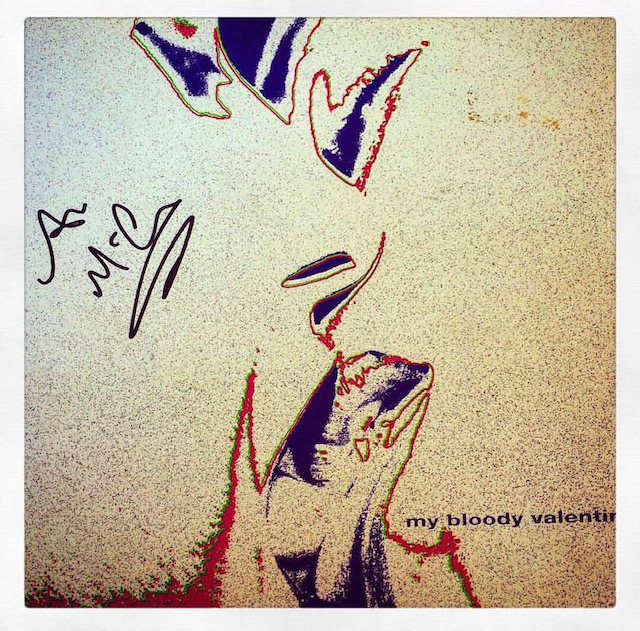
My 7″, signed by McGee no less.
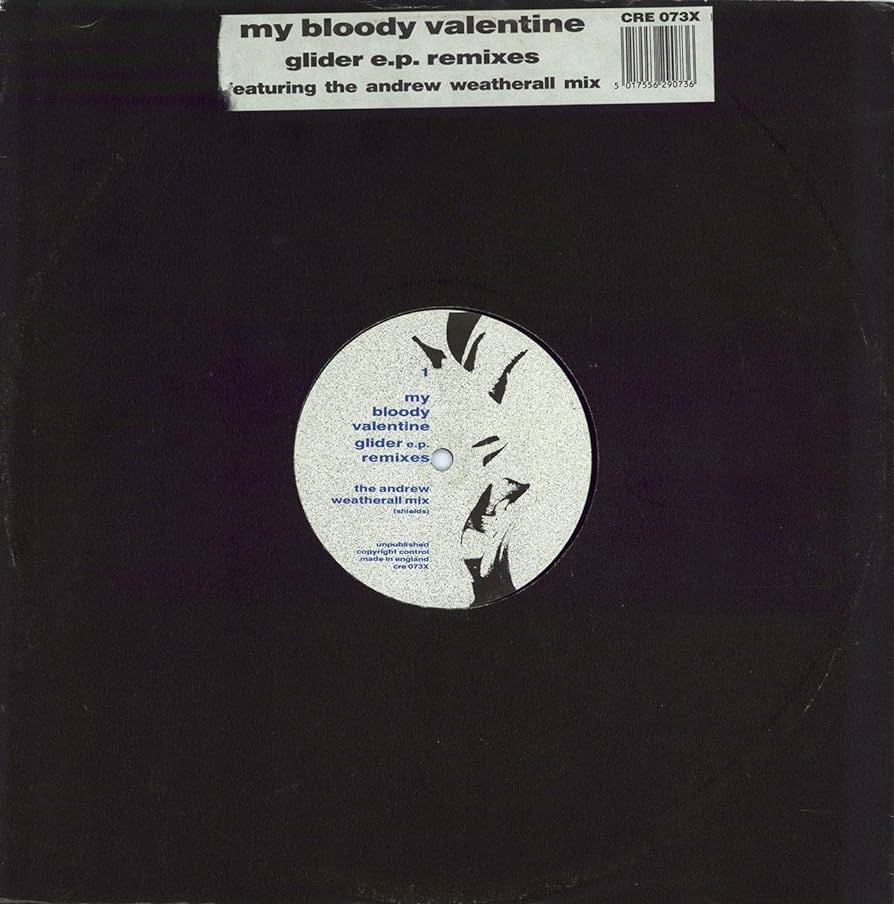
It has actual lyrics. You can look them up if you don’t believe me. They’re not what Kevin Shields wrote though. The stubborn artist – and with Soon and the rest of the Glider EP (and the Tremelo EP and Loveless), he is far more of an artist – studio auteur, even, than mere musician – wouldn’t give them to the label. He’d present Creation with the completed recordings and their titles and some poor office girl would have to sit and decipher everything through the fuggy haze on record and, very possibly, within the office itself. Naturally, many of the real lyrics are lost forever, the ‘official’ words actually the work of the Creation intern. That’s pop art for ye.
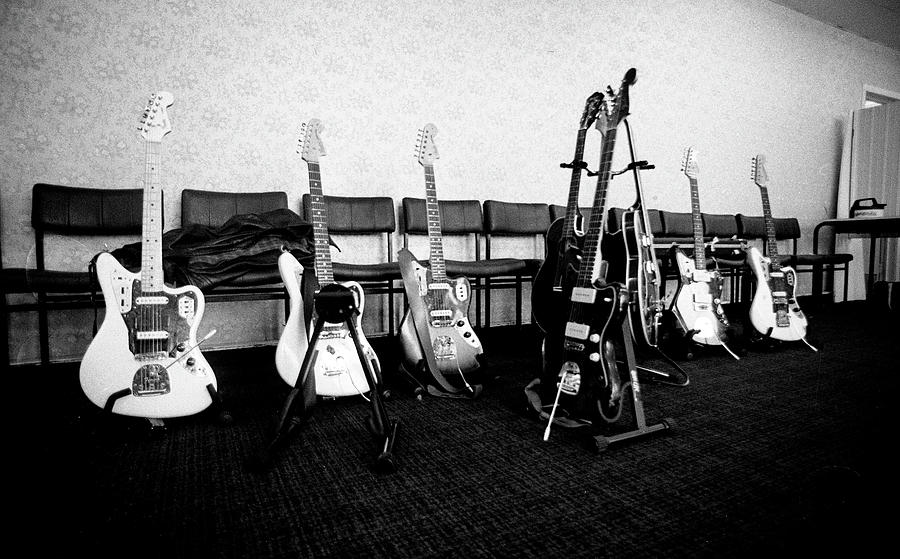
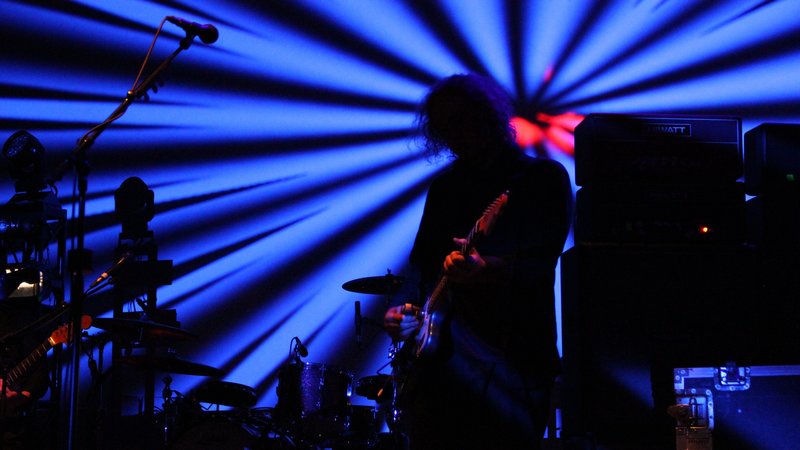
Soon isn’t necessarily a word you’d associate with My Bloody Valentine. A band so determined – so bloody-minded, even – it took them 21 years between records and then nothing since, it remains my favourite piece of music by them. It’s an astonishing piece of art still, even after 34 years. The product of hours and hours and breakdowns and missteps in the recording studio, it was painstakingly created by Kevin Shields, hunched over spooling tapes and faders and offset Fender Jazzmasters, tremelo arm nestled in his fingers and ready to glide. Just as Johnny has the jangle and Jimi has the fuzz, Shields has glide guitar as his signature. Detune your guitar to some far-out open tuning, hold a chord shape with the left hand and, as you strum, lean gently but firmly onto and into that tremelo arm. The floating bridge will reduce the tension on the strings, leaving you with that trademark sighing, tone bending, shape-shifting guitar sound. Just add a mission control-sized pedal board and a decent vintage amp or two to the chain for maximum push and pull effect.
I bet he went through a gazillion strings perfecting it.
Soon was released at an interesting intersection in indie music. My Bloody Valentine, a group synonymous with guitars and Docs and shapeless black jumpers found themselves influenced, knowingly or otherwise, by the rhythm-focused music comin’ atcha from Manchester.
That ‘Funky Drummer’ beat that propelled Fools Gold? The military two step that implored a million bucket-hatted eejits to twist their melons? Here it all was – the mellower cousin of Public Enemy’s fierce sampled beats – chopped, cut and pasted and stuck together again to provide the back beat for a track that no band, not even MBV themselves, could replicate live. Those repetitive Italo house hooklines that ear wormed their way from Happy Mondays’ back catalogue and caused van drivers to whistle while they worked? The same hooklines that had been born from Detroit techno and adopted as their own by the magpie-like Ryder clan? Here they were too, in flute form, but still there, popping up regularly enough to provide both hook and anchor for a track that might’ve been lost at sea without it.
It’s that little motif that plants Soon firmly into the future – even still in 2024 – and maintains the group’s legacy as forward-thinking studio pioneers. They’ve released other material since, of course. Not much though…and nothing with the heart and soul and (despite what I’ve just said above) originality of Soon. It’s a weird, warped beauty. Nocturnal. Otherworldly. Perfect. And peerless.
As a new artist, how hard is it to get your music heard? Rhetorical question perhaps, but “with great difficulty” would be the resounding answer. Current stats show that over 60,000 new tracks are uploaded to Spotify every day. That’s around half a million a week…two million a month….twenty four million a year. For a new artist, the impact they can expect to make is zilch. Comparable to a shed tear of realisation plopping into the Atlantic Ocean and hoping that enough ripples cause it to somehow stand out, only the foolhardy would believe that they could make it – whatever ‘make it’ is these days – and sustain a career in music.
The keen-for-success artist might also bombard the in boxes of the taste makers and influential movers and shakers on the internet in the vain/vague hope that someone will maybe feature them and their music. Even I, with my ‘outdated music for outdated people‘ tagline get dozens of weekly emails from hopefuls across the globe, all eager for me to feature them here. Sometimes I do, but as you know, mostly I don’t.
If you, the artist, wants to go the more traditional route of trying to woo a record company, the executives will no longer hot-foot it en masse to your headline show in a grimy London sweat-box. Instead, they’ll tap into your socials, check out how many followers you have, how many monthly listeners you can pull and what sort of merch you are selling via Bandcamp or wherever. Can I make money from them? is their first thought. Is the music any good? might be their second. And yet, and yet, great talent is out there…
I’m involved in putting on gigs and in recent weeks I’ve been lucky enough to witness some artists who, with a whole lot of luck, could and should be far more well-known than they currently are. A couple of weeks ago we had BMX Bandits play our wee venue (the Harbour Arts Centre) in Irvine. Duglas Bandit suggested Alice Faye as a support act. He’s such a fan of her that when it came to show time, he asked if he could introduce her to the audience…then walked across the stage to take a seat in one of the front rows to watch her. By this point in the evening, I knew why; during the soundcheck, it was just Alice, Danny the sound engineer and myself in the room, and when Alice started singing…oh man! I looked at the normally stoic and hard to impress Danny, who, lost in faders and reverb and noise gates, raised one eyebrow high and smiled knowingly to himself. He was experiencing exactly what I was; a phenomenon.
Alice’s voice was pure and clear with a tone and depth and unique personality that singled her out immediately as one of the greats. I really mean that. I was thinking Nina Simone, Joni Mitchell, Nico… unique and individual voices, and voices that Alice could sit alongside without being one iota out of place. As Alice sang her heart out shyly to an empty room, even the motes of swirling dust being picked up by the heat rays below the ancient HAC spotlights stopped what they were doing to listen. “This must’ve been what it was like when Amy Winehouse sang in front of someone for the first time,” I caught myself thinking at one point. Preposterous, yet not really. It was both jaw dropping and heart-warming in equal measure – here’s a new artist who can really, really sing. Lovely and astonishing. The song she was singing at the time was, I’m sure, Exact Same Thing, the fourth track on the playlist below.
She apparently has it all, Alice. In her vocal stylings there are clear nods not only to the past but the present. It’d be easy to imagine any of her songs sitting perfectly well amongst the ’60s shimmer and melodrama of Lana De Ray or the downbeat pop stylings of Billie Eilish. What it takes to get noticed then elevated to their sort of status is the golden prize. What’s that quote again about success being 10% talent and 90% luck? Alice Faye isn’t lacking anything on the talent front, that’s for sure. All she needs is the luck. And a lot of it.
Thrillingly, that luck might be happening. Alice has been picked up by the people behind Rufus Wainwright and she’ll support him on a couple of upcoming dates. Rufus’s audience, you would think, should appreciate a quirky voice and floating melody, so I’d hope Alice’s name is slightly better-known come the summer. Talent like Alice is so hard to find. Let’s treasure it when it lands in your lap.
In the summer of ’22, Ross Wilson assembled a 7-piece band to accompany him on Blue Rose Code‘s various festival stages. Ross, as you may well know, is more than comfortable performing as a solo performer, or as part of a stripped-back duo or trio, but the opportunity to flesh out his sound with guitar, keys, drums and a brass section proved too great to pass up…and his band and their input stretched him in great, fantastical directions as a result. Anyone who has caught him live with the full-fat Blue Rose Code will have witnessed shows akin to euphoria and religious experience. Going full-on Dexys, the band would go running – actual running – and then do press-ups backstage, right up until the point they were due on, so that by the time they’d begun their first number they were literally hitting the ground running. No easing into a set, no feeling their way with an unknown audience, it was bam! Bam! BAM! We are Blue Rose Code and this is what we do; off-mike hollers and whoops, loud boot stomps to emphasise big moments in the songs, a hand on heart as a key lyric is sung…you couldn’t help but get caught up in it all.
What Blue Rose Code did on those festival dates is very much apparent on the new album, Bright Circumstance. Building on that Dexys by way of Style Council approach honed through communal exercise and live shows, brass stabs as sharp as a stiletto puncture the Walls Come Tumbling Down stomp of opener Jericho. A fat and thumping four to the floor beat keeps it moving forward, shimmers of Hammond easing quietly into the gaps between brass and vocal and its call and response section. There’s a drop out in the middle, the spot where eager audiences were (and will be) invited to join in with enthusiastic hand claps, before the band revs up again and drives the song home in a brassy rush of Stax proportions. That’ll be yr album opener, and no mistake.
Blue Rose Code – Jericho
If you’ve seen Blue Rose Code live, in whichever guise, you’ll know that Ross touches on the big subjects; life, love, social issues and our unfair society, and they’re all here on Bright Circumstances. Most of the recent live set is present, and if you only know it from a stripped back show, the breadth of musicianship and colour afforded by the assembled musicians might leave you momentarily breathless. Sadie is carried by quietly brushed acoustic guitars, swelling, weeping pedal steel and more of that glorious Hammond shimmer; exactly the sort of track the still-switched-on Rod Stewart of the ’70s might have done to great effect.
A scraping, violin – think Neil Young’s Running Dry – scratches its way across the socio-political bite of Thirteen Years and its ‘are they heating or are they eating?‘ refrain. The bold Ross found himself in trouble last year when he managed to sneak this into a live performance being broadcast to the nation on BBC Radio 4. Inspiration is infiltration. A loose and jazzy Amazing Grace rounds off side one, Wilson taking liberties with his phrasing to great effect, the band showcasing their talents as their leader directs them in the ebb and flow of the melody.
Side two is the softer of the two sides, and it’s bookended wonderfully by two great tracks. The opener, Peace In Your Heart, will be familiar to audiences on any of the more recent BRC dates. A slow acoustic builder, it unravels into the sort of gospel folk that John Martyn and Van Morrison once did with great effect and, on this evidence, should see Ross Wilson considered an equal. You can dress your songs up in brass and electricity if you want to, but what it really comes down to, Jim, is a universal message played simply and sung well. There are no frills on Peace In Your Heart, and it’s the perfect comedown from the kitchen sink approach on side one.
Blue Rose Code – Peace In Your Heart
Midway through, you’ll find Don’t Be Afraid, its moody ambience and close-miked minor key atmospherics revealing fantastic harmonies and off-kilter counter melodies with each repeated listen. Funereal horns lead the song upwards to its heavenly conclusion, the vocal refrain namechecking God with all the gravitas and straightforwardness of Nick Cave.
The religious theme continues on Now The Big Man Has Gone, a lament for a pal no longer here. Lyle Watt, Ross’s long-standing foil on guitar and finder of the bluest of blue notes in any situation leads us in with a quietly strummed mandolin before the song opens up with more female harmonies, a mournful accordion and tinkling piano. And then it’s over.
It’s a great album, Bright Circumstance. It finds Ross in good spirits, in a good place in life and surrounded by sympathetic musicians and guests (Eddi Reader, Donald Shaw, Naomi Stirrat). He’s found peace and contentment, faith and spirituality and we are the benefactors of this. A decade into a music career that has seen him reach new heights and gather new fans with each subsequent release, it would be great if Bright Circumstance was the album that saw Ross finally lose the label of ‘best kept secret’ and brought him into the collective consciousness of music listeners with a fondness for great songs played and sung outrageously well. He deserves it. And so do we.
Bright Circumstance is released on the 10th May. You can get it everywhere, including Blue Rose Code‘s Bandcamp page (although the pre-order link isn’t quite live yet).
Before the bombast and bluster of Waterfront and its parent album Sparkle In The Rain, before Don’t You Forget About Me‘s omnipresence in top tens the world over, before they looked to the tiered arenas of the American midwest and long before they’d even thought about possibly considering property investments in Tuscany, Simple Minds made sonically-interesting and stubbornly European music; cold, glacial and filmic, music that suggested movement and travel by Eastern European train rather than by air conditioned limo the length of the Eastern Seaboard. Even their pseudo Cyrillic logo at the time, all thin and sparse and fat-fee, was a nudge-nudge wink-wink to the twin influences of the Iron Curtain and the Cold War. Those reversed Rs. The backwards Ns. Ask James Dean Bradfield about it the next time you see him.
As much as Simple Minds became a great Scottish export around the mid ’80s, it’s those earlier records where, for me, the magic really happens. Indeed, as the switched-on amongst us know, early Simple Minds was where it was truly at. That band, that line-up, that creative vision, not to mention the inspired choice of producers – John Leckie! Steve Hillage! – has a rare essence about it that makes those great, danceable post-punk records sound futuristic still, even 40 years on.
Simple Minds – Theme For Great Cities
The eerie keyboard motif that signifies Theme For Great Cities’ start is all over those Minds’ records from the era. Part Eno and part Magazine’s Dave Formula, it’s the singular instrument that hints at melody and song form in the band. Married to a punchy rhythm section, it made for a spatial and atmospheric sound, a sound that was unmistakeably Simple Minds.
Theme For Great Cities is the perfect example of the group, the juddering bassline and whip-smart electro backing conjuring images of speeding landscapes as you rattle through foreign lands. The band is precision-perfect in timing, metronomic and pinpoint in accuracy. Even Charlie Burchill is in on the act. He plays almost not one chord, almost not one sustained note. The disciplined post-punker that he is plays the track’s scratchy rhythm almost the entire time without so much as a tendon-resting break. Nile Rodgers in eye liner, he breaks free at one point to simply crash a minor chord with all the charm of a glass bottle being smashed against a wall, then slips into a little effect-heavy sustained glissando before once again taking up the chicken scratch. Arty? Yep. European? Yep. Roxy Music if played by Glaswegian tenement kids? Yep. It’s a beauty. That well-worn cliche about an old record sounding like it could’ve been recorded yesterday rings true with Theme For Great Cities.
Likewise This Earth That You Walk Upon.
Simple Minds – This Earth That You Walk Upon
It’s so disciplined, so ethereal, it might’ve launched itself straight from The Orb’s mixing desk in 1993. Its pitter-pattering drum machine springs to mind Sly Stone, but where Sly would close-mike himself and drawl coolly about baybees makin’ baybees, Simple Minds smother the pitter-patter in a soundscape of treated electric guitar and thumping slapped bass, synth washes and echo-laden keyboards. Spacey and flotation tank-light, This Earth That You Walk Upon is a bit of a year zero for the electro acts that would follow.
In movie making terms, the trajectory of Simple Minds is a bit like your favourite art house director foregoing the grit and grain of monochrome and throwing their lot in with the surround sound and widescreen epicness of the Hollywood blockbuster studio set. There’ll still be good bits in the movies, but as a whole, they’re too crowd pleasing and calculated. In the old days, the creatives at the helm knew the cost of nothing and the value of everything. When they make that move into the big leagues, the bottom line becomes the single most important factor, and undoubtedly the music suffers as a consequence. Thankfully, we can go back any time we like. Outdated music for outdated people? You bet it is.
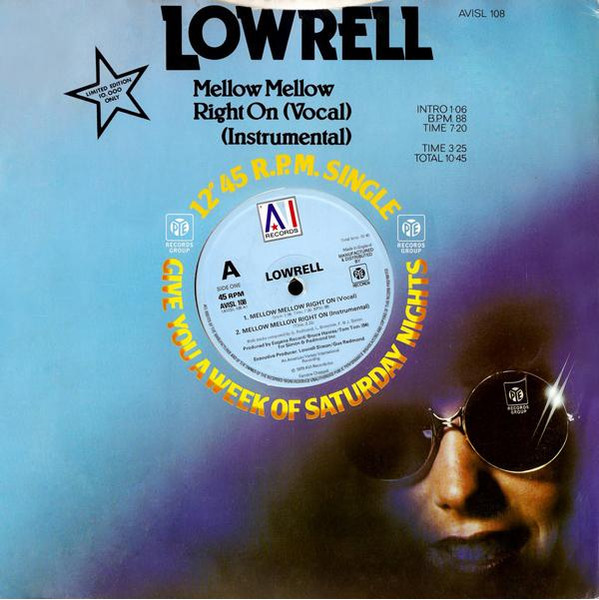
Lowrell Simon was a Chicago-based soul singer. After being in a succession of hopeful groups, slogging around on the circuit and briefly grazing the lower reaches of the US R&B charts, he was, by the mid ’70s, a staff writer at Curtom (Curtis Mayfield’s label) writing and producing soundtrack material of little consequence. Nothing truly spectacular really materialised from his writer’s pen until the end of the decade. By then, Lowrell was back recording as a solo artist, his experiences with Curtom better equipping him for the making of glossy, groove-driven soul music.
He struck gold with the very Mayfield-titled and timeless Mellow Mellow Right On.
Lowrell Simon – Mellow Mellow Right On
Anyone who’s heard Massive Attack’s Blue Lines – and that’s everyone here, right? – will recognise instantly its marching heartbeat of a bassline, used to great effect on that album’s Lately; stately, steady and never wavering, driving that track to its soulful and melancholic conclusion.
On the original, things are a bit more upbeat. That flare of unresolved strings at the start, all tension and no release, coupled with the wet slap of funk guitar and precise drum beat promises much and delivers exactly what you hope for. A choir pops up, “Mellow, mellow, right on!” they chant…and then Lowrell himself slopes in, all spoken word and chocolate-wrapped vocals – “Ladies, I’d like to take this time out just to say…” his easy vocal easing up, out and into Marvin Gaye territory.
Behind him, his disciplined band never drops the beat. They groove and smoove their way through ten metronomic minutes and more of pure discofied funk, the sound of flapping trouser legs, jumbo-winged collars and powder blue suits, of oversized hair and oversized heels. In an era much maligned and swept aside by the snotty arrival of punk, Mellow Mellow Right On glistens like the studio lighting refracting from the mirrored lens of a pair of aviator shades and serves as a reminder that the best disco was just as valid as any other music. Fight me.
You’d get no argument on that front from Edwyn Collins. Scrolling through a Postcard Records group on Facebook recently, that old Mojo article (above) jumped right out at me, and not just because of EC’s unmatching shirt ‘n trousers combination.
Edwyn, forever on the money, whether it comes to guitars or clothes or hair, is once again correct in his assessment of Mellow Mellow Right On. Sung especially for the ladies and wrapped in a bad-ass but glossy production (the wee electronic shooms that fire off now and again, the oil slick thick guitar, the tease and timbre of the strings) – it’d be easy to imagine Dr Dre getting behind the desk to work his G-Funk magic with this as the bedrock.
I bet Edwyn’s still grooving to it now. I know I am.
I’ve been reading everyone’s end of year lists and the one thing that strikes me – as it has done for the past half dozen years or so – is my out-of-touchness with new artists and releases. While all and any release is but a couple of clicks away from the very space I’m sitting at, I’m staunchly anti-Spotify…and it’s clearly to my listening detriment. I much prefer physical over digital any day of the week, but inevitably finance – or the lack of – has dictated that my consumption of new music is on a clear downward trend and gathering momentum with each passing month. It’ll likely be sometime around September 2024 when I stumble across a record from 2023 that’s had everyone raving for months beforehand, but I’m not that bothered to be honest.
I’ve really enjoyed the tracks that The Smile have used to promote their upcoming second album. Bending Hectic, all woozy electric guitar and close-miked Thom Yorke, was supposed to be a stand-alone single but I notice it’s on the tracklisting for the record, so clearly someone talked sense into them. To have thrown away a stone cold 21st century classic to the digital ether would have been stupid of them.
More recently, the album’s title track Wall Of Eyes has found its way onto the radio playlists. It’s a beauty; a bossa nova-ish acoustic groove with far-off layered strings that sound like thunder peals and a melody that takes repeated plays to fully unwind, but when it does…wow! I know folk go on and on and on about Radiohead – and this ain’t Radiohead – but it’s really great. Their debut album was a beauty and its follow-up already sounds like it might be too.
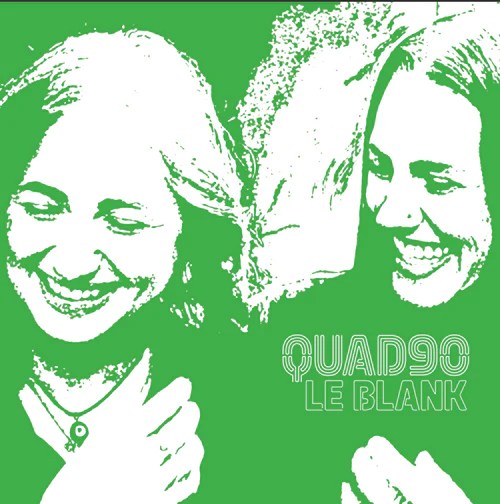
My favourite track of the year, for what it’s worth, was a one-sided promo 12″ that came out via Last Night From Glasgow. The label continues to go from strength to strength, and whilst providing a home to disparate but talented, long in the tooth and (mainly) Scottish acts, they also offer a platform to the new and inexperienced. Quad 90 was one such act and their track Le Blank will no doubt ring with a lot of this readership.
Quad 90 – Le Blank
It’s nothing you’ve never heard before. Forward-thinking with a knowing nod to the past, it could be ESG or ACR or even a Franz Ferdinand remix, but all necessary ingredients are present; post-punk chicken-scratch guitar, a ghosting, earwormy, Tom Tom Club-ish keyboard motif in the chorus, thumping Bernard Edwards bass and a sashaying double female vocal that falls somewhere between sultry and sulky. It played long and often round here before finding favour amongst the more discerrning radio shows across 6 Music and Radio Scotland (as did its follow-up Unequal Division) and is a good signifier of what might come next.
Gig-wise, I’m heavily involved with Freckfest in promoting shows in Irvine’s Harbour Arts Centre, a proper hidden gem of a music venue with just 100 seats and immeasurable vibes. Some of my favourite shows this year have been in here.
The Bug Club turned up on the last Tuesday in January – surely the hardest night of the year in which to sell tickets – and supported themselves by sneaking on unannounced and playing a whole half-hour of new material before coming back out to slay a hardy 80-strong audience with their Velvets x Modern Lovers rattle meets Osees x Stooges roll. For three folk, they make a quite marvellous racket. If they’re playing in a town near you (and they most likely will be at some point), you know what to do. Review here.
My favourite gig of the year was quite possibly around the same time, when the Hungry Beat collective pulled out all the stops in a marathon show that fused together like a scratchy Pete Frame family tree of Scottish alt. pop reimagined as The Band’s Last Waltz. Review here.
Other notable shows were The Waterboys epic and sprawling but razor-sharp show at the Barrowlands. Yer actual Mike Scott sent his foot messengers my way to express his personal thanks for this review, which was unexpected, and The Bluebells roof-raising homecoming album launch show in St Lukes. Yer actual Bobby Bluebell immediately re-Tweeted this review, accompanied by 3 love hearts, apparently the highest Bluebell accolade in the land.
Books are the new rock ‘n roll, dontchaknow? There were some really great book events this year that were the equal and more of any live music show. Andrew O’Hagan‘s Mayflies – already a modern classic and no mistake – had a bit of a reprise in Irvine over the late summer when a Nicola Sturgeon-chaired event saw Andrew chat about growing up in Irvine and the cultural influences that seeped their way into his autobiographical tale of life-long friendship. The former First Minister, a confirmed bookworm, asked me to sign one of my Perfect Reminder books for her and then re-Tweeted my follow-up review of the evening. Unsurprisingly, my stats went a wee bit stratospheric on the back of it, so I’m delighted (and relieved) that my writing in that review is up there with some of the best stuff I’ve ever written.
Not to be outdone, John Niven popped up in the HAC as part of the promotional tour for his powerful/excellent O Brother novel, a real autobiographical darkness and light page-turner that deals with the despair of family suicide and (the despair of) growing up in Irvine. If you’re of a similar age to me, there’ll be enough memory joggers contained within its pages to have you reading frantically to the end. It’s easily the best, most emotionally-charged book of 2023 and you really must read it. I’ve now read it twice, its pages forever smudged with the dampness of sad and happy tears.
On a personal level, I got to do more writing of worth (sleevenotes for the Trashcan Sinatras) and actual, real book stuff. A second publication bearing my name – The Full Pocket – came out at the start of the year and sold out just a few weeks ago. Of course, no sooner had it sold out than the Americans were asking for boxes of it and that man Niven was pointing out a badly-phrased and grammatically-poor sentence that might benefit from a rewrite. Should a reprint be in order, it’ll need a swift edit first.
The Full Pocket took me to another music ‘n literature event, this time in May at Frets in Strathaven, alongside James Yorkston and Vic Galloway. While James did his set, Vic and I made full use of the green room’s facilities and availed many of its bottles of their contents. Imagine my surprise the next morning when I saw photos of Vic, his quiff immaculate, accompanying James for a couple of numbers at the end of his set. I wonder just who it was I was talking to back stage all that time? I could swear Vic never moved from that green room the entire length of James Yorkston’s set.
Must get a new jacket for 2024
Vic, by now a close pal, obviously, turned up trumps in November when he got me backstage to say hello again to Johnny Marr. Vic was hosting an event where Johnny was talking about his 10 years as a solo artist and, with his last words said to me in May – “Keep in touch!” – ringing in my ears, I did just that and suggested he might be able to help me get a book to Johnny. After the show, Johnny greeted me like a long-lost friend – “Hey! It’s Craig from the Ballroom Blitz!” (a reference to his gig in Kilmarnock’s Grand Hall that Freckfest put on) and both myself and that other music writer-about-town Billy Sloan gave Johnny our respective books, much to the bemusement of the random guy who’d breached security and followed us quickly in. “Are youse guys famous?” he asked me with a worried look as he watched first Billy and then me chat easily and familiarly with Johnny. “They’ll fling me oot when they suss ahm jist a bam.”
Finally, I don’t know exactly what 2024 will bring, but I do know I’m likely to have my name on the front of another book. More on that when there’s more to tell…
When does self defence become state-sanctioned, and Western world-approved, genocide?
(War Is Over, If You Want It.)
For the past few weeks I’ve been wanting to write something on Israel/Palestine. Truth is, I don’t have it in me to write something that’s smart, intelligent, on point and devoid of empty cliché. I’ve tried, but the words don’t come out in the way I really want them to. When it comes to the serious issues, I’m just not smart enough to express my thoughts eloquently and intelligently.
When you read about the Holocaust and the Nazis, you like to imagine you’d be the good guy. You’d fight the Nazis, you’d free the concentration camps.
This guy – Paul Biggar – says it brilliantly. Rather than link to his page, I’ve copied it, measured word for measured word, and pasted it below. I think it’s just about the most powerful article I’ve read in relation to Palestine and Gaza.
I can’t sleep
Fadel Senna/AFP/Getty ImagesI can’t sleep. I’m lying in bed every night, and images of Gaza are running through my head. Fathers holding their babies, dead, caked in dust. Bombs dropped on homes [1], on hospitals [2], on schools [3]. Tens of thousands of dead [4] in indiscriminate bombings [5]. Children crying, pulling through rubble to find their families [6].The inhumanity of the soldiers is unbearable. They shoot civilians in the street [7], imprison and torture children [8], and strip and humiliate innocent men [9]. But the soldiers are having fun [10]. They’re posting to TikTok [11], doing some war crimes [12], then celebrating on the beach [13]. I hate them. I hate them.I can’t work. I code for 5 minutes before their bodies come back. I must work, but who can do a startup through a genocide, when 20,000 are dead [14], when the Israeli-imposed starvation is setting in [15]. I try though; the distraction is good for me.I look at my colleagues – the founders, the investors, my network, my friends, my advisors. I’m afraid to open their twitters. Each time I do, it’s a roulette: is it business as usual – a new fundraise, the latest in AI, a new model released. The blasé posts are a relief. I can tell myself that they’re censored, afraid to speak up about the genocide. Unable or not knowing how to do it. That’s understandable.The propaganda kills me. People I thought were friends, were allies. So much humanity for those killed on October 7th, none for the people killed on the 8th, 9th, 10th, 11th, 12th, or in November or December [16]. 20,000 people, killed by deliberate, indiscriminate bombing [17].None either for the people killed on Oct 6th, 5th, 4th [18]. For the people massacred in 1948 [19] and since. No protest of the illegal occupation [20], the illegal settlements [21]. The razing of the villages [22] and the olive groves [23]. They don’t exist to them; they didn’t happen.
Palestinian refugees leaving the Galilee in October-November 1948 from Wikipedia
Have they no questions about why 2 million people live in Gaza and how they came to be there [24]. How Israel carefully controls the calories allowed into Gaza [25], keeping everyone starving. That Israel can turn off the water [26], can turn off the electricity [27]. That this is something a country is able to do to a people. That this is something a country is willing to do to a people [28].
Is this what Israel is? The tech outpost, the US ally, the beacon of democracy in the Middle East? A country that kills journalists [30] and writers in surgical strikes [31]. That forces doctors away from ICU babies, leaving them to die and rot in their incubators [32]. Whose snipers shoot children and grannies in the head [33].
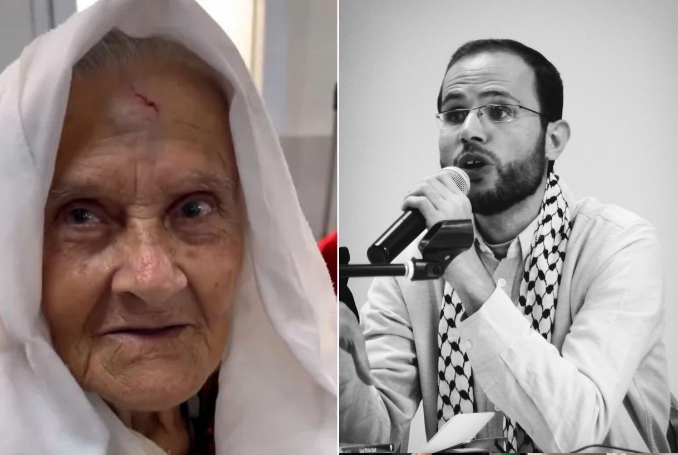
79 year old Hadiya Nassar was killed by an Israeli sniper in December. Poet, writer, and professor Refaat Alareer was killed by a missile which also killed his brother, his sister, and her 4 children.
When the cofounder of Hamas was 9 years old, his uncle was massacred by Israeli soldiers in the Khan Yunis massacre, along with 274 other unarmed Palestinians. He was shot in house-to-house searches. Others were lined up and executed. How many Hamas’ are being created today. [29]
When you read about the Holocaust and the Nazis, you like to imagine you’d be the good guy. You’d fight the Nazis, you’d free the concentration camps. But apparently I wouldn’t. Apparently I would have just sat there paralyzed, incapable of doing anything about the genocide I see every day. Unable to think of any way to help. All I can do is retweet and protest and write a stupid blog post. I feel so stupid.
I wasn’t ready to see that my friends are Brownshirts [34]. That they actively cheer on the genocide [35]. The anger, the desire – the need even – for retribution against innocent civilians. I wasn’t ready for my friends being camp guards, party officials, propagandists.
The propaganda is real, and organized [36], and obvious [37]. Posting about antisemitism in universities to cover indiscriminate bombing of civilians — have you no shame. Repeating Israeli claims which have no proof, and no credibility [38]. Keeping the discussion anywhere except on Palestinians being murdered in Gaza. Denying the number of dead because the numbers are reported by Hamas [39].
Of course, everyone is Hamas now. The child ripped in two by an MK-84 [40] is Hamas. The woman screaming for her sister, digging at the rubble – she’s Hamas. The orphaned nine year old, now the sole parent of her 4 year old brother. Both are Hamas.
Injured children arrive at Nasser Hospital in Khan Younis on Tuesday. Credit: Loay Ayyoub via Getty Images
Sometimes I work out how many people my taxes have killed [41]. Intrusive thoughts. Maybe they’re used for roads or healthcare, but maybe I bought a bomb last year and it razed a city block in Khan Yunis. Maybe it killed 50 people. Maybe I killed 50 people.
My investors keep posting. How unsafe the kids feel at Harvard [42]. Railing against “From the river to the sea” as they conveniently omit “Palestine will be free” [43]. Cancelling Tiktok for teaching the kids history instead of US and Israeli propaganda [44].
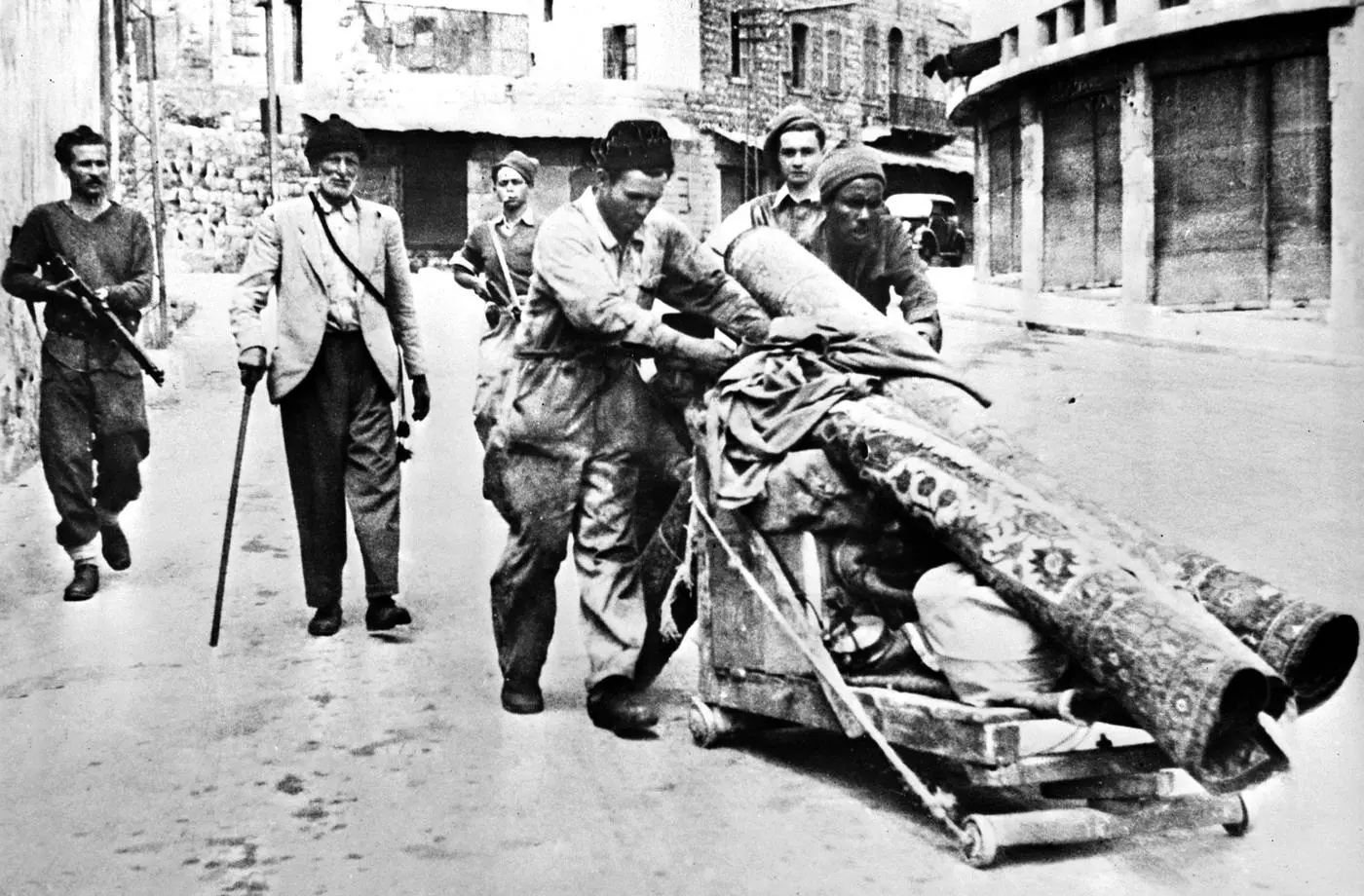
“Members of the Haganah paramilitary group escort Palestinians expelled from Haifa after Jewish forces took control in April 1948 (AFP)”. Middle East Eye
Anything to keep your eyes off the rubble that Gaza has become [45]. The trail of tears to an empty desert, bombed and shot as they go [46]. Anything to avoid their own culpability in this genocide. They are Hess. They post Israeli flags on twitter as Israel drops bombs on Gaza. They protest a ceasefire. THEY PROTEST A FUCKING CEASEFIRE.
I don’t know what to do, but I know these are not my people. Who can work with people whitewashing genocide. Are we supposed to pretend it’s business as usual as we send our friends’ intros, frolic at conferences, discuss monetization strategy.
To Ed Sim, Erica Brescia, Michael Dearing, and especially Matt Ocko, we’re done [47]. I’ll never pitch you again, never ask for help, never send intros or recommend you. I’m done with Boldstart, and DCVC, and Harrison Metal, and Redpoint. (I’m also done with Bessemer [48] and Sequoia [49] and First Round [50].)
I’m ashamed that these are some of my biggest supporters over the years, the people who invested in me, twice, the people who helped, who advised. I cannot work with the people whitewashing a killing, the people who know it’s happening, and who cover for it, who support the IDF and the US administration which allows it, which funds it.
Oct 7th was an atrocity, and so was every day since then. 20,000 Palestinians have been killed by indiscriminate, deliberate Israeli bombs.
Atrocities happened long before Oct 7th as well. The occupation was no secret. Hundreds of Palestinians killed each year since the Nakba. The rest kept under the Israeli boot, stripped of their rights and homes and dignity.
Their politicians tweet about Palestinians like they aren’t human. They discuss them like their lives don’t matter. They call them “animals”. They have killed thousands of Palestinians, and give every indication that they will continue the genocide.
They are saying it out loud [51]. I can see it, and so could Ed and Michael and Matt and Erica. They simply choose not to.
Actions
Pro-Israeli investors have created a culture of fear in tech where supporters of Palestinian freedom feel unable to raise their voices. I have spoken to many people in tech who are afraid that if they speak up, they’ll be unable to raise their next round, and lose 5-10 years of work on their venture, for their families and for their employees.
We must break the silence around the genocide in Gaza. I know this is a big ask. I know there are significant risks involved, and that’s not your fault. But all the same, we cannot continue to be complicit in this genocide.
Above all, name it. Say publicly what you see happening, and say that what Israel and the US are doing is wrong.
Feel silenced? Say that!
Just like most in tech made Black Lives Matter statements in 2020, come out and say #FreePalestine. Put a banner on your website.
Secondly, don’t make money for investors who whitewash genocide, namely partners at Boldstart, DCVC, Harrison Metal, Redpoint, Bessemer, Sequoia, or First Round.
Tech workers: Don’t work for companies who take funding from these firms. If you already work there, contact management and the founders, ask difficult questions in all-hands, anonymously if you need to. Threaten to get a new job – actually do get a new job.
Founders: don’t take money from these firms. If you already have, contact your partner to register your discomfort, and ask them to divest. Prevent them from investing in later rounds.
[1] See for example here or here, but hundreds of apartment blocks were in Gaza before its destruction. +972 Magazine reports that Israel has “A concerted policy to bomb family homes”, and details many accounts from those whose homes were bombed and families killed.
[4] The official death count on Dec 13 is 18,600, including over 5000 children. however, officials have lost the ability to count.
The accuracy of the Gaza Ministry of Health’s reporting of death tolls has been shown to be accurate by recent studies when looking at the 2008, 2014, and 2015 wars. US medical journal Lancet reviewed and affirms the numbers provided in the current war.
“These figures are professionally done and have proven to be reliable,” said Omar Shakir, Human Rights Watch’s Israel and Palestine director.
[5] Even President Biden has called the attacks “indiscriminate”, though the death toll and pictures of a destroyed Gaza demonstrate that directly.
[7] Israeli soldiers have been recorded shooting civilians who pose no threat, including children and a mentally disabled man. They even shot an Israeli civilian in Jerusalem, who was unarmed and had surrendered, falsely believed to be Hamas:
“When the soldiers saw him I’m assuming they thought he was a terrorist. But then when Yuval realized that that’s what they’re thinking, he opened his jacket to show he had nothing underneath, and got down on his knees. He opened his hands, so they could see he had nothing in his hands,” said Itkovich.
“He was shouting in Hebrew. He was shouting ‘I’m an Israeli.’ He threw his wallet, his identification, on the way so they could see he’s an Israeli. And they just shot him. They gunned him down,” he said.
[8] This well-referenced Human Rights Watch article (see similar on CNN and NBC) contains so many harrowing descriptions of shocking treatment of prisoners that you should read the whole thing. These excerpts barely do it justice:
As of November 1, Israeli authorities held nearly 7,000 Palestinians from the occupied territory in detention for alleged security offenses.
Far more Palestinians have been arrested since the October 7 attacks in Israel than have been released in the last week. Among those being held are dozens of women and scores of children.
The majority have never been convicted of a crime, including more than 2,000 of them being held in administrative detention, in which the Israeli military detains a person without charge or trial. Such detention can be renewed indefinitely based on secret information, which the detainee is not allowed to see. Administrative detainees are held on the presumption that they might commit an offense at some point in the future.
More than 1,400 complaints of torture, including painful shackling, sleep deprivation and exposure to extreme temperatures […]
[…] in 22 cases of detention of Palestinian children they documented in 2023, 64 percent said they were physically abused and 73 percent were strip searched by Israeli forces while in detention.
Prisoners released by the IDF in November report being beaten:
Na’im told CBS News. “Any new prisoner was coming in, he looked beaten up. We requested medicine or other stuff and they refused to give it to us.”
“He kept beating me for eight minutes with a stick and without caring where it lands,” Mohammed Nazal told Al Jazeera of how an Israeli guard tortured him.
“I was covering my head. The stick was aimed here, at my head, but my hands would receive the blow.”
Ahmed Al-Salaima told PBS “After October 7th, they started hitting female prisoners. And they started to reduce the quantity of the food. There were 9 of us in the room and they gave us two meals in small quantities. Before entering the jail, I was 158 pounds, but now I’m 121 pounds”
PBS has more testimony by released prisoners on their treatment.
[9] The IDF captured a group of men, stripped them to their underwear, blindfolded them and put them in trucks. The IDF later admitted that 85-90% of these men had no connection to Hamas, and provided no proof about the remaining 10-15%.
[10] This compilation thread by Palestinian writer and Euro-Med Human Rights Monitor Comms Chief Muhammad Shehada shows social media of IDF soldiers torturing prisoners, followed by Israeli civilians mocking and memeing about it. This was confirmed by other media.
In one, soldiers ride bicycles through rubble. In another, a soldier has moved Muslim prayer rugs into a bathroom. In another, a soldier films boxes of lingerie found in a Gaza home. Yet another shows a soldier trying to set fire to food and water supplies that are scarce in Gaza.
[12] This isn’t the only video I’ve seen of Palestinians being used as human shields by the IDF in the occupied Palestinian territories, but I’m trying to restrict most of the references in this piece to legacy media sites.
[14] This CNN chart updates as the death toll increases
[15] Israel blockaded Gaza from receiving food after October 7th, though a small amount (about 20 trucks a day, for a region that needs 100 trucks a day for subsistence) was allowed through during the Humanitarian pause. Gazans on the ground report they are starving.
[16] By Oct 17th, over 3,000 Gazans had been killed by Israel. By Dec 12th, that number had risen to over 18,000.
[17] Even President Biden, a self described Zionist and friend of Israel, has referred to Israel’s actions as “indiscriminate bombing”
[19] The Deir Yassin massacre in 1948 was committed by the forces that would become the IDF, in which at least 107 people were massacred.
“Women and children were stripped, lined up, photographed, and then slaughtered by automatic firing and survivors have told of even more incredible bestialities,” the report said. “Those who were taken prisoners were treated with degrading brutality.”
This was part of the Nakba, in which 15,000 Palestinians were killed and 750,000 were forced to flee.
[20] Israel has been deemed to violate many of the UN Conventions that were specifically drawn up after World War II to prevent the Nazis’ actions from happening again. Occupying land annexed by force (including Gaza and the West Bank) is illegal.
[22] During the Nakba, pre-Israeli militias razedvillages to prevent the returns of Palestinians to their land.
From 1947 to 1949, some 750,000 Palestinian Arabs were made refugees, and more than 500 Palestinian towns and villages were depopulated, most through direct attacks by Zionist militias that later became the Israeli Army.
Remarkably, olive trees contribute to 14% of Palestine’s economy.
Beyond the monetary value, olive trees have become symbolic of Palestinians attachment to their land.
Since 1967, more than 800,000 Palestinian olive trees have been illegally uprooted by the Israeli authority.3 In August 2021 alone, more than 9,000 have been removed
[24] Gaza is a tiny strip of land that was occupied by Egypt in 1948, and so was one of the only safe places for refugees from the Nakba to go. After 750,000 fled from Israeli massacres throughout Palestine, over 200,000 settled in Gaza.
The Israeli military made precise calculations of Gaza’s daily calorie needs to avoid malnutrition during a blockade imposed on the Palestinian territory between 2007 and mid-2010, according to files the defense ministry released on Wednesday under a court order.
[26] Israel controls the water in Palestine. West Bank Palestinians get access to only a third of the water that Israelis can use, and only 82% of the WHO recommended minimum.
In Gaza, some 90-95 per cent of the water supply is contaminated and unfit for human consumption. Israel does not allow water to be transferred from the West Bank to Gaza, and Gaza’s only fresh water resource, the Coastal Aquifer, is insufficient for the needs of the population and is being increasingly depleted by over-extraction and contaminated by sewage and seawater infiltration.
After October 7, the Israeli government shut off the pipes that supply Gaza with water.
It has since only resumed piping water to some parts of southern Gaza while some water has entered via Egypt, but it’s not reaching everyone and is not nearly enough to meet the needs of Gaza’s population, requiring many to rely on the local water supply. According to the UN however, more than 96 percent of the water supply in Gaza is “unfit for human consumption.”
[27] Israel controls access to fuel in Gaza, as it has for 2 decades. From Al Jazeera:
Israel classed diesel as a “dual use” good that can be used for military as well as civilian purposes. Therefore, it is heavily controlled or restricted.
However, Israel wrote the rule book on “kosher fuel” for Gaza, a highly complex system of approvals and monitoring put in place to guarantee that “civilian use” fuel flows only to Gaza’s sole power plant.
“I have ordered a complete siege on the Gaza Strip. There will be no electricity, no food, no fuel, everything is closed,” [Defense Minister] Gallant says following an assessment at the IDF Southern Command in Beersheba. “We are fighting human animals and we are acting accordingly,” he adds.
[29] The Khan Yunis massacre was documented in Footnotes In Gaza by Joe Sacca, containing many first-person accounts, including a conversation in the foreword with Abdel Aziz al-Rantisi, co-founder of Hamas (along with Sheikh Ahmed Yassin). He stated “I still remember the wailing and tears of my father over his brother. I couldn’t sleep for many months after that… It left a wound in my heart that can never heal. They planted hatred in our hearts.”
[30] At least 68 journalists have been killed in Gaza since the war began. Reporters Without Borders claims Israel is “eradicating” journalism in Gaza.
[31] The killing of Refaat al-Areer on December 7th, a well-known Palestinian poet and writer. It is alleged that he was targeted in a surgical strike which destroyed only the apartment at which he was staying. The Israeli missile strike also killed his brother, his sister, and her four children.
[32] Israeli soldiers forced doctors and staff to leave Al Nasr hospital on November 10th. Two weeks later, 5 babies were found decomposing in the ruins of the hospital.
[36] Lee Fang and Jack Poulson uncovered the pro-Israel information machine, a collaboration between pro-Israeli investors, tech executives, activists, and government officials. They collaborate to fire anyone arguing in favor of Palestinian freedom, including Courtney Carey from Wix, and Paddy Cosgrave from Websummit, and to put public pressure on any comments deemed anti-Israel.
[37] When folks suddenly start talking about anti-semitism at universities, or maligning slogans of Palestinian freedom, we know it’s to cover up the genocide that’s going on in Gaza.
[38] Joseph Massad, professor of modern Arab politics and intellectual history at Columbia University, makes the case that Israeli propaganda has been repeatedly shown to be false, and that they have no credibility apart from what is parroted by Western news organizations.
[39] The accuracy of the Gaza Ministry of Health’s reporting of death tolls has been shown to be accurate by recent studies when looking at the 2008, 2014, and 2015 wars. US medical journal Lancet reviewed and affirms the numbers provided in the current war.
“These figures are professionally done and have proven to be reliable,” said Omar Shakir, Human Rights Watch’s Israel and Palestine director.
Israel’s liberal use of very large weapons in dense urban areas, including U.S.-made 2,000-pound bombs that can flatten an apartment tower, is surprising, some experts say.
“It’s beyond anything that I’ve seen in my career,” said Marc Garlasco, a military adviser for the Dutch organization PAX and a former senior intelligence analyst at the Pentagon. To find a historical comparison for so many large bombs in such a small area, he said, we may “have to go back to Vietnam, or the Second World War.”
In fighting during this century, by contrast, U.S. military officials often believed that the most common American aerial bomb — a 500-pound weapon — was far too large for most targets when battling the Islamic State in urban areas like Mosul, Iraq, and Raqqa, Syria.
[41] An MK-84 costs $16,000, so your taxes can kill more civilians than you think.
[42] I’ll note that the same conservatives screaming about freedom of speech for the last decade were the first to ask for freedom of speech to be shut down at universities.
[43] “From the river to the sea, Palestine will be free” is deliberately misconstrued to imply the genocide of the the Israel people. When taken at face value, it can clearly be seen to aim for Palestinian freedom. Jewish Currents has a good article on this from 2021.
[44] Tech leaders such as the Information’s Sam Lessin called out Tiktok’s foreign ownership, complaining that it is a major national security threat. My understanding is that this referred to the significant difference between pro-Israeli and pro-Palestinian hashtags, with #freepalestine winning by a margin of 4-1.
Tiktok responded essentially that the kids are alright, and that millennials are much more likely to sympathize with Palestinian oppression.
[51] A selection of quotes by senior Israeli officials:
Human animals must be treated as such. There will be no electricity and no water [in Gaza], there will only be destruction. You wanted hell, you will get hell.” – Major General Ghassan Alian, Coordinator of Government Activities in the Territories
“I have ordered a complete siege on the Gaza Strip. There will be no electricity, no food, no fuel, everything is closed. We are fighting human animals and we are acting accordingly – Defense Minister Yoav Gallant
To be clear, when they say that Hamas needs to be eliminated, it also means those who sing, those who support and those who distribute candy, all of these are terrorists. […] They should all be eliminated –Itamar Ben-Gvir, Minister of National Security
Right now, one goal: Nakba! A Nakba that will overshadow the Nakba of 48. Nakba in Gaza and Nakba to anyone who dares to join! –Ariel Kallner, Likud Party [Tweet preserved here]
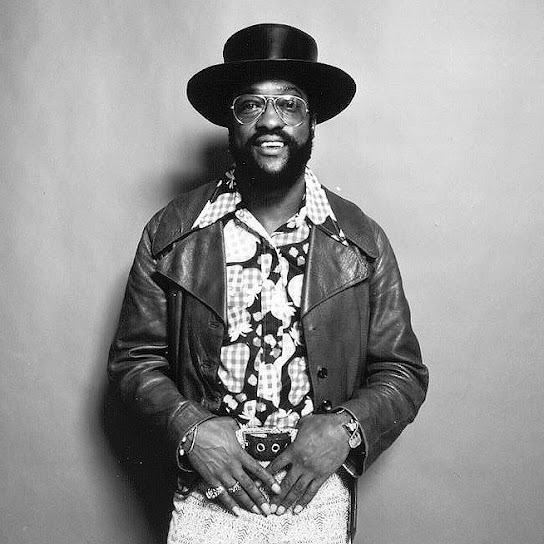
Billy Paul is best known for the smoothest of soul, his voice as silky as the bedsheets he could serenade you into. Me & Mrs Jones, I Want Cha’ Baby, Thanks For Saving My Life, Let’s Make A Baby… they all glide across the ears, airbrushed in Fender Rhodes, glossy orchestration and tasteful brass, Paul’s easy, conversational phrasing sung in a Barry White before-his-balls-had-dropped chocolate-coated vocal. Mainly written by Gamble & Huff, his music epitomises the pre-disco big band soul style that would morph into The Sound Of Philadelphia, a distinct style of music desperate to keep up and remain crucial while the world turned to synchopated beats and four-to-the-floor rhythms. In order to make its statement, the classic Philly sound – and by association, much of Billy Paul’s – relies on rhythmic hi-hats, lush orchestration and slick arrangements featuring a cast of players and entire choirs of backing vocalists. Save a few records, TSOP is not really my kinda stuff; it’s too slick, there’s no grit, it’s schmaltzy, even. I like my soul music down ‘n dirty and TSOP along with Billy Paul just doesn’t deliver. Or so I thought.
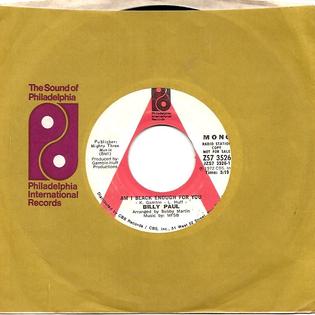
On his 360 Degrees of Billy Paul album, you’ll find the infectious and completely magic Am I Black Enough For You?
Billy Paul – Am I Black Enough For You?
This – this! – is more like the Philly sound I’m into! Announcing itself on a clavinet run that I believe (although I’m no expert on this) spells out S.T.E.V.I.E.W.O.N.D.E.R. in morse code, it gives way to cop show brass; low and sliding in the verses, stiletto-sharp and stabbing in the chorus and answering the vocals between the singing. There’s the ubiquitous wah-wah, free-flowing polyrhythmic congas, a casually funky, octave-leaping bassline that even Bootsy Collins might have trouble playing and it all runs away on an elongated outro that features – yes! – a false ending, the fading brass ‘n bass cheekily picking things back up again for another minute of headnodding groove just when you’re sure the party is over. It’s one of those records you’ll want to play again and again as soon as it’s finished.
Unusually for Billy Paul, the song’s message is political. Sitting alongside other black pride records such as James Brown’s Say It Loud (I’m Black And Proud), its message was one of defiance in the face of white oppression.
We’re gonna move on up One by one We ain’t gonna stop Until the work is done
We’re gonna move on up Three by three We gotta get rid of poverty
We’re gonna move on up Six by six I gotta use my mind Instead of my fists
Coming hot on the Cuban stacked heels of Me & Mrs Jones, his Billboard Hot 100 Number 1 smash, the record was a flop. It failed to make the top 75, even although it sold extremely well amongst its target audience. But it was alienating. Too confrontational, not something the average American Joe would be comfortable buying. It was clear commercial suicide after the success of …Mrs Jones, and yet, it’s so obviously a brilliant record. Fifty years on, attitudes to such records may have improved. You’d certainly like to think so. Get down on it.
When Steve Clarke was manager at Kilmarnock I’d often see him as we both made the daily commute from north to east Ayrshire. His pristine, glossy black Porsche Cayenne would ghost up behind me in the fast lane and I’d pull back into the slow lane, deferring to the superiority of both his mode of transport and his effortless man-management skills, skills that would see my team finish 3rd in the league while regularly beating both big Glasgow teams in the process. I was always desperate to catch his eye, give him a wee thumbs up by way of thanks from all Killie supporters who’d had little to cheer about since winning the League Cup in 2012. The closest I got to this was at the end of the bypass one morning, at the Moorfield roundabout on the outskirts of Kilmarnock. I’d pulled into the left hand lane and he’d pulled into the right, the turn-off you take for Rugby Park, the home of the Killie. Glancing right to check for traffic, I realised we were side by side. The thing was, he was also looking right for oncoming traffic and all I could see of him was the back of his tactically astute head. With no chance of catching his eye, my chance was gone. I never did get to show my appreciation, until
…a week or so ago. I’m driving back home from Kilmarnock this time. I’m in the process of overtaking an artic lorry near the crematorium when a large car appears out of the flood of late summer sunshine behind me, clearly on a mission to break whatever speed limit is in place, clearly with no time for any car in front of it. I look more closely in my mirror, ready to stare out the arrogance of the big car driver behind me, when I spot the wrinkled, perma-angry scowl of Steve Clarke. Even behind his mirrored sunglasses, I knew it was him. The deep and cavernous brow lines that curved above the sunglasses like a topographic map and the salt ‘n pepper beard set in a face of stone cast no doubt on the matter. As soon as there was a safe distance between myself and the lorry, I pulled back in, heart a-pounding. You don’t get in the road of the Scotland manager. Especially the best Scotland manager we’re maybe ever likely to have. As he pulled past me, I glanced to my right. His stoic face was looking straight ahead. Damn! He’s got a new car, but the personal licence plate confirmed the identity. An opportunity lost again. And this time I’d planned to offer up a double, McCartney thumbs aloft too, one for Killie and one for Scotland. It was not to be though, until…
…I reached the Morrisons roundabout a couple of miles up the road. Unbelievably, he was just in front of me! And, oh man! He was pulling into the straight ahead lane, just as I was filtering into the right hand lane. This time, he’d be looking in my direction! And, as we waited for the cars to clear, he did! He looked right at me. My mind a-scatter, I forgot all about the pre-planned double thumbs acknowledgment and instead I did what any self-respecting Killie//Scotland fan would’ve done. I gave him a proper left hand fist-pump, acknowledging his greatness with each exaggerated, shaken pump. Clarke looked away, looked back, stared at me. I was still fist pumping like a maniac when it dawned on me that the scowling Sir Steve thought I was shaking an angry, road-rage fist at him. Or maybe even, (oh no!) a wanker sign. As his squealing tyres moved onto a space in the roundabout that wasn’t really there, he sped off aggressively towards Saltcoats, no doubt wondering who the angry driver in the Vauxhall was.
Gutted.
I was double gutted a few days later when I stupidly reversed into my neighbour’s car. Parked awkwardly at the end of my drive, I was sure I could turn without much bother.
Bang.
It turns out I couldn’t.
An expensive lesson, as it’s proving to be, in having good spacial awareness.
It gets better.
A few days after that, with the bump in the hands of the insurance companies, I was sitting in the car in the hospital car park, early for a routine appointment and in the process of actually replying to the guy whose car I had reversed into. Suddenly there’s a thud and my car lurches forward. I look in the mirror. It’s not Steve Clarke this time. It’s an old lady reversing into me…and right into the exact spot that’s already a mess of ragged plastic and foreign paint.
I get out and signal to her. She rolls down her window.
“You’ve just reversed into me.”
“Naw ah didnae son.”
“Eh…you did.”
She gets out and looks. “I didnae dae that!”
“You didn’t do all of it, but you’ve made it worse than it was.”
“But I didnae dae onyhin’ “
“You did! You reversed into me!”
We look at her car. Not a mark on it. Not one.
“See. I didnae hit you.”
“You did though.”
“You’ll need to speak to my husband.”
Forget it, I said. Don’t worry about it. You couldn’t make it up. You really couldn’t.
Adam & The Ants– Cartrouble
Here’s Adam & The AntsCartrouble. I’m not so certain it’s anything much to do with bumps and breakdowns and more a metaphorical musing on the lack of bedroom activity, but it’s a great single. Not yet blessed with the Burundi beat, the Ants jerk away like a knock-kneed XTC, all crisp guitar lines and fluid hooks, in itself a metaphor for the crisp and fluid passing game that Steve Clarke has instilled in the Scotland national team this last wee while.
Anyway, check your mirrors. You never know who’s behind you…














 Plain Or Pan