
May 1971. Marvin Gaye releases What’s Going On?, a musical tour de force of luscious, orchestral funk, dusted with hard-hitting socio-political lyrics that address the state of America. It’ll play everywhere for evermore; Marvin Gaye’s magnum opus, the album that took him from soul singer to auteur.
Six months later, In November 1971, Sly and the Family Stone release an album which is titled in direct response to Marvin’s question.
What’s Going On? asks Marvin.
There’s A Riot Goin’ On, retorts Sly. That’s what.

There’s A Riot Goin’ On won’t play everywhere for evermore. It’ll go to the top of the Billboard Charts, selling a million-plus copies on the way there, and be certified platinum as a result, but its brooding, mid-paced funk will blind-side everyone after the event. It’s a dense and murky album, overdubbed and saturated to hell, hissing in places with a lo-fi weediness that could give a Boots’ own-brand C90 a run for its money.
Gone in the main are Stone’s staple signatures; there are no fuzz-bass freak-outs, no four-to-the-floor stompers, no call-and-response soul-savers, and, apart from the excellent and evergreen Runnin’ Away, little in the way of those light-hearted, nursery rhymish sing-songs with Sister Rose that had the ability to set the charts alight with all the brilliance and colour of the Rockefeller Christmas Tree.
A product very much of its time, There’s A Riot Goin’ On is a downbeat record which reflected the singer’s move from east coast to west and found him more interested in the peripheral recreational activities of yr average ’70s musician than the music itself; the coke. And the women.
And the coke.
And the women.
Sony, in a desperate act to have new product on sale stuck out a Greatest Hits album. It’s a beauty, but you’ll know that already. Sly had enough credit in the metaphorical bank with the label that they allowed him to indulge himself, but he was now cancelling concerts and had taken up with the Black Panthers, who not only were keen to manage him, they were keen to manage him in a particular way, employing heavies and underworld gangsters to keep certain people away from Sly – his bandmates included.
With the new album so far from Stone’s immediate thoughts, drummer Greg Errico upped sticks (uh-huh) and left. And when the band eventually did book studio time, Stone would record his own parts when the group wasn’t there, going into the studio after hours, erasing what had been laid down that day and re-doing it like a proto-Prince, in his own way and all by himself.
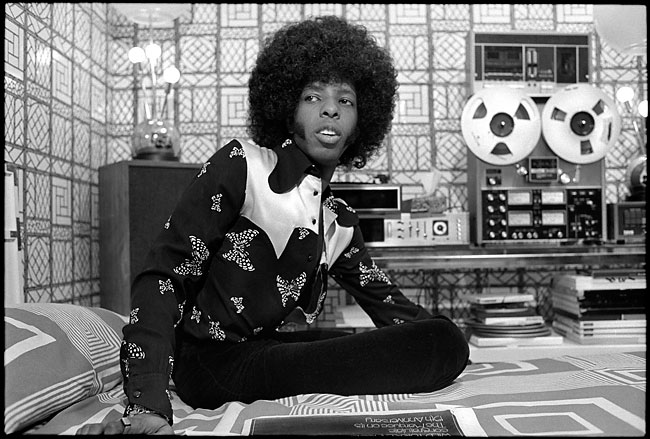
In lieu of Errico, Stone employed the new-to-the-market Maestro Rhythm King MRK-2 drum machine. Unhappy with the pre-set sounds, Stone set to overdubbing two and three tracks of pitter-pattering drum machine until he was happy with the now unrecogniseable-from-stock beats. Further overdubs came in the form of many, many female vocalists, all of whom were wooed by Sly with the promise of a slot on his new album in return for…well, y’know…
Deed done, the vocals would be wiped. And another hopeful would show up the next night, with the same scenario. Ol’ Sly repeated this multiple times. The result was the lo-fi, saturated murkiness that has since come to define the record. It’s an album that, although released as a Family Stone record, bore the sole fingerprints of the group’s leader.
And yet…and yet…
It has something about it, not least the big single, Family Affair and the already-mentioned Runnin’ Away, but also the opener, Luv ‘N Haight.
Sly and the Family Stone – Luv ‘n Haight

Wafting in on a wave of mid-paced wah-wah and bubbling bass, the track has Sly’s coke-rasp voice echoed above and below and between layers of horns and sky-high aahing and oohing female backing vocals, the singer scatting and vocalising about feeling so good while his sister takes the verses. Pianos clang, forever on the verge of being almost in tune, vampish Fender Rhodes ghost chords weave in and around the melody and those layers of horns begin to separate into fragments of the sort of incidental music you might find in Quincy. It’s an astonishing band performance, more so given that they were purportedly at odds with one another at the time.
For an album that puts the stack-heeled boot into the fake notion of the hippy dream, and a song titled punnily to reflect this, Luv ‘n Haight is, amazingly, pretty groovy. You’d never know there was a riot goin’ on by listening to this. The group sound as tight and together as ever. And that programmed drum pattern? It’s extraordinary, not entirely artificial to these ears either…and not a million miles from the sort of stuff Jaki Liebezeit would play a year later on Can’s Ege Bamyasi. An influence on Krautrock’s metronomic and polyryhthmic very own rhythm king? You’d have to think so.
Psssst! Wanna hear the album in all its intricate instrumental glory? Luv ‘n Haight sans vocals sounds terrific. Take a bow, the internet.
 Plain Or Pan