Get This!, Gone but not forgotten

Capital Gains

A couple of weeks ago we had a weekend in Edinburgh. We tend to go every year around Festival time, usually as a family, always just for a day and always when the madness of the Festival is in full flight. The last time we did this though was a bit of a disaster; the four of us had very different ideas of how our day might look and none of us saw our unvoiced visions come true. I fancied a walk round the Old Town, just to take in the vibe, y’know, maybe even a casual jaunt out to Stockbridge, purely for the purpose of discovering new record shops, dreaming of pausing for a well-deserved IPA on the way. Daughter had her mind set on eating vegan croissants in Instagramable, pastel-toned, artisan bakeries. The boy had trainers money burning a hole in the deep pockets of his slim-fit combats and wanted to go to those hot beds of Edinburgh tourism JD Sports and Sports Direct. Only Mrs Pan was happy to fall into the heavy flow of human traffic on the Grassmarket, avoid the massed silent disco and take her chances to see where it all took her/us. We all fell out, we vowed never to return as a bickering four-piece, and we stuck to our word.

At Christmas the kids presented us with a pair of tickets for the Military Tattoo – the reasons for which stretch back to another family disagreement – and so Mrs Pan and myself booked a hotel and had a fairly civilised yet cultured weekend away. To be honest, the Tattoo, with its brass and buttons and ten gun salutes wasn’t really my kinda thing, but we had great seats, the evening weather was balmy (even up at the normally baltic Castle) and the whole thing passed by in an impressive blur of noise, colour, and military barking. The chieftain/military guy who compered and linked the whole thing together was a walking, talking, cliched shortbread tin of rugged Scottishness. Planting his legs firmly like the Barony ‘A’ Frame and looking like the artwork on a box of porridge oats, he swept his hand theatrically across the darkening skies while bellowing out the tourist-friendly guide to auld Caledonia.

Scotland! Will ye luk et hurrrr! Take a moment tae savourrr the scene. Wae hurrr bonnie hills and purrrrple mountains, rrrrrivers and glens, she’s stood firrrrm and majestic for centurrries, thrrrrough warrrrtime, peacetime, the best and worrrrst o’ times. Can ye hearrrr? The pipes and drrrrrums o’ the Rrroyal Higland Fyoozzileerrrrz! It’s a rrrare, stirrring thing o’ beauty!

And, with military precision, a massed band of pipes and drums floods the arena to the gasps of the significant number of ex-pats in the crowd. It’s a slick event, 75 years young and sold out every night a year in advance, so who am I to turn my tartan-averse nose up at it? Mrs Pan loved it. Luvved it, aye.

It’s the peripheral stuff – the fringe stuff, or Fringe stuff, even, that I enjoy the most. Super-smart magicians pull £20 notes clean outta the Royal Mile’s fresh air. Street piano players in evening wear rattle through the classics with all the elan of an Usher Hall headliner. An atom-sized human cannonball does death-defying stunts just because he can. And a troupe of young Asian men in tights and flesh-coloured codpieces (and nothing else) do graceful and bendy yoga/silent ballet to a confused but appreciative gathering crowd.

Welcome to Edinburgh in August.

The streets are packed, the busiest I’ve ever seen the capital’s cobbles, a noisy mixture of plodding tourists, annoyed locals and a never-ending gauntlet of flyer-thrusting young hopefuls keen for you, for anyone, to take a punt on their show. There are a lot of shows to pick from; comedians and clowns compete with free tequila slammers and  Oxbridge am-drammers for your time and attention. One-woman reviews on the gender politics of Taylor Swift, one-man live art installations, “one-legged bicycles”, to quote Liam Gallagher a few days later. It’s all going on.

We threw our lot in with the comedians; the fast-rising Stuart Mitchell, the dry and droll Ian Stone, the superb Takashi Wakasugi and Australian Aidan Jones – whose whole show revolves around deconstructing the musical puzzle that is Chopin’s Nocturne in E flat major – being the pick of what was a high watermark of good quality comedy at sensible prices. 2.6 million ticket sales were recorded at the Festival and Fringe this year. Add to that the quarter of a million bucket-hatted mad-fer-its who rolled into town for the Oasis shows and you can begin to get a sense of the bonanza that the hotels and pubs and restaurants look forward to. Capital gains indeed.
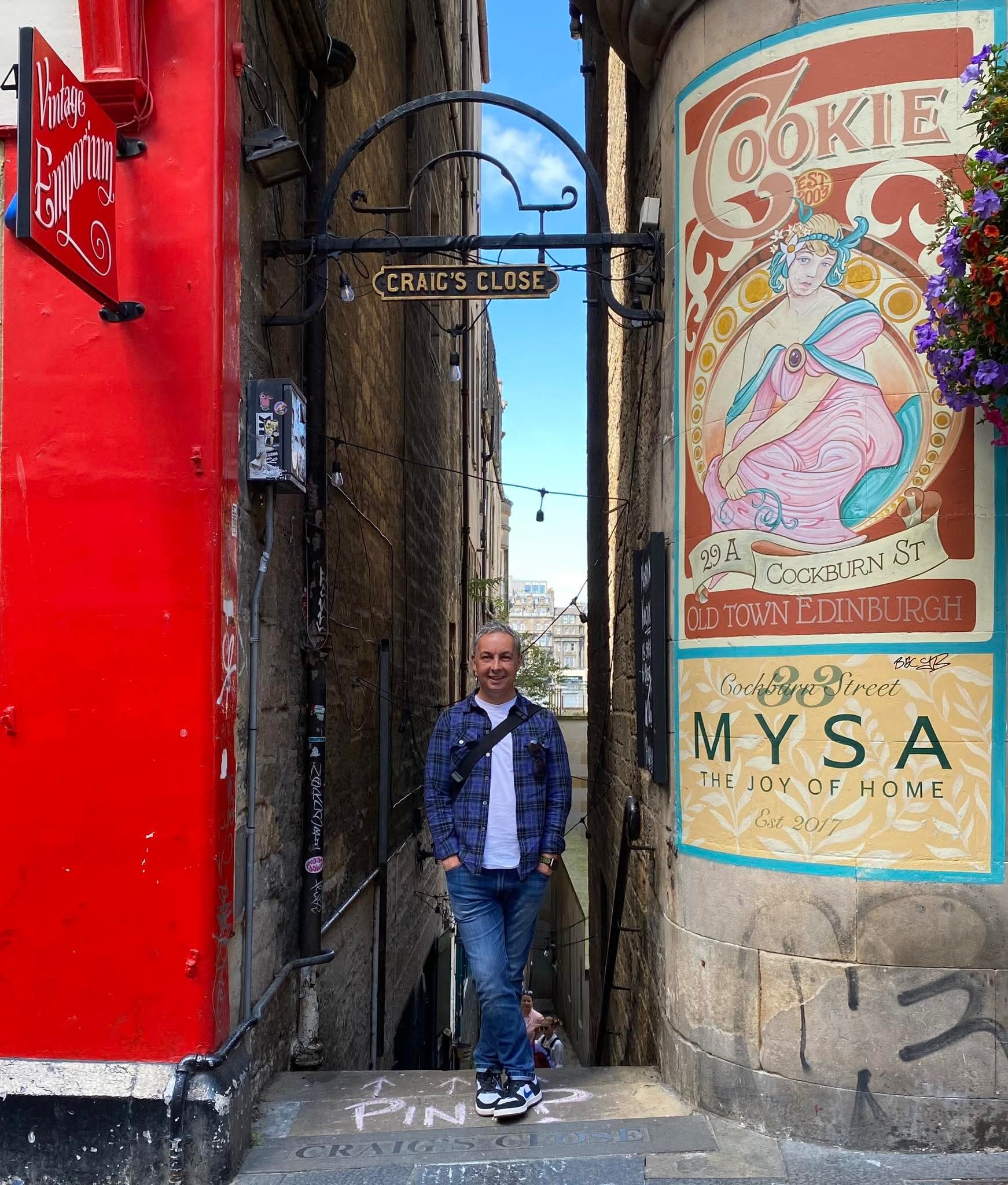
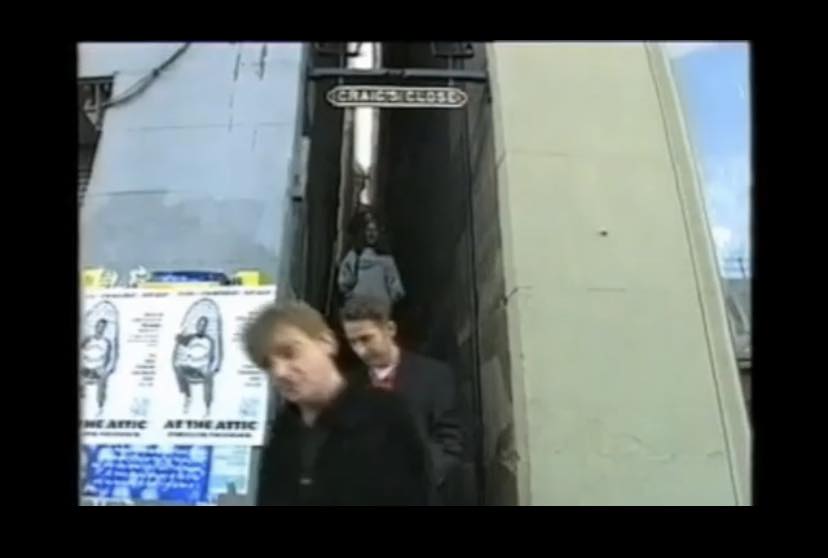
It’s now a tradition that when in Edinburgh I stand self-consciously in Cockburn Street below the entrance to Craig’s Close while Mrs Pan waits for a gap in the tidal wave of tourists to take a quick picture. I must have half a dozen and more snaps from this location, from black hair to grey, 30″ waist to 34″. My pal Scott aped the very same pose just this week – get yr own close, McLuckie! My dear old work colleague Sharon even went so far as to sketch me from one of the pictures in recent years. I’m building up quite the portfolio.

Another pal (and Fall fanatic), Iain, pointed out a year or two ago that Mark E Smith and the rest of The Fall had poured out of the opposite end of Craig’s Close in one of The Fall’s videos. A quick bit of research shows that this occurs in – of course – the promo film for Edinburgh Man.

The Fall Edinburgh Man

Edinburgh Man might be the closest Mark E Smith got his group to soul music. They were no strangers to soul covers over the year, but Edinburgh Man has none of the caustic and off-kilter backing or ranty vocalising that characterises most of The Fall’s discography. Sure, the guitars are kinda jittery and twangy and could break into a hundred mile an hour sprint with little encouragement required, but mainly they remain understated. There’s a high cooing backing vocal that wafts in and out like the haar from the Forth. There’s an understated keyboard line. And atop it all? Well, you might be inclined to say that Mark croons his way through it. It’s certainly heart-felt.

As I sit and stare at all of England’s souls

I tell you something – 

I wish I was in Edinburgh


I don’t mind being by myself 

Don’t wanna be anywhere else

Just wanna be in Edinburgh


They say you project yourself

But I’m an Edinburgh man myself

Smith moved to Edinburgh in the late 80s. He’d split with Brix, was finding Manchester too druggy and wanted a fresh place to start again. If we’re splitting hairs here, MES actually moved to Leith which, as anyone knows is to Edinburgh as Salford is to Manchester – certainly something that Mark Edward should’ve known. Still, the year or so he spent in ‘the real Edinburgh‘ as he called it, gave the world Edinburgh Man. Thanks for that, Mark.
Get This!, Gone but not forgotten

Waiting For The Tape To Turn

1978. At the time when Saturday Night Fever and Grease stubbornly refuse to budge from the top two positions on the album chart, just as the whole of Scotland is hypnotised by Archie Gemmell turning Dutch defences inside out down there in South America, right about the point when the ahead of the curve Swedes were banning aerosol sprays on account of their ozone-damaging properties (good luck being a Stockholm-based glue-sniffing, hair-dying punk rocker), Joy Division were releasing their An Ideal For Living EP.

If 1976 is punk’s Year Zero – and common consensus decrees it is – then the two-full-years into the future that is 1978 signifies the musical movement’s transition into post-punk. The unforgiving world of now! sound moves fast, and unless you’re one of those opportunistic phlegmy-trailed third rate, third wave cartoon punk bands who came along in the scabby wake of punk’s outgrown dead ends, the scene’s key movers and shakers were now very much in their imperial post-punk phase.

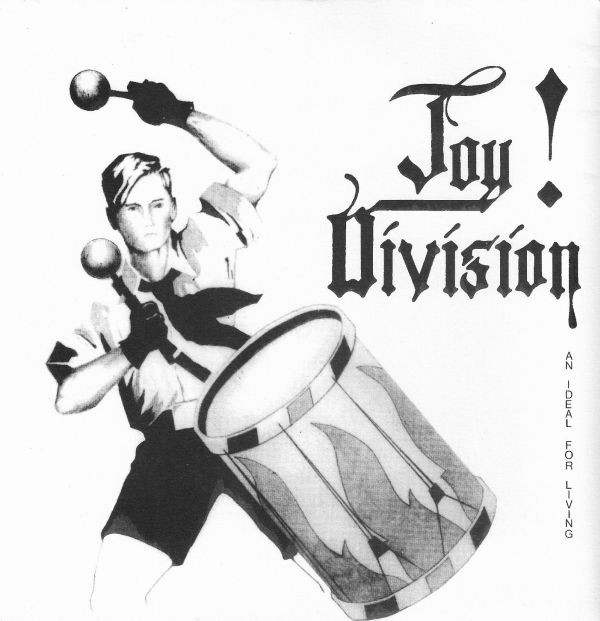
An Ideal For Living and its writers may have been a product of the punk scene, but see past the Hitler Youth drum-beating boy on the cover and the band’s name with it’s links to the very worst of contemporaneous modern history and you’ll conclude that, in attitude and outlook, Joy Division and their debut record was nothing less than post-punk.

It’s the breathing space that’s given to the instruments that does it.

Joy DivisionNo Love Lost

It’s low-budget, high concept, ambitious cinematic rock and then some. Just three instruments and a vocal line; linear, separated and identifiable, crystal clear and with all the fat trimmed off at the source. Peter Hook’s clang of bass and four string metronomic pulse, Kraftwerk by way of Salford, Bernard’s conservative use of slashing and scraping feral guitar, fed through an ear-bending phaser pedal for additional disorientation, the sheer dynamics of the drop ins and drop outs as the bass and drums dictate proceedings… this is all high drama travelogue played out by serious young men.

Where the worst of punk sounds like it’s recorded on sandpaper inside a cardboard box, the best of post-punk sounds futuristic and other-worldly.

It’s the drums on No Love Lost that separates it from the other guitar-driven records of the era.

Stephen Morris really wants his drums to sound like the expansive steam-powered hissing and spitting that gives Bowie’s Be My Wife such a coating of propulsive Victorian workhouse modernism, and although the group has yet to orbit Martin Hannett’s wild and idiosyncratic solar system, the production on No Love Lost hints at the very out there-ness they’d soon discover with Factory’s maverick desk controller. Morris’s drums are electronically treated; the snares refract and ricochet at the edges, the toms beat a heady and reverbed tribal thunk, the hi-hat sticks two fingers up to Sweden and sprays a tsk-tsk-tsk ton of ozone-damaging aerosol into the Tropsphere, the ride cymbal splashes a silvery sheen across the top of it all… it’s not a million miles away from Low-era Bowie at all.

The vocals don’t appear until the three minute mark, a long intro – almost prog – by any fat-free group’s standards in 1978, and when they do arrive they’re both shouty and wordy. Ian Curtis flits between a mouthy punk rocker where the tune is less important than the attitude and the sort of arty and enigmatic spoken word delivery that you might find on a Velvet Underground record. As with the drums, the edges of his vocals are treated in echo and delay and all manner of mystery-enhancing effect-ect-ects. Did they ever better this? Of course they did…but as first releases go, No Love Lost is a real stall-setter.

Yeah. When Travolta was omni-present, when Gemmell was achieving God-like status, when Sweden was leading the way in planet-saving eco-friendliness, Joy Division was sowing the very serious seeds of post-punk. Essential stuff, I’m sure you’ll agree.

Gone but not forgotten, Sampled

Phrasing

Hey! You! Put aside the dog-eared copy of Absolute Beginners that you’re currently re-reading for the 5th (6th?) time. Lift the needle from the freely-spinning Cafe Bleu on the old Dansette. Brew yourself a fresh cappuccino, or even an espresso forte, and sit back and read this.

Jazz is America’s first music, a liberation from daily struggle, the artist given the freedom to play and sing however they choose. Those jazz cats used the music as a platform for cultural expression, whether that be Billie Holiday’s heart-stopping vocal on Strange Fruit or John Coltrane’s faith meditation on A Love Supreme, Miles Davis’s exotic inroads on the voodoo funk of Miles In The Sky or Louis Armstrong’s rasping love song to the Wonderful World he found himself living in. Oppression, worship, love, death…jazz is life itself. Folk that say they don’t like jazz just haven’t yet found the strand of the genre that will resonate with them.

Jazz, though? Soul – that’s obvious. Blues? That’s obvious too. But jazz? Why jazz?

Way back a hundred or so years ago, ‘jazz’ was a slang word used to describe liveliness and spirited behaviour; ‘She’s so jazz!’, ‘This dance is wildly jazz!’, ‘That baseball team is totally jazz!’ etc. So, in the time it took Louis Armstrong to parp out a trumpet triad, ‘this music is totally jazz!’ went from adjective to noun. Interestingly (or otherwise) the word ‘jazz’ itself originated from the word ‘jism’, in that if you were lively and spirited between the sheets with the person of your fancy, well…you know what tends to happen. So, the next time you hear the word ‘jazz’, ponder on that for a bit.

“Hey boy, bring me ma drink,” Hey boy, play me anutha toon,” “Hey boy, don’cha quit playin’ until you been told to quit playin’.” In the jazz clubs during the good old days of white supremacy and inherent, unfiltered racism (which could be either last century or last week), American black men took to calling one another ‘man’ – a required and regular reminder of respect between the oppressed that their fellow brother should be just as valid and just as valued as any other man in the place.

“Hey, man. You doin’ okay?”

Nowadays, folk like myself use the word without thinking of its true origins. It’s worth reflecting the next time you drop the word into conversation.

Those black me and women could trace their collective blood line back to slavery. Of the many thousands of Africans who were shipped to the Americas, the ethnicity of a large percentage of the people was rooted in the Wolof tribe. As with all indigenous people, the Wolofs kept their history alive through song, passing down stories and traditions from the elders through music and oral storytelling. Hence the phrase ‘folk music’.

The Wolof word for ‘music’ is ‘katt’, and it’s thought this is the origin of the phrase ‘jazz cat’.

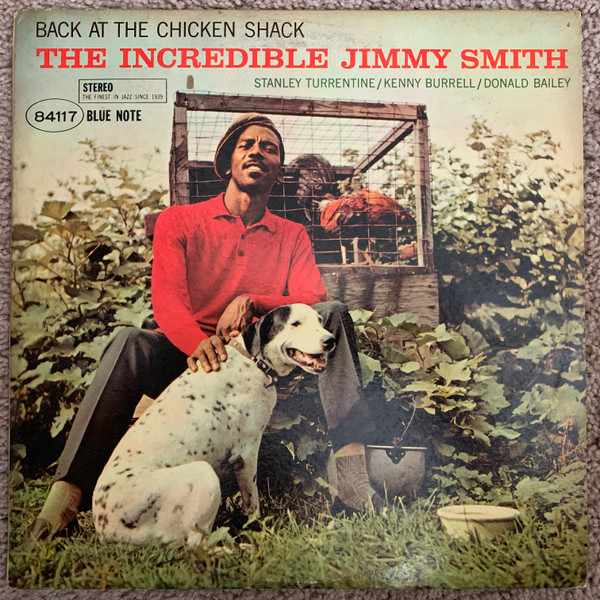
Me, I’m a fair weather jazz fan. My list of favourite jazz albums would look as obvious and lightweight as one you might find published in the arts section of the Guardian or in the near-the-back pages of Mojo. Miles…Coltrane…Nina… bore off, pretentious jazz wanker. With the sun blazing a hole in the sky and the last week of the summer holiday slowly fizzling to a close, it’s Jimmy Smith‘s Back At The Chicken Shack that’s been doing it for me these past few days.

Here’s something to ponder – why is it that the soul and blues players kept their Sunday name – James Brown, James Carr, but the jazz cats adopted the more street variation – Jimmy McGriff, Jimmy Smith?

Anyway. Jimmy Smith. He’s the link between jazz and soul, his shimmering and colossal Hammond organ sound driving his group with a grit and right-on funkiness that’s impossible to dislike. Like all the best jazzers, his group was fluid and ever changing, evolving its sound as each musician passed through on their way to wherever it was they were going.

Jimmy SmithBack At The Chicken Shack

On Back At The Chicken Shack‘s title track, Smith trades call and response organ phrases with the omnipresent Kenny Burrell on guitar and the ubiquitous Stanley Turrentine on tenor sax, his regular drummer Donald ‘Duck’ Bailey keeping the beat just on the right side of slow but progressive.

Burrell is all over the Blue Note catalogue, both as band leader and sideman, and his Gibson 400 CES ripples patterns of woody eloquence at every opportunity. On Back At The Chicken Shack he’s content to play understated augmented chords beneath Jimmy Smith’s expressive playing in the first and last sections, but in the middle, after his bandleader has given him the nod, he’s off and flying, fingers cleanly picking tight and taut melodies across the strings and frets with a speedy ease that’s both mesmerising (as a listener) and frustrating (as a hamfisted guitar player). His phrasing, the spaces he leaves between the notes, is perfect. Off-the-cuff-playing like this doesn’t come easy, as easy as it sounds.

Turrentine is no stranger to the Blue Note discography either and his forceful yet soothing sax playing swoops and soars in all the right places. The band falls in step behind him as he freeforms and riffs across the top of the steady groove being cooked up. If yr head ain’t nodding and yr foot ain’t tapping by this point, maybe you need to give your ears a wee clean out. Imagine hearing this live in a sweaty Village basement club, or even being spun by a hip DJ in the Flamingo in 1963, all the ace faces dancing in studied concentration. It’s enough to pop the buttons on yr tonic suit.

Back At The Chicken Shack – seek it out, man.

Gone but not forgotten, Live!

There Is No Culture Is My Brag*

There’s no gig goer on the planet whose live music experience isn’t enhanced by the headline act using a piece of classical music to herald their entrance to the stage.

Back at a Cult show in 1987, the Barrowlands lights went down and instantly Wagner’s Ride Of The Valkyries played at deafening volume. Strobes flashed, silhouettes of road crew and band members were frozen in position momentarily on-stage and the crowd, already at fever pitch, swirled and heaved as one giant organism to the booming classical music while the flickering group members strapped on their instruments and took their spots. The unmistakable outline of Astbury-as-Morrison leaned into the mic. The backline lights swept upwards to bathe the room in technicolour. Valkyries ended and the drummer (one of a series of revolving Cult sticksmen of the era) twirled his sticks as Billy Duffy, shrouded in dry ice and adopting a leather-trousered legs apart rock pose, picked the opening riff to Nirvana. It’s even louder than the intro music, it’s theatre and it works. Apocalpyse now!

From their September 1984 tour of the UK onwards, The Smiths famously took to the stage to the high drama of Prokofiev’s March of the Capulets, the signature piece from the Ukrainian composer’s score that would accompany the ballet of Shakespeare’s Romeo and Juliet.

The SmithsIntro Music, Irvine Magnum Centre 22.9.85

You’ll be more than familiar with old Sergei’s tune these days, Smiths fan or otherwise, due maybe to its inclusion in the Roman orgy-fuelled Caligula (another tenuous Smiths reference there), but certainly to its ubiquity on The Apprentice, where it soundtracks Alan Sugar’s every arrival in the boardroom. The piece of music’s sense of foreboding and knives-out tension is perfect for a pre-sacking amuse-bouche. It’s over-played these days to the point of pantomime, but back in 1984, to hear this booming out of The Smiths PA must have been genuinely thrilling. The increasing tension of Prokofiev’s score giving way to the euphoria that accompanied Morrissey’s rasping “hallo!” – it’s this that upsets me most about missing The Smiths in concert. Not the songs they’d play. Not the sense of communion. It’s that sense of anticipation of what is to come, and it’s Prokofiev’s music that does this.

A good musicologist would point to the semitones involved in the music’s refraining opening bars (dum-dah, dum-dah – see also ‘Jaws’) and the heady combination of dynamics and dissonance, of hellraising brass and high sweeping strings that simultaneously jangle the nerves and set the heart a-flutter, but to these ears it’s just a perfect piece of dramatic music, the ideal fanfare for a band steeped in spectacle and highbrow culture.

There’s a lighter section, all butterfly flutters on delicate strings and a suggestion, perhaps, of respite or even just a glimmer of hope on the horizon, before the brass blows its wicked way in again and the whole thing tramples all over you. In Romeo and Juliet, there’s no doubt that those Capulets are truly marching and totally unstoppable, and you fairly get the sense of this in Prokofiev’s attention-grabbing score.

In an interview I did with him a few years back, Mike Joyce told me that, even now when he hears it, the hairs on his arms stand to attention.

“…and I still know the exact part of the music when we’d turn to one another, nod and begin our walk onto the stage. The roar of the crowd as their anticipation is realised, becoming deafening as I take my seat and then Morrissey’s opening line before it all kicked off. Doing that every night never got boring, let me tell you.”

Smiths trainspotters can no doubt point to the exact version of March Of The Capulets used by The Smiths. That’d be the Philadelphia Orchestra recording from 1982, as conducted by Riccardo Muti, of course. Rake long and patiently and you’ll maybe find it at the back of a box of classical records in your local British Heart Foundation shop. That’s where I found mine.

Suite No. 2 from Romeo and Juliet, Op. 64ter: I. The Montagues and Capulets

Philadelphia Orchestra cond. by Riccardo Muti

Smiths trainspotters can also undoubtedly point to the group’s show in Gloucester on the 24th September 1984 as the first time their group would enter the stage in such giddy fashion. In keeping with his persona of the time, Morrissey welcomed everyone with a  ‘hello, you little scallywags‘ before Johnny led the others into Hand In Glove.

Now, that’s how you start a show!

*That headline? The Classical, innit. If y’know, y’know. And I know you do.

Cover Versions

A Date With Elvis

One of the side effects, if you like, of the current Oasis revival has been the reshining of the spotlight on the music of 30 or so years ago. Even at the time, it was clear that there were only two or three decent bands on the go. The rest of the (gads) scene was made up of skinny-jeaned, Adidas-clad chancers who’d alighted at Camden Town and grabbed hold of the corduroy coattails of the movement and ran with it. Bands with one word, two syllable names littered the gig listings, the narrower columns of the music press and, with a depressing regularity, the shelves of your local Our Price.

Sleeper. Bluetones. Dodgy. Menswear. Embrace. Oh man! That guy couldnae sing! A couple of bowlcut brothers dressed in everyman denim while continually rewriting Let It Be? Call y’rself Embra-sis and be done with it, boys. It’s all the fault of the record companies. See what people like and replicate, dilute, repeat to ever-diminishing returns, until the whole thing swallows itself up.

Those groups above are maybe even considered the ‘best’ of the lot too. Lest we forget S*M*A*S*H. These Animal Men. The Subways. My Life Story. Rialto. Gay Dad. Heavy Stereo. Marion. Longpigs. Northern Uproar. It’s an endless list, and I haven’t had to Google any of it. Those groups have all had more front covers than I’ll ever have, so really, who am I to comment? Dare I suggest each of them has a decent tune (or two?) hiding amongst whatever passed for a song in the setlists and demos that saw them signed in the first place? Full confession: I have a soft spot for Dodgy. Great players, great songwriters, great way with a harmony and a melody. See Lovebirds for full effect.

In John Niven’s Kill Your Friends, he writes an entire page or more filled only and entirely with the names of Gallagher slipstream-riding bands, most of whom never got beyond third on the bill at the Camden Falcon and demo stage, yet; ‘bands that, for a brief, tiny window, were surely going to be bigger than The Beatles. Now, when I handle these neglected, dusty objects, I sometimes feel that I am handling nothing less than the atrophied, fossilised remains of someone’s dreams’.

Ouch.

So, yeah, Oasis have gate-crashed the contemporary and millions of folk are either reliving their teens or, like my own teenage son, blagging their way into the stage-front standing area, Pep to the left, Kamara to the right, and fulfilling their dreams by seeing them live for the first time. Good luck to ’em all. I can’t wait for the next generation of Noel-inspired songwriters to start seeping their way onto Spotify.

Sleeper but.

There was a music press-coined term used to describe the anonymous males who played behind their more photogenic – and female – lead singers. Sleeperbloke. Skinny-jeaned, Adidas clad, some Fred Perry on display, maybe a Fila track suit too. The drummer was usually pretty watchable, in a Clem Burke sort of way. One of them would have a really great haircut, the sort that you’d look at in the street and think, ‘he’s in a band’.  One of them presented an image so beige they should’ve been dumped by the rest of the group at the first opportunity (but his dad owned the van though, so, y’know…). He was quite possibly the lead singer’s boyfriend and there he was on TFI Friday, barre chording grimly while the cameras shot his short-skirted girlfriend from the ankles up, watching on helplessly as she entered a whole new orbit of hipper boyfriends and short-lived fame.

SleeperWhat Do I Do Now?

Sleeper came and went and passed me by. Nnnahh. Blondie-lite and inoffensive, I had no need for them. But a good song is a good song is a good song, and What Do I Do Now? might well be their greatest (only great) moment. Sure, it has terribly breathy vocals – you can see Louise Wener and her big, brown, doe eyes giving you the come-on as you listen – and it’s got a burbling guitar break that sounds as if it’s playing at the bottom of the North Sea, but it’s a proper story song, of a relationship breaking down and how the two protagonists deal with it.

None other than Elvis Costello thought highly enough of it that he recorded his own, pared-down version. He turns it from a fizzing and clattering indie-rock track into a waltz-time acoustic ballad, his voice close-miked and enunciating perfectly the vocals that the song’s original singer wasn’t quite able to do. His vocals, reedy and high, gulping and low, perfectly toned and pitched, are brilliant on this.

Elvis CostelloWhat Do I Do Now?

Tore up all your photos, didn’t feel too clever

Spent the whole of Sunday, sticking you together

Now I’d like to call, but I feel too awkward

Some things need explaining, no-one told me it was raining.

Good lyric, that.


Coming never: Elvis Costello Sings The Greatest Hits of Britpop.