Get This!

Puddle Hopper

It began as an angry release from teenage woes, a swift early January 5k in the howling rain the antidote to the blues that beget all young folk at some point in their lives. The next night, another 5k, quicker and slicker and, dare we say it more enjoyable. Then 10k… then 10k in under an hour… under 50 minutes… pushing 40 minutes. Minutes and seconds shaved from personal bests as regularly as left foot follows right on the nightly pound around the streets. Proper running.

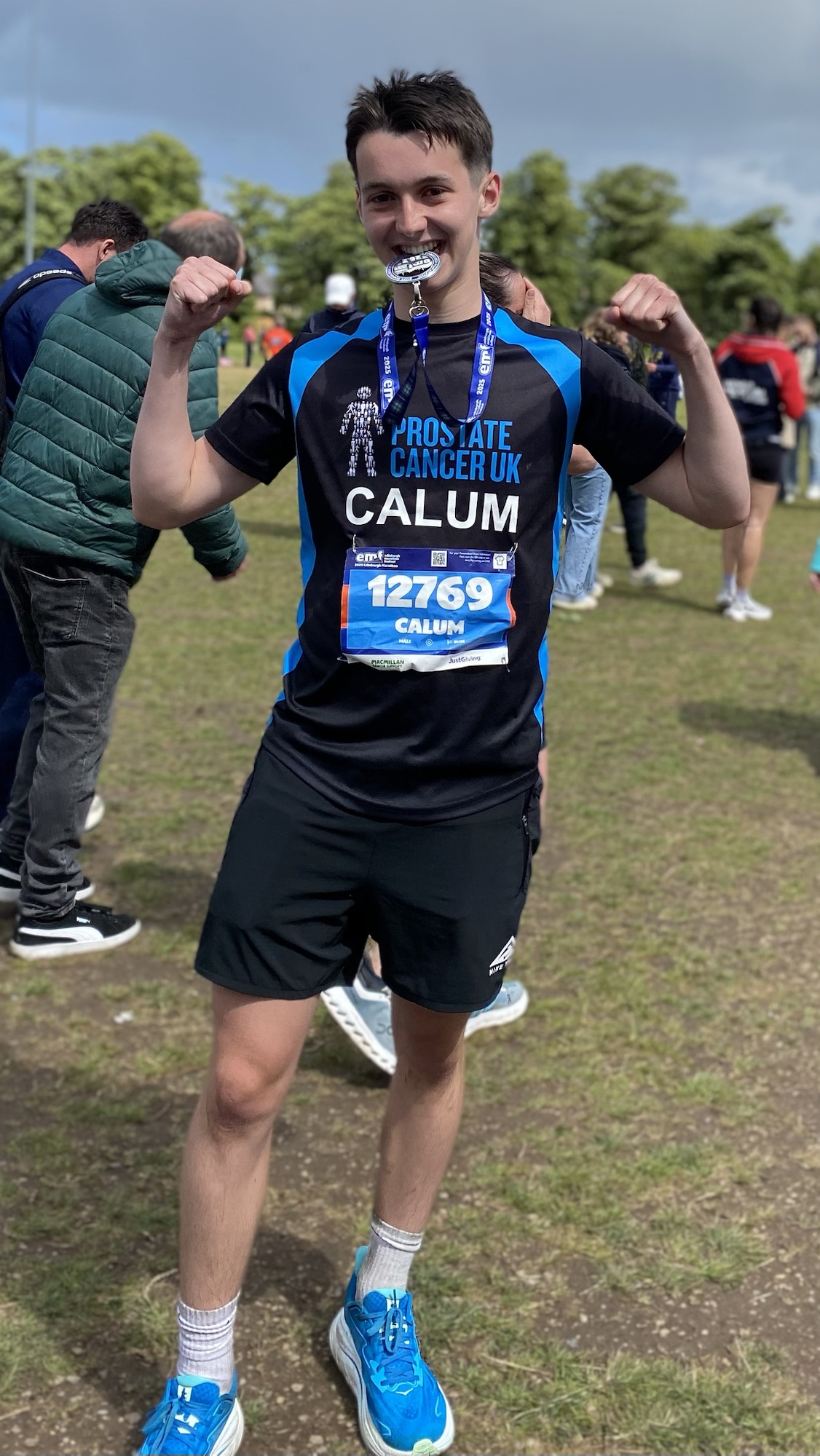
“I’ve applied for the Edinburgh Marathon,” announced the boy, one night in February.

“This year’s marathon?” we asked, not really believing him.

“Yeah. It’s in May.”

“What, this May?” we ask. “As in three months from now?”

“Yeah. Nae danger,” he shrugged.

He’s already set up a Just Giving page. He’ll run for Prostate Cancer UK, in recognition of the illness that took my dad’s – his papa’s – life.

He has sponsors, he has a training plan, he has it all sorted out without any help from us.

Young folk and their gung ho-ness is really something to be amazed at.
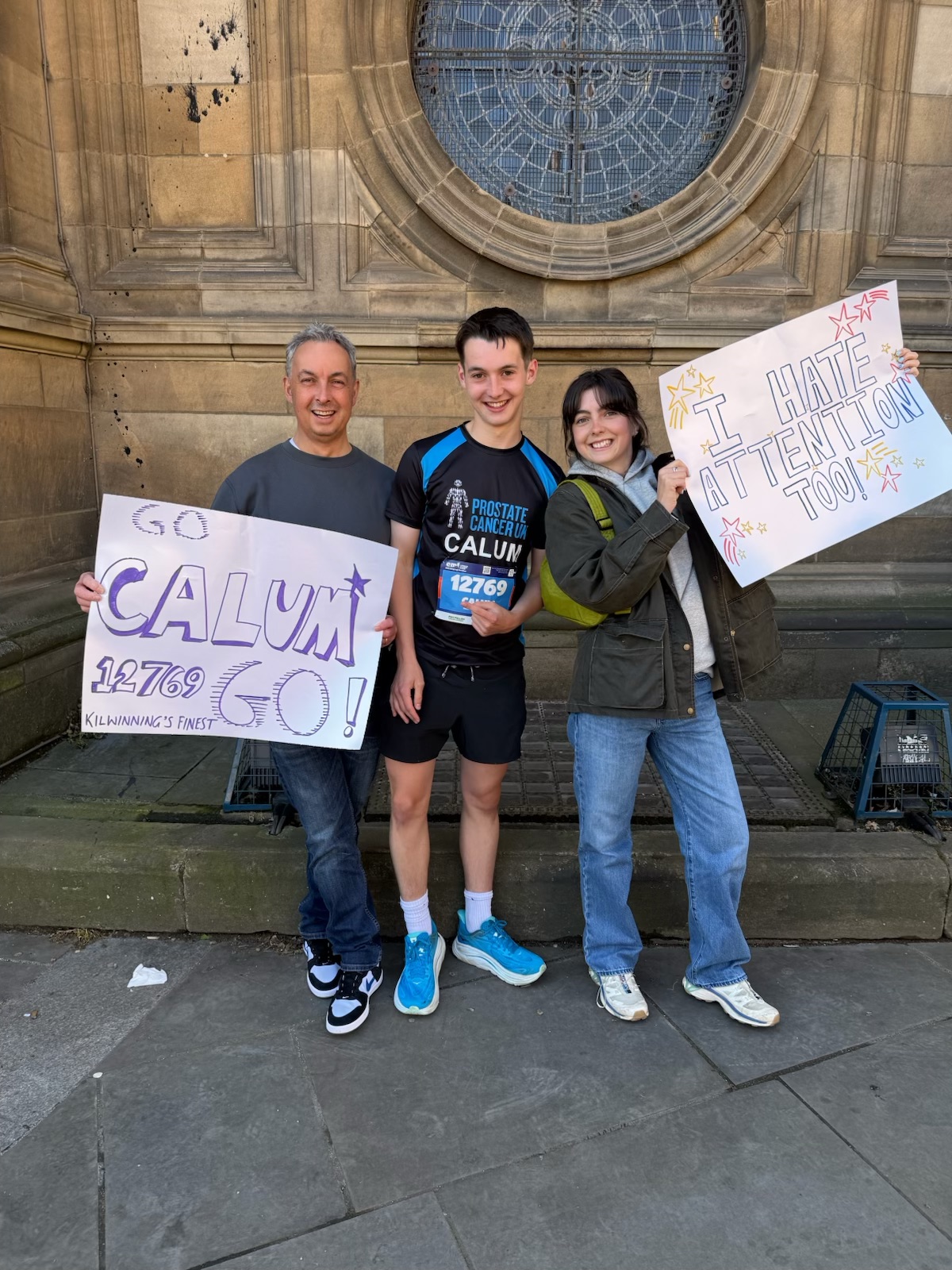
And so, we (mum, dad, big sister) found ourselves in Edinburgh on Sunday, watching all manner of ordinary people do an extraordinary thing. Old folk, young folk, middle aged crisis-averters, the lanky, the limbless and the laudable all coalesced in one giant, humming and thrumming, stretched out line, pounding the cobbles of Edinburgh’s Old Town and out….waaay out…beyond the coastal holiday resort of Seaton Sands to Prestonpans then back again to cross the finish line at Musselburgh Race Course.

We see Calum off at the starting pen then hot foot it to Waverley Bridge to catch him at the one mile mark. It’s a slow mile, he tells us later, given the sheer number of runners boxing one another in, but by miles 3, 4 and 5, the lines begin to stretch.
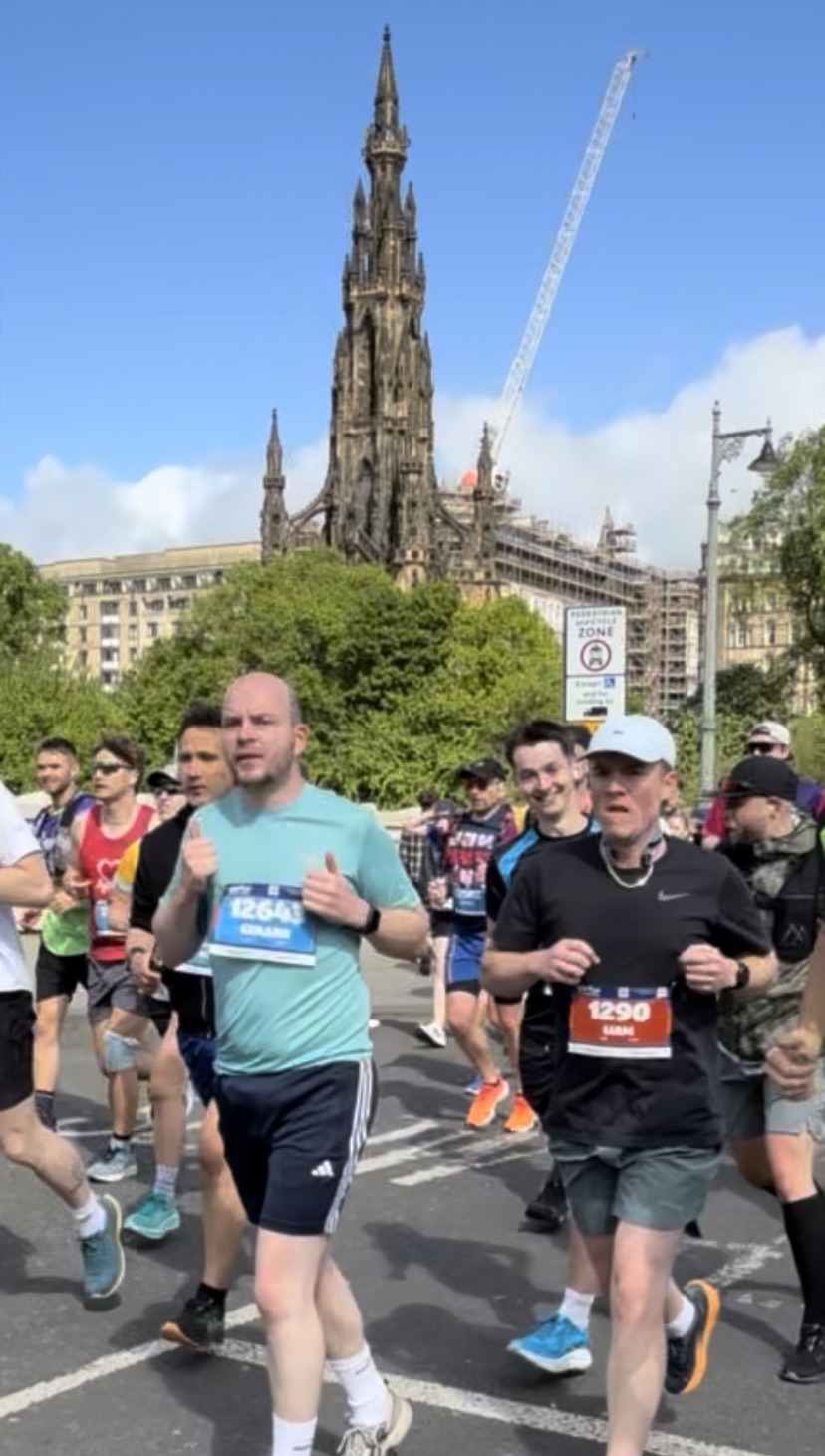
Our plan…and that of thousands of others, as it becomes apparent, is to get the North Berwick train and get off at Wallyford to cheer the boy on at mile 13. But the trains are ridiculously oversubscribed and ScotRail really isn’t much help. We can’t get on our intended train and are herded onto another one which won’t be leaving for an hour. We sit, packed in at our table and track the boy on our phones, watching his digital icon crawl across our screens as it makes its steady pace towards the half way mark. Of course, by the time we’re there, we’ve missed him. Our train has slow-snaked its way out of Waverley Station and despite our best efforts to get to the crucial mark on time, he’s two miles further up the field.

That’s good, I suppose.

He’s making excellent progress, despite the weather, which has in typical Scottish fashion been warm and sunny but windy to the point of gale force, then calm and still and punctuated by a stinging 10 minute attack of hailstones, to pure golden sunshine and torrential rain then back again. He’d confidently predicted he’d finish somewhere between 4 and 4 and a half hours and it looks as though he’s on course for that sort of time.

As mile 13 also doubles as mile 25, we leave and aim to get as close to the finish line as possible. By mile 26 the crowd is three-deep at the barrier. We find a spot 150 yards or so from the end, where the route turns into its final stretch and watch the blur of runners going past.

Some are as fresh as the moment they leapt out of bed that morning. Tattooed hipsters with unravelling man buns and glistening, rain speckled beards throw their arms aloft to elicit mass hysteria from the crowd and testosterone-pumping bursts of hidden speed from their sleek, muscular legs. Runners in wraparound glasses and backwards baseball caps coast past like the supreme beings they are. Runners with jaws set in stone and jutting at 90 degree angles push their very limits to new, far-put places. Teeth are gritted, facial muscles are stretched to sinew-snapping levels. Pain – pure pain – is etched on many faces. D’you know these Peter Howson paintings of hard-working industrial guys from the small towns of Scotland? Just like that. Everyone in the crowd, many of us who will never experience what running a marathon is actually like, shouts out the names of these strangers that are on the final stretch.

“Go on Samantha!”

“You can do it, Luca!”

“Keep it going, Abigail!”

Two younger men walk/slow-jog past with an elderly man propped up between their shoulders. The man in the middle is out of it. His legs don’t work and he’s unaware of where he is, but his two helpers are making sure he’ll cross that line.

A guy in his twenties rounds the bend, zig-zagging like a drunk man at closing time on Christmas Eve, left to right to left to further left and back again. His arms flap loosely by his side, he staggers to fall, lurches and rights himself at the last second. The crowd will him on.

“Come on Kenny, son! One last push, big man!”

It’s cliche central, but what else d’you say in times like this? I really hope Kenny made it.

There are at least 3 hot dogs running. A dragon, a chicken, a handful of fairies not far behind them. And then…

…the boy!

He’s almost past us…in fact, he is past us by the time I shout his name.

“Calum! Calum!! CALUM!!! GO ON SON!!!!”

Erin shouts his name. Anne shrieks. Calum looks back, smiling widely and delighted to see us.

And I burst into tears.

Proud barely begins to cover it.

The boy clocks a very impressive 3 hours 57 minutes, a sub-four, in marathon speak. It’s an extremely impressive time for a first marathon, for an 18-year old who only started running out of frustration a few months ago at the bum hand life was dealing him at the time.

Calum had a playlist made up, the idea being that he’d cross the line to Vangelis’s Chariots Of Fire (!), but because he was faster than anticipated, he ended up finishing to Sigur Ros’s atmospheric, anthemic and yet quietly restrained Hoppipolla. As you know already, ‘Hoppipolla’ in Sigur Ros speak means ‘puddle hopper’, a very apt track given the soaking roads and puddle-heavy route in places. A fitting tune to cross any line to, let alone that 26.2 mile line. I bet this sounded epic!

Sigur RosHoppipolla

Get This!, Peel Sessions

Senses Working Overtime

Ever since the Electric Prunes mixed their mojo and told us they’d had Too Much To Dream Last Night, licence was given to your more outré groups – the ones who perhaps make a riot of layered noise with a pop sensibility at the core – to mess with your mind and get all psychedelic on yr eyes ‘n ears.

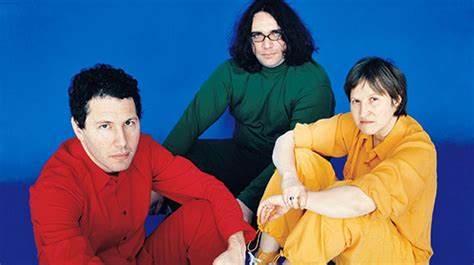
Yo La Tengo come, like Frank Sinatra before them, from Hoboken in New Jersey, but they’ve as much in common with Ol’ Blue Eyes as I do. Sinatra croons. Sinatra swings. Yo La Tengo swoons. And occasionally, Yo La Tengo stings. The groups’ group, they have a tidy way with minimalist backing and a bah-buh-bap backing vocal. They can weave silk worm-like tendrils of unwinding melody, gossamer-thin and stretched out for miles, and they know how to hook you in with a Bacharach-like parping horn and finger-clicking beat, but it’s when they’ve ingested the good stuff –  when they’ve had too much to dream last night – that Yo La Tengo becomes a different beast entirely.

Yo La TengoI Heard You Looking (Peel Session)

I first came to I Heard You Looking via Teenage Fanclub in the mid ’90s. Theirs is a faithful interpretation that had me scampering backwards to see what I’d missed out on, and as much as I really like YLT tracks such as My Little Corner Of The World (the Bacharach one) or the locked-in groove of Autumn Sweater (like Spacemen 3 writing for St Etienne), I always return to their original version of I Heard You Looking.

Maybe it’s because they’ve spent their time looking across the Hudson at Manhattan’s skyline that the tune – and it is a tune, in all senses – is massive. It builds from the very foundations like a skyscraper itself being constructed. A hesitant electric guitar creeps in with an upward-moving riff, all sliding chords, open strings and nerve-jangling expectation. Splashes of ride cymbal wash across crackling, electrified, open-miked airwaves. The drummer scratches his Noo Joisey ass and yawns his lazy way in. The bass player falls in line with both his drummer and the riff-playing guitarist and the group lock in to begin their slow jam.

Subtle shifts in the ambience – there’s two guitars interplaying by now, one sticking to the motherlode riff, the other wandering gaily up the frets, free-soloing and feedbacking and pulling the group ever-northwards – lift the volume and the intensity to the max. One guitarist has enough of the straightjacket approach and breaks loose in vivid technicolour, John Coltrane with an offset Fender and seemingly free reign to do whatever. The group surges and pulses in waves of electric guitar, pushing and pulling, ebbing and flowing, tearing the ears and the heart and the head in an unspooling of structure and frame. Then, an unseen nod of the head between the assembled musicians and the shards of white-hot noise and scattergun Moonisms are brought crashing back to earth by the anchor that is the riff.

And the group goes again.

And again.

For almost ten headswimmingly magic minutes.

…..

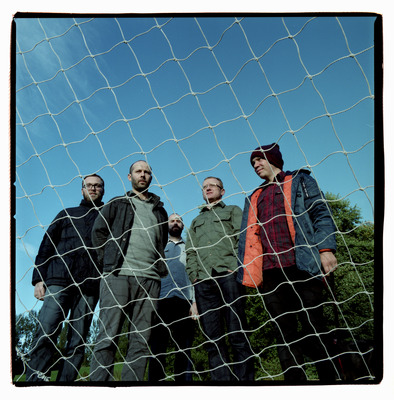
Another group who are no strangers to the effect of a noisy and epic jam is Mogwai.

When Stuart Braithwaite’s book came out a couple of years ago, the chapters fell into easy chunks;

I formed a band. I got really wasted. I listened to The Cure.

I rehearsed with the band. We got really wasted. We went to see The Cure.

We got really good. We got reeeally wasted. The Cure asked us to support them.

We got really, reeeally wasted. We got really, reeeally wasted with Robert Smith.

Life is complete.

C’mon Stuart! Life might be great cos you get to get up to shenanigans with Robert Smith every once in a while, but life is really complete because you happened to record, amongst a back catalogue of well-thumbed and well-spun albums, the most perfect track somewhere along the way.

For all of Mogwai’s loud/quiet/hailstorm of anvils that they’ve committed to record, none of it – none! – sounds so thrilling as The Sun Smells Too Loud. It really is the greatest track Mogwai have stuck their name to.

MogwaiThe Sun Smells Too Loud

Electro pulse. Shimmering twang. Whammy bar action. A great second chord. And a great third chord. A fantastic sliding up and up and down guitar riff, the group surfing the action in the background. The Sun Smells Too Loud is a hazy, woozy end of the night beauty. Great for cycling to too.

Repeated listens (and there’s been more than a few since parent album The Hawk Is Howling first appeared) throw up new melodies and counter-melodies within the spaces, not to mention tinkling milk bottle percussion and vintage, droning synths, but more importantly, The Sun Smells Too Loud throws up an aching melancholy. It’s all heart, all soul and all good. It might simply be non-organic electric guitar music played atop a rudimentary beat box, but The Sun Smells Too Loud is as soulful as Sam Cooke. It just is.

Sometimes, as on nights like this, the electric guitar, in all its variances and guises, is all y’need. Turn up to 10, as they used to say on the run out grooves.

Hard-to-find

Si. Oui. Ja. Yes!

It’s bombastic, booming and utterly brilliant. The Beethoven’s 5th of that awfully-named Britpop era.

It’s the drums.! Fucking great echoing and cavernous drums, like Hal Blaine on Hulk-sized steroids, forearms like Popeye as he nails the four to the floor. Tambourines ride the hi-hats, percussive and metallic, clattering toms tumble like the walls of Jericho. Biblical, as a bow-legged frontman of the times was wont to proclaim.

It’s the strings! The total antithesis of the era’s coke-flecked guitar bands’ syrupy and de-rigueur, bolted on after-thoughts, these are fucking great strings, soaring and sweeping and swooning their way through the summer of ‘95 with graceful elan, the way they might’ve done 30 years previously had The Beatles been commissioned to write a smash hit for Dusty Springfield;

Oh, the guitars! It’s the great guitars, the fucking great guitars, electrified and fried, feedbacking and freewheeling, searing and tearing and twanging and chugging their holy and wholly amplified way from uproarious beginning to spent out end. Six nickel-wound and steel strings never sounded so alive and so essential before now.

It’s the incidentals; the way the guitar slips through the gears, taking those gliding vocals with it, the pause mid-way through when the guitar player plays some hammer ons around open chords (just the way he did in his previous band) before the expectant and fantastic lift-off as the vocalist breaks free and tears off out into the great wide open, hand claps and drum beats and gospel soul backing doing their best to hold on to his coat tails. What a fucking arrangement!

Oh yeah. The vocals. It’s all about the vocals. Great octave-leaping things of joy that neither you nor I, regardless of how often we’ve opened our hopeless holes and sung along, will ever be able to get close too. They start down here, somewhere around the diaphragm, and end up waaaay out there, somewhere north of the moon, beyond God and all the greats who’ve gone before. Fucking stratospheric and then some.

What. A. Fucking. Record.

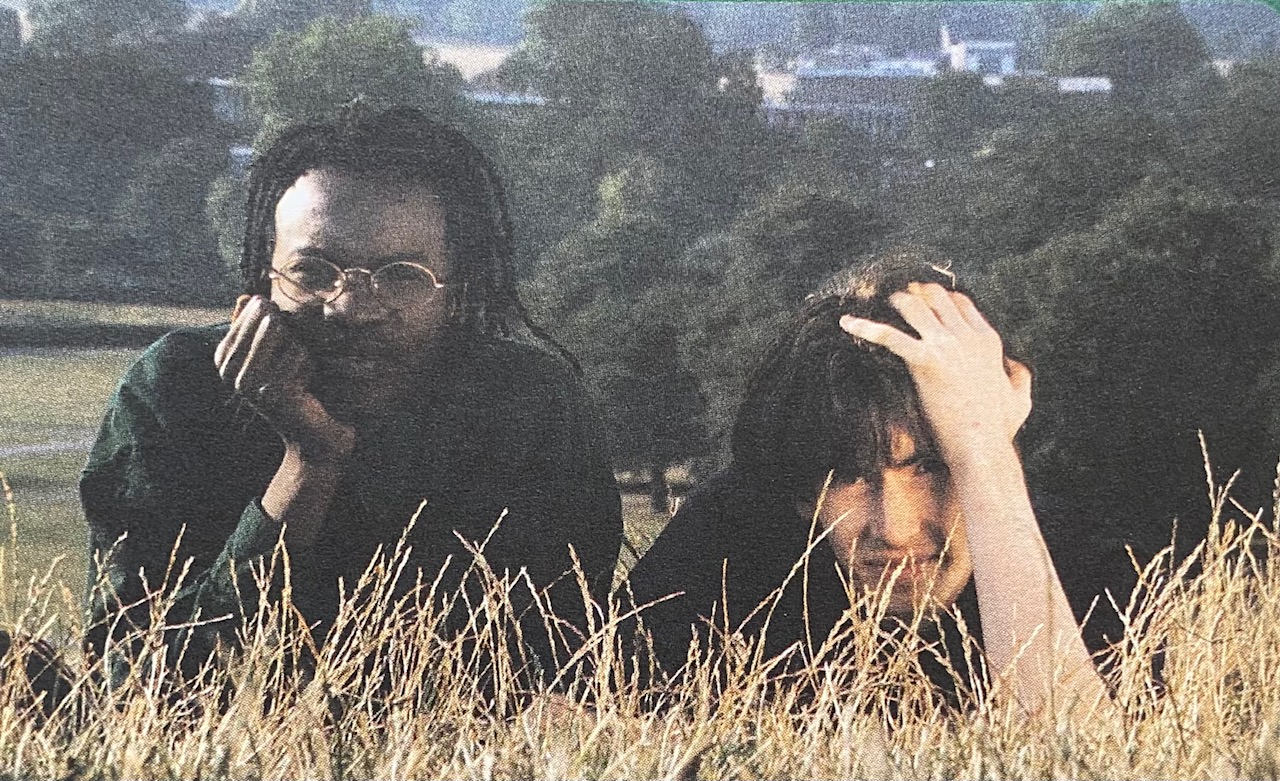
It’s Yes, by McAlmont & Butler, if you haven’t worked it out already.

I noticed that, from Bernard Butler’s Instagram feed, Yes had somehow turned 30 this weekend.

I had a conviction from the moment of conception in the summer of 1994…make a piece of music that transcends…it had to make you feel the exhilaration of how sound and song can transform your experience of being a human.

It is totally ramshackle, noisy and out of tune (is it!?!) and that is how we all are flying through the universe…

I can visualise me and Mako (drums) in the cellar of Mike Hedges chateau, screaming at each other, David across the ballroom straining for every ridiculous key change without a concern.

We were all on fire and that’s what you hear.”

They could do it pretty spectacularly in the live setting too:

There’s a part in John Niven’s viciously brilliant Kill Your Friends when two A&R guys are shamelessly scouring the small print in the charts in Music Week to find the ideal hit-making producer required for one of their new signings.

Mike Hedges…his mixes are just too middle-y. Not enough top or bottom end.”

Stelfox, the main protagonist, rolls his eyes in exasperation at the cluelessness of his A&R partner. It’s not informed knowledge that’s important in the A&R game, it’s having a view. Everyone must have a view, thinks Stelfox, even if your view is of no consequence at all.

Exhibit One: Mike Hedges manned the mixing desk when McAlmont & Butler recorded Yes, capturing forever the sound of pure magic via his fingertips and faders. (see above)

Exhibit Two: Mike Hedges would use his own blueprint within the year when helping the Manic Street Preachers construct A Design For Life, another of the decade’s stand-out tracks. (a future post for sure)

A record that’s both out of its time and forever timeless, Yes is an undeniable classic in anyone’s language.

Get This!

Tune In, Turn On, Cop Out

Davy Henderson is something of a Scottish music totem. Any record fortunate enough to have his involvement tends to be interesting, inventive and entirely idiosyncratic. From his time in the rattlin’, jerky Fire Engines through the pop-focused chart attack of Win to his role in the Nectarine No. 9 and beyond, Henderson has maintained a distinctive sound and style that is recognisable from first play onwards.

He’s a bit of a drawler, is Davy. A sliding and elasticated singer with more tone than technique and more whine than refine, he’s high in pitch and not averse to stretching a vah-ah-ah-owel beyond its natural length. His vocals might fall short of inclusion in the category that yr average DAB radio listener would consider ‘Classic Vocalist’, but then, you and I are no average DAB radio listeners. It can’t just be me who thinks that, with his style, delivery and unpretentious soul at the heart of the voice, he’s far more appealing to listen to than any pitch perfect but plastic warbler. In this wee corner of the world where we celebrate the unique, the marginalised and the one-offs, Davy Henderson is a King.

The Sexual ObjectsHere Come The Rubber Cops

Released in 2008, Here Come The Rubber Cops was produced, perhaps surprisingly, by the enigmatic and oh so secretive Boards Of Canada. It was released in such limited numbers (300 7″ singles) that you’ll be hard pushed to find a copy. Which is a real shame, as it’s a beauty.

Ringing in on the sort of descending major 7th chord progression that a band like Camera Obscura might use to good effect, it oozes and woozes, lo fi and Velvets-like, and packs an awful lot into its 5 and a bit minutes of skewed guitar-based alt. pop.

Asthmatic synths, hissing hi-hats, eternal hand claps, highly strung jangling yet watery 12 string guitars… such is the pure self-belief the assembled musicians have in the power of their record, we’re just short of a kitchen sink on the bingo card for the complete ‘Legit Post-Punk’ full house.

Tambourine? Tick.

A tapestry of guitars that blend rattle with roll? Tick.

Major to minor chord changes and plentiful hooky riffage? Tick.

Shouty pre-choruses and and a singer duetting with himself? Tick.

Forever teetering on the edge of falling apart? Tick.

A ‘pure sunshine’ moment when a cascade of overlapping ‘ooh-la-lala’ backing vocals arrive to ride the record out into the sunset? Tickety-tick.

There’s no denyin’ the right-on and groovy influences that have informed Here Come The Rubber Cops a (VU, obvs, Lovin’ Spoonful, Orange Juice, all those other Davy Henderson bands themselves) and the record is all the better for it. Tune in, turn on, cop out.


Live!

IdleChild

It’s 1978. World Cup summer. Irvine is underneath the flightpath flown by the very helicopter that will bring Ally McLeod and his winning team of world-beaters from Hampden (not far over there) to Prestwick Airport (just down the road) where their plane for Argentina awaits, so it’s fair to say excitement is at fever pitch. We’ve all (Mark, Stuart, Graham, Chrissy) got Scotland strips; dark blue, white triangular collar, Umbro diamonds running for miles down the sleeve, and we kick balls and become World champions for hours between the garages at the back of our houses. John Gebbie and his wee brother Derek join in, although Curries in Townhead was long out of Scotland strips by this point and their mum has got them sky blue Manchester City strips instead. Hours of booting light flyaway plastic balls and rolling around in the stony dirt later and my brother Euan has a hole in his socks and shorts and that triangular white collar on the top is misshapen and filthy. By comparison, Derek’s strip is still tucked neatly into the high waistband of the shorts and is as pristine and clean as his pure white Milky Bar Kid bowlcut to the point that he could probably return it to Mr Currie for a full refund. Funny what you remember.

We live in a quiet pedestrianised street that’s as safe as you could ever hope for if you are a parent of young kids. My sister Shona is playing with her pal Kirsty, their dolls scattered across our front grass. Kirsty lives diagonally across the path. In a t-shirt and nappy, her wee brother Roddy is running happy barefooted circles around the front garden before being lifted inside by his mum. At some point, Mrs Woomble, Roddy and Kirsty’s mum, invites me in to their house to see the electric trainset that Mr Woomble has built in the loft. I stick my head up and in and the train whizzes around the hatch, under a bridge, past some fake trees and plastic cows grazing on a piece of green felt and back again. It’s very impressive.

In 1980, we move to a new house in Bank Street, a main throroughfare into and out of the town and definitely not the quiet suburban street we’ve just left behind. The Woombles move to Bank Street too, funnily enough, and once again live diagonally across the road. At some point they move away (to France, as it transpires, with Mr Woomble’s work, and then the States) and we’d never meet again until…

…I’m in the trenches of music retail. I enjoy the spoils of listening to all the new releases in the stock room the Friday before the Monday release. When processing stock, I’ll take time to read sleevenotes and credits… all of the stuff that both you and I still do to this day. One day I unpack an Idlewild album. I stick it on, and as its jagged and angular guitars clatter like the anti-Oasis (a very good thing by this point in time). I read the small print on the CD booklet. It’s the name of the singer that jumps out at me. Roddy Woomble. There can’t be too many Roddy Woombles in the world, surely. I invest extra time in this particular album – Hope Is Important – and fall for its wonky and angry sound. By the time of the next record – 100 Broken Windows – and its follow up, The Remote Part, that wild ramalama of guitars has continued to mellow and Roddy has found his true voice. He has a way of phrasing that brings to mind Michael Stipe on those IRS-era REM albums; circuitous, literate, slightly unsure of himself but squeezing as many words as possible into each line. Roddy Woomble. Roddy Woomble. This isn’t the same wee guy running around in nappies in Adam’s Walk, is it? Is it?

Turns out it was.

On Sunday night there, we had Roddy in Irvine’s Harbour Arts Centre for the third time in maybe 8 years or so.

I’ve just driven past my old house!” he says to me on arrival.

No way! I just left my mum’s 20 minutes ago!” I reply, and we fall into a long and easy chat about trainsets in lofts, Derek Gebbie’s pure blond Joey Ramone bowlcut, the big houses in Bank Street and a million other Irvine and music-related points of conversation. I mention that I’d walked my sister’s dog down Adam’s Walk only last weekend, the first time I’d been in that street for over 40 years. It looked reassuringly the same, I say. Both Roddy’s old house and mine look not much different, save the mature gardens and newer front doors and windows. There’s an extension bolted on to the back of where I used to live but other than that, time has been kind to it. The Gebbies are still next door, although Derek and his bowlcut have long moved away.

Today, I have had a nostalgic pang like no other. Roddy has lived all over the world. I’ve remained within a 12 mile radius of where I grew up. The circle of life has brought us once again into one another’s orbit. We are, as it transpires, still Irvine boys at heart.

I’ve always loved Idlewild’s American English, where the guitars are chiming and polished, the production full and anthemic and the group’s sights are firmly set on the bullseye marked ‘smash hit’. Straight in at number 15? That’s a hit in anyone’s books.

IdlewildAmerican English


Get This!

Dig Mac

Born long after you or I, Mac DeMarco began releasing records in the strange, unclassifiable wilderness years of the 2010s. Unlike the ’70s (disco, punk) or the ’80s (new wave, electronic creativity), or the ’90s (grunge to begin with, Britpop mid-decade and a million genres afterwards) or the ’00s with its Strokes/Arctic Monkeys fixation the yin to reality TV’s yang, the 2010s were a bit all over the place. Fractured and cast to the wind, the music of the times formed less of a cohesive scene and more of a seeping splurge of internet-powered musical hopefuls, delivered like sewage directly to the listener via algorithms and targeted playlists whether you wanted them or not. And it’s mainly been like that ever since. There’s a lot to get through before you find the good stuff…and who’s got time for that these days?

You rely on tip-offs. A clued-in pal. A decent radio show such as Riley and Coe. A right time, right place support act. The cream rises slowly but surely.

Neon Waltz, a band I thought might really make it – whatever that is these days – turned me on to Mac DeMarco. In a local paper interview with them a good few years ago, their vocalist Jordan Shearer mentioned that I, with my fondness for a well-played twanging guitar, should look him up. Good advice, as it turned out.

Ode To ViceroyMac DeMarco

No one does lazy, hazy, somnolent guitar quite like Mac DeMarco. Cleanly picked and beautifully amped, his guitar oozes and woozes, tripped out and discombobulated, wobbbbbling and bending the notes right around the fretboard and back again; Kevin Shields without the fuzzbox. DeMarco utilises chorus and vibrato and rides a floating tremelo arm the way you or I might row a boat or attempt to use a chopstick on a chunk of Chinese chicken; up, down, in, out, fast, slow, seemingly rudimentary (but definitely not) and highly effective. It’s called style. Knopfler has that clean-picked glassy solo sound. Marr has the excitable arpeggiating riffage. DeMarco has an amalgamation of the two, jigsawed to drunk whammy bar action through a Roland Jazz Chorus amp. Unique and individual, it’s lovely stuff.

Ode To Viceroy is a song about the simple pleasure of smoking. Millennials, I thought, were health-conscious, gym-going, body image-conscious pictures of health. Not DeMarco. And it suits him. He sings with a yawn. He scratches his nether regions as he does so. Drags his hands through unkempt hair before reaching for his headwear. Pulls on his battered Converse. Might even tie them. The most important thing for Mac first thing in the morning is a good long drag on a Viceroy cigarette. Who’s going to begrudge him that?

Lo-fi and flirting with the idea of being in tune, DeMarco might come across as some sort of skip cap-wearing slacker dude, but he knows his way around an amp setting and a fretboard. That little descending run he plays in the outro is terrific, something that, with slightly different effect settings, John Squire might’ve got decent mileage from. His chosen sound is both signature and soulful, and if I had been born maybe 20 years later, I might have gone totally nuts for him in a way that this tired old cynic hasn’t. I could see myself trying to ape that sound and style – a sound and style, like all the best original guitar players, that is tantalisingly out of reach of mere copycats and wannabees such as myself.

He’s worth investigating, is Mac DeMarco. You don’t need a tailored playlist or an aggressive algorithm to tell you that, trust me. In something of a role-reversal, I’m now off to skim through my daughter’s records and borrow the DeMarco album that I know is nestled somewhere in there.