Alternative Version, Peel Sessions

Primary Education

I’ve got a strained relationship with The Cure. They are, unarguably, one of our greatest singles bands; poppy, hooky and melodic yet strange and idiosyncratic, a band out of step with everything around them, stubbornly unique and brilliant because of it. Just Like Heaven…Hot Hot Hot!!!…Caterpillar…Close To Me…Lovecats…In Between Days…Lullaby…Why Can’t I Be You?… Friday I’m In Love…The Walk…Pictures Of You…A Forest…there’s a perfect playlist right there.

It’s the albums I struggle with. If the singles are 10 second hundred metre sprints, the albums are triathlon levels of endurance by comparison. Meandering, dark, twisty, self-indulgent – all the things I like, as it goes – I find it’s too much of an effort to properly enjoy a Cure album. There’s nothing light and airy about them, and I say that as someone who’ll listen to Radiohead until the day I die. I just slowly detach and find myself drifting off. ‘Is this nearly finished?’ I’ll ask myself as Robert and co sleepwalk their way, treacle-like, into into only the third track. It makes the thought of a live show almost too much. Even Springsteen, I bet, would find himself yawning at the two hour mid-point. My loss, I dare say.
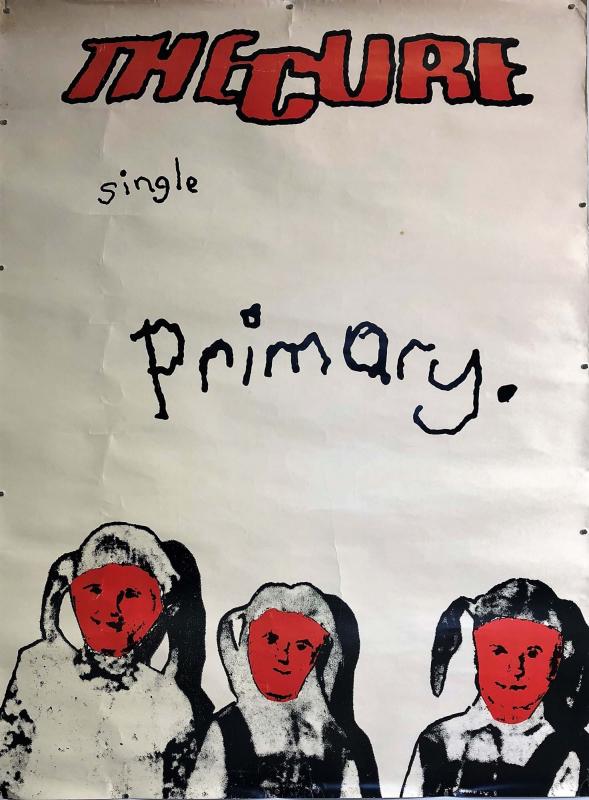
Primary though. There’s a great track. The sole single release from 1981’s Faith album, Primary starts with a rattling, ear-splitting snare drum, played with all the finesse of a ham-fisted one-armed man. Bash! Bash! Bash! Bash! Bash! Bash! Bash! Ker-bash! If you can separate the individual instruments and voices on the record, you’ll hear that from first bash to last, the drummer never wavers from his incessant 8-bar beat.

The CurePrimary

Backing firmly in place, Robert makes excellent use of his chorus and phase pedals, coating the track in a thick metallic swamp of rapid, scraping downstrokes and swirling chunky notes. It might sound just like his National guitar set to stun, but on this track Smith actually plays bass. As does Simon Gallup. Being unique and idiosyncratic sorts, two bass guitars on the one record is perfectly normal. While Smith maintains the song’s rhythm and muscle, Gallup wanders up and down the frets like Peter Hook in eyeliner. Perhaps surprisingly, there are no guitars on Primary at all.
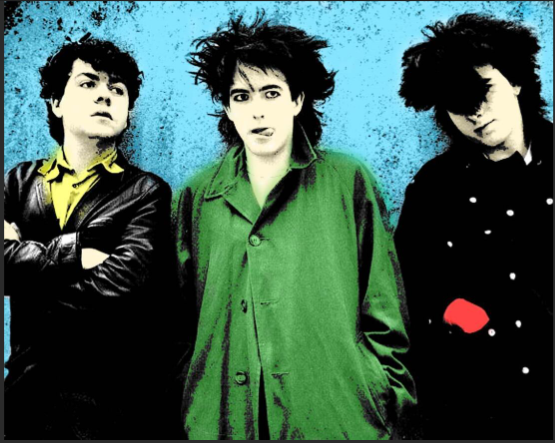
It’s an intense sound, Primary. Shouty, swirly and relentlessly clattering, it finds The Cure out of step with their peers, and not for the last time. 1981 was the year when the synth became the de facto pop instrument of choice. End of year lists were populated by the Human League and Soft Cell. OMD were making inroads towards household name status. Ultravox’s Vienna was ubiquitous. Kim Wilde was doing her English version of Blondie while Clem Burke jumped drum stool to moonlight with Eurythmics. Esoteric and different, The Cure stick out as stubbornly as the Dennis the Menace haircuts they employed at the time.

The CurePrimary (Peel Session)

Two bass guitars, one snare drum, a double-tracked voice and a whole load of imagination across three minutes – or six if you can track down the elusive 12″-only mix. Primary is a weird wee single, not afforded the status of anything in that stellar list in the opening paragraph above, but something that’s just as deserving of a place at The Cure’s top table.
 

Get This!

Everything’s Gone Green

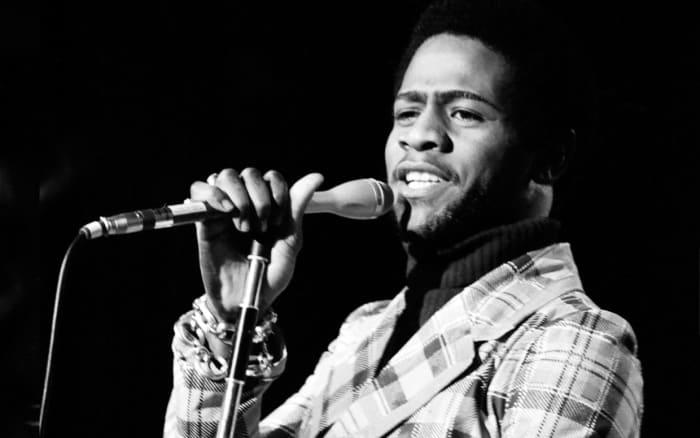
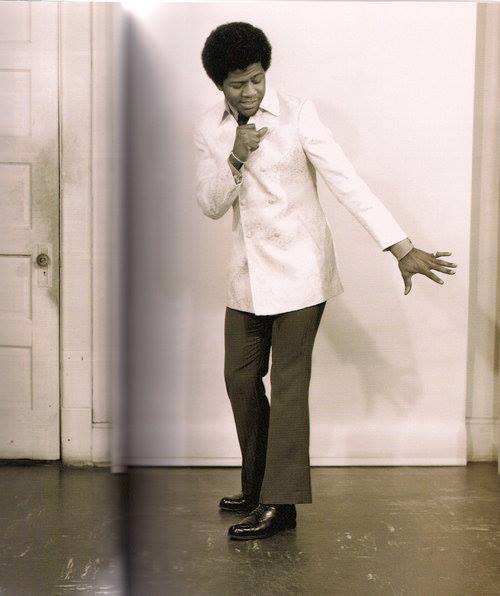
This is late night music. Not upbeat, party starting music, but post-midnight meditation, meant for those wee hours that fall somewhere in the slither of space that exists just before the crack of dawn. Spun finely from ether-borne gold and slowly spooled into seamless being, the singer’s voice aches and breaks and cracks, his hot-shot band playing slow and steady, majestically understated so that the song is best served. It’s not, perhaps, the first track you’ll think of when Al Green is mentioned, but it may well come to be one of your favourites. A random shuffling of it on the iPod yesterday had me scrambling about for my battered old copy of I’m Still In Love With You, the Al album it appears on, and since then, he’s been soundtracking the weekend. Everything’s gone Green, you might say.

Al GreenSimply Beautiful

It isn’t, by any standard of imagination, what you’d call an in-your-face soul track. There’s no stomping beat, no rasping brass section, no hysterical lead vocalist hollering tears of pain down the microphone. A lot of that has to do with Green’s controlled delivery – close-miked and delivered straight from the heart – but much of the track’s introspective feel is due to Al Green’s secret weapon; the Hodges brothers.

Stax had that crack in-house band with Steve Cropper, Duck Dunn and co driving the label’s sound. Motown grooved to the four to the floor beat of the Funk Brothers. Hi Records had the Hodges Brothers. Never doubt that they’re just as influential, just as essential to the development of soul music.

The record’s producer Willie Mitchell could’ve been forgiven for flying in a female gospel trio to flesh out the song’s hook lines. He may even have thought to employ a tenor sax and a couple of trumpets to replicate that descending four note signature riff that helps anchor the song, but with the Hodges brothers on board, none of that was necessary.

Teenie Hodges

I’ve written about Teenie Hodges before. The guitarists’ guitarist and then some, Teenie is an integral part of the Al Green sound. Never brash or flashy, Teenie’s range of finely-picked arpeggios and jazz chords are the perfect foil for his vocalist’s voice. Hodges doesn’t ever get in the road of things. On Simply Beautiful, he plays very little, but what he plays – Robert Johnson-ish acoustic blues licks, cascading nylon-stringed ripples of melody and gently sliding chords – is supremely considered and tasteful and, as is the way of his playing across Al Green’s catalogue, damn-near perfect.

His brother Leroy on bass is equally economical here. Shaking himself into thudding a doe-eyed root note that lands on the same beat as the kick drum, his playing is languid to the point of being horizontally laid back. Brother Charlie on drums and/or keys (the album credits aren’t too clear) is no different. The drum pattern begins with some metronomic hi-hat and kick drum…and stays there for the duration of the track. There’s no doubt at all that Charlie (and Leroy, for that matter) could play the absolute shit out of their instruments should it be called for, but Simply Beautiful is all about The Song and they masterfully serve it.

Behind Green’s exquisitely lithe delivery you’ll hear some lovely warm Hammond, underscoring the sort of shimmering string section that made Portishead’s Dummy such a unique listen. On Simply Beautiful, the strings are equally as subtle, perfectly-placed in the background and a gazillion miles away from any of those string-driven soul stompers that you might routinely shake yr tailfeather to. This’ll allow you to listen closely between the song’s plentiful spaces where you’ll hear the overdubs of Al interjecting with himself; a spoken word here, a gravelly moan there, a high sliding falsetto to complement the main vocal. The whole thing is a masterclass in understatement, the trio of Hodges playing in simpatico to let the song breathe naturally. Simply Beautiful indeed.

Listen on repeat for maximum effect, of course.


demo

The Queen Is Dead Annoyed At Johnny

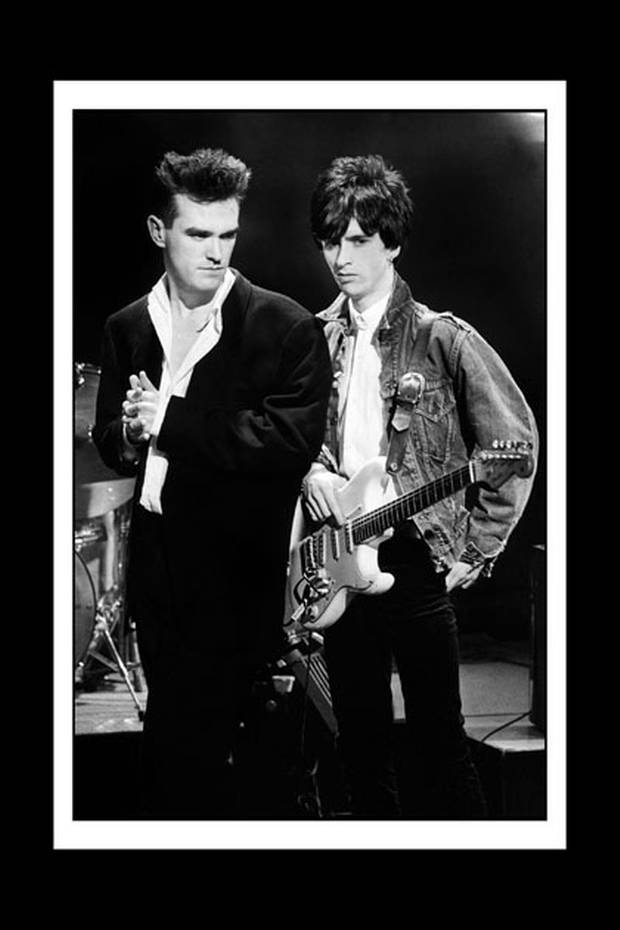
We’re night four into a two week Vegas residency. An option for a third week has been pencilled in, but not yet committed to. The audio-visual wonderland that is The Sphere was mentioned from the outset, but by opening night we’re in the Colosseum inside Caesar’s Palace, its stage decked out in the most ostentatious floral display that can be mustered in a city not known for the understatement. 4000 hopped-up Anglophiles in cardigans and suit jackets stand on its velvet seats in a vulgar display of phoney rebellion, the turn-ups on their jeans almost as brazen as the bare-faced front of the singer they’re here to idolise.

Early reviews have been mixed, and that’s being kind. ‘Lumpen drums’, a bass player ‘devoid of the original’s flair and fluidity’ and, most damning of all, guitars that are ‘far more darkle than sparkle’. The singer too is getting it tight. His once collapsing quiff has collapsed to the point of thinning. He has a noticeable paunch, tucked into the high waistband of a shit pair of parallel jeans and his voice is gone gone gone. ‘Miserable Lie‘, a brave addition to nights’ one and two’s setlists has been swiftly dropped for the easier to reach ‘Jeane‘, but the guitar player – a hired LA rock guy and most definitely not Johnny Marr – can’t resist soloing between Morrissey’s lines. The knives are out and being sharpened by the encore. Johnny watches from across the Atlantic and shakes his head, his Ron Wood mod crop flopping in frustration. This is The ‘Smiths’ reunion and it stinks.

Back in his 2016 autobiography, Johnny Marr mentioned that he and Morrissey had met up and, over a pint or two, tip-toed delicately around the idea of a Smiths reunion. It was Johnny’s idea seemingly, and while Morrissey was initially on board, Morrissey being Morrissey then broke contact. Ghosted Johnny, as the young folk say these days.

If you’ve even half an eye on music, you’ll know that in the near-decade since, Johnny has built quite the profile. His live shows are sold out and celebratory, he pops up with a near Grohl-esque regularity – can we still mention him? – on the stages of his peers (James, Pearl Jam, The Pretenders, The Killers et al) and he’s collated a coffee table book featuring well-chosen words and arty shots of his arsenal of guitars. He’s often on hand to lend a quote on a matter of cultural or political importance. He even popped up on one particularly memorable edition of Would I Lie To You?

Johnny, should you need confirmation, is a Good Guy.

It seems that in far more recent times – in June just gone – Morrissey returned to his old sparring partner, suggesting that their previously-discussed Smiths reunion might in fact be (ker-ching!) not a bad idea after all. Corporate behemoth AEG, an umbrella company that owns multiple sports teams, the Coachella brand and many arenas across the globe had put an offer of a 2025 Smiths World Tour to Morrissey and Marr, and ol’ Moz, he of the ever-decreasing record sales and ever-increasing right wing tendencies, was quite keen on the idea.

It turns out that Johnny was somewhat less than enthused. It’s not for nothing that when asked by a fan on Twitter if he’d consider doing an Oasis and get The Smiths back together, Johnny simply Tweeted a shot of Nigel Farage. Matter closed.

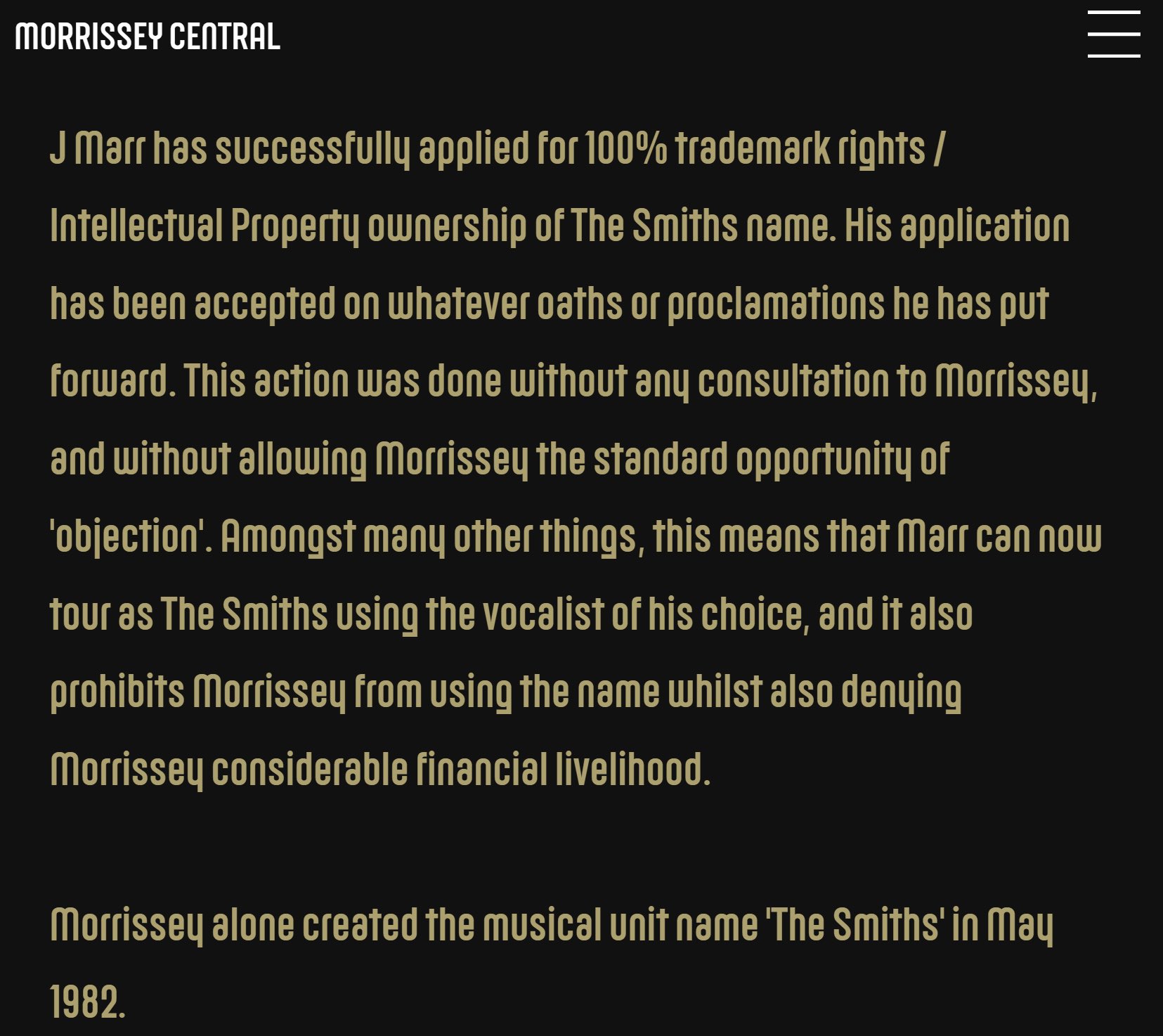
Cue pissed off Morrissey and a statement.

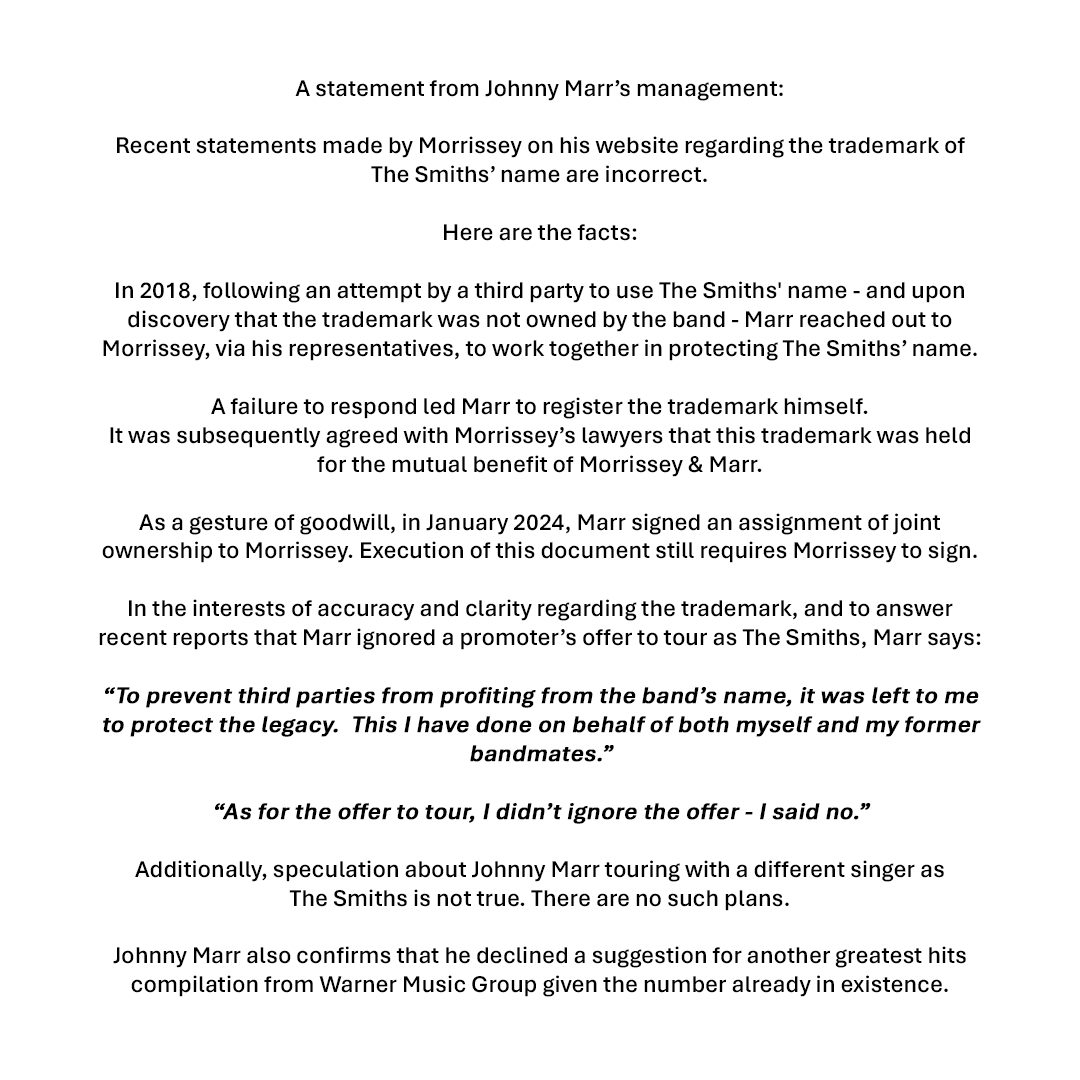
And cue retaliatory statement from Johnny.

Until Johnny’s management released these words, the internet had been in a daft panic over the thought of a Johnny-fronted Smiths heading out on tour. Complete nonsense of course. That just wouldn’t ever happen. We both know that no Johnny or Morrissey = no Smiths. And there’s already no Andy. Mike? I’m not sure which horse he’d back in this one horse race. There’s no doubt at all that Johnny Marr had got wind of the possibility of Morrissey rounding up any old gang of bequiffed janglers and goose-stepping them across Europe and the States next year to celebrate the return of ‘The Smiths’.  Johnny, wisely, has made moves to ensure this never happens.

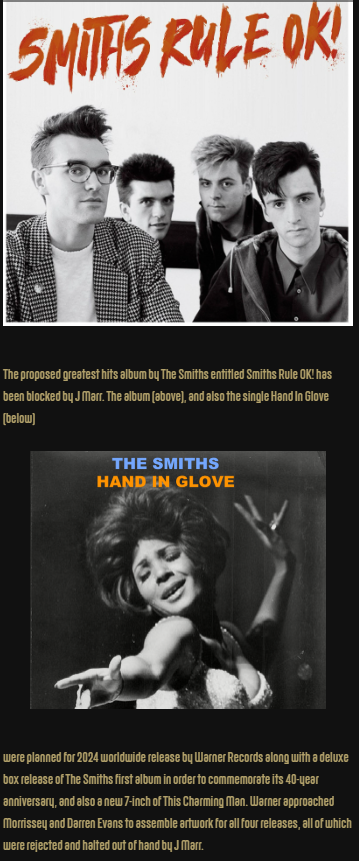
The tour would have come on the back of a box set and Shirley Bassey-housed Hand In Glove reissue celebrating The Smiths debut album plus that crappily-titled ‘Smiths Rule OK‘ compilation, and Johnny, as the statement goes, has put his foot down at that idea too. How many Smiths compilations does one household need anyway? (Bizarre fact – there are more Greatest Hits compilations of boy band Blue than there are studio albums by them. Reissue, revalue, repackage ‘n all that jazz.)

Look at any Smiths record, be it 7″, 12″ or LP, and you’ll recognise it as a work of art in its own right. Old movie stars tinted in turquoise and gilded in greens, heroes and heroines presented in burnt umbers and off-yellows. The fonts stately and bold, the back sleeves always listing the principle Smiths and what they’ve played on it. Never mind what they sound like, that Smiths catalogue is one of the most iconic-looking collections in guitar-driven pop.

The SmithsThis Night Has Opened My Eyes (June ’84 demo, unreleased)

In any case, the artwork for the intended new Best Of is, by any stretch of the imagination, a disaster. It just wouldn’t do. How Morrissey, with such an eye for detail and the importance of the seemingly small stuff that folk like us obsess over could give the green light to a proposed sleeve that looks like a ten minute rush job at the end of a long Friday is anyone’s guess. It’s just as well Johnny is switched on and still cares about his band’s legacy.

This might come at a cost though. With one key Smith keen to improve his already-handsome income and the other happy to ensure his group’s back catalogue isn’t tainted, that debut album box set looks set to be shelved. For obsessives that’s a bit of a disaster. The Troy Tate tapes in fabulous hi-fi. That Cookies’ cover. An early live show with the young feral Smiths stamping their mark on guitar-driven pop. Whatever was lined up for the box set may now be confined to the dusty library shelves of the archives.

That reunion idea though. Absolutely vile, as the song goes.

One last thing before I go. That third party in 2018. The one who tried to take control of The Smiths name. Who was it?

Get This!

Some Mothers Do ‘Ave ‘Em

In what might be a discarded Only Connect question, as a starter for 10 can you tell me who links Paul Weller, Sylvester and Joe Satriani?

Anyone?

A clue: he’s the same guy who links Whitney Houston, Starship and the odd Disney soundtrack or two.

No?

Bongo Bob is your answer. Bongo Bob.

A Latin Jazz aficionada, Bob worked out of San Francisco’s Bay Area in the ’80s and beyond and was the percussionist of choice for anyone needing a polyrhythmic smattering of exotica across their music. But don’t let the nickname fool you, for Bob was also the go-to guy when it came to programming computers once studios began moving from analogue to digital. One Step Ahead Bob, that’s what they shoulda called him.

That’s Bob’s computerised percussion smoothly rattling away in a none-more-’80s fashion behind Whitney as she glides through the octaves getting “so emoshunal, baybee.” His programming is all over much of Joe Satriani’s output, the sympathetic and understated backing that allows Joe to flow to his ear-bleeding max. There he is too on Starship’s perennial ‘Nothing’s Gonna Stop Us Now‘, his fairground ride sequencing giving the track its signature feel. Forgotten what it sounds like? Stick on Heart ’80s or Greatest Hits Radio and it’ll be with you very shortly.

Check out Bob’s extensive CV and see for yourself. If all you ever listen to is oldies radio, retro FM-blasting non-stop hits and/or classic AOR rock, there’s a chance you’ve heard Bob’s work far more than you realise.

You though – yeah, you. You don’t listen to oldies radio. Not all the time anyway. And you wouldn’t be seen dead with a Satriani album. Sylvester? Yeah, you like his stuff. Well, the early stuff, obvs. You Make Me Feel Mighty Real, really. And (trainspotters ahoy!) his groovy cover of Southern Man, but not the subsequently under-appreciated records that Bob added requisite danceability to. Never even knew about them, mate. (Sniff).

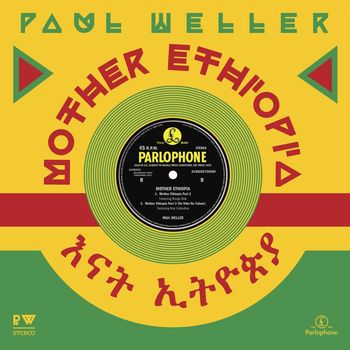
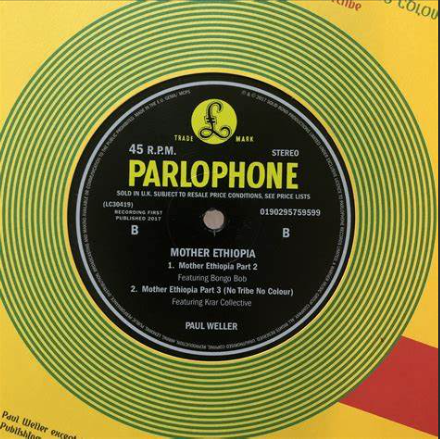
Imagine, then, that Paul Weller gets together with the Stone Foundation and at one point asks Bongo Bob along for the ride. How these planets collided is anyone’s guess, but there they are. PW and the Stone Foundation are no strangers to one another. Weller has played guitar with them on stage, laid down guitar parts on their recordings and generally elevated the status of the soul collective whenever they need it. Bongo Bob though? Weller is no slacker when it comes to collaboration. (There’s another good Only Connect question: who connects Amy Winehouse, Graham Coxon and Suggs?) But Bongo Bob? He travels a lot, does Paul, musically as well as globally. I can only think his studious knowledge of music in all its various genres somehow led him to the Californian bongo maestro and they took it from there.

A strange pairing, perhaps, but one which produced a minor Weller instrumental stomper.

Paul WellerMother Ethiopia (Part 2)

Perhaps in no small part to a lifelong love of the fluid riffing of Frame and Marr, I love my African music when the guitar splashes all over it like an uncontrollable fountain of joy. Mother Ethiopia is Weller’s contribution to Ethiopique Series, a long running (est ’97) thing which shines a spotlight on the music of Ethiopia. As the 30+ releases in the series will attest, lots of Ethiopian music is mainly all rhythm and horns. A very heavy thing at times. And very groovy too.

Weller’s track (particularly its part 2, above) conjures up the dusty spirit of an Addis Ababa taxi driver’s cab at peak rush hour, its tinny radio blasting warm sounds into your sweaty face. Bluesy desert guitar gives way to that great African rhythm, Bongo Bob palm slapping his instrument and fighting for ear space with an ancient wobbly synth line. There’s chanting of some sort, more sand-blown guitar, more synth, now twisting itself into weird African scales…and then the horns. They’re on the one, half James Brown, half Fela Kuti and lead a brief and funky charge. A sinewy slither of sax and trumpet weaves and winds its way between Weller’s loafered foot stomps and clipped, staccato guitar and, blown by the prevailing Westerly winds, vanishes in a dust cloud of Afrobeat. Or is it Afrojazz? The incessant rhythm only just about lets up. Magic stuff.

It’s not Changingman. It’s not Broken Stones. It’s niche Paul Weller. Worth a proper listen in your own time.

Cover Versions, Hard-to-find

Skippery People

If y’know yr Bible, you’ll know that the ‘wheel inside a wheel’ idiom first appears in the book of Ezekiel. A phrase used to describe something that’s complex, maybe even over-complicated, it could well be applied to Slippery People, the Talking Heads track that hollers the words repeatedly in the song’s chorus. Not that Slippery People is over-complicated. It’s a straightforward groover of a pop song, but it’s certainly complex in arrangement, especially in its live incarnation.

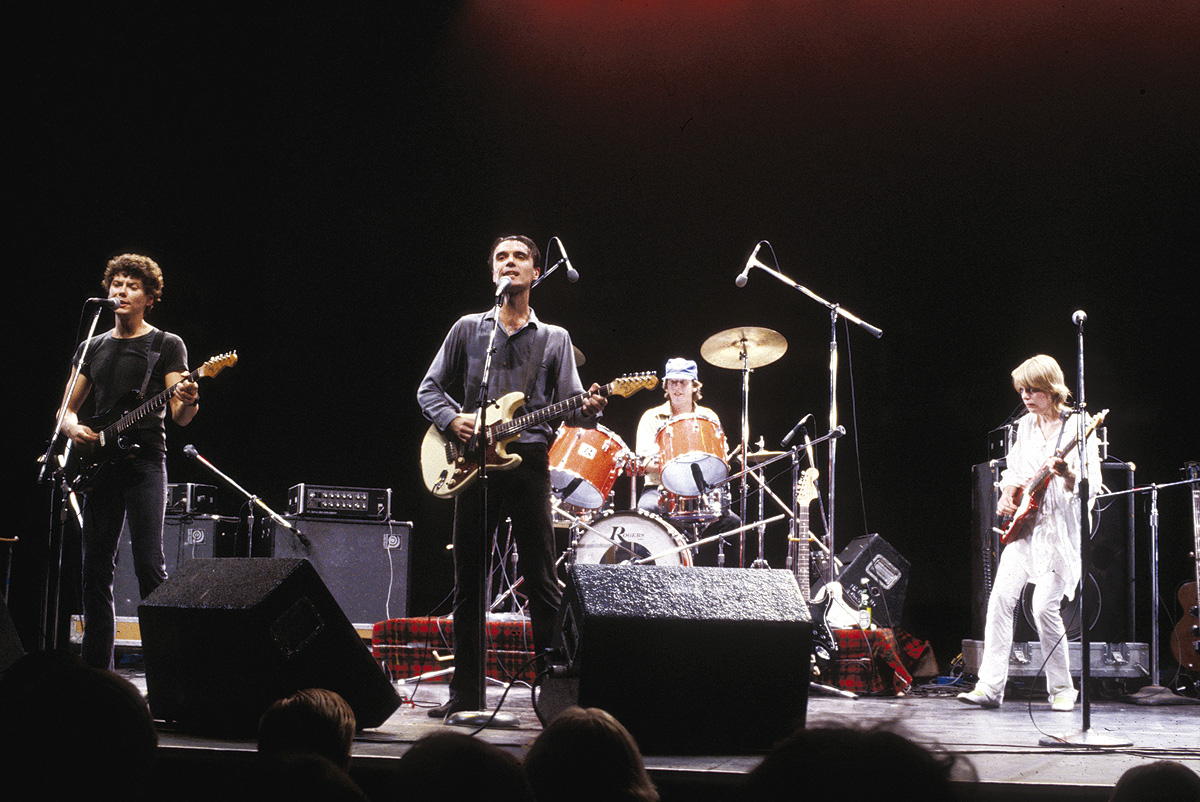
The definitive version taken from Stop Making Sense was part of the holy trinity of 12″ records that soundtracked my mid-teens. Alongside Blue Monday and I Travel, it rattled on repeat from parents’ tinny living room stereos, its graphic equalisered grinding funk the foreground noise to teenage nonsense and Holsten-powered hijinks. My copy – an instant conduit to 40 years ago – has seen far better days. Low in gloss and sticky with fingerprints, it’s covered in Torvill and Dean-esque gouges of war, played to the point of death yet hanging on in there.

“…that gun, this part is simp…that gun, this part is simp…that gun, this part is simp…” (nudge) “try to recognise what is in your mind.”

“…What’s the matt…him…alright…..seven times five…come t..life…your eyes…” (and off it comes).

My Slippery People sticks and skips half a dozen times and has done for years, to the point that I should really take a Sharpie to its battered sleeve and rename it Skippery People. It’s unlistenable hell, truth be told. Any time it pops up anywhere other than on my own turntable, it really throws me when it plays through without interruption. Funny, that.

For clarity, let it to be said; that live version is a tremendous record.

Talking HeadsSlippery People (Stop Making Sense version)

The four principle Talking Heads are augmented here by bongos, bare-boned funk and minimal, morse-coding keyboards. Jerry Harrison on synth falls into a groove with David Byrne’s dirty funk guitar while Chris ‘n Tina, the husband and wife rhythm machine, play out a steady tune within the tune (wheel inside a wheel?).

On drums, Chris swings like Holger Czukay in a straightjacket, metronome-perfect, the solid bedrock that allows Tina to freestyle her bubbling offbeat notes up and down the frets as she sees fit. Clearly, there are grrreat bass players and then there’s Tina Weymouth. But you knew that already.

There’s ting-a-ling high notes on the keys, breakdowns that sound like faraway Coney Island ice cream vans in a July heat haze and Afrobeat levels of percussive flow from start to finish. The two backing singers who mirror Byrne’s spasmic jerks and respond to his “Whatsamattawithhim?” calls with enthusiastic “He’s alright!” shouts elevate the flatlining and linear studio version up, out and into the stratosphere.

Though these days he might have an ego matched only by the massive suit he wore on stage at the time, David Byrne’s gulping and hiccupping refrain remains the song’s key identifier. Magic stuff.

Compare and contrast with the science lab sterile studio version. I’ve warmed to its coldness in recent years, but having been spoiled by the live version first, it’s a clear second best to Stop Making Sense‘s polyryhthmic jamboree.

Talking HeadsSlippery People (12″ version)

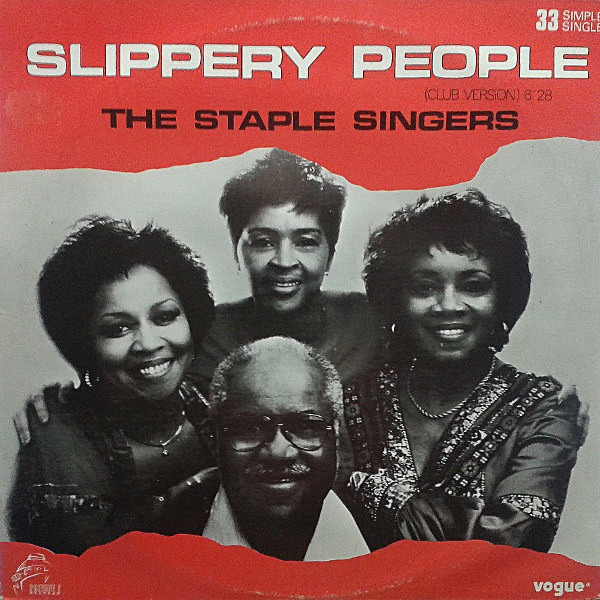
The Staple Singers first had a go at Slippery People on a 1984 episode of Soul Train. Here, they emphasised the religious symbolism in the lyrics, pushed the girls’ gospel voices to the fore and turned it into a churchy song of high, high praise. Some switched on studio executive immediately had the quick thinking to frogmarch them straight into a studio where they then cut their own extended club version of the track.

Staple SingersSlippery People (Club Version)


It’s fairly phenomenal, relying on Talking Heads’ studio original (and Burning Down The House‘s electro drum rolls) as its jumping off point, its overlapping synths and crashing drum machines set to maximum volume for ultimate ‘in the club’ effect. The guitars are, unusually for a Staples’ record, bereft of Pop’s usual wobbling tremelo but are instead suitably gritty and grindy. The bass line bends and bubbles in sympathetic harmony with the original. And the call and response refrains between the girls and their dad are joyful – listen to Pops deliver his lines and tell me he’s not having fun.

Backslidin’, how did we do? Pretty good, Pops. Pretty good.